Oxygen administration
Oxygen therapy is widely available and used in
a variety of settings to relieve or prevent tissue
hypoxia.
• The goal of oxygen therapy (AARC, 2007) is to
prevent or relieve hypoxia by delivering
oxygen at concentrations greater than
ambient air(21%).
Purposes
• It reduces mortality related to hypoxia
• Improves self-reported sleep quality and
general comfort
• Increases exercise tolerance
• Reduces polycythemia and pulmonary
function
Safety Precautions
• Oxygen is a highly
combustible gas.
• Although it does not
burn spontaneously or
cause an explosion,
• it can easily cause a fire
in a patient’s room if it
contacts a spark from
an open flame or
electrical equipment
continued..
Promote oxygen safety by the following
measures
• Oxygen is a therapeutic gas and must be prescribed
and adjusted only with a health care provider’s order.
• Distribution must Place an “Oxygen in Use” sign on
the patient’s door and in the patient’s room.
• No smoking should be allowed on the premises.
• Keep oxygen-delivery systems 10 feet from any open
flames.
• Determine that all electrical equipment in the room is
functioning correctly and properly grounded
Supply of Oxygen
• Oxygen is supplied to a patient’s bedside either by
oxygen tanks or through a permanent wall-piped
system.
• Oxygen tanks are transported on wide-based
carriers that allow the tank to be placed upright at
the bedside.
• Regulators control the amount of oxygen delivered.
• One common type is an upright flow meter with a
flow adjustment valve at the top.
• A second type is a cylinder indicator with a flow
adjustment handle.
Methods of Oxygen Delivery
Nasal Cannula:
 A nasal cannula is a simple, comfortable
device used for precise oxygen delivery.
 The two nasal prongs are slightly curved
and inserted in a patient’s nostrils.
 To keep the nasal prongs in
place, fit the attached tubing over the
patient’s ears and secure it under the chin
using the sliding connector.
 Attach the nasal cannula to a humidified
oxygen source with a flow rate up 1 to 6
L/min (24% to 44% oxygen).
 Flow rates equal to or greater than 4 L/
min have a drying effect on the mucosa
and thus need to be humidified.
Oxygen Masks.
• An oxygen mask is a plastic
device that fits snugly over the
mouth and nose and is secured
in place with a strap.
• It delivers oxygen as the patient
breathes through either the
mouth or nose by way of a plastic
tubing at the base of the mask
that is attached to an oxygen
source.
• An adjustable elastic band is
attached to either side of the
mask that slides over the head to
above the ears to hold the mask
in place.
high flow
• There are two primary
types of oxygen masks:
those delivering
• Low concentrations of
oxygen and those
delivering high
concentrations.
Continued..
• Simple face mask fits loosely and delivers oxygen
concentrations from 6 to12 L/min (35% to 50%
oxygen).
• The mask is contraindicated for patients with carbon
dioxide retention because retention can be
worsened.
• Flow rates should be 5 L or more to avoid rebreathing
exhaled carbon dioxide retained in the mask.
• Be alert to skin breakdown under the mask with long-
term use
• A plastic face mask with a reservoir bag is capable of
delivering higher concentrations of oxygen.
• A partial rebreather or non rebreather mask is a
simple mask with a reservoir bag that should be at
least one third to one half full on inspiration.
• It delivers a flow rate of 10 to 15 L/ min (60% to
90% oxygen).
• Frequently inspect the reservoir bag to make sure
that it is inflated.
• If it is deflated, the patient is breathing large
amounts of exhaled carbon dioxide.
• High-flow oxygen systems should be humidified.
• The Venturi mask delivers higher oxygen
concentrations of 24% to 60% and usually
requires oxygen flow rates of 4 to 12 L/min,
depending on the flow-control meter selected
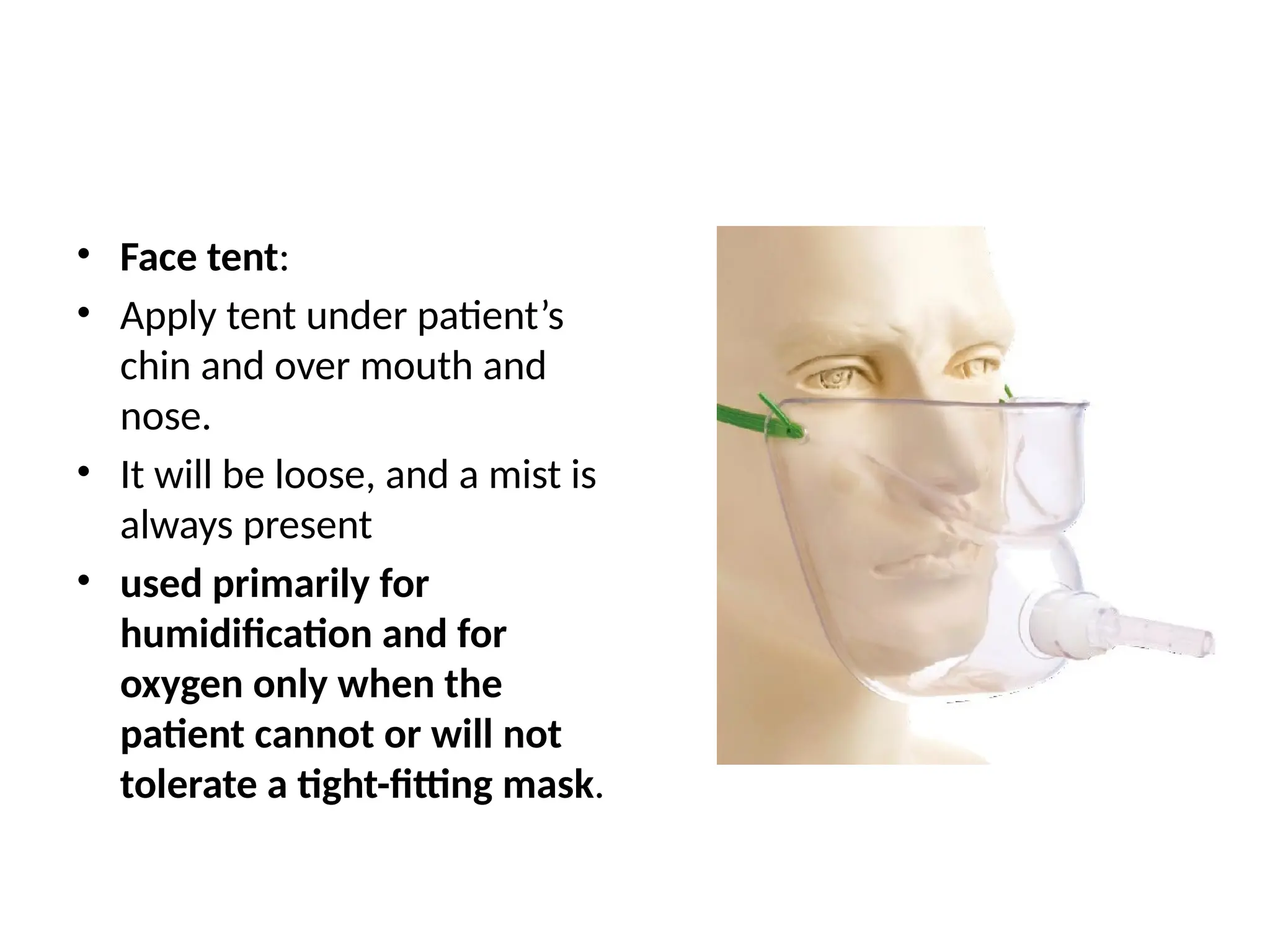
• Face tent:
• Apply tent under patient’s
chin and over mouth and
nose.
• It will be loose, and a mist is
always present
• used primarily for
humidification and for
oxygen only when the
patient cannot or will not
tolerate a tight-fitting mask.
Articles
• Oxygen Tubing (Consider Extension Tubing),
Humidifier If Indicated,
• Sterile Water For Humidifier
• Oxygen Source
• Oxygen Flow meter
• Stethoscope
• Pulse Oximeter
• Appropriate Room Signs
Procedure
• Identify patient using two identifiers (e.g., name and
birth date or name and medical record number
• Assess patient’s respiratory status, including
symmetry of chest wall expansion, chest wall
abnormalities (e.g., kyphosis), temporary conditions
(e.g., pregnancy, trauma) affecting ventilation,
respiratory rate and depth, sputum production, and
lung sounds.
• Observe for patent airway and remove secretions by
having patient cough and expectorate mucus or by
suctioning
Continued..
• Position tips of nasal cannula properly in patient’s
nares and adjust elastic headband or plastic slide on
cannula so it is snug and comfortable
• If using an oxygen face mask, adjust elastic band
over ears until mask fits comfortably over patient’s
face and mouth.
Continued..
• Verify setting on flow meter and oxygen source
for proper setup and prescribed flow rate.
• Check cannula/mask every 8 hours.
• Keep humidification container filled at all times.
• Monitor patient’s response to changes in oxygen
flow rate with pulse oximetry
• Monitor ABGs when ordered; however, obtaining
ABG measurement is an invasive procedure, and
ABGs are not measured frequently
• Observe patient’s external ears, bridge of
nose, nares, and nasal mucous membranes for
evidence of skin breakdown.
Type Flow rate Advantage Disadvantage
Low-Flow
Delivery
Devices
Nasal cannula
1-6 L/min:
24%-44%
Safe and simple
Easily tolerated
Effective for low
concentrations
Does not impede eating or
talking
Inexpensive, disposable
Unable to use with nasal
obstruction
Drying to mucous
membranes
Can dislodge easily
May cause skin irritation or
breakdown around ears or
nares
Patient’s breathing pattern
(mouth or nasal) affects
exact FiO2
Simple face
mask
6-12 L/min:
35%-50%
Useful for short periods
such as patient
transportation
Contraindicated for
patients who retain CO2
May induce feelings of
claustrophobia
Therapy interrupted with
eating and drinking
Increased risk of aspiration
Partial and
Non rebreather
masks
10-15 L/min:
60%-90%
Useful for short
periods
Delivers increased
FiO2
Easily humidifies O2
Does not dry
mucous membranes
Hot and confining;
may irritate skin;
tight seal necessary
Interferes with
eating and talking
Bag may twist or
kink; should not
totally deflate
High Flow
Venturi mask
24%-50% Provides specific
amount of oxygen
with humidity
added
Administers low,
constant O2
Mask and added
humidity may irritate
skin
Therapy interrupted
with eating and
drinking
Specific flow rate
must be followed
Humidifier
• Humidification of
inspired air
• Fill distilled water
Complications of oxygen therapy
• Oxygen-induced hypoventilation/ hypoxic
drive
• Absorption actelectasis
• Oxygen toxicity
Oxygen toxicity
• Breathing oxygen at higher than normal partial
pressure leads to hyperoxia and can cause
oxygen toxicity or oxygen poisoning
patient is exposed to very high
concentrations of oxygen for a short
duration,
patient is exposed to lower
concentrations of oxygen but for a
longer duration.
Central Nervous System manifestations
• Headache
• Irritability and anxiety
• Dizziness
• Disorientation
• Hyperventilation
• Hiccups
• Cold shivering
• Fatigue
• Tingling in the limbs
• Visual changes such as blurring vision
• Tinnitus and Hearing disturbances
• Nausea
• Twitching
• Seizure
Pulmonary toxicity
• Mild tickle sensation on inhalation
• Mild burning on inhalation
• Uncontrollable coughing
• Hemoptysis
• Dyspnea
• Fever
• Hyperemia of the nasal mucosa
• CXR shows inflammation and pulmonary edema
Eye related manifestations
• In premature babies, retinopathy of
prematurity
• retinal edema
• Cataract formation (long-term exposure)

Oxygen administration procedure, indication, complications

  • 1.
  • 2.
    Oxygen therapy iswidely available and used in a variety of settings to relieve or prevent tissue hypoxia. • The goal of oxygen therapy (AARC, 2007) is to prevent or relieve hypoxia by delivering oxygen at concentrations greater than ambient air(21%).
  • 3.
    Purposes • It reducesmortality related to hypoxia • Improves self-reported sleep quality and general comfort • Increases exercise tolerance • Reduces polycythemia and pulmonary function
  • 4.
    Safety Precautions • Oxygenis a highly combustible gas. • Although it does not burn spontaneously or cause an explosion, • it can easily cause a fire in a patient’s room if it contacts a spark from an open flame or electrical equipment
  • 5.
    continued.. Promote oxygen safetyby the following measures • Oxygen is a therapeutic gas and must be prescribed and adjusted only with a health care provider’s order. • Distribution must Place an “Oxygen in Use” sign on the patient’s door and in the patient’s room. • No smoking should be allowed on the premises. • Keep oxygen-delivery systems 10 feet from any open flames. • Determine that all electrical equipment in the room is functioning correctly and properly grounded
  • 7.
    Supply of Oxygen •Oxygen is supplied to a patient’s bedside either by oxygen tanks or through a permanent wall-piped system. • Oxygen tanks are transported on wide-based carriers that allow the tank to be placed upright at the bedside. • Regulators control the amount of oxygen delivered. • One common type is an upright flow meter with a flow adjustment valve at the top. • A second type is a cylinder indicator with a flow adjustment handle.
  • 9.
    Methods of OxygenDelivery Nasal Cannula:  A nasal cannula is a simple, comfortable device used for precise oxygen delivery.  The two nasal prongs are slightly curved and inserted in a patient’s nostrils.  To keep the nasal prongs in place, fit the attached tubing over the patient’s ears and secure it under the chin using the sliding connector.  Attach the nasal cannula to a humidified oxygen source with a flow rate up 1 to 6 L/min (24% to 44% oxygen).  Flow rates equal to or greater than 4 L/ min have a drying effect on the mucosa and thus need to be humidified.
  • 10.
    Oxygen Masks. • Anoxygen mask is a plastic device that fits snugly over the mouth and nose and is secured in place with a strap. • It delivers oxygen as the patient breathes through either the mouth or nose by way of a plastic tubing at the base of the mask that is attached to an oxygen source. • An adjustable elastic band is attached to either side of the mask that slides over the head to above the ears to hold the mask in place.
  • 11.
    high flow • Thereare two primary types of oxygen masks: those delivering • Low concentrations of oxygen and those delivering high concentrations.
  • 12.
    Continued.. • Simple facemask fits loosely and delivers oxygen concentrations from 6 to12 L/min (35% to 50% oxygen). • The mask is contraindicated for patients with carbon dioxide retention because retention can be worsened. • Flow rates should be 5 L or more to avoid rebreathing exhaled carbon dioxide retained in the mask. • Be alert to skin breakdown under the mask with long- term use
  • 13.
    • A plasticface mask with a reservoir bag is capable of delivering higher concentrations of oxygen. • A partial rebreather or non rebreather mask is a simple mask with a reservoir bag that should be at least one third to one half full on inspiration. • It delivers a flow rate of 10 to 15 L/ min (60% to 90% oxygen). • Frequently inspect the reservoir bag to make sure that it is inflated. • If it is deflated, the patient is breathing large amounts of exhaled carbon dioxide. • High-flow oxygen systems should be humidified.
  • 15.
    • The Venturimask delivers higher oxygen concentrations of 24% to 60% and usually requires oxygen flow rates of 4 to 12 L/min, depending on the flow-control meter selected
  • 17.
    • Face tent: •Apply tent under patient’s chin and over mouth and nose. • It will be loose, and a mist is always present • used primarily for humidification and for oxygen only when the patient cannot or will not tolerate a tight-fitting mask.
  • 18.
    Articles • Oxygen Tubing(Consider Extension Tubing), Humidifier If Indicated, • Sterile Water For Humidifier • Oxygen Source • Oxygen Flow meter • Stethoscope • Pulse Oximeter • Appropriate Room Signs
  • 19.
    Procedure • Identify patientusing two identifiers (e.g., name and birth date or name and medical record number • Assess patient’s respiratory status, including symmetry of chest wall expansion, chest wall abnormalities (e.g., kyphosis), temporary conditions (e.g., pregnancy, trauma) affecting ventilation, respiratory rate and depth, sputum production, and lung sounds. • Observe for patent airway and remove secretions by having patient cough and expectorate mucus or by suctioning
  • 20.
    Continued.. • Position tipsof nasal cannula properly in patient’s nares and adjust elastic headband or plastic slide on cannula so it is snug and comfortable • If using an oxygen face mask, adjust elastic band over ears until mask fits comfortably over patient’s face and mouth.
  • 21.
    Continued.. • Verify settingon flow meter and oxygen source for proper setup and prescribed flow rate. • Check cannula/mask every 8 hours. • Keep humidification container filled at all times. • Monitor patient’s response to changes in oxygen flow rate with pulse oximetry • Monitor ABGs when ordered; however, obtaining ABG measurement is an invasive procedure, and ABGs are not measured frequently
  • 22.
    • Observe patient’sexternal ears, bridge of nose, nares, and nasal mucous membranes for evidence of skin breakdown.
  • 23.
    Type Flow rateAdvantage Disadvantage Low-Flow Delivery Devices Nasal cannula 1-6 L/min: 24%-44% Safe and simple Easily tolerated Effective for low concentrations Does not impede eating or talking Inexpensive, disposable Unable to use with nasal obstruction Drying to mucous membranes Can dislodge easily May cause skin irritation or breakdown around ears or nares Patient’s breathing pattern (mouth or nasal) affects exact FiO2 Simple face mask 6-12 L/min: 35%-50% Useful for short periods such as patient transportation Contraindicated for patients who retain CO2 May induce feelings of claustrophobia Therapy interrupted with eating and drinking Increased risk of aspiration
  • 24.
    Partial and Non rebreather masks 10-15L/min: 60%-90% Useful for short periods Delivers increased FiO2 Easily humidifies O2 Does not dry mucous membranes Hot and confining; may irritate skin; tight seal necessary Interferes with eating and talking Bag may twist or kink; should not totally deflate High Flow Venturi mask 24%-50% Provides specific amount of oxygen with humidity added Administers low, constant O2 Mask and added humidity may irritate skin Therapy interrupted with eating and drinking Specific flow rate must be followed
  • 25.
    Humidifier • Humidification of inspiredair • Fill distilled water
  • 26.
    Complications of oxygentherapy • Oxygen-induced hypoventilation/ hypoxic drive • Absorption actelectasis • Oxygen toxicity
  • 27.
    Oxygen toxicity • Breathingoxygen at higher than normal partial pressure leads to hyperoxia and can cause oxygen toxicity or oxygen poisoning patient is exposed to very high concentrations of oxygen for a short duration, patient is exposed to lower concentrations of oxygen but for a longer duration.
  • 28.
    Central Nervous Systemmanifestations • Headache • Irritability and anxiety • Dizziness • Disorientation • Hyperventilation • Hiccups • Cold shivering • Fatigue • Tingling in the limbs • Visual changes such as blurring vision • Tinnitus and Hearing disturbances • Nausea • Twitching • Seizure
  • 29.
    Pulmonary toxicity • Mildtickle sensation on inhalation • Mild burning on inhalation • Uncontrollable coughing • Hemoptysis • Dyspnea • Fever • Hyperemia of the nasal mucosa • CXR shows inflammation and pulmonary edema
  • 30.
    Eye related manifestations •In premature babies, retinopathy of prematurity • retinal edema • Cataract formation (long-term exposure)

Editor's Notes

  • #26 About 80% of the gas in the alveoli is nitrogen. If high concentrations of oxygen are provided, the nitrogen is displaced. When the oxygen diffuses across the alveolar-capillary membrane into the bloodstream, the nitrogen is no longer present to distend the alveoli (called a nitrogen washout). This reduction in alveolar volume results in a form of collapse called absorption atelectasis. This situation also causes an increase in the physiologic shunt and resulting hypoxemia