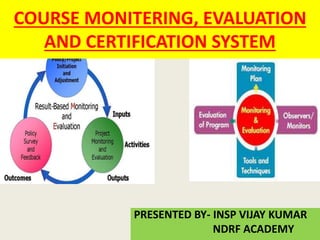
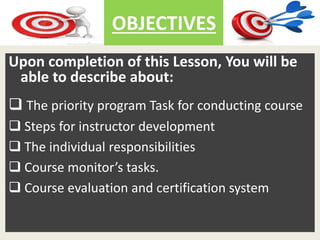
COURSE MONITERING, EVALUATION
AND CERTIFICATION SYSTEM
PRESENTED BY- INSP VIJAY KUMAR
NDRF ACADEMY
OBJECTIVES
Upon completion of this Lesson, You will be
able to describe about:
 The priority program Task for conducting course
 Steps for instructor development
 The individual responsibilities
 Course monitor’s tasks.
 Course evaluation and certification system
PRIORITY TASK
 Select Instructors
 Facilities
 Funding and outsourcing
 Institutionalization (principle, system, belief of
institution)
 Sustainability (plan of the program)
5 STEPS TO INSTRUCTOR DEVELOPMENT
FOR MT
• Audience selection (Basic MFR/CSSR)
• TFI (Training for Instructor)
TOT qualified
• IW’s (Instructor’s workshop)
• Assistant Instructor
performed duty
• Instructor
AUDIENCE SELECTION
Who should our initial target audience be?
FIRE DEPARTMENTS
POLICE DEPARTMENTS
RED CROSS
CIVIL DEFENSE/RED
CRESCENT SOCIETIES
TRAINING FOR INSTRUCTORS(TFI)
Basically we follow only two
ways..
• Interactive Method
• Demonstration-Practice
Method
INSTRUCTOR WORKSHOP
• Course specific (MFR,CSSR,CBRN etc.)
• Learn how the course is implemented, from
preparation to post course reporting.
• Lesson and practical exercise presentation to
evaluate potential instructors.
COURSE ASSISTANT
• Course flow- Ensure course is running according to
the training programs, pre decided objectives follows
properly or not.
• Logistics- Ensure training material/items related to
the program/course.
• Exercises-
• Allows the instructors to evaluate the candidate’s
abilities.
• Program’s Quality control measures.
Like-: participatory tools, assessment way of
instructors.
Note:- course co-ordinator and instructor can be play
as a roll of course assistant.
ROLE OF INSTRUCTOR
 Lead instructor
 Co-instructor
 Logistics
 Mentor
 Evaluator
 Observer
 Course Assistant
 Course coordinator
 Course monitor
“A good coordinator will most likely be a good monitor”
INDIVIDUAL RESPONSIBILITY
Participant’s responsibility?
• . Attend all sessions
• Participate in all activities
• Qualify the evaluation system.
• Develop the Potential of instructors in this level.
That’s Why We Must Have To Do….
Send participant’s package early in which--
• Provide lesson summary
• Provide course schedule
• Provide evaluation procedures
• Provide Block and Detail syllabus etc.
INDIVIDUAL RESPONSIBILITY
Instructor responsibility?
• Deliver the lesson with high potiential
• Skillfully teach the stations
• Accomplish given tasks as designed by the CC.
• Attitude towards given task
That’s Why We Must Have To Do….
• Instructor meetings
• Course Coordinator Provides a step-by-step process
to make sure nothing is missed.
• Maximum participation
• Maximum hands-on time
• Debriefing and preparation
“IF YOU CUT A CORNERS, YOU CHEAT
THE PARTICIPANTS AND FAIL YOUR
RESPONSIBILITY”
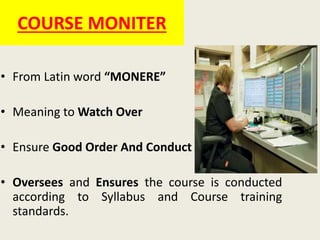
COURSE MONITER
• From Latin word “MONERE”
• Meaning to Watch Over
• Ensure Good Order And Conduct
• Oversees and Ensures the course is conducted
according to Syllabus and Course training
standards.
• Evaluates the performance of the instruction
team and overall course delivery then at last
make report.
• Provides counsel to Course Coordinator, attends
instructor meetings and offers evaluative
guidance to instruction team.
• Serves as an authority in helping the Coordinator,
to sort out the difficulties.
INDIVIDUAL RESPONSIBILITY
Monitor’s Responsibility?
• See all aspects of the course
• Part of the team
• Invigilator of the program
• Trouble shoot in some limit.
• Course Coordinator’s Buddy
That’s Why The Monitor
• Does not participate in course delivery
-Must be free to observe all aspects of course
• Observes every instructor’s
-Instructional skills and Program deviation
Interacts with course assistants-
-Logistics and Host support
Attends instructors meeting –
-Course flow
-Conflict resolution
Monitor’s Qualities
• Complete and intimate knowledge of the program
• Experienced
• Dedication and Commitment to the program
MONITOR’S TASK
• Provides guidance on program’s questions
• Recommends on equipment needs
• Recommends on instructor and coordinator needs
• Collects course improvement recommendations
• Determines needs for future monitoring
EVALUATION
Three basic types-
• Participant evaluation
Completed by Instructors
• Course evaluation
Completed by Participants
• Program evaluation
Completed by Monitor
EVALUATION TECHNIQUES
• Always start with highest score.
• Document all deficiencies.
• Don’t hesitate to slow process down.
• Be thorough (In depth, not superficial or partial)
CERTIFICATION SYSTEM
• Certification refers to the confirmation of certain
characteristics of an object, person, or
organization.
• Accreditation is a specific organization’s process
of certification.
Types:
1- Nodal Organizational Courses certificate
2- Institutional Courses certificate
CERTIFICATION SYSTEM
3) NSET Courses certificate-
 The National Society for Earthquake Technology -
Nepal (NSET) is a Nepali non-governmental organisation working
on reducing earthquake risk and increasing earthquake
preparedness in Nepal as well as other earthquake-prone
countries.
 NSET was founded on June 18, 1993
 Registered at the District Administration Office, Kathmandu on
April 28, 1994
EVALUATION/ POST TEST
• What was our topic ?
• What is the steps to instructor
development?
• Who is the course coordinator’s BUDDY?
CLOSING
THANK YOU!
Course monitering

Course monitering

  • 2.
    COURSE MONITERING, EVALUATION ANDCERTIFICATION SYSTEM PRESENTED BY- INSP VIJAY KUMAR NDRF ACADEMY
  • 3.
    OBJECTIVES Upon completion ofthis Lesson, You will be able to describe about:  The priority program Task for conducting course  Steps for instructor development  The individual responsibilities  Course monitor’s tasks.  Course evaluation and certification system
  • 4.
    PRIORITY TASK  SelectInstructors  Facilities  Funding and outsourcing  Institutionalization (principle, system, belief of institution)  Sustainability (plan of the program)
  • 5.
    5 STEPS TOINSTRUCTOR DEVELOPMENT FOR MT • Audience selection (Basic MFR/CSSR) • TFI (Training for Instructor) TOT qualified • IW’s (Instructor’s workshop) • Assistant Instructor performed duty • Instructor
  • 6.
    AUDIENCE SELECTION Who shouldour initial target audience be? FIRE DEPARTMENTS POLICE DEPARTMENTS RED CROSS CIVIL DEFENSE/RED CRESCENT SOCIETIES
  • 7.
    TRAINING FOR INSTRUCTORS(TFI) Basicallywe follow only two ways.. • Interactive Method • Demonstration-Practice Method
  • 8.
    INSTRUCTOR WORKSHOP • Coursespecific (MFR,CSSR,CBRN etc.) • Learn how the course is implemented, from preparation to post course reporting. • Lesson and practical exercise presentation to evaluate potential instructors.
  • 9.
    COURSE ASSISTANT • Courseflow- Ensure course is running according to the training programs, pre decided objectives follows properly or not. • Logistics- Ensure training material/items related to the program/course. • Exercises- • Allows the instructors to evaluate the candidate’s abilities.
  • 10.
    • Program’s Qualitycontrol measures. Like-: participatory tools, assessment way of instructors. Note:- course co-ordinator and instructor can be play as a roll of course assistant.
  • 11.
    ROLE OF INSTRUCTOR Lead instructor  Co-instructor  Logistics  Mentor  Evaluator  Observer  Course Assistant  Course coordinator  Course monitor “A good coordinator will most likely be a good monitor”
  • 12.
    INDIVIDUAL RESPONSIBILITY Participant’s responsibility? •. Attend all sessions • Participate in all activities • Qualify the evaluation system. • Develop the Potential of instructors in this level.
  • 13.
    That’s Why WeMust Have To Do…. Send participant’s package early in which-- • Provide lesson summary • Provide course schedule • Provide evaluation procedures • Provide Block and Detail syllabus etc.
  • 14.
    INDIVIDUAL RESPONSIBILITY Instructor responsibility? •Deliver the lesson with high potiential • Skillfully teach the stations • Accomplish given tasks as designed by the CC. • Attitude towards given task
  • 15.
    That’s Why WeMust Have To Do…. • Instructor meetings • Course Coordinator Provides a step-by-step process to make sure nothing is missed. • Maximum participation • Maximum hands-on time • Debriefing and preparation
  • 16.
    “IF YOU CUTA CORNERS, YOU CHEAT THE PARTICIPANTS AND FAIL YOUR RESPONSIBILITY”
  • 17.
    COURSE MONITER • FromLatin word “MONERE” • Meaning to Watch Over • Ensure Good Order And Conduct • Oversees and Ensures the course is conducted according to Syllabus and Course training standards.
  • 18.
    • Evaluates theperformance of the instruction team and overall course delivery then at last make report. • Provides counsel to Course Coordinator, attends instructor meetings and offers evaluative guidance to instruction team. • Serves as an authority in helping the Coordinator, to sort out the difficulties.
  • 19.
    INDIVIDUAL RESPONSIBILITY Monitor’s Responsibility? •See all aspects of the course • Part of the team • Invigilator of the program • Trouble shoot in some limit. • Course Coordinator’s Buddy
  • 20.
    That’s Why TheMonitor • Does not participate in course delivery -Must be free to observe all aspects of course • Observes every instructor’s -Instructional skills and Program deviation
  • 21.
    Interacts with courseassistants- -Logistics and Host support Attends instructors meeting – -Course flow -Conflict resolution
  • 22.
    Monitor’s Qualities • Completeand intimate knowledge of the program • Experienced • Dedication and Commitment to the program
  • 23.
    MONITOR’S TASK • Providesguidance on program’s questions • Recommends on equipment needs • Recommends on instructor and coordinator needs • Collects course improvement recommendations • Determines needs for future monitoring
  • 24.
    EVALUATION Three basic types- •Participant evaluation Completed by Instructors • Course evaluation Completed by Participants • Program evaluation Completed by Monitor
  • 25.
    EVALUATION TECHNIQUES • Alwaysstart with highest score. • Document all deficiencies. • Don’t hesitate to slow process down. • Be thorough (In depth, not superficial or partial)
  • 26.
    CERTIFICATION SYSTEM • Certificationrefers to the confirmation of certain characteristics of an object, person, or organization. • Accreditation is a specific organization’s process of certification. Types: 1- Nodal Organizational Courses certificate 2- Institutional Courses certificate
  • 27.
    CERTIFICATION SYSTEM 3) NSETCourses certificate-  The National Society for Earthquake Technology - Nepal (NSET) is a Nepali non-governmental organisation working on reducing earthquake risk and increasing earthquake preparedness in Nepal as well as other earthquake-prone countries.  NSET was founded on June 18, 1993  Registered at the District Administration Office, Kathmandu on April 28, 1994
  • 30.
  • 31.
    • What wasour topic ? • What is the steps to instructor development? • Who is the course coordinator’s BUDDY?
  • 32.
  • 33.