ANALGESICS &
ANTIPYRETICS
DR TARAK NATH CHATTOPADHYAY
MBBS, MD GENERAL MEDICINE
Let’s start
65 female presented with pain in both knees, more on left
side. Pain worsens while walking or standing. X-ray shows
joint space narrowing, mild effusion & osteophytic projection.
She had a heart attack 1y back & treated with angioplasty.
She is taking aspirin 75mg regularly
What analgesic to be given?
Which analgesic should be avoided?
PAIN & FEVER
Pain: Pain is a symptom of inflammation
Fever: When the temperature is above 100.4 F
Analgesic: A drug that selectively relieves pain by acting on
CNS or on peripheral pain mechanisms without significantly
altering consciousness.
Antipyretic: A drug that reduces fever by lowering body
temperature
Pain RECEPTOR
Free nerve endings located in various body tissues
responding to thermal, mechanical, chemical stimuli
Injured tissue releases chemicals Prostaglandins &
Leucotrienes that make pain receptor more sensitive
PHYSIOLOGY OF PAIN
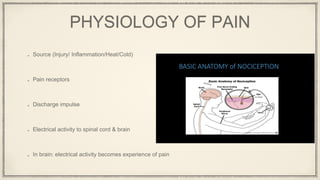
Source (Injury/ Inflammation/Heat/Cold)
Pain receptors
Discharge impulse
Electrical activity to spinal cord & brain
In brain: electrical activity becomes experience of pain
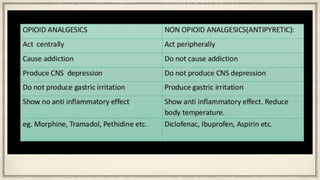
CLASSIFICATIONS
OPIOIDS: Morphine & morphine like substance
Non Opioid: NSAIDS, ACETAMINOPHEN,
NSAIDS
Mechanism of action
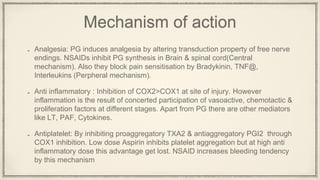
Analgesia: PG induces analgesia by altering transduction property of free nerve
endings. NSAIDs inhibit PG synthesis in Brain & spinal cord(Central
mechanism). Also they block pain sensitisation by Bradykinin, TNF@,
Interleukins (Perpheral mechanism).
Anti inflammatory : Inhibition of COX2>COX1 at site of injury. However
inflammation is the result of concerted participation of vasoactive, chemotactic &
proliferation factors at different stages. Apart from PG there are other mediators
like LT, PAF, Cytokines.
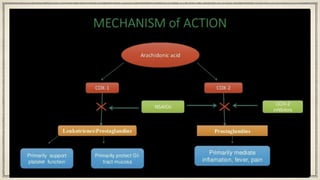
Antiplatelet: By inhibiting proaggregatory TXA2 & antiaggregatory PGI2 through
COX1 inhibition. Low dose Aspirin inhibits platelet aggregation but at high anti
inflammatory dose this advantage get lost. NSAID increases bleeding tendency
by this mechanism
Mechanism of action
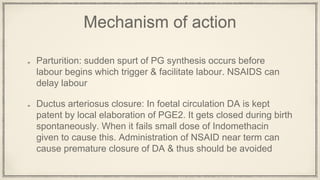
Parturition: sudden spurt of PG synthesis occurs before
labour begins which trigger & facilitate labour. NSAIDS can
delay labour
Ductus arteriosus closure: In foetal circulation DA is kept
patent by local elaboration of PGE2. It gets closed during birth
spontaneously. When it fails small dose of Indomethacin
given to cause this. Administration of NSAID near term can
cause premature closure of DA & thus should be avoided
Mechanism of action
Gastric mucosal damage: COX1 mediated synthesis of PGE2 & PGI2
protects gastric mucosa. Deficiency of PG causes reduction of mucus,
HCO3, increases H+ secretion thus causing gastric erosion. Selective
COX 2 inhibitor & paracetamol is free from this adverse effect. Also PG
analogue can be administered to counteract NSAID induced gastric
toxicity.
Renal effect: Hypovolaemia causes PG synthesis which causes it rare all
adjustments by vasodilation, inhibits tubular Cl- absorption( Na, H2O
accompany). NSAID causes renal blood flow reduction, juxtaglomerular
COX2 inhibition causes Na & H2O retention, papillary necrosis. These
changes are marked in patients with CHF, Cirrhosis of liver, CKD. Diuretic
& antihypertensive action reduced.
Classification
Nonselective COX inhibitor: Salicylate ( Aspirin), Propionic acid
derivative( Ibuprofen, Naproxen), Acetic acid derivative ( Indomethacin,
ketorolac), Fenamate( Mephenamic acid), Enolic acid ( Piroxicam),
Pyrazolone (Phenylbutazone)
Preferential COX 2 inhibitor: Diclofenac, Aceclofenac, Nimesulide
Selective COX2 inhibitors: Celecoxib, Etoricoxib, Parecoxib
Aspirin
Acetyl salicylic acid
Acetylation of COX
Weak analgesic. .(3-.6 g 6-8 hourly) Ineffective in visceral pain
Potent anti inflammatory at high dose 3-6 gm/day Acute rheumatic fever, RA
Antiplatelet action at low dose 75-150 mg/day. Action lasts for about a week
T1/2 15-20 min. Together with salicylic acid 3-5 hour. T1/2 of anti inflammatory dose 8-
12 hour while during poisoning may be up to 30 hours
Adverse effects: Gastric mucosal damage & PUD, Hypersensitivity! Reye’s syndrome
in children
Contraindications
PUD
Children with chicken pox/ influenza
CLD
Frank heart failure with low output status
1 week before surgery
Breast feeding mother
Repeated dose in pregnancy causes LBW baby, delayed/ prolonged labour,
premature closure of DA
Other NSAIDS
Ibuprofen: Better tolerated than aspirin . Not to be given in pregnancy. Used as analgesic 400-600 mg 2-3 times
a day
Naproxen: Longer duration of action12-16 hour. Effective in Gout, RA, Migraine,Ankylosing spondylosis. Gastric
bleed more common but lower thrombotic risk.
Mephenamic acid: Effective in Dysmenorrhea. Diarrhoea is major AE.
Ketorolac: Potent analgesic, comparable to opioids. Used in post operative , dental pain. Not to be used for more
than 5 days
Indomethacin: Potent analgesic, anti inflammatory. Malignancy associated fever, Reactive arthrithritis, GI side
effects are more prominent. Leukopenia, hypersensitivity reaction are more common. Causes dizziness,
hallucinations psychosis. Contraindicated in driver, machinery worker, psychiatric/epilepsy patients, women
children
Nimesulide: weaker analgesic. Completely absorbed orally. Effective in sinusitis, sport injuries, . Withdrawn due to
high incidence of fulminant hepatic failure. Used in patients having bronchospasm/ intolerance to other NSAID
Diclofenac: somewhat COX2 selective. Good tissue permeability, stays 3 times longer in synovial fluid. Increased
hepatic dysfunction, high incidence of cardiac events.
COX2 inhibitor
Less gastric mucosal damage, lower incidence of PUD
Does not suppress TXA2. No Antiplatelet function
But reduces PGI2. High incidence of cardiac events
Used in Gout, RA, AnkSpon, Dental pain
Acetaminophen
Potent antipyretic, negligible anti inflammatory, weak analgesic. Analgesic action is additive with
aspirin
Poorly understood MOA. Weak Inhibitor of Pg synthesis in peripheral tissue but inhibits COX in brain.
Postulated to be inhibitor of COX3
T1/2 2-3 hours
Well tolerated. GI side effects are negligible
Poisoning: occurs specially in children with hepatic dysfunction. Occurs in > 150mg/kg or > 10g/day
in adult. Fatal dose 250mg/kg. N acetyl p benzoquinoneimine ( metabolite of PCM ) gets detoxified in
liver by conjugation with glutathione. With high dose glucoronidation capacity saturated, hepatic
glutathione depleted, metabolite binds to hepatic cells causing necrosis. In chronic alcoholic CYP2E1
is induced causing more production of NABQI. Hepatic toxicity can occur with 5gm/day dosage. Not
recommended in infants < 2kg.
Antidote: N. acetyl cysteine replenishes hepatic glutathione storage. Ineffective if started > 16 hours
Local NSAID
Diclofenac 1%
Ibuprofen 10%
Naproxen10%
Nimesulide1%
Ketoprofen 2.5%
Flurbiprofen5%
Piroxicam.5%
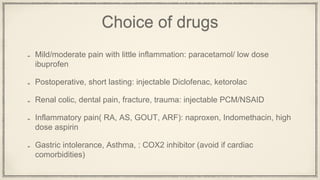
Choice of drugs
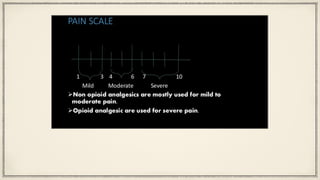
Mild/moderate pain with little inflammation: paracetamol/ low dose
ibuprofen
Postoperative, short lasting: injectable Diclofenac, ketorolac
Renal colic, dental pain, fracture, trauma: injectable PCM/NSAID
Inflammatory pain( RA, AS, GOUT, ARF): naproxen, Indomethacin, high
dose aspirin
Gastric intolerance, Asthma, : COX2 inhibitor (avoid if cardiac
comorbidities)
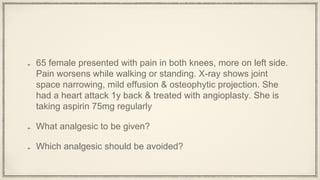
65 female presented with pain in both knees, more on left side.
Pain worsens while walking or standing. X-ray shows joint
space narrowing, mild effusion & osteophytic projection. She
had a heart attack 1y back & treated with angioplasty. She is
taking aspirin 75mg regularly
What analgesic to be given?
Which analgesic should be avoided?
Thank you
For not sleeping!!

Analgesics & Antipyretics

  • 1.
    ANALGESICS & ANTIPYRETICS DR TARAKNATH CHATTOPADHYAY MBBS, MD GENERAL MEDICINE
  • 2.
    Let’s start 65 femalepresented with pain in both knees, more on left side. Pain worsens while walking or standing. X-ray shows joint space narrowing, mild effusion & osteophytic projection. She had a heart attack 1y back & treated with angioplasty. She is taking aspirin 75mg regularly What analgesic to be given? Which analgesic should be avoided?
  • 3.
    PAIN & FEVER Pain:Pain is a symptom of inflammation Fever: When the temperature is above 100.4 F Analgesic: A drug that selectively relieves pain by acting on CNS or on peripheral pain mechanisms without significantly altering consciousness. Antipyretic: A drug that reduces fever by lowering body temperature
  • 6.
    Pain RECEPTOR Free nerveendings located in various body tissues responding to thermal, mechanical, chemical stimuli Injured tissue releases chemicals Prostaglandins & Leucotrienes that make pain receptor more sensitive
  • 7.
    PHYSIOLOGY OF PAIN Source(Injury/ Inflammation/Heat/Cold) Pain receptors Discharge impulse Electrical activity to spinal cord & brain In brain: electrical activity becomes experience of pain
  • 8.
    CLASSIFICATIONS OPIOIDS: Morphine &morphine like substance Non Opioid: NSAIDS, ACETAMINOPHEN,
  • 10.
  • 11.
    Mechanism of action Analgesia:PG induces analgesia by altering transduction property of free nerve endings. NSAIDs inhibit PG synthesis in Brain & spinal cord(Central mechanism). Also they block pain sensitisation by Bradykinin, TNF@, Interleukins (Perpheral mechanism). Anti inflammatory : Inhibition of COX2>COX1 at site of injury. However inflammation is the result of concerted participation of vasoactive, chemotactic & proliferation factors at different stages. Apart from PG there are other mediators like LT, PAF, Cytokines. Antiplatelet: By inhibiting proaggregatory TXA2 & antiaggregatory PGI2 through COX1 inhibition. Low dose Aspirin inhibits platelet aggregation but at high anti inflammatory dose this advantage get lost. NSAID increases bleeding tendency by this mechanism
  • 12.
    Mechanism of action Parturition:sudden spurt of PG synthesis occurs before labour begins which trigger & facilitate labour. NSAIDS can delay labour Ductus arteriosus closure: In foetal circulation DA is kept patent by local elaboration of PGE2. It gets closed during birth spontaneously. When it fails small dose of Indomethacin given to cause this. Administration of NSAID near term can cause premature closure of DA & thus should be avoided
  • 13.
    Mechanism of action Gastricmucosal damage: COX1 mediated synthesis of PGE2 & PGI2 protects gastric mucosa. Deficiency of PG causes reduction of mucus, HCO3, increases H+ secretion thus causing gastric erosion. Selective COX 2 inhibitor & paracetamol is free from this adverse effect. Also PG analogue can be administered to counteract NSAID induced gastric toxicity. Renal effect: Hypovolaemia causes PG synthesis which causes it rare all adjustments by vasodilation, inhibits tubular Cl- absorption( Na, H2O accompany). NSAID causes renal blood flow reduction, juxtaglomerular COX2 inhibition causes Na & H2O retention, papillary necrosis. These changes are marked in patients with CHF, Cirrhosis of liver, CKD. Diuretic & antihypertensive action reduced.
  • 14.
    Classification Nonselective COX inhibitor:Salicylate ( Aspirin), Propionic acid derivative( Ibuprofen, Naproxen), Acetic acid derivative ( Indomethacin, ketorolac), Fenamate( Mephenamic acid), Enolic acid ( Piroxicam), Pyrazolone (Phenylbutazone) Preferential COX 2 inhibitor: Diclofenac, Aceclofenac, Nimesulide Selective COX2 inhibitors: Celecoxib, Etoricoxib, Parecoxib
  • 15.
    Aspirin Acetyl salicylic acid Acetylationof COX Weak analgesic. .(3-.6 g 6-8 hourly) Ineffective in visceral pain Potent anti inflammatory at high dose 3-6 gm/day Acute rheumatic fever, RA Antiplatelet action at low dose 75-150 mg/day. Action lasts for about a week T1/2 15-20 min. Together with salicylic acid 3-5 hour. T1/2 of anti inflammatory dose 8- 12 hour while during poisoning may be up to 30 hours Adverse effects: Gastric mucosal damage & PUD, Hypersensitivity! Reye’s syndrome in children
  • 16.
    Contraindications PUD Children with chickenpox/ influenza CLD Frank heart failure with low output status 1 week before surgery Breast feeding mother Repeated dose in pregnancy causes LBW baby, delayed/ prolonged labour, premature closure of DA
  • 17.
    Other NSAIDS Ibuprofen: Bettertolerated than aspirin . Not to be given in pregnancy. Used as analgesic 400-600 mg 2-3 times a day Naproxen: Longer duration of action12-16 hour. Effective in Gout, RA, Migraine,Ankylosing spondylosis. Gastric bleed more common but lower thrombotic risk. Mephenamic acid: Effective in Dysmenorrhea. Diarrhoea is major AE. Ketorolac: Potent analgesic, comparable to opioids. Used in post operative , dental pain. Not to be used for more than 5 days Indomethacin: Potent analgesic, anti inflammatory. Malignancy associated fever, Reactive arthrithritis, GI side effects are more prominent. Leukopenia, hypersensitivity reaction are more common. Causes dizziness, hallucinations psychosis. Contraindicated in driver, machinery worker, psychiatric/epilepsy patients, women children Nimesulide: weaker analgesic. Completely absorbed orally. Effective in sinusitis, sport injuries, . Withdrawn due to high incidence of fulminant hepatic failure. Used in patients having bronchospasm/ intolerance to other NSAID Diclofenac: somewhat COX2 selective. Good tissue permeability, stays 3 times longer in synovial fluid. Increased hepatic dysfunction, high incidence of cardiac events.
  • 18.
    COX2 inhibitor Less gastricmucosal damage, lower incidence of PUD Does not suppress TXA2. No Antiplatelet function But reduces PGI2. High incidence of cardiac events Used in Gout, RA, AnkSpon, Dental pain
  • 19.
    Acetaminophen Potent antipyretic, negligibleanti inflammatory, weak analgesic. Analgesic action is additive with aspirin Poorly understood MOA. Weak Inhibitor of Pg synthesis in peripheral tissue but inhibits COX in brain. Postulated to be inhibitor of COX3 T1/2 2-3 hours Well tolerated. GI side effects are negligible Poisoning: occurs specially in children with hepatic dysfunction. Occurs in > 150mg/kg or > 10g/day in adult. Fatal dose 250mg/kg. N acetyl p benzoquinoneimine ( metabolite of PCM ) gets detoxified in liver by conjugation with glutathione. With high dose glucoronidation capacity saturated, hepatic glutathione depleted, metabolite binds to hepatic cells causing necrosis. In chronic alcoholic CYP2E1 is induced causing more production of NABQI. Hepatic toxicity can occur with 5gm/day dosage. Not recommended in infants < 2kg. Antidote: N. acetyl cysteine replenishes hepatic glutathione storage. Ineffective if started > 16 hours
  • 20.
    Local NSAID Diclofenac 1% Ibuprofen10% Naproxen10% Nimesulide1% Ketoprofen 2.5% Flurbiprofen5% Piroxicam.5%
  • 21.
    Choice of drugs Mild/moderatepain with little inflammation: paracetamol/ low dose ibuprofen Postoperative, short lasting: injectable Diclofenac, ketorolac Renal colic, dental pain, fracture, trauma: injectable PCM/NSAID Inflammatory pain( RA, AS, GOUT, ARF): naproxen, Indomethacin, high dose aspirin Gastric intolerance, Asthma, : COX2 inhibitor (avoid if cardiac comorbidities)
  • 22.
    65 female presentedwith pain in both knees, more on left side. Pain worsens while walking or standing. X-ray shows joint space narrowing, mild effusion & osteophytic projection. She had a heart attack 1y back & treated with angioplasty. She is taking aspirin 75mg regularly What analgesic to be given? Which analgesic should be avoided?
  • 23.