AUTONOMIC
DISTURBANCES IN
DIABETES
ASSESSMENT AND
ANESTHETIC
IMPLICATIONS
PRESENTER-Dr RICHIE SANAM FINAL YEAR PG
MODERATOR-Dr USSA VARAPRASAD
PROFESSOR AND HOD
DEPT OF ANESTHESIA AND CRITICAL CARE
Dr PSIMS&RF
Journal club
JOURNAL CLUB
• Title-Autonomic disturbances in diabetes: Assessment and anaesthetic
implications
• Authors-Srilata Moningi, Sapna Nikhar, Gopinath Ramachandran FROM NIMS
• Journal-INDIAN JOURNAL OF ANESTHESIA VOL-62 2017
• Authenticity-GOOD
• Conflicts of interest-NIL
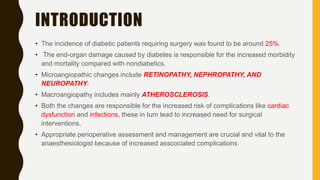
INTRODUCTION
• The incidence of diabetic patients requiring surgery was found to be around 25%.
• The end-organ damage caused by diabetes is responsible for the increased morbidity
and mortality compared with nondiabetics.
• Microangiopathic changes include RETINOPATHY, NEPHROPATHY, AND
NEUROPATHY.
• Macroangiopathy includes mainly ATHEROSCLEROSIS.
• Both the changes are responsible for the increased risk of complications like cardiac
dysfunction and infections, these in turn lead to increased need for surgical
interventions.
• Appropriate perioperative assessment and management are crucial and vital to the
anaesthesiologist because of increased asscociated complications
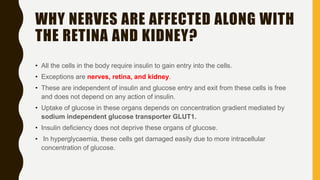
WHY NERVES ARE AFFECTED ALONG WITH
THE RETINA AND KIDNEY?
• All the cells in the body require insulin to gain entry into the cells.
• Exceptions are nerves, retina, and kidney.
• These are independent of insulin and glucose entry and exit from these cells is free
and does not depend on any action of insulin.
• Uptake of glucose in these organs depends on concentration gradient mediated by
sodium independent glucose transporter GLUT1.
• Insulin deficiency does not deprive these organs of glucose.
• In hyperglycaemia, these cells get damaged easily due to more intracellular
concentration of glucose.
PATHOPHYSIOLOGY OF AUTONOMIC
DISTURBANCES
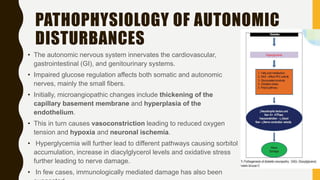
• The autonomic nervous system innervates the cardiovascular,
gastrointestinal (GI), and genitourinary systems.
• Impaired glucose regulation affects both somatic and autonomic
nerves, mainly the small fibers.
• Initially, microangiopathic changes include thickening of the
capillary basement membrane and hyperplasia of the
endothelium.
• This in turn causes vasoconstriction leading to reduced oxygen
tension and hypoxia and neuronal ischemia.
• Hyperglycemia will further lead to different pathways causing sorbitol
accumulation, increase in diacylglycerol levels and oxidative stress
further leading to nerve damage.
• In few cases, immunologically mediated damage has also been
AUTONOMIC NUEROPATHY AND ITS
PRESENTATION
• Diabetic autonomic neuropathy (AN) is among the least acknowledged and interpreted
complications of diabetes despite its substantial negative effect on survival and quality
of life in people with diabetes.
• Nevertheless, subclinical autonomic dysfunction can be seen within a year of diagnosis
in type 2 diabetic patients and within 2 years in type 1 diabetic patients.
• Recent evidence has shown that autonomic imbalance may precede the development
of the inflammatory cascade in type 2 diabetes.
CARDIOVASCULAR AUTONOMIC
NUEROPATHY
• CAN occurs in ~ 17% of patients with type 1 diabetes and 22% of those with type 2.
• An additional 9% of type 1 patients and 12% of type 2 patients have borderline dysfunction.
• CAN may be present at diagnosis, and prevalence increases with age, duration of
diabetes, obesity, smoking, and poor glycemic control.
• The usual features include:
A. Abnormalities in heart rate control – Unopposed sympathetic activity due to
involvement of the vagus nerve results in either resting tachycardia or heart rate
variability (HRV).
Reduced heart rate variation is earliest indicator of CAN.
Fixed heart rate not responding to any maneuver is seen in late diabetic patients with
almost a
denervated heart with further involvement of the sympathetic nervous system
ABNORMALITIES IN CENTRAL AND
PERIPHERAL VASCULAR DYNAMICS
• Impaired sympathetic and parasympathetic responses that normally augment cardiac output and
redirect peripheral blood flow to skeletal muscles result in exercise intolerance.
• This is evident by decreased ejection fraction, systolic dysfunction, and impaired diastolic
filling.
• These patients are even prone to arrhythmias due to regional myocardial autonomic
denervation.
• With both altered vascular responsiveness and regional myocardial neuropathy, malignant
arrhythmogenesis, and sudden cardiac death are common.
• Normally a postural change from supine to sitting position results in baroreceptor initiated and
centrally mediated sympathetic reflex response leading to increase in peripheral vascular resistance
and increase in norepinephrine leading to cardiac acceleration.
• Impaired reflex response and sympathetic efferent neuropathy usually causes fall in peripheral
resistance with change in posture and results in orthostatic hypotension.
• The presenting features vary from asymptomatic to light-headedness and presyncopal symptoms like
weakness, faintness, dizziness, visual impairment, with change of posture from lying down to standing
INVOLVEMENT OF CORONARY
ARTERIES
• The incidence is high in diabetes.
• Most of them are asymptomatic due to AN.
• The neuropathic damage to the myocardial sensory afferent fibers in the autonomic nerve
supply reduces the appreciation for ischemic pain resulting in delayed recognition and
intervention.
• Some patients may present with myocardial pain.
• Chest pain in diabetic patients should be considered to be of myocardial origin until proven
otherwise.
• The possibility of silent myocardial infarction should not be excluded in patients with
symptoms of unexplained fatigue, confusion, tiredness, edema, hemoptysis, nausea and
vomiting, diaphoresis, arrhythmias, cough, or dyspnea.
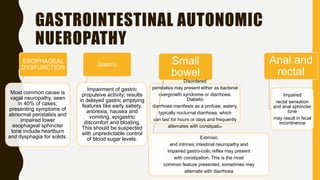
GASTROINTESTINAL AUTONOMIC
NUEROPATHY
ESOPHAGEAL
DYSFUNCTION
Most common cause is
vagal neuropathy, seen
in 40% of cases;
presenting symptoms of
abnormal peristalsis and
impaired lower
esophageal sphincter
tone include heartburn
and dysphagia for solids.
Gastric
Impairment of gastric
propulsive activity; results
in delayed gastric emptying
features like early satiety,
anorexia, nausea and
vomiting, epigastric
discomfort and bloating.
This should be suspected
with unpredictable control
of blood sugar levels.
Small
bowel
Disordered
peristalsis may present either as bacterial
overgrowth syndrome or diarrhoea.
Diabetic
diarrhoea manifests as a profuse, watery,
typically nocturnal diarrhoea, which
can last for hours or days and frequently
alternates with constipation
Extrinsic
and intrinsic intestinal neuropathy and
impaired gastro-colic reflex may present
with constipation. This is the most
common feature presented, sometimes may
alternate with diarrhoea
Anal and
rectal
Impaired
rectal sensation
and anal sphincter
tone
may result in fecal
incontinence
GENITOURINARY AN
Neurogenic bladder
• Cystopathy which may occur due to impaired
detrusor functioning and impaired bladder
sensation.
• This may result either in bladder cystopathy,
incomplete emptying of the bladder and
increased post void residual, urinary retention
and increase urinary frequency depending
upon the fibers affected – afferent or efferent
or both, parasympathetic or sympathetic or
both.
• A post voiding residual volume of more than
150 mL is diagnostic of neurogenic bladder.
• Neurogenic bladder may put patients at risk
for urinary infections
Sexual dysfuncion
• Includes erectile dysfunction (ED), retrograde
ejaculation and female sexual dysfunction.
• ED is the most common form of autonomic
disorder and is also found to be a good
marker for generalized vascular event.
• Penile failure is a potent marker for upcoming
and preventable CVS events.
• Female sexual dysfunction include decreased
sexual desire and increased pain during
intercourse due to inadequate lubrication.
OTHERS
• Hypoglycaemia unawareness: Though literature has shown negative correlation of
AN with hypoglycaemia unawareness, recent evidence has shown attenuation of
epinephrine release with hypoglycaemia and blunted response and release of plasma
pancreatic polypeptidase in patients with AN
• Hypoglycaemic autonomic failure: Attenuation of epinephrine and other counter
regulatory hormones in patients with hypoglycaemia unawareness is defined as
hypoglycaemic autonomic failure.
• Presence of AN further attenuates this response and increases the severity of this
incidence.
• The strict glycaemic control aggravates hypoglycaemic autonomic faillure.
OTHERS
• Impaired microvascular blood flow to the skin: Microvascular insufficiency results in
abnormal contraction of the arterioles and arteries of the skin.
• Laser Doppler flowmetry is a non-invasive method of assessing the changes in
microvascular blood flow with mental arithmetic, cold pressor, heating, and handgrip.
• Dry skin leading to fissures and ulcer development helps in further seedling of infection and
gangrene.
• AN also causes increased osteoclastic activity and reduced bone density.
• . Anaemia and AN: Sympathetic AN leading to reduced sympathetic stimulation of
erythropoietin production has been previously hypothesised as the cause of anaemia.
• Mortality and major cardiovascular event with AN: AN, in the form of renal failure,
cardiac events, such as sudden cardiac death, has been well correlated with 5-year
mortality.
• Mortality rates after a myocardial infarction are also higher for diabetic patients than for
nondiabetic patients.
• This may be due to autonomic insufficiency, increasing the tendency for development of
ventricular arrhythmia and cardiovascular event after infarction
AUTONOMIC ASSESMENT
• CARDIAC
• GASTROINTESTINAL
• GENITOURINARY
• BLADDER DYSFUNCTION
• ASSESSING SUDOMOTOR FUNCTION
• ASSESSING PERIPHERAL NUEROVASCULAR RESPONSES
• ASSESSING PUPILLARY REPONSE
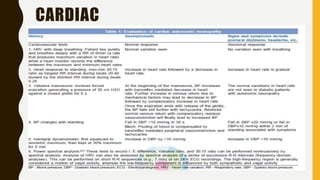
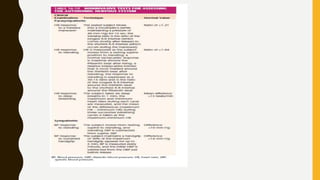
CARDIAC
GASTROINTESTINAL
• 1.Gastric emptying can be assessed by:
• i. Assessment of glycaemic control
• ii. Medication history, including the use of anticholinergic agents, ganglion blockers, and psychotropic
drugs
• iii. Gastroduodenoscopy to exclude pyloric or other mechanical obstruction
• iv. Manometry to detect antral hypomotility and/or pylorospasm
• v. Double-isotope scintigraphy to measure solid-phase gastric emptying
• vi. Electrogastrography detects abnormalities in GI pacemaking, but its role has not been established
in diagnosis or treatment decision making
• 2. Tests for the diagnosis and assessment of constipation might include the following:
• i. Anorectal manometry for evaluating sphincter tone and the rectal anal inhibitory reflex.
• Assessment of colonic segmental transit time. Pelvic examination, with careful bimanual examination
for women
• 3. Diarrhoea.
• Assessment of diarrhoea in patients with diabetes might include detailed history along with
examination for enteric pathogens, ova and parasites to rule out different causes of diarrhoea.
• Further, appropriate tests may be needed to rule out causes like small bowel malabsorptive disorders,
steatorrhoea, coeliac disease andbacterial overgrowth.
GENITOURINARY
• ED is routinely assessed by a detailed medical history, sexual function history,
medication history, assessment of glycaemic control, hormonal and psychological
evaluation.
• Specific tests related to AN include the following:
• i. Measurement of nocturnal penile tumescence
• ii. Measurement of penile and brachial blood pressure with Doppler probes and
calculation of the penile-brachial pressure index (<0.7 suggests penile vascular
disease)
• iii. Sacral outflow (S2, S3, and S4) assessment, which represents the sacral
parasympathetic divisions: anal sphincter tone, perianal sensation, anal wink, and
bulbocavernous reflex are clinical features of denervation of the important nerve supply
that enable erections to occur
• iv. Intra-cavernosal injection of vasoactive compound (e.g., papaverine and
prostaglandin E1) with a response of 65–70% of the time reflecting a predominantly
neurogenic cause of ED and compatible with a significant arterial component.
• Failure of the response suggests venous incompetence
BLADDER DYSFUNCTION
• Evaluation of diabetic bladder dysfunction should be done for any diabetic patient with
recurrent urinary tract infection, pyelonephritis, incontinence, or a palpable bladder.
• The evaluation might include the following:
• Assessment of renal function, urinary culture, post void ultrasound to assess residual
volume and upper-urinary tract dilation, cystometry and voiding cystometrogram to
measure bladder sensation and volume pressure changes associated with bladder
filling with known volumes of water and voiding.
SUDOMOTOR FUNCTION
• Testing of the eccrine sweat glands provides a measure of sympathetic cholinergic
function.
• Tests of sudomotor function include the quantitative sudomotor axon reflex test, the
sweat imprint, the thermoregulatory sweat test, and the sympathetic skin response.
• Sudoscan measures electrochemical skin conductance of hands and feet through
reverse iontophoresis.
• This is a promising, sensitive tool to detect neuropathy in patients with diabetes
mellitus.
• This is a very simple, easy-to-perform test that can be done in the clinical setting in 3–
5 min.
PERIPHERAL NUEROVASCULAR
RESPONSES
• These responses are a measure of autonomic microvascular integrity and is markedly
depressed in patients with AN.
• These include
• ORIENTING RESPONSE
• MENTAL ARITHMETIC
• HANDGRIP,
• COLD PRESSOR RESPONSE.
PUPILLARY FUNCTION
• Patients with diabetic AN show delayed or absent reflex response to light reduced
resting pupillary diameter.
SAN ANTONIO CONSENSUS PANEL
RECOMMENDATIONS
1.Symptoms possibly reflecting AN should not, by themselves, be considered markers
for its presence.
II. Non-invasive validated measures of autonomic neural reflexes should be used as
specific markers of AN if end-organ failure is carefully ruled out and other important
factors, such as concomitant illness, drug use, and age are taken into account.
III. An abnormality on more than one test on more than one occasion is desirable to
establish the presence of autonomic dysfunction.
IV. Independent tests of both parasympathetic and sympathetic function should be
performed.
V. A battery of quantitative measures of autonomic reflexes should be used to monitor
improvement or deterioration of autonomic nerve function.
PREVENTIVE IMPLICATIONS OF CAN:
• 1. To assist in the establishment (or re-establishment) of tight glycaemic control
• 2. To facilitate the decision to initiate treatment for cardiovascular autonomic
dysfunction
• 3. To emphasize the importance of adherence to diet and exercise interventions
ANESTHETIC IMPLICATIONS
• The choice of anaesthesia for most of the surgeries is regional anaesthesia in terms of
pain relief.
• For diabetic patients, the regional techniques are best as they blunt the surgical stress
response responsible for hyperglycaemia and also block sympathetic efferent signals.
• In diabetic patients with AN, use of regional anaesthesia can result in deleterious
life-threatening hypotension.
• The same effect may be induced by general anaesthesia.
• Thus, it is imperative to determine the best choice of anaesthetic technique to
facilitateearly recovery.
IMPLICATIONS
• 1.Gastric emptying time is delayed in patients with uncontrolled hyperglycaemia.
• Strict guidelines for nothing by mouth should be followed to avoid the chances of
regurgitation and aspiration.
• Metoclopramide is administered to decrease the gastric emptying time.
• Aspiration is likely to get aggravated in diabetes due to stiff joint syndrome and in such
patients prokinetics-like cisapride may be ineffective in reducing the volume of gastric
content.
• 2. Anaemia may be associated patients with AN; this needs to be optimised
before undertaking any intervention
IMPLICATIONS
• 3.Haemodynamic response to intubation is altered in diabetic patients.
• Patients with AN may present either with an exaggerated or an attenuated haemodynamic response.
• Careful monitoring with titrated anaesthetic regimen, minimal airway manipulation, and timely
intervention is required to maintain stabledynamics.
• 4. Perioperative cardiovascular lability:
• The normal autonomic response of vasoconstriction and tachycardia did not completely compensate
for the vasodilating effects of anaesthesia.
• This may result in severe degree of hypotension sometimes not responding to vasopressors and
inotropes.
• Assessment of the blood volume status before and during the conduct of anaesthesia will guide in
titrating the dose of anaesthesia and in combating hypotension.
• Monitoring mandates the use of arterial blood pressure for beat-to-beat variation in blood pressure,
electrocardiogram to identify rhythm disturbances and ischemic changes and central venous pressure
to assess fluid volume status
IMPLICATIONS
• 5.These patients are more prone to hypothermia and thus decreased drug
metabolism and impaired wound healing, and rarely with hyperthermia.
• Effective techniques to prevent hypothermia and continuous temperature monitoring should
be considered.
• 6. Insulin has paradoxical effects on cardiovascular system.
• At low doses, it has vasoconstrictor effect but at high doses, which are often used for
diabetes treatment, it causes vasodilatation.
• That is the reason, in patients with AN, insulin causes a decrease in supine arterial
pressure and exacerbates postural hypotension.
• 7. Patients with AN have reduced hypoxic-induced ventilatory drive.
• Choice of anaesthesia and dosage proper planning of perioperative management is
essential to decrease the incidence of complications.
• Judicious use of opioid should be done to avoid postoperative respiratory depression
IMPLICATIONS
• 8.The severity of AN can have adverse consequences in diabetic patients.
• Patients may have uncontrolled cardiovascular stability especially with central neuraxial anaesthesia.
• Proper preoperative assessment and planning is essential for a safe outcome.
• Nerve blocks preferably ultrasound guided is safe.
• The presence of peripheral neuropathy must be well documented prior to any regional procedure.
• 9. Risk of infection and vascular damage may be increased with the use of regional techniques
in diabetic patients, consequently increasing risk of development of epidural abscess.
• 10. Evidence also suggests that there is increased risk of neuropathy after peripheral nerve
blocks
• 11. Strict vigilance, monitoring and control of blood sugars are essential depending upon the
type and duration of surgery throughout the perioperative procedure.
IMPLICATIONS
• 12. Slow controlled positioning is essential to avoid precipitous fall of blood pressure.
• Padding of vulnerable area is properly done to avoid iatrogenic injuries during positioning.
• 13. Orthostatic hypotension may precipitate in the postoperative period.
• Continuous monitoring of blood pressure, respiration with oxygen supplementation, and adequate
analgesia are mandatory at least for 24 h following any intervention.
• 14. Pneumoperitoneum in laparoscopic surgeries is again a concern in diabetic patients with
AN.
• This should be used with caution or avoided to negate its ischemic effects on the adjacent viscera and
blood vessels.
• Another major concern is postoperative paralytic ileus, especially following abdominal surgeries.
• Strict control of blood sugars in the perioperative period also helps in the management of this
problem.
IMPLICATIONS
• Several strategies need to be utilised forenhanced recovery of patients undergoing surgery
to promote earlier resumption of normal diet, earlier mobilisation, and reduced length of
stay.
• Adequate postoperative pain management, preferably with ultrasound-guided regional
blocks are helpful
• Diabetes patients for emergency surgery needs special attention as risk of diabetic
ketoacidosis is present and uncontrolled diabetes with
• AN can present with various haemodynamicdisturbances.
• It is preferred to operate after stabilisation of patient.
• The decision to operate the patient carries significant risk of mortality and should be
avoided if at all possible
GOLD STANDARD TEST
• Cardiovascular autonomic reflex tests CART) such as heart rate responses to deep
breathing, standing, andValsalva manoeuvre, as well as blood pressure response to
standing are considered as the gold standard in clinical testing for AN.
• Their applicability in bedside clinical practice is based on their sensitivity, specificity,
reproducibility, ease and safety of use, and standardisation.
TORONTO CONSENSUS PANEL
• Criteria for diagnosis and staging of CAN are as follows:
• (1) A single abnormal CART result suffices for the diagnosis of possible or early CAN;
• (2) The presence of two or three abnormal test among the seven autonomic
cardiovascular indices (5 CARTS, time-domain, and frequency-domain heart rate
variation tests) are required for the diagnosis of definite or confirmed CAN; and
• (3) The presence of orthostatic hypotension in addition to the above criteria signifies
the presence of severe or advanced CAN.
SUMMARY
• Diabetic AN along with other pathophysiological disturbances plays a role in the
perioperative management of patients undergoing surgery.
• Anesthesia per se has systemic manifestations.
• Patients with AN should be properly assessed with battery of tests, optimised with
timely interventions for a safe outcome.
• Thank you

Autonomic neuropathy and anesthetic implications

  • 1.
    AUTONOMIC DISTURBANCES IN DIABETES ASSESSMENT AND ANESTHETIC IMPLICATIONS PRESENTER-DrRICHIE SANAM FINAL YEAR PG MODERATOR-Dr USSA VARAPRASAD PROFESSOR AND HOD DEPT OF ANESTHESIA AND CRITICAL CARE Dr PSIMS&RF Journal club
  • 2.
    JOURNAL CLUB • Title-Autonomicdisturbances in diabetes: Assessment and anaesthetic implications • Authors-Srilata Moningi, Sapna Nikhar, Gopinath Ramachandran FROM NIMS • Journal-INDIAN JOURNAL OF ANESTHESIA VOL-62 2017 • Authenticity-GOOD • Conflicts of interest-NIL
  • 3.
    INTRODUCTION • The incidenceof diabetic patients requiring surgery was found to be around 25%. • The end-organ damage caused by diabetes is responsible for the increased morbidity and mortality compared with nondiabetics. • Microangiopathic changes include RETINOPATHY, NEPHROPATHY, AND NEUROPATHY. • Macroangiopathy includes mainly ATHEROSCLEROSIS. • Both the changes are responsible for the increased risk of complications like cardiac dysfunction and infections, these in turn lead to increased need for surgical interventions. • Appropriate perioperative assessment and management are crucial and vital to the anaesthesiologist because of increased asscociated complications
  • 4.
    WHY NERVES AREAFFECTED ALONG WITH THE RETINA AND KIDNEY? • All the cells in the body require insulin to gain entry into the cells. • Exceptions are nerves, retina, and kidney. • These are independent of insulin and glucose entry and exit from these cells is free and does not depend on any action of insulin. • Uptake of glucose in these organs depends on concentration gradient mediated by sodium independent glucose transporter GLUT1. • Insulin deficiency does not deprive these organs of glucose. • In hyperglycaemia, these cells get damaged easily due to more intracellular concentration of glucose.
  • 5.
    PATHOPHYSIOLOGY OF AUTONOMIC DISTURBANCES •The autonomic nervous system innervates the cardiovascular, gastrointestinal (GI), and genitourinary systems. • Impaired glucose regulation affects both somatic and autonomic nerves, mainly the small fibers. • Initially, microangiopathic changes include thickening of the capillary basement membrane and hyperplasia of the endothelium. • This in turn causes vasoconstriction leading to reduced oxygen tension and hypoxia and neuronal ischemia. • Hyperglycemia will further lead to different pathways causing sorbitol accumulation, increase in diacylglycerol levels and oxidative stress further leading to nerve damage. • In few cases, immunologically mediated damage has also been
  • 6.
    AUTONOMIC NUEROPATHY ANDITS PRESENTATION • Diabetic autonomic neuropathy (AN) is among the least acknowledged and interpreted complications of diabetes despite its substantial negative effect on survival and quality of life in people with diabetes. • Nevertheless, subclinical autonomic dysfunction can be seen within a year of diagnosis in type 2 diabetic patients and within 2 years in type 1 diabetic patients. • Recent evidence has shown that autonomic imbalance may precede the development of the inflammatory cascade in type 2 diabetes.
  • 7.
    CARDIOVASCULAR AUTONOMIC NUEROPATHY • CANoccurs in ~ 17% of patients with type 1 diabetes and 22% of those with type 2. • An additional 9% of type 1 patients and 12% of type 2 patients have borderline dysfunction. • CAN may be present at diagnosis, and prevalence increases with age, duration of diabetes, obesity, smoking, and poor glycemic control. • The usual features include: A. Abnormalities in heart rate control – Unopposed sympathetic activity due to involvement of the vagus nerve results in either resting tachycardia or heart rate variability (HRV). Reduced heart rate variation is earliest indicator of CAN. Fixed heart rate not responding to any maneuver is seen in late diabetic patients with almost a denervated heart with further involvement of the sympathetic nervous system
  • 8.
    ABNORMALITIES IN CENTRALAND PERIPHERAL VASCULAR DYNAMICS • Impaired sympathetic and parasympathetic responses that normally augment cardiac output and redirect peripheral blood flow to skeletal muscles result in exercise intolerance. • This is evident by decreased ejection fraction, systolic dysfunction, and impaired diastolic filling. • These patients are even prone to arrhythmias due to regional myocardial autonomic denervation. • With both altered vascular responsiveness and regional myocardial neuropathy, malignant arrhythmogenesis, and sudden cardiac death are common. • Normally a postural change from supine to sitting position results in baroreceptor initiated and centrally mediated sympathetic reflex response leading to increase in peripheral vascular resistance and increase in norepinephrine leading to cardiac acceleration. • Impaired reflex response and sympathetic efferent neuropathy usually causes fall in peripheral resistance with change in posture and results in orthostatic hypotension. • The presenting features vary from asymptomatic to light-headedness and presyncopal symptoms like weakness, faintness, dizziness, visual impairment, with change of posture from lying down to standing
  • 9.
    INVOLVEMENT OF CORONARY ARTERIES •The incidence is high in diabetes. • Most of them are asymptomatic due to AN. • The neuropathic damage to the myocardial sensory afferent fibers in the autonomic nerve supply reduces the appreciation for ischemic pain resulting in delayed recognition and intervention. • Some patients may present with myocardial pain. • Chest pain in diabetic patients should be considered to be of myocardial origin until proven otherwise. • The possibility of silent myocardial infarction should not be excluded in patients with symptoms of unexplained fatigue, confusion, tiredness, edema, hemoptysis, nausea and vomiting, diaphoresis, arrhythmias, cough, or dyspnea.
  • 10.
    GASTROINTESTINAL AUTONOMIC NUEROPATHY ESOPHAGEAL DYSFUNCTION Most commoncause is vagal neuropathy, seen in 40% of cases; presenting symptoms of abnormal peristalsis and impaired lower esophageal sphincter tone include heartburn and dysphagia for solids. Gastric Impairment of gastric propulsive activity; results in delayed gastric emptying features like early satiety, anorexia, nausea and vomiting, epigastric discomfort and bloating. This should be suspected with unpredictable control of blood sugar levels. Small bowel Disordered peristalsis may present either as bacterial overgrowth syndrome or diarrhoea. Diabetic diarrhoea manifests as a profuse, watery, typically nocturnal diarrhoea, which can last for hours or days and frequently alternates with constipation Extrinsic and intrinsic intestinal neuropathy and impaired gastro-colic reflex may present with constipation. This is the most common feature presented, sometimes may alternate with diarrhoea Anal and rectal Impaired rectal sensation and anal sphincter tone may result in fecal incontinence
  • 11.
    GENITOURINARY AN Neurogenic bladder •Cystopathy which may occur due to impaired detrusor functioning and impaired bladder sensation. • This may result either in bladder cystopathy, incomplete emptying of the bladder and increased post void residual, urinary retention and increase urinary frequency depending upon the fibers affected – afferent or efferent or both, parasympathetic or sympathetic or both. • A post voiding residual volume of more than 150 mL is diagnostic of neurogenic bladder. • Neurogenic bladder may put patients at risk for urinary infections Sexual dysfuncion • Includes erectile dysfunction (ED), retrograde ejaculation and female sexual dysfunction. • ED is the most common form of autonomic disorder and is also found to be a good marker for generalized vascular event. • Penile failure is a potent marker for upcoming and preventable CVS events. • Female sexual dysfunction include decreased sexual desire and increased pain during intercourse due to inadequate lubrication.
  • 12.
    OTHERS • Hypoglycaemia unawareness:Though literature has shown negative correlation of AN with hypoglycaemia unawareness, recent evidence has shown attenuation of epinephrine release with hypoglycaemia and blunted response and release of plasma pancreatic polypeptidase in patients with AN • Hypoglycaemic autonomic failure: Attenuation of epinephrine and other counter regulatory hormones in patients with hypoglycaemia unawareness is defined as hypoglycaemic autonomic failure. • Presence of AN further attenuates this response and increases the severity of this incidence. • The strict glycaemic control aggravates hypoglycaemic autonomic faillure.
  • 13.
    OTHERS • Impaired microvascularblood flow to the skin: Microvascular insufficiency results in abnormal contraction of the arterioles and arteries of the skin. • Laser Doppler flowmetry is a non-invasive method of assessing the changes in microvascular blood flow with mental arithmetic, cold pressor, heating, and handgrip. • Dry skin leading to fissures and ulcer development helps in further seedling of infection and gangrene. • AN also causes increased osteoclastic activity and reduced bone density. • . Anaemia and AN: Sympathetic AN leading to reduced sympathetic stimulation of erythropoietin production has been previously hypothesised as the cause of anaemia. • Mortality and major cardiovascular event with AN: AN, in the form of renal failure, cardiac events, such as sudden cardiac death, has been well correlated with 5-year mortality. • Mortality rates after a myocardial infarction are also higher for diabetic patients than for nondiabetic patients. • This may be due to autonomic insufficiency, increasing the tendency for development of ventricular arrhythmia and cardiovascular event after infarction

  • 14.
    AUTONOMIC ASSESMENT • CARDIAC •GASTROINTESTINAL • GENITOURINARY • BLADDER DYSFUNCTION • ASSESSING SUDOMOTOR FUNCTION • ASSESSING PERIPHERAL NUEROVASCULAR RESPONSES • ASSESSING PUPILLARY REPONSE
  • 15.
  • 17.
    GASTROINTESTINAL • 1.Gastric emptyingcan be assessed by: • i. Assessment of glycaemic control • ii. Medication history, including the use of anticholinergic agents, ganglion blockers, and psychotropic drugs • iii. Gastroduodenoscopy to exclude pyloric or other mechanical obstruction • iv. Manometry to detect antral hypomotility and/or pylorospasm • v. Double-isotope scintigraphy to measure solid-phase gastric emptying • vi. Electrogastrography detects abnormalities in GI pacemaking, but its role has not been established in diagnosis or treatment decision making • 2. Tests for the diagnosis and assessment of constipation might include the following: • i. Anorectal manometry for evaluating sphincter tone and the rectal anal inhibitory reflex. • Assessment of colonic segmental transit time. Pelvic examination, with careful bimanual examination for women • 3. Diarrhoea. • Assessment of diarrhoea in patients with diabetes might include detailed history along with examination for enteric pathogens, ova and parasites to rule out different causes of diarrhoea. • Further, appropriate tests may be needed to rule out causes like small bowel malabsorptive disorders, steatorrhoea, coeliac disease andbacterial overgrowth.
  • 18.
    GENITOURINARY • ED isroutinely assessed by a detailed medical history, sexual function history, medication history, assessment of glycaemic control, hormonal and psychological evaluation. • Specific tests related to AN include the following: • i. Measurement of nocturnal penile tumescence • ii. Measurement of penile and brachial blood pressure with Doppler probes and calculation of the penile-brachial pressure index (<0.7 suggests penile vascular disease) • iii. Sacral outflow (S2, S3, and S4) assessment, which represents the sacral parasympathetic divisions: anal sphincter tone, perianal sensation, anal wink, and bulbocavernous reflex are clinical features of denervation of the important nerve supply that enable erections to occur • iv. Intra-cavernosal injection of vasoactive compound (e.g., papaverine and prostaglandin E1) with a response of 65–70% of the time reflecting a predominantly neurogenic cause of ED and compatible with a significant arterial component. • Failure of the response suggests venous incompetence
  • 19.
    BLADDER DYSFUNCTION • Evaluationof diabetic bladder dysfunction should be done for any diabetic patient with recurrent urinary tract infection, pyelonephritis, incontinence, or a palpable bladder. • The evaluation might include the following: • Assessment of renal function, urinary culture, post void ultrasound to assess residual volume and upper-urinary tract dilation, cystometry and voiding cystometrogram to measure bladder sensation and volume pressure changes associated with bladder filling with known volumes of water and voiding.
  • 20.
    SUDOMOTOR FUNCTION • Testingof the eccrine sweat glands provides a measure of sympathetic cholinergic function. • Tests of sudomotor function include the quantitative sudomotor axon reflex test, the sweat imprint, the thermoregulatory sweat test, and the sympathetic skin response. • Sudoscan measures electrochemical skin conductance of hands and feet through reverse iontophoresis. • This is a promising, sensitive tool to detect neuropathy in patients with diabetes mellitus. • This is a very simple, easy-to-perform test that can be done in the clinical setting in 3– 5 min.
  • 21.
    PERIPHERAL NUEROVASCULAR RESPONSES • Theseresponses are a measure of autonomic microvascular integrity and is markedly depressed in patients with AN. • These include • ORIENTING RESPONSE • MENTAL ARITHMETIC • HANDGRIP, • COLD PRESSOR RESPONSE.
  • 22.
    PUPILLARY FUNCTION • Patientswith diabetic AN show delayed or absent reflex response to light reduced resting pupillary diameter.
  • 23.
    SAN ANTONIO CONSENSUSPANEL RECOMMENDATIONS 1.Symptoms possibly reflecting AN should not, by themselves, be considered markers for its presence. II. Non-invasive validated measures of autonomic neural reflexes should be used as specific markers of AN if end-organ failure is carefully ruled out and other important factors, such as concomitant illness, drug use, and age are taken into account. III. An abnormality on more than one test on more than one occasion is desirable to establish the presence of autonomic dysfunction. IV. Independent tests of both parasympathetic and sympathetic function should be performed. V. A battery of quantitative measures of autonomic reflexes should be used to monitor improvement or deterioration of autonomic nerve function.
  • 24.
    PREVENTIVE IMPLICATIONS OFCAN: • 1. To assist in the establishment (or re-establishment) of tight glycaemic control • 2. To facilitate the decision to initiate treatment for cardiovascular autonomic dysfunction • 3. To emphasize the importance of adherence to diet and exercise interventions
  • 25.
    ANESTHETIC IMPLICATIONS • Thechoice of anaesthesia for most of the surgeries is regional anaesthesia in terms of pain relief. • For diabetic patients, the regional techniques are best as they blunt the surgical stress response responsible for hyperglycaemia and also block sympathetic efferent signals. • In diabetic patients with AN, use of regional anaesthesia can result in deleterious life-threatening hypotension. • The same effect may be induced by general anaesthesia. • Thus, it is imperative to determine the best choice of anaesthetic technique to facilitateearly recovery.
  • 26.
    IMPLICATIONS • 1.Gastric emptyingtime is delayed in patients with uncontrolled hyperglycaemia. • Strict guidelines for nothing by mouth should be followed to avoid the chances of regurgitation and aspiration. • Metoclopramide is administered to decrease the gastric emptying time. • Aspiration is likely to get aggravated in diabetes due to stiff joint syndrome and in such patients prokinetics-like cisapride may be ineffective in reducing the volume of gastric content. • 2. Anaemia may be associated patients with AN; this needs to be optimised before undertaking any intervention
  • 27.
    IMPLICATIONS • 3.Haemodynamic responseto intubation is altered in diabetic patients. • Patients with AN may present either with an exaggerated or an attenuated haemodynamic response. • Careful monitoring with titrated anaesthetic regimen, minimal airway manipulation, and timely intervention is required to maintain stabledynamics. • 4. Perioperative cardiovascular lability: • The normal autonomic response of vasoconstriction and tachycardia did not completely compensate for the vasodilating effects of anaesthesia. • This may result in severe degree of hypotension sometimes not responding to vasopressors and inotropes. • Assessment of the blood volume status before and during the conduct of anaesthesia will guide in titrating the dose of anaesthesia and in combating hypotension. • Monitoring mandates the use of arterial blood pressure for beat-to-beat variation in blood pressure, electrocardiogram to identify rhythm disturbances and ischemic changes and central venous pressure to assess fluid volume status
  • 28.
    IMPLICATIONS • 5.These patientsare more prone to hypothermia and thus decreased drug metabolism and impaired wound healing, and rarely with hyperthermia. • Effective techniques to prevent hypothermia and continuous temperature monitoring should be considered. • 6. Insulin has paradoxical effects on cardiovascular system. • At low doses, it has vasoconstrictor effect but at high doses, which are often used for diabetes treatment, it causes vasodilatation. • That is the reason, in patients with AN, insulin causes a decrease in supine arterial pressure and exacerbates postural hypotension. • 7. Patients with AN have reduced hypoxic-induced ventilatory drive. • Choice of anaesthesia and dosage proper planning of perioperative management is essential to decrease the incidence of complications. • Judicious use of opioid should be done to avoid postoperative respiratory depression
  • 29.
    IMPLICATIONS • 8.The severityof AN can have adverse consequences in diabetic patients. • Patients may have uncontrolled cardiovascular stability especially with central neuraxial anaesthesia. • Proper preoperative assessment and planning is essential for a safe outcome. • Nerve blocks preferably ultrasound guided is safe. • The presence of peripheral neuropathy must be well documented prior to any regional procedure. • 9. Risk of infection and vascular damage may be increased with the use of regional techniques in diabetic patients, consequently increasing risk of development of epidural abscess. • 10. Evidence also suggests that there is increased risk of neuropathy after peripheral nerve blocks • 11. Strict vigilance, monitoring and control of blood sugars are essential depending upon the type and duration of surgery throughout the perioperative procedure.
  • 30.
    IMPLICATIONS • 12. Slowcontrolled positioning is essential to avoid precipitous fall of blood pressure. • Padding of vulnerable area is properly done to avoid iatrogenic injuries during positioning. • 13. Orthostatic hypotension may precipitate in the postoperative period. • Continuous monitoring of blood pressure, respiration with oxygen supplementation, and adequate analgesia are mandatory at least for 24 h following any intervention. • 14. Pneumoperitoneum in laparoscopic surgeries is again a concern in diabetic patients with AN. • This should be used with caution or avoided to negate its ischemic effects on the adjacent viscera and blood vessels. • Another major concern is postoperative paralytic ileus, especially following abdominal surgeries. • Strict control of blood sugars in the perioperative period also helps in the management of this problem.
  • 31.
    IMPLICATIONS • Several strategiesneed to be utilised forenhanced recovery of patients undergoing surgery to promote earlier resumption of normal diet, earlier mobilisation, and reduced length of stay. • Adequate postoperative pain management, preferably with ultrasound-guided regional blocks are helpful • Diabetes patients for emergency surgery needs special attention as risk of diabetic ketoacidosis is present and uncontrolled diabetes with • AN can present with various haemodynamicdisturbances. • It is preferred to operate after stabilisation of patient. • The decision to operate the patient carries significant risk of mortality and should be avoided if at all possible
  • 32.
    GOLD STANDARD TEST •Cardiovascular autonomic reflex tests CART) such as heart rate responses to deep breathing, standing, andValsalva manoeuvre, as well as blood pressure response to standing are considered as the gold standard in clinical testing for AN. • Their applicability in bedside clinical practice is based on their sensitivity, specificity, reproducibility, ease and safety of use, and standardisation.
  • 33.
    TORONTO CONSENSUS PANEL •Criteria for diagnosis and staging of CAN are as follows: • (1) A single abnormal CART result suffices for the diagnosis of possible or early CAN; • (2) The presence of two or three abnormal test among the seven autonomic cardiovascular indices (5 CARTS, time-domain, and frequency-domain heart rate variation tests) are required for the diagnosis of definite or confirmed CAN; and • (3) The presence of orthostatic hypotension in addition to the above criteria signifies the presence of severe or advanced CAN.
  • 34.
    SUMMARY • Diabetic ANalong with other pathophysiological disturbances plays a role in the perioperative management of patients undergoing surgery. • Anesthesia per se has systemic manifestations. • Patients with AN should be properly assessed with battery of tests, optimised with timely interventions for a safe outcome.
  • 35.