Dr.NARENDRA S TENGLI
1ST Year JR
DEPARTMENT OF
PULMONARY MEDICINE
Oxygen properties
Oxygen cascade
Oxygen transport
Oxygen dissociation curve
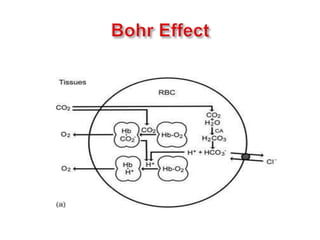
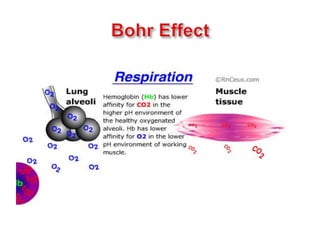
Bohr effect
Oxygen delivery ,oxygen delivery devices
Hypoxia and hypoxemia definition and causes
Pulse oximeter and principal
Oxygen therapy- indication
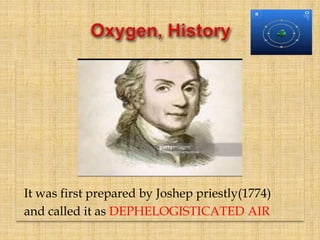
It was first prepared by Joshep priestly(1774)
and called it as DEPHELOGISTICATED AIR
 Colourless, odourless and tasteless gas
 It is not very soluble in water
 It is neutral in PH
 Denser than air
 Support burning, breathing, decaying and
rusting
 Combines easily with many metal and non
metal
Why we need
oxygen?
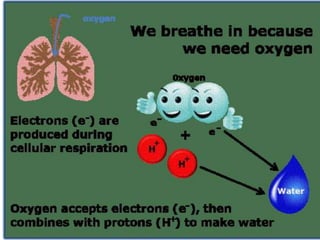
The metabolism of oxygen
takes place at the end of
electron transport chain in
mitochondria
Where the electrons that
accumulate as a result of ATP
production are cleared by chemical
reduction of oxygen to water
Oxygen is transported from the air that we breath
to the mitochondria
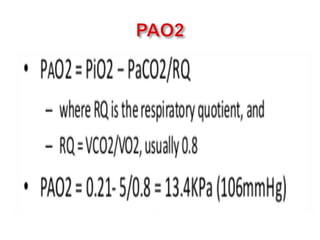
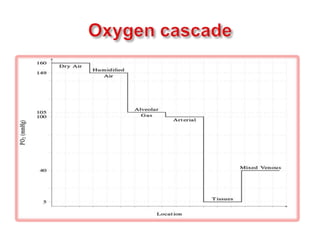
O2 moves down pressure gradient
The PaO2 in air ( at see level ) is about 157 mmHg
falling to 7- 11 mmHg in the mitochondria
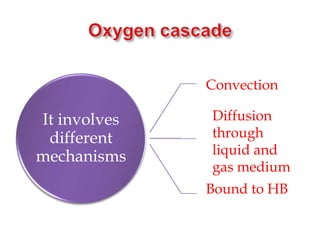
It involves
different
mechanisms
Convection
Diffusion
through
liquid and
gas medium
Bound to HB
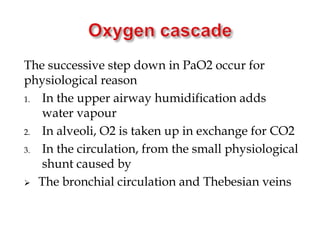
The successive step down in PaO2 occur for
physiological reason
1. In the upper airway humidification adds
water vapour
2. In alveoli, O2 is taken up in exchange for CO2
3. In the circulation, from the small physiological
shunt caused by
 The bronchial circulation and Thebesian veins
Oxygen is carried
in 2 forms in the
blood
Oxygen combined
to haemoglobin
(97%)
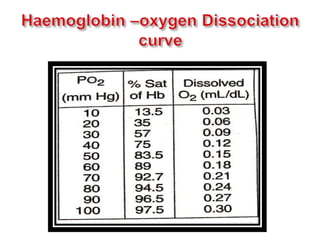
Oxygen dissolved
in blood (3%)
1. Oxygen combined to haemoglobin (97%)
Once the HB is saturated, oxygen content can
only be marginally increased by dissolved
oxygen
2. Oxygen dissolved in blood
-This accounts for a minimal amount (0.3ml per
dl)
The amount dissolved obeys Henry’s law
 Dynamic reaction, reversible
 Haemoglobin is a protein
 It contains ferrous iron atom
 Reaction is oxygenation
 8 atom or 4 molecule of oxygen
 T configuration and R configuration(500)
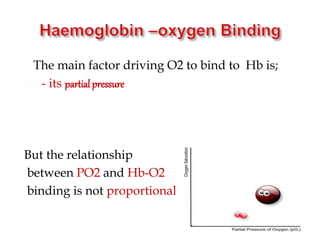
The main factor driving O2 to bind to Hb is;
 - its partial pressure
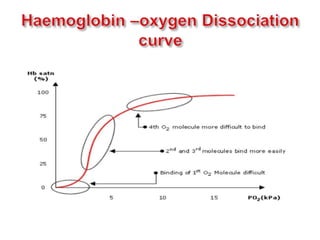
But the relationship
between PO2 and Hb-O2
binding is not proportional
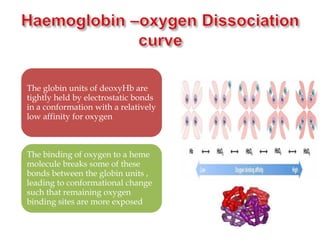
The globin units of deoxyHb are
tightly held by electrostatic bonds
in a conformation with a relatively
low affinity for oxygen
The binding of oxygen to a heme
molecule breaks some of these
bonds between the globin units ,
leading to conformational change
such that remaining oxygen
binding sites are more exposed
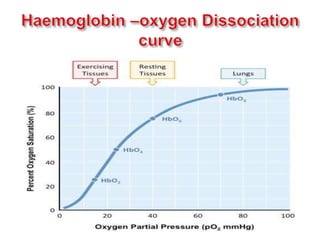
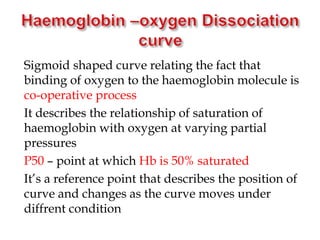
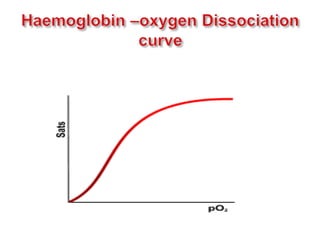
Sigmoid shaped curve relating the fact that
binding of oxygen to the haemoglobin molecule is
co-operative process
It describes the relationship of saturation of
haemoglobin with oxygen at varying partial
pressures
P50 – point at which Hb is 50% saturated
It’s a reference point that describes the position of
curve and changes as the curve moves under
diffrent condition
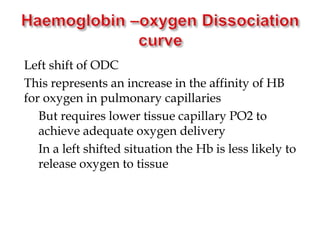
Left shift of ODC
This represents an increase in the affinity of HB
for oxygen in pulmonary capillaries
- But requires lower tissue capillary PO2 to
achieve adequate oxygen delivery
- In a left shifted situation the Hb is less likely to
release oxygen to tissue
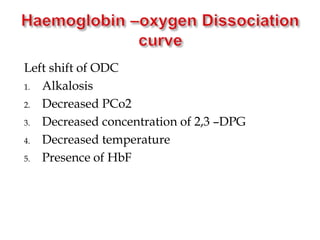
Left shift of ODC
1. Alkalosis
2. Decreased PCo2
3. Decreased concentration of 2,3 –DPG
4. Decreased temperature
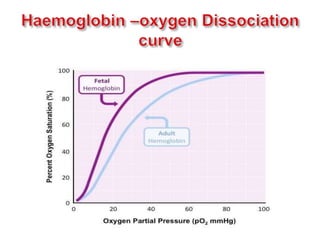
5. Presence of HbF
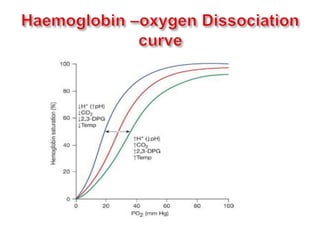
Right shift of the ODC
 This represents an dreases in the affinity of Hb
for oxygen
 In this situation P50 is increased , requiring
high pulmonary capillary saturation to saturate
HB
 If a right shift occurs the Hb molecule is more
likely to offload oxygen to the tissues
Right shift of ODC
1. Acidosis
2. Increased PCO2
3. Increased concentration of 2,3- DPG
4. Increased temperature
5. High altitude
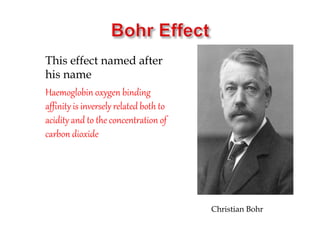
This effect named after
his name
Haemoglobin oxygen binding
affinity is inversely related both to
acidity and to the concentration of
carbon dioxide
Christian Bohr
1. Increase the efficiency of oxygen
transportation
2. Bhor effect facilitates O2 release in tissues
particularly those tissues in most need of
oxygen
3. The Bohr effect enables the body to adapt to
changing condition and makes it possible to
supply extra oxygen to the tissue that needs
most
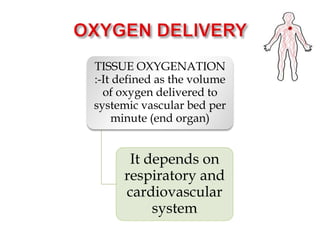
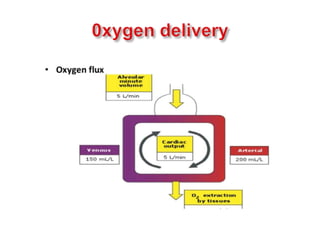
TISSUE OXYGENATION
:-It defined as the volume
of oxygen delivered to
systemic vascular bed per
minute (end organ)
It depends on
respiratory and
cardiovascular
system
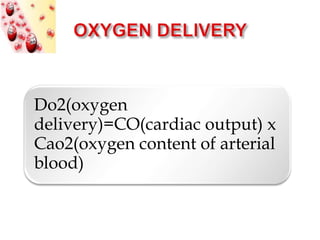
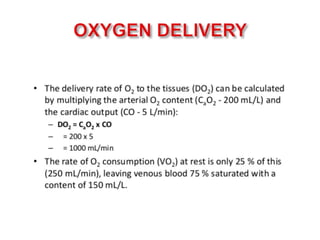
Do2(oxygen
delivery)=CO(cardiac output) x
Cao2(oxygen content of arterial
blood)
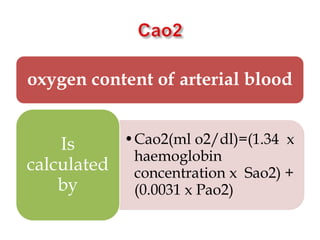
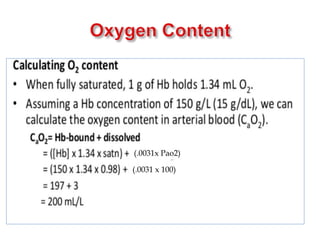
oxygen content of arterial blood
•Cao2(ml o2/dl)=(1.34 x
haemoglobin
concentration x Sao2) +
(0.0031 x Pao2)
Is
calculated
by
(.0031x Pao2)
(.0031 x 100)
Components
1. Oxygen source
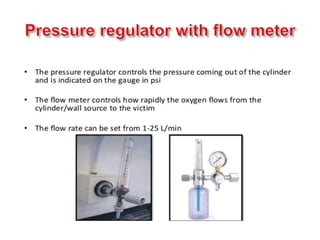
2. Pressure regulator and flow
meter
3. Oxygen delivery device
4. Patient
Central oxygen supply system
Oxygen concentrator
Oxygen Cylinder
 Operate at 1800-2400 psi
 Cannot bae directly delivered to patient
Need down regulating valve flow meter to
manipulate the flow rate
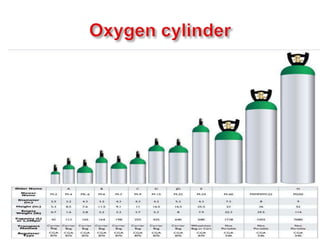
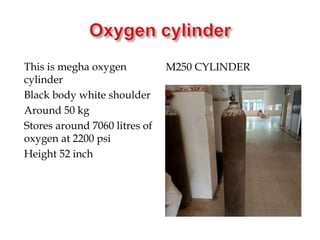
M250 CYLINDER
This is megha oxygen
cylinder
Black body white shoulder
Around 50 kg
Stores around 7060 litres of
oxygen at 2200 psi
Height 52 inch
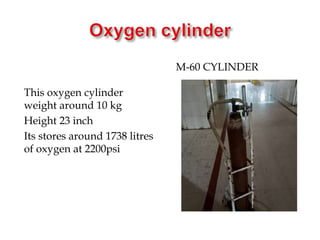
MM-60 CYLINDER
This oxygen cylinder
weight around 10 kg
Height 23 inch
Its stores around 1738 litres
of oxygen at 2200psi
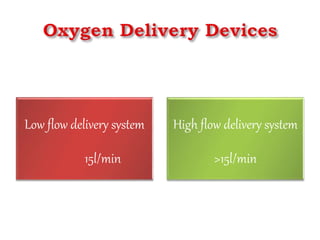
Low flow delivery system
15l/min
High flow delivery system
>15l/min
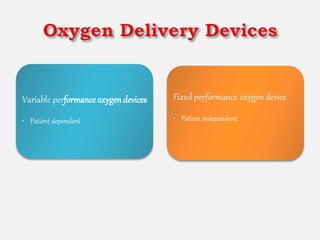
Variable performance oxygendevices
• Patient dependent
Fixed performance oxygen device
• Patient independent
Low-flow and Variable Performance Oxygen
Device
1. The maximum flow in these system is 15/min
2. These devices dilute/concentrate the
administered Fio2- so they are called variable
performance device
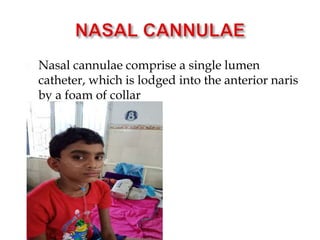
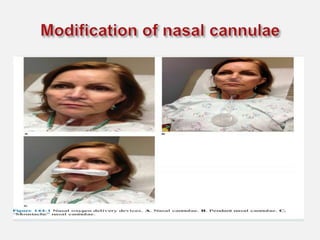
 Nasal cannulae comprise a single lumen
catheter, which is lodged into the anterior naris
by a foam of collar
The continuous flow creates a reservoir of oxygen in
nasopharynx from which the patient draws during
inspiration
The Fio2 achieved is proportional to
1. The flow rate of oxygen
2. The patient tidal volume, inspiratory flow and
respiratory rate
3. The volume of nasopharynx
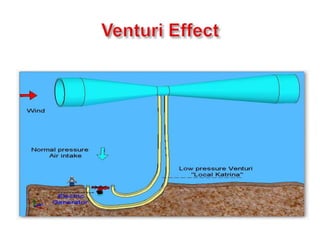
Mouth breathing patient
Mouth breathing causes inspiratory air
flow .this produces a venturi effect in
the posterior pharynx entraining
oxygen from the nose
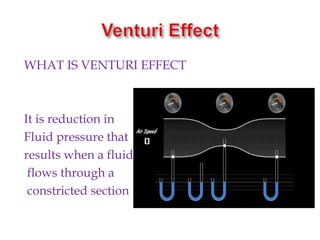
WHAT IS VENTURI EFFECT
It is reduction in
Fluid pressure that
results when a fluid
flows through a
constricted section
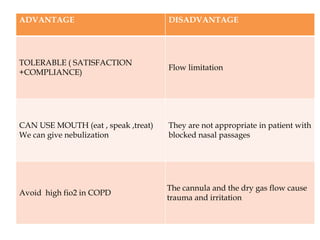
ADVANTAGE DISADVANTAGE
TOLERABLE ( SATISFACTION
+COMPLIANCE)
Flow limitation
CAN USE MOUTH (eat , speak ,treat)
We can give nebulization
They are not appropriate in patient with
blocked nasal passages
Avoid high fio2 in COPD
The cannula and the dry gas flow cause
trauma and irritation
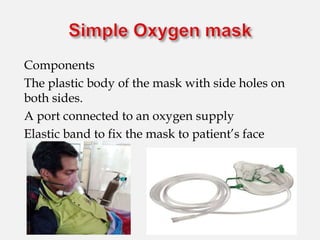
Components
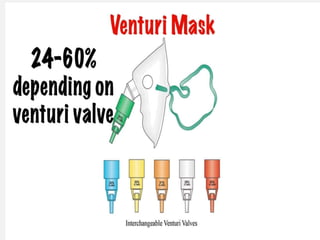
The plastic body of the mask with side holes on
both sides.
A port connected to an oxygen supply
Elastic band to fix the mask to patient’s face
 Ambient air is entrained through the holes on
both sides of mask. The holes also allow
exhaled gases to be vented out
 During expiratory pause the fresh oxygen
supplied helps in venting the exhaled gases
through the side holes
 The body of the mask (acting as a reservoir) is
filled with fresh oxygen supply and is available
for start of the next inspiration
a) The final concentration of inspired oxygen
depends on
b) The oxygen supply flow rate
c) The pattern of ventilation
d) The patient inspiratory flow rate
e) How tight the mask fit is on the face
f) Expiratory pause
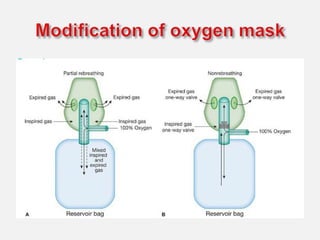
a) Mask reservoir bag system
b) A) partial rebreathing
c) B) non breathing
d) These are simple mask with attachesd
reservoir of 600 to 800 ml, resting below the
patient chin
 High flow oxygen devices deliver a constant
fio2
 This is done by very high flow of pure oxygen
which exceed the patients minute ventilation
 Some devices even incorporate oxygen
reservoirs whose volumes exceed the patients
anatomical dead space
 Components
1. The plastic body of the mask with holes on
both sides
2. The proximal end of the mask consist of a
venture device
3. The venture devices are colour coded and
marked with recommended oxygen flow rate
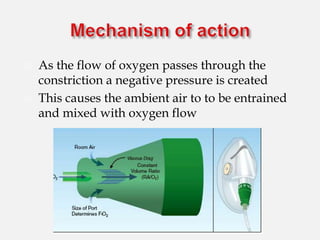
 The mask uses the Bernoulli principle
 The size of constriction determines the final
concentration of oxygen
 The gas flow is higher than the peak
inspiratory flow rate
 As the flow of oxygen passes through the
constriction a negative pressure is created
 This causes the ambient air to to be entrained
and mixed with oxygen flow
These devices are ideal for patients with chronic
lung disease who require a specific Fio2 due risk
of hypercapnia from hyperoxia
These masks are recommended by the british
thoracic society for COPD patients in emergency
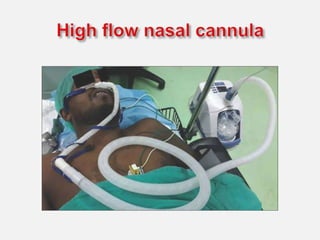
The newest technique of o2 delivery is high flow
nasal o2 using heated and humidified gas
Flow rates of 40-60 L/min can be delivered
through wide nasal prongs without discomfort
and mucosal injury
Studies have shown that ,that in patient who
require a high fio2 using mask devices , switching
to humidified , high flow nasal o2 was associated
with a significant improvement
a) It is a condition in which the body or
region of the body is deprived of adequate
oxygen supply at tissue level
b) Hypoxia is different from hypoxemia
a) It is a an abnormally low level oxygen in
blood
more specifically it is an oxygen deficiency in
arterial blood
Po2<60 or arterial oxygen saturation <90%
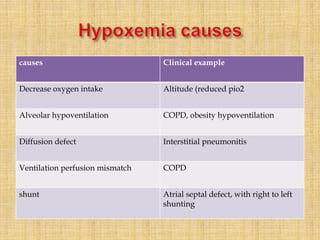
causes Clinical example
Decrease oxygen intake Altitude (reduced pio2
Alveolar hypoventilation COPD, obesity hypoventilation
Diffusion defect Interstitial pneumonitis
Ventilation perfusion mismatch COPD
shunt Atrial septal defect, with right to left
shunting
 Oxygen therapy is guided by
measure ( the arterial po2 and o2
saturation) that have no proven
relation ship with tissue
oxygenation
 Small , light weight , clip like device
 Measure arterial saturation in peripheral blood
 Pulse rate
 It mainly works on Beer’s law
 The law states the concentration of a chemical
is directly proportional to the absorbance of a
solution
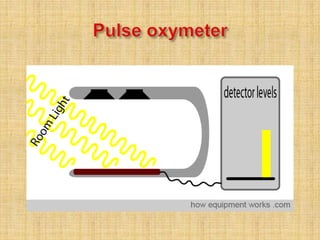
 When light is passed through a finger , ear lobe
or other tissue, the majority of it is absorbed by
connective tissue ,skin and venous blood
 The amount absorbed is constant
 With each heart beat ,pulsatile flow of arterial
blood occurs
 Allowing the pulse oximeter to detect changes
in light absorbance at two wave lengths , 660
nm (red) and 940 (infrared)
 Several limitation
 Any substance in blood with similar absorption
at these two wave lengths
 Like carboxyheamoglobinemia and
methemoglobinemia
 It cannot be used in low flow such as cardiac
arrest and profound shock
 SEVER TRICUSPID REGURGITATION
 <70% ACCURACY DECLINES
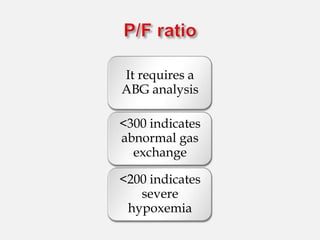
It requires a
ABG analysis
<300 indicates
abnormal gas
exchange
<200 indicates
severe
hypoxemia
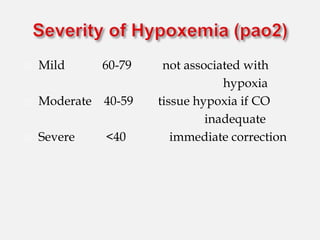
 Mild 60-79 not associated with
hypoxia
 Moderate 40-59 tissue hypoxia if CO
inadequate
 Severe <40 immediate correction
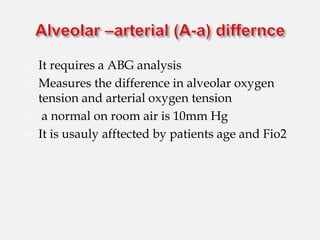
 It requires a ABG analysis
 Measures the difference in alveolar oxygen
tension and arterial oxygen tension
 a normal on room air is 10mm Hg
 It is usauly afftected by patients age and Fio2
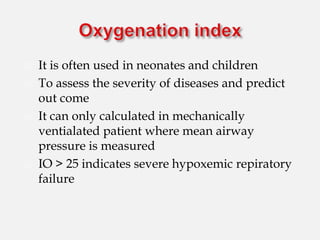
 It is often used in neonates and children
 To assess the severity of diseases and predict
out come
 It can only calculated in mechanically
ventialated patient where mean airway
pressure is measured
 IO > 25 indicates severe hypoxemic repiratory
failure
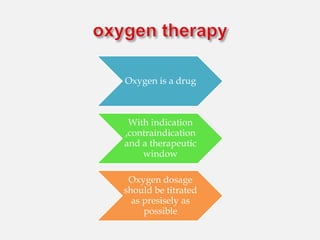
Oxygen is a drug
With indication
,contraindication
and a therapeutic
window
Oxygen dosage
should be titrated
as presisely as
possible
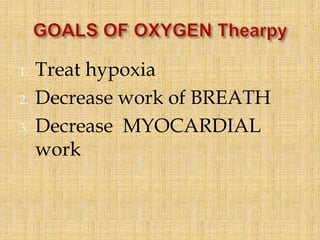
1. Treat hypoxia
2. Decrease work of BREATH
3. Decrease MYOCARDIAL
work
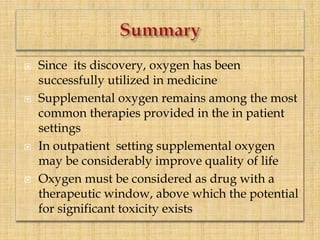
 Since its discovery, oxygen has been
successfully utilized in medicine
 Supplemental oxygen remains among the most
common therapies provided in the in patient
settings
 In outpatient setting supplemental oxygen
may be considerably improve quality of life
 Oxygen must be considered as drug with a
therapeutic window, above which the potential
for significant toxicity exists
OXYGEN DISSOCIATION CURVE.pptx

OXYGEN DISSOCIATION CURVE.pptx

  • 1.
    Dr.NARENDRA S TENGLI 1STYear JR DEPARTMENT OF PULMONARY MEDICINE
  • 2.
    Oxygen properties Oxygen cascade Oxygentransport Oxygen dissociation curve Bohr effect Oxygen delivery ,oxygen delivery devices Hypoxia and hypoxemia definition and causes Pulse oximeter and principal Oxygen therapy- indication
  • 3.
    It was firstprepared by Joshep priestly(1774) and called it as DEPHELOGISTICATED AIR
  • 4.
     Colourless, odourlessand tasteless gas  It is not very soluble in water  It is neutral in PH  Denser than air  Support burning, breathing, decaying and rusting  Combines easily with many metal and non metal
  • 5.
  • 7.
    The metabolism ofoxygen takes place at the end of electron transport chain in mitochondria Where the electrons that accumulate as a result of ATP production are cleared by chemical reduction of oxygen to water
  • 8.
    Oxygen is transportedfrom the air that we breath to the mitochondria O2 moves down pressure gradient The PaO2 in air ( at see level ) is about 157 mmHg falling to 7- 11 mmHg in the mitochondria
  • 9.
  • 10.
    The successive stepdown in PaO2 occur for physiological reason 1. In the upper airway humidification adds water vapour 2. In alveoli, O2 is taken up in exchange for CO2 3. In the circulation, from the small physiological shunt caused by  The bronchial circulation and Thebesian veins
  • 13.
    Oxygen is carried in2 forms in the blood Oxygen combined to haemoglobin (97%) Oxygen dissolved in blood (3%)
  • 14.
    1. Oxygen combinedto haemoglobin (97%) Once the HB is saturated, oxygen content can only be marginally increased by dissolved oxygen 2. Oxygen dissolved in blood -This accounts for a minimal amount (0.3ml per dl) The amount dissolved obeys Henry’s law
  • 15.
     Dynamic reaction,reversible  Haemoglobin is a protein  It contains ferrous iron atom  Reaction is oxygenation  8 atom or 4 molecule of oxygen  T configuration and R configuration(500)
  • 16.
    The main factordriving O2 to bind to Hb is;  - its partial pressure But the relationship between PO2 and Hb-O2 binding is not proportional
  • 20.
    The globin unitsof deoxyHb are tightly held by electrostatic bonds in a conformation with a relatively low affinity for oxygen The binding of oxygen to a heme molecule breaks some of these bonds between the globin units , leading to conformational change such that remaining oxygen binding sites are more exposed
  • 21.
    Sigmoid shaped curverelating the fact that binding of oxygen to the haemoglobin molecule is co-operative process It describes the relationship of saturation of haemoglobin with oxygen at varying partial pressures P50 – point at which Hb is 50% saturated It’s a reference point that describes the position of curve and changes as the curve moves under diffrent condition
  • 23.
    Left shift ofODC This represents an increase in the affinity of HB for oxygen in pulmonary capillaries - But requires lower tissue capillary PO2 to achieve adequate oxygen delivery - In a left shifted situation the Hb is less likely to release oxygen to tissue
  • 24.
    Left shift ofODC 1. Alkalosis 2. Decreased PCo2 3. Decreased concentration of 2,3 –DPG 4. Decreased temperature 5. Presence of HbF
  • 25.
    Right shift ofthe ODC  This represents an dreases in the affinity of Hb for oxygen  In this situation P50 is increased , requiring high pulmonary capillary saturation to saturate HB  If a right shift occurs the Hb molecule is more likely to offload oxygen to the tissues
  • 26.
    Right shift ofODC 1. Acidosis 2. Increased PCO2 3. Increased concentration of 2,3- DPG 4. Increased temperature 5. High altitude
  • 29.
    This effect namedafter his name Haemoglobin oxygen binding affinity is inversely related both to acidity and to the concentration of carbon dioxide Christian Bohr
  • 32.
    1. Increase theefficiency of oxygen transportation 2. Bhor effect facilitates O2 release in tissues particularly those tissues in most need of oxygen 3. The Bohr effect enables the body to adapt to changing condition and makes it possible to supply extra oxygen to the tissue that needs most
  • 34.
    TISSUE OXYGENATION :-It definedas the volume of oxygen delivered to systemic vascular bed per minute (end organ) It depends on respiratory and cardiovascular system
  • 35.
  • 37.
    oxygen content ofarterial blood •Cao2(ml o2/dl)=(1.34 x haemoglobin concentration x Sao2) + (0.0031 x Pao2) Is calculated by
  • 38.
  • 40.
    Components 1. Oxygen source 2.Pressure regulator and flow meter 3. Oxygen delivery device 4. Patient
  • 41.
    Central oxygen supplysystem Oxygen concentrator Oxygen Cylinder  Operate at 1800-2400 psi  Cannot bae directly delivered to patient Need down regulating valve flow meter to manipulate the flow rate
  • 43.
    M250 CYLINDER This ismegha oxygen cylinder Black body white shoulder Around 50 kg Stores around 7060 litres of oxygen at 2200 psi Height 52 inch
  • 44.
    MM-60 CYLINDER This oxygencylinder weight around 10 kg Height 23 inch Its stores around 1738 litres of oxygen at 2200psi
  • 46.
    Low flow deliverysystem 15l/min High flow delivery system >15l/min
  • 47.
    Variable performance oxygendevices •Patient dependent Fixed performance oxygen device • Patient independent
  • 50.
    Low-flow and VariablePerformance Oxygen Device 1. The maximum flow in these system is 15/min 2. These devices dilute/concentrate the administered Fio2- so they are called variable performance device
  • 51.
     Nasal cannulaecomprise a single lumen catheter, which is lodged into the anterior naris by a foam of collar
  • 52.
    The continuous flowcreates a reservoir of oxygen in nasopharynx from which the patient draws during inspiration The Fio2 achieved is proportional to 1. The flow rate of oxygen 2. The patient tidal volume, inspiratory flow and respiratory rate 3. The volume of nasopharynx
  • 53.
    Mouth breathing patient Mouthbreathing causes inspiratory air flow .this produces a venturi effect in the posterior pharynx entraining oxygen from the nose
  • 54.
    WHAT IS VENTURIEFFECT It is reduction in Fluid pressure that results when a fluid flows through a constricted section
  • 56.
    ADVANTAGE DISADVANTAGE TOLERABLE (SATISFACTION +COMPLIANCE) Flow limitation CAN USE MOUTH (eat , speak ,treat) We can give nebulization They are not appropriate in patient with blocked nasal passages Avoid high fio2 in COPD The cannula and the dry gas flow cause trauma and irritation
  • 58.
    Components The plastic bodyof the mask with side holes on both sides. A port connected to an oxygen supply Elastic band to fix the mask to patient’s face
  • 59.
     Ambient airis entrained through the holes on both sides of mask. The holes also allow exhaled gases to be vented out  During expiratory pause the fresh oxygen supplied helps in venting the exhaled gases through the side holes  The body of the mask (acting as a reservoir) is filled with fresh oxygen supply and is available for start of the next inspiration
  • 60.
    a) The finalconcentration of inspired oxygen depends on b) The oxygen supply flow rate c) The pattern of ventilation d) The patient inspiratory flow rate e) How tight the mask fit is on the face f) Expiratory pause
  • 61.
    a) Mask reservoirbag system b) A) partial rebreathing c) B) non breathing d) These are simple mask with attachesd reservoir of 600 to 800 ml, resting below the patient chin
  • 63.
     High flowoxygen devices deliver a constant fio2  This is done by very high flow of pure oxygen which exceed the patients minute ventilation  Some devices even incorporate oxygen reservoirs whose volumes exceed the patients anatomical dead space
  • 64.
     Components 1. Theplastic body of the mask with holes on both sides 2. The proximal end of the mask consist of a venture device 3. The venture devices are colour coded and marked with recommended oxygen flow rate
  • 65.
     The maskuses the Bernoulli principle  The size of constriction determines the final concentration of oxygen  The gas flow is higher than the peak inspiratory flow rate
  • 66.
     As theflow of oxygen passes through the constriction a negative pressure is created  This causes the ambient air to to be entrained and mixed with oxygen flow
  • 68.
    These devices areideal for patients with chronic lung disease who require a specific Fio2 due risk of hypercapnia from hyperoxia These masks are recommended by the british thoracic society for COPD patients in emergency
  • 69.
    The newest techniqueof o2 delivery is high flow nasal o2 using heated and humidified gas Flow rates of 40-60 L/min can be delivered through wide nasal prongs without discomfort and mucosal injury Studies have shown that ,that in patient who require a high fio2 using mask devices , switching to humidified , high flow nasal o2 was associated with a significant improvement
  • 71.
    a) It isa condition in which the body or region of the body is deprived of adequate oxygen supply at tissue level b) Hypoxia is different from hypoxemia
  • 72.
    a) It isa an abnormally low level oxygen in blood more specifically it is an oxygen deficiency in arterial blood Po2<60 or arterial oxygen saturation <90%
  • 73.
    causes Clinical example Decreaseoxygen intake Altitude (reduced pio2 Alveolar hypoventilation COPD, obesity hypoventilation Diffusion defect Interstitial pneumonitis Ventilation perfusion mismatch COPD shunt Atrial septal defect, with right to left shunting
  • 74.
     Oxygen therapyis guided by measure ( the arterial po2 and o2 saturation) that have no proven relation ship with tissue oxygenation
  • 75.
     Small ,light weight , clip like device  Measure arterial saturation in peripheral blood  Pulse rate  It mainly works on Beer’s law  The law states the concentration of a chemical is directly proportional to the absorbance of a solution
  • 77.
     When lightis passed through a finger , ear lobe or other tissue, the majority of it is absorbed by connective tissue ,skin and venous blood  The amount absorbed is constant  With each heart beat ,pulsatile flow of arterial blood occurs  Allowing the pulse oximeter to detect changes in light absorbance at two wave lengths , 660 nm (red) and 940 (infrared)
  • 78.
     Several limitation Any substance in blood with similar absorption at these two wave lengths  Like carboxyheamoglobinemia and methemoglobinemia  It cannot be used in low flow such as cardiac arrest and profound shock  SEVER TRICUSPID REGURGITATION  <70% ACCURACY DECLINES
  • 79.
    It requires a ABGanalysis <300 indicates abnormal gas exchange <200 indicates severe hypoxemia
  • 80.
     Mild 60-79not associated with hypoxia  Moderate 40-59 tissue hypoxia if CO inadequate  Severe <40 immediate correction
  • 81.
     It requiresa ABG analysis  Measures the difference in alveolar oxygen tension and arterial oxygen tension  a normal on room air is 10mm Hg  It is usauly afftected by patients age and Fio2
  • 82.
     It isoften used in neonates and children  To assess the severity of diseases and predict out come  It can only calculated in mechanically ventialated patient where mean airway pressure is measured  IO > 25 indicates severe hypoxemic repiratory failure
  • 83.
    Oxygen is adrug With indication ,contraindication and a therapeutic window Oxygen dosage should be titrated as presisely as possible
  • 87.
    1. Treat hypoxia 2.Decrease work of BREATH 3. Decrease MYOCARDIAL work
  • 89.
     Since itsdiscovery, oxygen has been successfully utilized in medicine  Supplemental oxygen remains among the most common therapies provided in the in patient settings  In outpatient setting supplemental oxygen may be considerably improve quality of life  Oxygen must be considered as drug with a therapeutic window, above which the potential for significant toxicity exists