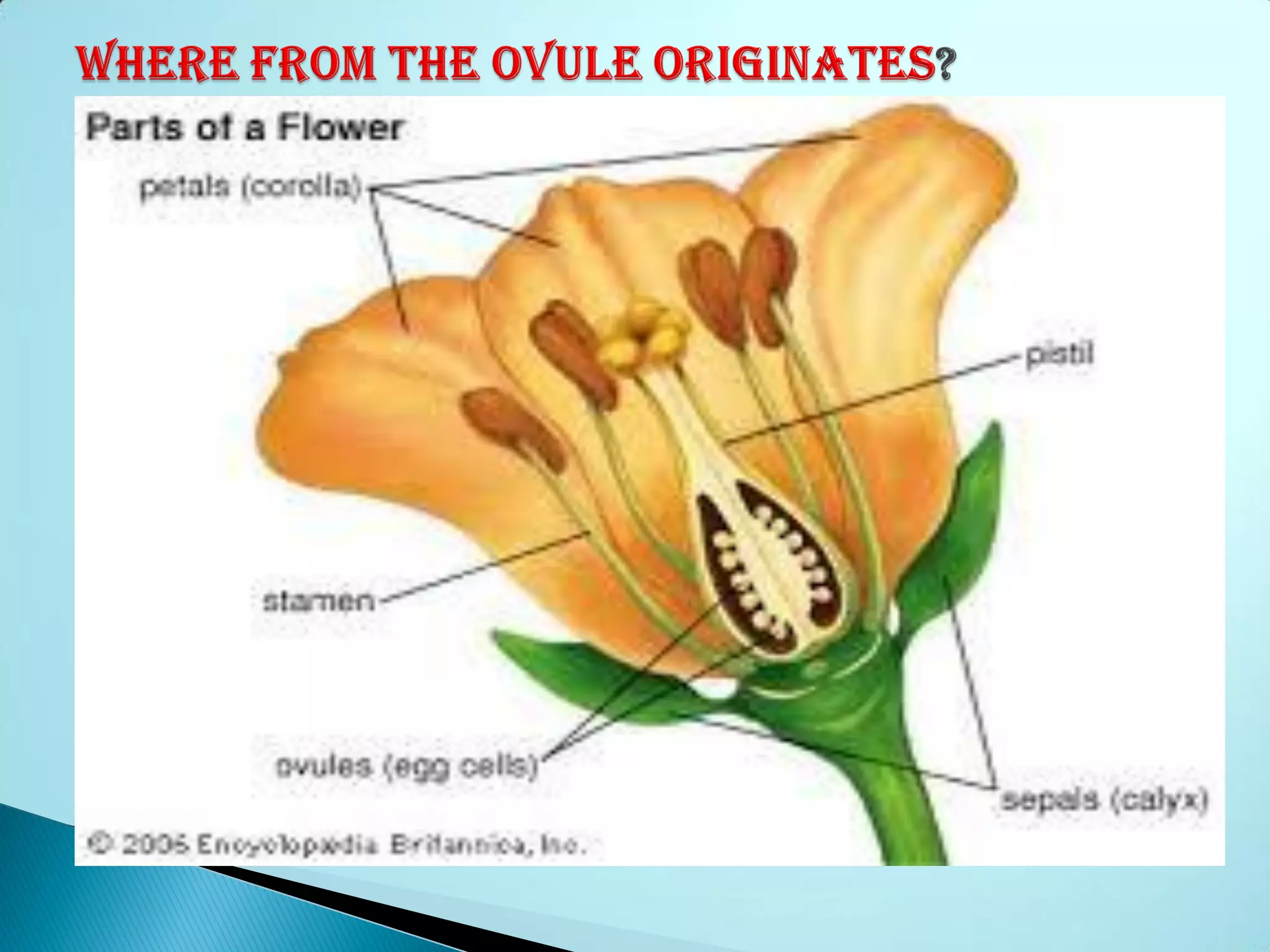
The embryology of angiosperms focuses on ovules, which are critical in seed development and can be traced back 400 million years. Ovules vary in structure and classification, including types such as orthotropous, anatropous, and others, based on their position and the presence of integuments. The document highlights key components of ovules like the funicle, hilum, integuments, micropyle, and nucellus, as well as the developmental processes that occur within.
Ovule, thedevelopmental precursor of seeds is the organ of
prime importance in angiosperm flowers and it can be traced
back in evolution almost 400 million years ago to the earliest
seed plants as far as phylogeny is concerned. Having diverse
position in ovary, nucellus thickness, number & thickness of
integuments, degree and direction of curvature and
histological differentiations have drawn the importance of
plant biologists.
The ovule develops as multicellular placental outgrowth
including the epidermal & number of hypodermal cells. With
further development, this gives to the nucellus and one or two
integuments from its basal region.
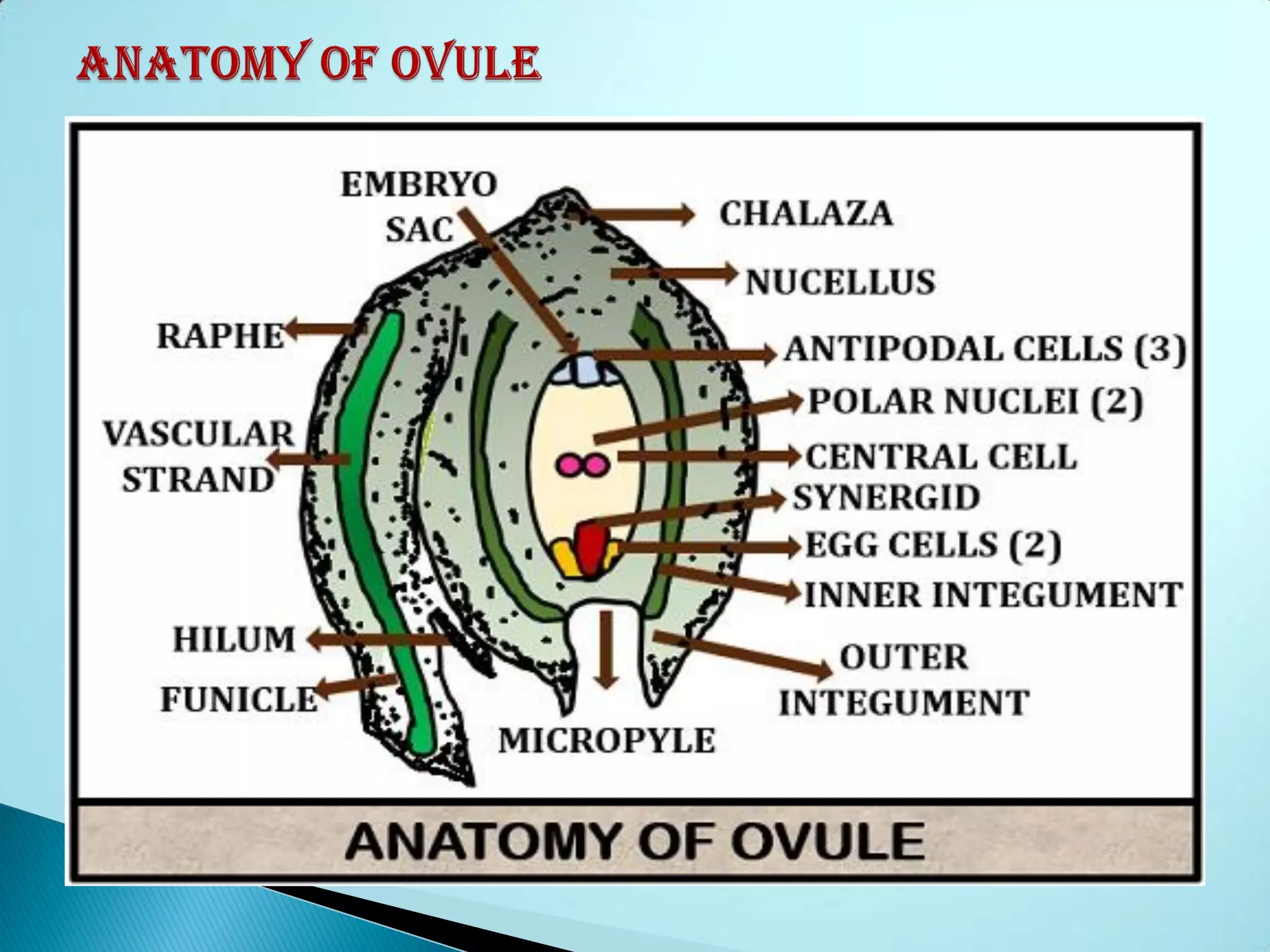
Angiosperm ovules basically consists of a nucellus and two
integuments and sessile on the placenta or attached by its stalk
4.
Most commonlya vascular strands extends from the placenta
through the funiculus to the chalaza, i.e. the area below the
base of the nucellus where the integuments depart. The
funiculus and the chalaza are intercalary structure and thus
well demarcated than the nucellus and integuments. The
nucellus represents the mega sporangium, in which the
meiocytes undergoes meiosis forming four megaspores,
typically only one of which develops into embryo sac
representing the megagametophyte.The embryo sac contains
basically four or eight nuclei, organized into four or seven
cells, depending on whether two or three round mitotic
divisions in the developing embryo(Maheswari,
1950;Friedman, 2006).
6.
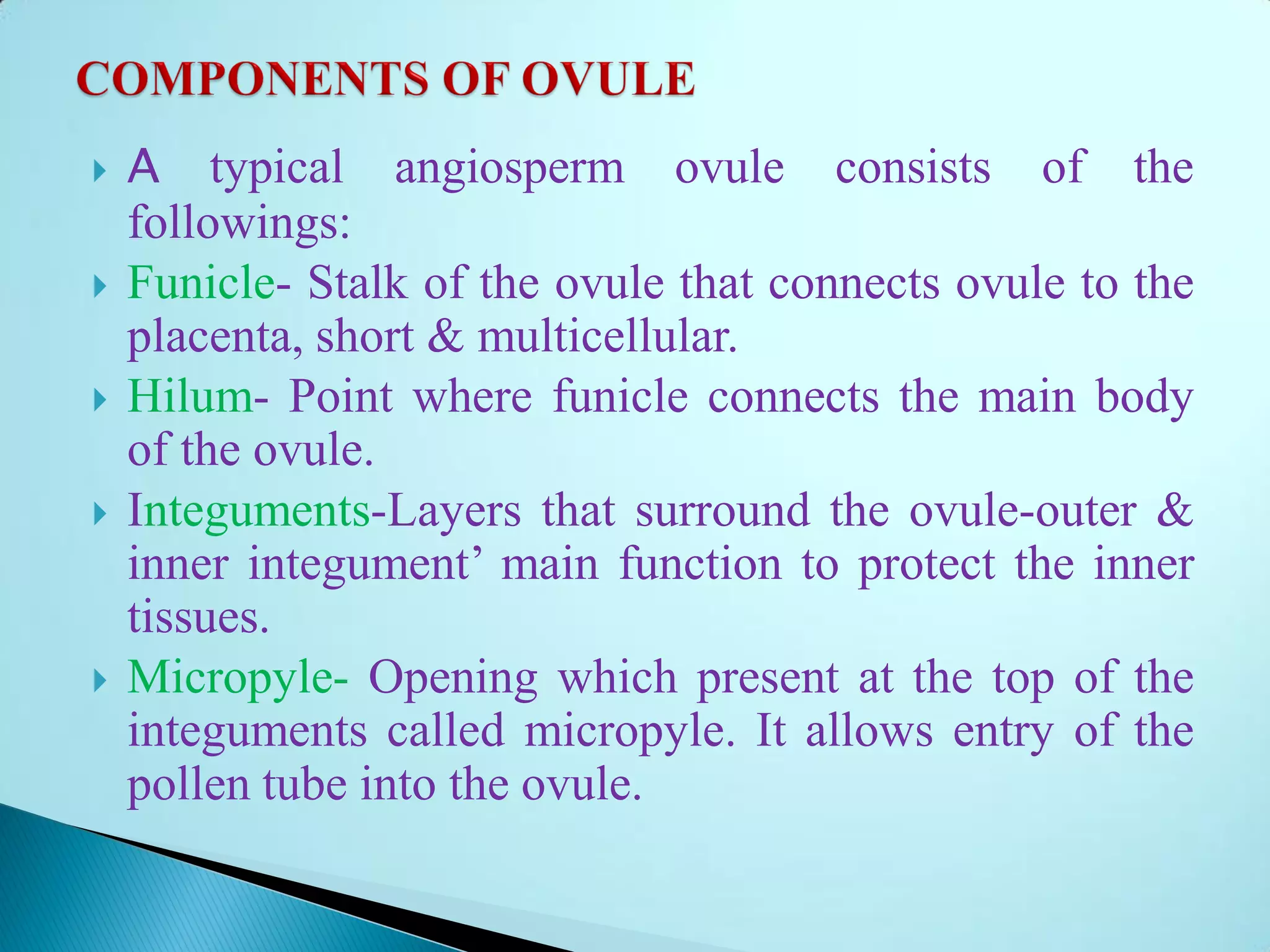
A typicalangiosperm ovule consists of the
followings:
Funicle- Stalk of the ovule that connects ovule to the
placenta, short & multicellular.
Hilum- Point where funicle connects the main body
of the ovule.
Integuments-Layers that surround the ovule-outer &
inner integument’ main function to protect the inner
tissues.
Micropyle- Opening which present at the top of the
integuments called micropyle. It allows entry of the
pollen tube into the ovule.
8.
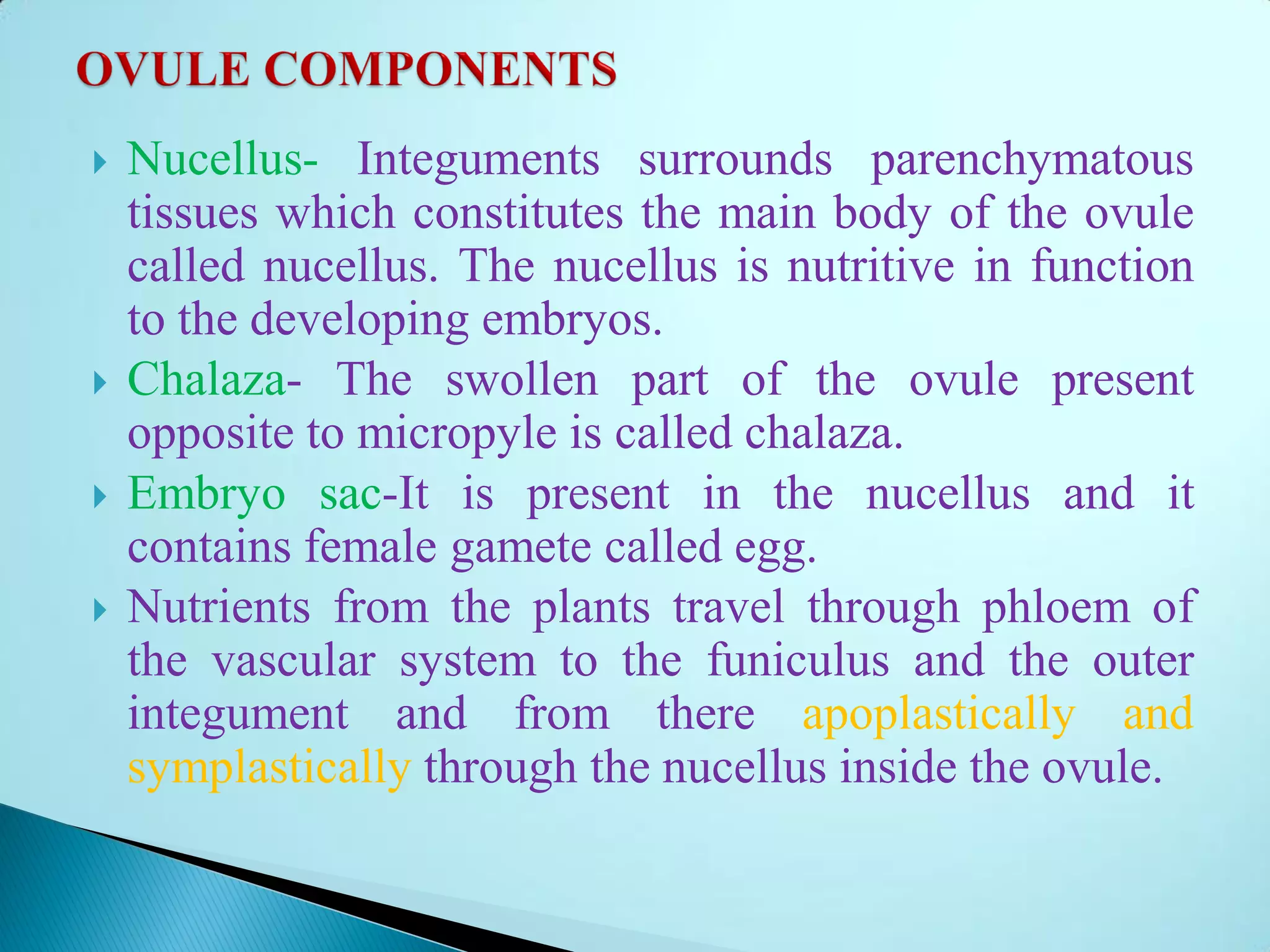
Nucellus- Integumentssurrounds parenchymatous
tissues which constitutes the main body of the ovule
called nucellus. The nucellus is nutritive in function
to the developing embryos.
Chalaza- The swollen part of the ovule present
opposite to micropyle is called chalaza.
Embryo sac-It is present in the nucellus and it
contains female gamete called egg.
Nutrients from the plants travel through phloem of
the vascular system to the funiculus and the outer
integument and from there apoplastically and
symplastically through the nucellus inside the ovule.
9.
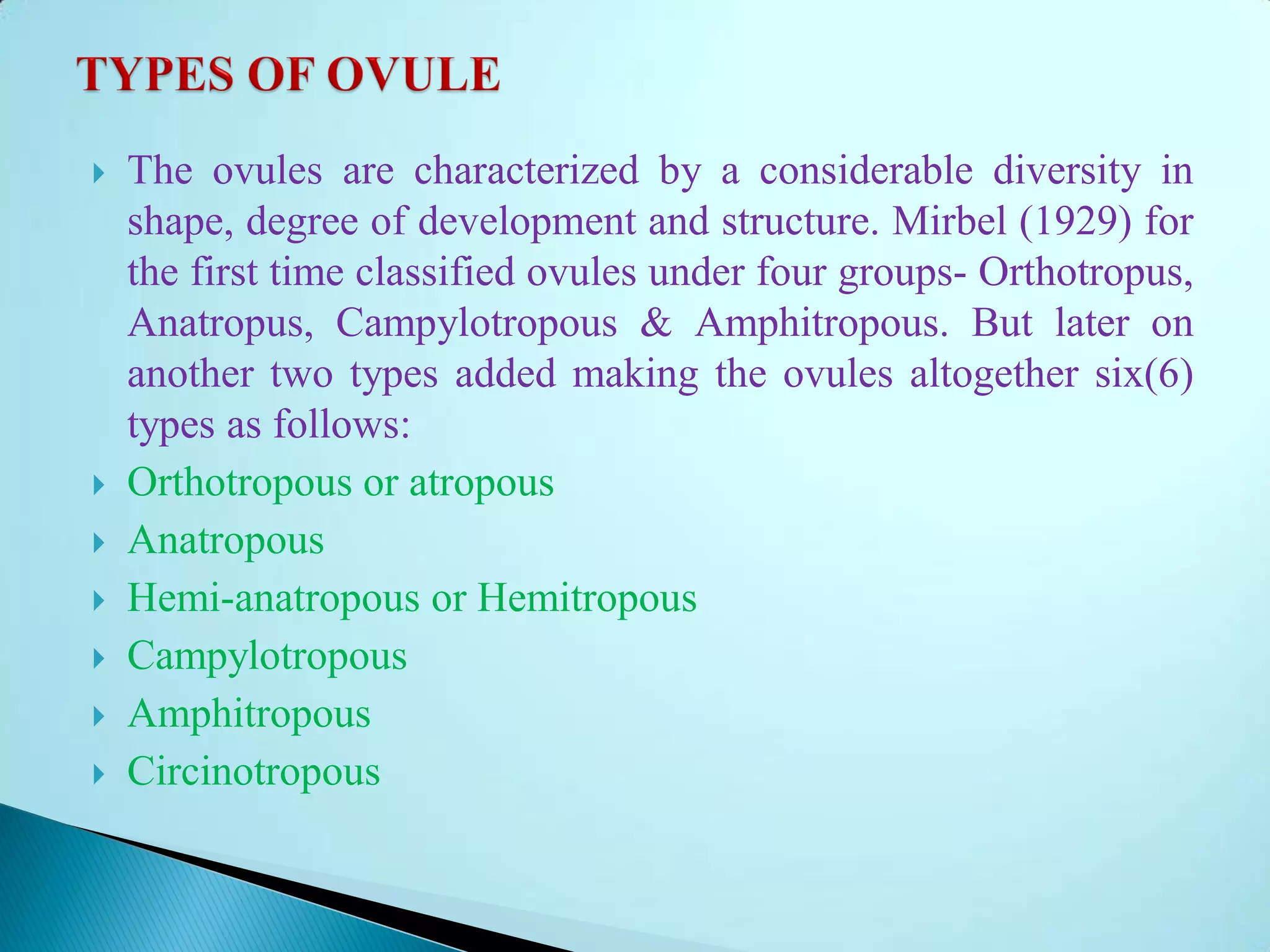
The ovulesare characterized by a considerable diversity in
shape, degree of development and structure. Mirbel (1929) for
the first time classified ovules under four groups- Orthotropus,
Anatropus, Campylotropous & Amphitropous. But later on
another two types added making the ovules altogether six(6)
types as follows:
Orthotropous or atropous
Anatropous
Hemi-anatropous or Hemitropous
Campylotropous
Amphitropous
Circinotropous
11.
As statedearlier, Ovules may have diversity,. When
only one integument present called unitegmic, if the
ovule contains two integuments called bitegmic and
very rarely three integuments called tritegmic is
present in plants like Asphodelus.In some plants like
Santalum, no integument called ategmic is also found
to occur.
On the basis of the position of micropyle, with
respect to funiculus, Ovules are classified under six
broad categories as stated earlier. The details are
given below.
12.
Orthotropous Ovule:It is atropous or straight where the
micropyle, Chalaza & funiculus , all are in the same line. E.g.
Cycas, members of Polygonaceae and Piperaceae.
Anatropous Ovule: In 80% genera, this is very common
type.In this ovule, the funicle is long , whole body is inverted
through 180⁰ , As a result, micropyle comes close to the
funicle. Most common almost monocots and dicots like the
members of Asteraceae , Solanaceae etc.
Hemianatropous or Hemitropous Ovule: The body of the
ovule is inverted through 90⁰. As a result the funicle comes to
lie at right angle to the nucellus.Micropyle and the chalaza lie
in the same plane. Members of primitive family
Rananunculaceae like Ranunculus etc.
13.
Campylotropous Ovule:When the body of the ovule is not
inverted but it appears like horse shoe. The micropyle and the
chalaza do not lie on the same plane , however the nucellus or
embryo sac remain straight. Members of the family like
Capparidaceae, Brassicaceae, Caryophyllaceae and Fabaceae.
Amphitropous Ovule: It is almost similar to Campylotropous
but the nucellus or embryo sac is bent like horse shoe.
Members of Alismataceae.
Circinotropous Ovule; It is very rare in occurrence. Here, the
body of the ovule is bent through 360⁰, so that it takes a
complete turn. Micropyle, Chalaza and the nucellus are on the
same plane.
15.
Encyclopedia Britannica
An introduction to the Embryology of
angiosperms by P. Maheswari
A text book of Botany by Hait, Bhattacharya,
Ghosh
Advanced Plant taxonomy by A.K.Mondal
Different websites from Google for images
and contents.