Overload & Rest
Lloyd Dean
Fundamentals of Training
Objectives
 By the end of the lesson you should be able to:
 List the 6 laws of training
 Describe the principles of overload
 State the importance of rest after exercise
Task
 You are a consultant for a junior strength and
conditioner at an elite sporting club
 Inform them on the need for individuality and
specificity in their training programmes
 Give examples of good and bad practice for this
6 Laws of Training
1. Law of individual difference (Individuality)
2. The accommodation principle (Tedium)
3. The progressive overload principle (Overload)
4. The G.A.S (General Adaptation Syndrome)
principle (Rest)
5. The use/disuse principle (Reversibility)
6. The law of dynamic correspondence
(Specificity)
(Seyle, 1946; Siff 2003; Zatsiorsky & Kraemer,
2006)
The progressive overload principle
(Overload)
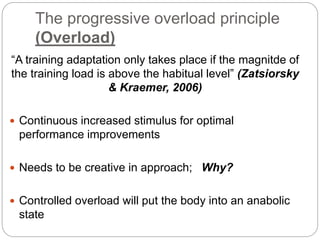
“A training adaptation only takes place if the magnitde of
the training load is above the habitual level” (Zatsiorsky
& Kraemer, 2006)
 Continuous increased stimulus for optimal
performance improvements
 Needs to be creative in approach; Why?
 Controlled overload will put the body into an anabolic
state
The progressive overload principle
(Overload)
 F – How often training last for. Can be measured by
how many repetitions and sets are completed. This is
know as volume load
 I – 1RM, HR, Reps, Set, Rest, RPE all impact
intensity
 T – Duration of exercise, recovery during sets and
exercise sessions
 T – Choice of simple or complex exercises can effect
this. E.g Back Squats are complex and place the
The progressive overload principle
(Overload)
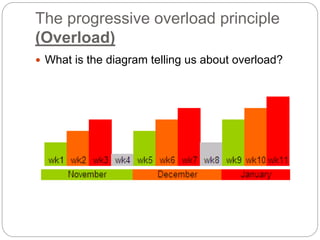
 What is the diagram telling us about overload?
The G.A.S (General Adaptation
Syndrome) principle (Rest)
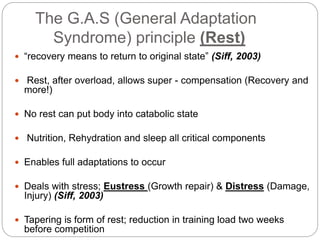
 “recovery means to return to original state” (Siff, 2003)
 Rest, after overload, allows super - compensation (Recovery and
more!)
 No rest can put body into catabolic state
 Nutrition, Rehydration and sleep all critical components
 Enables full adaptations to occur
 Deals with stress; Eustress (Growth repair) & Distress (Damage,
Injury) (Siff, 2003)
 Tapering is form of rest; reduction in training load two weeks
before competition
The G.A.S (General Adaptation
Syndrome) principle (Rest)
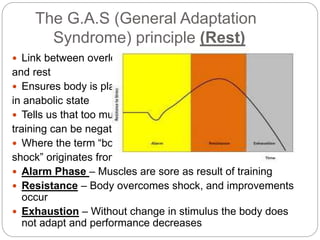
 Link between overload
and rest
 Ensures body is placed
in anabolic state
 Tells us that too much
training can be negative
 Where the term “body
shock” originates from
 Alarm Phase – Muscles are sore as result of training
 Resistance – Body overcomes shock, and improvements
occur
 Exhaustion – Without change in stimulus the body does
not adapt and performance decreases
Objectives
 You should now be able to:
 List the 6 laws of training
 Describe the principles of overload
 State the importance of rest after exercise

Overload and rest

  • 1.
    Overload & Rest LloydDean Fundamentals of Training
  • 2.
    Objectives  By theend of the lesson you should be able to:  List the 6 laws of training  Describe the principles of overload  State the importance of rest after exercise
  • 3.
    Task  You area consultant for a junior strength and conditioner at an elite sporting club  Inform them on the need for individuality and specificity in their training programmes  Give examples of good and bad practice for this
  • 4.
    6 Laws ofTraining 1. Law of individual difference (Individuality) 2. The accommodation principle (Tedium) 3. The progressive overload principle (Overload) 4. The G.A.S (General Adaptation Syndrome) principle (Rest) 5. The use/disuse principle (Reversibility) 6. The law of dynamic correspondence (Specificity) (Seyle, 1946; Siff 2003; Zatsiorsky & Kraemer, 2006)
  • 5.
    The progressive overloadprinciple (Overload) “A training adaptation only takes place if the magnitde of the training load is above the habitual level” (Zatsiorsky & Kraemer, 2006)  Continuous increased stimulus for optimal performance improvements  Needs to be creative in approach; Why?  Controlled overload will put the body into an anabolic state
  • 6.
    The progressive overloadprinciple (Overload)  F – How often training last for. Can be measured by how many repetitions and sets are completed. This is know as volume load  I – 1RM, HR, Reps, Set, Rest, RPE all impact intensity  T – Duration of exercise, recovery during sets and exercise sessions  T – Choice of simple or complex exercises can effect this. E.g Back Squats are complex and place the
  • 7.
    The progressive overloadprinciple (Overload)  What is the diagram telling us about overload?
  • 8.
    The G.A.S (GeneralAdaptation Syndrome) principle (Rest)  “recovery means to return to original state” (Siff, 2003)  Rest, after overload, allows super - compensation (Recovery and more!)  No rest can put body into catabolic state  Nutrition, Rehydration and sleep all critical components  Enables full adaptations to occur  Deals with stress; Eustress (Growth repair) & Distress (Damage, Injury) (Siff, 2003)  Tapering is form of rest; reduction in training load two weeks before competition
  • 9.
    The G.A.S (GeneralAdaptation Syndrome) principle (Rest)  Link between overload and rest  Ensures body is placed in anabolic state  Tells us that too much training can be negative  Where the term “body shock” originates from  Alarm Phase – Muscles are sore as result of training  Resistance – Body overcomes shock, and improvements occur  Exhaustion – Without change in stimulus the body does not adapt and performance decreases
  • 10.
    Objectives  You shouldnow be able to:  List the 6 laws of training  Describe the principles of overload  State the importance of rest after exercise