Heart Rate
Training Zones
 The most important muscle in your
body
 It is the pump that delivers oxygen
rich blood throughout your body
 The heart is made up of cardiac
muscle and can become stronger
with use and good health practices
 To improve and maintain the
strength of your heart it is
important to participate in regular
aerobic exercise
Introducing…The HEART
The number of times your heart beats
per minute (BPM)
Also known as PULSE
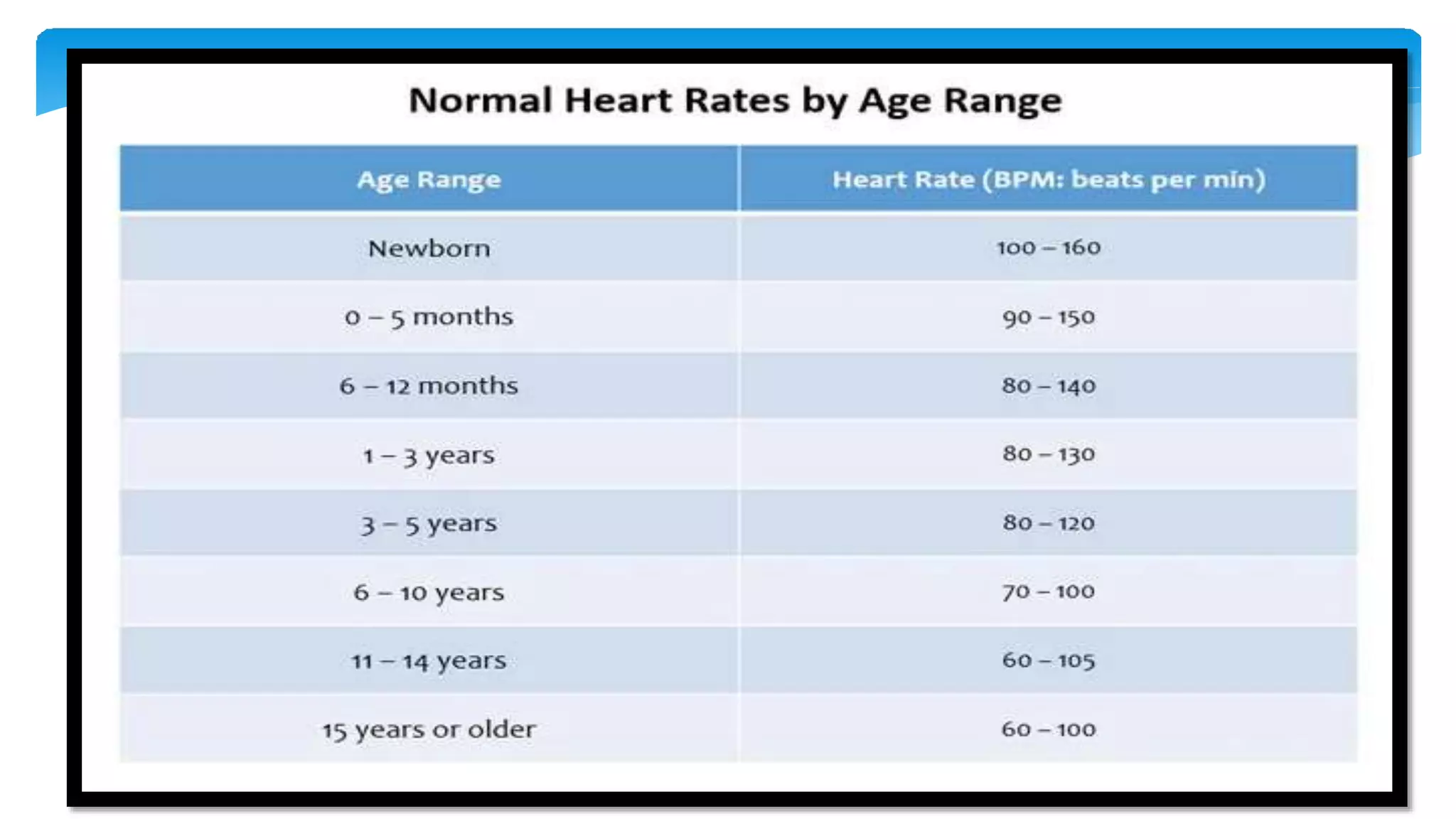
Normal HR varies from person to
person, knowing yours can be an
important health gauge.
What is Heart Rate?
Locate your pulse
Count the number of beats in 1 minute
(60 seconds)
ACTIVITY : COUNTING MY
HEART RATE
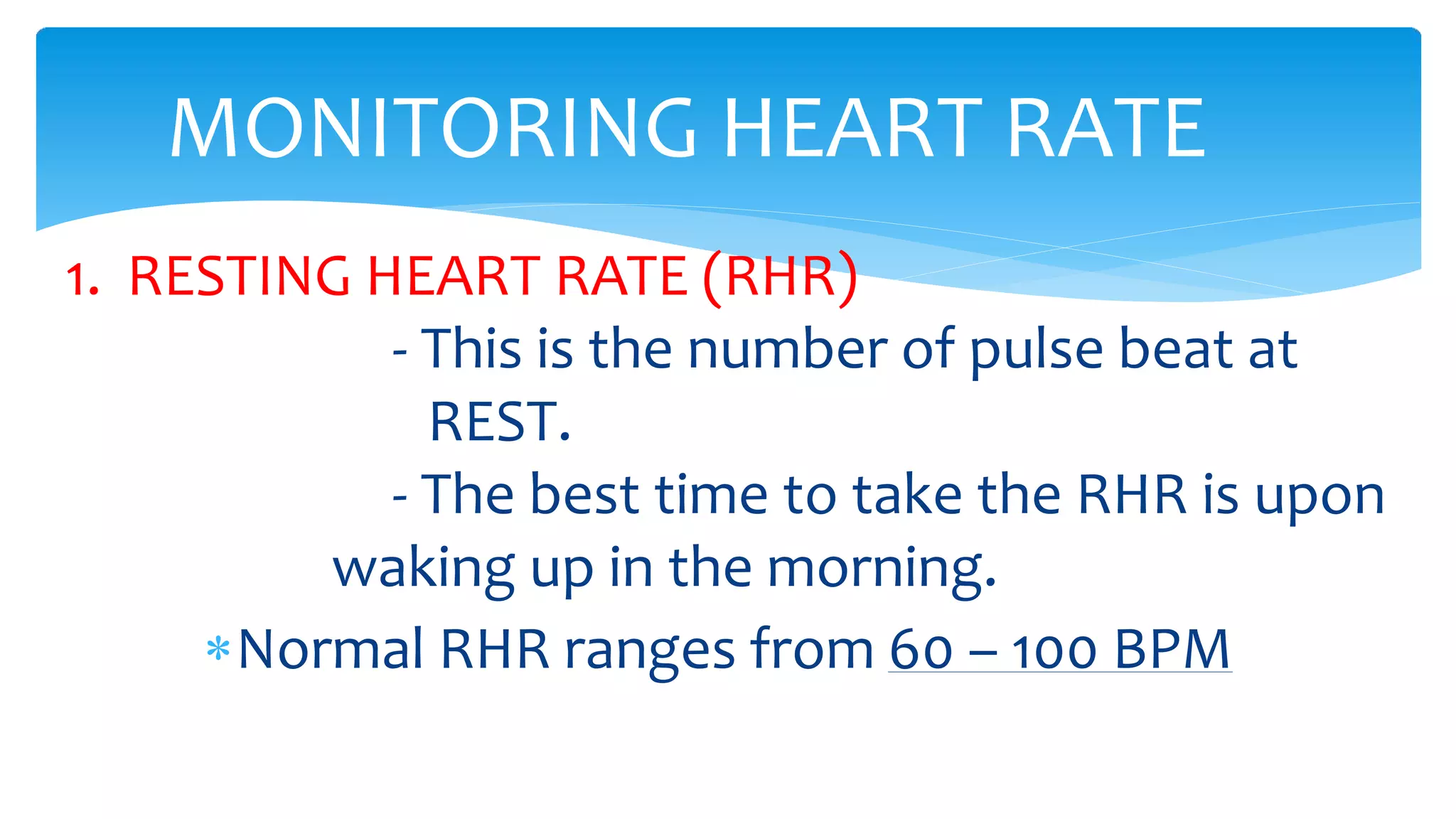
1. RESTING HEART RATE (RHR)
- This is the number of pulse beat at
REST.
- The best time to take the RHR is upon
waking up in the morning.
Normal RHR ranges from 60 – 100 BPM
MONITORING HEART RATE
2. MAXIMUM HEART RATE (MHR)
- age related number of BPM of the
heart when working at maximum
- refers to the fastest rate at which
your heart will beat in one minute.
MONITORING HEART RATE
1. MAXIMUM HEART RATE (MHR)
- MHR can vary from person to person and
they are not an indicator of physical fitness. In
other words, it doesn’t rise as you get stronger
or faster, and it doesn’t mean that someone
with higher MHR is in better shape than you.
MONITORING HEART RATE
1. MAXIMUM HEART RATE (MHR)
- However, knowing your max HR can
help you track your fitness progress and
determine your target heart rate. That can
give you a more exact method of
determining your exercise intensity.
MONITORING HEART RATE
1. AGE : Your MHR can decline as you age
2. ALTITUDE : Altitude can lower your MHR.
3. FITNESS: MHR has nothing to do with how
physical fit you are.
4. GENES: Your MHR is influenced by your genes.
5. INDIVIDUAL DIFFERENCES: MHR can vary
significantly even among people of the same age
and sex.
FACTORS THAT AFFECT MHR
6. SIZE : MHR is usually higher in smaller people,
which is why women often have a higher MHR than
men.
7. WORKING OUT : Training doesn’t really change
your MHR, but if there is any change, it may get
lower as your body experiences expanded blood and
heart volumes.
FACTORS THAT AFFECT MHR
 Subtract your age from 220. The result is an age-
predicted maximum beats per minute.
FORMULA:
MHR = 220 - Age
HOW TO CALCULATE YOUR
MAXIMUM HEART RATE?
EXAMPLE:
MHR = 220 - 20
= 200 BPM
3. HEART- RATE RESERVE
- The heart rate reserve (HRR) is the
difference between a person's resting heart
rate and maximum heart rate.
- It is the range of heart rate values that
you can see for an individual, between the
lowest they have at rest and the highest they
can achieve through exertion.
MONITORING HEART RATE
 Subtract your heart’s resting rate from your
maximum heart rate.
FORMULA:
HRR = MHR − RHR
HOW TO CALCULATE YOUR
HEART RATE RESERVE?
EXAMPLE:
40 years old
MHR = 220 – 40
= 180 BPM
RHR = 80 BPM
HOW TO CALCULATE YOUR
HEART RATE RESERVE?
SOLUTION:
HRR = MHR – RHR
= 180 – 80
HRR = 100 BPM
4. AEROBIC TRAINING HEART- RATE for FAT
BURNING
Aerobic exercise is any type of cardiovascular
conditioning. It can include activities like brisk walking,
swimming, running, or cycling. You probably know it as
“cardio.”
By definition, aerobic exercise means “with oxygen.”
Your breathing and heart rate will increase during
aerobic activities.
MONITORING HEART RATE
AEROBIC TRAINING HEART- RATE for FAT
BURNING
Anaerobic exercises - involve quick
bursts of energy such as weightlifting or
sprinting. They’re performed at maximum
effort for a short time. This is unlike aerobic
exercises. You perform aerobic exercises for
a sustained period of time.
MONITORING HEART RATE
AEROBIC TRAINING HEART- RATE for FAT
BURNING
Anaerobic exercises – performed at a
maximum effort for a short time.
Aerobic exercises – performed
exercises for a sustained period of time.
MONITORING HEART RATE
AEROBIC TRAINING HEART- RATE for FAT
BURNING
This fat-burning range will lie between 50 and
75 percent of your heart-rate reserve.
MONITORING HEART RATE
Example:
HRR = 100 BPM
RHR = 80 BPM
HOW TO CALCULATE YOUR AEROBIC TRAINING
HEART- RATE RANGE FOR FAT BURNING?
Using the example, 50 percent of 100
beats per minute is 50. and 75 percent
of 100 is 75.
Next, add your RESTING HEART RATE
(RHR) to both numbers:
50 + 80 = 130 bpm
75 +80 = 155 bpm
Therefore, during aerobic training, the heart rate that will most efficiently
burn fat is 130 to 155 beats per minute.
Example:
HRR = 135 BPM
RHR = 91 BPM
HOW TO CALCULATE YOUR AEROBIC TRAINING
HEART- RATE RANGE FOR FAT BURNING?
Solution:
= HRR x .50
= 135 x .50
= 67.5
= HRR x .75
= 135 x .75
= 101.75
= 67.5 + RHR
= 67.5 + 91
= 158.5 bpm
= 101.75 + RHR
= 101.75 + 91
= 192.75 bpm
Therefore, during
aerobic training, the
heart rate that will
most efficiently burn
fat is 158.5 to 192.75
beats per minute.
MHR = 220 – Age
REMEMBER THESE FORMULAS:
RHR = count number of
bpm at REST
HRR = MHR - RHR
ATHR (50%) = HRR x .50 + RHR
ATHR (75%) = HRR x .75 + RHR
LET’S TRY SOLVING!
GIVEN:
AGE : 36
RHR : 88
CALCULATE THE MHR, HRR, and AEROBIC
TRAINING HEART RATE RANGE FOR FAT
BURNING:
Solution:
MHR= 220-36
= 184 BPM
ATHR(50%) = HRR x .50 + RHR
= 96 x .50 + 88
= 136 BPM
Therefore, during
aerobic training, the
heart rate that will
most efficiently burn
fat is 136 to 160 beats
per minute.
HRR= MHR-RHR
= 184- 88
= 96 BPM
ATHR(75%) = HRR x .75 + RHR
= 96 x .75 + 88
= 160 BPM
Instruction : Open your google classroom and
accomplish activity 3.
Deadline : August 20, 2021
ACTIVITY 3 : MY TRAINING
HEART RATE

Training heart rate zones

  • 1.
  • 2.
     The mostimportant muscle in your body  It is the pump that delivers oxygen rich blood throughout your body  The heart is made up of cardiac muscle and can become stronger with use and good health practices  To improve and maintain the strength of your heart it is important to participate in regular aerobic exercise Introducing…The HEART
  • 3.
    The number oftimes your heart beats per minute (BPM) Also known as PULSE Normal HR varies from person to person, knowing yours can be an important health gauge. What is Heart Rate?
  • 5.
    Locate your pulse Countthe number of beats in 1 minute (60 seconds) ACTIVITY : COUNTING MY HEART RATE
  • 7.
    1. RESTING HEARTRATE (RHR) - This is the number of pulse beat at REST. - The best time to take the RHR is upon waking up in the morning. Normal RHR ranges from 60 – 100 BPM MONITORING HEART RATE
  • 8.
    2. MAXIMUM HEARTRATE (MHR) - age related number of BPM of the heart when working at maximum - refers to the fastest rate at which your heart will beat in one minute. MONITORING HEART RATE
  • 9.
    1. MAXIMUM HEARTRATE (MHR) - MHR can vary from person to person and they are not an indicator of physical fitness. In other words, it doesn’t rise as you get stronger or faster, and it doesn’t mean that someone with higher MHR is in better shape than you. MONITORING HEART RATE
  • 10.
    1. MAXIMUM HEARTRATE (MHR) - However, knowing your max HR can help you track your fitness progress and determine your target heart rate. That can give you a more exact method of determining your exercise intensity. MONITORING HEART RATE
  • 11.
    1. AGE :Your MHR can decline as you age 2. ALTITUDE : Altitude can lower your MHR. 3. FITNESS: MHR has nothing to do with how physical fit you are. 4. GENES: Your MHR is influenced by your genes. 5. INDIVIDUAL DIFFERENCES: MHR can vary significantly even among people of the same age and sex. FACTORS THAT AFFECT MHR
  • 12.
    6. SIZE :MHR is usually higher in smaller people, which is why women often have a higher MHR than men. 7. WORKING OUT : Training doesn’t really change your MHR, but if there is any change, it may get lower as your body experiences expanded blood and heart volumes. FACTORS THAT AFFECT MHR
  • 13.
     Subtract yourage from 220. The result is an age- predicted maximum beats per minute. FORMULA: MHR = 220 - Age HOW TO CALCULATE YOUR MAXIMUM HEART RATE? EXAMPLE: MHR = 220 - 20 = 200 BPM
  • 14.
    3. HEART- RATERESERVE - The heart rate reserve (HRR) is the difference between a person's resting heart rate and maximum heart rate. - It is the range of heart rate values that you can see for an individual, between the lowest they have at rest and the highest they can achieve through exertion. MONITORING HEART RATE
  • 15.
     Subtract yourheart’s resting rate from your maximum heart rate. FORMULA: HRR = MHR − RHR HOW TO CALCULATE YOUR HEART RATE RESERVE?
  • 16.
    EXAMPLE: 40 years old MHR= 220 – 40 = 180 BPM RHR = 80 BPM HOW TO CALCULATE YOUR HEART RATE RESERVE? SOLUTION: HRR = MHR – RHR = 180 – 80 HRR = 100 BPM
  • 17.
    4. AEROBIC TRAININGHEART- RATE for FAT BURNING Aerobic exercise is any type of cardiovascular conditioning. It can include activities like brisk walking, swimming, running, or cycling. You probably know it as “cardio.” By definition, aerobic exercise means “with oxygen.” Your breathing and heart rate will increase during aerobic activities. MONITORING HEART RATE
  • 18.
    AEROBIC TRAINING HEART-RATE for FAT BURNING Anaerobic exercises - involve quick bursts of energy such as weightlifting or sprinting. They’re performed at maximum effort for a short time. This is unlike aerobic exercises. You perform aerobic exercises for a sustained period of time. MONITORING HEART RATE
  • 19.
    AEROBIC TRAINING HEART-RATE for FAT BURNING Anaerobic exercises – performed at a maximum effort for a short time. Aerobic exercises – performed exercises for a sustained period of time. MONITORING HEART RATE
  • 20.
    AEROBIC TRAINING HEART-RATE for FAT BURNING This fat-burning range will lie between 50 and 75 percent of your heart-rate reserve. MONITORING HEART RATE
  • 21.
    Example: HRR = 100BPM RHR = 80 BPM HOW TO CALCULATE YOUR AEROBIC TRAINING HEART- RATE RANGE FOR FAT BURNING? Using the example, 50 percent of 100 beats per minute is 50. and 75 percent of 100 is 75. Next, add your RESTING HEART RATE (RHR) to both numbers: 50 + 80 = 130 bpm 75 +80 = 155 bpm Therefore, during aerobic training, the heart rate that will most efficiently burn fat is 130 to 155 beats per minute.
  • 22.
    Example: HRR = 135BPM RHR = 91 BPM HOW TO CALCULATE YOUR AEROBIC TRAINING HEART- RATE RANGE FOR FAT BURNING? Solution: = HRR x .50 = 135 x .50 = 67.5 = HRR x .75 = 135 x .75 = 101.75 = 67.5 + RHR = 67.5 + 91 = 158.5 bpm = 101.75 + RHR = 101.75 + 91 = 192.75 bpm Therefore, during aerobic training, the heart rate that will most efficiently burn fat is 158.5 to 192.75 beats per minute.
  • 23.
    MHR = 220– Age REMEMBER THESE FORMULAS: RHR = count number of bpm at REST HRR = MHR - RHR ATHR (50%) = HRR x .50 + RHR ATHR (75%) = HRR x .75 + RHR
  • 24.
  • 25.
    GIVEN: AGE : 36 RHR: 88 CALCULATE THE MHR, HRR, and AEROBIC TRAINING HEART RATE RANGE FOR FAT BURNING: Solution: MHR= 220-36 = 184 BPM ATHR(50%) = HRR x .50 + RHR = 96 x .50 + 88 = 136 BPM Therefore, during aerobic training, the heart rate that will most efficiently burn fat is 136 to 160 beats per minute. HRR= MHR-RHR = 184- 88 = 96 BPM ATHR(75%) = HRR x .75 + RHR = 96 x .75 + 88 = 160 BPM
  • 26.
    Instruction : Openyour google classroom and accomplish activity 3. Deadline : August 20, 2021 ACTIVITY 3 : MY TRAINING HEART RATE