INVESTIGATION  OF  INFERTILE COUPLE Evidence  Based  Medicine  In a climate of DR. JEHAD YOUSEF FICS , FRCOG ALHAYAT ART CENTRE  AMMN, JORDAN
   Very long list of tests, have been advocated to assist in determining the cause of the infertility in the diagnostic evaluation of infertile couple. The necessity and cost effectiveness of performing many of these tests and correcting the abnormalities found by them have not been demonstrated.
Investigations of Male Factor Conventional semen analysis Computer- assisted sperm analysis  ( CASA ) Strict sperm morphology  "Tygerberg strict  criteria“ A variety of sperm function tests - The acrosome reaction test  - Hypo-osmotic swelling test - Measurement of generation of Reactive oxygen species - Sperm capacitation assays  - Hemizona-binding assay - Hamster penetration test - Human sperm-zona penetration assay - etc. A variety of imaging techniques  for detection of varicocele
Assessment of ovulation Basal body temperature Urine LH kits Mid luteal serum progesterone Routine hormonal profile: FSH, LH, Prolactin,TSH Endometrial biopsy  Serial pelvic Ultrasonography. A variety of tests for assessment of ovarian reserve  such as D3 FSH & E2,  Inhibin B,  Clomid  challenge test, Gondotropin agonist stimulation test,   TVS  for ovarian volume, antral follicle count  and  Stromal blood flow.
Investigations of tubal factor Hysterosalpingography (HSG) Hysterosonography  Laparoscopy Hydrolaparoscopy.  Falloscopy
Other investigations PCT for assessment of the cervical factor.  Hysteroscopy and  3 D US for assessment of the uterine factor. Laparoscopy for assessment of the peritoneal factors. Chlamydia trachomatis antibodies for assessment of possible tubo-ovarian  adhesions. CA-125 blood testing for assessment of possible endomtetriosis. Immunological factors are evaluated by a variety of special tests.
Controverses Lack of agreement exists among trained infertility speicalists with regard  to prognostic utility as well as criteria of normality of many of these tests? There is no consensus on which tests are essential before reaching the exact diagnosis ?
Investigations of infertile couple  Evidence Medicine Based Era National Evidence-Based Clinical Guidelines “ Assessment and treatment for people with fertility problems  developed by the National Collaborating Centre   for Women and Children's Health on behalf of  the National Institute   for Clinical Excellence (NICE)” February 2004
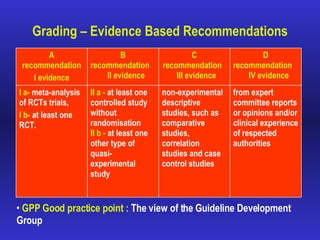
Grading – Evidence Based Recommendations GPP Good practice point :  The view of the Guideline Development Group from expert committee reports or opinions and/or clinical experience of respected authorities non-experimental descriptive studies, such as comparative studies, correlation studies and case control studies II a -  at least one controlled study without randomisation  II b -  at least one other type of quasi-experimental study I a-  meta-analysis of RCTs trials, I b-  at least one RCT. D recommendation   IV evidence C recommendation   III evidence B recommendation   II evidence A recommendation I evidence
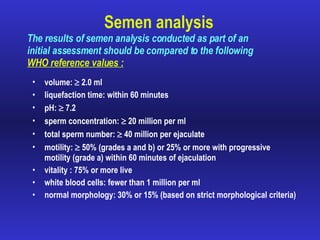
Semen analysis The results of semen analysis conducted as part of an initial assessment should be compared to the following WHO reference values : volume:    2.0 ml liquefaction time: within 60 minutes pH:    7.2 sperm concentration:    20 million per ml total sperm number:    40 million per ejaculate motility:    50% (grades a and b) or 25% or more with progressive motility (grade a) within 60 minutes of ejaculation vitality : 75% or more live white blood cells: fewer than 1 million per ml  normal morphology: 30% or 15% (based on strict morphological criteria)
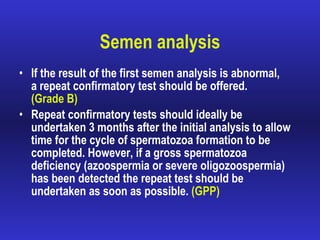
Semen analysis If the result of the first semen analysis is abnormal,  a repeat confirmatory test should be offered.  (Grade B) Repeat confirmatory tests should ideally be  undertaken 3 months after the initial analysis to allow time for the cycle of spermatozoa formation to be completed. However, if a gross spermatozoa deficiency (azoospermia or severe oligozoospermia) has been detected the repeat test should be undertaken as soon as possible.  (GPP)
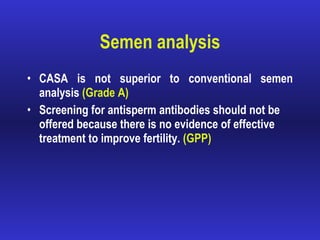
Semen analysis CASA is not superior to conventional semen analysis  (Grade A) Screening for antisperm antibodies should not be offered because there is no evidence of effective treatment to improve fertility.  (GPP)
Assessment of Ovulation Women with fertility problems should b e asked about the frequency and regularity of menstrual cycles. Women with regular monthly menstrual cycles are likely to be ovulating.  (Grade B) The use of basal body temperature charts to confirm ovulation does not reliably predict ovulation and is not recommended.  (Grade B)
Assessment of Ovulation Women with regular menstrual cycles and more than 1 year’s infertility are offered a blood test to measure serum progesterone in the mid-luteal phase of their cycle (day 21 of a 28-day cycle) to confirm ovulation.  (Grade B)
Assessment of Ovulation Women with prolonged irregular menstrual cycles should be offered a blood test to measure serum progesterone. Depending on the timing of menstrual periods, this test may need to be conducted later in the cycle (for example day 28 of a 35-day cycle) and repeated weekly thereafter until the next menstrual cycle starts.  (GPP) For such women direct or indirect measurement of progesterone is unnecessary until after therapy is initiated.
Assessment of Ovulation Women with irregular menstrual cycles should be offered a blood test to measure serum FSH & LH  (GPP). Blood test for prolactin should only be offered to women who have an ovulatory disorder, galactorrhoea or a pituitary tumour.  (Grade C)
Assessment of Ovulation Tests of ovarian reserve currently have limited sensitivity and specificity in predicting fertility. However, women who have high levels of gonadotrophins should be informed that they are likely to have reduced fertility.  (Grade C) The value of assessing ovarian reserve using Inhibin B is uncertain and is therefore not recommended.  (Grade C)
Assessment of Ovulation Women with possible fertility problems are no more likely than the general population to have thyroid disease and the routine measurement of thyroid function should not be offered. Estimation of thyroid function should be confined to women with symptoms of thyroid disease.  (Grade C).
Assessment of Ovulation Women should not be offered an endometrial biopsy to evaluate the luteal phase as part of the investigation of fertility problems because there is no evidence that medical treatment of luteal phase defect improves  pregnancy rates  (Grade B).
Assessment of  tubal factor   The results of semen analysis and assessment of ovulation should be known before a test for tubal patency is performed. Women who are not known to have co-morbidities (such as pelvic inflammatory disease, previous ectopic pregnancy or endometriosis) should be offered HSG  to screen for tubal occlusion because this is a reliable test for ruling out tubal occlusion, and it is less invasive and makes more efficient use of resources than laparoscopy.  (Grade B)
Assessment of  tubal factor Where appropriate expertise is available, screening for tubal occlusion using hysterosalpingo-contrast-ultrasonography should be considered because it is an effective alternative to HSG for women who are not known to have co-morbidities  (Grade A)
Assessment of  tubal factor Women who are thought to have co-morbidities should be offered laparoscopy and dye so that tubal and other pelvic pathology can be assessed at the same time.  (Grade B)
Screening for Chlamydia trachomatis   Before undergoing uterine instrumentation women should be offered screening for  Chlamydia trachomatis  using an appropriately sensitive technique.  (Grade B) If the result of a test for  Chlamydia trachomatis  is positive, women and their sexual partners should be referred for appropriate management with treatment and contact tracing.  (Grade C) Prophylactic antibiotics should be considered before uterine instrumentation (including HSG), if screening has not been carried out.  (GPP)
Assessing uterine abnormalities Women should not be offered hysteroscopy on its own as part of the initial investigation unless clinically indicated, because the effectiveness of surgical treatment of uterine abnormalities on improving pregnancy rates has not been established.  (Grade B) women with infertility and a normal HSG had no abnormalities of the uterine cavity when subsequently examined by hysteroscopy.
Post-coital testing of cervical mucus The routine use of post-coital testing of cervical mucus in the investigation of fertility problems is not recommended because it has no predictive value on pregnancy rate.  (Grade A) . The post-coital test may be of value in the diagnosis of sexual dysfunction  and  ejaculatory problems. . Results of post-coital testing may have little influence  on treatment strategy in the light of the widespread use of IUI  for fertility  problems associated with sperm-cervical mucus interaction. . The lack of effective treatment for anti-sperm antibodies may render PCT  unnecessary.
CONCLUDING REMARKS
Until it is demonstrated conclusively that treatment of abnormalities diagnosed by any of infertility testing, results in a significantly better pregnancy rate than placebo or no treatment, the advisability of performing such test, remains unproven and should not be performed.
Conventional Semen analysis. Assessment of utero-tubal status by HSG  and indicated laparoscopy . Mid luteal progesterone for the diagnosis of ovulation   Are useful tests, and correlate directly with the likelihood of conception.
Post-coital test.    Sperm penetration into cervical mucus.    Hysteroscopy.    Sperm antibody tests. V aricocele assessment. Endometrial biopsy.  The sperm penetration assay in the zona-free hamster oocyte. Are less useful tests, as their results are not correlated with pregnancy.
It is not cost effective to perform a diagnostic laparoscopy as part of the initial infertility evaluation in women in whom, history, and physical examination, TVS, HSG, antibodies to Chlamydia trachomatis and CA-125 level are all normal. Provided the woman is under age 35 and having ovulatory cycles and patent tubes, and there are more than 5 million motile sperm in the ejaculate of the male partner, 4-6 cycles of IUI    COH should be undertaken before performing a diagnostic laparoscopy and resorting to  ARTs. Such approach has been shown to increase fecundability rates to 10 - 25% per cycle and is thus useful initial approach  for subfertile couples.
Research could help improve treatment results in female infertility by discovering as-yet-unknown causes of infertility that coexist with recognized diagnoses. Such unknown causes may include post-fertilization defects that cannot by definition respond to the pre-fertilization interventions that comprise many of the available treatments.
Care must be taken to avoid exploitation of the infertile couple with expensive unnecessary tests A simplified approach will lead to a significant reduction in both the time and cost of investigating an infertile couple. The diagnostic process of investigating infertility has evolved more by discarding old tests than by finding useful new ones
THANK YOU FOR YOUR ATTENTION DR. JEHAD YOUSEF FICS, FRCOG E-mail:ramoamman@yahoo.co.uk

Laparoscopy 4

  • 1.
    INVESTIGATION OF INFERTILE COUPLE Evidence Based Medicine In a climate of DR. JEHAD YOUSEF FICS , FRCOG ALHAYAT ART CENTRE AMMN, JORDAN
  • 2.
    Very long list of tests, have been advocated to assist in determining the cause of the infertility in the diagnostic evaluation of infertile couple. The necessity and cost effectiveness of performing many of these tests and correcting the abnormalities found by them have not been demonstrated.
  • 3.
    Investigations of MaleFactor Conventional semen analysis Computer- assisted sperm analysis ( CASA ) Strict sperm morphology "Tygerberg strict criteria“ A variety of sperm function tests - The acrosome reaction test - Hypo-osmotic swelling test - Measurement of generation of Reactive oxygen species - Sperm capacitation assays - Hemizona-binding assay - Hamster penetration test - Human sperm-zona penetration assay - etc. A variety of imaging techniques for detection of varicocele
  • 4.
    Assessment of ovulationBasal body temperature Urine LH kits Mid luteal serum progesterone Routine hormonal profile: FSH, LH, Prolactin,TSH Endometrial biopsy Serial pelvic Ultrasonography. A variety of tests for assessment of ovarian reserve such as D3 FSH & E2, Inhibin B, Clomid challenge test, Gondotropin agonist stimulation test, TVS for ovarian volume, antral follicle count and Stromal blood flow.
  • 5.
    Investigations of tubalfactor Hysterosalpingography (HSG) Hysterosonography Laparoscopy Hydrolaparoscopy. Falloscopy
  • 6.
    Other investigations PCTfor assessment of the cervical factor. Hysteroscopy and 3 D US for assessment of the uterine factor. Laparoscopy for assessment of the peritoneal factors. Chlamydia trachomatis antibodies for assessment of possible tubo-ovarian adhesions. CA-125 blood testing for assessment of possible endomtetriosis. Immunological factors are evaluated by a variety of special tests.
  • 7.
    Controverses Lack ofagreement exists among trained infertility speicalists with regard to prognostic utility as well as criteria of normality of many of these tests? There is no consensus on which tests are essential before reaching the exact diagnosis ?
  • 8.
    Investigations of infertilecouple Evidence Medicine Based Era National Evidence-Based Clinical Guidelines “ Assessment and treatment for people with fertility problems developed by the National Collaborating Centre for Women and Children's Health on behalf of the National Institute for Clinical Excellence (NICE)” February 2004
  • 9.
    Grading – EvidenceBased Recommendations GPP Good practice point : The view of the Guideline Development Group from expert committee reports or opinions and/or clinical experience of respected authorities non-experimental descriptive studies, such as comparative studies, correlation studies and case control studies II a - at least one controlled study without randomisation II b - at least one other type of quasi-experimental study I a- meta-analysis of RCTs trials, I b- at least one RCT. D recommendation IV evidence C recommendation III evidence B recommendation II evidence A recommendation I evidence
  • 10.
    Semen analysis Theresults of semen analysis conducted as part of an initial assessment should be compared to the following WHO reference values : volume:  2.0 ml liquefaction time: within 60 minutes pH:  7.2 sperm concentration:  20 million per ml total sperm number:  40 million per ejaculate motility:  50% (grades a and b) or 25% or more with progressive motility (grade a) within 60 minutes of ejaculation vitality : 75% or more live white blood cells: fewer than 1 million per ml normal morphology: 30% or 15% (based on strict morphological criteria)
  • 11.
    Semen analysis Ifthe result of the first semen analysis is abnormal, a repeat confirmatory test should be offered. (Grade B) Repeat confirmatory tests should ideally be undertaken 3 months after the initial analysis to allow time for the cycle of spermatozoa formation to be completed. However, if a gross spermatozoa deficiency (azoospermia or severe oligozoospermia) has been detected the repeat test should be undertaken as soon as possible. (GPP)
  • 12.
    Semen analysis CASAis not superior to conventional semen analysis (Grade A) Screening for antisperm antibodies should not be offered because there is no evidence of effective treatment to improve fertility. (GPP)
  • 13.
    Assessment of OvulationWomen with fertility problems should b e asked about the frequency and regularity of menstrual cycles. Women with regular monthly menstrual cycles are likely to be ovulating. (Grade B) The use of basal body temperature charts to confirm ovulation does not reliably predict ovulation and is not recommended. (Grade B)
  • 14.
    Assessment of OvulationWomen with regular menstrual cycles and more than 1 year’s infertility are offered a blood test to measure serum progesterone in the mid-luteal phase of their cycle (day 21 of a 28-day cycle) to confirm ovulation. (Grade B)
  • 15.
    Assessment of OvulationWomen with prolonged irregular menstrual cycles should be offered a blood test to measure serum progesterone. Depending on the timing of menstrual periods, this test may need to be conducted later in the cycle (for example day 28 of a 35-day cycle) and repeated weekly thereafter until the next menstrual cycle starts. (GPP) For such women direct or indirect measurement of progesterone is unnecessary until after therapy is initiated.
  • 16.
    Assessment of OvulationWomen with irregular menstrual cycles should be offered a blood test to measure serum FSH & LH (GPP). Blood test for prolactin should only be offered to women who have an ovulatory disorder, galactorrhoea or a pituitary tumour. (Grade C)
  • 17.
    Assessment of OvulationTests of ovarian reserve currently have limited sensitivity and specificity in predicting fertility. However, women who have high levels of gonadotrophins should be informed that they are likely to have reduced fertility. (Grade C) The value of assessing ovarian reserve using Inhibin B is uncertain and is therefore not recommended. (Grade C)

  • 18.
    Assessment of OvulationWomen with possible fertility problems are no more likely than the general population to have thyroid disease and the routine measurement of thyroid function should not be offered. Estimation of thyroid function should be confined to women with symptoms of thyroid disease. (Grade C).
  • 19.
    Assessment of OvulationWomen should not be offered an endometrial biopsy to evaluate the luteal phase as part of the investigation of fertility problems because there is no evidence that medical treatment of luteal phase defect improves pregnancy rates (Grade B).
  • 20.
    Assessment of tubal factor The results of semen analysis and assessment of ovulation should be known before a test for tubal patency is performed. Women who are not known to have co-morbidities (such as pelvic inflammatory disease, previous ectopic pregnancy or endometriosis) should be offered HSG to screen for tubal occlusion because this is a reliable test for ruling out tubal occlusion, and it is less invasive and makes more efficient use of resources than laparoscopy. (Grade B)
  • 21.
    Assessment of tubal factor Where appropriate expertise is available, screening for tubal occlusion using hysterosalpingo-contrast-ultrasonography should be considered because it is an effective alternative to HSG for women who are not known to have co-morbidities (Grade A)
  • 22.
    Assessment of tubal factor Women who are thought to have co-morbidities should be offered laparoscopy and dye so that tubal and other pelvic pathology can be assessed at the same time. (Grade B)
  • 23.
    Screening for Chlamydiatrachomatis Before undergoing uterine instrumentation women should be offered screening for Chlamydia trachomatis using an appropriately sensitive technique. (Grade B) If the result of a test for Chlamydia trachomatis is positive, women and their sexual partners should be referred for appropriate management with treatment and contact tracing. (Grade C) Prophylactic antibiotics should be considered before uterine instrumentation (including HSG), if screening has not been carried out. (GPP)
  • 24.
    Assessing uterine abnormalitiesWomen should not be offered hysteroscopy on its own as part of the initial investigation unless clinically indicated, because the effectiveness of surgical treatment of uterine abnormalities on improving pregnancy rates has not been established. (Grade B) women with infertility and a normal HSG had no abnormalities of the uterine cavity when subsequently examined by hysteroscopy.
  • 25.
    Post-coital testing ofcervical mucus The routine use of post-coital testing of cervical mucus in the investigation of fertility problems is not recommended because it has no predictive value on pregnancy rate. (Grade A) . The post-coital test may be of value in the diagnosis of sexual dysfunction and ejaculatory problems. . Results of post-coital testing may have little influence on treatment strategy in the light of the widespread use of IUI for fertility problems associated with sperm-cervical mucus interaction. . The lack of effective treatment for anti-sperm antibodies may render PCT unnecessary.
  • 26.
  • 27.
    Until it isdemonstrated conclusively that treatment of abnormalities diagnosed by any of infertility testing, results in a significantly better pregnancy rate than placebo or no treatment, the advisability of performing such test, remains unproven and should not be performed.
  • 28.
    Conventional Semen analysis.Assessment of utero-tubal status by HSG and indicated laparoscopy . Mid luteal progesterone for the diagnosis of ovulation Are useful tests, and correlate directly with the likelihood of conception.
  • 29.
    Post-coital test.  Sperm penetration into cervical mucus.  Hysteroscopy.  Sperm antibody tests. V aricocele assessment. Endometrial biopsy.  The sperm penetration assay in the zona-free hamster oocyte. Are less useful tests, as their results are not correlated with pregnancy.
  • 30.
    It is notcost effective to perform a diagnostic laparoscopy as part of the initial infertility evaluation in women in whom, history, and physical examination, TVS, HSG, antibodies to Chlamydia trachomatis and CA-125 level are all normal. Provided the woman is under age 35 and having ovulatory cycles and patent tubes, and there are more than 5 million motile sperm in the ejaculate of the male partner, 4-6 cycles of IUI  COH should be undertaken before performing a diagnostic laparoscopy and resorting to ARTs. Such approach has been shown to increase fecundability rates to 10 - 25% per cycle and is thus useful initial approach for subfertile couples.
  • 31.
    Research could helpimprove treatment results in female infertility by discovering as-yet-unknown causes of infertility that coexist with recognized diagnoses. Such unknown causes may include post-fertilization defects that cannot by definition respond to the pre-fertilization interventions that comprise many of the available treatments.
  • 32.
    Care must betaken to avoid exploitation of the infertile couple with expensive unnecessary tests A simplified approach will lead to a significant reduction in both the time and cost of investigating an infertile couple. The diagnostic process of investigating infertility has evolved more by discarding old tests than by finding useful new ones
  • 33.
    THANK YOU FORYOUR ATTENTION DR. JEHAD YOUSEF FICS, FRCOG E-mail:ramoamman@yahoo.co.uk