Prof. Aboubakr Elnashar 
Benha University Hospital, EGYPT 
Aboubakr Elnashar
Aboubakr Elnashar
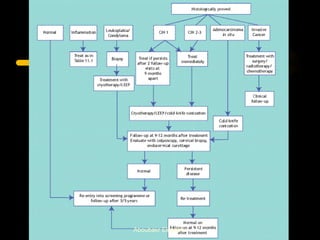
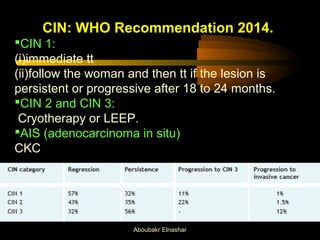
CIN: WHO Recommendation 2014. 
CIN 1: 
(i)immediate tt 
(ii)follow the woman and then tt if the lesion is 
persistent or progressive after 18 to 24 months. 
CIN 2 and CIN 3: 
Cryotherapy or LEEP. 
AIS (adenocarcinoma in situ) 
CKC 
Aboubakr Elnashar
Strategy 
Three visits strategy 
one for screening 
one for colposcopy, 
one for treatment: poor compliance, especially 
among rural women. 
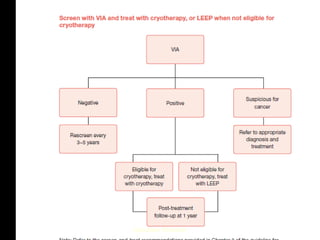
Single visit: see-and-treat strategy 
satisfactory results 
no significant extra morbidity 
[Emam et al, 2009]. 
Aboubakr Elnashar
See & treat (Single visit diagnosis & tt) 
•It means 
(Cryo therapy, cold coagulator or LEEP) at first visit to 
women with (VIA or colposcopic) findings suggestive of 
SIL. 
•Advantages: 
False negative histology is low (4.7% ) 
Reduce waiting lists & anxiety 
•Disadvantages: 
Over tt of insignificant lesions 
•It should be limited to HGSIL (Pastner,1994) 
Aboubakr Elnashar
Aboubakr Elnashar
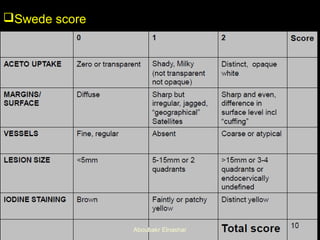
Swede score 
Aboubakr Elnashar
Swede score of 4 and above: Punch biopsies of 
the cervix 
Swede score 6 and above: 
immediate treatment 
with cold coagulation under visualisation with the 
Gynocular and local anaesthesia. 
patients not suitable for cold coagulation or with 
biopsies revealing microinvasive cervical disease or 
worse: appropriate diagnostic workup and 
management protocol. 
Aboubakr Elnashar
Aboubakr Elnashar
Methods 
Indications of ablative therapy 
1. Satisfactory colposcopy 
2. No suggestion of invasive disease 
3. No suspicion of glandular disease 
4. Cytology & histology correspond 
suspicion of invasion or unsatisfactory 
colposcopic assessment excludes any ablative 
method of treatment. 
Aboubakr Elnashar
Indication of Excisional therapy 
1. Unsatisfactory colposcopy. 
2. Suspicion of invasion 
3. Suspicion of glandular disease 
4. Discrepancy between cytology & 
histopathology 
Aboubakr Elnashar
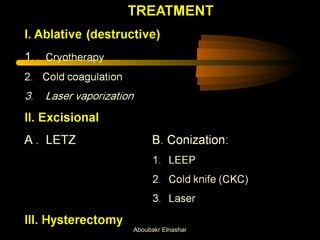
I. Ablative 
1. Cryotherapy 
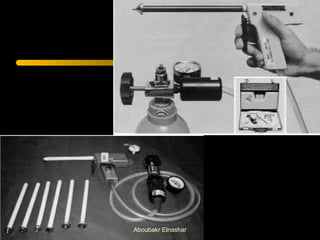
Relies on : 
steady supply of compressed refrigerant gases (N2O 
or CO2) in transportable cylinders. 
Mechanism: 
Excellent contact between the cryoprobe tip and the 
ectocervix: 
N2O-based cryotherapy: –89°C 
CO2-based system: –68°C at the core of the ice ball and – 
20°C at the edges. 
Cells reduced to –20°C for one or more minutes will undergo 
cryonecrosis. 
Aboubakr Elnashar
Eligibility criteria 
•The entire lesion is located in the ectocervix 
without extension to the vagina and/or endocervix 
• The lesion is visible in its entire extent and does 
not extend more than 2 to 3 mm into the canal 
• The lesion can be adequately covered by the 
largest available cryotherapy probe (2.5 cm); the 
lesion extends ≤2 mm beyond the cryotherapy 
probe 
Aboubakr Elnashar
• There is no evidence of invasive cancer 
• The endocervical canal is normal and there is no 
suggestion of glandular dysplasia 
• The woman is not pregnant 
• If the woman has recently delivered, she is at 
least three months post-partum 
• There is no evidence of PID 
• The woman has given informed written consent to have the treatment 
• CIN is confirmed by cervical biopsy/colposcopy 
Aboubakr Elnashar
• Healing: 
six weeks 
Side effects: 
watery vaginal discharge for 3-4 w after tt 
• Advise 
not to use a vaginal douche, tampons or have sexual 
intercourse for one month after tt.. 
• Treatment failure: 
5-10% 
Aboubakr Elnashar
Aboubakr Elnashar
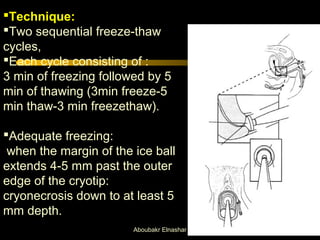
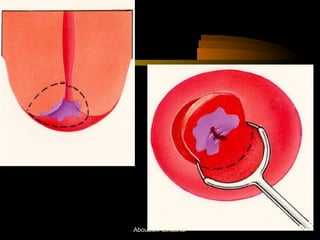
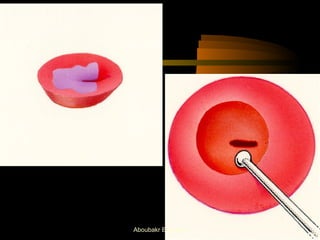
Technique: 
Two sequential freeze-thaw 
cycles, 
Each cycle consisting of : 
3 min of freezing followed by 5 
min of thawing (3min freeze-5 
min thaw-3 min freezethaw). 
Adequate freezing: 
when the margin of the ice ball 
extends 4-5 mm past the outer 
edge of the cryotip: 
cryonecrosis down to at least 5 
mm depth. 
Aboubakr Elnashar
Advantages 
1. Favorable safety profile 
2. Outpatient procedure 
3. No anesthetic requirements 
4. Ease of procedure 
5. Low-cost equipment with minimal maintenance 
6. Bleeding complications rare 
7. No proven adverse reproductive effects 
8. Acceptable primary cure rate 
Aboubakr Elnashar
Disadvantages 
1. No tissue specimen for histopathology 
2. Cannot treat lesions with unfavorable sizes or 
shapes 
3. Uterine cramping 
4. Potential for vasovagal reaction 
5. Profuse vaginal discharge postprocedure 
6. Cephalad migration of SCJ 
Video 
Aboubakr Elnashar
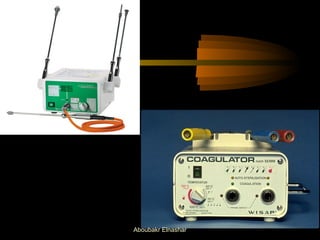
2. Cold coagulation 
Method: 
lesion is treated with tefloncoated probe to 100°C- 
120°C 
The probe is applied to each part of the cervix for 
30-40 sec. ensuring that the whole TZ is destroyed 
beyond the limit of acetowhite epithelium. 
Sultrin cream vaginally, nightly for one week 
avoid intercourse and use of tampons for 3w. 
Aboubakr Elnashar
Advantages: 
1.All grades of CIN can be treated 
2.outpatient clinic. 
3.Relatively painless procedure requiring minimal or 
no analgesia. 
4.Safe, efficient, with a very low morbidity rate. 
5.Short tt time 
6.Well accepted by both patients and colposcopists 
Aboubakr Elnashar
Success Rate 
CINIII: 95% 
CIN I and III: 96.5% -99% following one or more tt 
Persistent disease: 
very low rate (7. 1%) 
(Semple. Et al; 2008) 
Recurrence rate 
very low, 5.6%, 
Aboubakr Elnashar
Aboubakr Elnashar
II. Excesional 
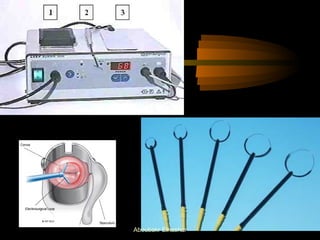
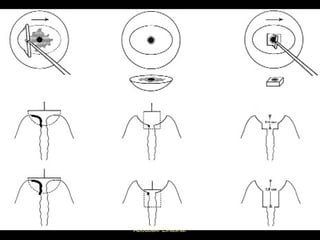
1. LEEP 
Loops: 
0.2 mm hard stainless steel or titanium 
Diameters : 1-3 cm. 
Aboubakr Elnashar
Aboubakr Elnashar
The eligibiligy criteria that must be met before 
LEEP is performed 
• If the lesion involves or extends into the 
endocervical canal, the distal or cranial limit of the 
lesion should be seen; the furthest (distal) extent is 
no more than 1 cm in depth 
• No evidence of invasive cancer or glandular 
dysplasia 
• No evidence of PID, cervicitis, vaginal 
trichomoniasis, bacterial vaginosis, anogenital ulcer 
or bleeding disorder 
Aboubakr Elnashar
• If the woman has recently delivered, she 
should be at least three months postpartum 
• Women with hypertension should have their 
blood pressure well controlled 
•CIN is confirmed by cervical biopsy, when possible 
Failure rate: 
10%. 
Aboubakr Elnashar
Technique 
1.Lithotomy position, speculum inserted, colposcopy , 
cervix is painted with Lugol’s iodine. 
2.Patient grounded with pad return electrode 
3.Circumferential cervical block using 1% lidocaine. 
Inject just beneath & lateral to the lesion 
4.Short lasting IV sedation is given to women who so 
demanded. 
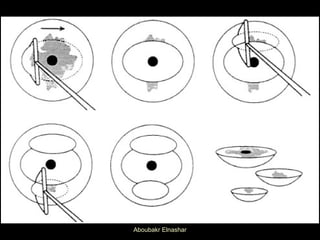
5.A loop wider than the lesion(s) and the TZ to be 
removed should be used; otherwise, the lesion should 
be removed with multiple passes 
6.Depending on the loop size, a power setting 25-55 
watts of blend (cutting plus coagulation) current 
Aboubakr Elnashar
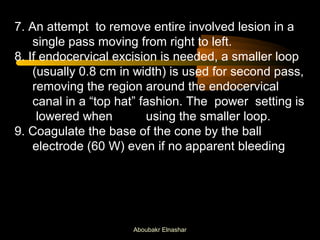
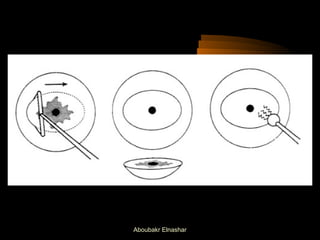
7. An attempt to remove entire involved lesion in a 
single pass moving from right to left. 
8. If endocervical excision is needed, a smaller loop 
(usually 0.8 cm in width) is used for second pass, 
removing the region around the endocervical 
canal in a “top hat” fashion. The power setting is 
lowered when using the smaller loop. 
9. Coagulate the base of the cone by the ball 
electrode (60 W) even if no apparent bleeding 
Aboubakr Elnashar
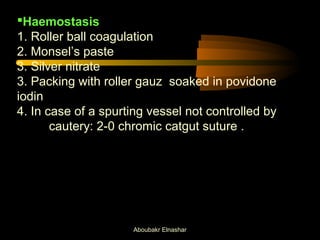
Haemostasis 
1. Roller ball coagulation 
2. Monsel’s paste 
3. Silver nitrate 
3. Packing with roller gauz soaked in povidone 
iodin 
4. In case of a spurting vessel not controlled by 
cautery: 2-0 chromic catgut suture . 
Aboubakr Elnashar
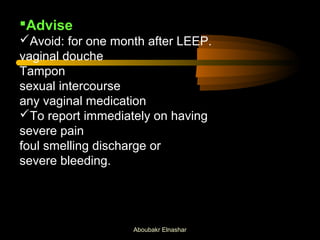
Advise 
Avoid: for one month after LEEP. 
vaginal douche 
Tampon 
sexual intercourse 
any vaginal medication 
To report immediately on having 
severe pain 
foul smelling discharge or 
severe bleeding. 
Aboubakr Elnashar
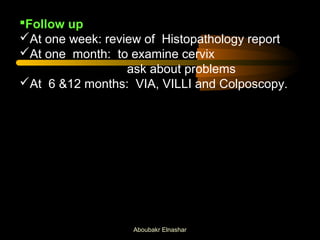
Follow up 
At one week: review of Histopathology report 
At one month: to examine cervix 
ask about problems 
At 6 &12 months: VIA, VILLI and Colposcopy. 
Aboubakr Elnashar
Complications 
1.Bleeding: primary secondary 
Moderate to severe: ≤2% 
2. Infection 
3. Discharge: brown or black for up to two weeks 
4. Incomplete removal of lesion 
5. Inadvertent burns 
6. Cervical stenosis 
Aboubakr Elnashar
Advantages 
 Over ablative methods 
 Tissue specimen for histopathology evaluation 
Over laser 
 tt time is shorter 
Easier to learn 
No hazard to the eyesight 
Equipment breakdowns occur less often 
Cone sampling is better than laser 
less handling of tissue 
Discomfort is reduced 
Low costs of equipment 
Aboubakr Elnashar
Disadvantages 
1. Thermal damage may obscure specimen 
margin status 
2. Special training required 
3. Risk of post procedure bleeding 
4. Theoretical risk of vapor plume inhalation 
Aboubakr Elnashar
Aboubakr Elnashar
Aboubakr Elnashar
Aboubakr Elnashar
Aboubakr Elnashar
Aboubakr Elnashar
Aboubakr Elnashar
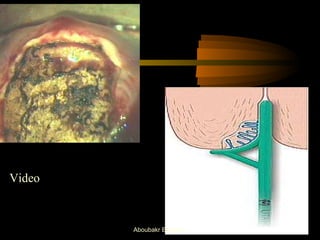
Video 
Aboubakr Elnashar
2. Cold-knife conization 
Indications 
•The lesion extends into the endocervical canal and 
it is not possible to confirm the exact extent. 
• The lesion extends into the canal and the farthest 
extent exceeds the excisional capability of the LEEP 
cone technique (maximum excisional depth of 1.5 
cm). 
• The lesion extends into the canal and the farthest 
extent exceeds the excisional capability of the 
colposcopist. 
• The cytology is repeatedly abnormal, suggesting 
neoplasia, but there is no corresponding colposcopic 
abnormality of the cervix or vagina on which to 
perform biopsy. Aboubakr Elnashar
• Cytology suggests a much more serious lesion 
than that which is seen and biopsy-confirmed. 
• Cytology shows atypical glandular cells that 
suggest the possibility of glandular dysplasia or 
adenocarcinoma. 
• Colposcopy suggests the possibility of glandular 
dysplasia or adenocarcinoma. 
• Endocervical curettage reveals abnormal histology. 
Aboubakr Elnashar
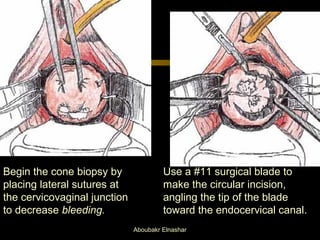
Begin the cone biopsy by 
placing lateral sutures at 
the cervicovaginal junction 
to decrease bleeding. 
Use a #11 surgical blade to 
make the circular incision, 
angling the tip of the blade 
toward the endocervical canal. 
Aboubakr Elnashar
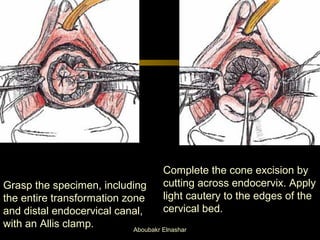
Grasp the specimen, including 
the entire transformation zone 
and distal endocervical canal, 
with an Allis clamp. 
Complete the cone excision by 
cutting across endocervix. Apply 
light cautery to the edges of the 
cervical bed. 
Aboubakr Elnashar
Advantages 
 Tissue specimen for histopathology without margin 
compromise 
Disadvantages 
 Potential for hge 
 Lengthier procedure 
 Postoperative discomfort 
 General or regional anesthesia required 
 Operating room setting 
 High cost 
 Larger volume of cervical stroma removed 
 Increased risk of adverse reproductive outcomes 
Aboubakr Elnashar
III. Hysterectomy 
Indications 
1. Other gynecological conditions: 
.fibroid, prolapse, endometriosis, PID . 
2. Refuse all other forms of therapy 
3.SIL at limits of conization specimen 
4. Poor compliance with follow-up 
Sterilization is not an indication 
Aboubakr Elnashar
Follow up after treatment of CIN 
• Non of the methods for tt of CIN offers an absolute 
cure rate. 
• Recurrences most common: in the first 2 yr, in the os & 
on the outside margins 
Aim 
Persistent or recurrent disease (after 12 mo) 
Visits 
6 mo intervals for 2 yr, then annually 
Assessment 
Combined cytology & colposcopy at first visits, then 
cytology (endocx & ectocx), VIA 
Aboubakr Elnashar
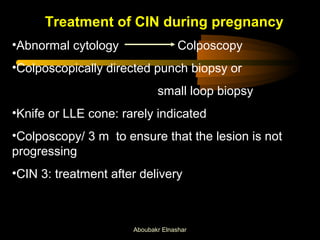
Treatment of CIN during pregnancy 
•Abnormal cytology Colposcopy 
•Colposcopically directed punch biopsy or 
small loop biopsy 
•Knife or LLE cone: rarely indicated 
•Colposcopy/ 3 m to ensure that the lesion is not 
progressing 
•CIN 3: treatment after delivery 
Aboubakr Elnashar
Prof. Aboubakr Elnashar 
Benha University Hospital, EGYPT 
E-mail: elnashar@hotmail.com 
Aboubakr Elnashar

CIN treatment

  • 1.
    Prof. Aboubakr Elnashar Benha University Hospital, EGYPT Aboubakr Elnashar
  • 2.
  • 3.
    CIN: WHO Recommendation2014. CIN 1: (i)immediate tt (ii)follow the woman and then tt if the lesion is persistent or progressive after 18 to 24 months. CIN 2 and CIN 3: Cryotherapy or LEEP. AIS (adenocarcinoma in situ) CKC Aboubakr Elnashar
  • 4.
    Strategy Three visitsstrategy one for screening one for colposcopy, one for treatment: poor compliance, especially among rural women. Single visit: see-and-treat strategy satisfactory results no significant extra morbidity [Emam et al, 2009]. Aboubakr Elnashar
  • 5.
    See & treat(Single visit diagnosis & tt) •It means (Cryo therapy, cold coagulator or LEEP) at first visit to women with (VIA or colposcopic) findings suggestive of SIL. •Advantages: False negative histology is low (4.7% ) Reduce waiting lists & anxiety •Disadvantages: Over tt of insignificant lesions •It should be limited to HGSIL (Pastner,1994) Aboubakr Elnashar
  • 6.
  • 7.
  • 8.
    Swede score of4 and above: Punch biopsies of the cervix Swede score 6 and above: immediate treatment with cold coagulation under visualisation with the Gynocular and local anaesthesia. patients not suitable for cold coagulation or with biopsies revealing microinvasive cervical disease or worse: appropriate diagnostic workup and management protocol. Aboubakr Elnashar
  • 9.
  • 10.
    Methods Indications ofablative therapy 1. Satisfactory colposcopy 2. No suggestion of invasive disease 3. No suspicion of glandular disease 4. Cytology & histology correspond suspicion of invasion or unsatisfactory colposcopic assessment excludes any ablative method of treatment. Aboubakr Elnashar
  • 11.
    Indication of Excisionaltherapy 1. Unsatisfactory colposcopy. 2. Suspicion of invasion 3. Suspicion of glandular disease 4. Discrepancy between cytology & histopathology Aboubakr Elnashar
  • 12.
    I. Ablative 1.Cryotherapy Relies on : steady supply of compressed refrigerant gases (N2O or CO2) in transportable cylinders. Mechanism: Excellent contact between the cryoprobe tip and the ectocervix: N2O-based cryotherapy: –89°C CO2-based system: –68°C at the core of the ice ball and – 20°C at the edges. Cells reduced to –20°C for one or more minutes will undergo cryonecrosis. Aboubakr Elnashar
  • 13.
    Eligibility criteria •Theentire lesion is located in the ectocervix without extension to the vagina and/or endocervix • The lesion is visible in its entire extent and does not extend more than 2 to 3 mm into the canal • The lesion can be adequately covered by the largest available cryotherapy probe (2.5 cm); the lesion extends ≤2 mm beyond the cryotherapy probe Aboubakr Elnashar
  • 14.
    • There isno evidence of invasive cancer • The endocervical canal is normal and there is no suggestion of glandular dysplasia • The woman is not pregnant • If the woman has recently delivered, she is at least three months post-partum • There is no evidence of PID • The woman has given informed written consent to have the treatment • CIN is confirmed by cervical biopsy/colposcopy Aboubakr Elnashar
  • 15.
    • Healing: sixweeks Side effects: watery vaginal discharge for 3-4 w after tt • Advise not to use a vaginal douche, tampons or have sexual intercourse for one month after tt.. • Treatment failure: 5-10% Aboubakr Elnashar
  • 16.
  • 17.
    Technique: Two sequentialfreeze-thaw cycles, Each cycle consisting of : 3 min of freezing followed by 5 min of thawing (3min freeze-5 min thaw-3 min freezethaw). Adequate freezing: when the margin of the ice ball extends 4-5 mm past the outer edge of the cryotip: cryonecrosis down to at least 5 mm depth. Aboubakr Elnashar
  • 18.
    Advantages 1. Favorablesafety profile 2. Outpatient procedure 3. No anesthetic requirements 4. Ease of procedure 5. Low-cost equipment with minimal maintenance 6. Bleeding complications rare 7. No proven adverse reproductive effects 8. Acceptable primary cure rate Aboubakr Elnashar
  • 19.
    Disadvantages 1. Notissue specimen for histopathology 2. Cannot treat lesions with unfavorable sizes or shapes 3. Uterine cramping 4. Potential for vasovagal reaction 5. Profuse vaginal discharge postprocedure 6. Cephalad migration of SCJ Video Aboubakr Elnashar
  • 20.
    2. Cold coagulation Method: lesion is treated with tefloncoated probe to 100°C- 120°C The probe is applied to each part of the cervix for 30-40 sec. ensuring that the whole TZ is destroyed beyond the limit of acetowhite epithelium. Sultrin cream vaginally, nightly for one week avoid intercourse and use of tampons for 3w. Aboubakr Elnashar
  • 21.
    Advantages: 1.All gradesof CIN can be treated 2.outpatient clinic. 3.Relatively painless procedure requiring minimal or no analgesia. 4.Safe, efficient, with a very low morbidity rate. 5.Short tt time 6.Well accepted by both patients and colposcopists Aboubakr Elnashar
  • 22.
    Success Rate CINIII:95% CIN I and III: 96.5% -99% following one or more tt Persistent disease: very low rate (7. 1%) (Semple. Et al; 2008) Recurrence rate very low, 5.6%, Aboubakr Elnashar
  • 23.
  • 24.
    II. Excesional 1.LEEP Loops: 0.2 mm hard stainless steel or titanium Diameters : 1-3 cm. Aboubakr Elnashar
  • 25.
  • 26.
    The eligibiligy criteriathat must be met before LEEP is performed • If the lesion involves or extends into the endocervical canal, the distal or cranial limit of the lesion should be seen; the furthest (distal) extent is no more than 1 cm in depth • No evidence of invasive cancer or glandular dysplasia • No evidence of PID, cervicitis, vaginal trichomoniasis, bacterial vaginosis, anogenital ulcer or bleeding disorder Aboubakr Elnashar
  • 27.
    • If thewoman has recently delivered, she should be at least three months postpartum • Women with hypertension should have their blood pressure well controlled •CIN is confirmed by cervical biopsy, when possible Failure rate: 10%. Aboubakr Elnashar
  • 28.
    Technique 1.Lithotomy position,speculum inserted, colposcopy , cervix is painted with Lugol’s iodine. 2.Patient grounded with pad return electrode 3.Circumferential cervical block using 1% lidocaine. Inject just beneath & lateral to the lesion 4.Short lasting IV sedation is given to women who so demanded. 5.A loop wider than the lesion(s) and the TZ to be removed should be used; otherwise, the lesion should be removed with multiple passes 6.Depending on the loop size, a power setting 25-55 watts of blend (cutting plus coagulation) current Aboubakr Elnashar
  • 29.
    7. An attemptto remove entire involved lesion in a single pass moving from right to left. 8. If endocervical excision is needed, a smaller loop (usually 0.8 cm in width) is used for second pass, removing the region around the endocervical canal in a “top hat” fashion. The power setting is lowered when using the smaller loop. 9. Coagulate the base of the cone by the ball electrode (60 W) even if no apparent bleeding Aboubakr Elnashar
  • 30.
    Haemostasis 1. Rollerball coagulation 2. Monsel’s paste 3. Silver nitrate 3. Packing with roller gauz soaked in povidone iodin 4. In case of a spurting vessel not controlled by cautery: 2-0 chromic catgut suture . Aboubakr Elnashar
  • 31.
    Advise Avoid: forone month after LEEP. vaginal douche Tampon sexual intercourse any vaginal medication To report immediately on having severe pain foul smelling discharge or severe bleeding. Aboubakr Elnashar
  • 32.
    Follow up Atone week: review of Histopathology report At one month: to examine cervix ask about problems At 6 &12 months: VIA, VILLI and Colposcopy. Aboubakr Elnashar
  • 33.
    Complications 1.Bleeding: primarysecondary Moderate to severe: ≤2% 2. Infection 3. Discharge: brown or black for up to two weeks 4. Incomplete removal of lesion 5. Inadvertent burns 6. Cervical stenosis Aboubakr Elnashar
  • 34.
    Advantages  Overablative methods  Tissue specimen for histopathology evaluation Over laser  tt time is shorter Easier to learn No hazard to the eyesight Equipment breakdowns occur less often Cone sampling is better than laser less handling of tissue Discomfort is reduced Low costs of equipment Aboubakr Elnashar
  • 35.
    Disadvantages 1. Thermaldamage may obscure specimen margin status 2. Special training required 3. Risk of post procedure bleeding 4. Theoretical risk of vapor plume inhalation Aboubakr Elnashar
  • 36.
  • 37.
  • 38.
  • 39.
  • 40.
  • 41.
  • 42.
  • 43.
    2. Cold-knife conization Indications •The lesion extends into the endocervical canal and it is not possible to confirm the exact extent. • The lesion extends into the canal and the farthest extent exceeds the excisional capability of the LEEP cone technique (maximum excisional depth of 1.5 cm). • The lesion extends into the canal and the farthest extent exceeds the excisional capability of the colposcopist. • The cytology is repeatedly abnormal, suggesting neoplasia, but there is no corresponding colposcopic abnormality of the cervix or vagina on which to perform biopsy. Aboubakr Elnashar
  • 44.
    • Cytology suggestsa much more serious lesion than that which is seen and biopsy-confirmed. • Cytology shows atypical glandular cells that suggest the possibility of glandular dysplasia or adenocarcinoma. • Colposcopy suggests the possibility of glandular dysplasia or adenocarcinoma. • Endocervical curettage reveals abnormal histology. Aboubakr Elnashar
  • 45.
    Begin the conebiopsy by placing lateral sutures at the cervicovaginal junction to decrease bleeding. Use a #11 surgical blade to make the circular incision, angling the tip of the blade toward the endocervical canal. Aboubakr Elnashar
  • 46.
    Grasp the specimen,including the entire transformation zone and distal endocervical canal, with an Allis clamp. Complete the cone excision by cutting across endocervix. Apply light cautery to the edges of the cervical bed. Aboubakr Elnashar
  • 47.
    Advantages  Tissuespecimen for histopathology without margin compromise Disadvantages  Potential for hge  Lengthier procedure  Postoperative discomfort  General or regional anesthesia required  Operating room setting  High cost  Larger volume of cervical stroma removed  Increased risk of adverse reproductive outcomes Aboubakr Elnashar
  • 48.
    III. Hysterectomy Indications 1. Other gynecological conditions: .fibroid, prolapse, endometriosis, PID . 2. Refuse all other forms of therapy 3.SIL at limits of conization specimen 4. Poor compliance with follow-up Sterilization is not an indication Aboubakr Elnashar
  • 49.
    Follow up aftertreatment of CIN • Non of the methods for tt of CIN offers an absolute cure rate. • Recurrences most common: in the first 2 yr, in the os & on the outside margins Aim Persistent or recurrent disease (after 12 mo) Visits 6 mo intervals for 2 yr, then annually Assessment Combined cytology & colposcopy at first visits, then cytology (endocx & ectocx), VIA Aboubakr Elnashar
  • 50.
    Treatment of CINduring pregnancy •Abnormal cytology Colposcopy •Colposcopically directed punch biopsy or small loop biopsy •Knife or LLE cone: rarely indicated •Colposcopy/ 3 m to ensure that the lesion is not progressing •CIN 3: treatment after delivery Aboubakr Elnashar
  • 51.
    Prof. Aboubakr Elnashar Benha University Hospital, EGYPT E-mail: elnashar@hotmail.com Aboubakr Elnashar