HYSTEROSCOPY FOR  INFERTILE PATIENT An Evidence Based Approach Dr.Mohamed El Sherbiny MD  Obstetrics&Gynecology   Senior Consultant  Damietta General Hospital Damietta Egypt
Cochrane library  . Royal College of Obstetricians &Gynecologists (RCOG)  Guidelines. Journal of evidence based obstetrics and gynecology. National Guideline Clearinghouse . New Zealand Guidelines Group PubMed  Sources of EB for The Topic
DIAGNOSTIC HYSTEROSCOPY
RIGIDE OR FLEXIBLE ?? A rigid hysteroscope was superior to  a flexible  hysteroscope for outpatient hysteroscopy Rudi Campo  ,  Evidence-based Obstetrics & Gynecology  Volume:3 Issue:3 Date:September 2001 p140-141
Preparation of The Cervix Vaginal misoprostol prior to diagnostic hysteroscopy reduced cervical resistance in non-pregnant women Fong& Singh   Evidence-based  Obstetrics & Gynecology   :  3 Issue:2 Date:June 2001 p88-90
Distension Media:  Saline Vs Co 2 Normal saline should be used as it offers: advantages (shorter and less discomfort) over co 2  instillation. New Zealand Guidelines Group : Level A
SHOULD HYSTERSCOPY BE DONE ROUTINLY IN THE  EVALUATION  OF INFERTILITY ? NO
Tests which have an established correlation with pregnancy  are: 1- Semen analysis 2-Tubal patency by HSG or laparoscopy  3-Mid luteal progesterone for the  diagnosis  of ovulation   They  are the basic essential tests for diagnosis of infertility.   Routine  Infertility  Investigation ESHRE Capri  workshop & National Guideline Clearinghouse  2000 RCOG Guidelines : Grade  B  Recommendation 1999
Routine Infertility investigation??! Hysteroscopy should  not be considered as  a routine investigation in the infertile couple. RCOG Guidelines : Grade C Recommendation 1999
Indications of  Diagnostic Hysteroscopy for Reproductive Failure Abnormal hysterosalpingogram. Abnormal uterine bleeding  Suspected intrauterine pathology Uterine anomalies Pregnancy wastage Unexplained infertility Valle 1996
When Hysteroscopy Should Be  Done  For  Unexplained Infertility ? At Laparoscopy ? Before  IVF  ? After Failed IVF ?
SHOULD HYSTEROSCOPY BE USED  ROUTINELY AT THE  TIME OF LAPAROSCOPY  FOR  .  THE INVESTIGATION OF  .  INFERTILIY ?
El Sherbiny M,  Medical   J   of   Cairo Univ., Vol.65 No. 3, Sept. 1997 El Sherbiny M,  The 7th Annual Meeting Of The Intern. Society for Gynecologic Endoscopy ,Sun City, South Africa;15:18 March,1998   Hysteroscopy done at laparoscopy  time, has low complication rate,  high degree of safety, minimal time  requirement and adds little  equipment & cost.  Positive hysteroscopic findings were found in many cases (15%) despite having normal HSG and no suggestive history of uterine lesion
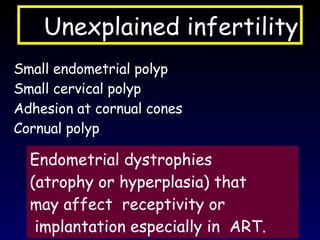
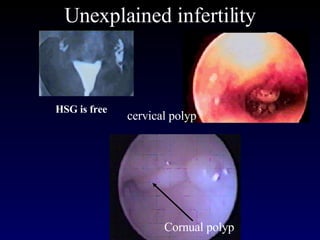
Unexplained infertility Small endometrial polyp Small cervical polyp Adhesion at cornual cones Cornual polyp Endometrial dystrophies (atrophy or hyperplasia) that  may affect  receptivity or implantation especially in  ART.
` Unexplained infertility Cornual polyp cervical polyp HSG is free
Mini-pan-endoscopic Approach Transvaginal hydrolaparoscopy   in association with  Minihysteroscopy   provided more information and was better tolerated than HSG in an outpatient infertility investigation.  Cicinelli  et al . Fertil Steril 2001 Nov;76(5):1048-51 RCT (23 cases)
OPERATIVE HYSTEROSCOPY
Indications of  Operative Hysteroscopy for Reproductive Failure Polyp. Submucous leiomyoma. Uterine septa. Intrauterine Adhesions. Misplaced or embedded IUD Tubal cannulation  & Falloposcopy.  Valle 1996
Priming  With Misoprostol Vaginal misoprostol prior to operative hysteroscopy facilitated the procedure and reduced complication Y.F.Fong and K.Singh   Evidence-based  Obstet & Gynecol.,2000
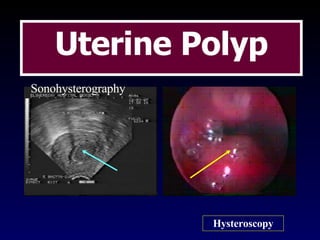
Uterine Polyp Uterine Fibroid
Both saline infusion sonohysterography and hysteroscopy are well tolerated by women. Saline infusion sonohysterography has a high failure rate but has a lower pain score than hysteroscopy. Rogerson et al,   BJOG 2002 Jul;109(7):800-4 RCT (117 cases) Transvaginal Sonohysterography Versus Hysteroscopy
Transvaginal Sonohysterography Versus Hysteroscopy (TVSH) should be considered prior to hysteroscopy in women in whom intrauterine pathology such as submucous fibroids and polyps are suspected as diagnostic hysteroscopy can be avoided in up to 40% of women New Zealand Guidelines Group : 1998-2002 Level A
36 38 Uterine Polyp Sonohysterography Hysteroscopy
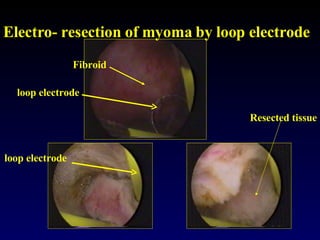
Electro- resection of myoma by loop electrode loop electrode loop electrode Fibroid Resected tissue
Uterine Fibroid Women who are diagnosed with submucous uterine fibroids and heavy or abnormal menstrual bleeding should be offered hysteroscopic resection . New Zealand Guidelines Group : 1998-2002 Level C
Myomas can be removed effectively when: Uterine size (depth )8-12 cm  >50% inside cavity. < 5 Cm size  Hysteroscopic Resection Advanced Reproductive Care Inc  : 2002
Endometrial Thinning Prior To Hysteroscopic Surgery For Menorrhagia  It improves both the operating conditions for the surgeon and short term post-operative outcome. GRH analogues produce slightly more consistent endometrial thinning than danazol.  Sowter  et al  : 1998  (Cochrane Review).  In:  The Cochrane Library,  Issue 2 2002. Oxford: Update Software.
Intrauterine  synechiae
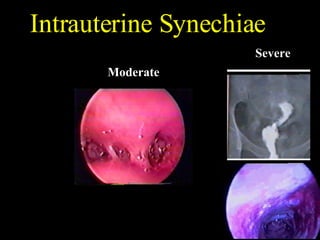
HSG : Filling defect Stellate & irregular, Commonly inhomogeneous HYSTEROSCOPY Confirmation Evaluation of the extent of the disease Intrauterine Synechiae
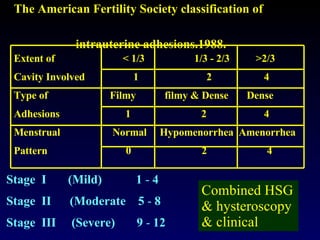
The American Fertility Society classification of  intrauterine adhesions.1988. Extent of  < 1/3  1/3 - 2/3  >2/3  Cavity Involved   1  2  4 Type of   Filmy  filmy & Dense  Dense  Adhesions   1  2  4 Menstrual  Normal  Hypomenorrhea  Amenorrhea Pattern  0  2  4  Stage  I  (Mild)  1  -  4 Stage  II  (Moderate  5  -  8 Stage  III  (Severe)  9  -  12  Combined HSG & hysteroscopy  & clinical
Intrauterine Synechiae Severe Moderate
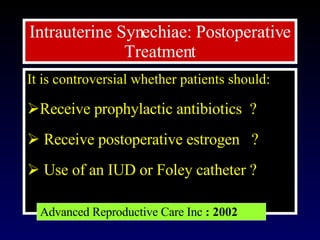
It is controversial whether patients should: Receive prophylactic antibiotics  ? Receive postoperative estrogen  ?  Use of an IUD or Foley catheter ?  Intrauterine Synechiae:  Postoperative Treatment Advanced Reproductive Care Inc  : 2002
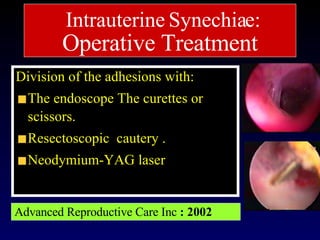
Division of the adhesions with: The endoscope The curettes or scissors.  Resectoscopic  cautery . Neodymium-YAG laser  Advanced Reproductive Care Inc  : 2002 121 Intrauterine Synechiae:   Operative Treatment
Restoration of menses: 70- 90%  Pregnancy rate : 60% - 90%.   Term pregnancy : 40- 80% Poor for : Severe disease,  Multiple procedures have been necessary.  Intrauterine Synechiae :   Prognosis Advanced Reproductive Care Inc  : 2002
Perforation  : 2%. Infection  : 2%. Adhesion reformation :20-40%. Placental complications :2-40%.. Intrauterine Synechiae :   Complications Advanced Reproductive Care Inc  : 2002
CONGENITAL ANOMALIES
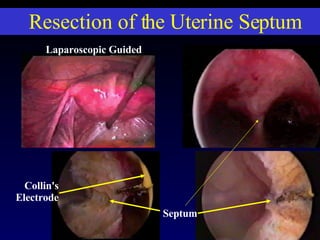
Septate Uterus :  Value of Hysteroscopy Confirming the abnormality  Evaluating the uterine cavity capacity  Discarding other pathologic findings such as polyps, endometritis, hypertrophy  Guiding surgical aproach Traver  et al. Infertility in the 3 rd  Millennium Prague, 2000
Resection of the Uterine Septum 121 Laparoscopic Guided Septum Collin's Electrode
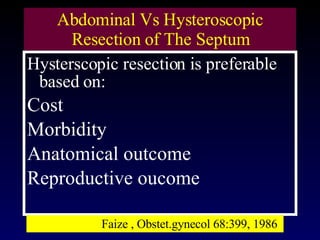
Abdominal Vs Hysteroscopic Resection of The Septum Hysterscopic resection is preferable based on:  Cost  Morbidity Anatomical outcome  Reproductive oucome Faize , Obstet.gynecol 68:399, 1986
Proximal Tubal Obstruction (PTO)
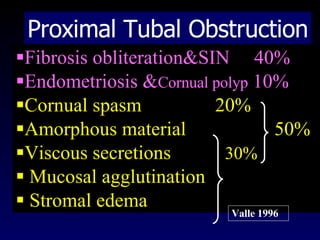
Proximal Tubal Obstruction Fibrosis obliteration&SIN  40% Endometriosis & Cornual polyp  10% Cornual spasm  20% Amorphous material  50% Viscous secretions  30% Mucosal agglutination Stromal edema Valle 1996
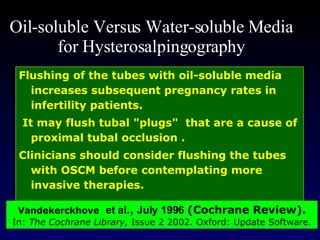
Oil-soluble Versus Water-soluble Media  for  H ysterosalpingography  Flushing of the tubes with oil-soluble media increases subsequent pregnancy rates in infertility patients.  It may flush t ubal &quot;plugs&quot;  that  are a cause of proximal tubal occlusion  . Clinicians should consider flushing the tubes with OSCM before contemplating more invasive therapies. Vandekerckhove   et al .,   July 1996   (Cochrane   Review).   In:  The Cochrane Library,  Issue 2 2002. Oxford: Update Software.
Tubal Catheterization Where proximal tubal obstruction is suspected, and there are no other tubal abnormalities, a tubal catheterisation procedure may be attempted  RCOG Guidelines : Grade B Recommendation
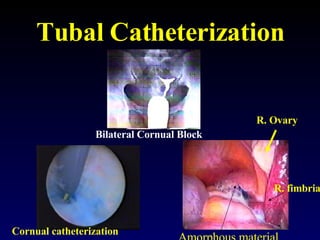
Tubal Catheterization Bilateral Cornual Block Amorphous material R. Ovary R. fimbria Cornual catheterization
Falloposcope Recently, the Food and Drug Administration has just given  the first approval for a falloposcope in the United States. The falloposcope will be utilized through the hysteroscope and will allows direct visualisation of the proximal segment and provides an atraumatic recanalisation .  .  Advanced Reproductive Care Inc  : 2002
The risk to normal fallopian tubes through the use of falloposcopy is not clearly known but thought not to be significant..  Falloposcope Advanced Reproductive Care Inc  : 2002
Thank You

Infertility Hysteroscopy

  • 1.
    HYSTEROSCOPY FOR INFERTILE PATIENT An Evidence Based Approach Dr.Mohamed El Sherbiny MD Obstetrics&Gynecology Senior Consultant Damietta General Hospital Damietta Egypt
  • 2.
    Cochrane library  .Royal College of Obstetricians &Gynecologists (RCOG) Guidelines. Journal of evidence based obstetrics and gynecology. National Guideline Clearinghouse . New Zealand Guidelines Group PubMed Sources of EB for The Topic
  • 3.
  • 4.
    RIGIDE OR FLEXIBLE?? A rigid hysteroscope was superior to a flexible hysteroscope for outpatient hysteroscopy Rudi Campo , Evidence-based Obstetrics & Gynecology Volume:3 Issue:3 Date:September 2001 p140-141
  • 5.
    Preparation of TheCervix Vaginal misoprostol prior to diagnostic hysteroscopy reduced cervical resistance in non-pregnant women Fong& Singh Evidence-based Obstetrics & Gynecology : 3 Issue:2 Date:June 2001 p88-90
  • 6.
    Distension Media: Saline Vs Co 2 Normal saline should be used as it offers: advantages (shorter and less discomfort) over co 2 instillation. New Zealand Guidelines Group : Level A
  • 7.
    SHOULD HYSTERSCOPY BEDONE ROUTINLY IN THE EVALUATION OF INFERTILITY ? NO
  • 8.
    Tests which havean established correlation with pregnancy are: 1- Semen analysis 2-Tubal patency by HSG or laparoscopy 3-Mid luteal progesterone for the diagnosis of ovulation They are the basic essential tests for diagnosis of infertility. Routine Infertility Investigation ESHRE Capri workshop & National Guideline Clearinghouse 2000 RCOG Guidelines : Grade B Recommendation 1999
  • 9.
    Routine Infertility investigation??!Hysteroscopy should not be considered as a routine investigation in the infertile couple. RCOG Guidelines : Grade C Recommendation 1999
  • 10.
    Indications of Diagnostic Hysteroscopy for Reproductive Failure Abnormal hysterosalpingogram. Abnormal uterine bleeding Suspected intrauterine pathology Uterine anomalies Pregnancy wastage Unexplained infertility Valle 1996
  • 11.
    When Hysteroscopy ShouldBe Done For Unexplained Infertility ? At Laparoscopy ? Before IVF ? After Failed IVF ?
  • 12.
    SHOULD HYSTEROSCOPY BEUSED ROUTINELY AT THE TIME OF LAPAROSCOPY FOR . THE INVESTIGATION OF . INFERTILIY ?
  • 13.
    El Sherbiny M, Medical J of Cairo Univ., Vol.65 No. 3, Sept. 1997 El Sherbiny M, The 7th Annual Meeting Of The Intern. Society for Gynecologic Endoscopy ,Sun City, South Africa;15:18 March,1998 Hysteroscopy done at laparoscopy time, has low complication rate, high degree of safety, minimal time requirement and adds little equipment & cost. Positive hysteroscopic findings were found in many cases (15%) despite having normal HSG and no suggestive history of uterine lesion
  • 14.
    Unexplained infertility Smallendometrial polyp Small cervical polyp Adhesion at cornual cones Cornual polyp Endometrial dystrophies (atrophy or hyperplasia) that may affect receptivity or implantation especially in ART.
  • 15.
    ` Unexplained infertilityCornual polyp cervical polyp HSG is free
  • 16.
    Mini-pan-endoscopic Approach Transvaginalhydrolaparoscopy in association with Minihysteroscopy provided more information and was better tolerated than HSG in an outpatient infertility investigation. Cicinelli et al . Fertil Steril 2001 Nov;76(5):1048-51 RCT (23 cases)
  • 17.
  • 18.
    Indications of Operative Hysteroscopy for Reproductive Failure Polyp. Submucous leiomyoma. Uterine septa. Intrauterine Adhesions. Misplaced or embedded IUD Tubal cannulation & Falloposcopy. Valle 1996
  • 19.
    Priming WithMisoprostol Vaginal misoprostol prior to operative hysteroscopy facilitated the procedure and reduced complication Y.F.Fong and K.Singh Evidence-based Obstet & Gynecol.,2000
  • 20.
  • 21.
    Both saline infusionsonohysterography and hysteroscopy are well tolerated by women. Saline infusion sonohysterography has a high failure rate but has a lower pain score than hysteroscopy. Rogerson et al, BJOG 2002 Jul;109(7):800-4 RCT (117 cases) Transvaginal Sonohysterography Versus Hysteroscopy
  • 22.
    Transvaginal Sonohysterography VersusHysteroscopy (TVSH) should be considered prior to hysteroscopy in women in whom intrauterine pathology such as submucous fibroids and polyps are suspected as diagnostic hysteroscopy can be avoided in up to 40% of women New Zealand Guidelines Group : 1998-2002 Level A
  • 23.
    36 38 UterinePolyp Sonohysterography Hysteroscopy
  • 24.
    Electro- resection ofmyoma by loop electrode loop electrode loop electrode Fibroid Resected tissue
  • 25.
    Uterine Fibroid Womenwho are diagnosed with submucous uterine fibroids and heavy or abnormal menstrual bleeding should be offered hysteroscopic resection . New Zealand Guidelines Group : 1998-2002 Level C
  • 26.
    Myomas can beremoved effectively when: Uterine size (depth )8-12 cm >50% inside cavity. < 5 Cm size Hysteroscopic Resection Advanced Reproductive Care Inc : 2002
  • 27.
    Endometrial Thinning PriorTo Hysteroscopic Surgery For Menorrhagia It improves both the operating conditions for the surgeon and short term post-operative outcome. GRH analogues produce slightly more consistent endometrial thinning than danazol. Sowter et al : 1998 (Cochrane Review). In: The Cochrane Library, Issue 2 2002. Oxford: Update Software.
  • 28.
  • 29.
    HSG : Fillingdefect Stellate & irregular, Commonly inhomogeneous HYSTEROSCOPY Confirmation Evaluation of the extent of the disease Intrauterine Synechiae
  • 30.
    The American FertilitySociety classification of intrauterine adhesions.1988. Extent of < 1/3 1/3 - 2/3 >2/3 Cavity Involved 1 2 4 Type of Filmy filmy & Dense Dense Adhesions 1 2 4 Menstrual Normal Hypomenorrhea Amenorrhea Pattern 0 2 4 Stage I (Mild) 1 - 4 Stage II (Moderate 5 - 8 Stage III (Severe) 9 - 12 Combined HSG & hysteroscopy & clinical
  • 31.
  • 32.
    It is controversialwhether patients should: Receive prophylactic antibiotics ? Receive postoperative estrogen ? Use of an IUD or Foley catheter ? Intrauterine Synechiae: Postoperative Treatment Advanced Reproductive Care Inc : 2002
  • 33.
    Division of theadhesions with: The endoscope The curettes or scissors. Resectoscopic cautery . Neodymium-YAG laser Advanced Reproductive Care Inc : 2002 121 Intrauterine Synechiae: Operative Treatment
  • 34.
    Restoration of menses:70- 90% Pregnancy rate : 60% - 90%. Term pregnancy : 40- 80% Poor for : Severe disease, Multiple procedures have been necessary. Intrauterine Synechiae : Prognosis Advanced Reproductive Care Inc : 2002
  • 35.
    Perforation :2%. Infection : 2%. Adhesion reformation :20-40%. Placental complications :2-40%.. Intrauterine Synechiae : Complications Advanced Reproductive Care Inc : 2002
  • 36.
  • 37.
    Septate Uterus : Value of Hysteroscopy Confirming the abnormality Evaluating the uterine cavity capacity Discarding other pathologic findings such as polyps, endometritis, hypertrophy Guiding surgical aproach Traver et al. Infertility in the 3 rd Millennium Prague, 2000
  • 38.
    Resection of theUterine Septum 121 Laparoscopic Guided Septum Collin's Electrode
  • 39.
    Abdominal Vs HysteroscopicResection of The Septum Hysterscopic resection is preferable based on: Cost Morbidity Anatomical outcome Reproductive oucome Faize , Obstet.gynecol 68:399, 1986
  • 40.
  • 41.
    Proximal Tubal ObstructionFibrosis obliteration&SIN 40% Endometriosis & Cornual polyp 10% Cornual spasm 20% Amorphous material 50% Viscous secretions 30% Mucosal agglutination Stromal edema Valle 1996
  • 42.
    Oil-soluble Versus Water-solubleMedia for H ysterosalpingography Flushing of the tubes with oil-soluble media increases subsequent pregnancy rates in infertility patients. It may flush t ubal &quot;plugs&quot; that are a cause of proximal tubal occlusion . Clinicians should consider flushing the tubes with OSCM before contemplating more invasive therapies. Vandekerckhove et al ., July 1996 (Cochrane Review). In: The Cochrane Library, Issue 2 2002. Oxford: Update Software.
  • 43.
    Tubal Catheterization Whereproximal tubal obstruction is suspected, and there are no other tubal abnormalities, a tubal catheterisation procedure may be attempted RCOG Guidelines : Grade B Recommendation
  • 44.
    Tubal Catheterization BilateralCornual Block Amorphous material R. Ovary R. fimbria Cornual catheterization
  • 45.
    Falloposcope Recently, theFood and Drug Administration has just given the first approval for a falloposcope in the United States. The falloposcope will be utilized through the hysteroscope and will allows direct visualisation of the proximal segment and provides an atraumatic recanalisation . . Advanced Reproductive Care Inc : 2002
  • 46.
    The risk tonormal fallopian tubes through the use of falloposcopy is not clearly known but thought not to be significant.. Falloposcope Advanced Reproductive Care Inc : 2002
  • 47.