Out of Specification
1
Definition
2
If the analytical result(s) of a batch or material is/are
falling out side of the established specification
ranges, is called / considered as Out of Specification.
Or
The term OOS test results includes all suspect results
that fall outside the predetermined Specification
Out of Specifications
There are lot of guidelines are available for defining
to handle the OOS products/materials/batches as:
 MHRA guideline for OOS
 CDER guideline for OOS
 PIC/S guideline for OOS
3
Out of Specifications
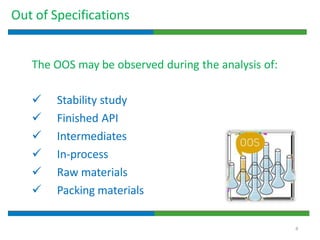
The OOS may be observed during the analysis of:
 Stability study
 Finished API
 Intermediates
 In-process
 Raw materials
 Packing materials
4
Out of Specifications
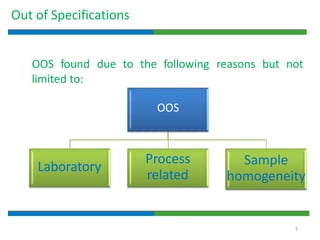
OOS found due to the following reasons but not
limited to:
OOS
Laboratory
Process
related
Sample
homogeneity
5
Out of Specifications
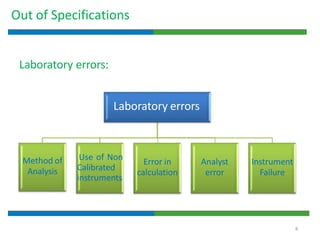
Laboratory errors:
Laboratory errors
Method of
Analysis
Use of Non
Calibrated
instruments
Error in
calculation
Analyst
error
Instrument
Failure
6
Out of Specifications
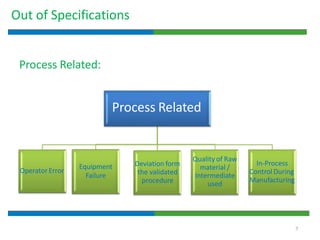
Process Related:
Process Related
Operator Error
Equipment
Failure
Deviation form
the validated
procedure
Quality of Raw
material /
Intermediate
used
In-Process
Control During
Manufacturing
7
Out of Specifications
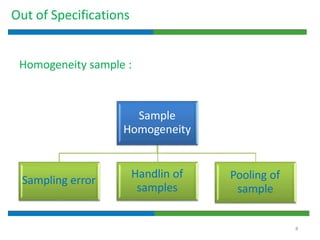
Homogeneity sample :
Sample
Homogeneity
Sampling error
Handlin of
samples
Pooling of
sample
8
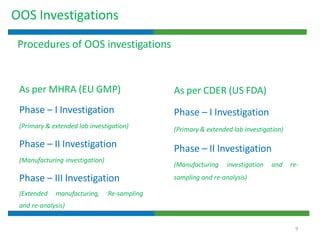
OOS Investigations
9
As per MHRA (EU GMP)
Phase – I Investigation
(Primary & extended lab investigation)
Phase – II Investigation
(Manufacturing investigation)
Phase – III Investigation
(Extended manufacturing, Re-sampling
and re-analysis)
Procedures of OOS investigations
As per CDER (US FDA)
Phase – I Investigation
(Primary & extended lab investigation)
Phase – II Investigation
(Manufacturing investigation and re-
sampling and re-analysis)
OOS Investigations
10
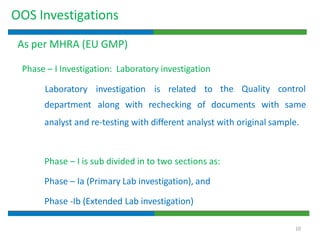
Phase – I Investigation: Laboratory investigation
Laboratory investigation is related to the Quality control
department along with rechecking of documents with same
analyst and re-testing with different analyst with original sample.
Phase – I is sub divided in to two sections as:
Phase – Ia (Primary Lab investigation), and
Phase -Ib (Extended Lab investigation)
As per MHRA (EU GMP)
OOS Investigations
11
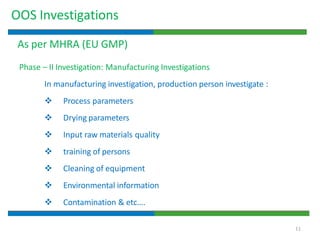
As per MHRA (EU GMP)
Phase – II Investigation: Manufacturing Investigations
In manufacturing investigation, production person investigate :
 Process parameters
 Drying parameters
 Input raw materials quality
 training of persons
 Cleaning of equipment
 Environmental information
 Contamination & etc….
OOS Investigations
12
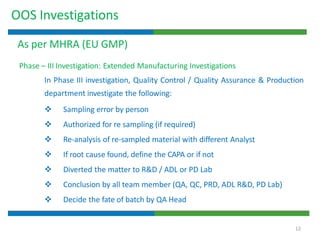
As per MHRA (EU GMP)
Phase – III Investigation: Extended Manufacturing Investigations
In Phase III investigation, Quality Control / Quality Assurance & Production
department investigate the following:
 Sampling error by person
 Authorized for re sampling (if required)
 Re-analysis of re-sampled material with different Analyst
 If root cause found, define the CAPA or if not
 Diverted the matter to R&D / ADL or PD Lab
 Conclusion by all team member (QA, QC, PRD, ADL R&D, PD Lab)
 Decide the fate of batch by QA Head
OOS Investigations
13
Re-testing:
The analysis of original sample at the time of phase- I laboratory investigation.
Re-sampling:
The original batch is sampled by QA second time after QA head authorization for re-
analysis.
Re-analysis:
The analysis of re-sampled material for the verification of results, if
manufacturing investigation does not have root cause.
OOS Investigations
14
Phase – I Investigation: Laboratory investigation
Laboratory investigation is related to the Quality control
same
original
department along with rechecking of documents with
analyst and re-testing with different analyst with
sample.
Phase – II Investigation: Manufacturing investigation
Process related investigation is to
Production department along with
analysis.
be carried
re-sampling
out by
and re-
As per CDER (US FDA)
OOS Investigations
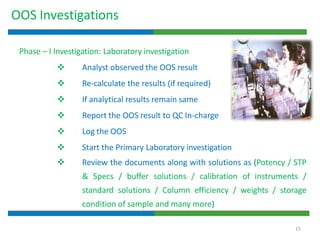
Phase – I Investigation: Laboratory investigation
 Analyst observed the OOS result
 Re-calculate the results (if required)
 If analytical results remain same
 Report the OOS result to QC In-charge
 Log the OOS
 Start the Primary Laboratory investigation
 Review the documents along with solutions as (Potency / STP
& Specs / buffer solutions / calibration of instruments /
standard solutions / Column efficiency / weights / storage
condition of sample and many more)
15
OOS Investigations
Phase – I Investigation: Laboratory investigation


 If there is no abnormality observed during the primary
lab investigation then
Report same results and considered as valid OOS and report
Quality Head review the primary lab investigation and
evaluate for re-testing (if QA Head permits)
 Repeat the analysis as thrice with original sample with
different analyst
 Report the average result of repeat analysis
 Report the average result
16
OOS Investigations
Phase – I Investigation: Laboratory investigation
 If the result complies
 Report as complies and invalidate the OOS
 Release the batch
 If any of result if not complies (among three)
 Report as OOS and continue the OOS
 Report to QA head
QA head will recommend for the Phase – II investigation (manufacturing
investigation)
17
OOS Investigations
Phase – II Investigation: Manufacturing investigation
Production persons shall investigate the following:
 Input quantity of raw material
 Input RM quality
 Process parameters details
 Critical process parameter details (time / temp)
 In-process results
 Out put of the material
 Re-conciliation of raw materials
 Utility pressures
 Calibration / Preventive maintenance of equipment
 Attached ancillaries status
18
OOS Investigations
19
Phase – II Investigation: Manufacturing investigation
Production persons shall investigate the following:
 Cleaning of equipments
 Training of personnel
 Brain storming with operators
 Contamination verifications

If there is
Environmental review
no assignable cause observed during manufacturing
investigations, same is to be reported to Quality Assurance Head.
OOS Investigations
Phase – II Investigation: Manufacturing investigation
QA, QC and production department will evaluate the investigations and after that:
 Sampling procedure review, if suspected
 QA head may recommend for re-sampling
 QC analyst shall analyze the sample as per STP
 Report the result (Pass / Failed)
 If Pass
 Define the CAPA
 Release the Batch
 If failed
 Reject the batch
 Divert the matter to R&D / ADL / PD Lab
20
OOS Investigations
21
Phase – II Investigation: Manufacturing investigation
R&D / ADL / PD Lab shall:
Investigate the failure based on experiments / experiences
Various types of experiments
To find out the root cause
To identify, is this material can b e reprocessed / reworked
Make a summary report
 Take the user trial with the material





 Defined the corrective actions
OOS Investigations
22
Phase – II Investigation: Manufacturing investigation
QA/QC/Production department shall:







 QA head shall define the fate of batch for reprocess / rework /
destruction
Accept the corrective and preventive actions
Training to all concerned for root cause / corrective action / preventive
action
Monitor the activity for corrective actions
Evaluate the results of corrective actions
Implement the preventive actions
Verify the implementation of preventive actions
After satisfactory implementation close the OOS & CAPA
OOS Investigations
All these activity for investigation / corrective actions / preventive
actions should be recorded and reviewed and archived.
23
OOS Investigations
24
If OOS batch is to be reprocessed / re-work:
Sample as per SOP for sampling of material
Analyze the material according to the specification and STP
Evaluate the quality of the batch
Keep this batch for stability (Accelerated / Long term)
Evaluate the stability results of the batch
 Follow the written approved BMR for re-process / Rework





 Communicate the OOS to the customers (as mentioned in to the
Quality agreement)
OOS Investigations
Impact of OOS on REGULATORY:
OOS should be reported to RA
OOS batch should not be sold to Regulatory market
OOS batch can not be blend with fresh approved batch
 Stability study required



 OOS batch can not be directly sell to the market
25
Abbreviations
26
: Center for drug evaluation and research
OOS : Out of specification
RA : Regulatory affairs
STP
 CDER




: Standard testing procedure
EU-GMP : European good manufacturing practices
Pharmaceutical inspection co-operation
scheme
 PIC/s :
Thank You
27