SOM,ASOMANDCSOM [TTD]
PRINCIPALS OF MANAGEMENT
AND SURGICAL APPROACHES
SEMINAR PRESNTED BY
DRV SANKAR NAIK
SEROUSOTITIS MEDIA(SOM)
SEROUSOTITIS
MEDIA(SOM)
DEFINITION:
Otitis media with effusion (OME) is defined as
chronic accumulation of mucus within the
middle ear, and rarely this could involve the
mastoid air cell system.This accumulation
causes conductive hearing loss.
PATHOGENISIS
OME PICTURE
PATHOGENISIS
 Histology and histopathology of eustachean tube:
 The pseudostratified ciliated columnar epithelium of
respiratory tract extends up the eustachean tube as far
as the anterior part of the middle ear cavity.These cells
are capable of producing mucous.There are also goblet
cells seen in their midst.These cells are also capable of
secreting mucous material. Otitis media with effusion
is caused by inflammation of this epithelium in the
eustachean tube and hypotympanum. In established
cases of glue ear, the cuboidal epitheliumof middle ear
and mastoid air cells gets replaced by thickened
pseudostratified columnar epithelium.The cilia of
these cells have also been found to be ineffective in
propelling the secretions into the nasopharynx.The
submucosa is found to be oedematous, inflammed
with dilated blood vessels with increased number of
macrophages and plasma cells
SEROUS
OTITIS MEDIA
(som)
Etiology:
1. In many children otitis media with effusion is preceded by
an episode of acute otitismedia.This is common in children
who is more prone for upper respiratory infections.Common
being viral infections which damages the eustachean tube
epithelium.
2. Craniofacial abnormalities: Children with cleft palate
have deficient palatal muscles causing a poor eustachean
tube function leading on to Otitis media with effusion.This
occurs despite a successful surgical repair of the cleft palate.
Children with Down'ssyndrome are also more prone for
OME.
Note: Children with bifid uvula donot appear to have higher
incidence of OME
ETIOLOGY:ctd
3. Allergy: Previously nasal allergy has been
postulated as an important factor in the
development of Otitis media with effusion.
4. Gastrooesophageal reflux: GERDS has
been commonly demonstrated radiologically
in children with OME. Furthermore
biochemical analysis of middle ear fluid have
demonstrated significant amounts of pepsin
(in 80% of cases).
5. Parental smoking has been attributed as an
important predisposing factor for the
development of OME.
ETIOLOGY:ctd
Age of occurrence: OME shows classically a
bimodal distribution.The first peak occurs
around 2 years of age, and the second peak
occurs at about 5 years of age.This distribution
occurs roughly around the ages when the child
goes to preschool and primary school.
Seasonal association: OME commonly occurs
during winter season, when there is more
likelihood of upper respiratory infections, and
also because of the possibility of closer contact
with affected children.This is seen in
temperate zones. In non temperate zones it is
commonly seen during rainy season.
SYMPTOMS
 Blocking sensation of the ears
 Deafness (conductive type )
 Child’s performance will be low
 Wooly feeling in the ear
 Autophony
 Nasal discharge
 Nasal obstruction
Signs
 Tympanic membrane retraction
 Evidence of fluid in the middle ear
 Mobility ofTM is decreased
 TM appears dull and lusterless
Tuning fork test :
 Rinnes negative
 Webers lateralised to affected side
 ABC normal
Investigations
PLAIN X RAY
 Waters view of PNS to rule out the sinus infection
 Lateral view of nasopharynx to rule out hypertrophied
adenoids
AUDIOMETRY
 PTA - conductive deafness commonly in low frequency
becoz of increase of mass factors in middle ear
 IA - flat curve with shift in compliance to negative side
WATER`SVIEW
LATERALVIEW:
NASOPHARYNX
PTA :CHL-LOW
FREQUENCY
IMPEDANCE:
FLATECURVE
TREATMENT
 Prevention of secretory otitis media
 Removal of possible causes e.g. adenoidectomy
 Anti allergic treatment – anti histamines , desensitisation
 Advice child to sit in front row
 Myringotomy with grommet insertion
MYRINGOTOMY
Definition
It is incision of theTM with the purpose to drain suppurative or
non suppurative Effusion of the middle ear or to provide aireiation
in case of malfunctioning eustachian tube
Indication
1:Asom
2:Som
3:Aero-otitis media ( to drain fluid and unlock the ET )
4:Atelectatic ear ( grommet is often inserted for
long term aeriation)
Contraindication
1:suspected intratympanic glomus tumour
2: profuse bleeding
Myringotomy
steps
STEPS OF OPERATION
1. Ear canal cleaned
2 .In asom circumferential incision is made in the
posteroinferior quadrant ofTM midway between handle of
malleus and tympanic annulus ,avoiding injury to
incudostapedial joint
3. som a small radial incision is given in the posteroinferior or
anteroinferior quadrant and all the efussion sucked out
Myringotomy
Incision types
ACUTESUPPURATIVE
OTITIS MEDIA (ASOM)
ACUTE
SUPPURATIVE
OTITIS MEDIA
(ASOM)
 Definition:
 pyogenic infection of middle ear clef lasting for less
than 3 weeks.
 ROUTES OF INCETION :
 1.Via Eustachain tube
 2.ViaTympanic membrane perforation
 3.Haematogenous (rare)
PREDISPOSING FACTORS:
 1. Recurrent attacks of common cold, upper respiratory
 tract infections and exanthematous fevers like
measles, diphtheria or whooping cough.
 2. Infections of tonsils and adenoids.
 3. Chronic rhinitis and sinusitis.
 4. Nasal allergy.
 5.Tumours of nasopharynx, packing of nose or
nasopharynx for epistaxis.
 6. Cleft palate
Bacteriology
 Haemophilus influenzae
 Streptococcus pneumoniae
 Staphylococcus aureus
 Moraxella catarrhalis
 H. influenzae
 β-Hemolytic streptococci (cause acute
necrotizing otitis media)
Stages ofA.S.O.M
STAGESOF
ASOM
Stage 1:of hyperemia .
Stage 2: of exudation.
Stage 3: of suppuration.
Stage 4: of coalescent mastoiditis.
Stage 5: of complication.
Stage 6: of resolution.
Stage 1:
Hyperemia
 Earache
 Fullness of the ear
 Fever
 Deafness-mild conductive type
 Running nose and nasal obstruction
signs
 Tympanic membrane congested
 Cartwheel appearance
 Nasal mucosa congestion
treatment
Antibiotics
Analgesics and antipyretics
Decongestants
Nasal drops
Steam inhalation
Stage 2:
exudation
 Ear pain will increase.
 Blocking sensation of the ear will increase.
 Deafness increase
Signs:
 TM thick,congested,bulging
 X-ray mastoid –haziness,cloudy.
Treatment:
 Antibiotics
 Myringotomy
X Ray of Mastoid
Stage 3:
Suppuration
Symptoms:
 Ear pain decrease-because of discharge
 Discharge –blood stained,serosanguineous,mucoplurent
Signs
 TM small central perforation
 Light house sign.
Treatment:
 Aural toilet-dry mopping
 Broad spectrum antibiotic ear drops gentamycin,neosporin
MASTOID
RESERVOIR SIGN
Pathogenesis
of coalescent
mastoiditis
Hyperemia
Neo vascularity
Mucosal edema
Obstruction of aditus
Failure of drainage
Venous stasis
Localised acidosis
Dissolvation of the wall of air cells because of hyperemic decalcification
Coalescence of mastoid air cells mastoid will be bag of pus
Stage 4:
coalescent
mastoiditis
Symptoms :
 Earache increase after period of 2
weeks of remission
 Fever
 Discharge-mucoplurent
 Deafness
Signs:
 Mastoid tenderness
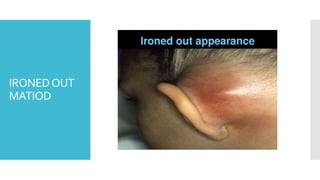
 Ironed out mastoid
 Tm-cp with polypoidal middle ear
mucosa
 Sagging of the posterior superior
meatal wall
 X-ray mastoid clouding of air cells
Treatment : cortical mastoidectomy
and drainage of pus
IRONEDOUT
MATIOD
TMCP
Sagging of
posterior super
meatal wall
Stage 5:
complications
 Untreated cases can lead to complications which can
be divided into two :Intra and extra cranial
complications.
extra cranial complications
 Mastoiditis and mastoid abscess
 Facial nerve paralysis
 Labyrinthitis
 Petrositis
 Otogenic tetanus
Intracranial complications
 Extradural abscess
 Subdural abscess
 Brain abscess
 Lateral sinus thrombosis
 Otitic hydrocephalous
 Meningitis
Treatment depends on type of complications
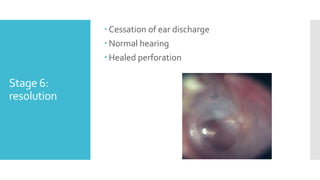
Stage 6:
resolution
 Cessation of ear discharge
 Normal hearing
 Healed perforation
CHRONIC
SUPPURATIVEOTITIS
MEDIA (CSOM)
DEFINITION
&
CLASSIFICATION
It is defined as chronic inflammation of mucoperiosteal
lining of the middle ear cleft .
CLASSIFICATION
1.TUBOTYMPANICTYPE / SAFETYPE
 Inactive mucosal COM ( permanent perforation without discharge)
 Active mucosal COM ( permanent perforation with discharge )
 Healed COM
2.
ATTICOANTRAL
TYPE/UNSAFE
TYPE
2. ATTICOANTRALTYPE/ UNSAFETYPE
 Inactive squamous COM (Retraction pocket with potential of being
active with cholesteatoma )
 active squamous ( retraction pocket with cholesteatoma)
TUBO
TYMPANIC
TYPE
-ETIOLOGY
Predisposing factors
 Improper treatment ofASOM
 Infection of surrounding areas
 Some diseases likeTB
 Pneumatisation of mastoid
Exciting factors
 Gram negative organisms like pseudomonas ,proteus ,
e-coli
 Streptococcus
 Staphylococcus
SYMPTOMS
1.Discharge : profuse ,intermittent ,predominantly
mucoid ,occasionally mucopurulent , non –foul
smelling , whitish to yellowish and tenacious.
 Active
 Inactive
 Healed
2.Deafness : mild conductive
3.Earache
SIGNS
1.Discharge
2.Tympanic membrane :central perporation can be
A – small / pin hole perforation
Tests to identify pin hole perforation
1.Bonsins test
2.Valsalva test
3.Drop of otobiotic ear drops instilled in ear then pt. is asked to doValsalva ,
air bubbles are seen
B- medium sized perforation
C- large / sub – total perforation
D complete / total perforation
Types of
perforation
Auditory
function tests
3.Tuning fork tests
Rinnes negative
Webers lateralised to affected side
Abc normal
INVESTIGATIONS
Culture and
sensitivity
Examination under
microscope
PTA
Xray of mastoid
X ray PNS
X ray of soft tissue
neck lateral view
DNE Improved / decreased/no Hearing
Then perforation is closed with cigarette foil
And repeat audiogram
Before patching PTA taken
PATCHTEST
TREATMENT
 Active stage : conservative treatment
with medical management
 Quiscent stage : if infective focus is
limited to mastoid , a myringo plasty
.tympanoplasty can be done along with
cortical mastoidectomy.
 Inactive stage .
Myringoplasty
DEFINITION
Myringoplasty is a procedure used to seal a
perforated tympanic membrane using a graft
material
Temporalis fascia is the commonly used graft material
because:
 1. It is an autograft with excellent chance of take
 2. It is available close to the site of operation making
its harvest
 3. It has a low basal metabolic rate, brightening its
success rate
 4. Its thickness is more or less similar to that of
tympanic membrane
 There are two available methods of performing
myringoplasty: Overlay technique Under lay
technique
Overlay technique:
 This is a difficult technique to master. Here the
graft material is inserted under the squamous
(skinlayer) of the ear drum. It is a difficult task
peeling only the skin layer away from the tympanic
membrane, placing the graft over the perforation
and redraping the skin layer.
Underlay technique:
 This is a simpler and commonly used technique.
Here the graft is placed under the tympano meatal
flap which has been elevated hence the name
under lay.The major advantage of this procedure is
that it is easy to perform with a good success rate.
Indications of
Myringoplasty:
 1. Central perforation which has been dry
atleast for a period of 6 weeks.
 2. As a follow up to mastoidectomy procedure
to recreate the hearing mechanism
Prerequisites
for
myringoplasty
1. Central perforation which has been dry for at
least 6 weeks
2. Normal middle ear
3. Intact ossicular chain
4. Good cochlear reserve
STEP I
 Firstly a temporalis fascia of adequate site must
be harvested and allowed to dry.
 The surgery is performed under local anesthesia
 Temporalis fascia graft is harvested under local
anesthesia conventionally and allowed to dry.
 The external auditory canal is then anesthetised
using 2 % xylocaine mixed with 1 in 10,000
adrenaline injection. About 1/2 cc is infiltrated at 3
- o clock, 6 - o clock, 9 - o clock, and 12 - o clock
positions about 3mm from the annulus.
 The patient is premedicated with intramuscular
injections of 1 ampule fortwin and 1 ampule
phenergan.
Step I
 Freshening the margins of perforation
 In this step the margins of the perforation is
freshened using a sickle knife of an angled pick
 This step is very important because it breaks
the adhesions formed between the squamous
margin of the ear drum (outer layer) with that
of the middle ear mucosa
 These adhesions if left undisturbed will hinder
the take up of the neo tympanic graft.
 This procedure will infact widen the already
present perforation.There is nothing to be
alarmed about it
STEP II
 This step is otherwise known as elevation of tympano meatal
flap.
 Using a drum knife a curvilinear incision is made about 3 mm
lateral to the annulus.
 This incision ideally extends between the 12 - o clock, 3 - o
clock, and 6 - o clock positions in the left ear, and 12 - o clock, 9
- o clock and 6 - o clock positions in the right ear.
 The skin is slowly elevated away from the bone of the external
canal.
 Pressure should be applied to the bone while elevation.
 This serves two purposes:
 1. It prevents excessive bleeding
 2. It prevents tearing of the flapThis step ends when the skin
flap is raised up to the level of the annulus.
STEP III
 Elevation of the annulus and incising the middle
ear mucosa.
 In this step the annulus is gradually lifted from its
rim.
 As soon as the annulus is elevated a sickle knife is
used to incise the middle ear mucosal
attachement with the tympano meatal flap.
 This is a very important step because the inner
layer of the remnant ear drum is continuous with
the middle ear mucosa.
 As soon as the middle ear mucosa is raised, the
flap is pushed anteriorly till the handle of the
malleus becomes visible.
STEP IV
 Freeing the tympano meatal flap from the handle of
malleus.
 In this step the tymano meatal flap is freed from the
handle of malleus by sharp dissection of the middle ear
mucosa.
 Sometimes the handle of the malleus may be turned
inwards hitching against the promontory
 In this scenario, an attempt is made to lateralise the
handle of the malleus.
 it is not possible to lateralise the handle of the malleus,
the small deviated tip portion of the handle can be
clipped.
 The handle of the malleus is freshened and stripped of
its mucosal covering
STEPV
 Placement of graft (underlay technique).
 Now a properly dried temporalis fascia graft of
appropriate size is introduced through the ear canal.
 The graft is gently pushed under the tympano meatal
flap which has been elevated.
 The graft is insinuated under the handle of malleus.
 The tympano meatal flap is repositioned in such a way
that it covers the free edge of the graft which has been
introduced.
 Bits of gelfoam is placed around the edges of the
raised flap.
 One gel foam bit is placed over the sealed perforation.
This gelfoam has a specific role to play.
 Due to the suction effect created it pulls the graft
against the edges of the perforation thus perventing
medialisation of the graft material.
3RD SEMINAR VSN,,.pptx

3RD SEMINAR VSN,,.pptx

  • 1.
    SOM,ASOMANDCSOM [TTD] PRINCIPALS OFMANAGEMENT AND SURGICAL APPROACHES SEMINAR PRESNTED BY DRV SANKAR NAIK
  • 2.
  • 3.
    SEROUSOTITIS MEDIA(SOM) DEFINITION: Otitis media witheffusion (OME) is defined as chronic accumulation of mucus within the middle ear, and rarely this could involve the mastoid air cell system.This accumulation causes conductive hearing loss.
  • 4.
  • 5.
  • 7.
    PATHOGENISIS  Histology andhistopathology of eustachean tube:  The pseudostratified ciliated columnar epithelium of respiratory tract extends up the eustachean tube as far as the anterior part of the middle ear cavity.These cells are capable of producing mucous.There are also goblet cells seen in their midst.These cells are also capable of secreting mucous material. Otitis media with effusion is caused by inflammation of this epithelium in the eustachean tube and hypotympanum. In established cases of glue ear, the cuboidal epitheliumof middle ear and mastoid air cells gets replaced by thickened pseudostratified columnar epithelium.The cilia of these cells have also been found to be ineffective in propelling the secretions into the nasopharynx.The submucosa is found to be oedematous, inflammed with dilated blood vessels with increased number of macrophages and plasma cells
  • 8.
    SEROUS OTITIS MEDIA (som) Etiology: 1. Inmany children otitis media with effusion is preceded by an episode of acute otitismedia.This is common in children who is more prone for upper respiratory infections.Common being viral infections which damages the eustachean tube epithelium. 2. Craniofacial abnormalities: Children with cleft palate have deficient palatal muscles causing a poor eustachean tube function leading on to Otitis media with effusion.This occurs despite a successful surgical repair of the cleft palate. Children with Down'ssyndrome are also more prone for OME. Note: Children with bifid uvula donot appear to have higher incidence of OME
  • 9.
    ETIOLOGY:ctd 3. Allergy: Previouslynasal allergy has been postulated as an important factor in the development of Otitis media with effusion. 4. Gastrooesophageal reflux: GERDS has been commonly demonstrated radiologically in children with OME. Furthermore biochemical analysis of middle ear fluid have demonstrated significant amounts of pepsin (in 80% of cases). 5. Parental smoking has been attributed as an important predisposing factor for the development of OME.
  • 10.
    ETIOLOGY:ctd Age of occurrence:OME shows classically a bimodal distribution.The first peak occurs around 2 years of age, and the second peak occurs at about 5 years of age.This distribution occurs roughly around the ages when the child goes to preschool and primary school. Seasonal association: OME commonly occurs during winter season, when there is more likelihood of upper respiratory infections, and also because of the possibility of closer contact with affected children.This is seen in temperate zones. In non temperate zones it is commonly seen during rainy season.
  • 12.
    SYMPTOMS  Blocking sensationof the ears  Deafness (conductive type )  Child’s performance will be low  Wooly feeling in the ear  Autophony  Nasal discharge  Nasal obstruction
  • 13.
    Signs  Tympanic membraneretraction  Evidence of fluid in the middle ear  Mobility ofTM is decreased  TM appears dull and lusterless Tuning fork test :  Rinnes negative  Webers lateralised to affected side  ABC normal
  • 14.
    Investigations PLAIN X RAY Waters view of PNS to rule out the sinus infection  Lateral view of nasopharynx to rule out hypertrophied adenoids AUDIOMETRY  PTA - conductive deafness commonly in low frequency becoz of increase of mass factors in middle ear  IA - flat curve with shift in compliance to negative side
  • 15.
  • 16.
  • 17.
  • 18.
  • 19.
    TREATMENT  Prevention ofsecretory otitis media  Removal of possible causes e.g. adenoidectomy  Anti allergic treatment – anti histamines , desensitisation  Advice child to sit in front row  Myringotomy with grommet insertion
  • 20.
    MYRINGOTOMY Definition It is incisionof theTM with the purpose to drain suppurative or non suppurative Effusion of the middle ear or to provide aireiation in case of malfunctioning eustachian tube Indication 1:Asom 2:Som 3:Aero-otitis media ( to drain fluid and unlock the ET ) 4:Atelectatic ear ( grommet is often inserted for long term aeriation) Contraindication 1:suspected intratympanic glomus tumour 2: profuse bleeding
  • 21.
  • 22.
    STEPS OF OPERATION 1.Ear canal cleaned 2 .In asom circumferential incision is made in the posteroinferior quadrant ofTM midway between handle of malleus and tympanic annulus ,avoiding injury to incudostapedial joint 3. som a small radial incision is given in the posteroinferior or anteroinferior quadrant and all the efussion sucked out
  • 23.
  • 24.
  • 25.
    ACUTE SUPPURATIVE OTITIS MEDIA (ASOM)  Definition: pyogenic infection of middle ear clef lasting for less than 3 weeks.  ROUTES OF INCETION :  1.Via Eustachain tube  2.ViaTympanic membrane perforation  3.Haematogenous (rare)
  • 26.
    PREDISPOSING FACTORS:  1.Recurrent attacks of common cold, upper respiratory  tract infections and exanthematous fevers like measles, diphtheria or whooping cough.  2. Infections of tonsils and adenoids.  3. Chronic rhinitis and sinusitis.  4. Nasal allergy.  5.Tumours of nasopharynx, packing of nose or nasopharynx for epistaxis.  6. Cleft palate
  • 27.
    Bacteriology  Haemophilus influenzae Streptococcus pneumoniae  Staphylococcus aureus  Moraxella catarrhalis  H. influenzae  β-Hemolytic streptococci (cause acute necrotizing otitis media)
  • 28.
  • 29.
    STAGESOF ASOM Stage 1:of hyperemia. Stage 2: of exudation. Stage 3: of suppuration. Stage 4: of coalescent mastoiditis. Stage 5: of complication. Stage 6: of resolution.
  • 30.
    Stage 1: Hyperemia  Earache Fullness of the ear  Fever  Deafness-mild conductive type  Running nose and nasal obstruction
  • 31.
    signs  Tympanic membranecongested  Cartwheel appearance  Nasal mucosa congestion
  • 32.
  • 33.
    Stage 2: exudation  Earpain will increase.  Blocking sensation of the ear will increase.  Deafness increase Signs:  TM thick,congested,bulging  X-ray mastoid –haziness,cloudy. Treatment:  Antibiotics  Myringotomy
  • 34.
    X Ray ofMastoid
  • 35.
    Stage 3: Suppuration Symptoms:  Earpain decrease-because of discharge  Discharge –blood stained,serosanguineous,mucoplurent Signs  TM small central perforation  Light house sign. Treatment:  Aural toilet-dry mopping  Broad spectrum antibiotic ear drops gentamycin,neosporin
  • 36.
  • 37.
    Pathogenesis of coalescent mastoiditis Hyperemia Neo vascularity Mucosaledema Obstruction of aditus Failure of drainage Venous stasis Localised acidosis Dissolvation of the wall of air cells because of hyperemic decalcification Coalescence of mastoid air cells mastoid will be bag of pus
  • 38.
    Stage 4: coalescent mastoiditis Symptoms : Earache increase after period of 2 weeks of remission  Fever  Discharge-mucoplurent  Deafness Signs:  Mastoid tenderness  Ironed out mastoid  Tm-cp with polypoidal middle ear mucosa  Sagging of the posterior superior meatal wall  X-ray mastoid clouding of air cells Treatment : cortical mastoidectomy and drainage of pus
  • 39.
  • 40.
  • 41.
    Stage 5: complications  Untreatedcases can lead to complications which can be divided into two :Intra and extra cranial complications. extra cranial complications  Mastoiditis and mastoid abscess  Facial nerve paralysis  Labyrinthitis  Petrositis  Otogenic tetanus
  • 42.
    Intracranial complications  Extraduralabscess  Subdural abscess  Brain abscess  Lateral sinus thrombosis  Otitic hydrocephalous  Meningitis Treatment depends on type of complications
  • 43.
    Stage 6: resolution  Cessationof ear discharge  Normal hearing  Healed perforation
  • 44.
  • 45.
    DEFINITION & CLASSIFICATION It is definedas chronic inflammation of mucoperiosteal lining of the middle ear cleft . CLASSIFICATION 1.TUBOTYMPANICTYPE / SAFETYPE  Inactive mucosal COM ( permanent perforation without discharge)  Active mucosal COM ( permanent perforation with discharge )  Healed COM
  • 46.
    2. ATTICOANTRAL TYPE/UNSAFE TYPE 2. ATTICOANTRALTYPE/ UNSAFETYPE Inactive squamous COM (Retraction pocket with potential of being active with cholesteatoma )  active squamous ( retraction pocket with cholesteatoma)
  • 47.
    TUBO TYMPANIC TYPE -ETIOLOGY Predisposing factors  Impropertreatment ofASOM  Infection of surrounding areas  Some diseases likeTB  Pneumatisation of mastoid Exciting factors  Gram negative organisms like pseudomonas ,proteus , e-coli  Streptococcus  Staphylococcus
  • 48.
    SYMPTOMS 1.Discharge : profuse,intermittent ,predominantly mucoid ,occasionally mucopurulent , non –foul smelling , whitish to yellowish and tenacious.  Active  Inactive  Healed 2.Deafness : mild conductive 3.Earache
  • 49.
    SIGNS 1.Discharge 2.Tympanic membrane :centralperporation can be A – small / pin hole perforation Tests to identify pin hole perforation 1.Bonsins test 2.Valsalva test 3.Drop of otobiotic ear drops instilled in ear then pt. is asked to doValsalva , air bubbles are seen B- medium sized perforation C- large / sub – total perforation D complete / total perforation
  • 50.
  • 51.
    Auditory function tests 3.Tuning forktests Rinnes negative Webers lateralised to affected side Abc normal
  • 52.
    INVESTIGATIONS Culture and sensitivity Examination under microscope PTA Xrayof mastoid X ray PNS X ray of soft tissue neck lateral view DNE Improved / decreased/no Hearing Then perforation is closed with cigarette foil And repeat audiogram Before patching PTA taken PATCHTEST
  • 53.
    TREATMENT  Active stage: conservative treatment with medical management  Quiscent stage : if infective focus is limited to mastoid , a myringo plasty .tympanoplasty can be done along with cortical mastoidectomy.  Inactive stage .
  • 54.
  • 55.
    DEFINITION Myringoplasty is aprocedure used to seal a perforated tympanic membrane using a graft material Temporalis fascia is the commonly used graft material because:  1. It is an autograft with excellent chance of take  2. It is available close to the site of operation making its harvest  3. It has a low basal metabolic rate, brightening its success rate  4. Its thickness is more or less similar to that of tympanic membrane
  • 56.
     There aretwo available methods of performing myringoplasty: Overlay technique Under lay technique Overlay technique:  This is a difficult technique to master. Here the graft material is inserted under the squamous (skinlayer) of the ear drum. It is a difficult task peeling only the skin layer away from the tympanic membrane, placing the graft over the perforation and redraping the skin layer. Underlay technique:  This is a simpler and commonly used technique. Here the graft is placed under the tympano meatal flap which has been elevated hence the name under lay.The major advantage of this procedure is that it is easy to perform with a good success rate.
  • 57.
    Indications of Myringoplasty:  1.Central perforation which has been dry atleast for a period of 6 weeks.  2. As a follow up to mastoidectomy procedure to recreate the hearing mechanism
  • 58.
    Prerequisites for myringoplasty 1. Central perforationwhich has been dry for at least 6 weeks 2. Normal middle ear 3. Intact ossicular chain 4. Good cochlear reserve
  • 59.
    STEP I  Firstlya temporalis fascia of adequate site must be harvested and allowed to dry.  The surgery is performed under local anesthesia  Temporalis fascia graft is harvested under local anesthesia conventionally and allowed to dry.  The external auditory canal is then anesthetised using 2 % xylocaine mixed with 1 in 10,000 adrenaline injection. About 1/2 cc is infiltrated at 3 - o clock, 6 - o clock, 9 - o clock, and 12 - o clock positions about 3mm from the annulus.  The patient is premedicated with intramuscular injections of 1 ampule fortwin and 1 ampule phenergan.
  • 60.
    Step I  Fresheningthe margins of perforation  In this step the margins of the perforation is freshened using a sickle knife of an angled pick  This step is very important because it breaks the adhesions formed between the squamous margin of the ear drum (outer layer) with that of the middle ear mucosa  These adhesions if left undisturbed will hinder the take up of the neo tympanic graft.  This procedure will infact widen the already present perforation.There is nothing to be alarmed about it
  • 61.
    STEP II  Thisstep is otherwise known as elevation of tympano meatal flap.  Using a drum knife a curvilinear incision is made about 3 mm lateral to the annulus.  This incision ideally extends between the 12 - o clock, 3 - o clock, and 6 - o clock positions in the left ear, and 12 - o clock, 9 - o clock and 6 - o clock positions in the right ear.  The skin is slowly elevated away from the bone of the external canal.  Pressure should be applied to the bone while elevation.  This serves two purposes:  1. It prevents excessive bleeding  2. It prevents tearing of the flapThis step ends when the skin flap is raised up to the level of the annulus.
  • 62.
    STEP III  Elevationof the annulus and incising the middle ear mucosa.  In this step the annulus is gradually lifted from its rim.  As soon as the annulus is elevated a sickle knife is used to incise the middle ear mucosal attachement with the tympano meatal flap.  This is a very important step because the inner layer of the remnant ear drum is continuous with the middle ear mucosa.  As soon as the middle ear mucosa is raised, the flap is pushed anteriorly till the handle of the malleus becomes visible.
  • 63.
    STEP IV  Freeingthe tympano meatal flap from the handle of malleus.  In this step the tymano meatal flap is freed from the handle of malleus by sharp dissection of the middle ear mucosa.  Sometimes the handle of the malleus may be turned inwards hitching against the promontory  In this scenario, an attempt is made to lateralise the handle of the malleus.  it is not possible to lateralise the handle of the malleus, the small deviated tip portion of the handle can be clipped.  The handle of the malleus is freshened and stripped of its mucosal covering
  • 64.
    STEPV  Placement ofgraft (underlay technique).  Now a properly dried temporalis fascia graft of appropriate size is introduced through the ear canal.  The graft is gently pushed under the tympano meatal flap which has been elevated.  The graft is insinuated under the handle of malleus.  The tympano meatal flap is repositioned in such a way that it covers the free edge of the graft which has been introduced.  Bits of gelfoam is placed around the edges of the raised flap.  One gel foam bit is placed over the sealed perforation. This gelfoam has a specific role to play.  Due to the suction effect created it pulls the graft against the edges of the perforation thus perventing medialisation of the graft material.