
OSTEOMYELITIS
Ahmed Abdulwahab
UG Code : 1330095
1
OSTEOMYELITIS
The term osteomyelitis literally means inflammation of the bone marrow.
Its usually begins in the medullary cavity, involving cancellous bone then it
extends and spreads to cortical bone and eventually to the periosteum.
That causes soft tissue inflammation and edema within the closed bony
marrow Spaces.
As with the dental pulp, soft tissue edema that is enclosed by
hard tissue results in increased tissue hydrostatic pressure that rises above
the blood pressure .
2
OSTEOMYELITIS
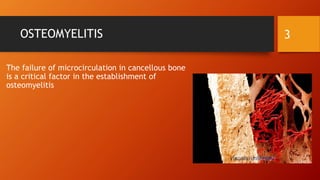
The failure of microcirculation in cancellous bone
is a critical factor in the establishment of
osteomyelitis
3
OSTEOMYELITIS
Although the maxilla can also become involved
in osteomyelitis,
it does so rarely compared with the mandible.
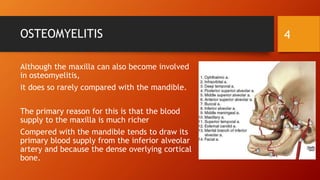
The primary reason for this is that the blood
supply to the maxilla is much richer
Compered with the mandible tends to draw its
primary blood supply from the inferior alveolar
artery and because the dense overlying cortical
bone.
4
OSTEOMYELITIS
osteomyelitis of the mandible also rarely occurs if
the host defenses are intact.
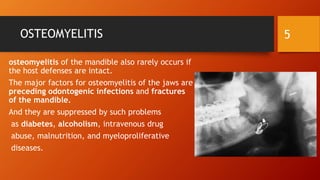
The major factors for osteomyelitis of the jaws are
preceding odontogenic infections and fractures
of the mandible.
And they are suppressed by such problems
as diabetes, alcoholism, intravenous drug
abuse, malnutrition, and myeloproliferative
diseases.
5
OSTEOMYELITIS
Recent performed investigations on the microbiology of osteomyelitis of
the mandible have similar to those causing odontogenic infections
Thus, osteomyelitis of the mandible differs substantially from
osteomyelitis of other bones.
6
OSTEOMYELITIS
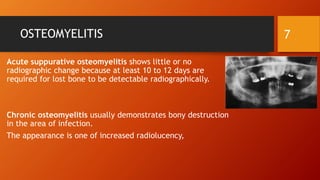
Acute suppurative osteomyelitis shows little or no
radiographic change because at least 10 to 12 days are
required for lost bone to be detectable radiographically.
Chronic osteomyelitis usually demonstrates bony destruction
in the area of infection.
The appearance is one of increased radiolucency,
7
OSTEOMYELITIS
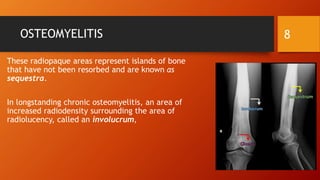
These radiopaque areas represent islands of bone
that have not been resorbed and are known as
sequestra.
In longstanding chronic osteomyelitis, an area of
increased radiodensity surrounding the area of
radiolucency, called an involucrum,
8
OSTEOMYELITIS
Osteomyelitis is treated medically as well as surgically.
Acute osteomyelitis of the jaws is primarily managed by the
administration of surgical débridement, removal of causative factors,
and appropriate antibiotics.
If the event is a fracture of the mandible, careful attention must be given
to accurate reduction and stable fixation.
If the patient has a serious acute osteomyelitis, hospitalization
may be required for intravenous administration of antibiotics,
9
OSTEOMYELITIS
Surgical treatment of acute or chronic suppurative osteomyelitis
consists primarily of removing obviously nonvital teeth in the area
of the infection, any wires or bone plates that may have been used
to stabilize a fracture in the area, or any necrotic, loose pieces of
bone.
10
OSTEOMYELITIS
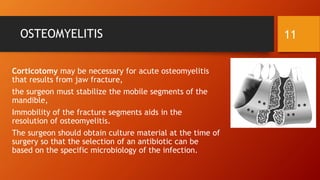
Corticotomy may be necessary for acute osteomyelitis
that results from jaw fracture,
the surgeon must stabilize the mobile segments of the
mandible,
Immobility of the fracture segments aids in the
resolution of osteomyelitis.
The surgeon should obtain culture material at the time of
surgery so that the selection of an antibiotic can be
based on the specific microbiology of the infection.
11
OSTEOMYELITIS
Therapy for acute and chronic osteomyelitis should ensure that
antibiotics are continued for a much longer time than is usual for
odontogenic infections.
should be continued for at least 6 weeks after resolution of symptoms.
For severe chronic osteomyelitis that has been difficult to control,
antibiotic administration may continue for up to 6 months.
12
OSTEOMYELITIS
Osteomyelitis of the mandible is a severe infection that may result
in loss of a large portion of the mandible.
Therefore, a clinician who has the training and experience to
handle the problem expeditiously should manage this infection.
13
THANK YOU FOR
ATTENTION
Ahmed Abdulwahab
UG Code : 1330095

Osteomyelitis (Dentistry)

  • 1.
  • 2.
    OSTEOMYELITIS The term osteomyelitisliterally means inflammation of the bone marrow. Its usually begins in the medullary cavity, involving cancellous bone then it extends and spreads to cortical bone and eventually to the periosteum. That causes soft tissue inflammation and edema within the closed bony marrow Spaces. As with the dental pulp, soft tissue edema that is enclosed by hard tissue results in increased tissue hydrostatic pressure that rises above the blood pressure . 2
  • 3.
    OSTEOMYELITIS The failure ofmicrocirculation in cancellous bone is a critical factor in the establishment of osteomyelitis 3
  • 4.
    OSTEOMYELITIS Although the maxillacan also become involved in osteomyelitis, it does so rarely compared with the mandible. The primary reason for this is that the blood supply to the maxilla is much richer Compered with the mandible tends to draw its primary blood supply from the inferior alveolar artery and because the dense overlying cortical bone. 4
  • 5.
    OSTEOMYELITIS osteomyelitis of themandible also rarely occurs if the host defenses are intact. The major factors for osteomyelitis of the jaws are preceding odontogenic infections and fractures of the mandible. And they are suppressed by such problems as diabetes, alcoholism, intravenous drug abuse, malnutrition, and myeloproliferative diseases. 5
  • 6.
    OSTEOMYELITIS Recent performed investigationson the microbiology of osteomyelitis of the mandible have similar to those causing odontogenic infections Thus, osteomyelitis of the mandible differs substantially from osteomyelitis of other bones. 6
  • 7.
    OSTEOMYELITIS Acute suppurative osteomyelitisshows little or no radiographic change because at least 10 to 12 days are required for lost bone to be detectable radiographically. Chronic osteomyelitis usually demonstrates bony destruction in the area of infection. The appearance is one of increased radiolucency, 7
  • 8.
    OSTEOMYELITIS These radiopaque areasrepresent islands of bone that have not been resorbed and are known as sequestra. In longstanding chronic osteomyelitis, an area of increased radiodensity surrounding the area of radiolucency, called an involucrum, 8
  • 9.
    OSTEOMYELITIS Osteomyelitis is treatedmedically as well as surgically. Acute osteomyelitis of the jaws is primarily managed by the administration of surgical débridement, removal of causative factors, and appropriate antibiotics. If the event is a fracture of the mandible, careful attention must be given to accurate reduction and stable fixation. If the patient has a serious acute osteomyelitis, hospitalization may be required for intravenous administration of antibiotics, 9
  • 10.
    OSTEOMYELITIS Surgical treatment ofacute or chronic suppurative osteomyelitis consists primarily of removing obviously nonvital teeth in the area of the infection, any wires or bone plates that may have been used to stabilize a fracture in the area, or any necrotic, loose pieces of bone. 10
  • 11.
    OSTEOMYELITIS Corticotomy may benecessary for acute osteomyelitis that results from jaw fracture, the surgeon must stabilize the mobile segments of the mandible, Immobility of the fracture segments aids in the resolution of osteomyelitis. The surgeon should obtain culture material at the time of surgery so that the selection of an antibiotic can be based on the specific microbiology of the infection. 11
  • 12.
    OSTEOMYELITIS Therapy for acuteand chronic osteomyelitis should ensure that antibiotics are continued for a much longer time than is usual for odontogenic infections. should be continued for at least 6 weeks after resolution of symptoms. For severe chronic osteomyelitis that has been difficult to control, antibiotic administration may continue for up to 6 months. 12
  • 13.
    OSTEOMYELITIS Osteomyelitis of themandible is a severe infection that may result in loss of a large portion of the mandible. Therefore, a clinician who has the training and experience to handle the problem expeditiously should manage this infection. 13
  • 14.
    THANK YOU FOR ATTENTION AhmedAbdulwahab UG Code : 1330095