Topic Name : OSI & TCP/IP MODEL
Course Title: Computer Networks
Course Code: CSE317
Submitted To:
Pranab Bandhu Nath
Senior Lecturer
Department of CSE
City University
Submitted by
Shohana Akter Kakon
ID : 1834902539
Batch : 49th
Semster : 8th
OSI Model
The OSI Model is a logical and conceptual model that defines network
communication used by systems open to interconnection and communication
with other systems. The Open System Interconnection (OSI Model) also defines a
logical network and effectively describes computer packet transfer by using
various layers of protocols.
Characteristics of the OSI Model
 A layer should only be created where the definite levels of abstraction are
needed.
 The function of each layer should be selected as per the internationally
standardized protocols.
 The number of layers should be large so that separate functions should not
be put in the same layer. At the same time, it should be small enough so
that architecture doesn't become very complicated.
 In the OSI model, each layer relies on the next lower layer to perform
primitive functions. Every level should able to provide services to the next
higher layer.
 Changes made in one layer should not need changes in other lavers.
Layers of the OSI Model:
 Application layer
 Presentation layer
 Session layer
 Transport layer
 Network layer
 Data link layer
 7. Physical layer
Advantages of the OSI Model
 It helps you to standardize router, switch, motherboard, and
other hardware
 Reduces complexity and standardizes interfaces
 Facilitates modular engineering
 Helps you to ensure interoperable technology
 Helps you to accelerate the evolution
 Protocols can be replaced by new protocols when technology
changes.
 It is a standard model in computer networking.
 Supports connectionless and connection-oriented services.
Disadvantages of OSI Model
 Fitting of protocols is a tedious task.
 You can only use it as a reference model.
 It doesn't define any specific protocol.
 In the OSI network layer model, some services are duplicated in many
layers such as the transport and data link layers
 Layers can't work in parallel as each layer need to wait to obtain data from
the previous layer.
TCP/IP Model
TCP/IP helps you to determine how a specific computer should be connected to
the internet and how you can transmit data between them. It helps you to create
a virtual network when multiple computer networks are connected together.
Characteristics TCP/IP Model
 Support for a flexible architecture
 Adding more systems to a network is easy.
 In TCP/IP, the network remains intact until the source and destination
machines were functioning properly.
 TCP is a connection-oriented protocol.
 TCP offers reliability and ensures that data which arrives out of sequence
should put back into order.
 TCP allows you to implement flow control, so the sender never overpowers
a receiver with data.
Layers of the TCP/IP Model
 Application layer
 Transport layer
 Network layer
 Network Interface layer
Advantages of TCP/IP
 It helps you to establish/set up a connection between different types of
computers.
 It operates independently of the operating system.
 It supports many routing-protocols.
 It enables the internetworking between the organizations.
 TCP/IP model has a highly scalable client-server architecture.
 It can be operated independently.
 Supports several routing protocols.
 It can be used to establish a connection between two computers.
Disadvantages of TCP/IP
 TCP/IP is a complicated model to set up and manage.
 The shallow/overhead of TCP/IP is higher-than IPX (Internetwork Packet
Exchange).
 In this, model the transport layer does not guarantee delivery of packets.
 Replacing protocol in TCP/IP is not easy.
 It has no clear separation from its services, interfaces, and protocols.
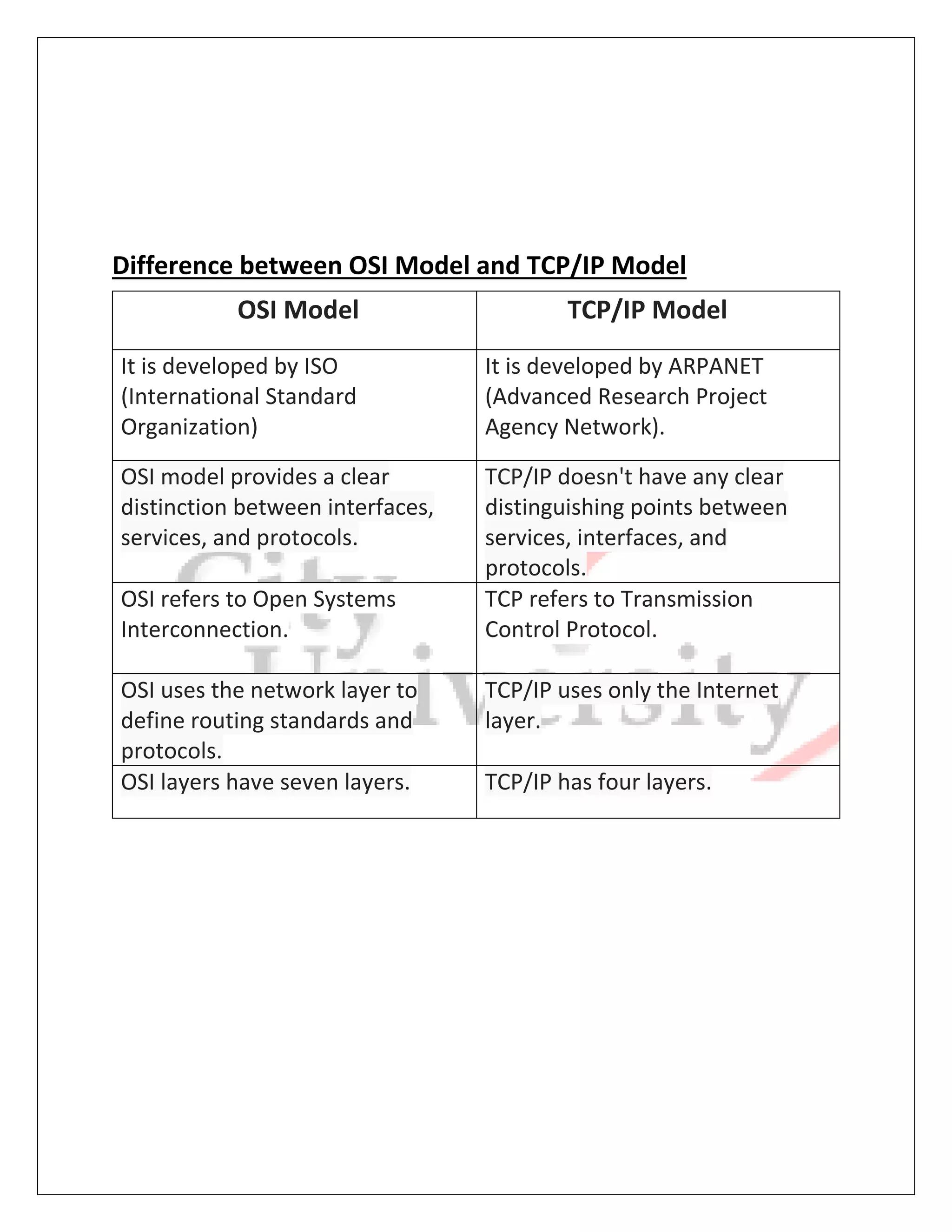
Difference between OSI Model and TCP/IP Model
OSI Model TCP/IP Model
It is developed by ISO
(International Standard
Organization)
It is developed by ARPANET
(Advanced Research Project
Agency Network).
OSI model provides a clear
distinction between interfaces,
services, and protocols.
TCP/IP doesn't have any clear
distinguishing points between
services, interfaces, and
protocols.
OSI refers to Open Systems
Interconnection.
TCP refers to Transmission
Control Protocol.
OSI uses the network layer to
define routing standards and
protocols.
TCP/IP uses only the Internet
layer.
OSI layers have seven layers. TCP/IP has four layers.

OSI & TCP/IP Model

  • 1.
    Topic Name :OSI & TCP/IP MODEL Course Title: Computer Networks Course Code: CSE317 Submitted To: Pranab Bandhu Nath Senior Lecturer Department of CSE City University Submitted by Shohana Akter Kakon ID : 1834902539 Batch : 49th Semster : 8th
  • 2.
    OSI Model The OSIModel is a logical and conceptual model that defines network communication used by systems open to interconnection and communication with other systems. The Open System Interconnection (OSI Model) also defines a logical network and effectively describes computer packet transfer by using various layers of protocols. Characteristics of the OSI Model  A layer should only be created where the definite levels of abstraction are needed.  The function of each layer should be selected as per the internationally standardized protocols.  The number of layers should be large so that separate functions should not be put in the same layer. At the same time, it should be small enough so that architecture doesn't become very complicated.  In the OSI model, each layer relies on the next lower layer to perform primitive functions. Every level should able to provide services to the next higher layer.  Changes made in one layer should not need changes in other lavers. Layers of the OSI Model:  Application layer  Presentation layer  Session layer  Transport layer  Network layer  Data link layer  7. Physical layer Advantages of the OSI Model
  • 3.
     It helpsyou to standardize router, switch, motherboard, and other hardware  Reduces complexity and standardizes interfaces  Facilitates modular engineering  Helps you to ensure interoperable technology  Helps you to accelerate the evolution  Protocols can be replaced by new protocols when technology changes.  It is a standard model in computer networking.  Supports connectionless and connection-oriented services. Disadvantages of OSI Model  Fitting of protocols is a tedious task.  You can only use it as a reference model.  It doesn't define any specific protocol.  In the OSI network layer model, some services are duplicated in many layers such as the transport and data link layers  Layers can't work in parallel as each layer need to wait to obtain data from the previous layer. TCP/IP Model TCP/IP helps you to determine how a specific computer should be connected to the internet and how you can transmit data between them. It helps you to create a virtual network when multiple computer networks are connected together. Characteristics TCP/IP Model  Support for a flexible architecture  Adding more systems to a network is easy.  In TCP/IP, the network remains intact until the source and destination machines were functioning properly.  TCP is a connection-oriented protocol.
  • 4.
     TCP offersreliability and ensures that data which arrives out of sequence should put back into order.  TCP allows you to implement flow control, so the sender never overpowers a receiver with data. Layers of the TCP/IP Model  Application layer  Transport layer  Network layer  Network Interface layer Advantages of TCP/IP  It helps you to establish/set up a connection between different types of computers.  It operates independently of the operating system.  It supports many routing-protocols.  It enables the internetworking between the organizations.  TCP/IP model has a highly scalable client-server architecture.  It can be operated independently.  Supports several routing protocols.  It can be used to establish a connection between two computers. Disadvantages of TCP/IP  TCP/IP is a complicated model to set up and manage.  The shallow/overhead of TCP/IP is higher-than IPX (Internetwork Packet Exchange).  In this, model the transport layer does not guarantee delivery of packets.  Replacing protocol in TCP/IP is not easy.  It has no clear separation from its services, interfaces, and protocols.
  • 5.
    Difference between OSIModel and TCP/IP Model OSI Model TCP/IP Model It is developed by ISO (International Standard Organization) It is developed by ARPANET (Advanced Research Project Agency Network). OSI model provides a clear distinction between interfaces, services, and protocols. TCP/IP doesn't have any clear distinguishing points between services, interfaces, and protocols. OSI refers to Open Systems Interconnection. TCP refers to Transmission Control Protocol. OSI uses the network layer to define routing standards and protocols. TCP/IP uses only the Internet layer. OSI layers have seven layers. TCP/IP has four layers.