Parul Institute of Engineering & Technology
Subject Code : 150702
Name Of Subject : COMPUTER NETWORK
Name of Unit : INTRODUCTION TO NETWORKS
Topic : OSI MODEL , TCP/IP MODEL AND COMPARISON
OF OSI & TCP/IP MODEL
Name of Student :Agrawal Swapnil J.
• OSI MODEL
• THE OSI MODEL
• DIFFERENT LAYERS OF OSI REFERENCE MODEL
• EXCHANGE OG INFORMATION IN OSI MODEL
• OSI FEATURES
Sub:-COMPUTER NETWORK Topic:-OSI,TCP/IP MODEL &
COMPARISON
CONTENTS
• TCP/IP MODEL
• INTRODUCTION TO TCP/IP
• LAYERS IN TCP/IP
• TCP/IP STACK
• TCP/IP ENCAPSULATION
• TCP/IP PROTOCOL
• COMPARISON OF OSI & TCP/IP MODEL
CONTENTS
Sub:-COMPUTER NETWORK Topic:-OSI,TCP/IP MODEL &
COMPARISON
Established in 1947, the International
Standards Organization (ISO) is a multinational
body dedicated to worldwide agreement on
international standards.
Almost three-fourths of countries in the world are
represented in the ISO. An ISO standard that covers
all aspects of network communications is the Open
Systems Interconnection (OSI) model. It was first
introduced in the late 1970s.
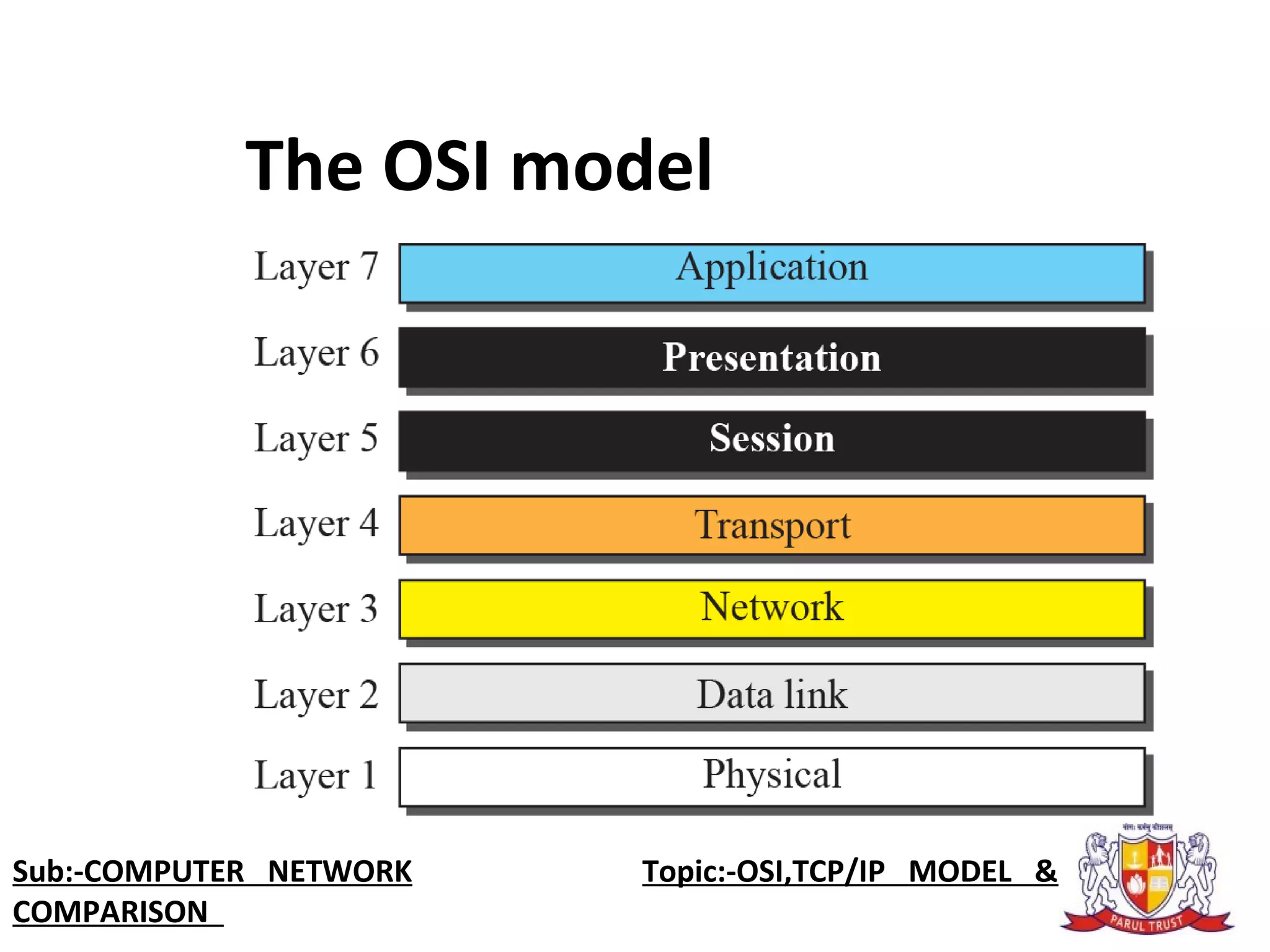
THE OSI MODEL
Sub:-COMPUTER NETWORK Topic:-OSI,TCP/IP MODEL &
COMPARISON
The OSI model
Sub:-COMPUTER NETWORK Topic:-OSI,TCP/IP MODEL &
COMPARISON
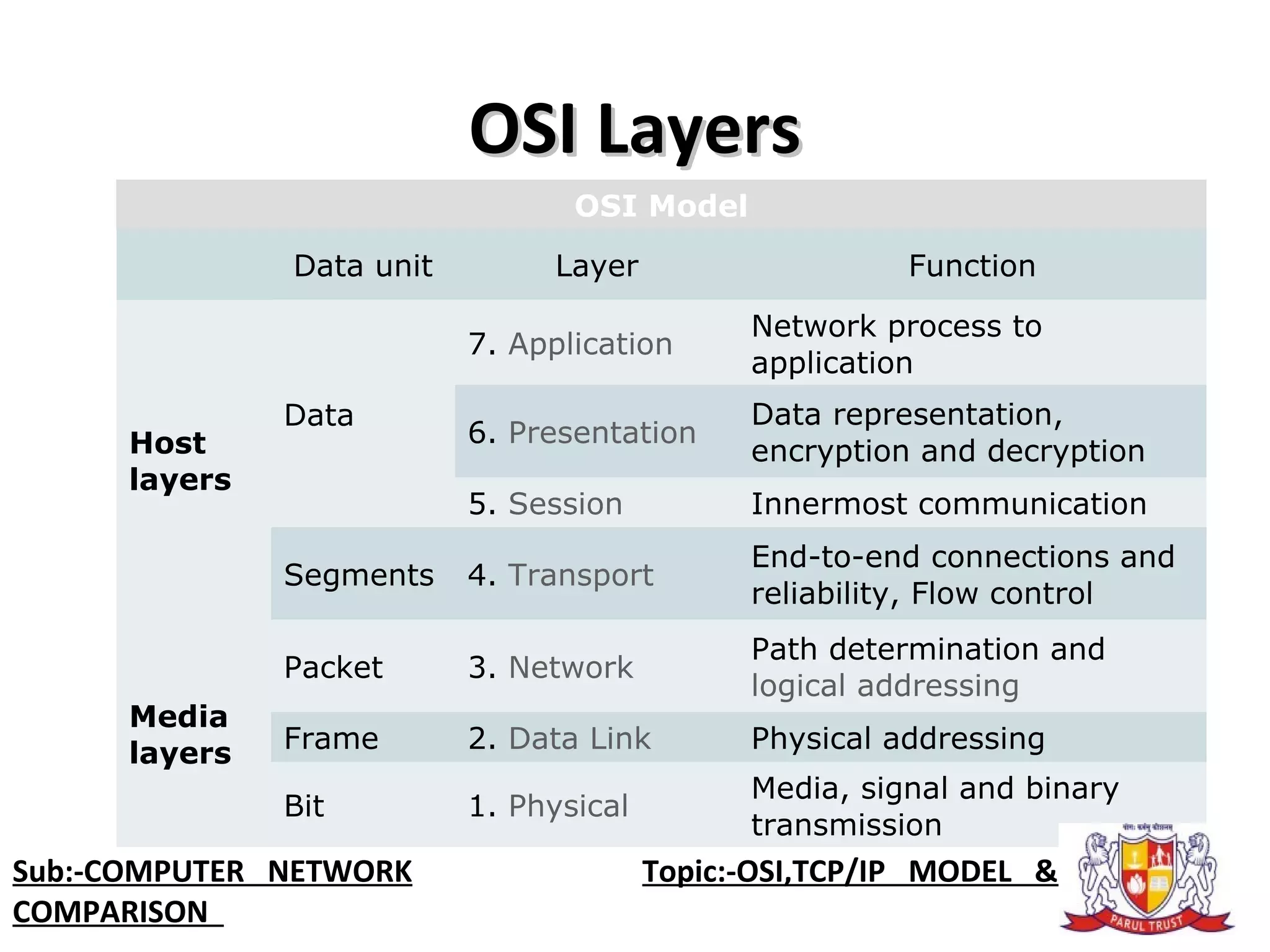
OSI LayersOSI Layers
OSI Model
Data unit Layer Function
Host
layers
Data
7. Application
Network process to
application
6. Presentation
Data representation,
encryption and decryption
5. Session Innermost communication
Segments 4. Transport
End-to-end connections and
reliability, Flow control
Media
layers
Packet 3. Network
Path determination and
logical addressing
Frame 2. Data Link Physical addressing
Bit 1. Physical
Media, signal and binary
transmission
Sub:-COMPUTER NETWORK Topic:-OSI,TCP/IP MODEL &
COMPARISON
OSI LayersOSI Layers
Sub:-COMPUTER NETWORK Topic:-OSI,TCP/IP MODEL &
COMPARISON
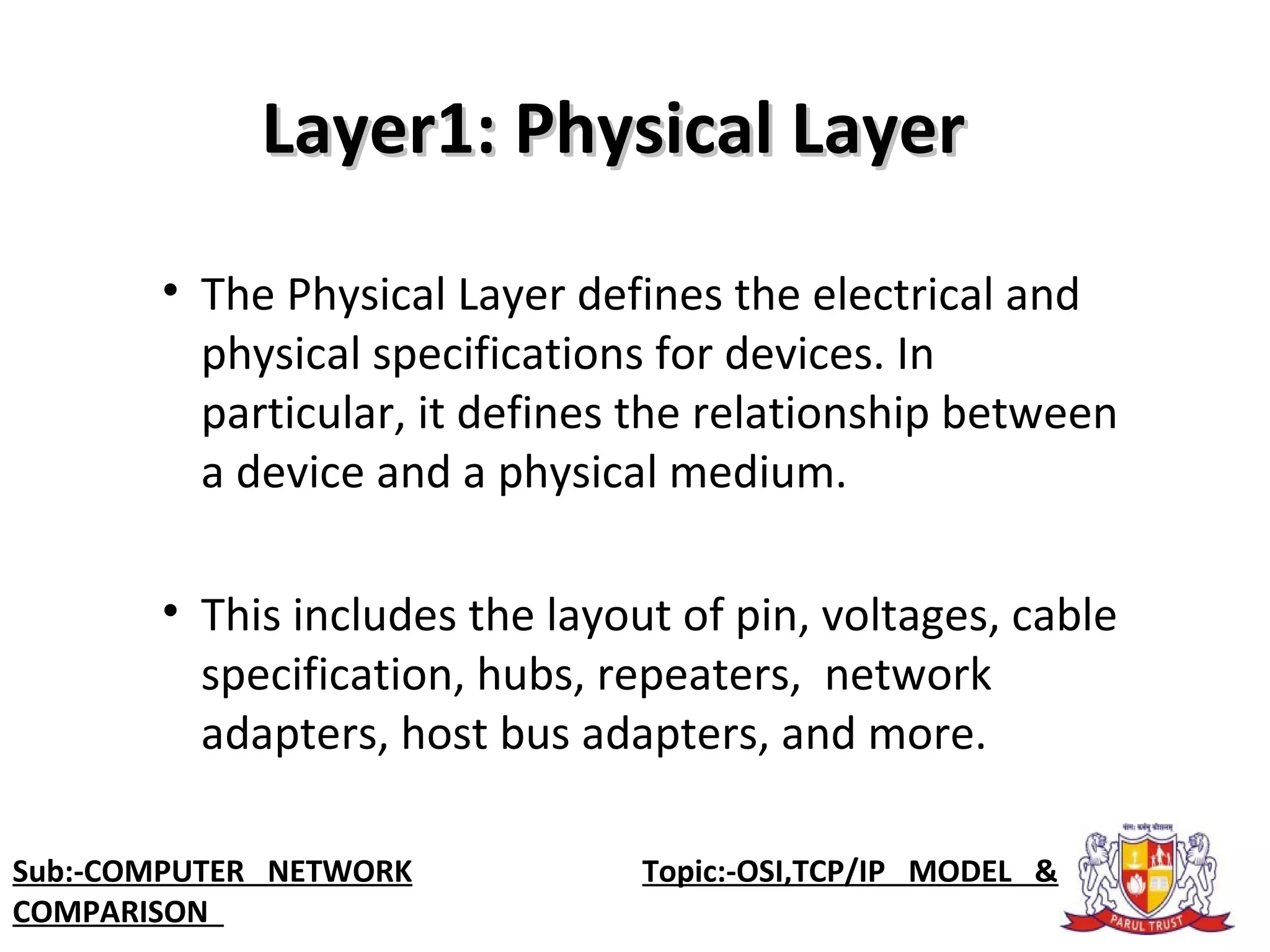
Layer1: Physical LayerLayer1: Physical Layer
• The Physical Layer defines the electrical and
physical specifications for devices. In
particular, it defines the relationship between
a device and a physical medium.
• This includes the layout of pin, voltages, cable
specification, hubs, repeaters, network
adapters, host bus adapters, and more.
Sub:-COMPUTER NETWORK Topic:-OSI,TCP/IP MODEL &
COMPARISON
• The Data Link Layer provides the functional
and procedural means to transfer data
between network entities and to detect and
possibly correct errors that may occur in the
Physical Layer.
• Originally, this layer was intended for point-to-
point and point-to-multipoint media,
characteristic of wide area media in the
telephone system.
• The data link layer is divided into two sub-
layers by IEEE.
Layer 2: Data Link LayerLayer 2: Data Link Layer
Sub:-COMPUTER NETWORK Topic:-OSI,TCP/IP MODEL &
COMPARISON
• The Network Layer performs
–network routing functions,
–perform fragmentation and reassembly,
–report delivery errors.
• Routers operate at this layer—sending data
throughout the extended network and making
the Internet possible.
Layer 3: Network LayerLayer 3: Network Layer
Sub:-COMPUTER NETWORK Topic:-OSI,TCP/IP MODEL &
COMPARISON
• The Network Layer provides the functional
and procedural means of transferring variable
length data sequences from a source to a
destination via one or more networks, while
maintaining the quality of service requested
by the Transport Layer.
Layer 3: Network LayerLayer 3: Network Layer
Sub:-COMPUTER NETWORK Topic:-OSI,TCP/IP MODEL &
COMPARISON
• The Transport Layer provides transparent
transfer of data between end users, providing
reliable data transfer services to the upper
layers.
• The Transport Layer controls the reliability of a
given link through flow control,
segmentation/documentation, and error
control.
Layer 4: Transport LayerLayer 4: Transport Layer
Sub:-COMPUTER NETWORK Topic:-OSI,TCP/IP MODEL &
COMPARISON
• The Session Layer controls the dialogues
(connections) between computers.
• It establishes, manages and terminates the
connections between the local and remote
application.
• It provides for full-duplex, half-duplex,
or simplex operation, and establishes check
pointing, adjournment, termination, and
restart procedures.
Layer 5: Session LayerLayer 5: Session Layer
Sub:-COMPUTER NETWORK Topic:-OSI,TCP/IP MODEL &
COMPARISON
• This layer provides independence from
differences in data representation (e.g.,
encryption) by translating from application to
network format, and vice versa.
• This layer formats and encrypts data to be
sent across a network, providing freedom
from compatibility problems.
• It is sometimes called the syntax layer.
Layer 6: Presentation LayerLayer 6: Presentation Layer
Sub:-COMPUTER NETWORK Topic:-OSI,TCP/IP MODEL &
COMPARISON
• The application layer is the OSI layer closest
to the end user, which means that both the
OSI application layer and the user interact
directly with the software application.
• Application layer functions typically include:
–identifying communication partners,
–determining resource availability,
–synchronizing communication.
Layer 7: Application LayerLayer 7: Application Layer
Sub:-COMPUTER NETWORK Topic:-OSI,TCP/IP MODEL &
COMPARISON
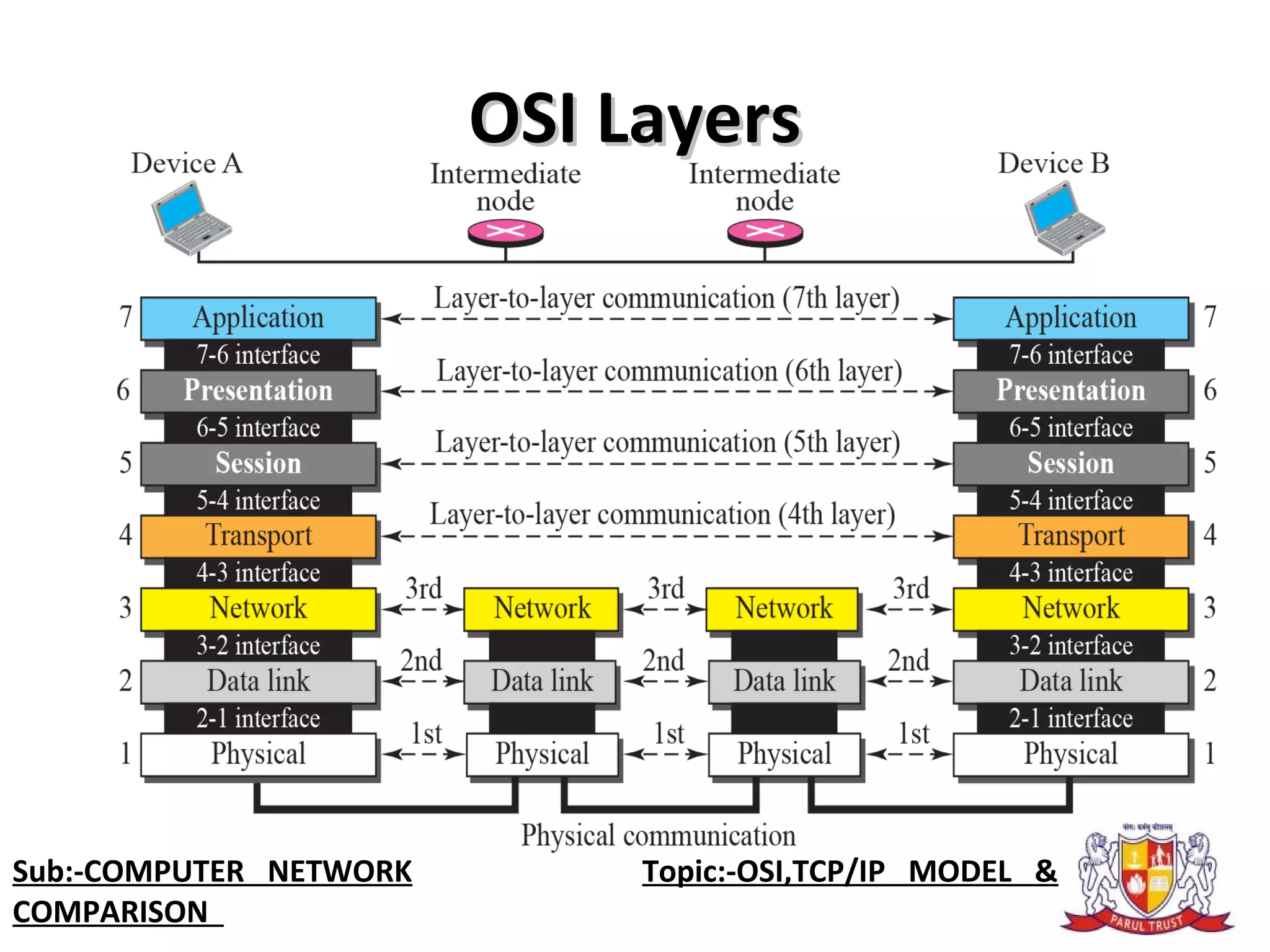
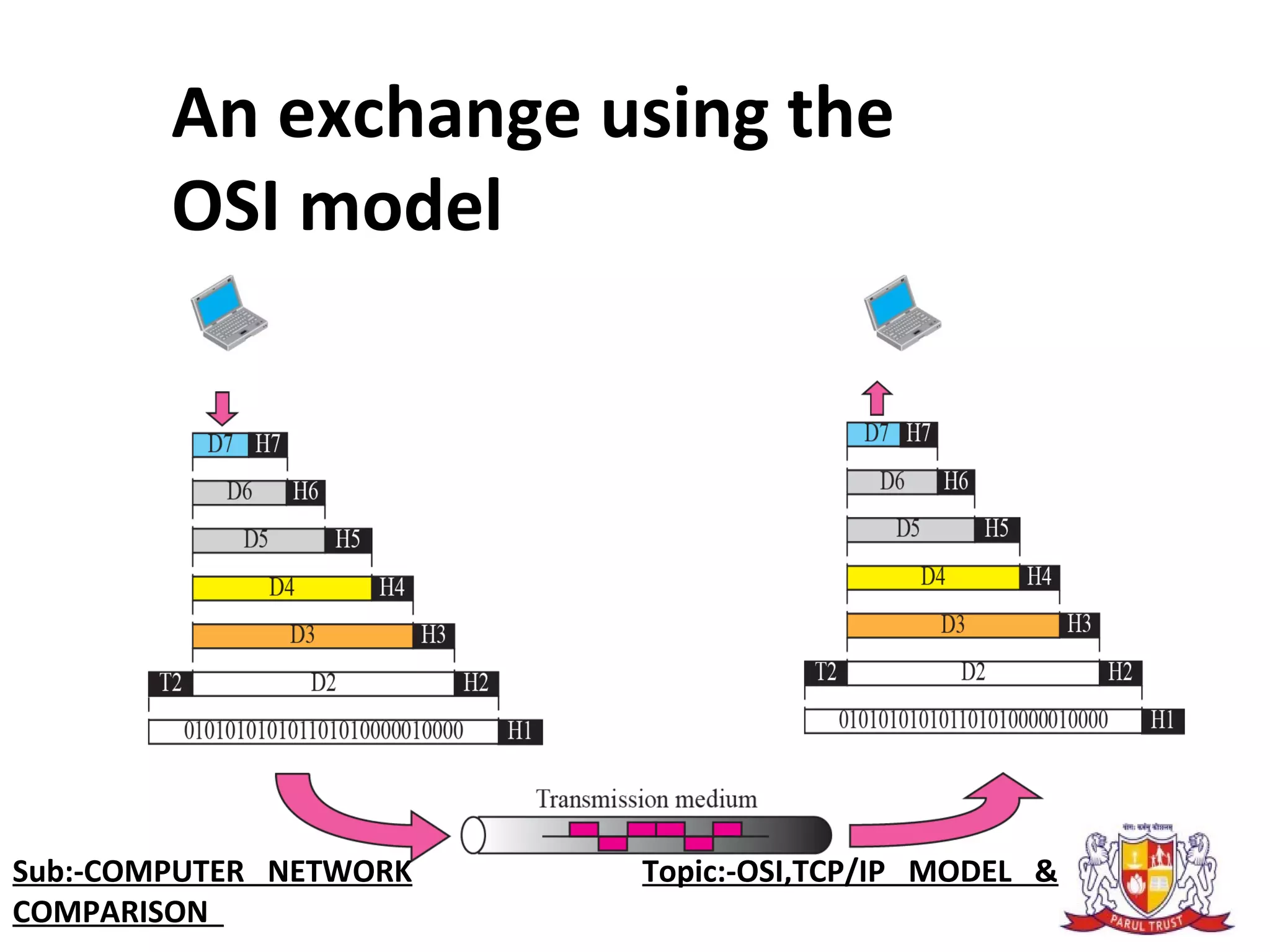
An exchange using the
OSI model
Sub:-COMPUTER NETWORK Topic:-OSI,TCP/IP MODEL &
COMPARISON
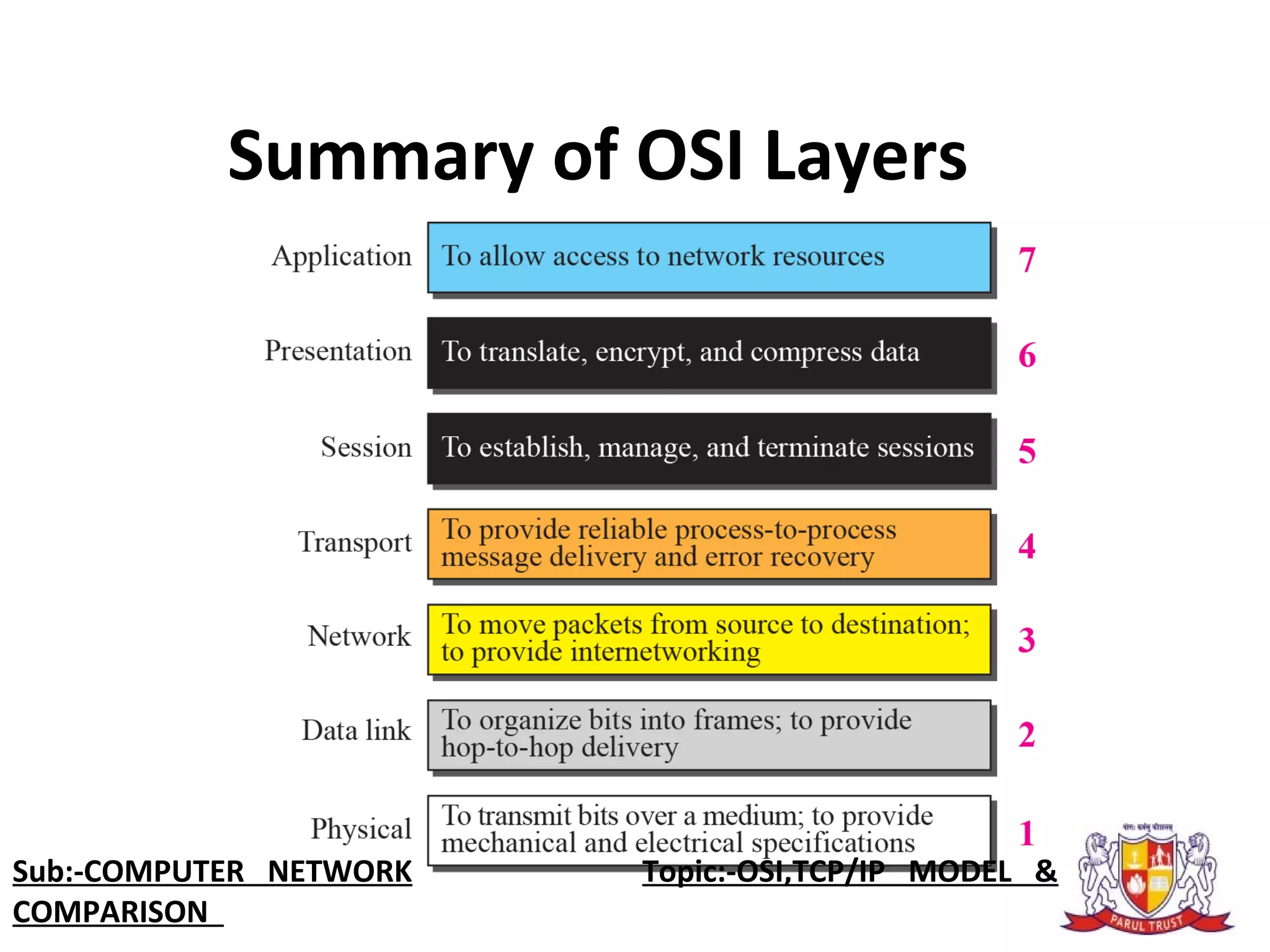
Summary of OSI Layers
Sub:-COMPUTER NETWORK Topic:-OSI,TCP/IP MODEL &
COMPARISON
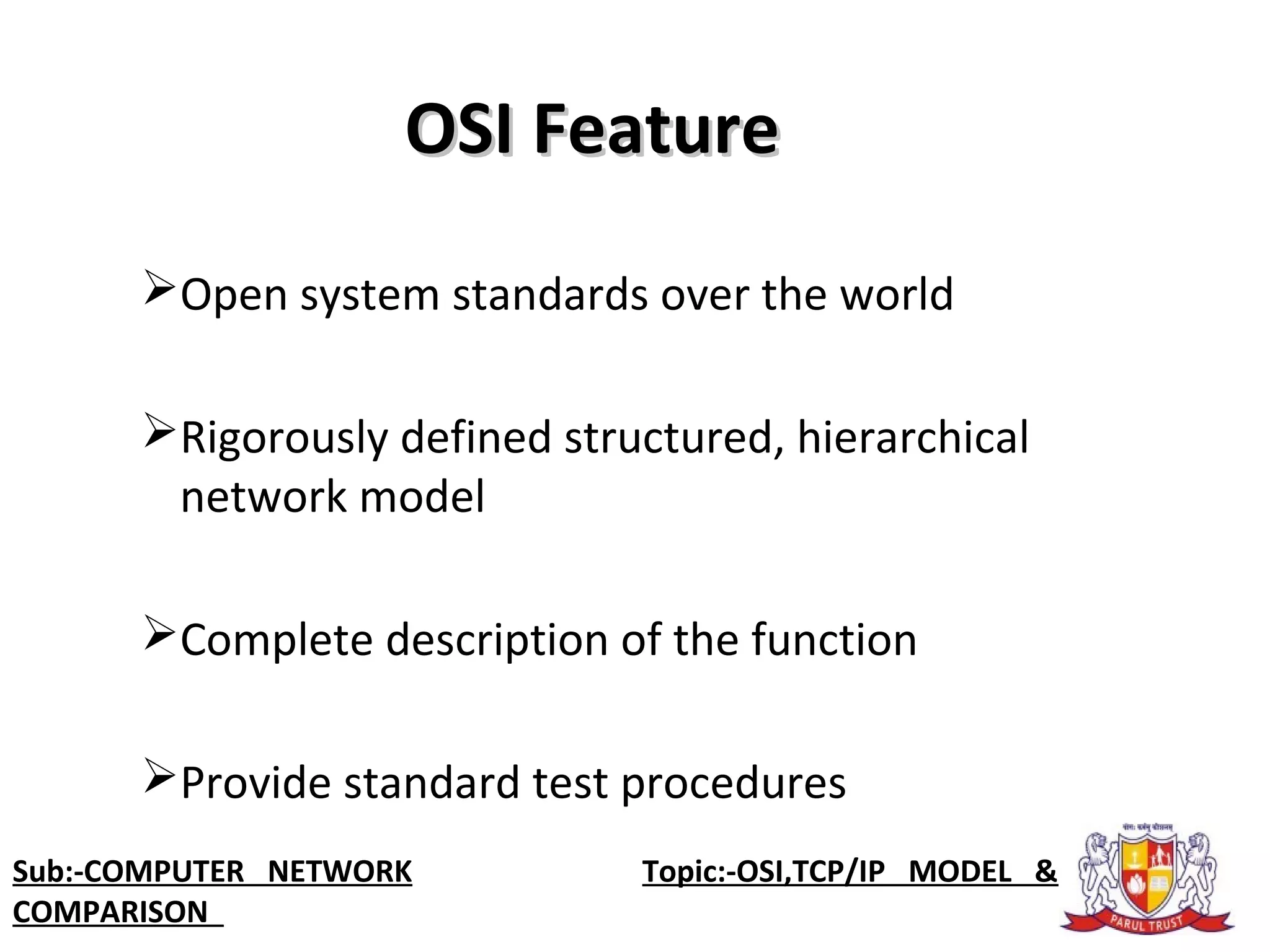
OSI FeatureOSI Feature
Open system standards over the world
Rigorously defined structured, hierarchical
network model
Complete description of the function
Provide standard test procedures
Sub:-COMPUTER NETWORK Topic:-OSI,TCP/IP MODEL &
COMPARISON
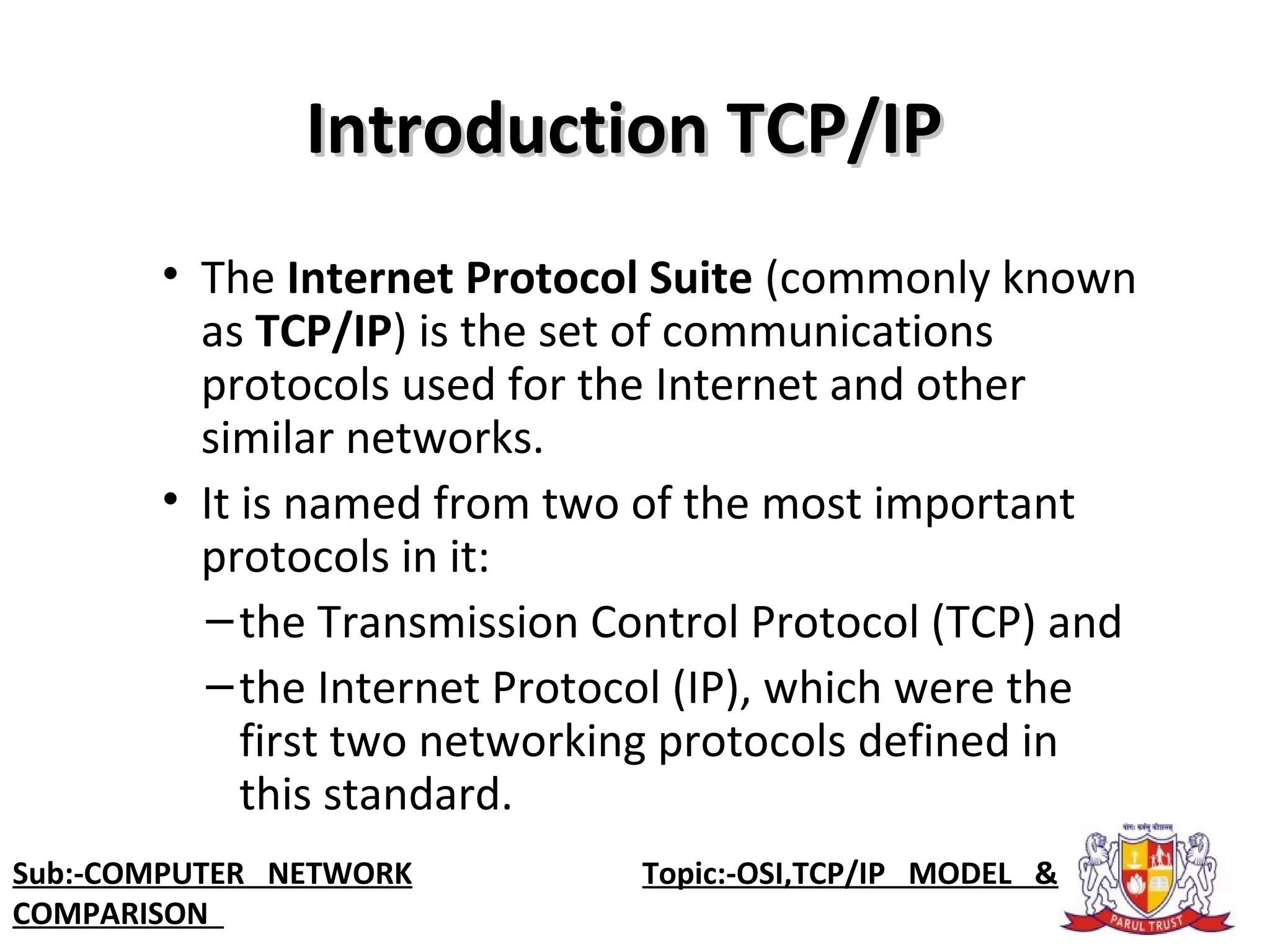
Introduction TCP/IPIntroduction TCP/IP
• The Internet Protocol Suite (commonly known 
as TCP/IP) is the set of communications 
protocols used for the Internet and other 
similar networks. 
• It is named from two of the most important 
protocols in it: 
–the Transmission Control Protocol (TCP) and
–the Internet Protocol (IP), which were the 
first two networking protocols defined in 
this standard.
Sub:-COMPUTER NETWORK                    Topic:-OSI,TCP/IP MODEL &
COMPARISON
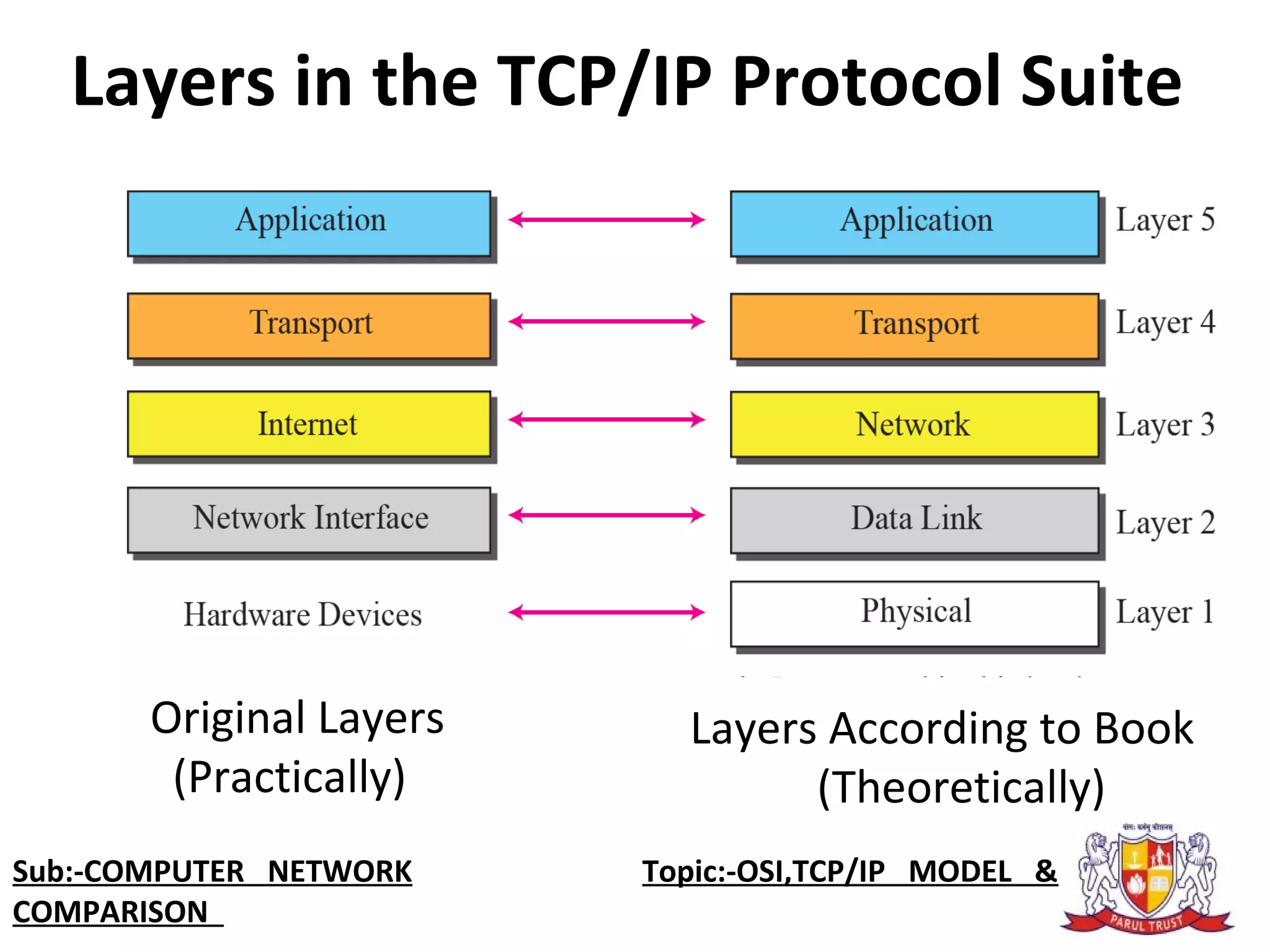
Layers in the TCP/IP Protocol Suite
Original Layers
  (Practically)
Layers According to Book
(Theoretically)
Sub:-COMPUTER NETWORK                    Topic:-OSI,TCP/IP MODEL &
COMPARISON
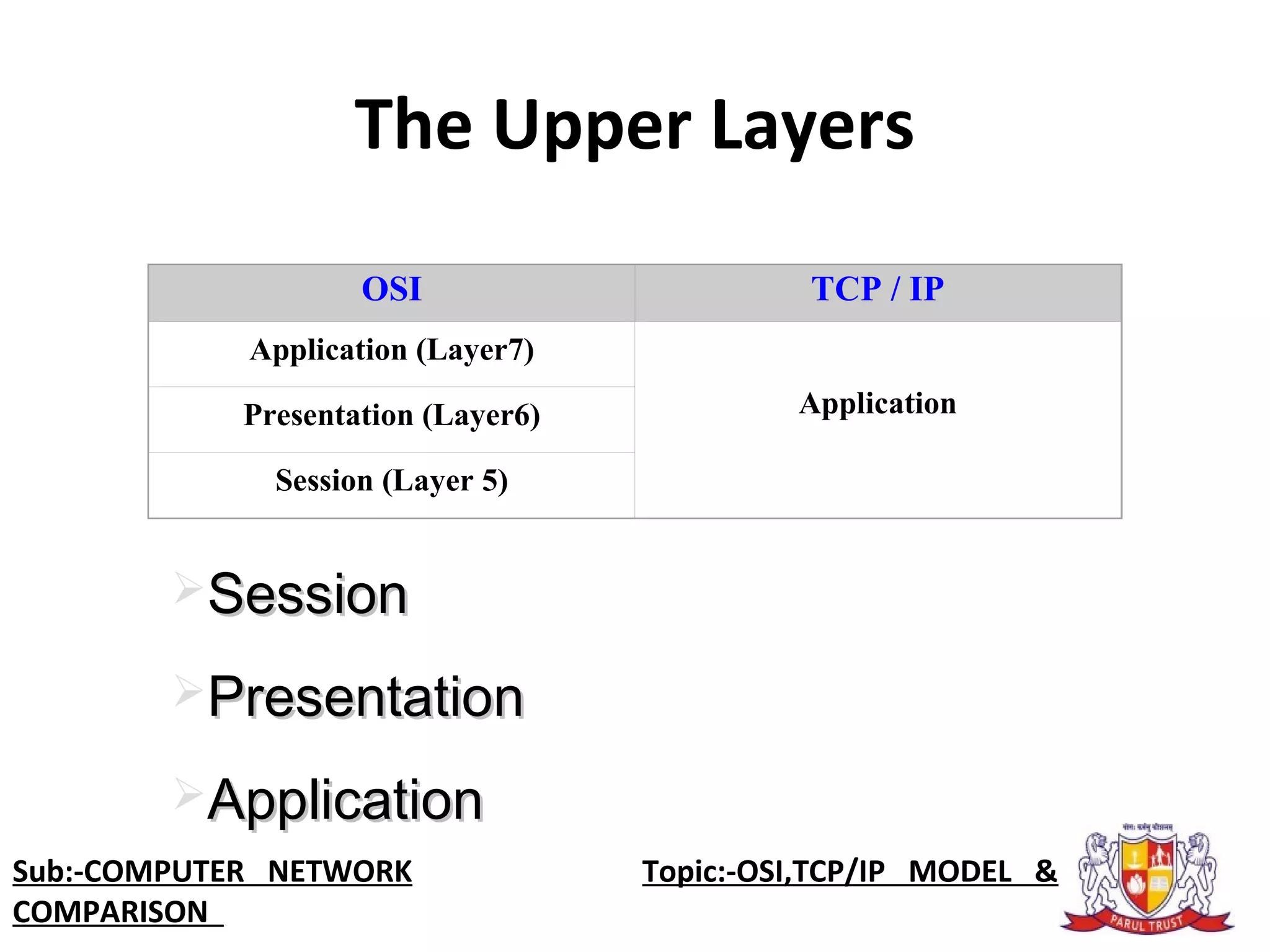
The Upper Layers
OSI TCP / IP
Application (Layer7)
ApplicationPresentation (Layer6)
Session (Layer 5)
SessionSession
PresentationPresentation
ApplicationApplication
Sub:-COMPUTER NETWORK                    Topic:-OSI,TCP/IP MODEL &
COMPARISON
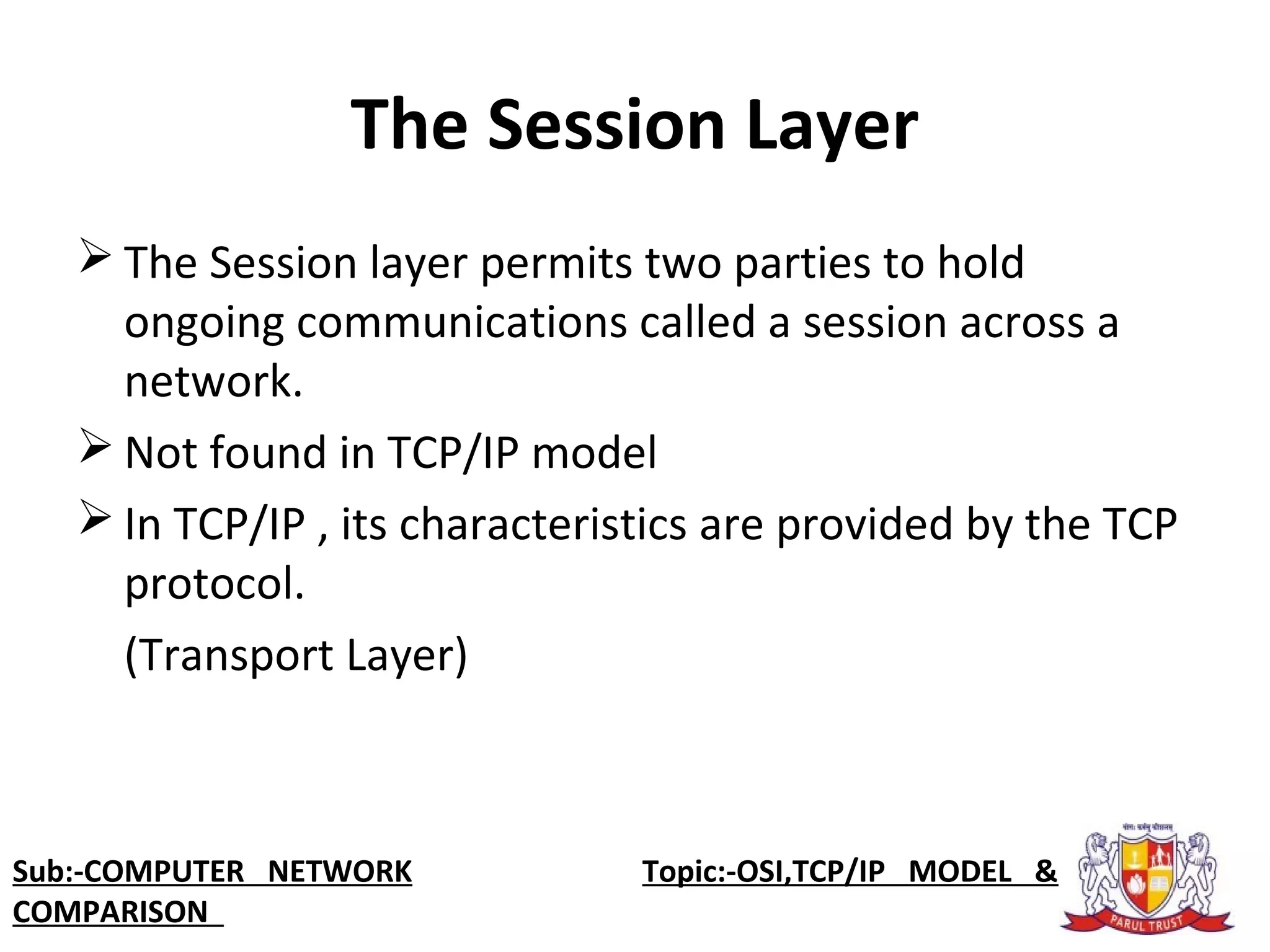
The Session Layer
 The Session layer permits two parties to hold 
ongoing communications called a session across a 
network.
 Not found in TCP/IP model
 In TCP/IP , its characteristics are provided by the TCP 
protocol. 
(Transport Layer)
Sub:-COMPUTER NETWORK                    Topic:-OSI,TCP/IP MODEL &
COMPARISON
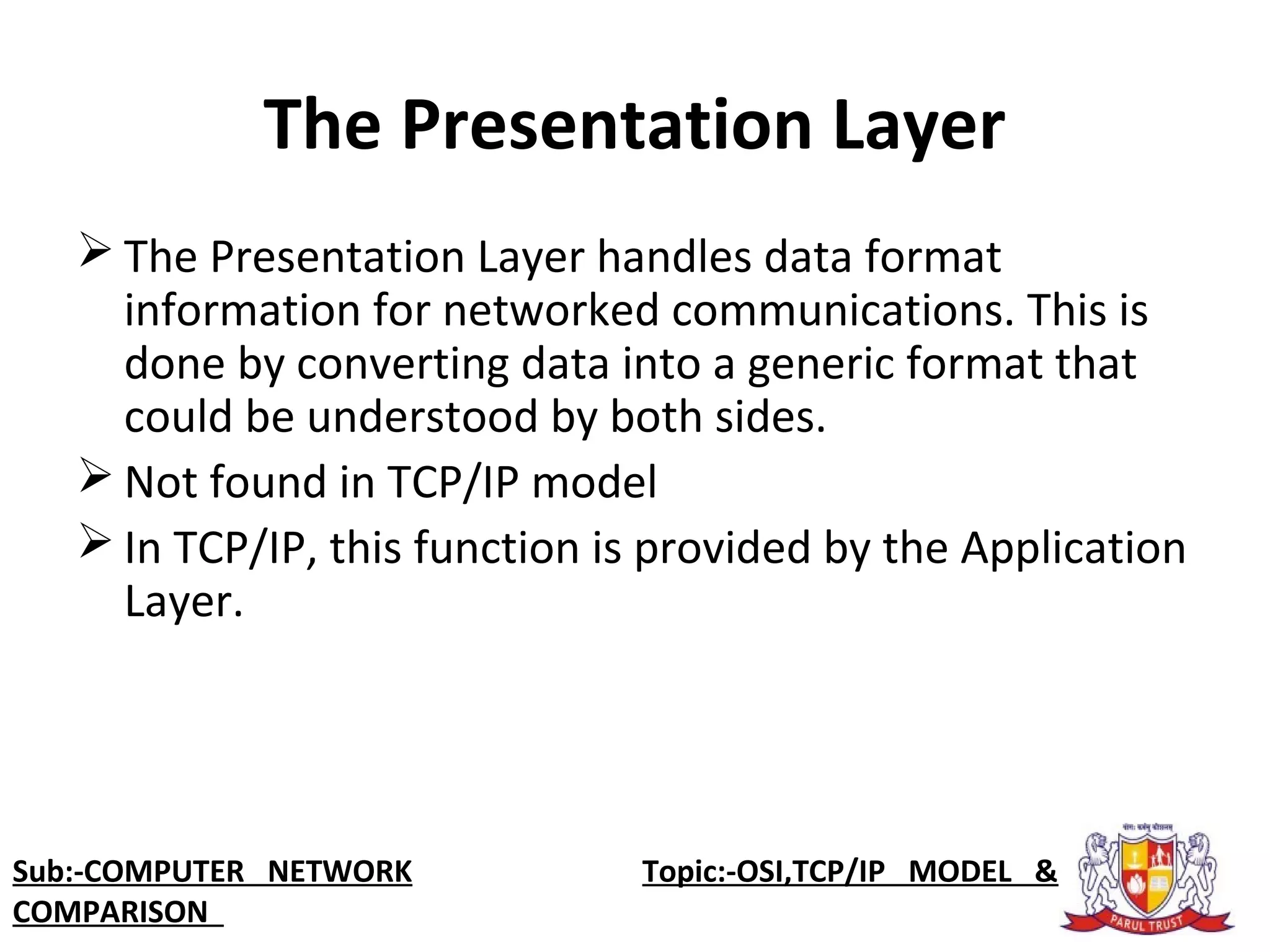
The Presentation Layer
 The Presentation Layer handles data format 
information for networked communications. This is 
done by converting data into a generic format that 
could be understood by both sides.
 Not found in TCP/IP model
 In TCP/IP, this function is provided by the Application 
Layer. 
Sub:-COMPUTER NETWORK                    Topic:-OSI,TCP/IP MODEL &
COMPARISON
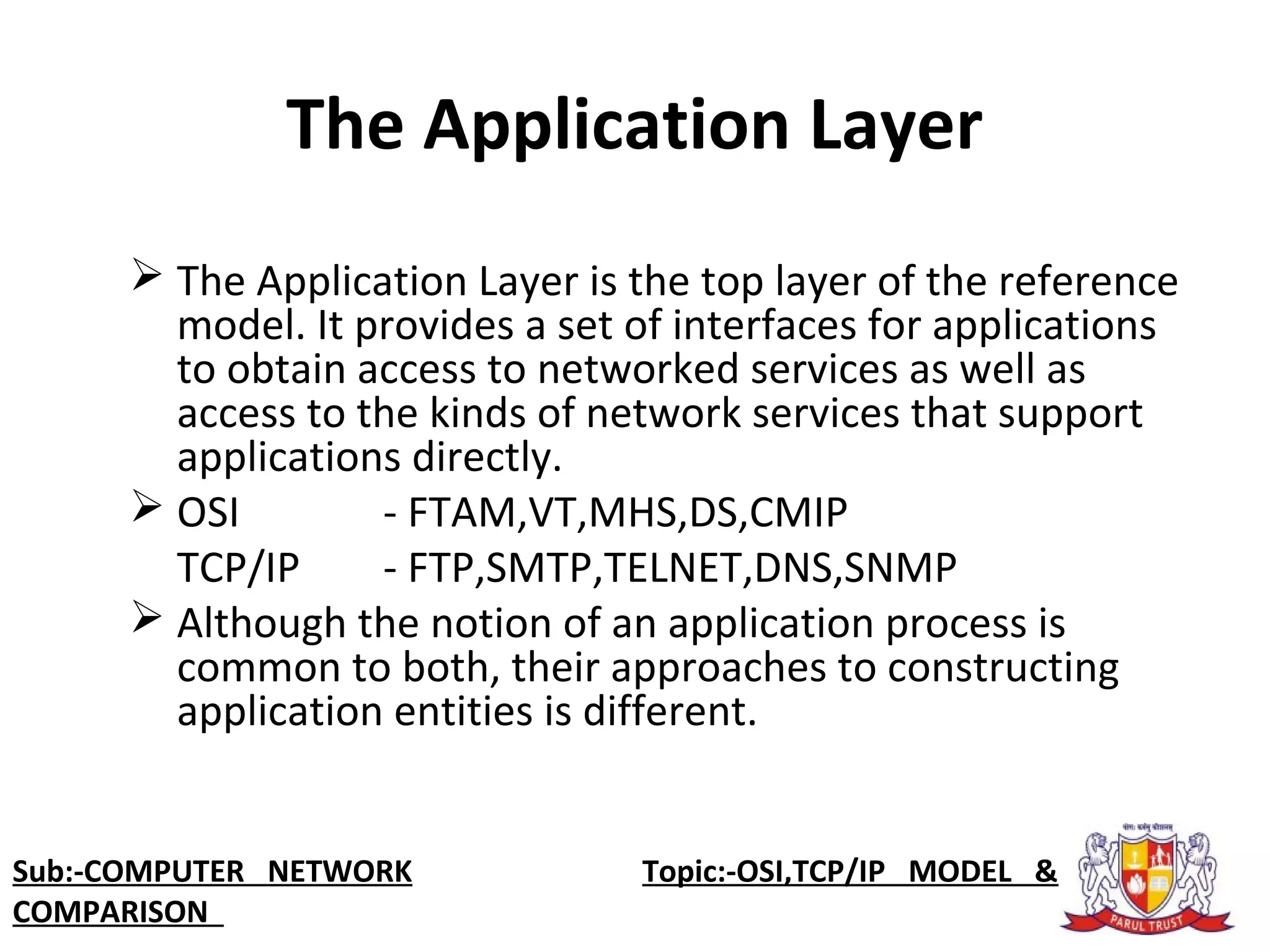
The Application Layer
 The Application Layer is the top layer of the reference 
model. It provides a set of interfaces for applications 
to obtain access to networked services as well as 
access to the kinds of network services that support 
applications directly.
 OSI - FTAM,VT,MHS,DS,CMIP
TCP/IP - FTP,SMTP,TELNET,DNS,SNMP
 Although the notion of an application process is 
common to both, their approaches to constructing 
application entities is different.
Sub:-COMPUTER NETWORK                    Topic:-OSI,TCP/IP MODEL &
COMPARISON
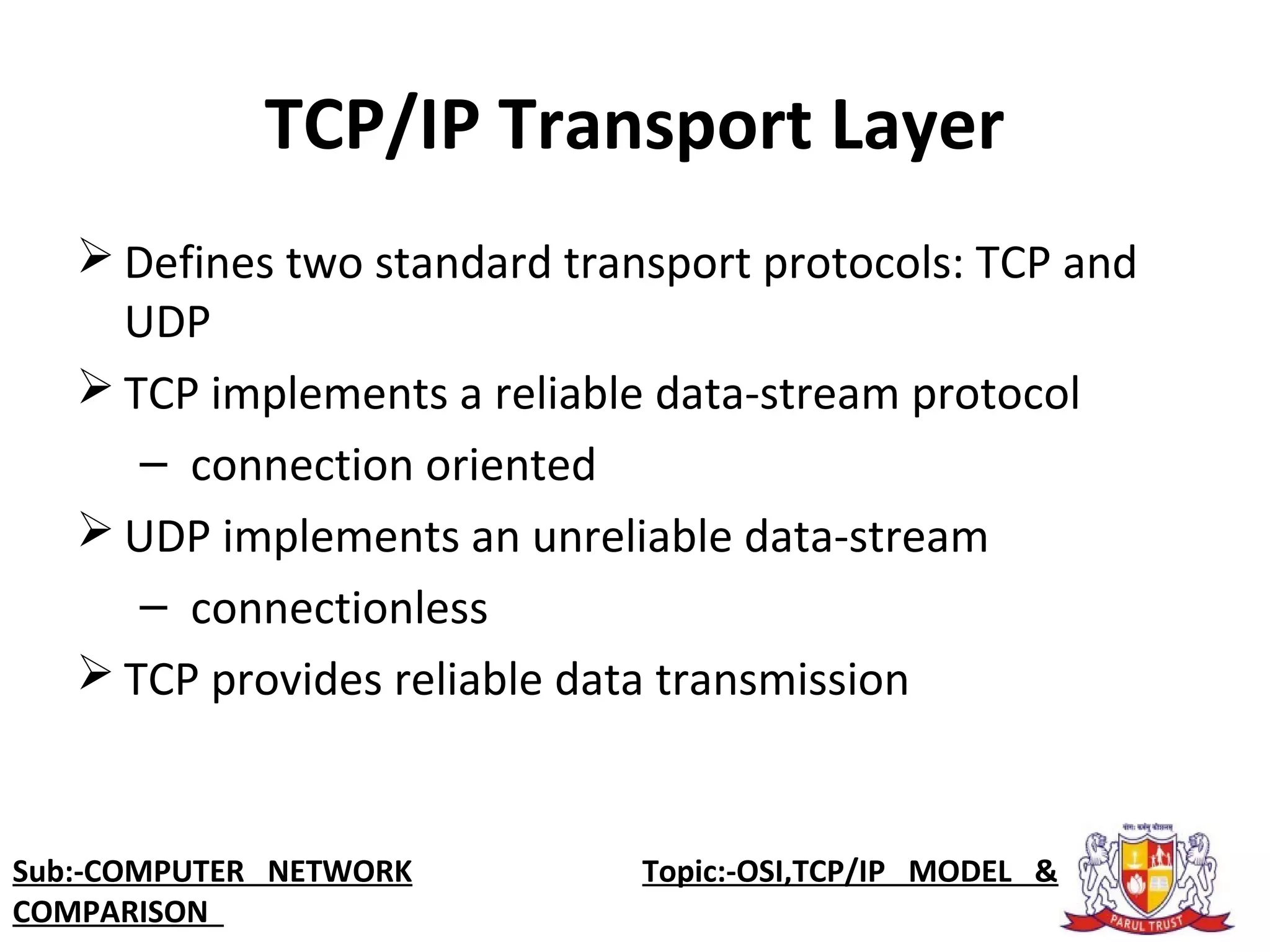
TCP/IP Transport Layer
 Defines two standard transport protocols: TCP and 
UDP
 TCP implements a reliable data-stream protocol
–  connection oriented
 UDP implements an unreliable data-stream 
–  connectionless
 TCP provides reliable data transmission
Sub:-COMPUTER NETWORK                    Topic:-OSI,TCP/IP MODEL &
COMPARISON
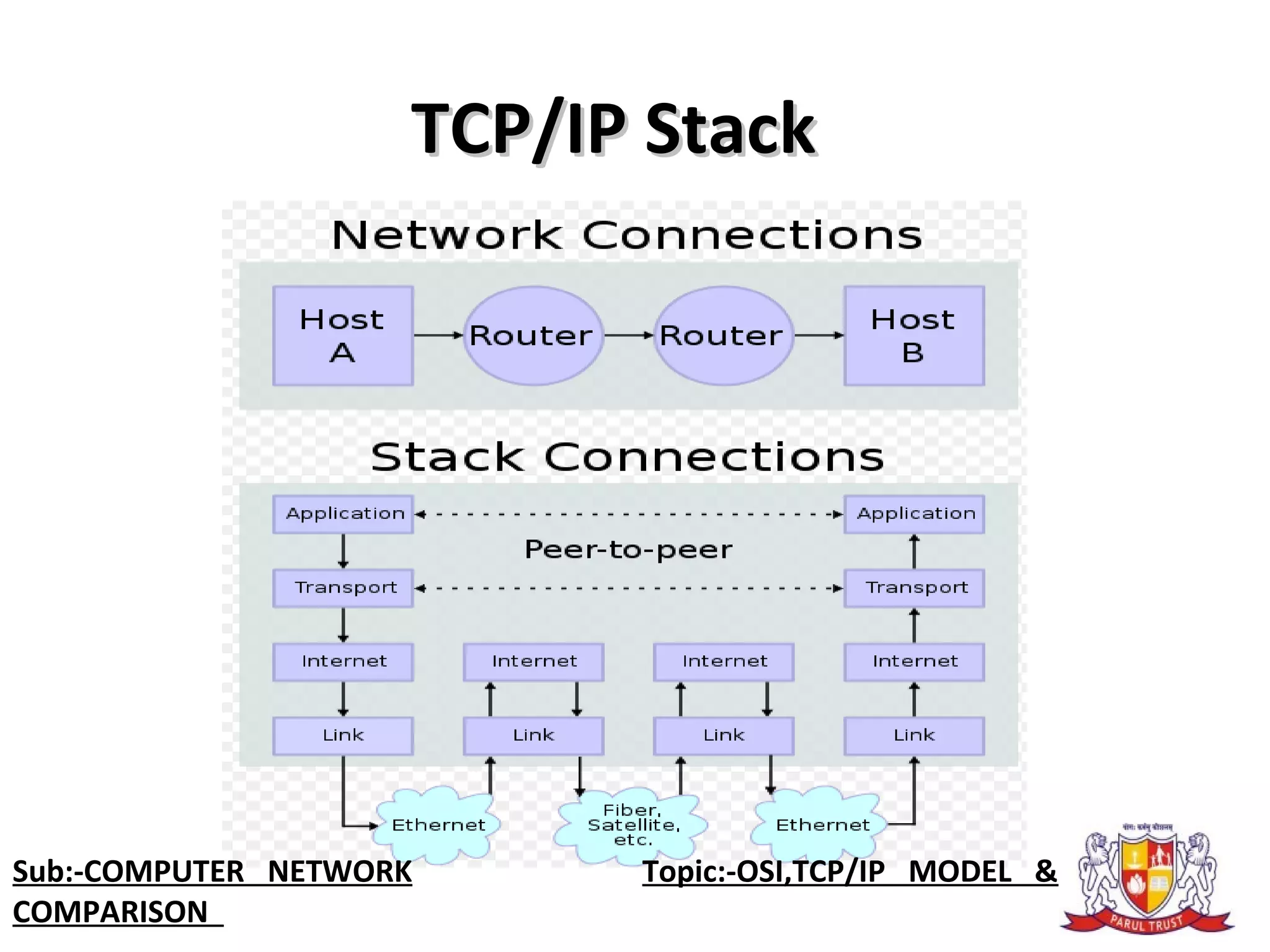
TCP/IP StackTCP/IP Stack
Sub:-COMPUTER NETWORK                    Topic:-OSI,TCP/IP MODEL &
COMPARISON
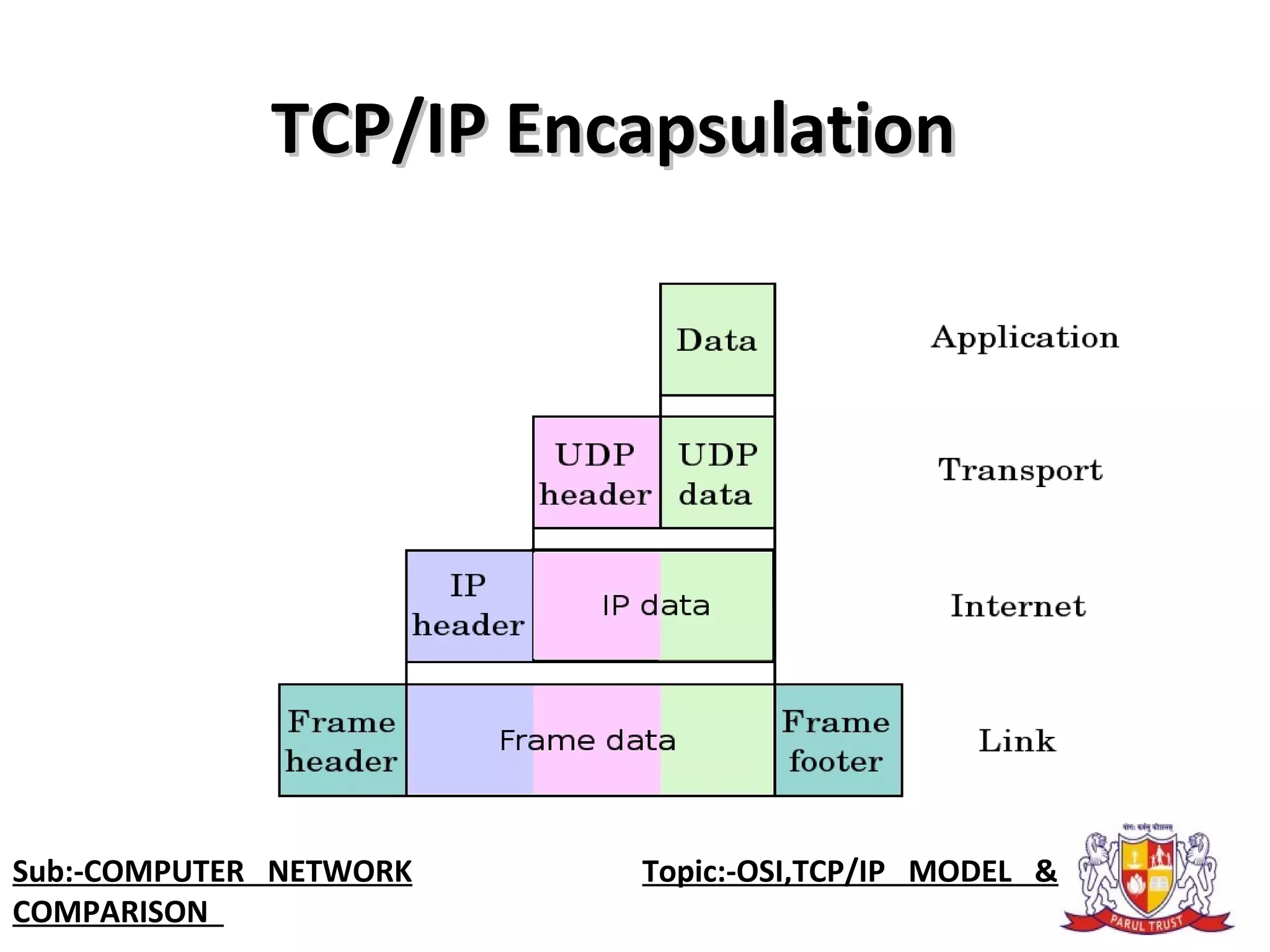
TCP/IP EncapsulationTCP/IP Encapsulation
Sub:-COMPUTER NETWORK                    Topic:-OSI,TCP/IP MODEL &
COMPARISON
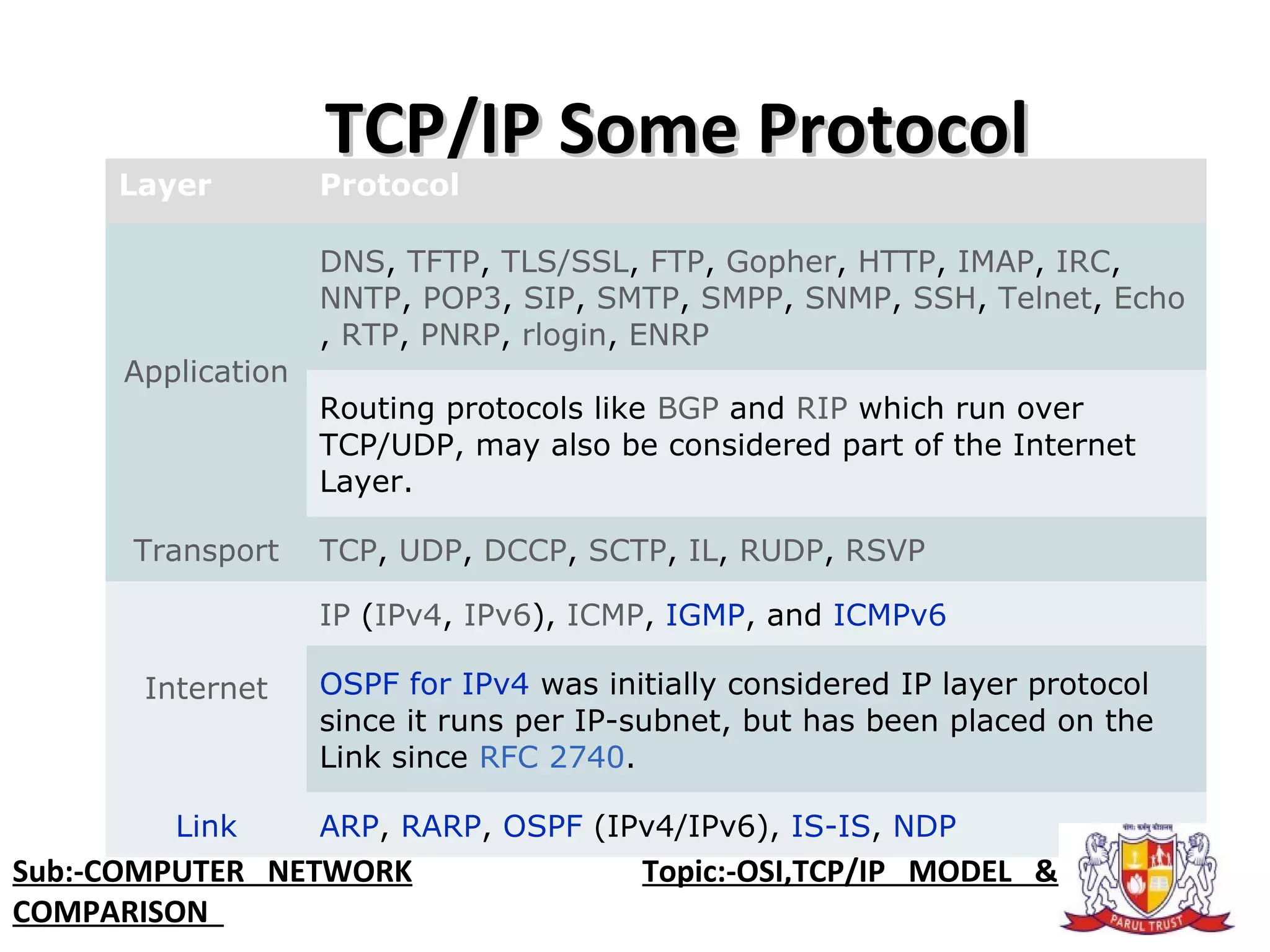
TCP/IP Some ProtocolTCP/IP Some Protocol
Layer Protocol
Application
DNS, TFTP, TLS/SSL, FTP, Gopher, HTTP, IMAP, IRC, 
NNTP, POP3, SIP, SMTP, SMPP, SNMP, SSH, Telnet, Echo
, RTP, PNRP, rlogin, ENRP
Routing protocols like BGP and RIP which run over 
TCP/UDP, may also be considered part of the Internet 
Layer.
Transport TCP, UDP, DCCP, SCTP, IL, RUDP, RSVP
Internet
IP (IPv4, IPv6), ICMP, IGMP, and ICMPv6
OSPF for IPv4 was initially considered IP layer protocol 
since it runs per IP-subnet, but has been placed on the 
Link since RFC 2740.
Link ARP, RARP, OSPF (IPv4/IPv6), IS-IS, NDP
Sub:-COMPUTER NETWORK Topic:-OSI,TCP/IP MODEL &
COMPARISON
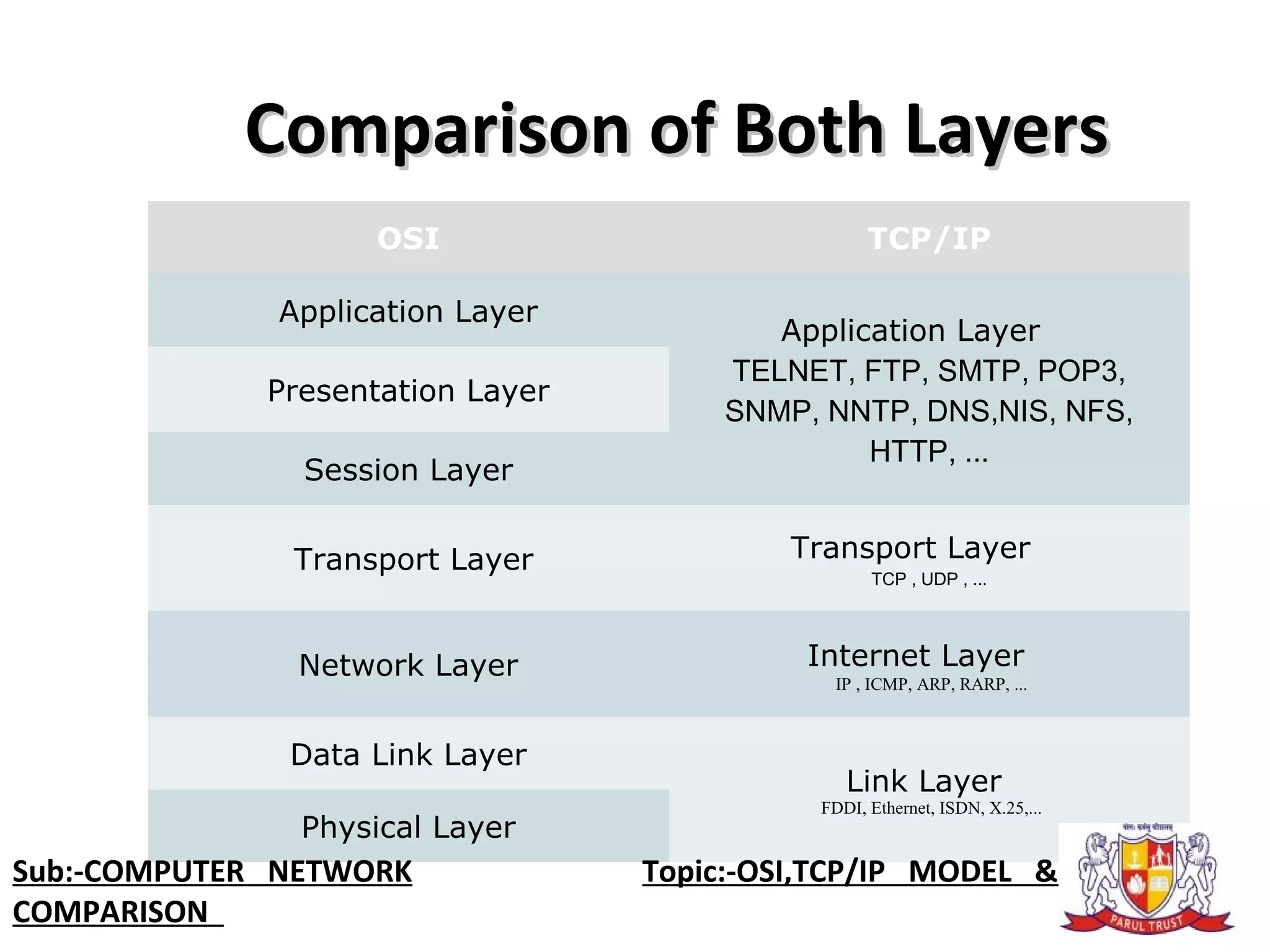
Comparison of Both LayersComparison of Both Layers
OSI TCP/IP
Application Layer
Application Layer  
TELNET, FTP, SMTP, POP3,
SNMP, NNTP, DNS,NIS, NFS,
HTTP, ...
Presentation Layer
Session Layer
 Transport Layer Transport Layer  
TCP , UDP , ...
Network Layer  Internet Layer  
 IP , ICMP, ARP, RARP, ...
Data Link Layer
Link Layer 
 FDDI, Ethernet, ISDN, X.25,...
Physical Layer
Sub:-COMPUTER NETWORK Topic:-OSI,TCP/IP MODEL &
COMPARISON
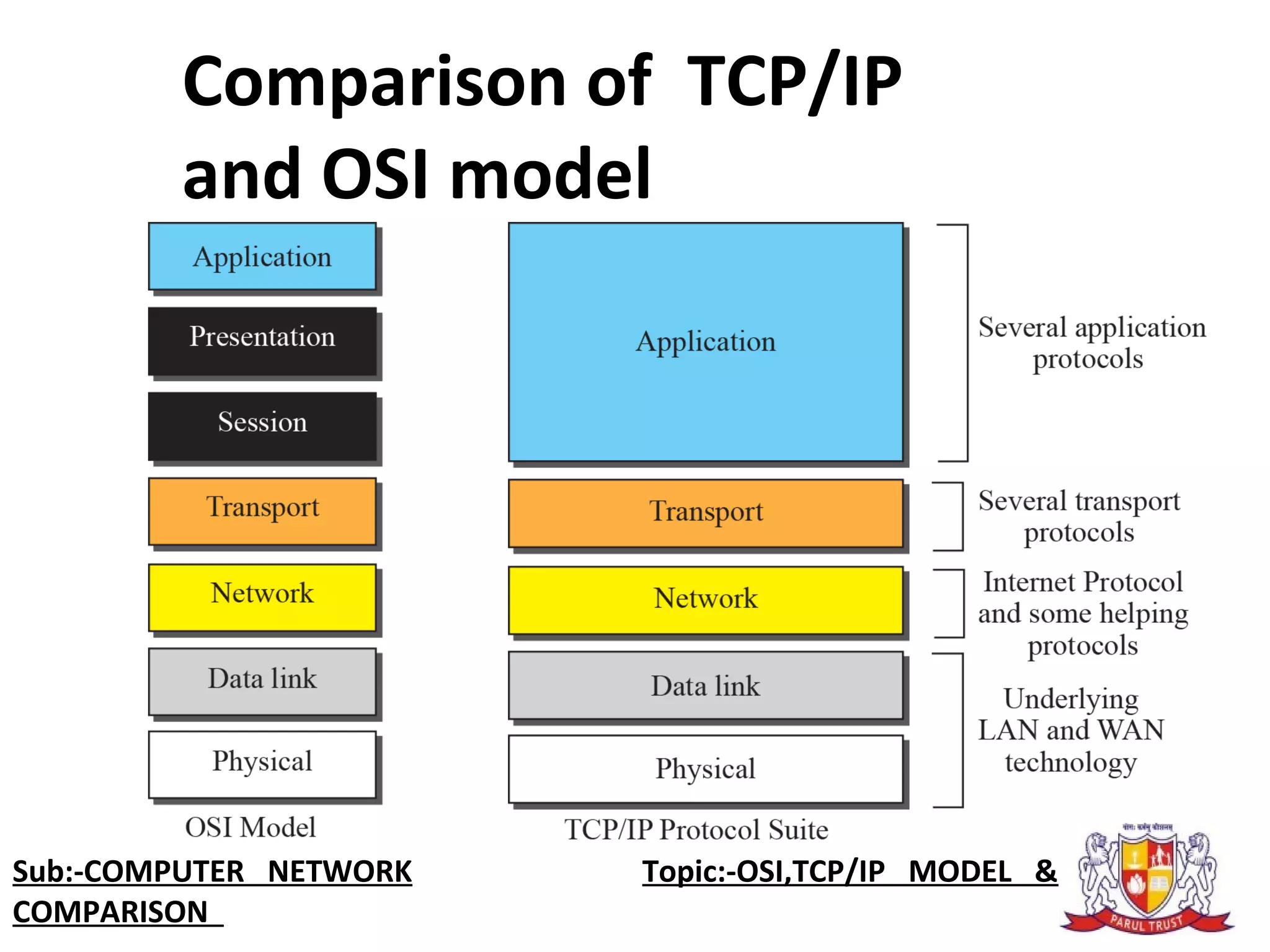
Comparison of TCP/IP
and OSI model
Sub:-COMPUTER NETWORK Topic:-OSI,TCP/IP MODEL &
COMPARISON
Comparing Transport for both
Models
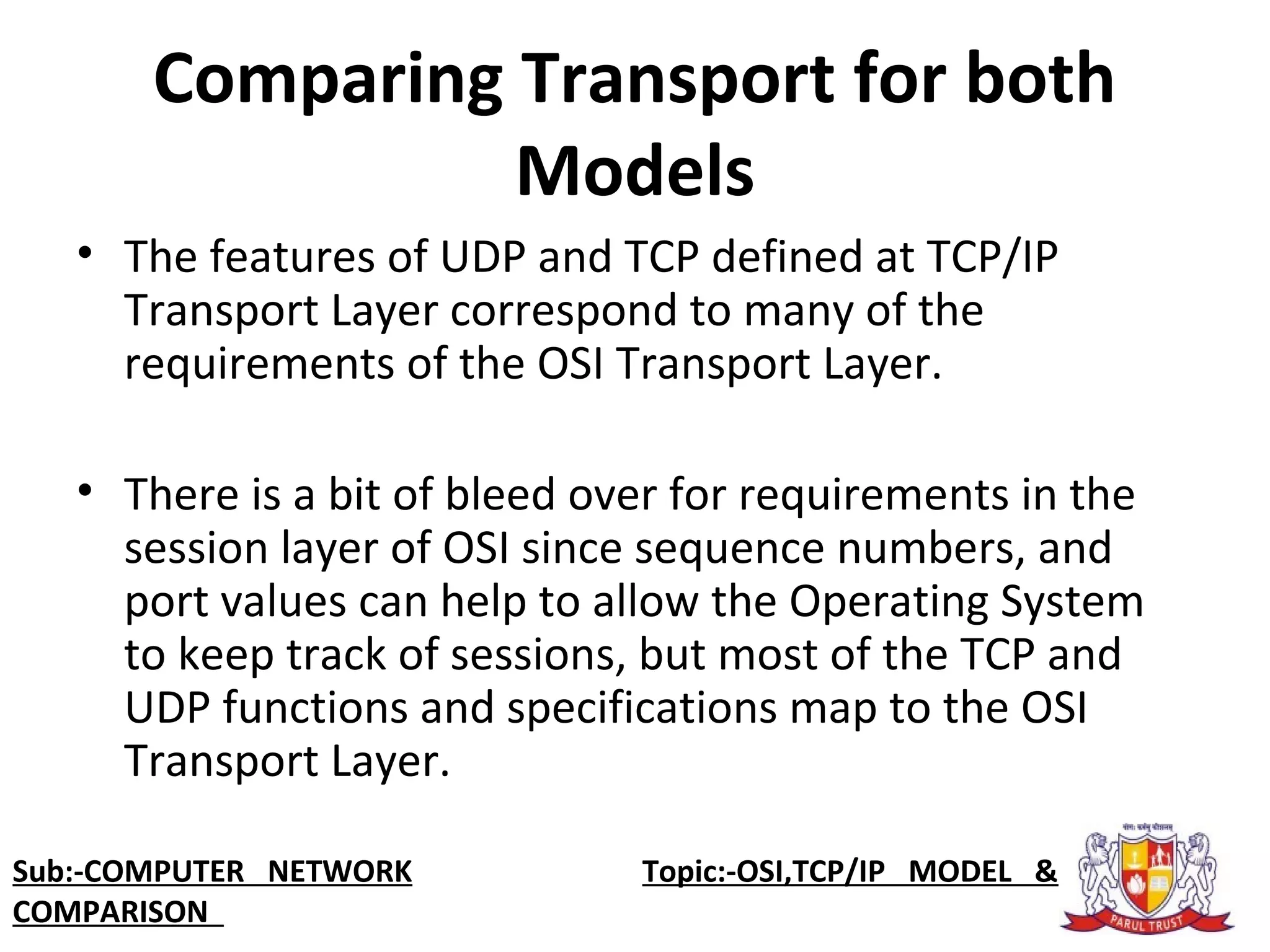
• The features of UDP and TCP defined at TCP/IP
Transport Layer correspond to many of the
requirements of the OSI Transport Layer.
• There is a bit of bleed over for requirements in the
session layer of OSI since sequence numbers, and
port values can help to allow the Operating System
to keep track of sessions, but most of the TCP and
UDP functions and specifications map to the OSI
Transport Layer.
Sub:-COMPUTER NETWORK Topic:-OSI,TCP/IP MODEL &
COMPARISON
Comparing Transport for both
Models
• The TCP/IP and OSI architecture models both employ
all connection and connectionless models at
transport layer. However, the internet architecture
refers to the two models in TCP/IP as simply
“connections” and datagram's.
• But the OSI reference model, with its penchant for
“precise” terminology, uses the terms connection-
mode and connection-oriented for the connection
model and the term connectionless-mode for the
connectionless model.
Sub:-COMPUTER NETWORK Topic:-OSI,TCP/IP MODEL &
COMPARISON
THANK YOU
REFERENCES
Books:-
1.COMPUTER NETWORKS
Fourth Edition by Andrew S. Tanenbaum
Web Resources:-
1.Google
2.Wikipedia
ANY QUERIES???

Computer Network - Introduction to Networks

  • 1.
    Parul Institute ofEngineering & Technology Subject Code : 150702 Name Of Subject : COMPUTER NETWORK Name of Unit : INTRODUCTION TO NETWORKS Topic : OSI MODEL , TCP/IP MODEL AND COMPARISON OF OSI & TCP/IP MODEL Name of Student :Agrawal Swapnil J.
  • 2.
    • OSI MODEL •THE OSI MODEL • DIFFERENT LAYERS OF OSI REFERENCE MODEL • EXCHANGE OG INFORMATION IN OSI MODEL • OSI FEATURES Sub:-COMPUTER NETWORK Topic:-OSI,TCP/IP MODEL & COMPARISON CONTENTS
  • 3.
    • TCP/IP MODEL •INTRODUCTION TO TCP/IP • LAYERS IN TCP/IP • TCP/IP STACK • TCP/IP ENCAPSULATION • TCP/IP PROTOCOL • COMPARISON OF OSI & TCP/IP MODEL CONTENTS Sub:-COMPUTER NETWORK Topic:-OSI,TCP/IP MODEL & COMPARISON
  • 4.
    Established in 1947,the International Standards Organization (ISO) is a multinational body dedicated to worldwide agreement on international standards. Almost three-fourths of countries in the world are represented in the ISO. An ISO standard that covers all aspects of network communications is the Open Systems Interconnection (OSI) model. It was first introduced in the late 1970s. THE OSI MODEL Sub:-COMPUTER NETWORK Topic:-OSI,TCP/IP MODEL & COMPARISON
  • 5.
    The OSI model Sub:-COMPUTERNETWORK Topic:-OSI,TCP/IP MODEL & COMPARISON
  • 6.
    OSI LayersOSI Layers OSIModel Data unit Layer Function Host layers Data 7. Application Network process to application 6. Presentation Data representation, encryption and decryption 5. Session Innermost communication Segments 4. Transport End-to-end connections and reliability, Flow control Media layers Packet 3. Network Path determination and logical addressing Frame 2. Data Link Physical addressing Bit 1. Physical Media, signal and binary transmission Sub:-COMPUTER NETWORK Topic:-OSI,TCP/IP MODEL & COMPARISON
  • 7.
    OSI LayersOSI Layers Sub:-COMPUTERNETWORK Topic:-OSI,TCP/IP MODEL & COMPARISON
  • 8.
    Layer1: Physical LayerLayer1:Physical Layer • The Physical Layer defines the electrical and physical specifications for devices. In particular, it defines the relationship between a device and a physical medium. • This includes the layout of pin, voltages, cable specification, hubs, repeaters, network adapters, host bus adapters, and more. Sub:-COMPUTER NETWORK Topic:-OSI,TCP/IP MODEL & COMPARISON
  • 9.
    • The DataLink Layer provides the functional and procedural means to transfer data between network entities and to detect and possibly correct errors that may occur in the Physical Layer. • Originally, this layer was intended for point-to- point and point-to-multipoint media, characteristic of wide area media in the telephone system. • The data link layer is divided into two sub- layers by IEEE. Layer 2: Data Link LayerLayer 2: Data Link Layer Sub:-COMPUTER NETWORK Topic:-OSI,TCP/IP MODEL & COMPARISON
  • 10.
    • The NetworkLayer performs –network routing functions, –perform fragmentation and reassembly, –report delivery errors. • Routers operate at this layer—sending data throughout the extended network and making the Internet possible. Layer 3: Network LayerLayer 3: Network Layer Sub:-COMPUTER NETWORK Topic:-OSI,TCP/IP MODEL & COMPARISON
  • 11.
    • The NetworkLayer provides the functional and procedural means of transferring variable length data sequences from a source to a destination via one or more networks, while maintaining the quality of service requested by the Transport Layer. Layer 3: Network LayerLayer 3: Network Layer Sub:-COMPUTER NETWORK Topic:-OSI,TCP/IP MODEL & COMPARISON
  • 12.
    • The TransportLayer provides transparent transfer of data between end users, providing reliable data transfer services to the upper layers. • The Transport Layer controls the reliability of a given link through flow control, segmentation/documentation, and error control. Layer 4: Transport LayerLayer 4: Transport Layer Sub:-COMPUTER NETWORK Topic:-OSI,TCP/IP MODEL & COMPARISON
  • 13.
    • The SessionLayer controls the dialogues (connections) between computers. • It establishes, manages and terminates the connections between the local and remote application. • It provides for full-duplex, half-duplex, or simplex operation, and establishes check pointing, adjournment, termination, and restart procedures. Layer 5: Session LayerLayer 5: Session Layer Sub:-COMPUTER NETWORK Topic:-OSI,TCP/IP MODEL & COMPARISON
  • 14.
    • This layerprovides independence from differences in data representation (e.g., encryption) by translating from application to network format, and vice versa. • This layer formats and encrypts data to be sent across a network, providing freedom from compatibility problems. • It is sometimes called the syntax layer. Layer 6: Presentation LayerLayer 6: Presentation Layer Sub:-COMPUTER NETWORK Topic:-OSI,TCP/IP MODEL & COMPARISON
  • 15.
    • The applicationlayer is the OSI layer closest to the end user, which means that both the OSI application layer and the user interact directly with the software application. • Application layer functions typically include: –identifying communication partners, –determining resource availability, –synchronizing communication. Layer 7: Application LayerLayer 7: Application Layer Sub:-COMPUTER NETWORK Topic:-OSI,TCP/IP MODEL & COMPARISON
  • 16.
    An exchange usingthe OSI model Sub:-COMPUTER NETWORK Topic:-OSI,TCP/IP MODEL & COMPARISON
  • 17.
    Summary of OSILayers Sub:-COMPUTER NETWORK Topic:-OSI,TCP/IP MODEL & COMPARISON
  • 18.
    OSI FeatureOSI Feature Opensystem standards over the world Rigorously defined structured, hierarchical network model Complete description of the function Provide standard test procedures Sub:-COMPUTER NETWORK Topic:-OSI,TCP/IP MODEL & COMPARISON
  • 19.
    Introduction TCP/IPIntroduction TCP/IP •The Internet Protocol Suite (commonly known  as TCP/IP) is the set of communications  protocols used for the Internet and other  similar networks.  • It is named from two of the most important  protocols in it:  –the Transmission Control Protocol (TCP) and –the Internet Protocol (IP), which were the  first two networking protocols defined in  this standard. Sub:-COMPUTER NETWORK                    Topic:-OSI,TCP/IP MODEL & COMPARISON
  • 20.
    Layers in theTCP/IP Protocol Suite Original Layers   (Practically) Layers According to Book (Theoretically) Sub:-COMPUTER NETWORK                    Topic:-OSI,TCP/IP MODEL & COMPARISON
  • 21.
    The Upper Layers OSITCP / IP Application (Layer7) ApplicationPresentation (Layer6) Session (Layer 5) SessionSession PresentationPresentation ApplicationApplication Sub:-COMPUTER NETWORK                    Topic:-OSI,TCP/IP MODEL & COMPARISON
  • 22.
    The Session Layer The Session layer permits two parties to hold  ongoing communications called a session across a  network.  Not found in TCP/IP model  In TCP/IP , its characteristics are provided by the TCP  protocol.  (Transport Layer) Sub:-COMPUTER NETWORK                    Topic:-OSI,TCP/IP MODEL & COMPARISON
  • 23.
    The Presentation Layer The Presentation Layer handles data format  information for networked communications. This is  done by converting data into a generic format that  could be understood by both sides.  Not found in TCP/IP model  In TCP/IP, this function is provided by the Application  Layer.  Sub:-COMPUTER NETWORK                    Topic:-OSI,TCP/IP MODEL & COMPARISON
  • 24.
    The Application Layer The Application Layer is the top layer of the reference  model. It provides a set of interfaces for applications  to obtain access to networked services as well as  access to the kinds of network services that support  applications directly.  OSI - FTAM,VT,MHS,DS,CMIP TCP/IP - FTP,SMTP,TELNET,DNS,SNMP  Although the notion of an application process is  common to both, their approaches to constructing  application entities is different. Sub:-COMPUTER NETWORK                    Topic:-OSI,TCP/IP MODEL & COMPARISON
  • 25.
    TCP/IP Transport Layer Defines two standard transport protocols: TCP and  UDP  TCP implements a reliable data-stream protocol –  connection oriented  UDP implements an unreliable data-stream  –  connectionless  TCP provides reliable data transmission Sub:-COMPUTER NETWORK                    Topic:-OSI,TCP/IP MODEL & COMPARISON
  • 26.
    TCP/IP StackTCP/IP Stack Sub:-COMPUTERNETWORK                    Topic:-OSI,TCP/IP MODEL & COMPARISON
  • 27.
    TCP/IP EncapsulationTCP/IP Encapsulation Sub:-COMPUTERNETWORK                    Topic:-OSI,TCP/IP MODEL & COMPARISON
  • 28.
    TCP/IP Some ProtocolTCP/IPSome Protocol Layer Protocol Application DNS, TFTP, TLS/SSL, FTP, Gopher, HTTP, IMAP, IRC,  NNTP, POP3, SIP, SMTP, SMPP, SNMP, SSH, Telnet, Echo , RTP, PNRP, rlogin, ENRP Routing protocols like BGP and RIP which run over  TCP/UDP, may also be considered part of the Internet  Layer. Transport TCP, UDP, DCCP, SCTP, IL, RUDP, RSVP Internet IP (IPv4, IPv6), ICMP, IGMP, and ICMPv6 OSPF for IPv4 was initially considered IP layer protocol  since it runs per IP-subnet, but has been placed on the  Link since RFC 2740. Link ARP, RARP, OSPF (IPv4/IPv6), IS-IS, NDP Sub:-COMPUTER NETWORK Topic:-OSI,TCP/IP MODEL & COMPARISON
  • 29.
    Comparison of BothLayersComparison of Both Layers OSI TCP/IP Application Layer Application Layer   TELNET, FTP, SMTP, POP3, SNMP, NNTP, DNS,NIS, NFS, HTTP, ... Presentation Layer Session Layer  Transport Layer Transport Layer   TCP , UDP , ... Network Layer  Internet Layer    IP , ICMP, ARP, RARP, ... Data Link Layer Link Layer   FDDI, Ethernet, ISDN, X.25,... Physical Layer Sub:-COMPUTER NETWORK Topic:-OSI,TCP/IP MODEL & COMPARISON
  • 30.
    Comparison of TCP/IP andOSI model Sub:-COMPUTER NETWORK Topic:-OSI,TCP/IP MODEL & COMPARISON
  • 31.
    Comparing Transport forboth Models • The features of UDP and TCP defined at TCP/IP Transport Layer correspond to many of the requirements of the OSI Transport Layer. • There is a bit of bleed over for requirements in the session layer of OSI since sequence numbers, and port values can help to allow the Operating System to keep track of sessions, but most of the TCP and UDP functions and specifications map to the OSI Transport Layer. Sub:-COMPUTER NETWORK Topic:-OSI,TCP/IP MODEL & COMPARISON
  • 32.
    Comparing Transport forboth Models • The TCP/IP and OSI architecture models both employ all connection and connectionless models at transport layer. However, the internet architecture refers to the two models in TCP/IP as simply “connections” and datagram's. • But the OSI reference model, with its penchant for “precise” terminology, uses the terms connection- mode and connection-oriented for the connection model and the term connectionless-mode for the connectionless model. Sub:-COMPUTER NETWORK Topic:-OSI,TCP/IP MODEL & COMPARISON
  • 33.
  • 34.
    REFERENCES Books:- 1.COMPUTER NETWORKS Fourth Editionby Andrew S. Tanenbaum Web Resources:- 1.Google 2.Wikipedia
  • 35.

Editor's Notes

  • #9 network adapters, host bus adapters, and more.