Inter thread Communication


                             1
Objectives


On completion of this period, you would be
able to learn

•   Inter thread communication methods
•   wait() method
•   notify() method
•   Producer-Consumer problem
•   Solution to Producer-Consumer problem


                                             2
Recap

In the previous class, you have learnt

•   Synchronization
•   Monitor
•   Unsynchronized examples
•   Locking objects
•   Examples on synchronization


                                         3
Inter Thread Communication Methods
• When more than one thread uses a shared
  resource they need to synchronize with each other

• While using a shared resource the threads need
  to communicate with each other, to get the
  expected behavior of the application

• Java provides some methods for the threads to
  communicate


                                                      4
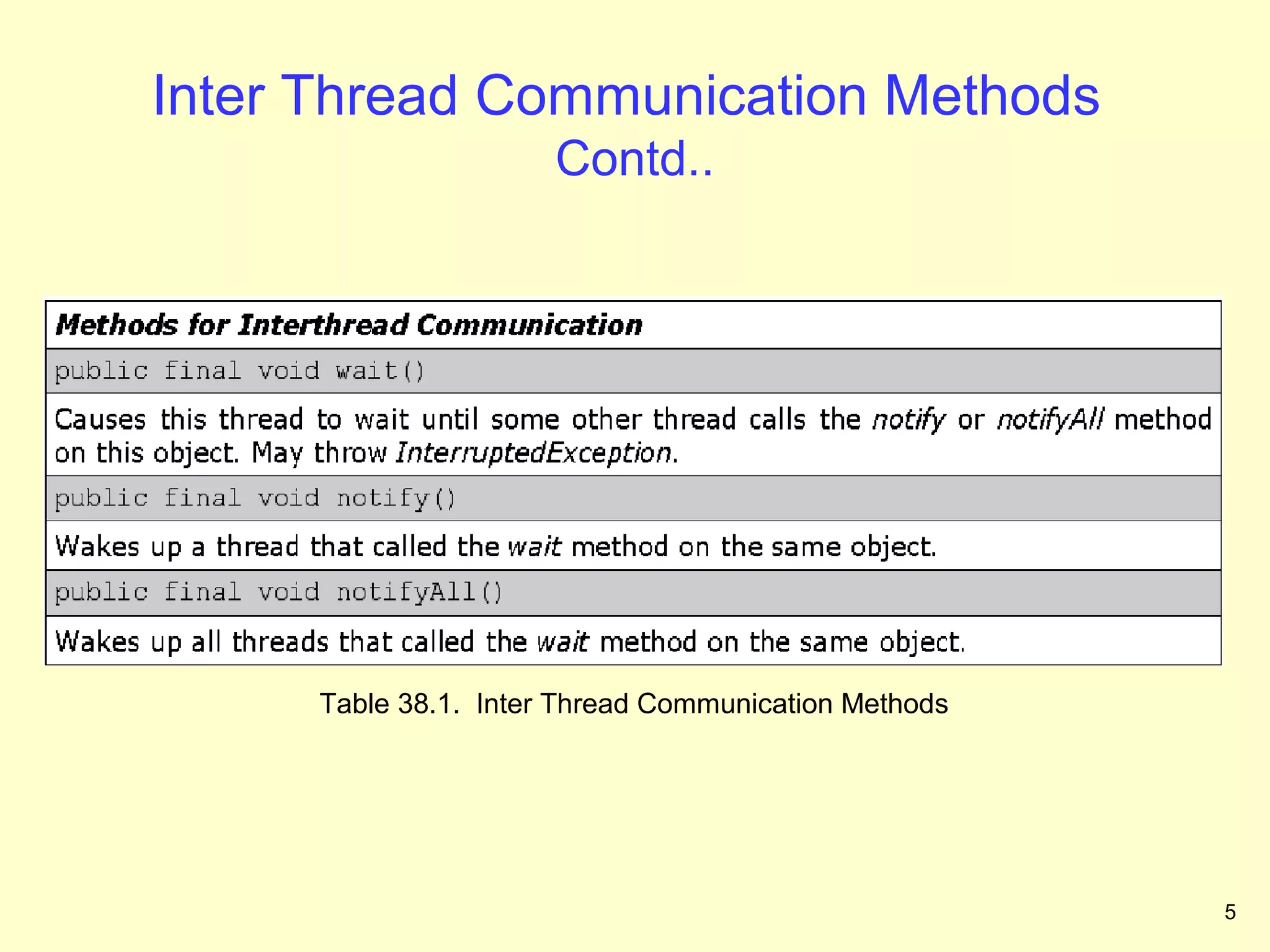
Inter Thread Communication Methods
                       Contd..


      Table 38.1. Inter Thread Communication Methods


                                                       5
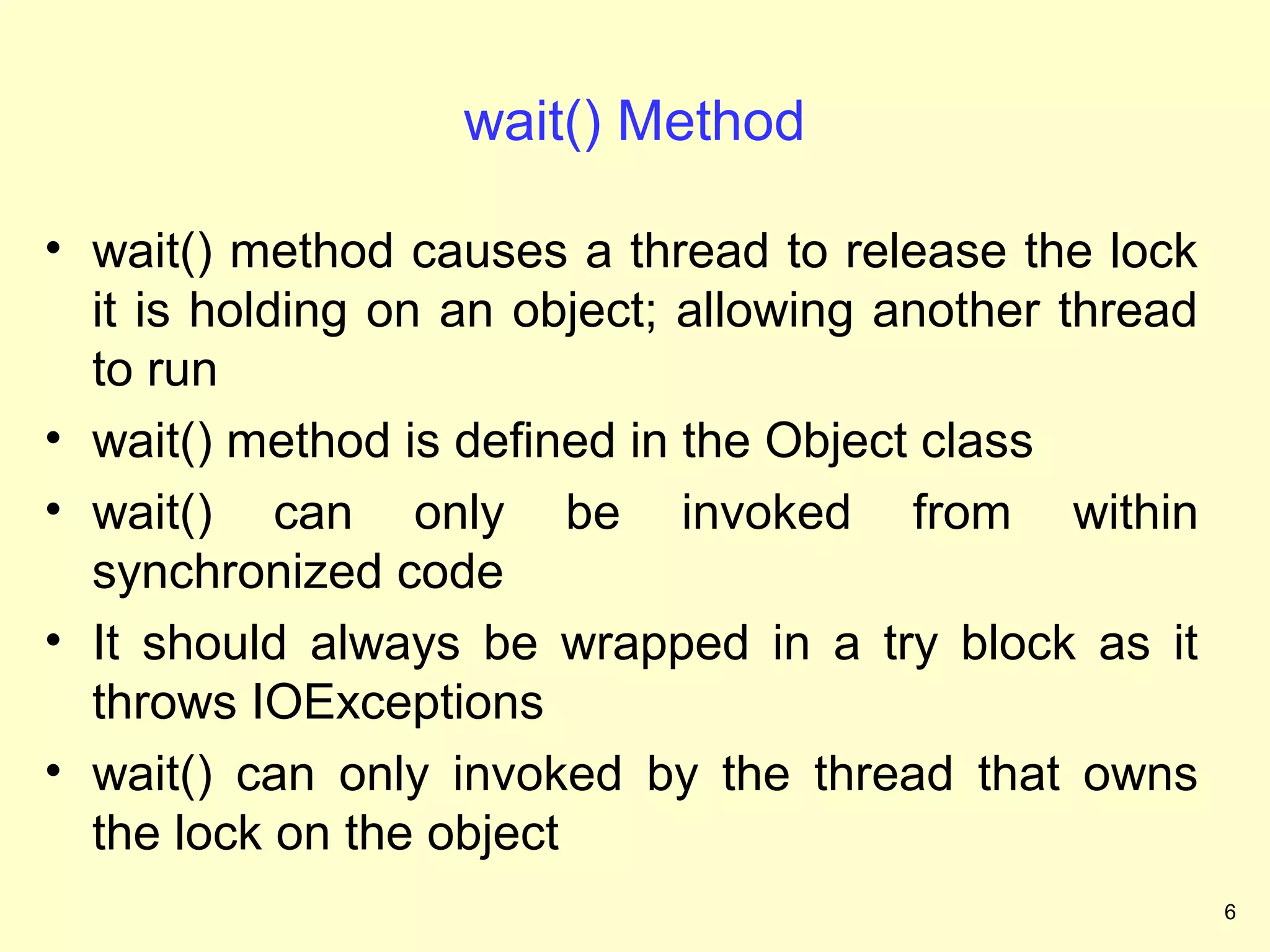
wait() Method

• wait() method causes a thread to release the lock
  it is holding on an object; allowing another thread
  to run
• wait() method is defined in the Object class
• wait() can only be invoked from within
  synchronized code
• It should always be wrapped in a try block as it
  throws IOExceptions
• wait() can only invoked by the thread that owns
  the lock on the object
                                                        6
wait() Method
                                        Contd . . .

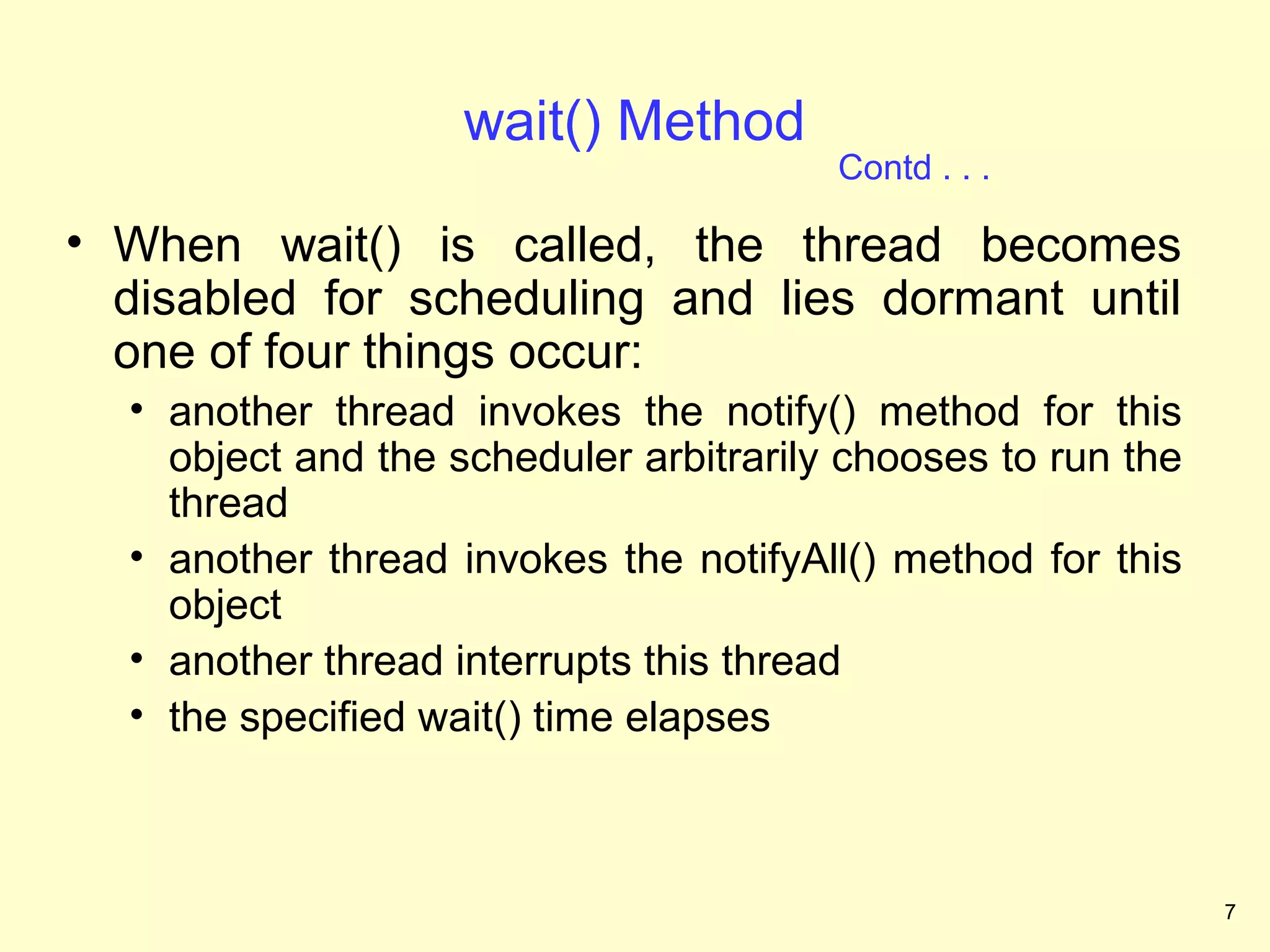
• When wait() is called, the thread becomes
  disabled for scheduling and lies dormant until
  one of four things occur:
  • another thread invokes the notify() method for this
    object and the scheduler arbitrarily chooses to run the
    thread
  • another thread invokes the notifyAll() method for this
    object
  • another thread interrupts this thread
  • the specified wait() time elapses


                                                              7
wait() Method
                                   Contd . . .

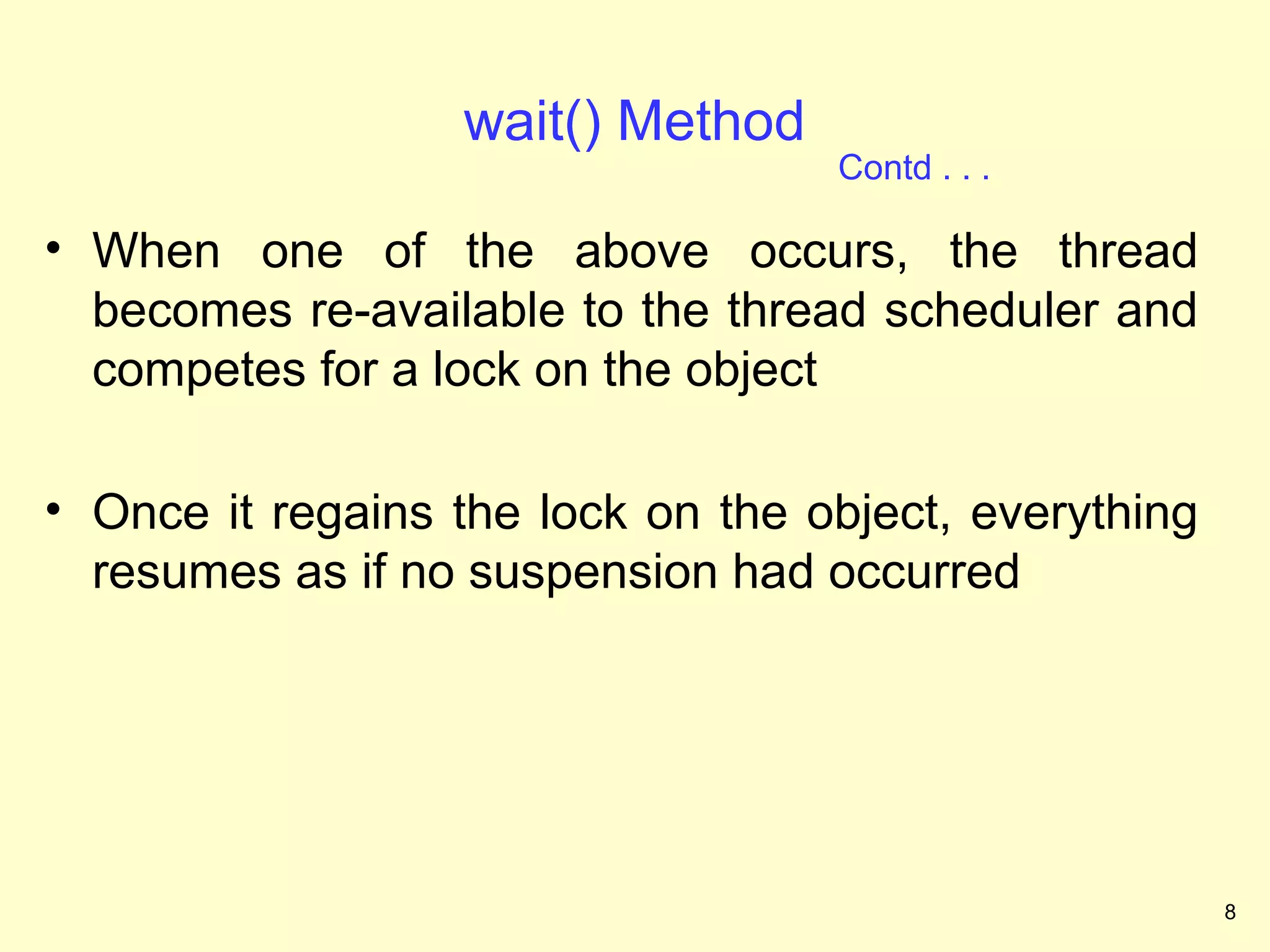
• When one of the above occurs, the thread
  becomes re-available to the thread scheduler and
  competes for a lock on the object

• Once it regains the lock on the object, everything
  resumes as if no suspension had occurred


                                                       8
notify() Method

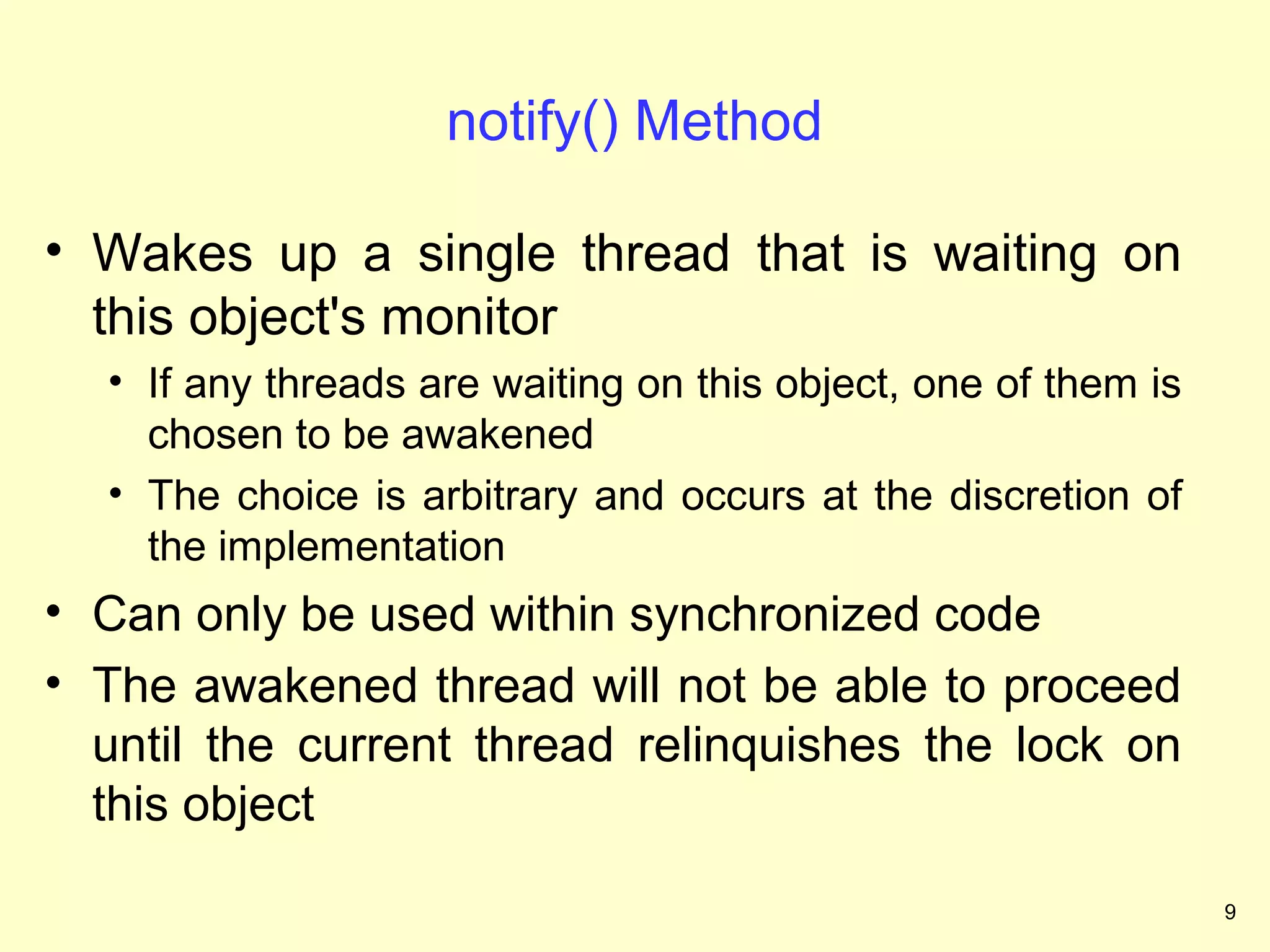
• Wakes up a single thread that is waiting on
  this object's monitor
  • If any threads are waiting on this object, one of them is
    chosen to be awakened
  • The choice is arbitrary and occurs at the discretion of
    the implementation
• Can only be used within synchronized code
• The awakened thread will not be able to proceed
  until the current thread relinquishes the lock on
  this object

                                                                9
Producer-Consumer Problem

• Producing thread may write to buffer (shared
  memory)
• Consuming thread reads from buffer
• If not synchronized, data can become corrupted
  • Producer may write before consumer read last data
     • Data lost
  • Consumer may read before producer writes new data
     • Data "doubled"


                                                        10
Producer-Consumer Problem
                                           Contd . . .
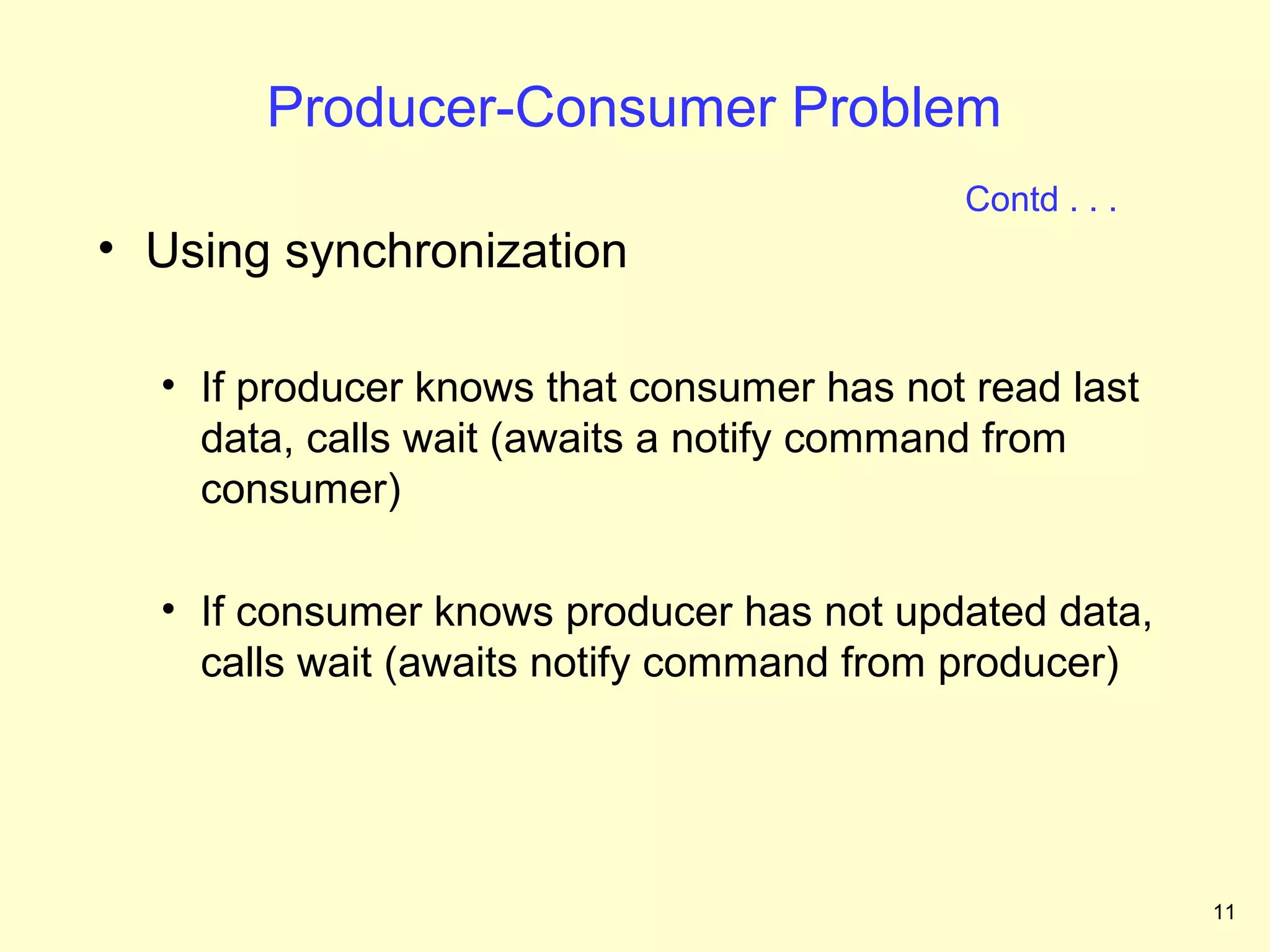
• Using synchronization

  • If producer knows that consumer has not read last
    data, calls wait (awaits a notify command from
    consumer)

  • If consumer knows producer has not updated data,
    calls wait (awaits notify command from producer)


                                                         11
Incorrect Implementation
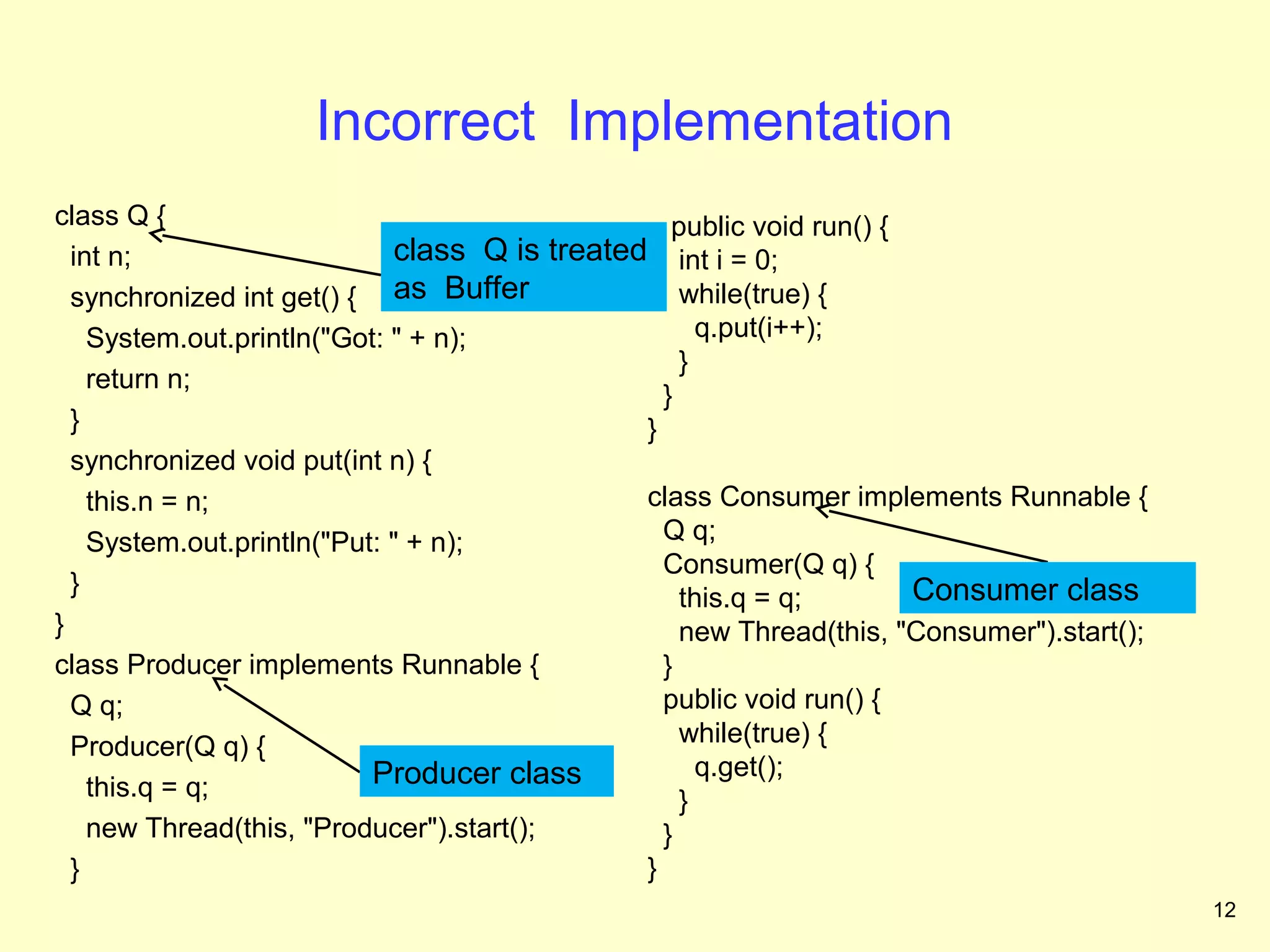
class Q {                                         public void run() {
  int n;                     class Q is treated int i = 0;
  synchronized int get() { as Buffer               while(true) {
    System.out.println("Got: " + n);                 q.put(i++);
                                                   }
    return n;
                                                 }
  }                                            }
  synchronized void put(int n) {
    this.n = n;                                class Consumer implements Runnable {
    System.out.println("Put: " + n);             Q q;
                                                 Consumer(Q q) {
  }                                                                   Consumer class
                                                   this.q = q;
}                                                  new Thread(this, "Consumer").start();
class Producer implements Runnable {             }
  Q q;                                           public void run() {
  Producer(Q q) {                                  while(true) {
                           Producer class            q.get();
    this.q = q;                                    }
    new Thread(this, "Producer").start();        }
  }                                            }
                                                                                           12
Incorrect Implementation
                                                Contd . . .
class PC {
  public static void main(String args[]) {
    Q q = new Q();
    new Producer(q);
    new Consumer(q);
    System.out.println("Press Control-C to stop.");
  }
}


                                                              13
Incorrect Implementation
                                               Contd . . .
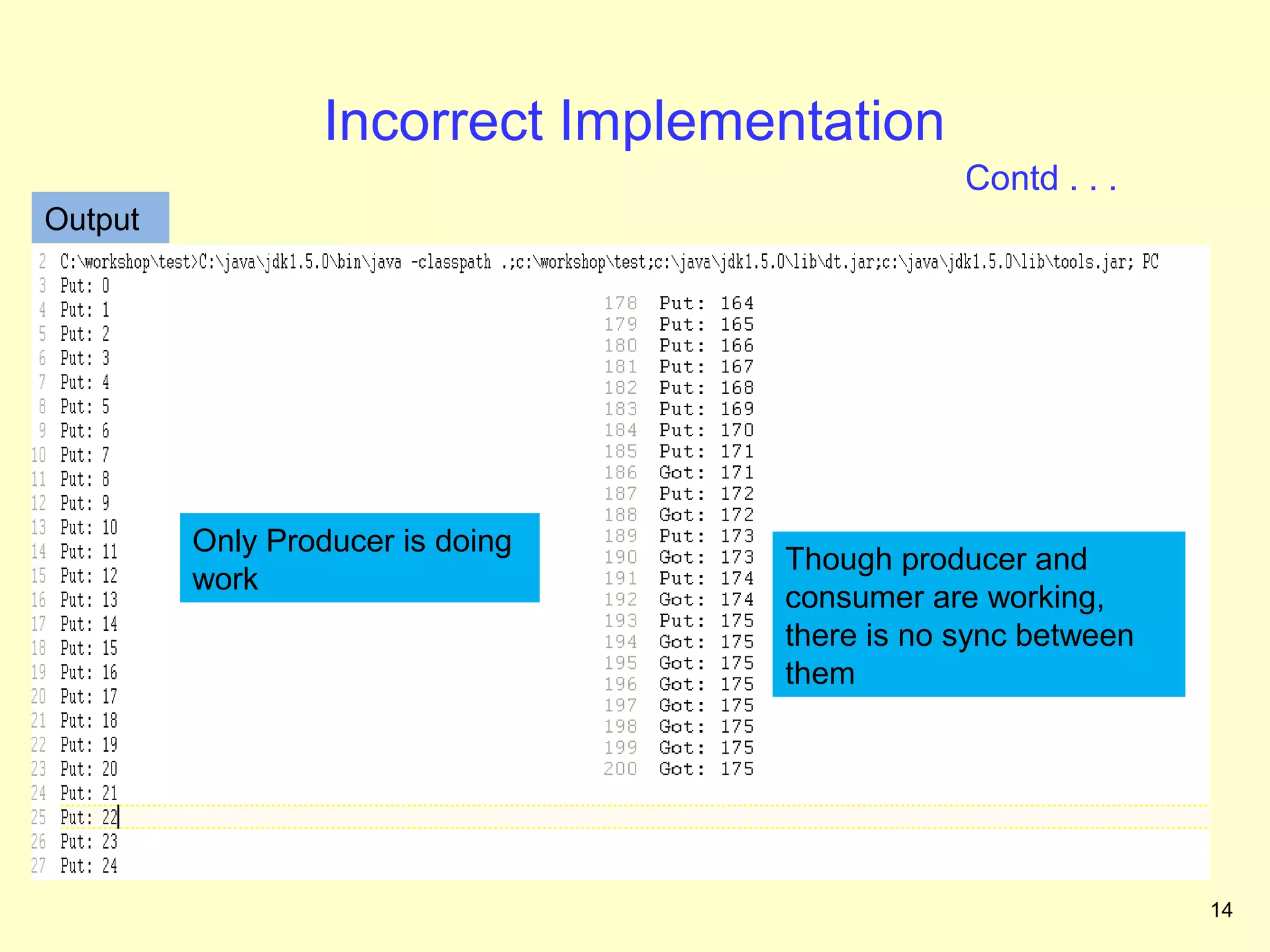
Output


         Only Producer is doing
                                   Though producer and
         work
                                   consumer are working,
                                   there is no sync between
                                   them


                                                              14
Correct Implementation
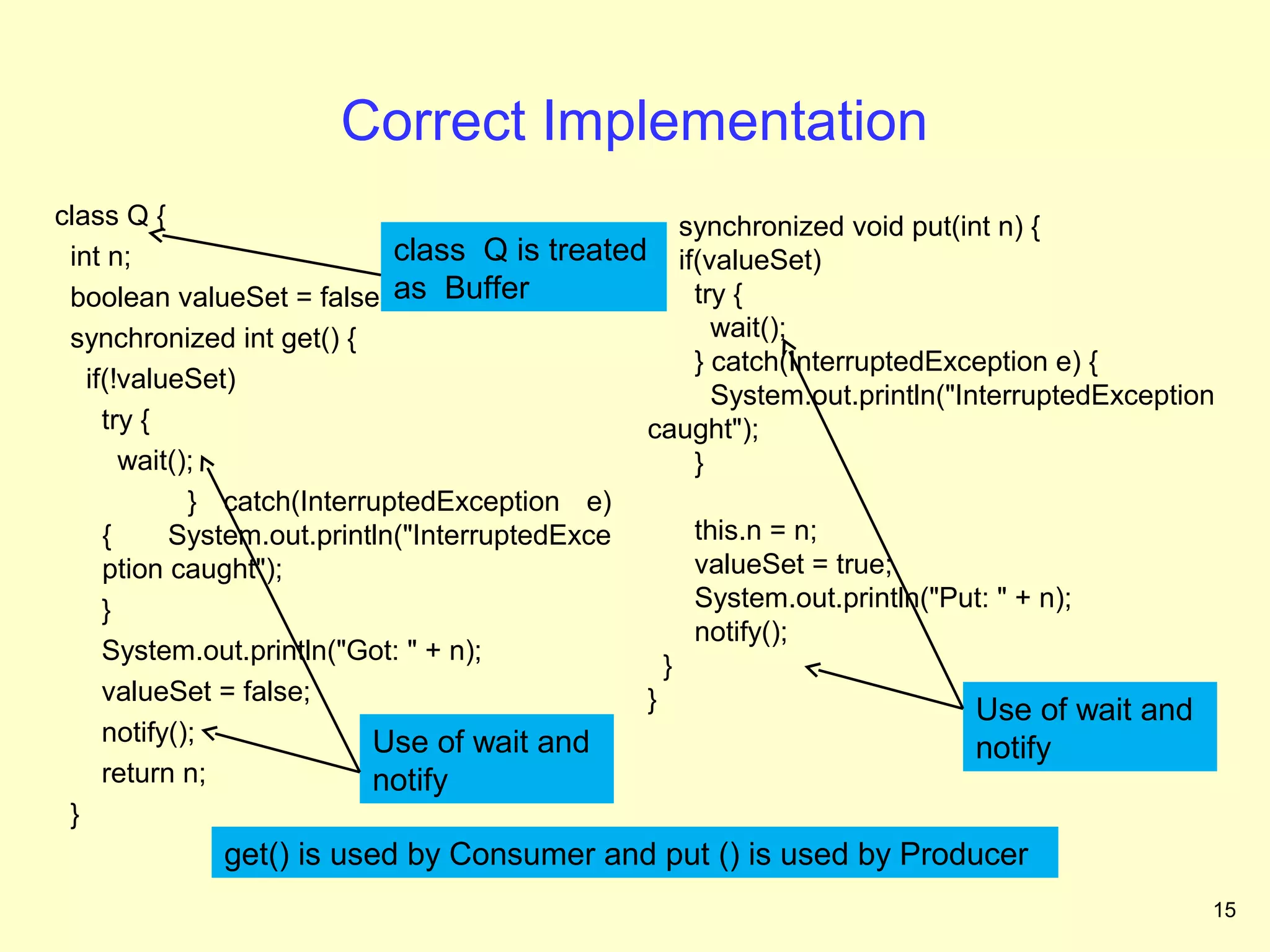
class Q {                                          synchronized void put(int n) {
 int n;                      class Q is treated if(valueSet)
 boolean valueSet = false; as Buffer                try {
 synchronized int get() {                             wait();
                                                    } catch(InterruptedException e) {
   if(!valueSet)
                                                      System.out.println("InterruptedException
     try {                                     caught");
       wait();                                      }
             } catch(InterruptedException e)
     {     System.out.println("InterruptedExce      this.n = n;
     ption caught");                                valueSet = true;
     }                                              System.out.println("Put: " + n);
                                                    notify();
     System.out.println("Got: " + n);
                                                 }
     valueSet = false;                         }                            Use of wait and
     notify();             Use of wait and                                  notify
     return n;             notify
 }
             get() is used by Consumer and put () is used by Producer
                                                                                             15
Correct Implementation
                                                                        Contd . . .
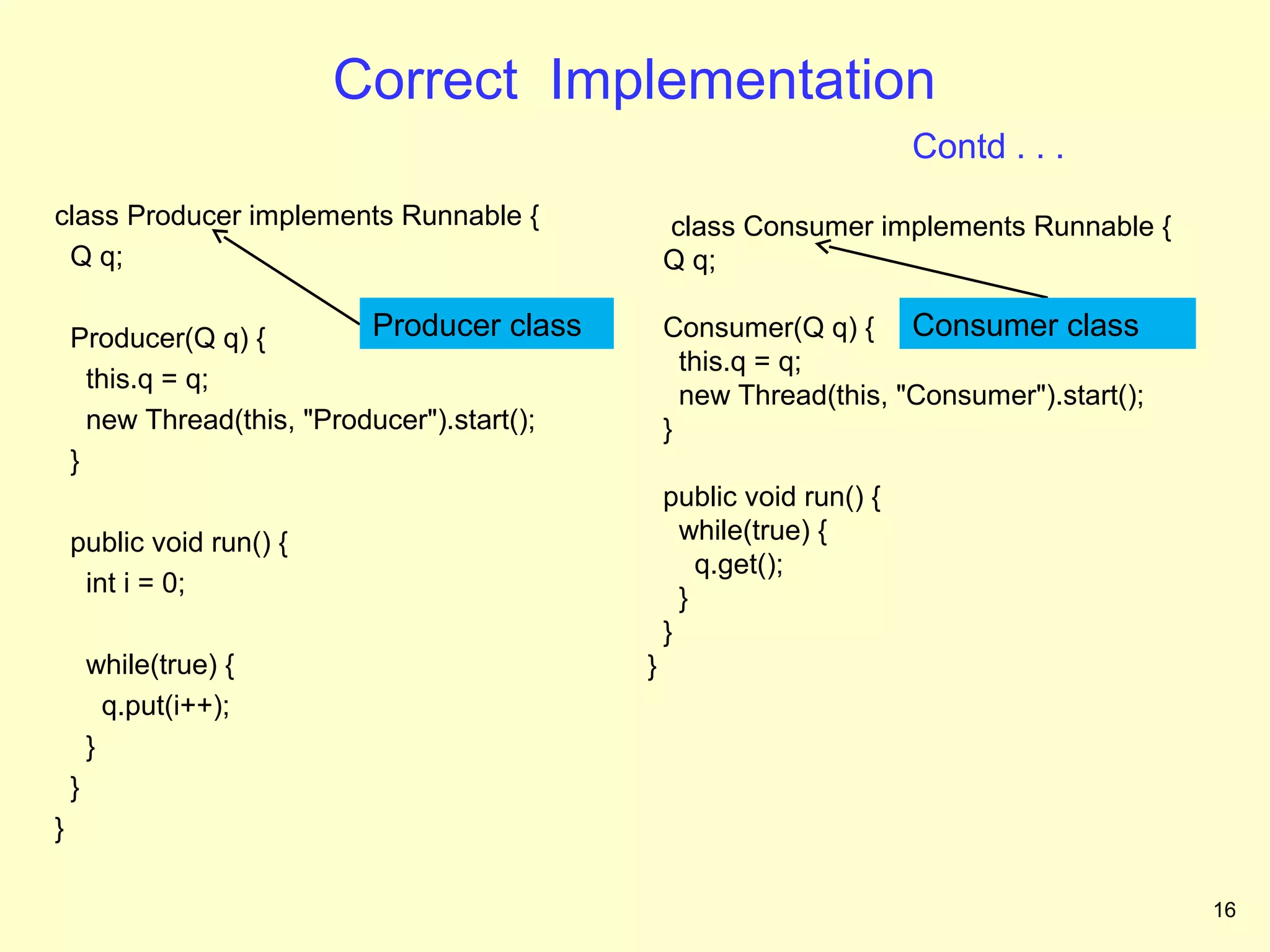
class Producer implements Runnable {              class Consumer implements Runnable {
 Q q;                                             Q q;

    Producer(Q q) {         Producer class        Consumer(Q q) { Consumer class
                                                    this.q = q;
      this.q = q;
                                                    new Thread(this, "Consumer").start();
      new Thread(this, "Producer").start();       }
    }
                                                  public void run() {
    public void run() {                             while(true) {
                                                      q.get();
     int i = 0;
                                                    }
                                                  }
        while(true) {                         }
          q.put(i++);
        }
    }
}

                                                                                            16
Correct Implementation
                                  Contd . . .
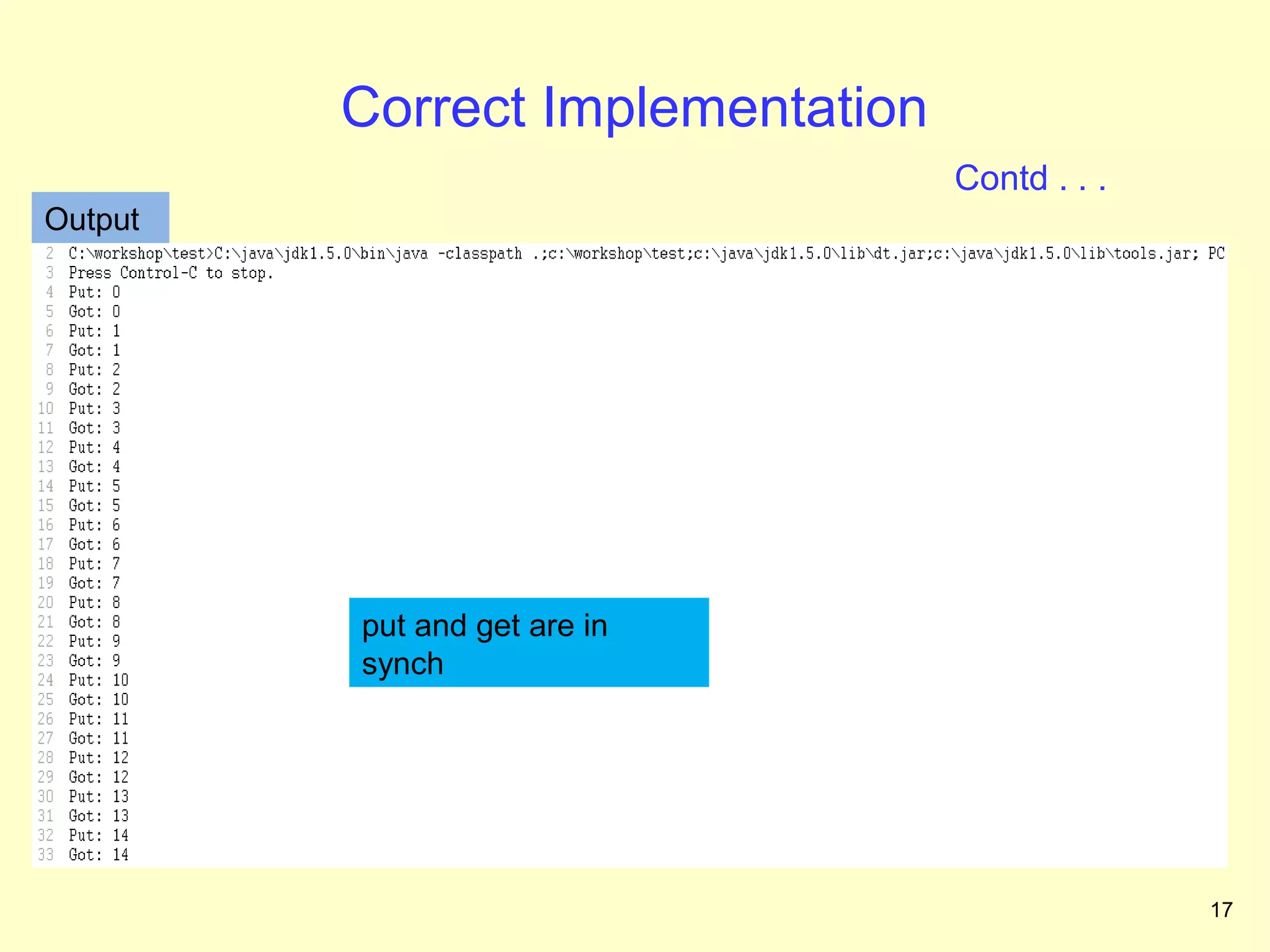
Output


         put and get are in
         synch


                                                17
Summary

• In this class, you have learnt

   • The methods for doing inter thread communication
   • Producer-Consumer problem
   • A program that implements Producer-Consumer
     problem


• In the next lesson we look at Deadlock problem


                                                        18
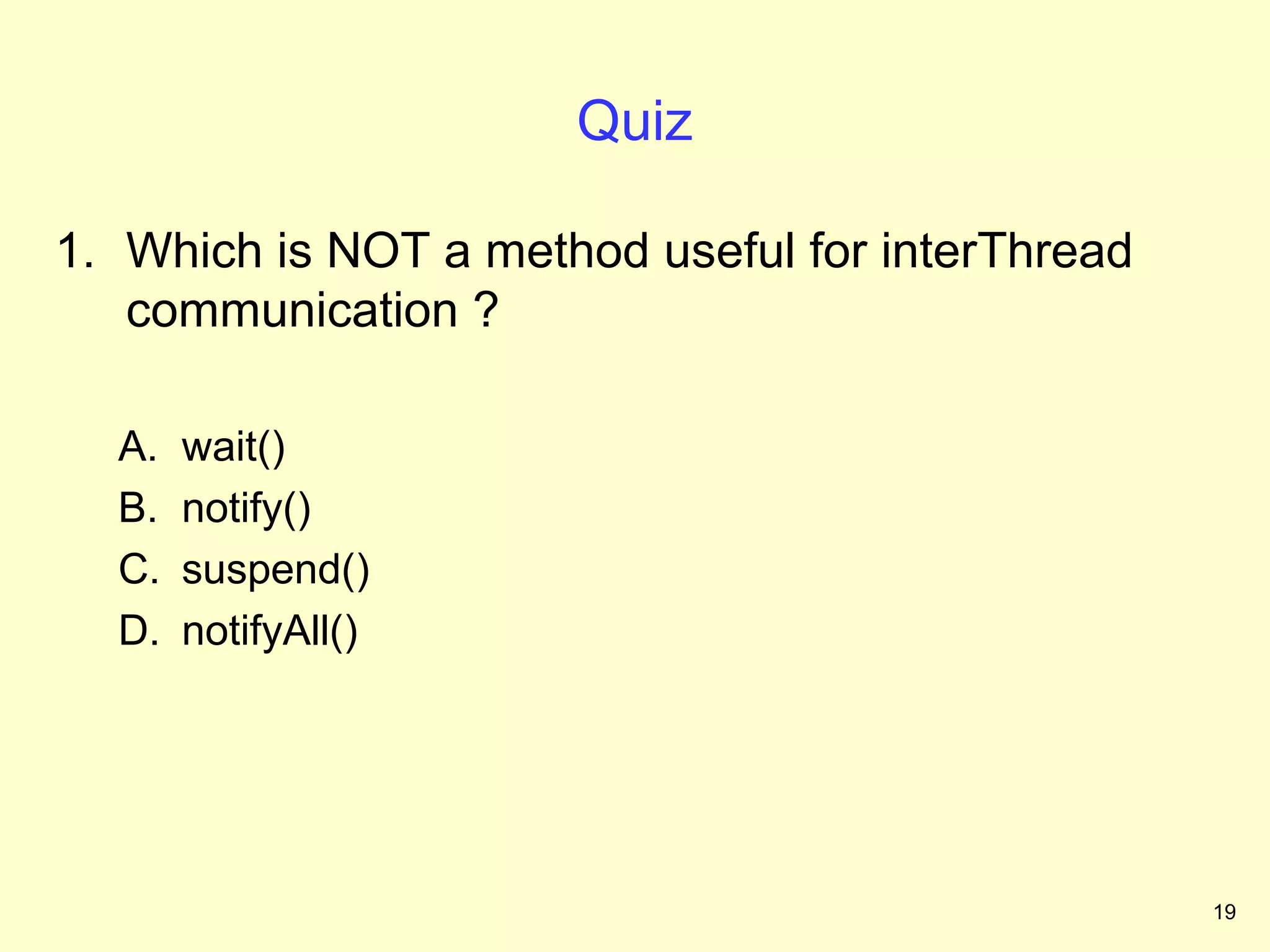
Quiz

1. Which is NOT a method useful for interThread
   communication ?

  A.   wait()
  B.   notify()
  C.   suspend()
  D.   notifyAll()


                                                  19
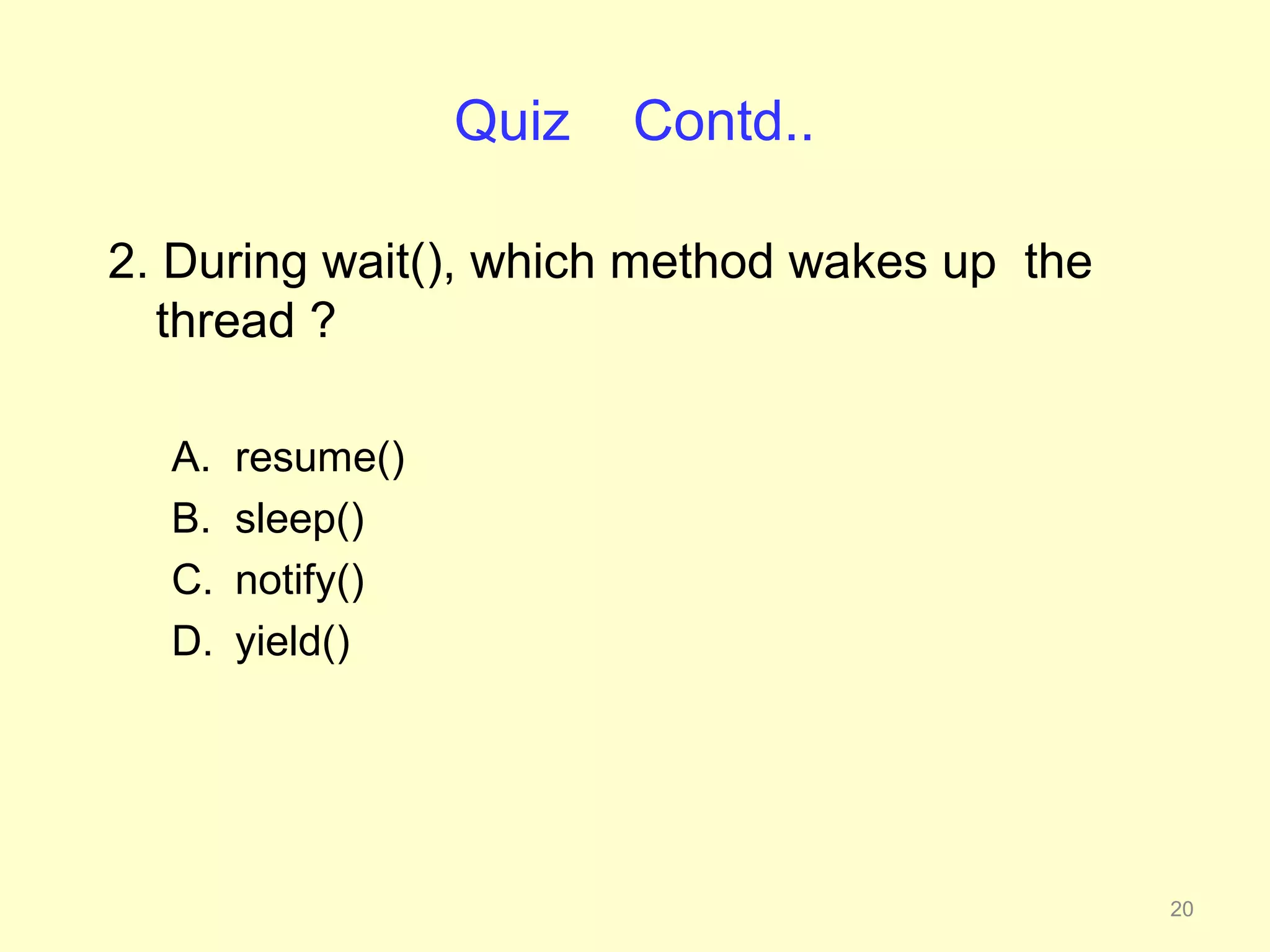
Quiz   Contd..

2. During wait(), which method wakes up the
  thread ?

  A.   resume()
  B.   sleep()
  C.   notify()
  D.   yield()


                                              20
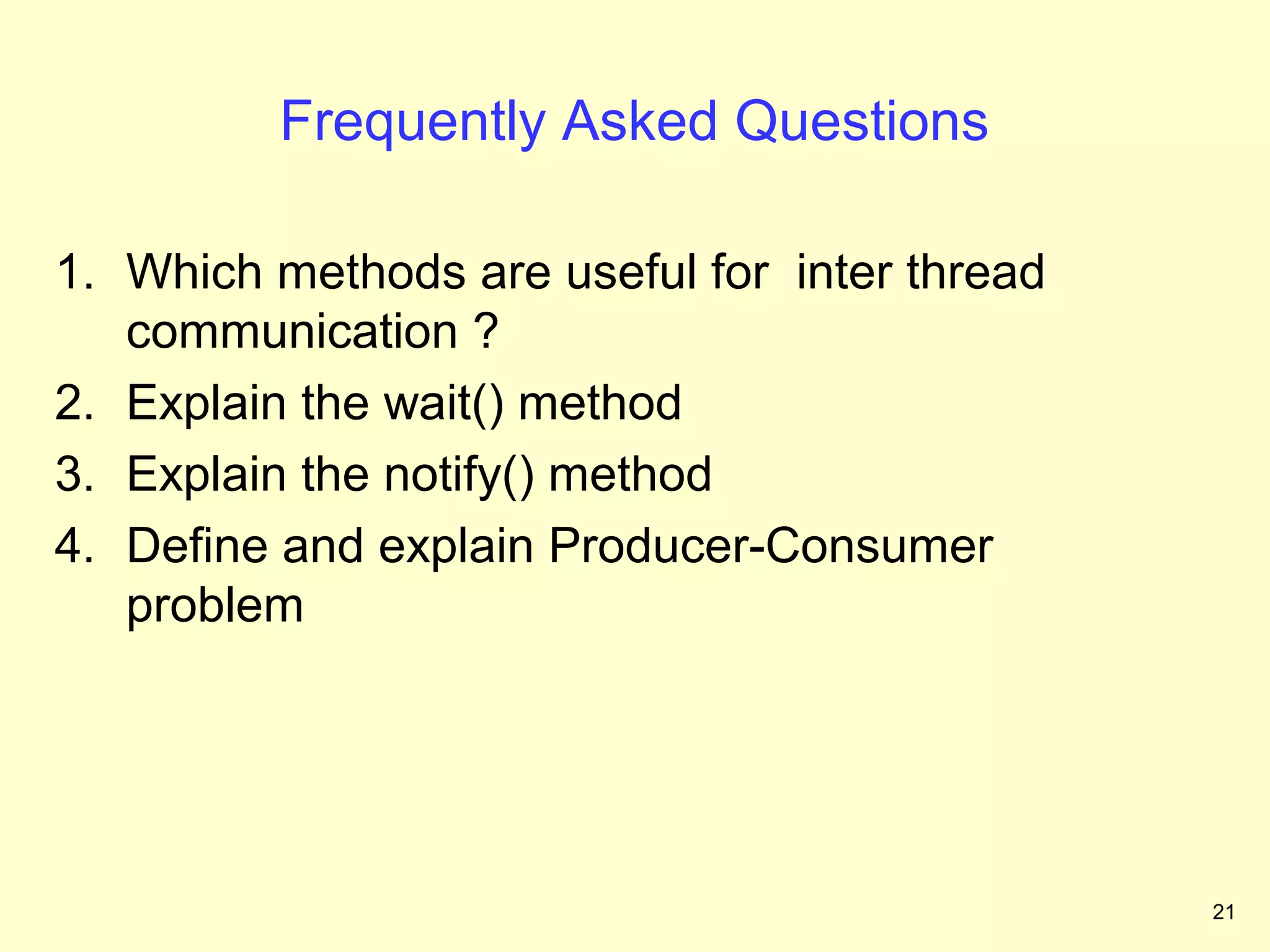
Frequently Asked Questions

1. Which methods are useful for inter thread
   communication ?
2. Explain the wait() method
3. Explain the notify() method
4. Define and explain Producer-Consumer
   problem


                                               21
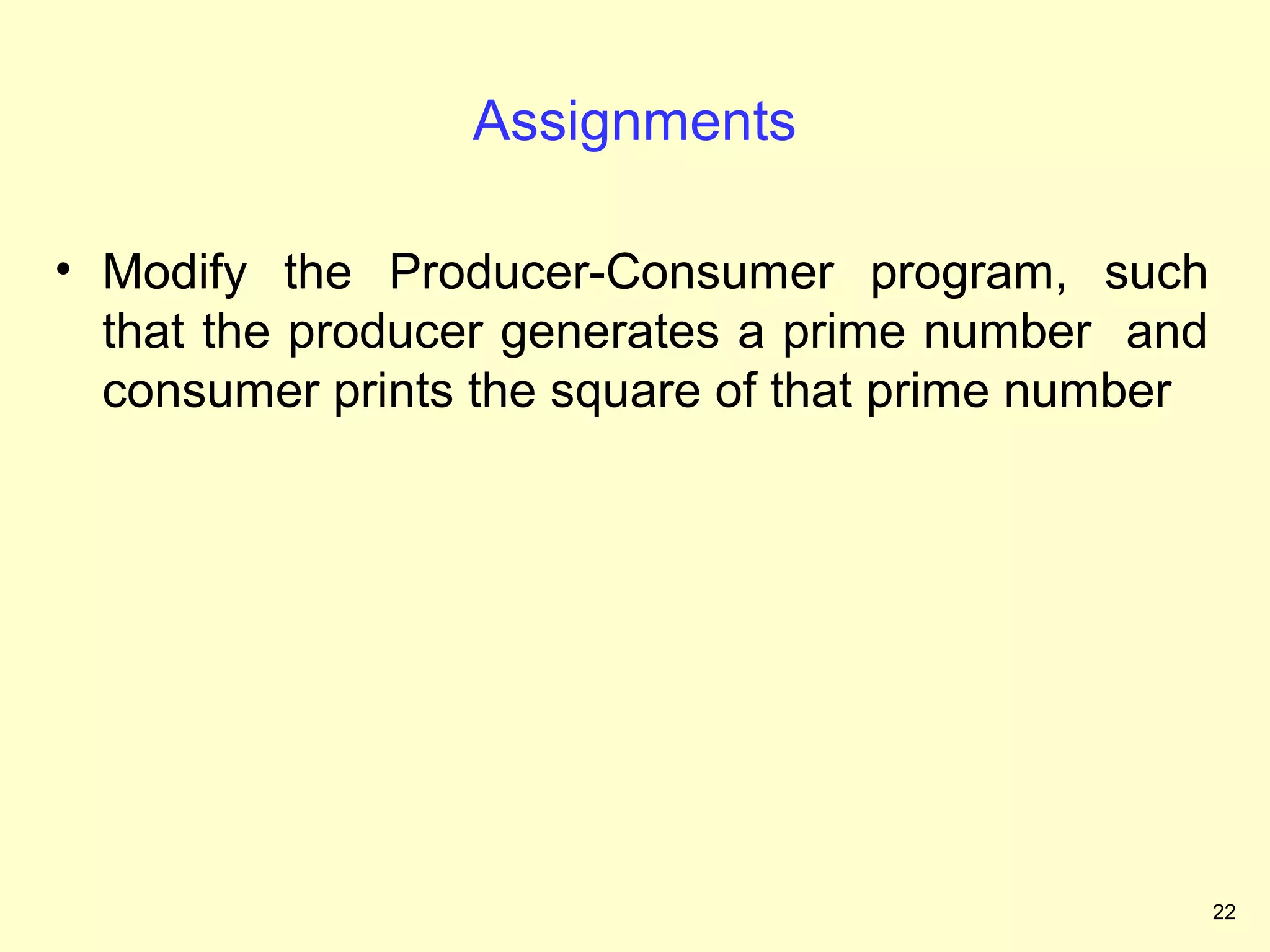
Assignments

• Modify the Producer-Consumer program, such
  that the producer generates a prime number and
  consumer prints the square of that prime number


                                                    22

Inter threadcommunication.38

  • 1.
  • 2.
    Objectives On completion ofthis period, you would be able to learn • Inter thread communication methods • wait() method • notify() method • Producer-Consumer problem • Solution to Producer-Consumer problem 2
  • 3.
    Recap In the previousclass, you have learnt • Synchronization • Monitor • Unsynchronized examples • Locking objects • Examples on synchronization 3
  • 4.
    Inter Thread CommunicationMethods • When more than one thread uses a shared resource they need to synchronize with each other • While using a shared resource the threads need to communicate with each other, to get the expected behavior of the application • Java provides some methods for the threads to communicate 4
  • 5.
    Inter Thread CommunicationMethods Contd.. Table 38.1. Inter Thread Communication Methods 5
  • 6.
    wait() Method • wait()method causes a thread to release the lock it is holding on an object; allowing another thread to run • wait() method is defined in the Object class • wait() can only be invoked from within synchronized code • It should always be wrapped in a try block as it throws IOExceptions • wait() can only invoked by the thread that owns the lock on the object 6
  • 7.
    wait() Method Contd . . . • When wait() is called, the thread becomes disabled for scheduling and lies dormant until one of four things occur: • another thread invokes the notify() method for this object and the scheduler arbitrarily chooses to run the thread • another thread invokes the notifyAll() method for this object • another thread interrupts this thread • the specified wait() time elapses 7
  • 8.
    wait() Method Contd . . . • When one of the above occurs, the thread becomes re-available to the thread scheduler and competes for a lock on the object • Once it regains the lock on the object, everything resumes as if no suspension had occurred 8
  • 9.
    notify() Method • Wakesup a single thread that is waiting on this object's monitor • If any threads are waiting on this object, one of them is chosen to be awakened • The choice is arbitrary and occurs at the discretion of the implementation • Can only be used within synchronized code • The awakened thread will not be able to proceed until the current thread relinquishes the lock on this object 9
  • 10.
    Producer-Consumer Problem • Producingthread may write to buffer (shared memory) • Consuming thread reads from buffer • If not synchronized, data can become corrupted • Producer may write before consumer read last data • Data lost • Consumer may read before producer writes new data • Data "doubled" 10
  • 11.
    Producer-Consumer Problem Contd . . . • Using synchronization • If producer knows that consumer has not read last data, calls wait (awaits a notify command from consumer) • If consumer knows producer has not updated data, calls wait (awaits notify command from producer) 11
  • 12.
    Incorrect Implementation class Q{ public void run() { int n; class Q is treated int i = 0; synchronized int get() { as Buffer while(true) { System.out.println("Got: " + n); q.put(i++); } return n; } } } synchronized void put(int n) { this.n = n; class Consumer implements Runnable { System.out.println("Put: " + n); Q q; Consumer(Q q) { } Consumer class this.q = q; } new Thread(this, "Consumer").start(); class Producer implements Runnable { } Q q; public void run() { Producer(Q q) { while(true) { Producer class q.get(); this.q = q; } new Thread(this, "Producer").start(); } } } 12
  • 13.
    Incorrect Implementation Contd . . . class PC { public static void main(String args[]) { Q q = new Q(); new Producer(q); new Consumer(q); System.out.println("Press Control-C to stop."); } } 13
  • 14.
    Incorrect Implementation Contd . . . Output Only Producer is doing Though producer and work consumer are working, there is no sync between them 14
  • 15.
    Correct Implementation class Q{ synchronized void put(int n) { int n; class Q is treated if(valueSet) boolean valueSet = false; as Buffer try { synchronized int get() { wait(); } catch(InterruptedException e) { if(!valueSet) System.out.println("InterruptedException try { caught"); wait(); } } catch(InterruptedException e) { System.out.println("InterruptedExce this.n = n; ption caught"); valueSet = true; } System.out.println("Put: " + n); notify(); System.out.println("Got: " + n); } valueSet = false; } Use of wait and notify(); Use of wait and notify return n; notify } get() is used by Consumer and put () is used by Producer 15
  • 16.
    Correct Implementation Contd . . . class Producer implements Runnable { class Consumer implements Runnable { Q q; Q q; Producer(Q q) { Producer class Consumer(Q q) { Consumer class this.q = q; this.q = q; new Thread(this, "Consumer").start(); new Thread(this, "Producer").start(); } } public void run() { public void run() { while(true) { q.get(); int i = 0; } } while(true) { } q.put(i++); } } } 16
  • 17.
    Correct Implementation Contd . . . Output put and get are in synch 17
  • 18.
    Summary • In thisclass, you have learnt • The methods for doing inter thread communication • Producer-Consumer problem • A program that implements Producer-Consumer problem • In the next lesson we look at Deadlock problem 18
  • 19.
    Quiz 1. Which isNOT a method useful for interThread communication ? A. wait() B. notify() C. suspend() D. notifyAll() 19
  • 20.
    Quiz Contd.. 2. During wait(), which method wakes up the thread ? A. resume() B. sleep() C. notify() D. yield() 20
  • 21.
    Frequently Asked Questions 1.Which methods are useful for inter thread communication ? 2. Explain the wait() method 3. Explain the notify() method 4. Define and explain Producer-Consumer problem 21
  • 22.
    Assignments • Modify theProducer-Consumer program, such that the producer generates a prime number and consumer prints the square of that prime number 22