PRESENTATION
ON
CORE JAVA
Introduction
Java language is the most popular
programming language in use today by many
measures.
Portability across hardware platforms
and operating systems is the main benefit of
Java applications.
CONTENT
• What is Java ?
• Where is Java used ?
• Features of Java
• Java Program Translation
• Java Virtual Machine
• Java system overview
• Java Program-Development phase
• Advantage of java
• Disadvantage of java
• Project
WHERE IS JAVA USED ?
According to the Sun , 3 billion devices run java.
There are many devices where Java is currently used.
Desktop Applications - Acrobat reader, Media player,
Antiviruses etc.
 Web Applications - irctc.co.in , javatpoint.com etc.
 Enterprise Application – Banking Application, Business
Application.
Mobile.
Embedded System.
Games.
Robotics.
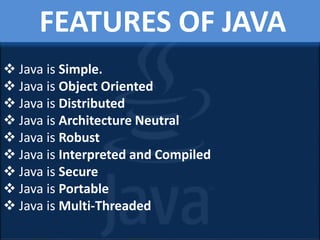
FEATURES OF JAVA
 Java is Simple.
 Java is Object Oriented
 Java is Distributed
 Java is Architecture Neutral
 Java is Robust
 Java is Interpreted and Compiled
 Java is Secure
 Java is Portable
 Java is Multi-Threaded
JAVA VIRTUAL MACHINE
 Java virtual machine is the like usual
computer which translate high level language
into machine language.
 Just like that Java virtual machine also
t ranslate Bytecode into machine language.
JVM are available for many hardware and
software Plateform.
WHAT IS OOP ?
Object-oriented programming is a method of
implementation.
A language in which everything represent in the
form of Object is called Object Oriented
Programming Language.
It not only makes the program less complex but
also makes the software reuse feasible and
possible
Java is not truly Object Oriented Programming
Language
 Object
 Class
 Encapsulation
 Inheritance
 Polymorphism
 Abstraction
CONCEPTS OF OOP
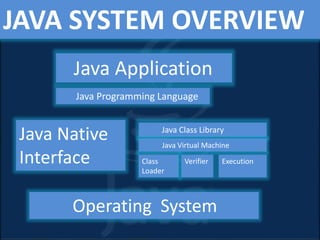
JAVA SYSTEM OVERVIEW
Java Application
Java Programming Language
Java Native
Interface
Java Class Library
Java Virtual Machine
Class
Loader
Verifier Execution
Operating System
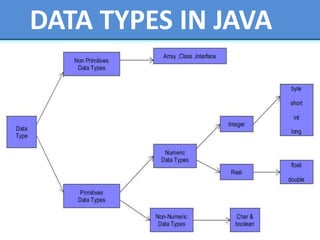
DATA TYPES IN JAVA
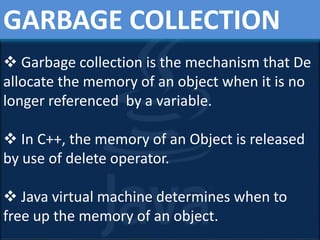
GARBAGE COLLECTION
 Garbage collection is the mechanism that De
allocate the memory of an object when it is no
longer referenced by a variable.
 In C++, the memory of an Object is released
by use of delete operator.
 Java virtual machine determines when to
free up the memory of an object.
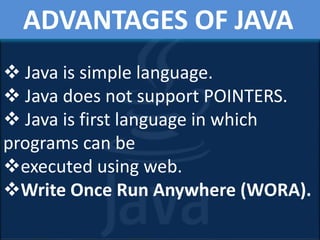
ADVANTAGES OF JAVA
 Java is simple language.
 Java does not support POINTERS.
 Java is first language in which
programs can be
executed using web.
Write Once Run Anywhere (WORA).
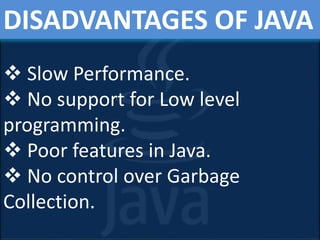
DISADVANTAGES OF JAVA
 Slow Performance.
 No support for Low level
programming.
 Poor features in Java.
 No control over Garbage
Collection.
PROJECT
LIBRARY MANAGEMENT SYSTEM
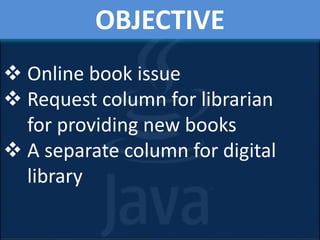
OBJECTIVE
 Online book issue
 Request column for librarian
for providing new books
 A separate column for digital
library
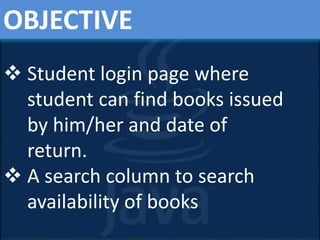
OBJECTIVE
 Student login page where
student can find books issued
by him/her and date of
return.
 A search column to search
availability of books
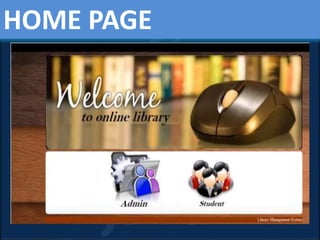
HOME PAGE
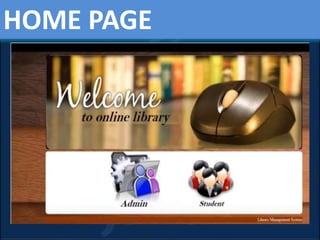
HOME PAGE
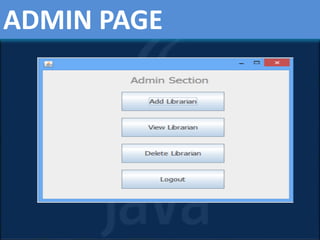
ADMIN PAGE
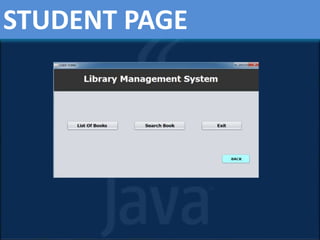
STUDENT PAGE
Thank
You…

Core java

  • 1.
  • 2.
    Introduction Java language isthe most popular programming language in use today by many measures. Portability across hardware platforms and operating systems is the main benefit of Java applications.
  • 3.
    CONTENT • What isJava ? • Where is Java used ? • Features of Java • Java Program Translation • Java Virtual Machine • Java system overview • Java Program-Development phase • Advantage of java • Disadvantage of java • Project
  • 4.
    WHERE IS JAVAUSED ? According to the Sun , 3 billion devices run java. There are many devices where Java is currently used. Desktop Applications - Acrobat reader, Media player, Antiviruses etc.  Web Applications - irctc.co.in , javatpoint.com etc.  Enterprise Application – Banking Application, Business Application. Mobile. Embedded System. Games. Robotics.
  • 5.
    FEATURES OF JAVA Java is Simple.  Java is Object Oriented  Java is Distributed  Java is Architecture Neutral  Java is Robust  Java is Interpreted and Compiled  Java is Secure  Java is Portable  Java is Multi-Threaded
  • 6.
    JAVA VIRTUAL MACHINE Java virtual machine is the like usual computer which translate high level language into machine language.  Just like that Java virtual machine also t ranslate Bytecode into machine language. JVM are available for many hardware and software Plateform.
  • 7.
    WHAT IS OOP? Object-oriented programming is a method of implementation. A language in which everything represent in the form of Object is called Object Oriented Programming Language. It not only makes the program less complex but also makes the software reuse feasible and possible Java is not truly Object Oriented Programming Language
  • 8.
     Object  Class Encapsulation  Inheritance  Polymorphism  Abstraction CONCEPTS OF OOP
  • 9.
    JAVA SYSTEM OVERVIEW JavaApplication Java Programming Language Java Native Interface Java Class Library Java Virtual Machine Class Loader Verifier Execution Operating System
  • 10.
  • 11.
    GARBAGE COLLECTION  Garbagecollection is the mechanism that De allocate the memory of an object when it is no longer referenced by a variable.  In C++, the memory of an Object is released by use of delete operator.  Java virtual machine determines when to free up the memory of an object.
  • 12.
    ADVANTAGES OF JAVA Java is simple language.  Java does not support POINTERS.  Java is first language in which programs can be executed using web. Write Once Run Anywhere (WORA).
  • 13.
    DISADVANTAGES OF JAVA Slow Performance.  No support for Low level programming.  Poor features in Java.  No control over Garbage Collection.
  • 14.
  • 15.
    OBJECTIVE  Online bookissue  Request column for librarian for providing new books  A separate column for digital library
  • 16.
    OBJECTIVE  Student loginpage where student can find books issued by him/her and date of return.  A search column to search availability of books
  • 17.
  • 18.
  • 19.
  • 20.
  • 21.