OSI REFERENCE
MODEL AND THE TCP/IP
MODEL
OSI REFERENCE MODEL
Models and Standards in Communication
• Communication
• Established standards
• Standards are known as protocols
• Implementation
• A framework is helpful in the design of hardware and software for
communication
• ISO-OSI Model serves this purpose
• ISO-OSI supersedes the TCP/IP model
OSI REFERENCE MODEL
• International Standards Organization (ISO) is a multinational body dedicated to world
wide agreement on international standards.
• Open System Interconnection (OSI) model is an ISO standard that covers all aspects of
network communication.
• An open system is a set of protocols that allows any two different systems to
communicate regardless of their underlying architecture.
• The model acts as a frame of reference in the design of communications and
networking products
• The purpose of the OSI model is to show how to facilitate communication between
different systems without requiring changes to the logic of the underlying hardware
and software. The OSI model is not a protocol; it is a model for understanding and
designing a network architecture that is flexible, robust, and interoperable.
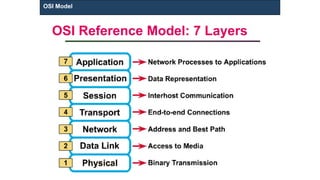
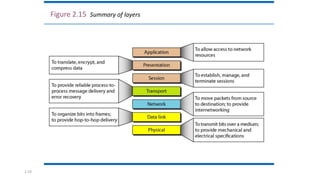
• OSI comprises of seven layers namely:
OSI Reference Model: 7 Layers
OSI Model
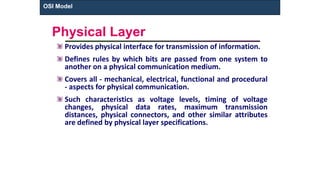
Physical Layer
Provides physical interface for transmission of information.
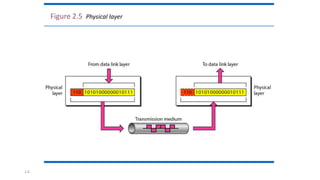
Defines rules by which bits are passed from one system to
another on a physical communication medium.
Covers all - mechanical, electrical, functional and procedural
- aspects for physical communication.
Such characteristics as voltage levels, timing of voltage
changes, physical data rates, maximum transmission
distances, physical connectors, and other similar attributes
are defined by physical layer specifications.
OSI Model
2.6
Figure 2.5 Physical layer
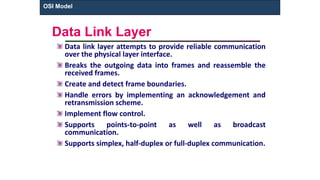
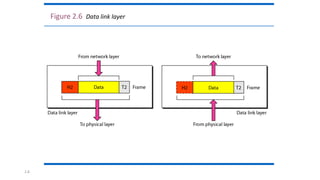
Data Link Layer
Data link layer attempts to provide reliable communication
over the physical layer interface.
Breaks the outgoing data into frames and reassemble the
received frames.
Create and detect frame boundaries.
Handle errors by implementing an acknowledgement and
retransmission scheme.
Implement flow control.
Supports points-to-point as well as broadcast
communication.
Supports simplex, half-duplex or full-duplex communication.
OSI Model
2.8
Figure 2.6 Data link layer
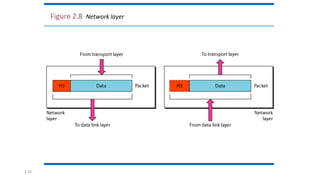
Network Layer
Implements routing of frames (packets) through the
network.
Defines the most optimum path the packet should take from
the source to the destination
Defines logical addressing so that any endpoint can be
identified.
Handles congestion in the network.
Facilitates interconnection between heterogeneous
networks (Internetworking).
The network layer also defines how to fragment a packet
into smaller packets to accommodate different media.
OSI Model
2.10
Figure 2.8 Network layer
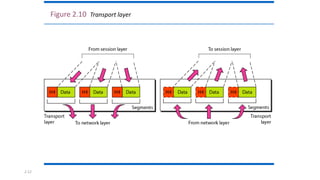
Transport Layer
Purpose of this layer is to provide a reliable mechanism for
the exchange of data between two processes in different
computers.
Ensures that the data units are delivered error free.
Ensures that data units are delivered in sequence.
Ensures that there is no loss or duplication of data units.
Provides connectionless or connection oriented service.
Provides for the connection management.
Multiplex multiple connection over a single channel.
OSI Model
2.12
Figure 2.10 Transport layer
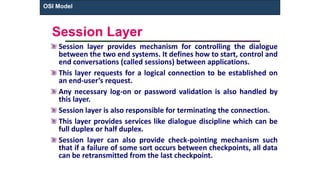
Session Layer
Session layer provides mechanism for controlling the dialogue
between the two end systems. It defines how to start, control and
end conversations (called sessions) between applications.
This layer requests for a logical connection to be established on
an end-user’s request.
Any necessary log-on or password validation is also handled by
this layer.
Session layer is also responsible for terminating the connection.
This layer provides services like dialogue discipline which can be
full duplex or half duplex.
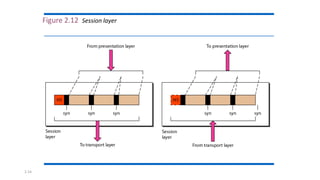
Session layer can also provide check-pointing mechanism such
that if a failure of some sort occurs between checkpoints, all data
can be retransmitted from the last checkpoint.
OSI Model
2.14
Figure 2.12 Session layer
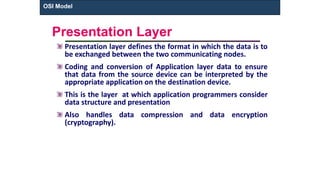
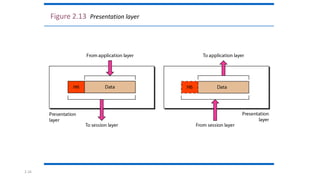
Presentation Layer
Presentation layer defines the format in which the data is to
be exchanged between the two communicating nodes.
Coding and conversion of Application layer data to ensure
that data from the source device can be interpreted by the
appropriate application on the destination device.
This is the layer at which application programmers consider
data structure and presentation
Also handles data compression and data encryption
(cryptography).
OSI Model
2.16
Figure 2.13 Presentation layer
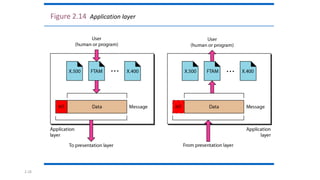
Application Layer
Application layer interacts with application programs and is
the highest level of OSI model.
Application layer contains management functions to
support distributed applications.
Examples of application layer are applications such as file
transfer, electronic mail, remote login etc.
OSI Model
2.18
Figure 2.14 Application layer
2.19
Figure 2.15 Summary of layers
• Transmission Control Protocol/Internet Protocol
• The Internet protocol suite is the networking model and a set of
communications protocols used for the Internet and similar networks.
TCP/IP is the communication protocol for the internet.
• TCP/IP defines the rule computers must follow to communicate with each
other over the internet.
• TCP/IP is TCP and IP working together.
• TCP takes care of the communication between your application software
(i.e. your browser) and your network software.
• IP takes care of the communication with other computers.
• TCP is responsible for breaking data down into IP packets before they are
sent, and for assembling the packets when they arrive.
• IP is responsible for sending the packets to the correct destination.
• It is commonly known as TCP/IP, because its most important
protocols, the Transmission Control Protocol (TCP) and the Internet
Protocol (IP) (192.168.1.50) were the first networking protocols defined in
this standard.
• It is occasionally known as the DoD model due to the foundational
influence of the ARPANET in the 1970s (operated by DARPA, an agency of
the United States Department of Defense).
• TCP/IP provides end-to-end connectivity specifying how data should be
formatted, addressed, transmitted, routed and received at the
destination.
• It has four abstraction layers which are used to sort all related protocols
according to the scope of networking involved. From lowest to
highest, the layers are:
• The link layer contains communication technologies for a single network
segment (link) of a local area network.
• The internet layer (IP) connects independent networks, thus establishing
internetworking.
• The transport layer handles host-to-host communication.
• The application layer contains all protocols for specific data
communications services on a process-to-process level. For example, the
Hypertext Transfer Protocol (HTTP) specifies the web browser
communication with a web server.
2.23
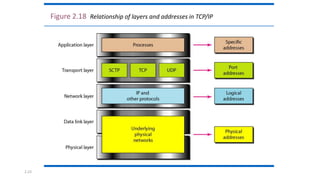
Figure 2.18 Relationship of layers and addresses in TCP/IP
• IP corresponds to the Network layer (Layer 3) in the OSI model, whereas
TCP corresponds to the Transport layer (Layer 4) in OSI.
• In other words, the term TCP/IP refers to network communications where
the TCP transport is used to deliver data across IP networks.
• The average person on the Internet works in a predominately TCP/IP
environment. Web browsers, for example, use TCP/IP to communicate
with Web servers.
WE ARE HUMBLED BY YOUR
COORPERATION, CONTRIBUTIONS
AND QUESTIONS WHICH
INCREASED OUR INSIGHT .
ABOVE ALL, GOD, OUR HELP
IN THE AGES PAST AND OUR
HOPE FOR THE YEARS TO
COME.

Osi reference model and the tcp

  • 1.
    OSI REFERENCE MODEL ANDTHE TCP/IP MODEL OSI REFERENCE MODEL
  • 2.
    Models and Standardsin Communication • Communication • Established standards • Standards are known as protocols • Implementation • A framework is helpful in the design of hardware and software for communication • ISO-OSI Model serves this purpose • ISO-OSI supersedes the TCP/IP model
  • 3.
    OSI REFERENCE MODEL •International Standards Organization (ISO) is a multinational body dedicated to world wide agreement on international standards. • Open System Interconnection (OSI) model is an ISO standard that covers all aspects of network communication. • An open system is a set of protocols that allows any two different systems to communicate regardless of their underlying architecture. • The model acts as a frame of reference in the design of communications and networking products • The purpose of the OSI model is to show how to facilitate communication between different systems without requiring changes to the logic of the underlying hardware and software. The OSI model is not a protocol; it is a model for understanding and designing a network architecture that is flexible, robust, and interoperable. • OSI comprises of seven layers namely:
  • 4.
    OSI Reference Model:7 Layers OSI Model
  • 5.
    Physical Layer Provides physicalinterface for transmission of information. Defines rules by which bits are passed from one system to another on a physical communication medium. Covers all - mechanical, electrical, functional and procedural - aspects for physical communication. Such characteristics as voltage levels, timing of voltage changes, physical data rates, maximum transmission distances, physical connectors, and other similar attributes are defined by physical layer specifications. OSI Model
  • 6.
  • 7.
    Data Link Layer Datalink layer attempts to provide reliable communication over the physical layer interface. Breaks the outgoing data into frames and reassemble the received frames. Create and detect frame boundaries. Handle errors by implementing an acknowledgement and retransmission scheme. Implement flow control. Supports points-to-point as well as broadcast communication. Supports simplex, half-duplex or full-duplex communication. OSI Model
  • 8.
  • 9.
    Network Layer Implements routingof frames (packets) through the network. Defines the most optimum path the packet should take from the source to the destination Defines logical addressing so that any endpoint can be identified. Handles congestion in the network. Facilitates interconnection between heterogeneous networks (Internetworking). The network layer also defines how to fragment a packet into smaller packets to accommodate different media. OSI Model
  • 10.
  • 11.
    Transport Layer Purpose ofthis layer is to provide a reliable mechanism for the exchange of data between two processes in different computers. Ensures that the data units are delivered error free. Ensures that data units are delivered in sequence. Ensures that there is no loss or duplication of data units. Provides connectionless or connection oriented service. Provides for the connection management. Multiplex multiple connection over a single channel. OSI Model
  • 12.
  • 13.
    Session Layer Session layerprovides mechanism for controlling the dialogue between the two end systems. It defines how to start, control and end conversations (called sessions) between applications. This layer requests for a logical connection to be established on an end-user’s request. Any necessary log-on or password validation is also handled by this layer. Session layer is also responsible for terminating the connection. This layer provides services like dialogue discipline which can be full duplex or half duplex. Session layer can also provide check-pointing mechanism such that if a failure of some sort occurs between checkpoints, all data can be retransmitted from the last checkpoint. OSI Model
  • 14.
  • 15.
    Presentation Layer Presentation layerdefines the format in which the data is to be exchanged between the two communicating nodes. Coding and conversion of Application layer data to ensure that data from the source device can be interpreted by the appropriate application on the destination device. This is the layer at which application programmers consider data structure and presentation Also handles data compression and data encryption (cryptography). OSI Model
  • 16.
  • 17.
    Application Layer Application layerinteracts with application programs and is the highest level of OSI model. Application layer contains management functions to support distributed applications. Examples of application layer are applications such as file transfer, electronic mail, remote login etc. OSI Model
  • 18.
  • 19.
  • 20.
    • Transmission ControlProtocol/Internet Protocol • The Internet protocol suite is the networking model and a set of communications protocols used for the Internet and similar networks. TCP/IP is the communication protocol for the internet. • TCP/IP defines the rule computers must follow to communicate with each other over the internet. • TCP/IP is TCP and IP working together. • TCP takes care of the communication between your application software (i.e. your browser) and your network software. • IP takes care of the communication with other computers. • TCP is responsible for breaking data down into IP packets before they are sent, and for assembling the packets when they arrive. • IP is responsible for sending the packets to the correct destination.
  • 21.
    • It iscommonly known as TCP/IP, because its most important protocols, the Transmission Control Protocol (TCP) and the Internet Protocol (IP) (192.168.1.50) were the first networking protocols defined in this standard. • It is occasionally known as the DoD model due to the foundational influence of the ARPANET in the 1970s (operated by DARPA, an agency of the United States Department of Defense). • TCP/IP provides end-to-end connectivity specifying how data should be formatted, addressed, transmitted, routed and received at the destination.
  • 22.
    • It hasfour abstraction layers which are used to sort all related protocols according to the scope of networking involved. From lowest to highest, the layers are: • The link layer contains communication technologies for a single network segment (link) of a local area network. • The internet layer (IP) connects independent networks, thus establishing internetworking. • The transport layer handles host-to-host communication. • The application layer contains all protocols for specific data communications services on a process-to-process level. For example, the Hypertext Transfer Protocol (HTTP) specifies the web browser communication with a web server.
  • 23.
    2.23 Figure 2.18 Relationshipof layers and addresses in TCP/IP
  • 24.
    • IP correspondsto the Network layer (Layer 3) in the OSI model, whereas TCP corresponds to the Transport layer (Layer 4) in OSI. • In other words, the term TCP/IP refers to network communications where the TCP transport is used to deliver data across IP networks. • The average person on the Internet works in a predominately TCP/IP environment. Web browsers, for example, use TCP/IP to communicate with Web servers.
  • 25.
    WE ARE HUMBLEDBY YOUR COORPERATION, CONTRIBUTIONS AND QUESTIONS WHICH INCREASED OUR INSIGHT . ABOVE ALL, GOD, OUR HELP IN THE AGES PAST AND OUR HOPE FOR THE YEARS TO COME.

Editor's Notes

  • #21 TCP/IP is the communication protocol for the internet.TCP/IP defines the rule computers must follow to communicate with each other over the internet.