COMPUTER NETWORK || PCC-CS602 || CA 1
NAME - MONIDIP BHUNIYA
UNIVERSITY ROLL-11000122027 | | CSE
GCETTS
INDEX
• Introduction to Networking Models
• OSI Model – Overview
• OSI Model – Layers & Functions
• TCP/IP Model – Overview
• TCP/IP Model – Layers & Functions
• Key Differences Between OSI and TCP/IP Models
• Advantages of Each Model
• Conclusion
2
MONIDIP BHUNIYA || CSE || 11000122027
INTRODUCTION TO NETWORKING
MODELS
3
• Definition of networking models : Networking models are frameworks that define how
data is transmitted and received across a network using a structured approach.
• Importance of standardized communication protocols :Standardized protocols ensure
seamless communication between different devices, networks, and software, making
global networking possible.
• Two major models: OSI Model: A theoretical 7-layer framework for standardizing
network communication. TCP/IP Model: A practical 4-layer model used for real-world
internet communication.
• Purpose: Ensuring seamless communication across different devices & networks
MONIDIP BHUNIYA || CSE || 11000122027
OSI MODEL – OVERVIEW
4
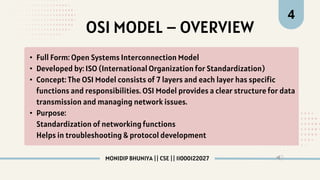
• Full Form: Open Systems Interconnection Model
• Developed by: ISO (International Organization for Standardization)
• Concept: The OSI Model consists of 7 layers and each layer has specific
functions and responsibilities. OSI Model provides a clear structure for data
transmission and managing network issues.
• Purpose:
Standardization of networking functions
Helps in troubleshooting & protocol development
MONIDIP BHUNIYA || CSE || 11000122027
OSI MODEL – LAYERS & FUNCTIONS
5
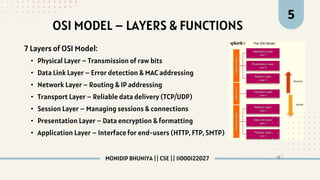
7 Layers of OSI Model:
• Physical Layer – Transmission of raw bits
• Data Link Layer – Error detection & MAC addressing
• Network Layer – Routing & IP addressing
• Transport Layer – Reliable data delivery (TCP/UDP)
• Session Layer – Managing sessions & connections
• Presentation Layer – Data encryption & formatting
• Application Layer – Interface for end-users (HTTP, FTP, SMTP)
MONIDIP BHUNIYA || CSE || 11000122027
TCP/IP MODEL – OVERVIEW
6
• Full Form: Transmission Control Protocol / Internet Protocol
• Developed by: DARPA (Defense Advanced Research Projects Agency)
• Concept: TCP/IP Model divides the data into packets at the sender’s end and the
same packets have to be recombined at the receiver’s end to form the same data,
and this thing happens to maintain the accuracy of the data.
• Purpose:
Backbone of the internet
Ensures reliable data transmission
MONIDIP BHUNIYA || CSE || 11000122027
TCP/IP MODEL – LAYERS & FUNCTIONS
7
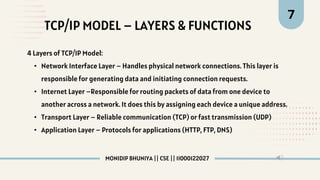
4 Layers of TCP/IP Model:
• Network Interface Layer – Handles physical network connections. This layer is
responsible for generating data and initiating connection requests.
• Internet Layer –Responsible for routing packets of data from one device to
another across a network. It does this by assigning each device a unique address.
• Transport Layer – Reliable communication (TCP) or fast transmission (UDP)
• Application Layer – Protocols for applications (HTTP, FTP, DNS)
MONIDIP BHUNIYA || CSE || 11000122027
DIFFERENCES BETWEEN OSI AND TCP/IP MODELS
8
MONIDIP BHUNIYA || CSE || 11000122027
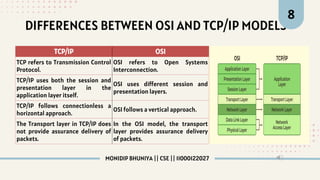
TCP/IP OSI
TCP refers to Transmission Control
Protocol.
OSI refers to Open Systems
Interconnection.
TCP/IP uses both the session and
presentation layer in the
application layer itself.
OSI uses different session and
presentation layers.
TCP/IP follows connectionless a
horizontal approach.
OSI follows a vertical approach.
The Transport layer in TCP/IP does
not provide assurance delivery of
packets.
In the OSI model, the transport
layer provides assurance delivery
of packets.
9
ADVANTAGES OF EACH MODEL
Advantages of OSI Model:
• Well-structured & modular
• Useful for troubleshooting networks
• Provides a guideline for new protocol
development
Advantages of TCP/IP Model:
• Real-world implementation (foundation of the
Internet)
• Simpler with fewer layers
• Works well in heterogeneous networks
MONIDIP BHUNIYA || CSE || 11000122027
CONCLUSION
• OSI and TCP/IP models define how data flows in a network
• OSI is conceptual & educational, while TCP/IP is practical & widely
used
• TCP/IP is more efficient for real-world applications but OSI provides
better abstraction
• Both models are essential for understanding networking protocols
10
MONIDIP BHUNIYA || CSE || 11000122027
• Andrew S. Tanenbaum, "Computer Networks"
• Behrouz A. Forouzan, "Data Communications and Networking"
• RFC 1122, "Requirements for Internet Hosts – Communication
Layers"
• Cisco Networking Academy, "OSI & TCP/IP Models"
REFERENCES
11
MONIDIP BHUNIYA || CSE || 11000122027
THANK YOU
Thank you sir for giving this topic .It will help me for gaining many
knowledge about this topic .Curious to know many more.
12
computer network (OSI AND TCP MODEL) pdf.pdf

  • 1.
    COMPUTER NETWORK ||PCC-CS602 || CA 1 NAME - MONIDIP BHUNIYA UNIVERSITY ROLL-11000122027 | | CSE GCETTS
  • 2.
    INDEX • Introduction toNetworking Models • OSI Model – Overview • OSI Model – Layers & Functions • TCP/IP Model – Overview • TCP/IP Model – Layers & Functions • Key Differences Between OSI and TCP/IP Models • Advantages of Each Model • Conclusion 2 MONIDIP BHUNIYA || CSE || 11000122027
  • 3.
    INTRODUCTION TO NETWORKING MODELS 3 •Definition of networking models : Networking models are frameworks that define how data is transmitted and received across a network using a structured approach. • Importance of standardized communication protocols :Standardized protocols ensure seamless communication between different devices, networks, and software, making global networking possible. • Two major models: OSI Model: A theoretical 7-layer framework for standardizing network communication. TCP/IP Model: A practical 4-layer model used for real-world internet communication. • Purpose: Ensuring seamless communication across different devices & networks MONIDIP BHUNIYA || CSE || 11000122027
  • 4.
    OSI MODEL –OVERVIEW 4 • Full Form: Open Systems Interconnection Model • Developed by: ISO (International Organization for Standardization) • Concept: The OSI Model consists of 7 layers and each layer has specific functions and responsibilities. OSI Model provides a clear structure for data transmission and managing network issues. • Purpose: Standardization of networking functions Helps in troubleshooting & protocol development MONIDIP BHUNIYA || CSE || 11000122027
  • 5.
    OSI MODEL –LAYERS & FUNCTIONS 5 7 Layers of OSI Model: • Physical Layer – Transmission of raw bits • Data Link Layer – Error detection & MAC addressing • Network Layer – Routing & IP addressing • Transport Layer – Reliable data delivery (TCP/UDP) • Session Layer – Managing sessions & connections • Presentation Layer – Data encryption & formatting • Application Layer – Interface for end-users (HTTP, FTP, SMTP) MONIDIP BHUNIYA || CSE || 11000122027
  • 6.
    TCP/IP MODEL –OVERVIEW 6 • Full Form: Transmission Control Protocol / Internet Protocol • Developed by: DARPA (Defense Advanced Research Projects Agency) • Concept: TCP/IP Model divides the data into packets at the sender’s end and the same packets have to be recombined at the receiver’s end to form the same data, and this thing happens to maintain the accuracy of the data. • Purpose: Backbone of the internet Ensures reliable data transmission MONIDIP BHUNIYA || CSE || 11000122027
  • 7.
    TCP/IP MODEL –LAYERS & FUNCTIONS 7 4 Layers of TCP/IP Model: • Network Interface Layer – Handles physical network connections. This layer is responsible for generating data and initiating connection requests. • Internet Layer –Responsible for routing packets of data from one device to another across a network. It does this by assigning each device a unique address. • Transport Layer – Reliable communication (TCP) or fast transmission (UDP) • Application Layer – Protocols for applications (HTTP, FTP, DNS) MONIDIP BHUNIYA || CSE || 11000122027
  • 8.
    DIFFERENCES BETWEEN OSIAND TCP/IP MODELS 8 MONIDIP BHUNIYA || CSE || 11000122027 TCP/IP OSI TCP refers to Transmission Control Protocol. OSI refers to Open Systems Interconnection. TCP/IP uses both the session and presentation layer in the application layer itself. OSI uses different session and presentation layers. TCP/IP follows connectionless a horizontal approach. OSI follows a vertical approach. The Transport layer in TCP/IP does not provide assurance delivery of packets. In the OSI model, the transport layer provides assurance delivery of packets.
  • 9.
    9 ADVANTAGES OF EACHMODEL Advantages of OSI Model: • Well-structured & modular • Useful for troubleshooting networks • Provides a guideline for new protocol development Advantages of TCP/IP Model: • Real-world implementation (foundation of the Internet) • Simpler with fewer layers • Works well in heterogeneous networks MONIDIP BHUNIYA || CSE || 11000122027
  • 10.
    CONCLUSION • OSI andTCP/IP models define how data flows in a network • OSI is conceptual & educational, while TCP/IP is practical & widely used • TCP/IP is more efficient for real-world applications but OSI provides better abstraction • Both models are essential for understanding networking protocols 10 MONIDIP BHUNIYA || CSE || 11000122027
  • 11.
    • Andrew S.Tanenbaum, "Computer Networks" • Behrouz A. Forouzan, "Data Communications and Networking" • RFC 1122, "Requirements for Internet Hosts – Communication Layers" • Cisco Networking Academy, "OSI & TCP/IP Models" REFERENCES 11 MONIDIP BHUNIYA || CSE || 11000122027
  • 12.
    THANK YOU Thank yousir for giving this topic .It will help me for gaining many knowledge about this topic .Curious to know many more. 12