OSI MODEL AND DATA LINK
LAYER
2ND UNIT
COMPUTER NETWORK AND
SECURITY
Chapter…….
• Network Models
• Error Detection and Correction
• Flow and Error Control
Network Models
• Protocol
Set of rules that enable two device to
connect and transmit data to one another.

• Service
Set of opration that layer provides to
the layer above or below it.
Key Elements of Protocol
• Syntax

Structure or format of the data.
• Semantics
meaning of each Section of bit.
• Timing
When data should be sent and how
fast they can be sent.
Standards
• De facto

De facto standards are often
established originally by manufacturers who
request to define the functionality of a new
product or technology.
• De jure
Thos standards that have legislated
by an officially recognized body are de jure
standards.
OSI Model
• Developed by the International standard
Organization(ISO).
• The model is called ISO OSI(Open System
Interconnection)
• The OSI model has Seven layers.
• H- Header Information(Source & Destination
address)
• T- Trailer Information(Error control)
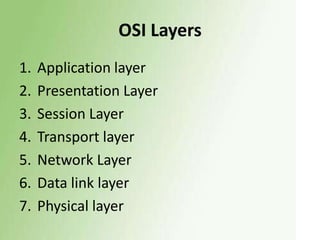
OSI Layers
1.
2.
3.
4.
5.
6.
7.

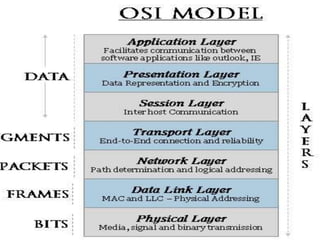
Application layer
Presentation Layer
Session Layer
Transport layer
Network Layer
Data link layer
Physical layer
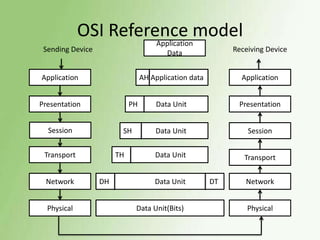
OSI Reference model
Application

Sending Device

Application

AH Application data

Presentation

SH

Transport

Physical

TH
DH

Application

Data Unit

Presentation

Data Unit

Session

Data Unit

PH

Session

Network

Receiving Device

Data

Transport

Data Unit
Data Unit(Bits)

DT

Network
Physical
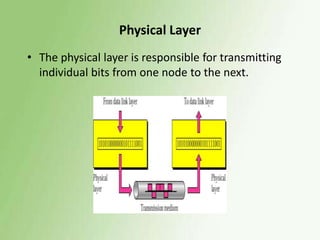
Physical Layer
• The physical layer is responsible for transmitting
individual bits from one node to the next.
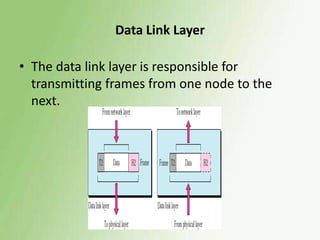
Data Link Layer
• The data link layer is responsible for
transmitting frames from one node to the
next.
Functions of Data link layer
• Framing
Divides the data in to smaller unit.
• Physical addressing
Hardware address is added in Header.
• Flow control
Control the flow of data between sender and
receiver
• Error control
generally error control mechanisms are added in
Data link Trailer(DT)
Network Layer
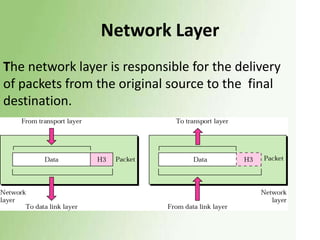
The network layer is responsible for the delivery
of packets from the original source to the final
destination.
Functions of Network Layer
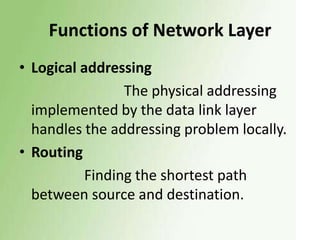
• Logical addressing
The physical addressing
implemented by the data link layer
handles the addressing problem locally.
• Routing
Finding the shortest path
between source and destination.
Transport Layer
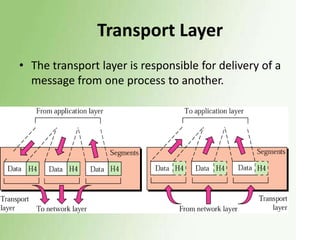
• The transport layer is responsible for delivery of a
message from one process to another.
Functions of Transport Layer
• Service point addressing
Used to identify the process
• Segmentation and reassembly
A message is divided into transmittable
segments, each having a sequence number. These
numbers enable the transport layer to reassemble
the message correctly upon arrival at the
destination.
• Flow control.
• Error control.
Session Layer
• Allow a user to log into a remote system or to
transfer a file between two machines.
Functions of Session Layer:
• Dialogue control
Control the conversation between two
system
• Synchronization
Coortinate the interaction among
communication system.
Presentation Layer
• It concerned with the syntax and semantics of the
information transmitted.
Functions of Session Layer:
• Translation
Own format information is exchange between two
different system
• Encryption
Original message into secret form
• Compression
Reduce the number of bit s contained in the
information
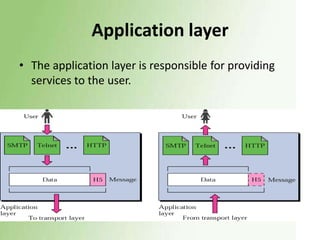
Application layer
• The application layer is responsible for providing
services to the user.
Functions of Application Layer
• Network Virtual Terminal
It allow a user to log on to the remote
computer.
• File Transfer, Access and Management
Allow user to access file from remote
computer.
• Mail Service
It provide the basic for E-Mail forwarding
and Storage.
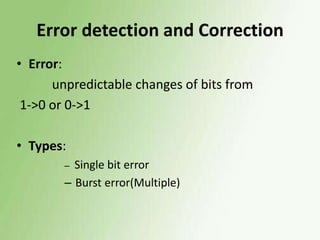
Error detection and Correction
• Error:
unpredictable changes of bits from
1->0 or 0->1

• Types:
Single bit error
– Burst error(Multiple)
–
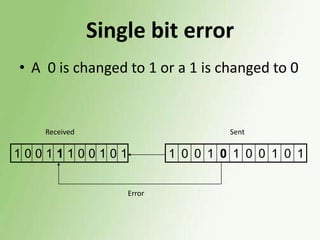
Single bit error
• A 0 is changed to 1 or a 1 is changed to 0

Received

Sent

10011100101

1 0 0 1 0 1 0 0 1 0 1
Error
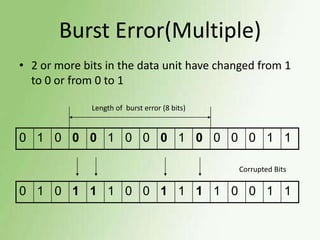
Burst Error(Multiple)
• 2 or more bits in the data unit have changed from 1
to 0 or from 0 to 1
Length of burst error (8 bits)

0 1 0 0 0 1 0 0 0 1 0 0 0 0 1 1
Corrupted Bits

0 1 0 1 1 1 0 0 1 1 1 1 0 0 1 1
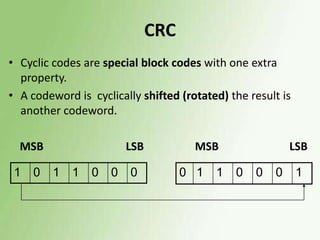
CRC
• Cyclic codes are special block codes with one extra
property.
• A codeword is cyclically shifted (rotated) the result is
another codeword.
MSB
1

0

LSB
1

1

0

0

0

MSB
0 1

1

LSB
0

0

0

1
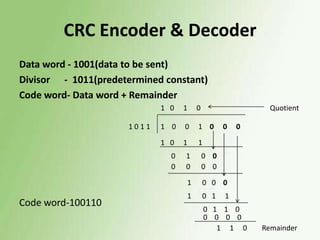
CRC Encoder & Decoder
Data word - 1001(data to be sent)
Divisor - 1011(predetermined constant)
Code word- Data word + Remainder
1 0

0

1 0

0

1 0

1 0

1011

1

1

1

0
0

Quotient
0

0 0
0 0

1

Code word-100110

1
0

0 0 0

1

0 1

0

1

0 1 1 0
0 0 0 0
1 1 0

Remainder
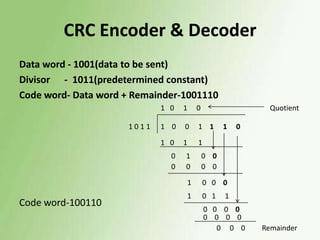
CRC Encoder & Decoder
Data word - 1001(data to be sent)
Divisor - 1011(predetermined constant)
Code word- Data word + Remainder-1001110
1 0

0

1 0

0

1 1

1 0

1011

1

1

1

0
0

Quotient
1

0 0
0 0

1

Code word-100110

1
0

0 0 0

1

0 1

0

1

0 0 0 0
0 0 0 0
0 0 0

Remainder
Parity Check
• Parity is a system in which each transmitted
character contain one additional bit.
• Two system of parity are normally used:
odd parity
even parity
• Odd parity means the total number of binary 1’s is in
the character,including the parity bit is odd.
• Even parity means that the number of binary 1’s bit
in the character,including the parity bit is even.
• This technique only detects the single bit error.
Checksum
• Several protocols still use the checksum for error
detection.
• For example, if the set of number
is(7,10,3,11,5),we send(7,10,3,11,5,36),where 36
is the sum of (7+10+3+11+5) the original number.
• The receiver adds the five numbers and compares
the result with the sum.
• If the two are the same,the receiver assumes no
error,accepts the five numbers and omits the sum.
Check sum
• There is an error somewhere and the data are not
accepted
• The traditional checksum uses a small number of
bits(16) to detect error in a massage of any size.
• It is not strong as CRC in error checking capability.
• For example,If the value of one word is increamented
and the value of another word is decreamented by
the same amount,the two error cannot be detected
because the sum remains the same.
Flow control
• Flow control
The management of data flow
between computers or device or between
nodes in a network so that the data can be
handled at an efficient pace
• Types of flow control
Stop – and – wait flow control
Sliding window flow control
Stop and Wait Flow control
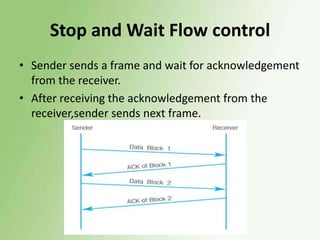
• Sender sends a frame and wait for acknowledgement
from the receiver.
• After receiving the acknowledgement from the
receiver,sender sends next frame.
Stop and wait flow control
• Advantage

Gurantee for the delivery of
every frame.Because sender sends the
next frame only after receiving the
acknowledgement of previous frame.
• Disadvantage
It is time consuming.
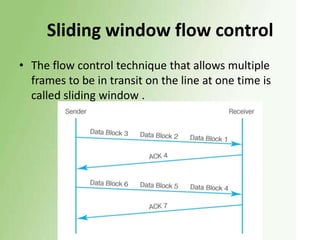
Sliding window flow control
• The flow control technique that allows multiple
frames to be in transit on the line at one time is
called sliding window .
Error control
• Error control is a method that can be
used to recover the corrupted data
whenever possible.
• Types of error control
backward error control
forward error control
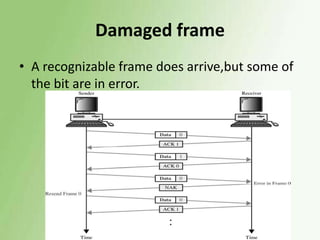
Damaged frame
• A recognizable frame does arrive,but some of
the bit are in error.
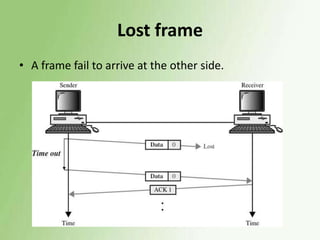
Lost frame
• A frame fail to arrive at the other side.
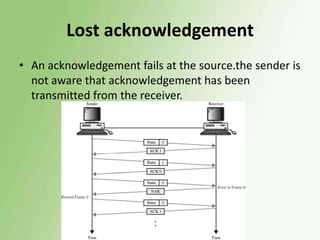
Lost acknowledgement
• An acknowledgement fails at the source.the sender is
not aware that acknowledgement has been
transmitted from the receiver.
ARQ
• Full form --Automatic Repeat Request
• The purpose of ARQ is to change an
unreliable data link into a reliable one.
• Version of ARQ
Stop-and –wait ARQ
Go-Back-N ARQ
Selective-repeat ARQ
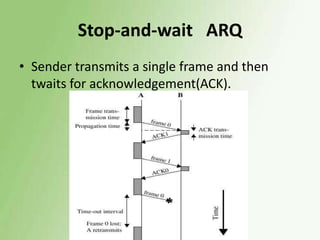
Stop-and-wait ARQ
• Sender transmits a single frame and then
twaits for acknowledgement(ACK).
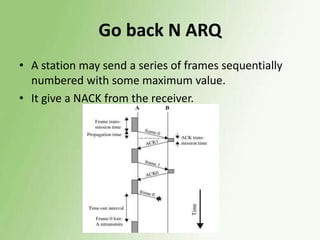
Go back N ARQ
• A station may send a series of frames sequentially
numbered with some maximum value.
• It give a NACK from the receiver.
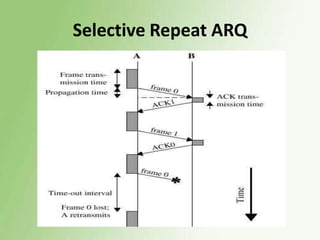
Selective Repeat ARQ
Osi model

Osi model

  • 1.
    OSI MODEL ANDDATA LINK LAYER 2ND UNIT COMPUTER NETWORK AND SECURITY
  • 2.
    Chapter……. • Network Models •Error Detection and Correction • Flow and Error Control
  • 3.
    Network Models • Protocol Setof rules that enable two device to connect and transmit data to one another. • Service Set of opration that layer provides to the layer above or below it.
  • 4.
    Key Elements ofProtocol • Syntax Structure or format of the data. • Semantics meaning of each Section of bit. • Timing When data should be sent and how fast they can be sent.
  • 5.
    Standards • De facto Defacto standards are often established originally by manufacturers who request to define the functionality of a new product or technology. • De jure Thos standards that have legislated by an officially recognized body are de jure standards.
  • 6.
    OSI Model • Developedby the International standard Organization(ISO). • The model is called ISO OSI(Open System Interconnection) • The OSI model has Seven layers. • H- Header Information(Source & Destination address) • T- Trailer Information(Error control)
  • 7.
    OSI Layers 1. 2. 3. 4. 5. 6. 7. Application layer PresentationLayer Session Layer Transport layer Network Layer Data link layer Physical layer
  • 9.
    OSI Reference model Application SendingDevice Application AH Application data Presentation SH Transport Physical TH DH Application Data Unit Presentation Data Unit Session Data Unit PH Session Network Receiving Device Data Transport Data Unit Data Unit(Bits) DT Network Physical
  • 10.
    Physical Layer • Thephysical layer is responsible for transmitting individual bits from one node to the next.
  • 11.
    Data Link Layer •The data link layer is responsible for transmitting frames from one node to the next.
  • 12.
    Functions of Datalink layer • Framing Divides the data in to smaller unit. • Physical addressing Hardware address is added in Header. • Flow control Control the flow of data between sender and receiver • Error control generally error control mechanisms are added in Data link Trailer(DT)
  • 13.
    Network Layer The networklayer is responsible for the delivery of packets from the original source to the final destination.
  • 14.
    Functions of NetworkLayer • Logical addressing The physical addressing implemented by the data link layer handles the addressing problem locally. • Routing Finding the shortest path between source and destination.
  • 15.
    Transport Layer • Thetransport layer is responsible for delivery of a message from one process to another.
  • 16.
    Functions of TransportLayer • Service point addressing Used to identify the process • Segmentation and reassembly A message is divided into transmittable segments, each having a sequence number. These numbers enable the transport layer to reassemble the message correctly upon arrival at the destination. • Flow control. • Error control.
  • 17.
    Session Layer • Allowa user to log into a remote system or to transfer a file between two machines. Functions of Session Layer: • Dialogue control Control the conversation between two system • Synchronization Coortinate the interaction among communication system.
  • 18.
    Presentation Layer • Itconcerned with the syntax and semantics of the information transmitted. Functions of Session Layer: • Translation Own format information is exchange between two different system • Encryption Original message into secret form • Compression Reduce the number of bit s contained in the information
  • 19.
    Application layer • Theapplication layer is responsible for providing services to the user.
  • 20.
    Functions of ApplicationLayer • Network Virtual Terminal It allow a user to log on to the remote computer. • File Transfer, Access and Management Allow user to access file from remote computer. • Mail Service It provide the basic for E-Mail forwarding and Storage.
  • 21.
    Error detection andCorrection • Error: unpredictable changes of bits from 1->0 or 0->1 • Types: Single bit error – Burst error(Multiple) –
  • 22.
    Single bit error •A 0 is changed to 1 or a 1 is changed to 0 Received Sent 10011100101 1 0 0 1 0 1 0 0 1 0 1 Error
  • 23.
    Burst Error(Multiple) • 2or more bits in the data unit have changed from 1 to 0 or from 0 to 1 Length of burst error (8 bits) 0 1 0 0 0 1 0 0 0 1 0 0 0 0 1 1 Corrupted Bits 0 1 0 1 1 1 0 0 1 1 1 1 0 0 1 1
  • 24.
    CRC • Cyclic codesare special block codes with one extra property. • A codeword is cyclically shifted (rotated) the result is another codeword. MSB 1 0 LSB 1 1 0 0 0 MSB 0 1 1 LSB 0 0 0 1
  • 25.
    CRC Encoder &Decoder Data word - 1001(data to be sent) Divisor - 1011(predetermined constant) Code word- Data word + Remainder 1 0 0 1 0 0 1 0 1 0 1011 1 1 1 0 0 Quotient 0 0 0 0 0 1 Code word-100110 1 0 0 0 0 1 0 1 0 1 0 1 1 0 0 0 0 0 1 1 0 Remainder
  • 26.
    CRC Encoder &Decoder Data word - 1001(data to be sent) Divisor - 1011(predetermined constant) Code word- Data word + Remainder-1001110 1 0 0 1 0 0 1 1 1 0 1011 1 1 1 0 0 Quotient 1 0 0 0 0 1 Code word-100110 1 0 0 0 0 1 0 1 0 1 0 0 0 0 0 0 0 0 0 0 0 Remainder
  • 27.
    Parity Check • Parityis a system in which each transmitted character contain one additional bit. • Two system of parity are normally used: odd parity even parity • Odd parity means the total number of binary 1’s is in the character,including the parity bit is odd. • Even parity means that the number of binary 1’s bit in the character,including the parity bit is even. • This technique only detects the single bit error.
  • 28.
    Checksum • Several protocolsstill use the checksum for error detection. • For example, if the set of number is(7,10,3,11,5),we send(7,10,3,11,5,36),where 36 is the sum of (7+10+3+11+5) the original number. • The receiver adds the five numbers and compares the result with the sum. • If the two are the same,the receiver assumes no error,accepts the five numbers and omits the sum.
  • 29.
    Check sum • Thereis an error somewhere and the data are not accepted • The traditional checksum uses a small number of bits(16) to detect error in a massage of any size. • It is not strong as CRC in error checking capability. • For example,If the value of one word is increamented and the value of another word is decreamented by the same amount,the two error cannot be detected because the sum remains the same.
  • 30.
    Flow control • Flowcontrol The management of data flow between computers or device or between nodes in a network so that the data can be handled at an efficient pace • Types of flow control Stop – and – wait flow control Sliding window flow control
  • 31.
    Stop and WaitFlow control • Sender sends a frame and wait for acknowledgement from the receiver. • After receiving the acknowledgement from the receiver,sender sends next frame.
  • 32.
    Stop and waitflow control • Advantage Gurantee for the delivery of every frame.Because sender sends the next frame only after receiving the acknowledgement of previous frame. • Disadvantage It is time consuming.
  • 33.
    Sliding window flowcontrol • The flow control technique that allows multiple frames to be in transit on the line at one time is called sliding window .
  • 34.
    Error control • Errorcontrol is a method that can be used to recover the corrupted data whenever possible. • Types of error control backward error control forward error control
  • 35.
    Damaged frame • Arecognizable frame does arrive,but some of the bit are in error.
  • 36.
    Lost frame • Aframe fail to arrive at the other side.
  • 37.
    Lost acknowledgement • Anacknowledgement fails at the source.the sender is not aware that acknowledgement has been transmitted from the receiver.
  • 38.
    ARQ • Full form--Automatic Repeat Request • The purpose of ARQ is to change an unreliable data link into a reliable one. • Version of ARQ Stop-and –wait ARQ Go-Back-N ARQ Selective-repeat ARQ
  • 39.
    Stop-and-wait ARQ • Sendertransmits a single frame and then twaits for acknowledgement(ACK).
  • 40.
    Go back NARQ • A station may send a series of frames sequentially numbered with some maximum value. • It give a NACK from the receiver.
  • 41.

Editor's Notes

  • #12 The data link layer transforms the physical layer, a raw transmission facility, to a reliable link and is responsible for node-to-node delivery. It makes the physical layer appear error free to the upper layer (network layer).