DataLink layer
Data Link Layer Design Issues
•Services Provided to the Network Layer
•Framing
•Error Control
•Flow Control
Functions of the Data Link Layer
•Provide service interface to the network layer
•Dealing with transmission errors
•Regulating data flow
•Slow receivers not swamped by fast senders
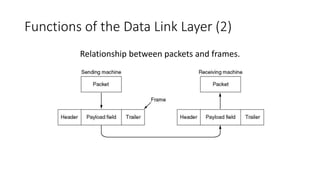
Functions of the Data Link Layer (2)
Relationship between packets and frames.
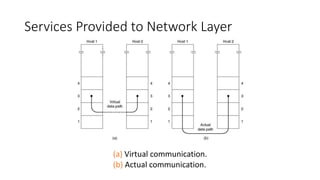
Services Provided to Network Layer
(a) Virtual communication.
(b) Actual communication.
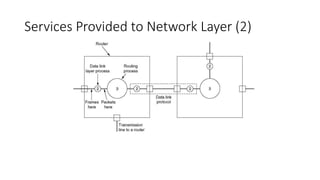
Services Provided to Network Layer (2)
Placement of the data link protocol.
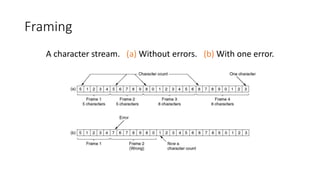
Framing
A character stream. (a) Without errors. (b) With one error.
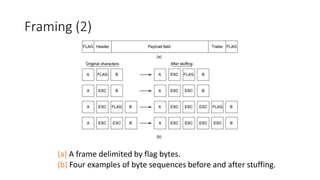
Framing (2)
(a) A frame delimited by flag bytes.
(b) Four examples of byte sequences before and after stuffing.
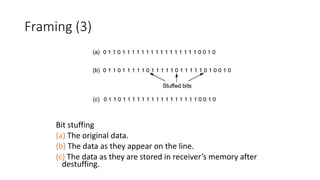
Framing (3)
Bit stuffing
(a) The original data.
(b) The data as they appear on the line.
(c) The data as they are stored in receiver’s memory after
destuffing.
Error Detection and Correction
•Error-Correcting Codes
•Error-Detecting Codes
•Key idea: redundant (additional) bits
(use only 2m out of 2n code words)
•Key metrics:
•how many errors can be
corrected/detected;
•what burst length
Hamming Distance
•Some codes words are valid; others are invalid
•Hamming distance between two code words is number
of bits that must be flipped to change from one to the
other
• If Hamming distance is d then d single bit errors needed to
change one word to the other
•Hamming distance of a code is the minimum Hamming
distance between two valid code words
•Detecting one single-bit error requires a distance 2
code; how does this generalize?
•Correcting one single-bit error requires a distance 3
code; how does this generalize?
Parity Schemes
•Parity bits: choose a rule
• Even parity – each codeword has even number of 1’s
• Odd parity – each codeword has odd number of 1’s
•Always transmit according to the rule
•On receipt, if rule is violated, word is invalid
•Can also do “vertical parity” over whole block to
achieve single-bit error correction
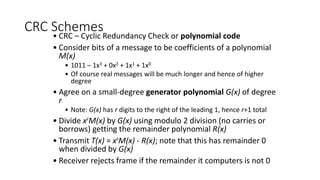
CRC Schemes
• CRC – Cyclic Redundancy Check or polynomial code
• Consider bits of a message to be coefficients of a polynomial
M(x)
• 1011 – 1x3 + 0x2 + 1x1 + 1x0
• Of course real messages will be much longer and hence of higher
degree
• Agree on a small-degree generator polynomial G(x) of degree
r
• Note: G(x) has r digits to the right of the leading 1, hence r+1 total
• Divide xrM(x) by G(x) using modulo 2 division (no carries or
borrows) getting the remainder polynomial R(x)
• Transmit T(x) = xrM(x) - R(x); note that this has remainder 0
when divided by G(x)
• Receiver rejects frame if the remainder it computers is not 0
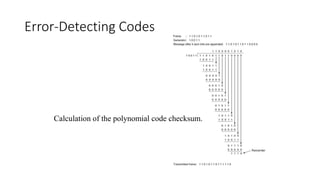
Error-Detecting Codes
Calculation of the polynomial code checksum.

Datalink_func.pptx

  • 1.
  • 2.
    Data Link LayerDesign Issues •Services Provided to the Network Layer •Framing •Error Control •Flow Control
  • 3.
    Functions of theData Link Layer •Provide service interface to the network layer •Dealing with transmission errors •Regulating data flow •Slow receivers not swamped by fast senders
  • 4.
    Functions of theData Link Layer (2) Relationship between packets and frames.
  • 5.
    Services Provided toNetwork Layer (a) Virtual communication. (b) Actual communication.
  • 6.
    Services Provided toNetwork Layer (2) Placement of the data link protocol.
  • 7.
    Framing A character stream.(a) Without errors. (b) With one error.
  • 8.
    Framing (2) (a) Aframe delimited by flag bytes. (b) Four examples of byte sequences before and after stuffing.
  • 9.
    Framing (3) Bit stuffing (a)The original data. (b) The data as they appear on the line. (c) The data as they are stored in receiver’s memory after destuffing.
  • 10.
    Error Detection andCorrection •Error-Correcting Codes •Error-Detecting Codes •Key idea: redundant (additional) bits (use only 2m out of 2n code words) •Key metrics: •how many errors can be corrected/detected; •what burst length
  • 11.
    Hamming Distance •Some codeswords are valid; others are invalid •Hamming distance between two code words is number of bits that must be flipped to change from one to the other • If Hamming distance is d then d single bit errors needed to change one word to the other •Hamming distance of a code is the minimum Hamming distance between two valid code words •Detecting one single-bit error requires a distance 2 code; how does this generalize? •Correcting one single-bit error requires a distance 3 code; how does this generalize?
  • 12.
    Parity Schemes •Parity bits:choose a rule • Even parity – each codeword has even number of 1’s • Odd parity – each codeword has odd number of 1’s •Always transmit according to the rule •On receipt, if rule is violated, word is invalid •Can also do “vertical parity” over whole block to achieve single-bit error correction
  • 13.
    CRC Schemes • CRC– Cyclic Redundancy Check or polynomial code • Consider bits of a message to be coefficients of a polynomial M(x) • 1011 – 1x3 + 0x2 + 1x1 + 1x0 • Of course real messages will be much longer and hence of higher degree • Agree on a small-degree generator polynomial G(x) of degree r • Note: G(x) has r digits to the right of the leading 1, hence r+1 total • Divide xrM(x) by G(x) using modulo 2 division (no carries or borrows) getting the remainder polynomial R(x) • Transmit T(x) = xrM(x) - R(x); note that this has remainder 0 when divided by G(x) • Receiver rejects frame if the remainder it computers is not 0
  • 14.
    Error-Detecting Codes Calculation ofthe polynomial code checksum.