




OSI MODEL
MS(CS)
IIUI
PROTOCOL STACK
• Protocol Stack is a combination of different protocol.
• All these protocols works together to perform specific task.
• Every Layer Hs different protocol.
• We discuss aboouut layer
SK Ahsan
LAYERED TASK
•We use the concept of layers in our daily life.
•As an example would two friends who communicate
through postal email.
•The process of sending a letter to a friend would be
complex if there are no service available from the post
office
SK Ahsan
LAYERED TASK
SK Ahsan
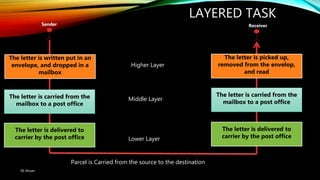
Sender Receiver
The letter is written put in an
envelope, and dropped in a
mailbox
The letter is delivered to
carrier by the post office
The letter is carried from the
mailbox to a post office
The letter is picked up,
removed from the envelop,
and read
The letter is delivered to
carrier by the post office
The letter is carried from the
mailbox to a post officeMiddle Layer
Lower Layer
Higher Layer
Parcel is Carried from the source to the destination
THE OSI MODEL
• ISO is an organization which is established in 1947.
• AN ISO standard that covers all aspects of network
communication.
• Network communication model is defined in OSI.
• It was first introduced in the late 1970s, 1983
SK Ahsan
ISO is the organization.
OSI is the model.
Note
SK Ahsan
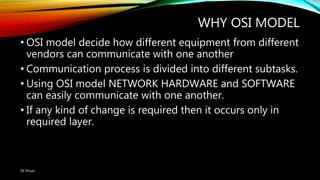
WHY OSI MODEL
• OSI model decide how different equipment from different
vendors can communicate with one another
• Communication process is divided into different subtasks.
• Using OSI model NETWORK HARDWARE and SOFTWARE
can easily communicate with one another.
• If any kind of change is required then it occurs only in
required layer.
SK Ahsan
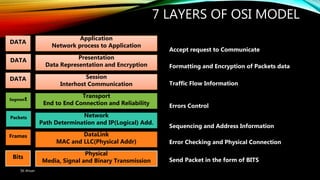
7 LAYERS OF OSI MODEL
SK Ahsan
Application
Network process to Application
Presentation
Data Representation and Encryption
Session
Interhost Communication
Transport
End to End Connection and Reliability
Network
Path Determination and IP(Logical) Add.
DataLink
MAC and LLC(Physical Addr)
Physical
Media, Signal and Binary Transmission Send Packet in the form of BITS
Error Checking and Physical Connection
Sequencing and Address Information
Errors Control
Traffic Flow Information
Formatting and Encryption of Packets data
Accept request to Communicate
DATA
DATA
DATA
Segment
Packets
Frames
Bits
MNEMONICS
•The following mnemonics may help you remember
the layers sequence and names.
•All People Seems To Need Data Processing.
•Please Do Not Take Sales People’s Advice.
•People Design Networks To Send packets
Accurately
•Always Put Some Thoughts Into Designing
Programs.
SK Ahsan
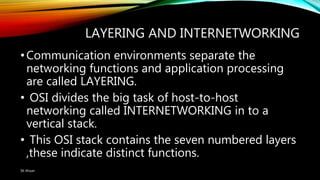
LAYERING AND INTERNETWORKING
•Communication environments separate the
networking functions and application processing
are called LAYERING.
• OSI divides the big task of host-to-host
networking called INTERNETWORKING in to a
vertical stack.
• This OSI stack contains the seven numbered layers
,these indicate distinct functions.
SK Ahsan
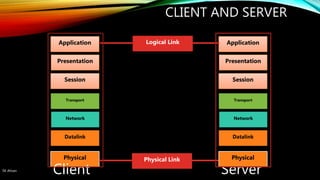
CLIENT AND SERVER
SK Ahsan
Application
Presentation
Session
Transport
Network
Datalink
Physical
Client Server
Application
Presentation
Session
Transport
Network
Datalink
PhysicalPhysical Link
Logical Link
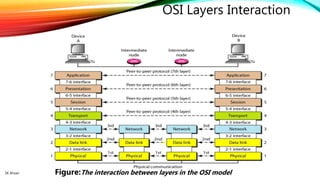
SK Ahsan Figure:The interaction between layers in the OSI model
OSI Layers Interaction
SK Ahsan
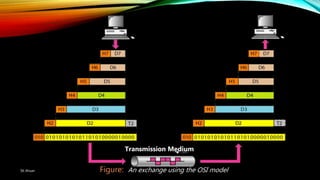
Transmission Medium
Figure: An exchange using the OSI model
ARCHITECTURE DESCRIPTION
SK Ahsan
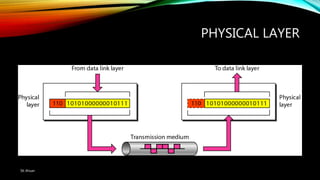
PHYSICAL LAYER
SK Ahsan
PHYSICAL LAYER
• It transmits data over physical medium or on network like
hardware like cables, cards, electrical, optical, mechanical
and functional interface to the medium.
• It handles the transmission of raw bits over a
communication link.
• It is responsible for transmitting bit(ZERO and ONE) by
providing signaling of the message and the interface
between the sender or receiver and the medium.
SK Ahsan
PHYSICAL LAYER
• Physical Layer must decide the following
• Characteristics of Media
• Representation of Bits
• Data Rate
• Synchronization
• Line Configuration
• Transmission Mode
SK Ahsan
The physical layer is responsible for movements of
individual bits from one hop (node) to the next.
Note
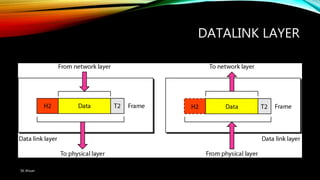
DATALINK LAYER
SK Ahsan
DATA LINK LAYER
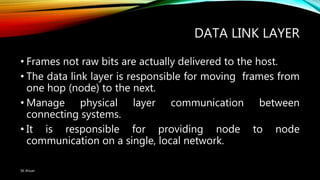
• Frames not raw bits are actually delivered to the host.
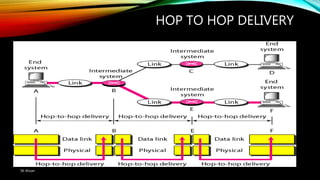
• The data link layer is responsible for moving frames from
one hop (node) to the next.
• Manage physical layer communication between
connecting systems.
• It is responsible for providing node to node
communication on a single, local network.
SK Ahsan
HOP TO HOP DELIVERY
SK Ahsan
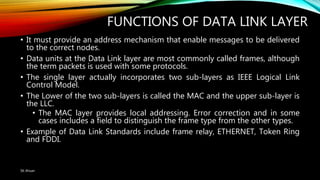
FUNCTIONS OF DATA LINK LAYER
• It must provide an address mechanism that enable messages to be delivered
to the correct nodes.
• Data units at the Data Link layer are most commonly called frames, although
the term packets is used with some protocols.
• The single layer actually incorporates two sub-layers as IEEE Logical Link
Control Model.
• The Lower of the two sub-layers is called the MAC and the upper sub-layer is
the LLC.
• The MAC layer provides local addressing. Error correction and in some
cases includes a field to distinguish the frame type from the other types.
• Example of Data Link Standards include frame relay, ETHERNET, Token Ring
and FDDI.
SK Ahsan
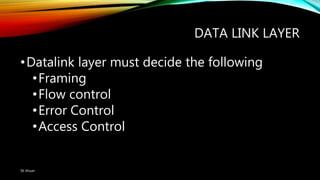
DATA LINK LAYER
•Datalink layer must decide the following
•Framing
•Flow control
•Error Control
•Access Control
SK Ahsan
The data link layer is responsible for moving
frames from one hop (node) to the next.
Note
NETWORK LAYER
SK Ahsan
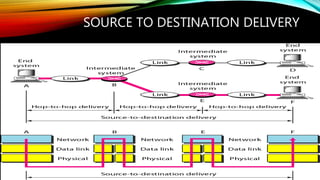
SOURCE TO DESTINATION DELIVERY
SK Ahsan
NETWORK LAYER
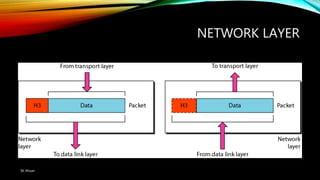
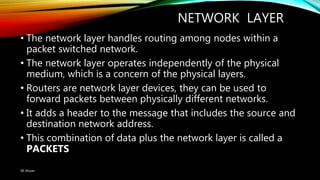
• The network layer handles routing among nodes within a
packet switched network.
• The network layer operates independently of the physical
medium, which is a concern of the physical layers.
• Routers are network layer devices, they can be used to
forward packets between physically different networks.
• It adds a header to the message that includes the source and
destination network address.
• This combination of data plus the network layer is called a
PACKETS
SK Ahsan
NETWORK LAYER
• It translates logical addresses and names into physical addresses for
Packets Delivery.
• The addressing which makes this delivery can be thought of as a
universal address as compared to the local addressing of the MAC.
• It determines routes for sending, managing network traffic problems,
packet switching, routing, data congestion and reassembling data.
• It control end-to-end flow of segmentation and reassembly functions
of large packets of data which exceed the Maximum Transmission
Units.
• The Internet Protocol(IP) is the most common example.
SK Ahsan
NETWORK LAYER
•Some responsibilities of the network layer are
as follows
•Logical Addressing
•Routing
SK Ahsan
The network layer is responsible for the
delivery of individual packets from
the source host to the destination host.
Note
TRANSPORT LAYER
SK Ahsan
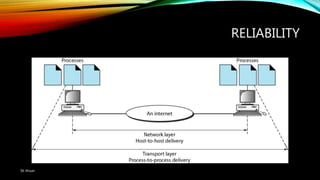
RELIABILITY
SK Ahsan
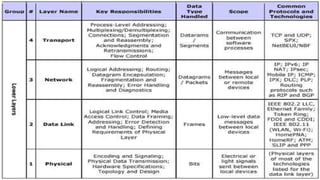
TRANSPORT LAYER
• It translates system names into addresses.
• The unit of data exchange is commonly called MESSAGE rather than a
packet or frame.
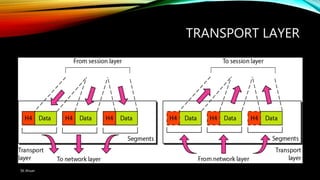
• It divides messages into fragments that fit within the size limitation
established by the network.
• It allows users to segments/reassemble several upper layer application on
to the same transport data stream.
• It ensure host to host session connection.
• This layer is responsible for addressing, determining network traffic
problems, packet switching, routing, congestion and reassembling data at
receiving end to recover the original message.
SK Ahsan
TRANSPORT LAYER
• It ensures that the segments delivered will be acknowledge back too the
sender.
• It provides retransmission of segments those are not acknowledged.
• Puts segments back into their correct sequence at the destination.
• To enable packets reassemble in their original order, this layer include a
MESSAGE SEQUENCE NUMBER in its header.
• Sometimes it provides a multiplexing between the same two end-points.
• Delivery may be GUARANTEED or CONNECTION-ORIENTED streams like
TCP or UDP
SK Ahsan
TRANSPORT LAYER
•It is also responsible for delivering message from a
specific process on one computer to the
corresponding process on the destination computer.
•Transport layer assigns a service access point to
each packet. In TCP/IP terms that is called PORT.
•One more responsibility of the transport layer is
DETECTING ERRORS In transmitting data.
SK Ahsan
TRANSPORT LAYER
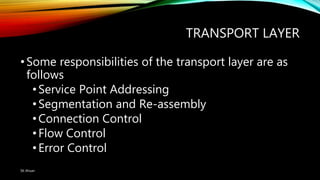
•Some responsibilities of the transport layer are as
follows
•Service Point Addressing
•Segmentation and Re-assembly
•Connection Control
•Flow Control
•Error Control
SK Ahsan
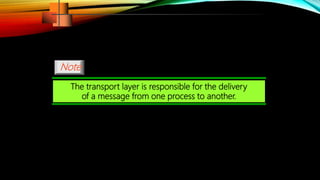
The transport layer is responsible for the delivery
of a message from one process to another.
Note
SK Ahsan
SESSION LAYER
SK Ahsan
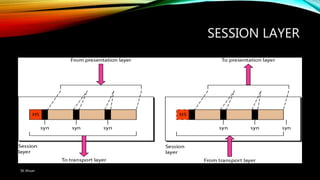
SESSION LAYER
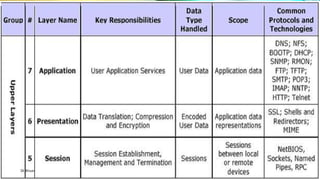
• It establishes, manages and terminates session between application.
• It provides mechanism for managing end-user, host, process operations
termination and restart procedures.
• It is responsible for dialog control between nodes. Dialog is a formal
conversation in which two nodes agree to exchange data.
• The communication across a network can take place and controlled in one of
three dialog modes are simplex, Half Duplex and Full Duplex.
• Testing for out-of-sequence packet is handles also.
• Session enables communication in organized manner in three phases as
Connection Establishment, Data Transfer and Connection Release.
SK Ahsan
PRESENTATION LAYER
SK Ahsan
PRESENTATION LAYER
• This layer provides data communication and code formatting.
• It provides a way for a remote host to inform the local client how to
present the data to the application or client.
• It ensures that the data that arrives from the network can be used by the
application, and information send by the application can be transmitted
on the network.
• It directly translates data from one format to another.
• It provides data encryptioiin, decryption, compression and
decompression.
• It delivers and format information for application layer processing.
SK Ahsan
PRESENTATION LAYER
•Presentation Layer perform the following
•Data Reformatting
•Encryption
SK Ahsan
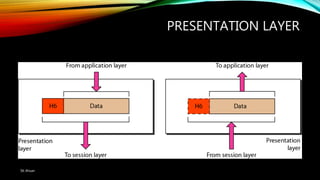
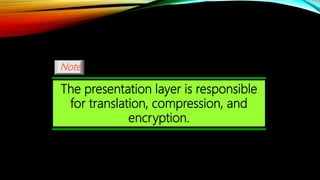
The presentation layer is responsible
for translation, compression, and
encryption.
Note
APPLICATION LAYER
SK Ahsan
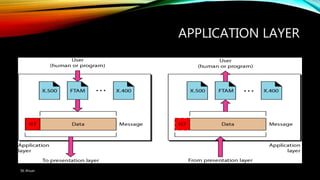
APPLICATION LAYER
• The application layer provides different services to user application.
• It interfaces directly to these services and provide conversion between
associated application process.
• It contains a variety of protocols that are commonly needed.
• Another application layer function is file transfer.
• Different file system have different file naming conventions.
• Transferring a file between two different system requires handling all
incompatibilities.
SK Ahsan
APPLICATION LAYER
•Application Layer provide different information
services as
•File Transfer
•Mail Services
•Directory Services
SK Ahsan
The application layer is responsible for
providing services to the user.
Note
SK Ahsan
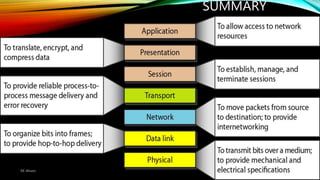
SUMMARY
REFERENCES
• Behroz A Frozen, Textbook Chapter 2, Topic 2.1, 2.2
• Larry and Peterson, Textbook Chapter 1
SK Ahsan
ABOUT
• Sunawar Khan Ahsan
• Sk_ahsan38@yahoo.com
• +923334892200
• More Slides Find on Slide Share
• facebeek.com/sk.ahsan.ms
SK Ahsan

Osi model

  • 1.
  • 2.
    PROTOCOL STACK • ProtocolStack is a combination of different protocol. • All these protocols works together to perform specific task. • Every Layer Hs different protocol. • We discuss aboouut layer SK Ahsan
  • 3.
    LAYERED TASK •We usethe concept of layers in our daily life. •As an example would two friends who communicate through postal email. •The process of sending a letter to a friend would be complex if there are no service available from the post office SK Ahsan
  • 4.
    LAYERED TASK SK Ahsan SenderReceiver The letter is written put in an envelope, and dropped in a mailbox The letter is delivered to carrier by the post office The letter is carried from the mailbox to a post office The letter is picked up, removed from the envelop, and read The letter is delivered to carrier by the post office The letter is carried from the mailbox to a post officeMiddle Layer Lower Layer Higher Layer Parcel is Carried from the source to the destination
  • 5.
    THE OSI MODEL •ISO is an organization which is established in 1947. • AN ISO standard that covers all aspects of network communication. • Network communication model is defined in OSI. • It was first introduced in the late 1970s, 1983 SK Ahsan
  • 6.
    ISO is theorganization. OSI is the model. Note SK Ahsan
  • 7.
    WHY OSI MODEL •OSI model decide how different equipment from different vendors can communicate with one another • Communication process is divided into different subtasks. • Using OSI model NETWORK HARDWARE and SOFTWARE can easily communicate with one another. • If any kind of change is required then it occurs only in required layer. SK Ahsan
  • 8.
    7 LAYERS OFOSI MODEL SK Ahsan Application Network process to Application Presentation Data Representation and Encryption Session Interhost Communication Transport End to End Connection and Reliability Network Path Determination and IP(Logical) Add. DataLink MAC and LLC(Physical Addr) Physical Media, Signal and Binary Transmission Send Packet in the form of BITS Error Checking and Physical Connection Sequencing and Address Information Errors Control Traffic Flow Information Formatting and Encryption of Packets data Accept request to Communicate DATA DATA DATA Segment Packets Frames Bits
  • 9.
    MNEMONICS •The following mnemonicsmay help you remember the layers sequence and names. •All People Seems To Need Data Processing. •Please Do Not Take Sales People’s Advice. •People Design Networks To Send packets Accurately •Always Put Some Thoughts Into Designing Programs. SK Ahsan
  • 10.
    LAYERING AND INTERNETWORKING •Communicationenvironments separate the networking functions and application processing are called LAYERING. • OSI divides the big task of host-to-host networking called INTERNETWORKING in to a vertical stack. • This OSI stack contains the seven numbered layers ,these indicate distinct functions. SK Ahsan
  • 11.
    CLIENT AND SERVER SKAhsan Application Presentation Session Transport Network Datalink Physical Client Server Application Presentation Session Transport Network Datalink PhysicalPhysical Link Logical Link
  • 12.
    SK Ahsan Figure:Theinteraction between layers in the OSI model OSI Layers Interaction
  • 13.
    SK Ahsan Transmission Medium Figure:An exchange using the OSI model
  • 14.
  • 15.
  • 16.
    PHYSICAL LAYER • Ittransmits data over physical medium or on network like hardware like cables, cards, electrical, optical, mechanical and functional interface to the medium. • It handles the transmission of raw bits over a communication link. • It is responsible for transmitting bit(ZERO and ONE) by providing signaling of the message and the interface between the sender or receiver and the medium. SK Ahsan
  • 17.
    PHYSICAL LAYER • PhysicalLayer must decide the following • Characteristics of Media • Representation of Bits • Data Rate • Synchronization • Line Configuration • Transmission Mode SK Ahsan
  • 18.
    The physical layeris responsible for movements of individual bits from one hop (node) to the next. Note
  • 19.
  • 20.
    DATA LINK LAYER •Frames not raw bits are actually delivered to the host. • The data link layer is responsible for moving frames from one hop (node) to the next. • Manage physical layer communication between connecting systems. • It is responsible for providing node to node communication on a single, local network. SK Ahsan
  • 21.
    HOP TO HOPDELIVERY SK Ahsan
  • 22.
    FUNCTIONS OF DATALINK LAYER • It must provide an address mechanism that enable messages to be delivered to the correct nodes. • Data units at the Data Link layer are most commonly called frames, although the term packets is used with some protocols. • The single layer actually incorporates two sub-layers as IEEE Logical Link Control Model. • The Lower of the two sub-layers is called the MAC and the upper sub-layer is the LLC. • The MAC layer provides local addressing. Error correction and in some cases includes a field to distinguish the frame type from the other types. • Example of Data Link Standards include frame relay, ETHERNET, Token Ring and FDDI. SK Ahsan
  • 23.
    DATA LINK LAYER •Datalinklayer must decide the following •Framing •Flow control •Error Control •Access Control SK Ahsan
  • 24.
    The data linklayer is responsible for moving frames from one hop (node) to the next. Note
  • 25.
  • 26.
    SOURCE TO DESTINATIONDELIVERY SK Ahsan
  • 27.
    NETWORK LAYER • Thenetwork layer handles routing among nodes within a packet switched network. • The network layer operates independently of the physical medium, which is a concern of the physical layers. • Routers are network layer devices, they can be used to forward packets between physically different networks. • It adds a header to the message that includes the source and destination network address. • This combination of data plus the network layer is called a PACKETS SK Ahsan
  • 28.
    NETWORK LAYER • Ittranslates logical addresses and names into physical addresses for Packets Delivery. • The addressing which makes this delivery can be thought of as a universal address as compared to the local addressing of the MAC. • It determines routes for sending, managing network traffic problems, packet switching, routing, data congestion and reassembling data. • It control end-to-end flow of segmentation and reassembly functions of large packets of data which exceed the Maximum Transmission Units. • The Internet Protocol(IP) is the most common example. SK Ahsan
  • 29.
    NETWORK LAYER •Some responsibilitiesof the network layer are as follows •Logical Addressing •Routing SK Ahsan
  • 30.
    The network layeris responsible for the delivery of individual packets from the source host to the destination host. Note
  • 31.
  • 32.
  • 33.
    TRANSPORT LAYER • Ittranslates system names into addresses. • The unit of data exchange is commonly called MESSAGE rather than a packet or frame. • It divides messages into fragments that fit within the size limitation established by the network. • It allows users to segments/reassemble several upper layer application on to the same transport data stream. • It ensure host to host session connection. • This layer is responsible for addressing, determining network traffic problems, packet switching, routing, congestion and reassembling data at receiving end to recover the original message. SK Ahsan
  • 34.
    TRANSPORT LAYER • Itensures that the segments delivered will be acknowledge back too the sender. • It provides retransmission of segments those are not acknowledged. • Puts segments back into their correct sequence at the destination. • To enable packets reassemble in their original order, this layer include a MESSAGE SEQUENCE NUMBER in its header. • Sometimes it provides a multiplexing between the same two end-points. • Delivery may be GUARANTEED or CONNECTION-ORIENTED streams like TCP or UDP SK Ahsan
  • 35.
    TRANSPORT LAYER •It isalso responsible for delivering message from a specific process on one computer to the corresponding process on the destination computer. •Transport layer assigns a service access point to each packet. In TCP/IP terms that is called PORT. •One more responsibility of the transport layer is DETECTING ERRORS In transmitting data. SK Ahsan
  • 36.
    TRANSPORT LAYER •Some responsibilitiesof the transport layer are as follows •Service Point Addressing •Segmentation and Re-assembly •Connection Control •Flow Control •Error Control SK Ahsan
  • 37.
    The transport layeris responsible for the delivery of a message from one process to another. Note
  • 38.
  • 39.
  • 40.
    SESSION LAYER • Itestablishes, manages and terminates session between application. • It provides mechanism for managing end-user, host, process operations termination and restart procedures. • It is responsible for dialog control between nodes. Dialog is a formal conversation in which two nodes agree to exchange data. • The communication across a network can take place and controlled in one of three dialog modes are simplex, Half Duplex and Full Duplex. • Testing for out-of-sequence packet is handles also. • Session enables communication in organized manner in three phases as Connection Establishment, Data Transfer and Connection Release. SK Ahsan
  • 41.
  • 42.
    PRESENTATION LAYER • Thislayer provides data communication and code formatting. • It provides a way for a remote host to inform the local client how to present the data to the application or client. • It ensures that the data that arrives from the network can be used by the application, and information send by the application can be transmitted on the network. • It directly translates data from one format to another. • It provides data encryptioiin, decryption, compression and decompression. • It delivers and format information for application layer processing. SK Ahsan
  • 43.
    PRESENTATION LAYER •Presentation Layerperform the following •Data Reformatting •Encryption SK Ahsan
  • 44.
    The presentation layeris responsible for translation, compression, and encryption. Note
  • 45.
  • 46.
    APPLICATION LAYER • Theapplication layer provides different services to user application. • It interfaces directly to these services and provide conversion between associated application process. • It contains a variety of protocols that are commonly needed. • Another application layer function is file transfer. • Different file system have different file naming conventions. • Transferring a file between two different system requires handling all incompatibilities. SK Ahsan
  • 47.
    APPLICATION LAYER •Application Layerprovide different information services as •File Transfer •Mail Services •Directory Services SK Ahsan
  • 48.
    The application layeris responsible for providing services to the user. Note
  • 49.
  • 50.
  • 51.
    REFERENCES • Behroz AFrozen, Textbook Chapter 2, Topic 2.1, 2.2 • Larry and Peterson, Textbook Chapter 1 SK Ahsan
  • 52.
    ABOUT • Sunawar KhanAhsan • Sk_ahsan38@yahoo.com • +923334892200 • More Slides Find on Slide Share • facebeek.com/sk.ahsan.ms SK Ahsan