Sunawar Khan
Islamia University of Bahawalpur
Bahawalnagar Campus
Analysis o f Algorithm
‫خان‬ ‫سنور‬ Algorithm Analysis
Insertion in BST
Querying a BST
Binary Search Tree
Other Operations on BST
Deletion in BST
Contents
‫خان‬ ‫سنور‬ Algorithm Analysis
Trees
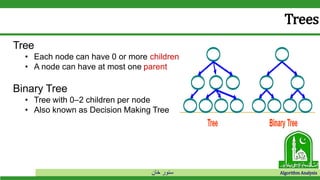
Tree
• Each node can have 0 or more children
• A node can have at most one parent
Binary Tree
• Tree with 0–2 children per node
• Also known as Decision Making Tree
‫خان‬ ‫سنور‬ Algorithm Analysis
What is Binary Tree
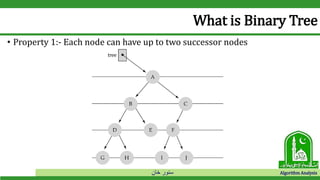
• Property 1:- Each node can have up to two successor nodes
‫خان‬ ‫سنور‬ Algorithm Analysis
What is Binary Tree?
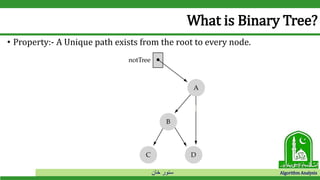
• Property:- A Unique path exists from the root to every node.
‫خان‬ ‫سنور‬ Algorithm Analysis
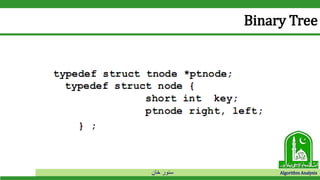
Binary Tree
‫خان‬ ‫سنور‬ Algorithm Analysis
Basic Terminology
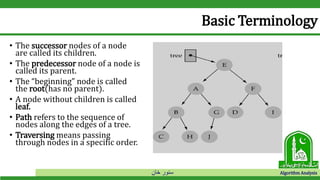
• The successor nodes of a node
are called its children.
• The predecessor node of a node is
called its parent.
• The “beginning” node is called
the root(has no parent).
• A node without children is called
leaf.
• Path refers to the sequence of
nodes along the edges of a tree.
• Traversing means passing
through nodes in a specific order.
‫خان‬ ‫سنور‬ Algorithm Analysis
Basic Terminology
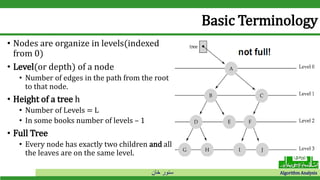
• Nodes are organize in levels(indexed
from 0)
• Level(or depth) of a node
• Number of edges in the path from the root
to that node.
• Height of a tree h
• Number of Levels = L
• In some books number of levels – 1
• Full Tree
• Every node has exactly two children and all
the leaves are on the same level.
‫خان‬ ‫سنور‬ Algorithm Analysis
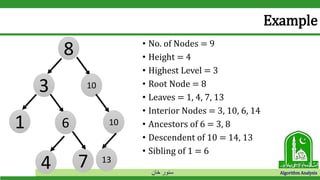
Example
• No. of Nodes = 9
• Height = 4
• Highest Level = 3
• Root Node = 8
• Leaves = 1, 4, 7, 13
• Interior Nodes = 3, 10, 6, 14
• Ancestors of 6 = 3, 8
• Descendent of 10 = 14, 13
• Sibling of 1 = 6
8
103
61 10
13
74
‫خان‬ ‫سنور‬ Algorithm Analysis
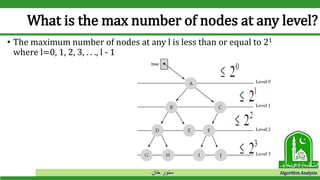
What is the max number of nodes at any level?
• The maximum number of nodes at any l is less than or equal to 21
where l=0, 1, 2, 3, . . ., l - 1
‫خان‬ ‫سنور‬ Algorithm Analysis
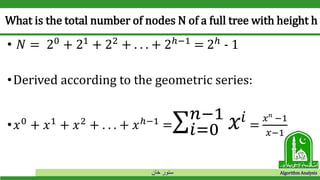
What is the total number of nodes N of a full tree with height h
• 𝑁 = 20
+ 21
+ 22
+ . . . + 2ℎ−1
= 2ℎ
- 1
•Derived according to the geometric series:
• 𝑥0
+ 𝑥1
+ 𝑥2
+ . . . + 𝑥ℎ−1
=σ𝑖=0
𝑛−1
𝑥𝑖 =
𝑥 𝑛
−1
𝑥−1
‫خان‬ ‫سنور‬ Algorithm Analysis
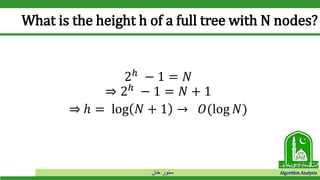
What is the height h of a full tree with N nodes?
2ℎ
− 1 = 𝑁
⇒ 2ℎ
− 1 = 𝑁 + 1
⇒ ℎ = log 𝑁 + 1 → 𝑂(log 𝑁)
‫خان‬ ‫سنور‬ Algorithm Analysis
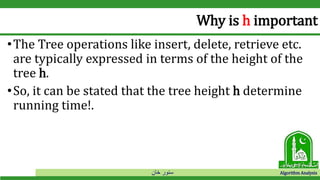
Why is h important
•The Tree operations like insert, delete, retrieve etc.
are typically expressed in terms of the height of the
tree h.
•So, it can be stated that the tree height h determine
running time!.
‫خان‬ ‫سنور‬ Algorithm Analysis
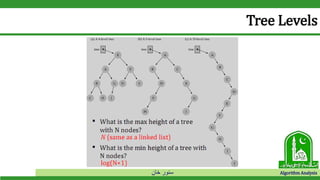
Tree Levels
‫خان‬ ‫سنور‬ Algorithm Analysis
Binary Search Tree
•Suppose DATA is an array which is sorted in
increasing numerical order and we want to fond the
location LOC of a given ITEM in DATA. Then there is
an extremely efficient searching algorithm Binary
Search.
‫خان‬ ‫سنور‬ Algorithm Analysis
Binary Search
• Consider that you want to find the location of some word in a dictionary
• I guess you are not fool enough to search it in a linear way or in other
words apply linear search. That is no one search page by page from the
start to end of the book.
• Rather, I guess you will open or divide the dictionary in the middle to
determine which half contains the word. This process goes on.
• Eventually you will find the location of the word and thus you are reducing
the number of possible locations for the word in the dictionary.
‫خان‬ ‫سنور‬ Algorithm Analysis
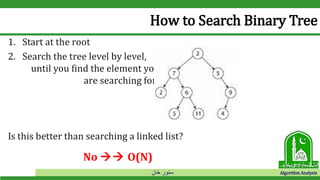
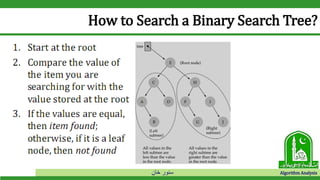
How to Search Binary Tree
‫خان‬ ‫سنور‬ Algorithm Analysis
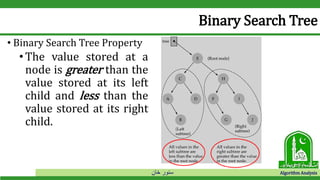
Binary Search Tree
• Binary Search Tree Property
• The value stored at a
node is greater than the
value stored at its left
child and less than the
value stored at its right
child.
‫خان‬ ‫سنور‬ Algorithm Analysis
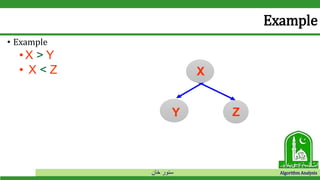
Example
• Example
• X > Y
• X < Z
Y Z
X
‫خان‬ ‫سنور‬ Algorithm Analysis
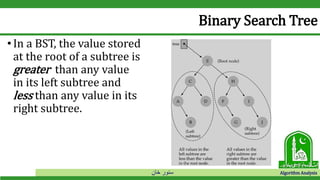
Binary Search Tree
•In a BST, the value stored
at the root of a subtree is
greater than any value
in its left subtree and
less than any value in its
right subtree.
‫خان‬ ‫سنور‬ Algorithm Analysis
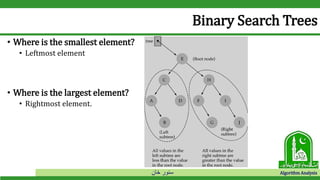
Binary Search Trees
• Where is the smallest element?
• Leftmost element
• Where is the largest element?
• Rightmost element.
‫خان‬ ‫سنور‬ Algorithm Analysis
How to Search a Binary Search Tree?
‫خان‬ ‫سنور‬ Algorithm Analysis
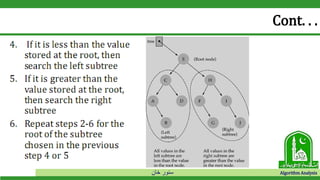
Cont. . .
‫خان‬ ‫سنور‬ Algorithm Analysis
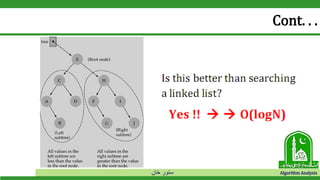
Cont. . .
‫خان‬ ‫سنور‬ Algorithm Analysis
Difference between BT and BST
• A Binary Tree is simply a tree in which each node can have at most two
children.
• A Binary Search Tree is a binary search tree is a binary tree in which the
nodes are assigned values, with the following restrictions:
• No duplicate values.
• The left subtree of a node can only have values less than the node
• The right subtree of a node can only have values greater than the node and
recursively defined
• The left subtree of a node is a binary search tree
• The right subtree of a node is a binary search tree.
‫خان‬ ‫سنور‬ Algorithm Analysis
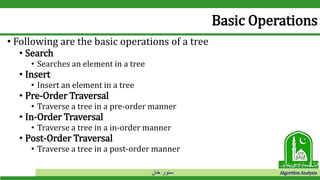
Basic Operations
• Following are the basic operations of a tree
• Search
• Searches an element in a tree
• Insert
• Insert an element in a tree
• Pre-Order Traversal
• Traverse a tree in a pre-order manner
• In-Order Traversal
• Traverse a tree in a in-order manner
• Post-Order Traversal
• Traverse a tree in a post-order manner
‫خان‬ ‫سنور‬ Algorithm Analysis
Tree Traversal
• Traversal is a process to visit all the nodes of a tree and may print their
values too.
• All nodes are connected via edges (links) we always start from the root
(head) node.
• We cannot randomly access a node in a tree.
• There are three ways which we use to traverse a tree −
• In-order Traversal
• Pre-order Traversal
• Post-order Traversal
‫خان‬ ‫سنور‬ Algorithm Analysis
In-order Traversal
• In this traversal method, the left sub tree is visited first, then the root
and later the right sub-tree.
• We should always remember that every node may represent a sub tree
itself.
• If a binary tree is traversed in-order, the output will produce sorted key
values in an ascending order.
•Algorithm
• Until all nodes are traversed −
• Step 1 − Recursively traverse left sub tree.
• Step 2 − Visit root node.
• Step 3 − Recursively traverse right sub tree.
‫خان‬ ‫سنور‬ Algorithm Analysis
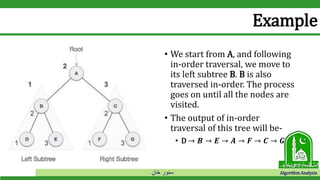
Example
• We start from A, and following
in-order traversal, we move to
its left subtree B. B is also
traversed in-order. The process
goes on until all the nodes are
visited.
• The output of in-order
traversal of this tree will be-
• D → 𝑩 → 𝑬 → 𝑨 → 𝑭 → 𝑪 → 𝑮
‫خان‬ ‫سنور‬ Algorithm Analysis
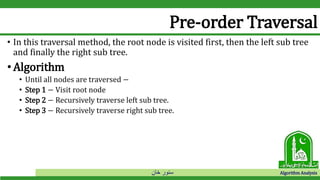
Pre-order Traversal
• In this traversal method, the root node is visited first, then the left sub tree
and finally the right sub tree.
•Algorithm
• Until all nodes are traversed −
• Step 1 − Visit root node
• Step 2 − Recursively traverse left sub tree.
• Step 3 − Recursively traverse right sub tree.
‫خان‬ ‫سنور‬ Algorithm Analysis
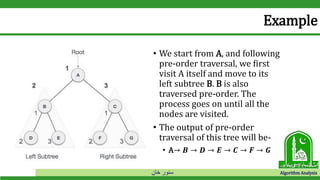
Example
• We start from A, and following
pre-order traversal, we first
visit A itself and move to its
left subtree B. B is also
traversed pre-order. The
process goes on until all the
nodes are visited.
• The output of pre-order
traversal of this tree will be-
• A→ 𝑩 → 𝑫 → 𝑬 → 𝑪 → 𝑭 → 𝑮
‫خان‬ ‫سنور‬ Algorithm Analysis
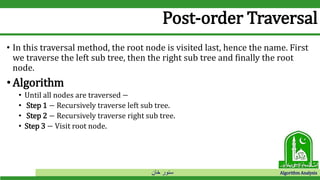
Post-order Traversal
• In this traversal method, the root node is visited last, hence the name. First
we traverse the left sub tree, then the right sub tree and finally the root
node.
•Algorithm
• Until all nodes are traversed −
• Step 1 − Recursively traverse left sub tree.
• Step 2 − Recursively traverse right sub tree.
• Step 3 − Visit root node.
‫خان‬ ‫سنور‬ Algorithm Analysis
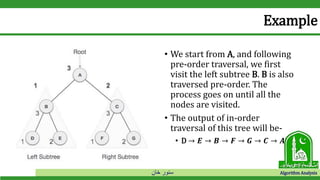
Example
• We start from A, and following
pre-order traversal, we first
visit the left subtree B. B is also
traversed pre-order. The
process goes on until all the
nodes are visited.
• The output of in-order
traversal of this tree will be-
• D → 𝑬 → 𝑩 → 𝑭 → 𝑮 → 𝑪 → 𝑨
‫خان‬ ‫سنور‬ Algorithm Analysis
Binary Search Tree Algorithm
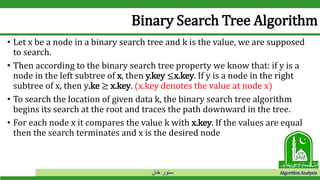
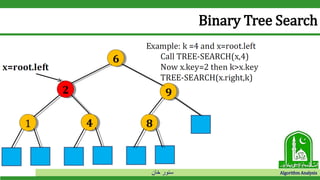
• Let x be a node in a binary search tree and k is the value, we are supposed
to search.
• Then according to the binary search tree property we know that: if y is a
node in the left subtree of x, then y.key ≤x.key. If y is a node in the right
subtree of x, then y.ke ≥ x.key. (x.key denotes the value at node x)
• To search the location of given data k, the binary search tree algorithm
begins its search at the root and traces the path downward in the tree.
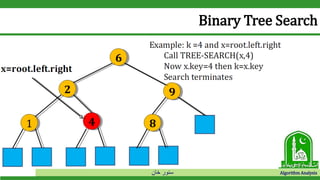
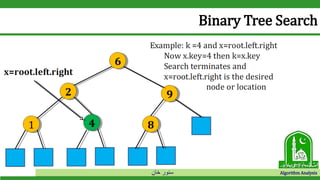
• For each node x it compares the value k with x.key. If the values are equal
then the search terminates and x is the desired node
‫خان‬ ‫سنور‬ Algorithm Analysis
Cont. . .
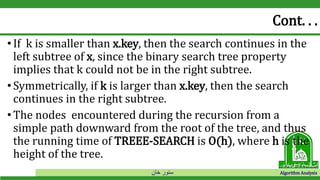
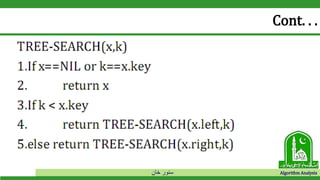
•If k is smaller than x.key, then the search continues in the
left subtree of x, since the binary search tree property
implies that k could not be in the right subtree.
•Symmetrically, if k is larger than x.key, then the search
continues in the right subtree.
•The nodes encountered during the recursion from a
simple path downward from the root of the tree, and thus
the running time of TREEE-SEARCH is O(h), where h is the
height of the tree.
‫خان‬ ‫سنور‬ Algorithm Analysis
Cont. . .
‫خان‬ ‫سنور‬ Algorithm Analysis
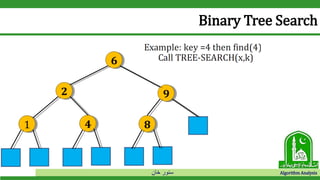
Binary Tree Search
‫خان‬ ‫سنور‬ Algorithm Analysis
Cont. . .
‫خان‬ ‫سنور‬ Algorithm Analysis
Binary Tree Search
‫خان‬ ‫سنور‬ Algorithm Analysis
Binary Tree Search
‫خان‬ ‫سنور‬ Algorithm Analysis
Binary Tree Search
‫خان‬ ‫سنور‬ Algorithm Analysis
BST Pseudo Code
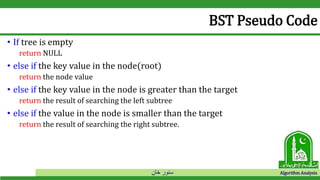
• If tree is empty
return NULL
• else if the key value in the node(root)
return the node value
• else if the key value in the node is greater than the target
return the result of searching the left subtree
• else if the value in the node is smaller than the target
return the result of searching the right subtree.
‫خان‬ ‫سنور‬ Algorithm Analysis
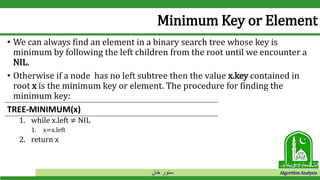
Minimum Key or Element
• We can always find an element in a binary search tree whose key is
minimum by following the left children from the root until we encounter a
NIL.
• Otherwise if a node has no left subtree then the value x.key contained in
root x is the minimum key or element. The procedure for finding the
minimum key:
1. while x.left ≠ NIL
1. x=x.left
2. return x
TREE-MINIMUM(x)
‫خان‬ ‫سنور‬ Algorithm Analysis
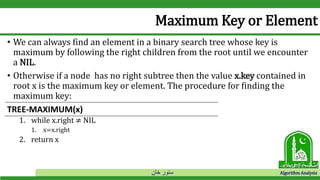
Maximum Key or Element
• We can always find an element in a binary search tree whose key is
maximum by following the right children from the root until we encounter
a NIL.
• Otherwise if a node has no right subtree then the value x.key contained in
root x is the maximum key or element. The procedure for finding the
maximum key:
1. while x.right ≠ NIL
1. x=x.right
2. return x
TREE-MAXIMUM(x)
‫خان‬ ‫سنور‬ Algorithm Analysis
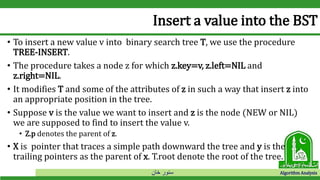
Insert a value into the BST
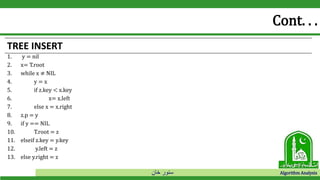
• To insert a new value v into binary search tree T, we use the procedure
TREE-INSERT.
• The procedure takes a node z for which z.key=v, z.left=NIL and
z.right=NIL.
• It modifies T and some of the attributes of z in such a way that insert z into
an appropriate position in the tree.
• Suppose v is the value we want to insert and z is the node (NEW or NIL)
we are supposed to find to insert the value v.
• Z.p denotes the parent of z.
• X is pointer that traces a simple path downward the tree and y is the
trailing pointers as the parent of x. T.root denote the root of the tree.
‫خان‬ ‫سنور‬ Algorithm Analysis
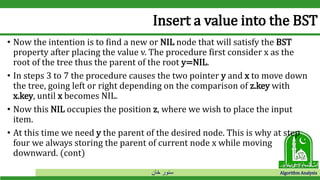
Insert a value into the BST
• Now the intention is to find a new or NIL node that will satisfy the BST
property after placing the value v. The procedure first consider x as the
root of the tree thus the parent of the root y=NIL.
• In steps 3 to 7 the procedure causes the two pointer y and x to move down
the tree, going left or right depending on the comparison of z.key with
x.key, until x becomes NIL.
• Now this NIL occupies the position z, where we wish to place the input
item.
• At this time we need y the parent of the desired node. This is why at step
four we always storing the parent of current node x while moving
downward. (cont)
‫خان‬ ‫سنور‬ Algorithm Analysis
Insert a value into the BST
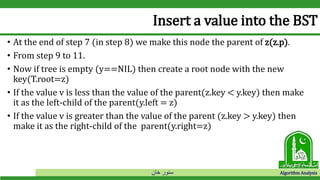
• At the end of step 7 (in step 8) we make this node the parent of z(z.p).
• From step 9 to 11.
• Now if tree is empty (y==NIL) then create a root node with the new
key(T.root=z)
• If the value v is less than the value of the parent(z.key < y.key) then make
it as the left-child of the parent(y.left = z)
• If the value v is greater than the value of the parent (z.key > y.key) then
make it as the right-child of the parent(y.right=z)
‫خان‬ ‫سنور‬ Algorithm Analysis
Cont. . .
1. y = nil
2. x= T.root
3. while x ≠ NIL
4. y = x
5. if z.key < x.key
6. x= x.left
7. else x = x.right
8. z.p = y
9. if y == NIL
10. T.root = z
11. elseif z.key = y.key
12. y.left = z
13. else y.right = z
TREE INSERT
‫خان‬ ‫سنور‬ Algorithm Analysis
Example
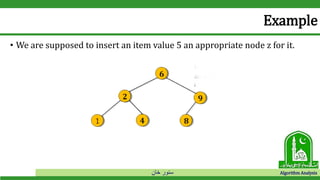
• We are supposed to insert an item value 5 an appropriate node z for it.
‫خان‬ ‫سنور‬ Algorithm Analysis
Example
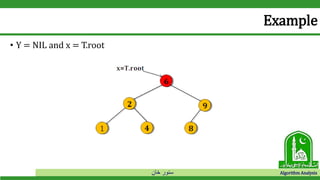
• Y = NIL and x = T.root
‫خان‬ ‫سنور‬ Algorithm Analysis
Example
• Now x ≠ 𝑁𝐼𝐿 𝑎𝑛𝑑 𝑧. 𝐾𝑒𝑦 < 𝑥. 𝑘𝑒𝑦 𝑇ℎ𝑎𝑡 𝑖𝑠 [5 < 6]
‫خان‬ ‫سنور‬ Algorithm Analysis
Example
• Now Y= T. rot 𝑎𝑛𝑑 𝑥 = 𝑇. 𝑟𝑜𝑜𝑡. 𝑙𝑒𝑓𝑡 𝐴𝑛𝑑 𝑧. 𝐾𝑒𝑦 > 𝑥. 𝑘𝑒𝑦 𝑇ℎ𝑎𝑡 𝑖𝑠 [5 > 2]
‫خان‬ ‫سنور‬ Algorithm Analysis
Example
• Y= T. root. left 𝑎𝑛𝑑 𝑥 = 𝑇. 𝑟𝑜𝑜𝑡. 𝑟𝑖𝑔ℎ𝑡 𝐴𝑛𝑑 𝑧. 𝐾𝑒𝑦 > 𝑥. 𝑘𝑒𝑦 𝑇ℎ𝑎𝑡 𝑖𝑠 [5 > 4]
‫خان‬ ‫سنور‬ Algorithm Analysis
Example
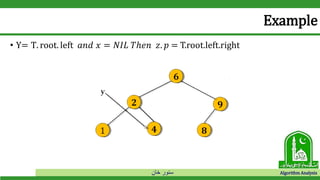
• Y= T. root. left 𝑎𝑛𝑑 𝑥 = 𝑁𝐼𝐿 𝑇ℎ𝑒𝑛 𝑧. 𝑝 = T.root.left.right
‫خان‬ ‫سنور‬ Algorithm Analysis
Example
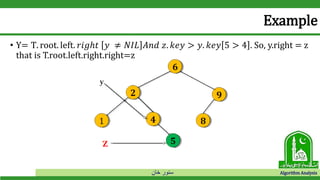
• Y= T. root. left. 𝑟𝑖𝑔ℎ𝑡 𝑦 ≠ 𝑁𝐼𝐿 𝐴𝑛𝑑 𝑧. 𝑘𝑒𝑦 > 𝑦. 𝑘𝑒𝑦 5 > 4 . So, y.right = z
that is T.root.left.right.right=z
‫خان‬ ‫سنور‬ Algorithm Analysis
Algorithm
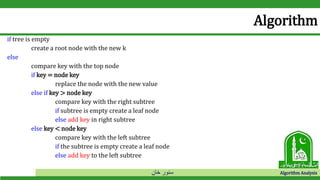
if tree is empty
create a root node with the new k
else
compare key with the top node
if key = node key
replace the node with the new value
else if key > node key
compare key with the right subtree
if subtree is empty create a leaf node
else add key in right subtree
else key < node key
compare key with the left subtree
if the subtree is empty create a leaf node
else add key to the left subtree
‫خان‬ ‫سنور‬ Algorithm Analysis
Delete a value from the BST
• Removing a node from a BST is a bit more complex, since we do not want to
create any “holes” in the tree. The intention is to remove the specified item from
the BST and adjust the tree.
• The binary search algorithm is used to locate the target item: starting at the root
it probes down the tree till it finds the target or reaches a leaf node (target not
in the tree)
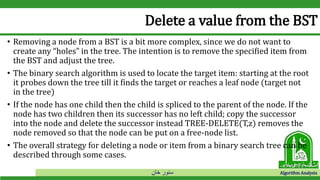
• If the node has one child then the child is spliced to the parent of the node. If the
node has two children then its successor has no left child; copy the successor
into the node and delete the successor instead TREE-DELETE(T,z) removes the
node removed so that the node can be put on a free-node list.
• The overall strategy for deleting a node or item from a binary search tree can be
described through some cases.
‫خان‬ ‫سنور‬ Algorithm Analysis
Delete a value from the BST
• Experimenting the cases:
if tree is empty return false
else attempt to locate node containing the target
using the binary search algorithm:
if the target is not found return false
else the target is found, then remove its node. Now while removing
the node four cases may happen.
‫خان‬ ‫سنور‬ Algorithm Analysis
Delete a value from the BST
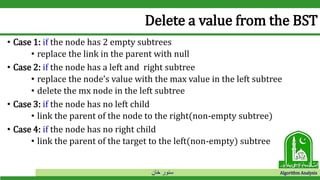
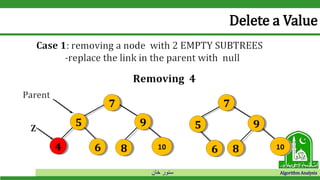
• Case 1: if the node has 2 empty subtrees
• replace the link in the parent with null
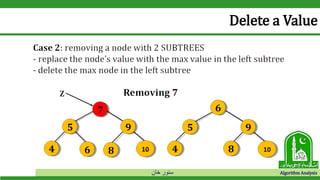
• Case 2: if the node has a left and right subtree
• replace the node’s value with the max value in the left subtree
• delete the mx node in the left subtree
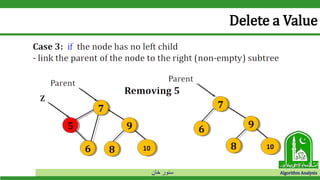
• Case 3: if the node has no left child
• link the parent of the node to the right(non-empty subtree)
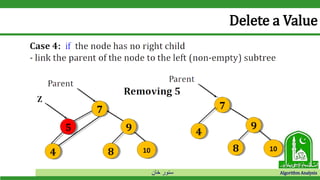
• Case 4: if the node has no right child
• link the parent of the target to the left(non-empty) subtree
‫خان‬ ‫سنور‬ Algorithm Analysis
Delete a Value
‫خان‬ ‫سنور‬ Algorithm Analysis
Delete a Value
‫خان‬ ‫سنور‬ Algorithm Analysis
Delete a Value
‫خان‬ ‫سنور‬ Algorithm Analysis
Delete a Value
‫خان‬ ‫سنور‬ Algorithm Analysis
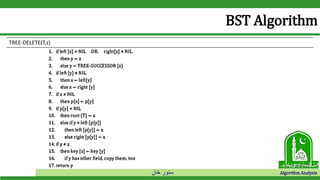
BST Algorithm
TREE-DELETE(T,z)
‫خان‬ ‫سنور‬ Algorithm Analysis
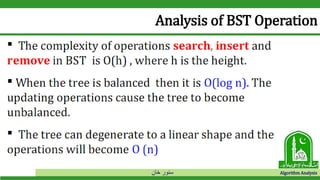
Analysis of BST Operation
‫خان‬ ‫سنور‬ Algorithm Analysis
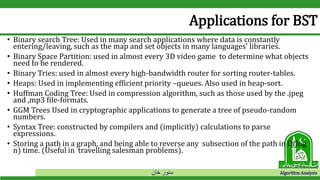
Applications for BST
• Binary search Tree: Used in many search applications where data is constantly
entering/leaving, such as the map and set objects in many languages’ libraries.
• Binary Space Partition: used in almost every 3D video game to determine what objects
need to be rendered.
• Binary Tries: used in almost every high-bandwidth router for sorting router-tables.
• Heaps: Used in implementing efficient priority –queues. Also used in heap-sort.
• Huffman Coding Tree: Used in compression algorithm, such as those used by the .jpeg
and ,mp3 file-formats.
• GGM Trees Used in cryptographic applications to generate a tree of pseudo-random
numbers.
• Syntax Tree: constructed by compilers and (implicitly) calculations to parse
expressions.
• Storing a path in a graph, and being able to reverse any subsection of the path in O(log
n) time. (Useful in travelling salesman problems).
‫خان‬ ‫سنور‬ Algorithm Analysis
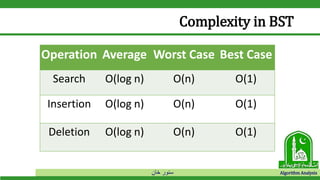
Complexity in BST
Operation Average Worst Case Best Case
Search O(log n) O(n) O(1)
Insertion O(log n) O(n) O(1)
Deletion O(log n) O(n) O(1)
‫خان‬ ‫سنور‬ Algorithm Analysis
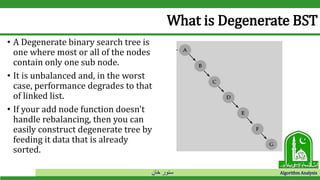
What is Degenerate BST
• A Degenerate binary search tree is
one where most or all of the nodes
contain only one sub node.
• It is unbalanced and, in the worst
case, performance degrades to that
of linked list.
• If your add node function doesn't
handle rebalancing, then you can
easily construct degenerate tree by
feeding it data that is already
sorted.
‫خان‬ ‫سنور‬ Algorithm Analysis
Does the ordering of inserting elements into a tree matter.
• Yes, certain orders might produce very unbalanced trees or degenerate
trees.
• Unbalanced trees are not desirable because search increase.
• Advance tree structure, such as red-black tree, AVL trees guarantee
balanced trees.
‫خان‬ ‫سنور‬ Algorithm Analysis
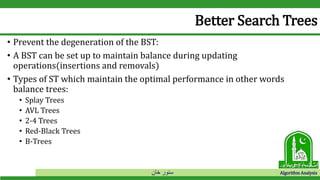
Better Search Trees
• Prevent the degeneration of the BST:
• A BST can be set up to maintain balance during updating
operations(insertions and removals)
• Types of ST which maintain the optimal performance in other words
balance trees:
• Splay Trees
• AVL Trees
• 2-4 Trees
• Red-Black Trees
• B-Trees
‫خان‬ ‫سنور‬ Algorithm Analysis
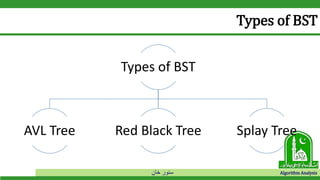
Types of BST
Types of BST
AVL Tree Red Black Tree Splay Tree
‫خان‬ ‫سنور‬ Algorithm Analysis
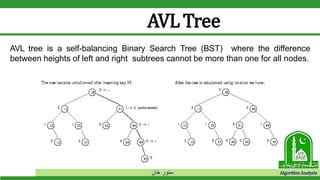
AVLTree
AVL tree is a self-balancing Binary Search Tree (BST) where the difference
between heights of left and right subtrees cannot be more than one for all nodes.
‫خان‬ ‫سنور‬ Algorithm Analysis
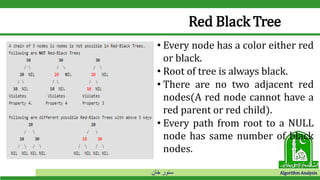
Red Black Tree
• Every node has a color either red
or black.
• Root of tree is always black.
• There are no two adjacent red
nodes(A red node cannot have a
red parent or red child).
• Every path from root to a NULL
node has same number of black
nodes.
‫خان‬ ‫سنور‬ Algorithm Analysis
Splay Tree
Automatically moves frequently accessed elements nearer to the root for
quick to access

Binary Search Tree

  • 1.
    Sunawar Khan Islamia Universityof Bahawalpur Bahawalnagar Campus Analysis o f Algorithm
  • 2.
    ‫خان‬ ‫سنور‬ AlgorithmAnalysis Insertion in BST Querying a BST Binary Search Tree Other Operations on BST Deletion in BST Contents
  • 3.
    ‫خان‬ ‫سنور‬ AlgorithmAnalysis Trees Tree • Each node can have 0 or more children • A node can have at most one parent Binary Tree • Tree with 0–2 children per node • Also known as Decision Making Tree
  • 4.
    ‫خان‬ ‫سنور‬ AlgorithmAnalysis What is Binary Tree • Property 1:- Each node can have up to two successor nodes
  • 5.
    ‫خان‬ ‫سنور‬ AlgorithmAnalysis What is Binary Tree? • Property:- A Unique path exists from the root to every node.
  • 6.
  • 7.
    ‫خان‬ ‫سنور‬ AlgorithmAnalysis Basic Terminology • The successor nodes of a node are called its children. • The predecessor node of a node is called its parent. • The “beginning” node is called the root(has no parent). • A node without children is called leaf. • Path refers to the sequence of nodes along the edges of a tree. • Traversing means passing through nodes in a specific order.
  • 8.
    ‫خان‬ ‫سنور‬ AlgorithmAnalysis Basic Terminology • Nodes are organize in levels(indexed from 0) • Level(or depth) of a node • Number of edges in the path from the root to that node. • Height of a tree h • Number of Levels = L • In some books number of levels – 1 • Full Tree • Every node has exactly two children and all the leaves are on the same level.
  • 9.
    ‫خان‬ ‫سنور‬ AlgorithmAnalysis Example • No. of Nodes = 9 • Height = 4 • Highest Level = 3 • Root Node = 8 • Leaves = 1, 4, 7, 13 • Interior Nodes = 3, 10, 6, 14 • Ancestors of 6 = 3, 8 • Descendent of 10 = 14, 13 • Sibling of 1 = 6 8 103 61 10 13 74
  • 10.
    ‫خان‬ ‫سنور‬ AlgorithmAnalysis What is the max number of nodes at any level? • The maximum number of nodes at any l is less than or equal to 21 where l=0, 1, 2, 3, . . ., l - 1
  • 11.
    ‫خان‬ ‫سنور‬ AlgorithmAnalysis What is the total number of nodes N of a full tree with height h • 𝑁 = 20 + 21 + 22 + . . . + 2ℎ−1 = 2ℎ - 1 •Derived according to the geometric series: • 𝑥0 + 𝑥1 + 𝑥2 + . . . + 𝑥ℎ−1 =σ𝑖=0 𝑛−1 𝑥𝑖 = 𝑥 𝑛 −1 𝑥−1
  • 12.
    ‫خان‬ ‫سنور‬ AlgorithmAnalysis What is the height h of a full tree with N nodes? 2ℎ − 1 = 𝑁 ⇒ 2ℎ − 1 = 𝑁 + 1 ⇒ ℎ = log 𝑁 + 1 → 𝑂(log 𝑁)
  • 13.
    ‫خان‬ ‫سنور‬ AlgorithmAnalysis Why is h important •The Tree operations like insert, delete, retrieve etc. are typically expressed in terms of the height of the tree h. •So, it can be stated that the tree height h determine running time!.
  • 14.
  • 15.
    ‫خان‬ ‫سنور‬ AlgorithmAnalysis Binary Search Tree •Suppose DATA is an array which is sorted in increasing numerical order and we want to fond the location LOC of a given ITEM in DATA. Then there is an extremely efficient searching algorithm Binary Search.
  • 16.
    ‫خان‬ ‫سنور‬ AlgorithmAnalysis Binary Search • Consider that you want to find the location of some word in a dictionary • I guess you are not fool enough to search it in a linear way or in other words apply linear search. That is no one search page by page from the start to end of the book. • Rather, I guess you will open or divide the dictionary in the middle to determine which half contains the word. This process goes on. • Eventually you will find the location of the word and thus you are reducing the number of possible locations for the word in the dictionary.
  • 17.
    ‫خان‬ ‫سنور‬ AlgorithmAnalysis How to Search Binary Tree
  • 18.
    ‫خان‬ ‫سنور‬ AlgorithmAnalysis Binary Search Tree • Binary Search Tree Property • The value stored at a node is greater than the value stored at its left child and less than the value stored at its right child.
  • 19.
    ‫خان‬ ‫سنور‬ AlgorithmAnalysis Example • Example • X > Y • X < Z Y Z X
  • 20.
    ‫خان‬ ‫سنور‬ AlgorithmAnalysis Binary Search Tree •In a BST, the value stored at the root of a subtree is greater than any value in its left subtree and less than any value in its right subtree.
  • 21.
    ‫خان‬ ‫سنور‬ AlgorithmAnalysis Binary Search Trees • Where is the smallest element? • Leftmost element • Where is the largest element? • Rightmost element.
  • 22.
    ‫خان‬ ‫سنور‬ AlgorithmAnalysis How to Search a Binary Search Tree?
  • 23.
  • 24.
  • 25.
    ‫خان‬ ‫سنور‬ AlgorithmAnalysis Difference between BT and BST • A Binary Tree is simply a tree in which each node can have at most two children. • A Binary Search Tree is a binary search tree is a binary tree in which the nodes are assigned values, with the following restrictions: • No duplicate values. • The left subtree of a node can only have values less than the node • The right subtree of a node can only have values greater than the node and recursively defined • The left subtree of a node is a binary search tree • The right subtree of a node is a binary search tree.
  • 26.
    ‫خان‬ ‫سنور‬ AlgorithmAnalysis Basic Operations • Following are the basic operations of a tree • Search • Searches an element in a tree • Insert • Insert an element in a tree • Pre-Order Traversal • Traverse a tree in a pre-order manner • In-Order Traversal • Traverse a tree in a in-order manner • Post-Order Traversal • Traverse a tree in a post-order manner
  • 27.
    ‫خان‬ ‫سنور‬ AlgorithmAnalysis Tree Traversal • Traversal is a process to visit all the nodes of a tree and may print their values too. • All nodes are connected via edges (links) we always start from the root (head) node. • We cannot randomly access a node in a tree. • There are three ways which we use to traverse a tree − • In-order Traversal • Pre-order Traversal • Post-order Traversal
  • 28.
    ‫خان‬ ‫سنور‬ AlgorithmAnalysis In-order Traversal • In this traversal method, the left sub tree is visited first, then the root and later the right sub-tree. • We should always remember that every node may represent a sub tree itself. • If a binary tree is traversed in-order, the output will produce sorted key values in an ascending order. •Algorithm • Until all nodes are traversed − • Step 1 − Recursively traverse left sub tree. • Step 2 − Visit root node. • Step 3 − Recursively traverse right sub tree.
  • 29.
    ‫خان‬ ‫سنور‬ AlgorithmAnalysis Example • We start from A, and following in-order traversal, we move to its left subtree B. B is also traversed in-order. The process goes on until all the nodes are visited. • The output of in-order traversal of this tree will be- • D → 𝑩 → 𝑬 → 𝑨 → 𝑭 → 𝑪 → 𝑮
  • 30.
    ‫خان‬ ‫سنور‬ AlgorithmAnalysis Pre-order Traversal • In this traversal method, the root node is visited first, then the left sub tree and finally the right sub tree. •Algorithm • Until all nodes are traversed − • Step 1 − Visit root node • Step 2 − Recursively traverse left sub tree. • Step 3 − Recursively traverse right sub tree.
  • 31.
    ‫خان‬ ‫سنور‬ AlgorithmAnalysis Example • We start from A, and following pre-order traversal, we first visit A itself and move to its left subtree B. B is also traversed pre-order. The process goes on until all the nodes are visited. • The output of pre-order traversal of this tree will be- • A→ 𝑩 → 𝑫 → 𝑬 → 𝑪 → 𝑭 → 𝑮
  • 32.
    ‫خان‬ ‫سنور‬ AlgorithmAnalysis Post-order Traversal • In this traversal method, the root node is visited last, hence the name. First we traverse the left sub tree, then the right sub tree and finally the root node. •Algorithm • Until all nodes are traversed − • Step 1 − Recursively traverse left sub tree. • Step 2 − Recursively traverse right sub tree. • Step 3 − Visit root node.
  • 33.
    ‫خان‬ ‫سنور‬ AlgorithmAnalysis Example • We start from A, and following pre-order traversal, we first visit the left subtree B. B is also traversed pre-order. The process goes on until all the nodes are visited. • The output of in-order traversal of this tree will be- • D → 𝑬 → 𝑩 → 𝑭 → 𝑮 → 𝑪 → 𝑨
  • 34.
    ‫خان‬ ‫سنور‬ AlgorithmAnalysis Binary Search Tree Algorithm • Let x be a node in a binary search tree and k is the value, we are supposed to search. • Then according to the binary search tree property we know that: if y is a node in the left subtree of x, then y.key ≤x.key. If y is a node in the right subtree of x, then y.ke ≥ x.key. (x.key denotes the value at node x) • To search the location of given data k, the binary search tree algorithm begins its search at the root and traces the path downward in the tree. • For each node x it compares the value k with x.key. If the values are equal then the search terminates and x is the desired node
  • 35.
    ‫خان‬ ‫سنور‬ AlgorithmAnalysis Cont. . . •If k is smaller than x.key, then the search continues in the left subtree of x, since the binary search tree property implies that k could not be in the right subtree. •Symmetrically, if k is larger than x.key, then the search continues in the right subtree. •The nodes encountered during the recursion from a simple path downward from the root of the tree, and thus the running time of TREEE-SEARCH is O(h), where h is the height of the tree.
  • 36.
  • 37.
    ‫خان‬ ‫سنور‬ AlgorithmAnalysis Binary Tree Search
  • 38.
  • 39.
    ‫خان‬ ‫سنور‬ AlgorithmAnalysis Binary Tree Search
  • 40.
    ‫خان‬ ‫سنور‬ AlgorithmAnalysis Binary Tree Search
  • 41.
    ‫خان‬ ‫سنور‬ AlgorithmAnalysis Binary Tree Search
  • 42.
    ‫خان‬ ‫سنور‬ AlgorithmAnalysis BST Pseudo Code • If tree is empty return NULL • else if the key value in the node(root) return the node value • else if the key value in the node is greater than the target return the result of searching the left subtree • else if the value in the node is smaller than the target return the result of searching the right subtree.
  • 43.
    ‫خان‬ ‫سنور‬ AlgorithmAnalysis Minimum Key or Element • We can always find an element in a binary search tree whose key is minimum by following the left children from the root until we encounter a NIL. • Otherwise if a node has no left subtree then the value x.key contained in root x is the minimum key or element. The procedure for finding the minimum key: 1. while x.left ≠ NIL 1. x=x.left 2. return x TREE-MINIMUM(x)
  • 44.
    ‫خان‬ ‫سنور‬ AlgorithmAnalysis Maximum Key or Element • We can always find an element in a binary search tree whose key is maximum by following the right children from the root until we encounter a NIL. • Otherwise if a node has no right subtree then the value x.key contained in root x is the maximum key or element. The procedure for finding the maximum key: 1. while x.right ≠ NIL 1. x=x.right 2. return x TREE-MAXIMUM(x)
  • 45.
    ‫خان‬ ‫سنور‬ AlgorithmAnalysis Insert a value into the BST • To insert a new value v into binary search tree T, we use the procedure TREE-INSERT. • The procedure takes a node z for which z.key=v, z.left=NIL and z.right=NIL. • It modifies T and some of the attributes of z in such a way that insert z into an appropriate position in the tree. • Suppose v is the value we want to insert and z is the node (NEW or NIL) we are supposed to find to insert the value v. • Z.p denotes the parent of z. • X is pointer that traces a simple path downward the tree and y is the trailing pointers as the parent of x. T.root denote the root of the tree.
  • 46.
    ‫خان‬ ‫سنور‬ AlgorithmAnalysis Insert a value into the BST • Now the intention is to find a new or NIL node that will satisfy the BST property after placing the value v. The procedure first consider x as the root of the tree thus the parent of the root y=NIL. • In steps 3 to 7 the procedure causes the two pointer y and x to move down the tree, going left or right depending on the comparison of z.key with x.key, until x becomes NIL. • Now this NIL occupies the position z, where we wish to place the input item. • At this time we need y the parent of the desired node. This is why at step four we always storing the parent of current node x while moving downward. (cont)
  • 47.
    ‫خان‬ ‫سنور‬ AlgorithmAnalysis Insert a value into the BST • At the end of step 7 (in step 8) we make this node the parent of z(z.p). • From step 9 to 11. • Now if tree is empty (y==NIL) then create a root node with the new key(T.root=z) • If the value v is less than the value of the parent(z.key < y.key) then make it as the left-child of the parent(y.left = z) • If the value v is greater than the value of the parent (z.key > y.key) then make it as the right-child of the parent(y.right=z)
  • 48.
    ‫خان‬ ‫سنور‬ AlgorithmAnalysis Cont. . . 1. y = nil 2. x= T.root 3. while x ≠ NIL 4. y = x 5. if z.key < x.key 6. x= x.left 7. else x = x.right 8. z.p = y 9. if y == NIL 10. T.root = z 11. elseif z.key = y.key 12. y.left = z 13. else y.right = z TREE INSERT
  • 49.
    ‫خان‬ ‫سنور‬ AlgorithmAnalysis Example • We are supposed to insert an item value 5 an appropriate node z for it.
  • 50.
    ‫خان‬ ‫سنور‬ AlgorithmAnalysis Example • Y = NIL and x = T.root
  • 51.
    ‫خان‬ ‫سنور‬ AlgorithmAnalysis Example • Now x ≠ 𝑁𝐼𝐿 𝑎𝑛𝑑 𝑧. 𝐾𝑒𝑦 < 𝑥. 𝑘𝑒𝑦 𝑇ℎ𝑎𝑡 𝑖𝑠 [5 < 6]
  • 52.
    ‫خان‬ ‫سنور‬ AlgorithmAnalysis Example • Now Y= T. rot 𝑎𝑛𝑑 𝑥 = 𝑇. 𝑟𝑜𝑜𝑡. 𝑙𝑒𝑓𝑡 𝐴𝑛𝑑 𝑧. 𝐾𝑒𝑦 > 𝑥. 𝑘𝑒𝑦 𝑇ℎ𝑎𝑡 𝑖𝑠 [5 > 2]
  • 53.
    ‫خان‬ ‫سنور‬ AlgorithmAnalysis Example • Y= T. root. left 𝑎𝑛𝑑 𝑥 = 𝑇. 𝑟𝑜𝑜𝑡. 𝑟𝑖𝑔ℎ𝑡 𝐴𝑛𝑑 𝑧. 𝐾𝑒𝑦 > 𝑥. 𝑘𝑒𝑦 𝑇ℎ𝑎𝑡 𝑖𝑠 [5 > 4]
  • 54.
    ‫خان‬ ‫سنور‬ AlgorithmAnalysis Example • Y= T. root. left 𝑎𝑛𝑑 𝑥 = 𝑁𝐼𝐿 𝑇ℎ𝑒𝑛 𝑧. 𝑝 = T.root.left.right
  • 55.
    ‫خان‬ ‫سنور‬ AlgorithmAnalysis Example • Y= T. root. left. 𝑟𝑖𝑔ℎ𝑡 𝑦 ≠ 𝑁𝐼𝐿 𝐴𝑛𝑑 𝑧. 𝑘𝑒𝑦 > 𝑦. 𝑘𝑒𝑦 5 > 4 . So, y.right = z that is T.root.left.right.right=z
  • 56.
    ‫خان‬ ‫سنور‬ AlgorithmAnalysis Algorithm if tree is empty create a root node with the new k else compare key with the top node if key = node key replace the node with the new value else if key > node key compare key with the right subtree if subtree is empty create a leaf node else add key in right subtree else key < node key compare key with the left subtree if the subtree is empty create a leaf node else add key to the left subtree
  • 57.
    ‫خان‬ ‫سنور‬ AlgorithmAnalysis Delete a value from the BST • Removing a node from a BST is a bit more complex, since we do not want to create any “holes” in the tree. The intention is to remove the specified item from the BST and adjust the tree. • The binary search algorithm is used to locate the target item: starting at the root it probes down the tree till it finds the target or reaches a leaf node (target not in the tree) • If the node has one child then the child is spliced to the parent of the node. If the node has two children then its successor has no left child; copy the successor into the node and delete the successor instead TREE-DELETE(T,z) removes the node removed so that the node can be put on a free-node list. • The overall strategy for deleting a node or item from a binary search tree can be described through some cases.
  • 58.
    ‫خان‬ ‫سنور‬ AlgorithmAnalysis Delete a value from the BST • Experimenting the cases: if tree is empty return false else attempt to locate node containing the target using the binary search algorithm: if the target is not found return false else the target is found, then remove its node. Now while removing the node four cases may happen.
  • 59.
    ‫خان‬ ‫سنور‬ AlgorithmAnalysis Delete a value from the BST • Case 1: if the node has 2 empty subtrees • replace the link in the parent with null • Case 2: if the node has a left and right subtree • replace the node’s value with the max value in the left subtree • delete the mx node in the left subtree • Case 3: if the node has no left child • link the parent of the node to the right(non-empty subtree) • Case 4: if the node has no right child • link the parent of the target to the left(non-empty) subtree
  • 60.
  • 61.
  • 62.
  • 63.
  • 64.
    ‫خان‬ ‫سنور‬ AlgorithmAnalysis BST Algorithm TREE-DELETE(T,z)
  • 65.
    ‫خان‬ ‫سنور‬ AlgorithmAnalysis Analysis of BST Operation
  • 66.
    ‫خان‬ ‫سنور‬ AlgorithmAnalysis Applications for BST • Binary search Tree: Used in many search applications where data is constantly entering/leaving, such as the map and set objects in many languages’ libraries. • Binary Space Partition: used in almost every 3D video game to determine what objects need to be rendered. • Binary Tries: used in almost every high-bandwidth router for sorting router-tables. • Heaps: Used in implementing efficient priority –queues. Also used in heap-sort. • Huffman Coding Tree: Used in compression algorithm, such as those used by the .jpeg and ,mp3 file-formats. • GGM Trees Used in cryptographic applications to generate a tree of pseudo-random numbers. • Syntax Tree: constructed by compilers and (implicitly) calculations to parse expressions. • Storing a path in a graph, and being able to reverse any subsection of the path in O(log n) time. (Useful in travelling salesman problems).
  • 67.
    ‫خان‬ ‫سنور‬ AlgorithmAnalysis Complexity in BST Operation Average Worst Case Best Case Search O(log n) O(n) O(1) Insertion O(log n) O(n) O(1) Deletion O(log n) O(n) O(1)
  • 68.
    ‫خان‬ ‫سنور‬ AlgorithmAnalysis What is Degenerate BST • A Degenerate binary search tree is one where most or all of the nodes contain only one sub node. • It is unbalanced and, in the worst case, performance degrades to that of linked list. • If your add node function doesn't handle rebalancing, then you can easily construct degenerate tree by feeding it data that is already sorted.
  • 69.
    ‫خان‬ ‫سنور‬ AlgorithmAnalysis Does the ordering of inserting elements into a tree matter. • Yes, certain orders might produce very unbalanced trees or degenerate trees. • Unbalanced trees are not desirable because search increase. • Advance tree structure, such as red-black tree, AVL trees guarantee balanced trees.
  • 70.
    ‫خان‬ ‫سنور‬ AlgorithmAnalysis Better Search Trees • Prevent the degeneration of the BST: • A BST can be set up to maintain balance during updating operations(insertions and removals) • Types of ST which maintain the optimal performance in other words balance trees: • Splay Trees • AVL Trees • 2-4 Trees • Red-Black Trees • B-Trees
  • 71.
    ‫خان‬ ‫سنور‬ AlgorithmAnalysis Types of BST Types of BST AVL Tree Red Black Tree Splay Tree
  • 72.
    ‫خان‬ ‫سنور‬ AlgorithmAnalysis AVLTree AVL tree is a self-balancing Binary Search Tree (BST) where the difference between heights of left and right subtrees cannot be more than one for all nodes.
  • 73.
    ‫خان‬ ‫سنور‬ AlgorithmAnalysis Red Black Tree • Every node has a color either red or black. • Root of tree is always black. • There are no two adjacent red nodes(A red node cannot have a red parent or red child). • Every path from root to a NULL node has same number of black nodes.
  • 74.
    ‫خان‬ ‫سنور‬ AlgorithmAnalysis Splay Tree Automatically moves frequently accessed elements nearer to the root for quick to access