Computer Networks
Layers of OSI Model
The Seven Layers of OSI Model
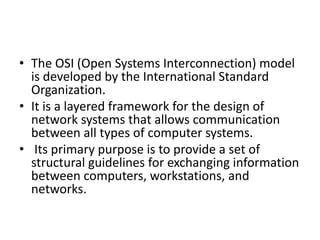
• The OSI (Open Systems Interconnection) model
is developed by the International Standard
Organization.
• It is a layered framework for the design of
network systems that allows communication
between all types of computer systems.
• Its primary purpose is to provide a set of
structural guidelines for exchanging information
between computers, workstations, and
networks.
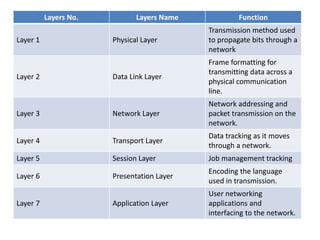
Layers No. Layers Name Function
Layer 1 Physical Layer
Transmission method used
to propagate bits through a
network
Layer 2 Data Link Layer
Frame formatting for
transmitting data across a
physical communication
line.
Layer 3 Network Layer
Network addressing and
packet transmission on the
network.
Layer 4 Transport Layer
Data tracking as it moves
through a network.
Layer 5 Session Layer Job management tracking
Layer 6 Presentation Layer
Encoding the language
used in transmission.
Layer 7 Application Layer
User networking
applications and
interfacing to the network.
Physical Layer
• The Physical Layer is the lowermost layer in the OSI
model and its major responsibility includes the actual
propagation of the unstructured data bits (0’s and 1’s)
across the network, from the physical layer of the
sending device to the physical layer of the receiving
device.
• The Physical layer contains information in the form of
bits.
• It transmits individual bits from one node to the next
node.
• The transmission media defined by the physical layer
include metallic cable, optical fiber, and the wireless
radio-wave.
Physical Layer Includes −
• Bit Synchronization – Physical layer provides the bit
synchronization of bits by providing a clock. This clock
controls the sender and receiver providing synchronization
at bit level.
• Bit Rate Control – Physical layer defines the transmission
rate. The number of bits sent per second.
• Physical Topologies – The physical layer specifies how the
different devices are arranged in a network (bus, ring, star,
and mesh topology).
• Transmission mode – The physical layer checks if the
transmission is simplex, half-duplex, or full-duplex. It
defines how the data flows between the two connected
devices.
Data Link Layer
• It is the second layer of the OSI model. The data link layer
is responsible for providing error-free communication
across the physical link connecting the primary and
secondary nodes within a network.
• It provides hop-to-hop delivery. It packages the data
from the physical layer into a group called blocks.
• The data link layer provides the final framing of the
information signal, and it provides synchronization
facilities for the orderly flow of data between the nodes.
• Framing − Breaks messages into frames and
reassembles frames into messages.
• Error handling − It is used to soles the damaged,
lost, and duplicate frames.
• Flow Control − It keeps a fast transmitter from
flooding a slow receiver.
• Access Control − In access control, if many hosts
have usage of the medium, When a single
communication channel is shared by multiple
devices, the MAC sub-layer of data link layer
helps to determine which device has control over
the channel at a given time.
Network Layer
• The network layer provides details that enable data
to be routed between devices in an environment
using multiple networks, sub-networks, or both.
• The networking components that operate at the
network layer include routers and their software.
• It determines which network configuration is most
appropriate for the function provided by the network
and addresses and routes data within a network by
establishing, maintaining, and terminating
connectors between them.
• It provides the upper layers of the hierarchy with
independence from the data transmission and
switching technologies used to interconnect
systems.
• It also provides the source and destination network
addresses, subnet information, and source and
destination node addresses.
• In this, the network is subdivided into subnet-work
that is separated by routers.
Transport Layer
• We can say that the transport layer controls
and ensures the end-to-end integrity of the
data message propagated through the
network between two devices, providing the
reliable, transparent transfer of data between
the endpoints.
Responsibilities of Transport Layer
• Segmentation and Reassembly − In this, a message is divided into
small pieces. Reassemble the message correctly upon arriving at
the destination.
• Reliability − It ensures that packets arrive at their destination.
Reassembles out-of-order messages.
• Service Decisions − It is used to check what types of service to
provide error-free point-to-point, datagram, etc.
• Mapping − It determines which messages belong to which
connections.
• Naming − It must be translated into an internal address and route,
send to node XYZ.
• Flow Control − It keeps a fast transmitter from flooding a slow
receiver.
• Error Control − To retransmit the damaged segments.
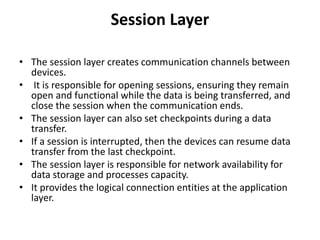
Session Layer
• The session layer creates communication channels between
devices.
• It is responsible for opening sessions, ensuring they remain
open and functional while the data is being transferred, and
close the session when the communication ends.
• The session layer can also set checkpoints during a data
transfer.
• If a session is interrupted, then the devices can resume data
transfer from the last checkpoint.
• The session layer is responsible for network availability for
data storage and processes capacity.
• It provides the logical connection entities at the application
layer.
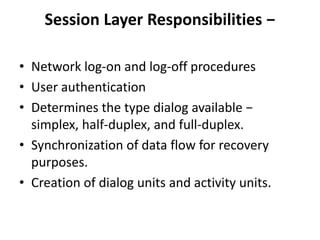
Session Layer Responsibilities −
• Network log-on and log-off procedures
• User authentication
• Determines the type dialog available −
simplex, half-duplex, and full-duplex.
• Synchronization of data flow for recovery
purposes.
• Creation of dialog units and activity units.
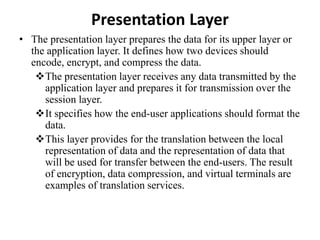
Presentation Layer
• The presentation layer prepares the data for its upper layer or
the application layer. It defines how two devices should
encode, encrypt, and compress the data.
The presentation layer receives any data transmitted by the
application layer and prepares it for transmission over the
session layer.
It specifies how the end-user applications should format the
data.
This layer provides for the translation between the local
representation of data and the representation of data that
will be used for transfer between the end-users. The result
of encryption, data compression, and virtual terminals are
examples of translation services.
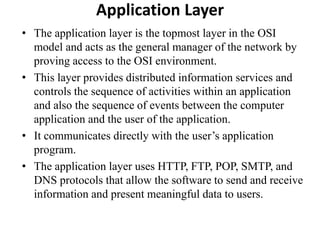
Application Layer
• The application layer is the topmost layer in the OSI
model and acts as the general manager of the network by
proving access to the OSI environment.
• This layer provides distributed information services and
controls the sequence of activities within an application
and also the sequence of events between the computer
application and the user of the application.
• It communicates directly with the user’s application
program.
• The application layer uses HTTP, FTP, POP, SMTP, and
DNS protocols that allow the software to send and receive
information and present meaningful data to users.

Computer network layers

  • 1.
    Computer Networks Layers ofOSI Model The Seven Layers of OSI Model
  • 2.
    • The OSI(Open Systems Interconnection) model is developed by the International Standard Organization. • It is a layered framework for the design of network systems that allows communication between all types of computer systems. • Its primary purpose is to provide a set of structural guidelines for exchanging information between computers, workstations, and networks.
  • 3.
    Layers No. LayersName Function Layer 1 Physical Layer Transmission method used to propagate bits through a network Layer 2 Data Link Layer Frame formatting for transmitting data across a physical communication line. Layer 3 Network Layer Network addressing and packet transmission on the network. Layer 4 Transport Layer Data tracking as it moves through a network. Layer 5 Session Layer Job management tracking Layer 6 Presentation Layer Encoding the language used in transmission. Layer 7 Application Layer User networking applications and interfacing to the network.
  • 4.
    Physical Layer • ThePhysical Layer is the lowermost layer in the OSI model and its major responsibility includes the actual propagation of the unstructured data bits (0’s and 1’s) across the network, from the physical layer of the sending device to the physical layer of the receiving device. • The Physical layer contains information in the form of bits. • It transmits individual bits from one node to the next node. • The transmission media defined by the physical layer include metallic cable, optical fiber, and the wireless radio-wave.
  • 5.
    Physical Layer Includes− • Bit Synchronization – Physical layer provides the bit synchronization of bits by providing a clock. This clock controls the sender and receiver providing synchronization at bit level. • Bit Rate Control – Physical layer defines the transmission rate. The number of bits sent per second. • Physical Topologies – The physical layer specifies how the different devices are arranged in a network (bus, ring, star, and mesh topology). • Transmission mode – The physical layer checks if the transmission is simplex, half-duplex, or full-duplex. It defines how the data flows between the two connected devices.
  • 6.
    Data Link Layer •It is the second layer of the OSI model. The data link layer is responsible for providing error-free communication across the physical link connecting the primary and secondary nodes within a network. • It provides hop-to-hop delivery. It packages the data from the physical layer into a group called blocks. • The data link layer provides the final framing of the information signal, and it provides synchronization facilities for the orderly flow of data between the nodes.
  • 7.
    • Framing −Breaks messages into frames and reassembles frames into messages. • Error handling − It is used to soles the damaged, lost, and duplicate frames. • Flow Control − It keeps a fast transmitter from flooding a slow receiver. • Access Control − In access control, if many hosts have usage of the medium, When a single communication channel is shared by multiple devices, the MAC sub-layer of data link layer helps to determine which device has control over the channel at a given time.
  • 8.
    Network Layer • Thenetwork layer provides details that enable data to be routed between devices in an environment using multiple networks, sub-networks, or both. • The networking components that operate at the network layer include routers and their software. • It determines which network configuration is most appropriate for the function provided by the network and addresses and routes data within a network by establishing, maintaining, and terminating connectors between them.
  • 9.
    • It providesthe upper layers of the hierarchy with independence from the data transmission and switching technologies used to interconnect systems. • It also provides the source and destination network addresses, subnet information, and source and destination node addresses. • In this, the network is subdivided into subnet-work that is separated by routers.
  • 10.
    Transport Layer • Wecan say that the transport layer controls and ensures the end-to-end integrity of the data message propagated through the network between two devices, providing the reliable, transparent transfer of data between the endpoints.
  • 11.
    Responsibilities of TransportLayer • Segmentation and Reassembly − In this, a message is divided into small pieces. Reassemble the message correctly upon arriving at the destination. • Reliability − It ensures that packets arrive at their destination. Reassembles out-of-order messages. • Service Decisions − It is used to check what types of service to provide error-free point-to-point, datagram, etc. • Mapping − It determines which messages belong to which connections. • Naming − It must be translated into an internal address and route, send to node XYZ. • Flow Control − It keeps a fast transmitter from flooding a slow receiver. • Error Control − To retransmit the damaged segments.
  • 12.
    Session Layer • Thesession layer creates communication channels between devices. • It is responsible for opening sessions, ensuring they remain open and functional while the data is being transferred, and close the session when the communication ends. • The session layer can also set checkpoints during a data transfer. • If a session is interrupted, then the devices can resume data transfer from the last checkpoint. • The session layer is responsible for network availability for data storage and processes capacity. • It provides the logical connection entities at the application layer.
  • 13.
    Session Layer Responsibilities− • Network log-on and log-off procedures • User authentication • Determines the type dialog available − simplex, half-duplex, and full-duplex. • Synchronization of data flow for recovery purposes. • Creation of dialog units and activity units.
  • 14.
    Presentation Layer • Thepresentation layer prepares the data for its upper layer or the application layer. It defines how two devices should encode, encrypt, and compress the data. The presentation layer receives any data transmitted by the application layer and prepares it for transmission over the session layer. It specifies how the end-user applications should format the data. This layer provides for the translation between the local representation of data and the representation of data that will be used for transfer between the end-users. The result of encryption, data compression, and virtual terminals are examples of translation services.
  • 15.
    Application Layer • Theapplication layer is the topmost layer in the OSI model and acts as the general manager of the network by proving access to the OSI environment. • This layer provides distributed information services and controls the sequence of activities within an application and also the sequence of events between the computer application and the user of the application. • It communicates directly with the user’s application program. • The application layer uses HTTP, FTP, POP, SMTP, and DNS protocols that allow the software to send and receive information and present meaningful data to users.