Sunawar Khan
Islamia University of Bahawalpur
Bahawalnagar Campus
Analysis o f Algorithm
‫خان‬ ‫سنور‬ Algorithm Analysis
Counting Sort
Linear Time Sorting
Bucket Sort
Radix Sort
Contents
‫خان‬ ‫سنور‬ Algorithm Analysis
Greedy Method v/s Dynamic Programing
• Both are used for Optimization problem. It required minimum or
maximum results.
• In Greedy Method:- Always follow a function until you find the optimal
result whether it is maximum or minimum.
• Prims algorithm for MST
• Dijkstra Algorithm for finding shortest path.
‫خان‬ ‫سنور‬ Algorithm Analysis
Greedy Method v/s Dynamic Programing
• In Dynamic programing we will try to find all possible solution and
then we’ll pick the best solution which is optimal.
• It is time consuming as compared to greedy method.
• It use recursive formulas for solving problem.
• It follows the principal of optimality.
‫خان‬ ‫سنور‬ Algorithm Analysis
Greedy V/S Dynamic
Greedy Technique Dynamic Technique
• It gives local “Optimal Solution”
• Print in time makes “local optimization”
• More efficient as compared to dynamic programing
• Example:- Fractional Knapsack
• It gives “Global Optimal Solution”
• It makes decision “ smart recursion ”
• Less efficient as compared too greedy technique
• Example:- 0/1 Knapsack
‫خان‬ ‫سنور‬ Algorithm Analysis
Principle of Optimality
• Principle of optimality says that a problem can be solved by sequence
of decisions to get the optimal solution.
• It follows Memoization Problem
‫خان‬ ‫سنور‬ Algorithm Analysis
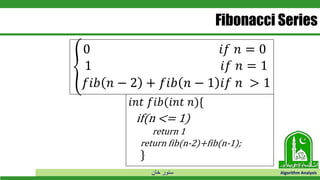
Fibonacci Series
൞
0 𝑖𝑓 𝑛 = 0
1 𝑖𝑓 𝑛 = 1
𝑓𝑖𝑏 𝑛 − 2 + 𝑓𝑖𝑏 𝑛 − 1 𝑖𝑓 𝑛 > 1
𝑖𝑛𝑡 𝑓𝑖𝑏(𝑖𝑛𝑡 𝑛){
if(n <= 1)
return 1
return fib(n-2)+fib(n-1);
}
‫خان‬ ‫سنور‬ Algorithm Analysis
Running Example
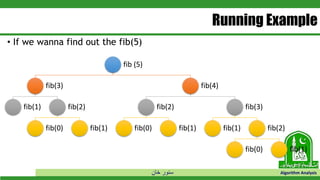
• If we wanna find out the fib(5)
fib (5)
fib(3)
fib(1) fib(2)
fib(0) fib(1)
fib(4)
fib(2)
fib(0) fib(1)
fib(3)
fib(1) fib(2)
fib(0) fib(1)
‫خان‬ ‫سنور‬ Algorithm Analysis
What?
• It is a strategy in designing of algorithm which is used when problem
breaks down into recurring small problems.
• It is typically applicable to optimization problems
• In such problems there can be many solution, each solution has a
value and we wish to find a solution with the optimal value.
‫خان‬ ‫سنور‬ Algorithm Analysis
Elements of Dynamic Programming
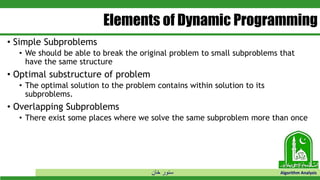
• Simple Subproblems
• We should be able to break the original problem to small subproblems that
have the same structure
• Optimal substructure of problem
• The optimal solution to the problem contains within solution to its
subproblems.
• Overlapping Subproblems
• There exist some places where we solve the same subproblem more than once
‫خان‬ ‫سنور‬ Algorithm Analysis
Steps to design Dynamic Programming Algo
• Characterize optimal substructure
• Recursively define the value of an optimal solution
• Compute the vale bottomUp
• (if needed) constraints an optimal solution
‫خان‬ ‫سنور‬ Algorithm Analysis
Applications
• Matrix Chain Multiplication
• Optimal Binary Search Tree
• All Pairs Shortest Path Problems
• Travelling Salesperson Problem
• 0/1 Knapsack Problem
• Reliability Design
‫خان‬ ‫سنور‬ Algorithm Analysis
Matrix Chain Multiplication
13x15 05x89 89x03 03x34
1 2 3 4
1 0
2 0
3 0
4 0
m[1,1] m[2, 2] m[3, 3] m[4, 4]
m
A CB D
‫خان‬ ‫سنور‬ Algorithm Analysis
Matrix Chain Multiplication
1 2 3 4
1 0 5785
2 0 1335
3 0 9078
4 0
m[1, 2] m[2, 3] m[3, 4]
m
m[A, B] m[B, C] m[C, D]
m
A CB D
13x05 05x89 89x03 03x34
13x05 05x89 05x89 89x03 89x03 03x34
13x05x89 05x89x3 89x3x4
5785 1335 9078
‫خان‬ ‫سنور‬ Algorithm Analysis
Matrix Chain Multiplication
1 2 3 4
1 0 5785 1530
2 0 1335
3 0 9078
4 0
m[1, 3]
m
A.(B.C) (A.B).C
m
A CB D
13x05 05x89 89x03 03x34
2 Possibilities
13x05 05x89 89x03
1530
m[1, 1] m[2,3] 13 x 5 x 3
Cost A Cost B.C Cost A.B.C = 13x5x3
0 + 1335 + 195
13x05 05x89 89x03
9256
m[1, 2] m[3,3] 13 x 89x 3
5785 + 0 + 3471
‫خان‬ ‫سنور‬ Algorithm Analysis
Matrix Chain Multiplication
1 2 3 4
1 0 5785 1530
2 0 1335 1845
3 0 9078
4 0
m[1, 3]
m
B.(C.D) (B.C).D
m
A CB D
13x05 05x89 89x03 03x34
2 Possibilities
05x89 89x03 03x34
24208
m[2, 2] m[3, 4] 05 x 89 x 34
Cost B Cost C.D Cost B.C.D = 05x89x34
0 + 9078 + 15130
05x89 89x03 03x34
1845
m[2, 3] m[4, 4] 5 x 3 x 34
1330 + 0 + 510
‫خان‬ ‫سنور‬ Algorithm Analysis
Matrix Chain Multiplication
•m[1, 4]
m[1, 4] = min{m[1,1] + m[2,4], 13 x 5 x 34,
m[1, 2] + m[3, 4] + 13 x 89 x 34,
m[1, 3] + m[4, 4] + 13 x 3 x 34 }
‫خان‬ ‫سنور‬ Algorithm Analysis
Matrix Chain Multiplication
•m[1, 4]
m[1, 4] = min{A. (B. C. D), (A.B).(C.D),(A.B.C).D}
‫خان‬ ‫سنور‬ Algorithm Analysis
Matrix Chain Multiplication
•m[1, 4]
m[1, 4] = min{0 + 1845 + 2210,
5789 + 78 + 39338,
1530 + 0 + 1326}
‫خان‬ ‫سنور‬ Algorithm Analysis
Matrix Chain Multiplication
•m[1, 4]
m[1, 4] = min{4055, 54201, 2856}
WHAT IS MIN? 2856
1 2 3 4
1 0 5785 1530 2856
2 0 1335 1845
3 0 9078
4 0
mm
‫خان‬ ‫سنور‬ Algorithm Analysis
Formula
•m[i, j] = min{m(I, k) + m(k+1, j) + di-1xdkxdj}

Dynamic programming

  • 1.
    Sunawar Khan Islamia Universityof Bahawalpur Bahawalnagar Campus Analysis o f Algorithm
  • 2.
    ‫خان‬ ‫سنور‬ AlgorithmAnalysis Counting Sort Linear Time Sorting Bucket Sort Radix Sort Contents
  • 3.
    ‫خان‬ ‫سنور‬ AlgorithmAnalysis Greedy Method v/s Dynamic Programing • Both are used for Optimization problem. It required minimum or maximum results. • In Greedy Method:- Always follow a function until you find the optimal result whether it is maximum or minimum. • Prims algorithm for MST • Dijkstra Algorithm for finding shortest path.
  • 4.
    ‫خان‬ ‫سنور‬ AlgorithmAnalysis Greedy Method v/s Dynamic Programing • In Dynamic programing we will try to find all possible solution and then we’ll pick the best solution which is optimal. • It is time consuming as compared to greedy method. • It use recursive formulas for solving problem. • It follows the principal of optimality.
  • 5.
    ‫خان‬ ‫سنور‬ AlgorithmAnalysis Greedy V/S Dynamic Greedy Technique Dynamic Technique • It gives local “Optimal Solution” • Print in time makes “local optimization” • More efficient as compared to dynamic programing • Example:- Fractional Knapsack • It gives “Global Optimal Solution” • It makes decision “ smart recursion ” • Less efficient as compared too greedy technique • Example:- 0/1 Knapsack
  • 6.
    ‫خان‬ ‫سنور‬ AlgorithmAnalysis Principle of Optimality • Principle of optimality says that a problem can be solved by sequence of decisions to get the optimal solution. • It follows Memoization Problem
  • 7.
    ‫خان‬ ‫سنور‬ AlgorithmAnalysis Fibonacci Series ൞ 0 𝑖𝑓 𝑛 = 0 1 𝑖𝑓 𝑛 = 1 𝑓𝑖𝑏 𝑛 − 2 + 𝑓𝑖𝑏 𝑛 − 1 𝑖𝑓 𝑛 > 1 𝑖𝑛𝑡 𝑓𝑖𝑏(𝑖𝑛𝑡 𝑛){ if(n <= 1) return 1 return fib(n-2)+fib(n-1); }
  • 8.
    ‫خان‬ ‫سنور‬ AlgorithmAnalysis Running Example • If we wanna find out the fib(5) fib (5) fib(3) fib(1) fib(2) fib(0) fib(1) fib(4) fib(2) fib(0) fib(1) fib(3) fib(1) fib(2) fib(0) fib(1)
  • 9.
    ‫خان‬ ‫سنور‬ AlgorithmAnalysis What? • It is a strategy in designing of algorithm which is used when problem breaks down into recurring small problems. • It is typically applicable to optimization problems • In such problems there can be many solution, each solution has a value and we wish to find a solution with the optimal value.
  • 10.
    ‫خان‬ ‫سنور‬ AlgorithmAnalysis Elements of Dynamic Programming • Simple Subproblems • We should be able to break the original problem to small subproblems that have the same structure • Optimal substructure of problem • The optimal solution to the problem contains within solution to its subproblems. • Overlapping Subproblems • There exist some places where we solve the same subproblem more than once
  • 11.
    ‫خان‬ ‫سنور‬ AlgorithmAnalysis Steps to design Dynamic Programming Algo • Characterize optimal substructure • Recursively define the value of an optimal solution • Compute the vale bottomUp • (if needed) constraints an optimal solution
  • 12.
    ‫خان‬ ‫سنور‬ AlgorithmAnalysis Applications • Matrix Chain Multiplication • Optimal Binary Search Tree • All Pairs Shortest Path Problems • Travelling Salesperson Problem • 0/1 Knapsack Problem • Reliability Design
  • 13.
    ‫خان‬ ‫سنور‬ AlgorithmAnalysis Matrix Chain Multiplication 13x15 05x89 89x03 03x34 1 2 3 4 1 0 2 0 3 0 4 0 m[1,1] m[2, 2] m[3, 3] m[4, 4] m A CB D
  • 14.
    ‫خان‬ ‫سنور‬ AlgorithmAnalysis Matrix Chain Multiplication 1 2 3 4 1 0 5785 2 0 1335 3 0 9078 4 0 m[1, 2] m[2, 3] m[3, 4] m m[A, B] m[B, C] m[C, D] m A CB D 13x05 05x89 89x03 03x34 13x05 05x89 05x89 89x03 89x03 03x34 13x05x89 05x89x3 89x3x4 5785 1335 9078
  • 15.
    ‫خان‬ ‫سنور‬ AlgorithmAnalysis Matrix Chain Multiplication 1 2 3 4 1 0 5785 1530 2 0 1335 3 0 9078 4 0 m[1, 3] m A.(B.C) (A.B).C m A CB D 13x05 05x89 89x03 03x34 2 Possibilities 13x05 05x89 89x03 1530 m[1, 1] m[2,3] 13 x 5 x 3 Cost A Cost B.C Cost A.B.C = 13x5x3 0 + 1335 + 195 13x05 05x89 89x03 9256 m[1, 2] m[3,3] 13 x 89x 3 5785 + 0 + 3471
  • 16.
    ‫خان‬ ‫سنور‬ AlgorithmAnalysis Matrix Chain Multiplication 1 2 3 4 1 0 5785 1530 2 0 1335 1845 3 0 9078 4 0 m[1, 3] m B.(C.D) (B.C).D m A CB D 13x05 05x89 89x03 03x34 2 Possibilities 05x89 89x03 03x34 24208 m[2, 2] m[3, 4] 05 x 89 x 34 Cost B Cost C.D Cost B.C.D = 05x89x34 0 + 9078 + 15130 05x89 89x03 03x34 1845 m[2, 3] m[4, 4] 5 x 3 x 34 1330 + 0 + 510
  • 17.
    ‫خان‬ ‫سنور‬ AlgorithmAnalysis Matrix Chain Multiplication •m[1, 4] m[1, 4] = min{m[1,1] + m[2,4], 13 x 5 x 34, m[1, 2] + m[3, 4] + 13 x 89 x 34, m[1, 3] + m[4, 4] + 13 x 3 x 34 }
  • 18.
    ‫خان‬ ‫سنور‬ AlgorithmAnalysis Matrix Chain Multiplication •m[1, 4] m[1, 4] = min{A. (B. C. D), (A.B).(C.D),(A.B.C).D}
  • 19.
    ‫خان‬ ‫سنور‬ AlgorithmAnalysis Matrix Chain Multiplication •m[1, 4] m[1, 4] = min{0 + 1845 + 2210, 5789 + 78 + 39338, 1530 + 0 + 1326}
  • 20.
    ‫خان‬ ‫سنور‬ AlgorithmAnalysis Matrix Chain Multiplication •m[1, 4] m[1, 4] = min{4055, 54201, 2856} WHAT IS MIN? 2856 1 2 3 4 1 0 5785 1530 2856 2 0 1335 1845 3 0 9078 4 0 mm
  • 21.
    ‫خان‬ ‫سنور‬ AlgorithmAnalysis Formula •m[i, j] = min{m(I, k) + m(k+1, j) + di-1xdkxdj}