Orthopedic
case teleconference
Ext. Patchara Pornsopanakorn Maharat Nakhonratchasima Hospital
@ER
ผู้ป่วยชายไทยอายุ 42 ปี อาชีพรับจ้าง ภูมิลาเนา จ.นครราชสีมา
Chief complaint : เจ็บไหล่ซ้าย 1 ชั่วโมง PTA
@ER
ผู้ป่วยชายไทยอายุ 42 ปี อาชีพรับจ้าง ภูมิลาเนา จ.นครราชสีมา
Chief complaint : เจ็บไหล่ซ้าย 1 ชั่วโมง PTA
Present illness : 1 hr. PTA
ขณะยกกระเบื้องส่งให้เพื่อนขึ้นกระบะ ได้ยินเสียงกึกบริเวณไหล่ หลังจาก
นั้นรู้สึกเจ็บไหล่ซ้าย ยกขึ้นไม่ไหว ไม่มีปวดบริเวณอื่นๆ ไม่มีล้มหัวกระแทก ไม่เคย
มีประวัติไหล่หลุดมาก่อน ปฏิเสธประวัติดื่มสุรา
PRIMARY SURVEY
 A : can speak, C-spine not tender
 B : equal breat sound, CCT negative
 C : BP 118/59 mmHg, PR 72 /min
 D : E4V5M6, pupil 2 mm RTLBE
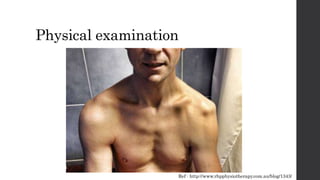
 E : deformity at Lt. shoulder, tender,
mild swelling, no external wound
SECONDARY SURVEY
• Allergy : no food/drug allergy
• Medication : none
• Past history : no U/D
• Last meal : 4 hrPTA
• Event : as in present illness
Physical examination
Ref : http://www.rhpphysiotherapy.com.au/blog/1343/
Physical examination
• GA : A Thai male, fully alert, well co-operative
• V/S : BT 37.1 C, BP 118/59 mmHg, PR 72 /min, RR 18
/min
• HEENT : no pale conjunctivae, anicteric sclerae
• Skin : no external wound seen
• Heart : normal S1 S2, no murmur
• Lung : clear, equal breath sound both lungs
• Abdomen : soft, not tender, normoactive bowel sound
Physical examination
• Extremities : deformity and tenderness at left
shoulder, arm in abduction and external rotation
while resting, humeral head can palpate at
anterior of shoulder, limit ROM due to pain, ruler
sign +, duga sign -, cap. Refill 2s
• Neuro : motor power gr. V all extremities,
sensory intact, reflex 2+ all
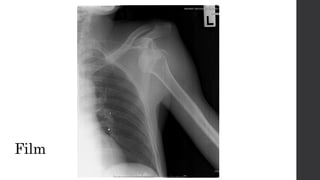
Film
Diagnosis
Anterior shoulder dislocation
with greater tuberosity fracture
Shoulder Dislocations
• Definition : head of humerus loses its articulation with
the glenoid cavity of the scapula
• Classification
 Anterior dislocation (98 percents)
 Posterior dislocation (2 percents)
 Inferior dislocation (very rare)
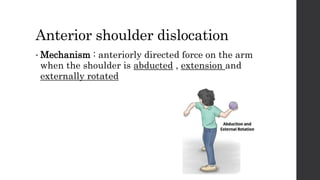
Anterior shoulder dislocation
• Mechanism : anteriorly directed force on the arm
when the shoulder is abducted , extension and
externally rotated
Risk factors
• Young age
• Male sex
• Competitive level of sports
• Contact sports
• Excessive caosular laxity
• Large gleno-humeral bone defects
dwyane wade 25 yr.
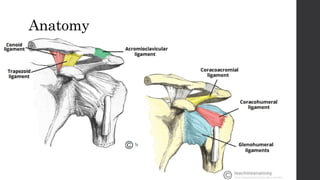
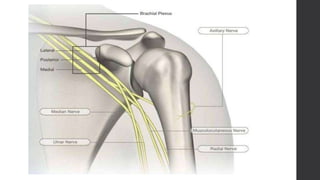
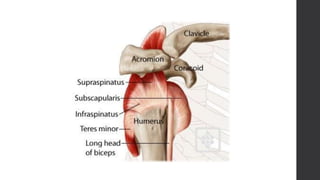
Anatomy
Anatomy
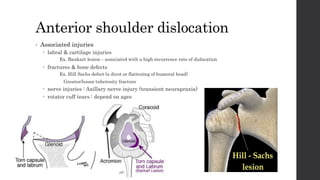
Anterior shoulder dislocation
• Associated injuries
 labral & cartilage injuries
Ex. Bankart lesion – associated with a high recurrence rate of dislocation
 fractures & bone defects
Ex. Hill Sachs defect (a divot or flattening of humeral head)
Greater/lessor tuberosity fracture
 nerve injuries : Axillary nerve injury (transient neurapraxia)
 rotator cuff tears : depend on ages
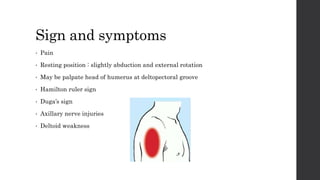
Sign and symptoms
• Pain
• Resting position : slightly abduction and external rotation
• May be palpate head of humerus at deltopectoral groove
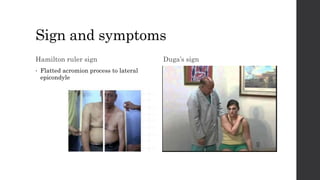
• Hamilton ruler sign
• Duga’s sign
• Axillary nerve injuries
• Deltoid weakness
Sign and symptoms
Hamilton ruler sign
• Flatted acromion process to lateral
epicondyle
Duga’s sign
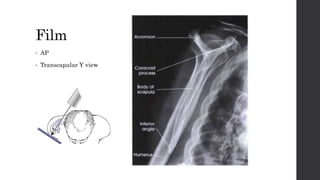
Film
• AP
• Transcapular Y view
Management
• Early reduction (control pain / under GA)
• Interlocking sling
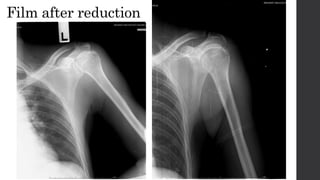
• Film after reduction
• Rehabilitation
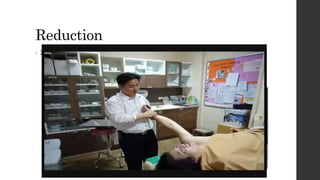
Reduction
• Hippocrates
• Stimson
• Milch
Reduction
• Zero position
 Abduction 165 degree, forward flexion 45 degree, medial epicondyle on anterior
 Traction on humeral shaft axis
 Abduction with flexion
Reduction
• Traction and counter traction
Film after reduction
Operative
• Failed closed reduction
• Soft tissue interposition
• Greater tuberosity fracture displaces > 1 cm.
Interlocking sling
• Age <45 : On interlocking sling 1-3 weeks
• Age >45 : until pain relieve, early ROM exercise
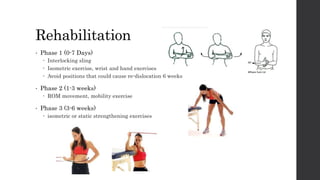
Rehabilitation
• Phase 1 (0-7 Days)
 Interlocking sling
 Isometric exercise, wrist and hand exercises
 Avoid positions that could cause re-dislocation 6 weeks
• Phase 2 (1-3 weeks)
 ROM movement, mobility exercise
• Phase 3 (3-6 weeks)
 isometric or static strengthening exercises
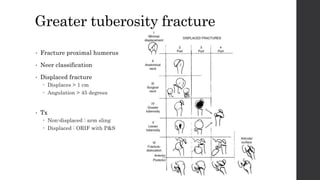
Greater tuberosity fracture
• Fracture proximal humerus
• Neer classification
• Displaced fracture
 Displaces > 1 cm
 Angulation > 45 degrees
• Tx
 Non-displaced : arm sling
 Displaced : ORIF with P&S
THANK YOU

Ant.shoulder dislocation

  • 1.
    Orthopedic case teleconference Ext. PatcharaPornsopanakorn Maharat Nakhonratchasima Hospital
  • 2.
    @ER ผู้ป่วยชายไทยอายุ 42 ปีอาชีพรับจ้าง ภูมิลาเนา จ.นครราชสีมา Chief complaint : เจ็บไหล่ซ้าย 1 ชั่วโมง PTA
  • 3.
    @ER ผู้ป่วยชายไทยอายุ 42 ปีอาชีพรับจ้าง ภูมิลาเนา จ.นครราชสีมา Chief complaint : เจ็บไหล่ซ้าย 1 ชั่วโมง PTA Present illness : 1 hr. PTA ขณะยกกระเบื้องส่งให้เพื่อนขึ้นกระบะ ได้ยินเสียงกึกบริเวณไหล่ หลังจาก นั้นรู้สึกเจ็บไหล่ซ้าย ยกขึ้นไม่ไหว ไม่มีปวดบริเวณอื่นๆ ไม่มีล้มหัวกระแทก ไม่เคย มีประวัติไหล่หลุดมาก่อน ปฏิเสธประวัติดื่มสุรา
  • 4.
    PRIMARY SURVEY  A: can speak, C-spine not tender  B : equal breat sound, CCT negative  C : BP 118/59 mmHg, PR 72 /min  D : E4V5M6, pupil 2 mm RTLBE  E : deformity at Lt. shoulder, tender, mild swelling, no external wound
  • 5.
    SECONDARY SURVEY • Allergy: no food/drug allergy • Medication : none • Past history : no U/D • Last meal : 4 hrPTA • Event : as in present illness
  • 6.
    Physical examination Ref :http://www.rhpphysiotherapy.com.au/blog/1343/
  • 7.
    Physical examination • GA: A Thai male, fully alert, well co-operative • V/S : BT 37.1 C, BP 118/59 mmHg, PR 72 /min, RR 18 /min • HEENT : no pale conjunctivae, anicteric sclerae • Skin : no external wound seen • Heart : normal S1 S2, no murmur • Lung : clear, equal breath sound both lungs • Abdomen : soft, not tender, normoactive bowel sound
  • 8.
    Physical examination • Extremities: deformity and tenderness at left shoulder, arm in abduction and external rotation while resting, humeral head can palpate at anterior of shoulder, limit ROM due to pain, ruler sign +, duga sign -, cap. Refill 2s • Neuro : motor power gr. V all extremities, sensory intact, reflex 2+ all
  • 9.
  • 10.
  • 11.
    Shoulder Dislocations • Definition: head of humerus loses its articulation with the glenoid cavity of the scapula • Classification  Anterior dislocation (98 percents)  Posterior dislocation (2 percents)  Inferior dislocation (very rare)
  • 12.
    Anterior shoulder dislocation •Mechanism : anteriorly directed force on the arm when the shoulder is abducted , extension and externally rotated
  • 13.
    Risk factors • Youngage • Male sex • Competitive level of sports • Contact sports • Excessive caosular laxity • Large gleno-humeral bone defects
  • 14.
  • 15.
  • 16.
  • 19.
    Anterior shoulder dislocation •Associated injuries  labral & cartilage injuries Ex. Bankart lesion – associated with a high recurrence rate of dislocation  fractures & bone defects Ex. Hill Sachs defect (a divot or flattening of humeral head) Greater/lessor tuberosity fracture  nerve injuries : Axillary nerve injury (transient neurapraxia)  rotator cuff tears : depend on ages
  • 20.
    Sign and symptoms •Pain • Resting position : slightly abduction and external rotation • May be palpate head of humerus at deltopectoral groove • Hamilton ruler sign • Duga’s sign • Axillary nerve injuries • Deltoid weakness
  • 21.
    Sign and symptoms Hamiltonruler sign • Flatted acromion process to lateral epicondyle Duga’s sign
  • 22.
  • 23.
    Management • Early reduction(control pain / under GA) • Interlocking sling • Film after reduction • Rehabilitation
  • 24.
  • 25.
    Reduction • Zero position Abduction 165 degree, forward flexion 45 degree, medial epicondyle on anterior  Traction on humeral shaft axis  Abduction with flexion
  • 26.
  • 27.
  • 28.
    Operative • Failed closedreduction • Soft tissue interposition • Greater tuberosity fracture displaces > 1 cm.
  • 29.
    Interlocking sling • Age<45 : On interlocking sling 1-3 weeks • Age >45 : until pain relieve, early ROM exercise
  • 30.
    Rehabilitation • Phase 1(0-7 Days)  Interlocking sling  Isometric exercise, wrist and hand exercises  Avoid positions that could cause re-dislocation 6 weeks • Phase 2 (1-3 weeks)  ROM movement, mobility exercise • Phase 3 (3-6 weeks)  isometric or static strengthening exercises
  • 31.
    Greater tuberosity fracture •Fracture proximal humerus • Neer classification • Displaced fracture  Displaces > 1 cm  Angulation > 45 degrees • Tx  Non-displaced : arm sling  Displaced : ORIF with P&S
  • 32.

Editor's Notes

  • #30 จัดให้แรงดึงกล้ามเนื้อรอบไหล่สมดุลกันทุกทิศทาง