Case Conference
EXT. SIRADA CHUTCHUKIATKUL
PHRAMONGKUTKLAO COLLEGE OF MEDICINE
Case
• ผู้ป่วยหญิง อายุ 66 ปี
• สัญชาติไทย ศาสนาพุทธ
• Chief complaint : ล้ม 2 ชั่วโมงก่นมาโรงพยาบาล
• Present illness : 2 ชม. ก่อนมารพ. ผู้ป่วยสะดุดล้ม ใช้มือ
ซ้ายยันพื้นขณะล้ม จากนั้นมีอาการปวดที่ข้อมือซ้าย กระดก
ข้อมือไม่ได้ จึงมารพ.
Primary survey
• A : can talk, not tender along C-spine
• B : Spontaneous breathing, equal and clear breath sound both
lungs, CCT negative
• C : BP 126/76 mmHg, PR 88 bpm, no external bleeding
• D : E4V5M6, Pupil 3 mm RTLBE
• E : Tender and swelling at radial side of left wrist, Limit ROM of left
wrist due to pain, cap refill < 2 sec, Radial artery 2+, Left fingers full
ROM
Secondary survey
• A : ปฏิเสธประวัติแพ้ยา แพ้อาหาร
• M : ปฏิเสธยาที่ใช้ประจำ
• P : ปฏิเสธประวัติโรคประจำตัว
• L : NPO 12.00 น
• E : สะดุดล้ม ใช้มือซ้ายยันพื้น เจ็บบริเวณข้อมือซ้าย ไม่มีส่วน
อื่นกระแทก
Physical examination
• GA : Good consciousness
• HEENT : Not pale conjunctivae, no facial deformity, full ROM of neck, not tender
along c-spine
• Heart : Pulse full and regular, Normal S1S2, No murmur
• Lungs: trachea in midline, equal chest movement, equal and clear breath sound
both lungs, CCT negative
• Abdomen, No distension, Soft, Not tender
• Extremities : Tender and swelling at radial side of left wrist, Limit ROM of left wrist due
to pain, cap refill < 2 sec, Radial artery 2+, Pinprick sensation intact, Left fingers full
ROM
• Neurological exam: E4V5M6, Pupil 3 mm RTLBE, Motor grade V all
Investigation
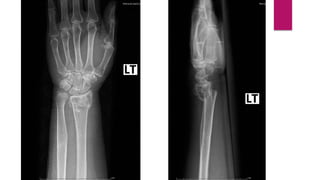
• Film Left wrist AP, Lateral
Diagnosis
• Left distal end radius fracture (Fernandez type I)
Management
• Sedation : MO 5 mg IV stat
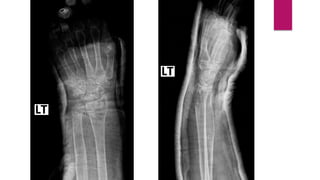
• Close reduction
• Short arm AP slab
Distal End Radius
Fracture
Distal end radius fracture
• Approximately 16% of all fractures treated by orthopaedic surgeons
• Three main peaks of fracture distribution:
• Children age 5-14
• Males under age 50 (High velocity)
• Females over the age of 40 years (Low velocity)
• Elderly (Mostly extra-articular)
• Young (Mostly intra-articular)
• Elderly patient risk factors : Decreased bone mineral density, female gender
and early menopause
Diagnosis
• History of mechanism of injury
• A visible deformity of the wrist is usually noted, with the hand most
commonly displaces in the dorsal direction.
• The acute shortening of the radius relative to the ulna may manifest as an
open wound palmarly and ulnarly where the intact ulna buttonholes
through the skin
• Movement of the hand and wrist are painful
• Adequate and accurate assessment of the neurovascular status of the
hand Is imperative. (Median nerve involvement – Carpal tunnel syndrome)
Diagnosis
• Evaluation of the injured joint, and a joint above and
below (ipsilateral elbow and shoulder joint)
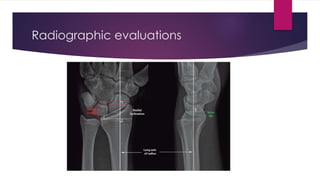
• Radiographs of the injured wrist (PA & Lateral)
• Radiographs of other areas, if symptoms warrant
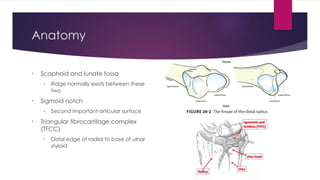
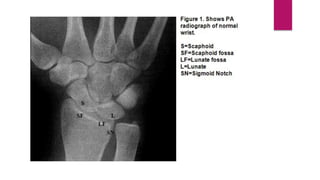
Anatomy
• Scaphoid and lunate fossa
• Ridge normally exists between these
two
• Sigmoid notch
• Second important articular surface
• Triangular fibrocartilage complex
(TFCC)
• Distal edge of radial to base of ulnar
styloid
Radiographic evaluations
Common Classifications
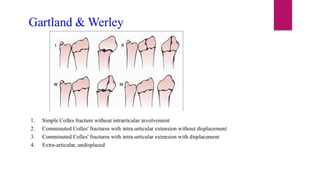
• Gartland & Werley
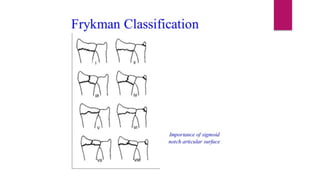
• Frykman (radiocarpal & radioulnar)
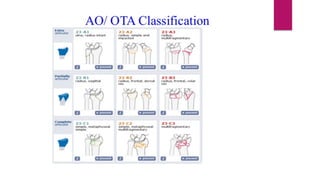
• AO
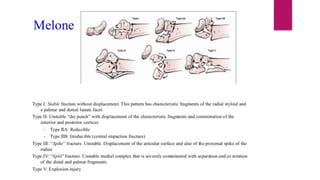
• Melone (impaction of lunate)
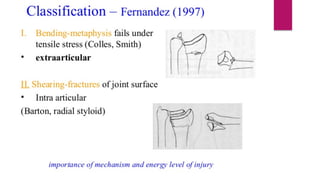
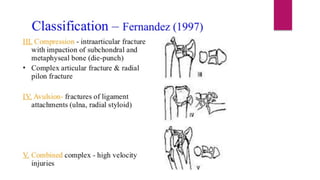
• Fernandez (mechanism)
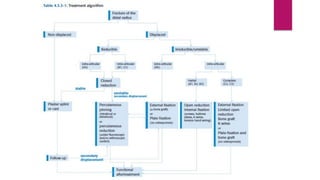
Treatment
• Non-operative
• Operative
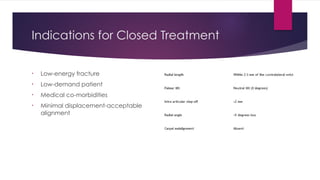
Indications for Closed Treatment
• Low-energy fracture
• Low-demand patient
• Medical co-morbidities
• Minimal displacement-acceptable
alignment
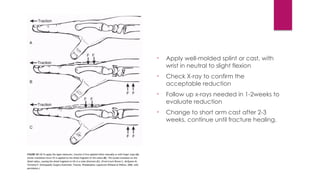
• Apply well-molded splint or cast, with
wrist in neutral to slight flexion
• Check X-ray to confirm the
acceptable reduction
• Follow up x-rays needed in 1-2weeks to
evaluate reduction
• Change to short arm cast after 2-3
weeks, continue until fracture healing.
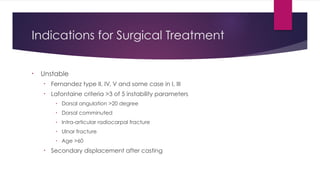
Indications for Surgical Treatment
• Unstable
• Fernandez type II, IV, V and some case in I, III
• Lafontaine criteria >3 of 5 instability parameters
• Dorsal angulation >20 degree
• Dorsal comminuted
• Intra-articular radiocarpal fracture
• Ulnar fracture
• Age >60
• Secondary displacement after casting
Indications for Surgical Treatment
• Irreducible fracture
• Double die punch
• Displaced comminuted PM fragment
• Articular step off > 2mm
• Severe comminution
• Shortening > 5mm
Indications for Surgical Treatment
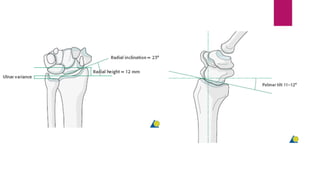
• Unacceptable alignment
• Radial inclination < 15 degree
• Shortening > 5 mm
• Dorsal tilt > 10 degree
• Volar tilt > 20 degree
• Articular step off or gap >2mm
• Open fracture
Indications for Surgical Treatment
• Associated injury
• Median Nerve Compression
• Distal Radioulnar Joint injury
• Carpal Ligament disruption
• Partial or complete tear scapholunate ligament
• Lunotriquetral ligaments tears 15%
THANK YOU

ConferenceExt.

  • 1.
    Case Conference EXT. SIRADACHUTCHUKIATKUL PHRAMONGKUTKLAO COLLEGE OF MEDICINE
  • 2.
    Case • ผู้ป่วยหญิง อายุ66 ปี • สัญชาติไทย ศาสนาพุทธ • Chief complaint : ล้ม 2 ชั่วโมงก่นมาโรงพยาบาล • Present illness : 2 ชม. ก่อนมารพ. ผู้ป่วยสะดุดล้ม ใช้มือ ซ้ายยันพื้นขณะล้ม จากนั้นมีอาการปวดที่ข้อมือซ้าย กระดก ข้อมือไม่ได้ จึงมารพ.
  • 3.
    Primary survey • A: can talk, not tender along C-spine • B : Spontaneous breathing, equal and clear breath sound both lungs, CCT negative • C : BP 126/76 mmHg, PR 88 bpm, no external bleeding • D : E4V5M6, Pupil 3 mm RTLBE • E : Tender and swelling at radial side of left wrist, Limit ROM of left wrist due to pain, cap refill < 2 sec, Radial artery 2+, Left fingers full ROM
  • 4.
    Secondary survey • A: ปฏิเสธประวัติแพ้ยา แพ้อาหาร • M : ปฏิเสธยาที่ใช้ประจำ • P : ปฏิเสธประวัติโรคประจำตัว • L : NPO 12.00 น • E : สะดุดล้ม ใช้มือซ้ายยันพื้น เจ็บบริเวณข้อมือซ้าย ไม่มีส่วน อื่นกระแทก
  • 5.
    Physical examination • GA: Good consciousness • HEENT : Not pale conjunctivae, no facial deformity, full ROM of neck, not tender along c-spine • Heart : Pulse full and regular, Normal S1S2, No murmur • Lungs: trachea in midline, equal chest movement, equal and clear breath sound both lungs, CCT negative • Abdomen, No distension, Soft, Not tender • Extremities : Tender and swelling at radial side of left wrist, Limit ROM of left wrist due to pain, cap refill < 2 sec, Radial artery 2+, Pinprick sensation intact, Left fingers full ROM • Neurological exam: E4V5M6, Pupil 3 mm RTLBE, Motor grade V all
  • 6.
    Investigation • Film Leftwrist AP, Lateral
  • 8.
    Diagnosis • Left distalend radius fracture (Fernandez type I)
  • 9.
    Management • Sedation :MO 5 mg IV stat • Close reduction • Short arm AP slab
  • 11.
  • 12.
    Distal end radiusfracture • Approximately 16% of all fractures treated by orthopaedic surgeons • Three main peaks of fracture distribution: • Children age 5-14 • Males under age 50 (High velocity) • Females over the age of 40 years (Low velocity) • Elderly (Mostly extra-articular) • Young (Mostly intra-articular) • Elderly patient risk factors : Decreased bone mineral density, female gender and early menopause
  • 13.
    Diagnosis • History ofmechanism of injury • A visible deformity of the wrist is usually noted, with the hand most commonly displaces in the dorsal direction. • The acute shortening of the radius relative to the ulna may manifest as an open wound palmarly and ulnarly where the intact ulna buttonholes through the skin • Movement of the hand and wrist are painful • Adequate and accurate assessment of the neurovascular status of the hand Is imperative. (Median nerve involvement – Carpal tunnel syndrome)
  • 14.
    Diagnosis • Evaluation ofthe injured joint, and a joint above and below (ipsilateral elbow and shoulder joint) • Radiographs of the injured wrist (PA & Lateral) • Radiographs of other areas, if symptoms warrant
  • 15.
    Anatomy • Scaphoid andlunate fossa • Ridge normally exists between these two • Sigmoid notch • Second important articular surface • Triangular fibrocartilage complex (TFCC) • Distal edge of radial to base of ulnar styloid
  • 17.
  • 19.
    Common Classifications • Gartland& Werley • Frykman (radiocarpal & radioulnar) • AO • Melone (impaction of lunate) • Fernandez (mechanism)
  • 26.
  • 28.
    Indications for ClosedTreatment • Low-energy fracture • Low-demand patient • Medical co-morbidities • Minimal displacement-acceptable alignment
  • 29.
    • Apply well-moldedsplint or cast, with wrist in neutral to slight flexion • Check X-ray to confirm the acceptable reduction • Follow up x-rays needed in 1-2weeks to evaluate reduction • Change to short arm cast after 2-3 weeks, continue until fracture healing.
  • 30.
    Indications for SurgicalTreatment • Unstable • Fernandez type II, IV, V and some case in I, III • Lafontaine criteria >3 of 5 instability parameters • Dorsal angulation >20 degree • Dorsal comminuted • Intra-articular radiocarpal fracture • Ulnar fracture • Age >60 • Secondary displacement after casting
  • 31.
    Indications for SurgicalTreatment • Irreducible fracture • Double die punch • Displaced comminuted PM fragment • Articular step off > 2mm • Severe comminution • Shortening > 5mm
  • 32.
    Indications for SurgicalTreatment • Unacceptable alignment • Radial inclination < 15 degree • Shortening > 5 mm • Dorsal tilt > 10 degree • Volar tilt > 20 degree • Articular step off or gap >2mm • Open fracture
  • 33.
    Indications for SurgicalTreatment • Associated injury • Median Nerve Compression • Distal Radioulnar Joint injury • Carpal Ligament disruption • Partial or complete tear scapholunate ligament • Lunotriquetral ligaments tears 15%
  • 34.