ORGANISATION
SUBSYSTEM
Lekshmi.S
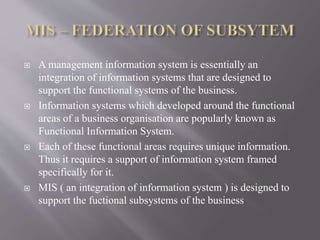
 A management information system is essentially an
integration of information systems that are designed to
support the functional systems of the business.
 Information systems which developed around the functional
areas of a business organisation are popularly known as
Functional Information System.
 Each of these functional areas requires unique information.
Thus it requires a support of information system framed
specifically for it.
 MIS ( an integration of information system ) is designed to
support the fuctional subsystems of the business
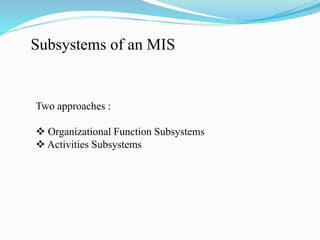
Subsystems of an MIS
Two approaches :
 Organizational Function Subsystems
 Activities Subsystems
Organizational Function
Subsystems
There may be common support system used by more than
one subsystem, but each functional system is unique in its
procedures,programs,models,etc.
 Production/Manufacturing
Marketing
 Personnel
 Logistics
 Finance & Accounting
 Information Processing
 Top Management
Activities Subsystems
 Transaction Processing – Processing of orders,
shipment and receipts.
 Operational Control – Scheduling of activities and
performance reports.
 Management Control – Formulation of budgets and
resource allocation.
 Strategic Planning – Formulation of objectives and
strategic plans.
System is the 3rd element of MIS.It is an inter related set
of elements that functions as a whole.
A system may be defined as a set of elements which are
joined together to achieve a common objective. The
elements are inter related and inter dependent.
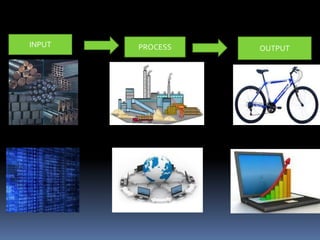
In an information system, data are input which is
processed to convert it into information. When feedback
and control elements are attatched to any system ( to
make it self – regulatory and self monitoring ), it is
known as Cybernetic System.
INPUT PROCESS OUTPUT
Open & Closed system
Super system & Sub system
Deterministic & Probabilistic System
Open & Closed System
A system which does not interact or exchange any
of its inputs or outputs with its environment.
Eg: A chemical reaction in a sealed , insulated
container.
A system which interacts with its environment and
exchanges inputs is called Open system.
Eg: Biological system (such as humans ) and
organizational systems.
Super system & Sub system
Some systems are part of a large system and they are
known as sub system. They are interactive and dependent
to each other. They work together to achieve a common
goal.
Eg: Human body – respiratory system, nervous system
Super system is a large and complex system. it may or
may not have a number of parts known as its subsystem.
Super system is always complex and difficult to
understand.
Eg: Education System
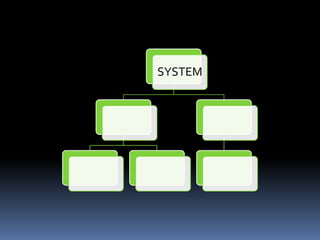
SYSTEM
Deterministic & Probabilistic System
A deterministic system is one in which the occurrence of all
the event is certain or it is a system which operates in
accordance with predefined set of rules. Every step and order
of their performance is known.
Eg: Billing System of a departmental store
A probabilistic system is one in which the occurrence of the
event cannot be perfectly predicted. The results of such system
cannot be pre-determined.
Eg: Examination system, Sales forecasting, Weather
forecasting.

Organization Sub System

  • 1.
  • 2.
     A managementinformation system is essentially an integration of information systems that are designed to support the functional systems of the business.  Information systems which developed around the functional areas of a business organisation are popularly known as Functional Information System.  Each of these functional areas requires unique information. Thus it requires a support of information system framed specifically for it.  MIS ( an integration of information system ) is designed to support the fuctional subsystems of the business
  • 3.
    Subsystems of anMIS Two approaches :  Organizational Function Subsystems  Activities Subsystems
  • 4.
    Organizational Function Subsystems There maybe common support system used by more than one subsystem, but each functional system is unique in its procedures,programs,models,etc.  Production/Manufacturing Marketing  Personnel  Logistics  Finance & Accounting  Information Processing  Top Management
  • 5.
    Activities Subsystems  TransactionProcessing – Processing of orders, shipment and receipts.  Operational Control – Scheduling of activities and performance reports.  Management Control – Formulation of budgets and resource allocation.  Strategic Planning – Formulation of objectives and strategic plans.
  • 6.
    System is the3rd element of MIS.It is an inter related set of elements that functions as a whole. A system may be defined as a set of elements which are joined together to achieve a common objective. The elements are inter related and inter dependent. In an information system, data are input which is processed to convert it into information. When feedback and control elements are attatched to any system ( to make it self – regulatory and self monitoring ), it is known as Cybernetic System.
  • 7.
  • 8.
    Open & Closedsystem Super system & Sub system Deterministic & Probabilistic System
  • 9.
    Open & ClosedSystem A system which does not interact or exchange any of its inputs or outputs with its environment. Eg: A chemical reaction in a sealed , insulated container. A system which interacts with its environment and exchanges inputs is called Open system. Eg: Biological system (such as humans ) and organizational systems.
  • 10.
    Super system &Sub system Some systems are part of a large system and they are known as sub system. They are interactive and dependent to each other. They work together to achieve a common goal. Eg: Human body – respiratory system, nervous system Super system is a large and complex system. it may or may not have a number of parts known as its subsystem. Super system is always complex and difficult to understand. Eg: Education System
  • 11.
  • 12.
    Deterministic & ProbabilisticSystem A deterministic system is one in which the occurrence of all the event is certain or it is a system which operates in accordance with predefined set of rules. Every step and order of their performance is known. Eg: Billing System of a departmental store A probabilistic system is one in which the occurrence of the event cannot be perfectly predicted. The results of such system cannot be pre-determined. Eg: Examination system, Sales forecasting, Weather forecasting.