Chapter 1
Data, Information
and System
System Analysis Design
Learning Goals
 Distinction between Data and Information
 Description of types of Information:
Tactical, Operational, Strategic, Statutory.
 Division of Management into different
hierarchical levels.
 Type of Information needed at different levels of
management.
 Division of organizations into several functional
areas and their information requirements
 Attributes of Information.
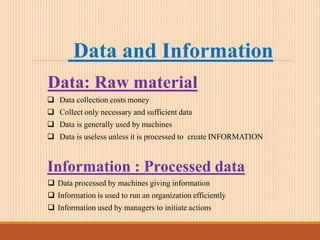
Data and Information
Data: Raw material
 Data collection costs money
 Collect only necessary and sufficient data
 Data is generally used by machines
 Data is useless unless it is processed to create INFORMATION
Information : Processed data
 Data processed by machines giving information
 Information is used to run an organization efficiently
 Information used by managers to initiate actions
Types of Information
 STRATEGIC : Needed for long range planning and directions. This is
less structured.
 TACTICAL : Needed to take short range decisions to improve
profitability and performance.
 OPERATIONAL : Needed for day to day operations of the organization.
Eg: Daily Sales, Billing.
 STATUTORY : Needed by law to sent to government authorities.
Eg: Sales tax return.
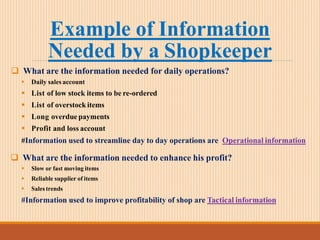
Example of Information
Needed by a Shopkeeper
 What are the information needed for daily operations?
 Daily sales account
 List of low stock items to be re-ordered
 List of overstock items
 Long overdue payments
 Profit and loss account
#Information used to streamline day to day operations are Operational information
 What are the information needed to enhance his profit?
 Slow or fast moving items
 Reliable supplier of items
 Sales trends
#Information used to improve profitability of shop are Tactical information
Example of Information
Needed by a Shopkeeper
 What are the information needed to expand the business?
 Whether to stock different varieties of items
 Whether to diversify
 Whether to start a new branch in a different locality
 Whether to start an e-shop
#Information to expand business and explore new opportunities are
known as Strategic Information
What are the information related to tax/government?
 Income tax account
 Sales tax account
#Used to provide information to the government known as Statutory Information
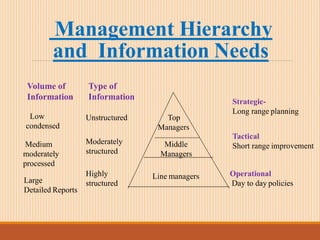
Management Hierarchy
and Information Needs
Volume of
Information
Type of
Information
Top
Managers
Middle
Managers
Line managers
Strategic-
Long range planning
Tactical
Short range improvement
Operational
Unstructured
Moderately
structured
Highly
structured Day to day policies
Low
condensed
Medium
moderately
processed
Large
Detailed Reports
Need for Information Systems
 Increasing size of organizations thus data volume
increases
 Timely processing for fast action
 Better competitiveness with better information
 Increasing of complexity of organizations require
innovative processing
 Distributed organizations
 Same data can be processed in different ways
Management Structure
Marketing
manager
Human
Resource
manager
Finance
manager
Materials
manager
Production
manager
Chief Executive (Strategical)
(Tactical)
(Operational)
Line managers
Qualities of Information
Quality How to ensure quality
Accurate Ensure correct input and processing rules.
Complete Include all data.
Timely Give at right time
Trustworthy Do not hide unpleasant information.
Relevant Understand user needs.
Brief Summarize relevant information.
Up-to-date Include all data up to present time.
Significance Use attractive format & graphical charts.
System’s Concept and
Definition
Term system is derived from the Greek
word ‘Systema’ which means an organized
relationship among functioning units or
components.
A system is an orderly grouping of
interdependent components linked together
according to a plan to achieve a specific
objective.
Characteristics of a System
Organization(Order)
Interaction
Interdependence
Integration
Central Objective
Continued…
Organization
 It implies structure and order.
Interaction
 It refers to manner in which each component functions with other components
of the system.
Interdependence
 Units/parts are dependent on each other.
Integration
 The parts of a system work together within the system even though each part
performs a unique function.
Central Objective
 Objective may be real or stated. All the components work together to achieve
that particular objective.
Elements of a System
Outputs and Inputs
Processor
Control
Feedback
Environment
Boundaries and Interface
Continued…
Inputs and Outputs- Inputs are the elements that enter the system
for processing and output is the result of processing.
Processor- It is the element that involves the actual transformation
of input into output
Control- The control element guides the system.
Feedback- Output is compared against performance standards.
Environment- It is the supra system within which an organization
operates.
Boundaries and Interface- A system should be defined by its
limits.
Types of System
Physical or Abstract System
Physical – These are tangible entities that may be static or
dynamic in operation.
 For example- parts of a computer center are the desks, chairs etc.
that facilitate operation of the computer. They are static and a
programmed computer is dynamic.
Abstract System – These are conceptual or non physical
entities.
 For example- the abstract conceptualization of physical situations.
A model is a representation of a real or planned system. A model
is used to visualize relationships.
Deterministic or
Probabilistic System
Deterministic System – It operates in a predictable
manner and the interaction between parts is known
with certainty.
For example: Two molecules of hydrogen and one
molecule of oxygen makes water.
Probabilistic System – It shows probable behavior.
The exact output is not known.
For example: weather forecasting, mail delivery.
Open and Closed Systems
Open System – It has many interfaces with its
environment. It interacts across its boundaries, it
receives inputs from and delivers outputs to the outside
world. It must adapt to the changing demands of the
user.
Example: an open cup of coffee
Closed System – It is isolated from the environmental
influences. A completely closed system is rare.
Example:
-a cup of coffee with a lid on it,
- or a simple water bottle.
Characteristics of
Open Systems
Input from outside- Open systems are self adjusting
and self regulating. When functioning properly open
system reaches a steady state or equilibrium.
Entropy- Dynamic systems run down over time
resulting in loss of energy or entropy. Open systems
resist entropy by seeking new input or modifying the
processes to return to a steady state.
Continued…
Process, output and cycles- Open system produce
useful output and operate in cycles, following a
continuous flow path.
Differentiation- They have a tendency toward an
increasing specialization of functions and a greater
differentiation of their components. For example the
role of machines and people tend toward greater
specialization and greater interaction.
Equifinality - Goals are achieved through differing
courses of action and a variety of paths.
Formal and Informal
Information Systems
Formal Information System is based on the
organization represented by organization chart.
 The chart is a map of positions and their authority
relationships, indicated by boxes and connected by straight
lines.
Informal Information System is an employee
based system designed to meet personnel and
vocational needs and to help solve, work related
problems.
Varieties of Computer Based
Information System
Computer Based Information System relies on
computer for handling business applications.
Basically three types –
- Business Data Processing(BDP)
 Deals with operational information
- Management information system(MIS)
 Deals with tactical information
- Decision support system(DSS)
 Deals with strategic information
Business Data Processing
System
Enter data to be processed
Edit, check input data
Control check to see if the data is
correct and reasonable
Store clean data as an organized data base in a
storage
Some Examples
Some Examples of BDP:
Payroll systems
Order processing systems
Reservation systems
Stock control systems
Systems for payments and funds transfers
Business Data Processing
There are 2 methods of business data processing
 On-line transaction processing(OLTP)
 Batch processing
OLTP: is used for query processing and rapid actions to requests.
 Example: Finding balance in one’s bank account Booking railway tickets
Batch processing: used for periodic data processing of massive data
 Example: Processing university exam results at the end of each semester
Payroll computation each month
Management Information
System
 Analyze outputs of routine data processing
using statistical or operations research tools
 Eg: -Observe periodic demands by statistical analysis
& use for tactical decisions
 Use operations research tools to decide product
mix using demand and cost data to maximize
profit
Some Examples
 Some Examples of MIS:
Sales management systems
Inventory control systems
Budgeting systems
Management Reporting Systems (MRS)
Personnel (HRM) systems
Decision Support System
Unstructured and difficult to obtain precise
information
Use of analytical and simulation models
Aids to conceptualize through graphs, animation etc.
Use of archival data to infer trends and rules
Some artificial intelligence tools may be used
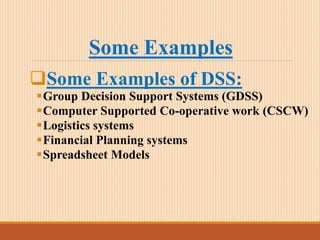
Some Examples
Some Examples of DSS:
Group Decision Support Systems (GDSS)
Computer Supported Co-operative work (CSCW)
Logistics systems
Financial Planning systems
Spreadsheet Models

system analysis and design, data, information and system

  • 1.
    Chapter 1 Data, Information andSystem System Analysis Design
  • 2.
    Learning Goals  Distinctionbetween Data and Information  Description of types of Information: Tactical, Operational, Strategic, Statutory.  Division of Management into different hierarchical levels.  Type of Information needed at different levels of management.  Division of organizations into several functional areas and their information requirements  Attributes of Information.
  • 3.
    Data and Information Data:Raw material  Data collection costs money  Collect only necessary and sufficient data  Data is generally used by machines  Data is useless unless it is processed to create INFORMATION Information : Processed data  Data processed by machines giving information  Information is used to run an organization efficiently  Information used by managers to initiate actions
  • 4.
    Types of Information STRATEGIC : Needed for long range planning and directions. This is less structured.  TACTICAL : Needed to take short range decisions to improve profitability and performance.  OPERATIONAL : Needed for day to day operations of the organization. Eg: Daily Sales, Billing.  STATUTORY : Needed by law to sent to government authorities. Eg: Sales tax return.
  • 5.
    Example of Information Neededby a Shopkeeper  What are the information needed for daily operations?  Daily sales account  List of low stock items to be re-ordered  List of overstock items  Long overdue payments  Profit and loss account #Information used to streamline day to day operations are Operational information  What are the information needed to enhance his profit?  Slow or fast moving items  Reliable supplier of items  Sales trends #Information used to improve profitability of shop are Tactical information
  • 6.
    Example of Information Neededby a Shopkeeper  What are the information needed to expand the business?  Whether to stock different varieties of items  Whether to diversify  Whether to start a new branch in a different locality  Whether to start an e-shop #Information to expand business and explore new opportunities are known as Strategic Information What are the information related to tax/government?  Income tax account  Sales tax account #Used to provide information to the government known as Statutory Information
  • 7.
    Management Hierarchy and InformationNeeds Volume of Information Type of Information Top Managers Middle Managers Line managers Strategic- Long range planning Tactical Short range improvement Operational Unstructured Moderately structured Highly structured Day to day policies Low condensed Medium moderately processed Large Detailed Reports
  • 8.
    Need for InformationSystems  Increasing size of organizations thus data volume increases  Timely processing for fast action  Better competitiveness with better information  Increasing of complexity of organizations require innovative processing  Distributed organizations  Same data can be processed in different ways
  • 9.
  • 10.
    Qualities of Information QualityHow to ensure quality Accurate Ensure correct input and processing rules. Complete Include all data. Timely Give at right time Trustworthy Do not hide unpleasant information. Relevant Understand user needs. Brief Summarize relevant information. Up-to-date Include all data up to present time. Significance Use attractive format & graphical charts.
  • 11.
    System’s Concept and Definition Termsystem is derived from the Greek word ‘Systema’ which means an organized relationship among functioning units or components. A system is an orderly grouping of interdependent components linked together according to a plan to achieve a specific objective.
  • 12.
    Characteristics of aSystem Organization(Order) Interaction Interdependence Integration Central Objective
  • 13.
    Continued… Organization  It impliesstructure and order. Interaction  It refers to manner in which each component functions with other components of the system. Interdependence  Units/parts are dependent on each other. Integration  The parts of a system work together within the system even though each part performs a unique function. Central Objective  Objective may be real or stated. All the components work together to achieve that particular objective.
  • 14.
    Elements of aSystem Outputs and Inputs Processor Control Feedback Environment Boundaries and Interface
  • 15.
    Continued… Inputs and Outputs-Inputs are the elements that enter the system for processing and output is the result of processing. Processor- It is the element that involves the actual transformation of input into output Control- The control element guides the system. Feedback- Output is compared against performance standards. Environment- It is the supra system within which an organization operates. Boundaries and Interface- A system should be defined by its limits.
  • 16.
    Types of System Physicalor Abstract System Physical – These are tangible entities that may be static or dynamic in operation.  For example- parts of a computer center are the desks, chairs etc. that facilitate operation of the computer. They are static and a programmed computer is dynamic. Abstract System – These are conceptual or non physical entities.  For example- the abstract conceptualization of physical situations. A model is a representation of a real or planned system. A model is used to visualize relationships.
  • 17.
    Deterministic or Probabilistic System DeterministicSystem – It operates in a predictable manner and the interaction between parts is known with certainty. For example: Two molecules of hydrogen and one molecule of oxygen makes water. Probabilistic System – It shows probable behavior. The exact output is not known. For example: weather forecasting, mail delivery.
  • 18.
    Open and ClosedSystems Open System – It has many interfaces with its environment. It interacts across its boundaries, it receives inputs from and delivers outputs to the outside world. It must adapt to the changing demands of the user. Example: an open cup of coffee Closed System – It is isolated from the environmental influences. A completely closed system is rare. Example: -a cup of coffee with a lid on it, - or a simple water bottle.
  • 19.
    Characteristics of Open Systems Inputfrom outside- Open systems are self adjusting and self regulating. When functioning properly open system reaches a steady state or equilibrium. Entropy- Dynamic systems run down over time resulting in loss of energy or entropy. Open systems resist entropy by seeking new input or modifying the processes to return to a steady state.
  • 20.
    Continued… Process, output andcycles- Open system produce useful output and operate in cycles, following a continuous flow path. Differentiation- They have a tendency toward an increasing specialization of functions and a greater differentiation of their components. For example the role of machines and people tend toward greater specialization and greater interaction. Equifinality - Goals are achieved through differing courses of action and a variety of paths.
  • 21.
    Formal and Informal InformationSystems Formal Information System is based on the organization represented by organization chart.  The chart is a map of positions and their authority relationships, indicated by boxes and connected by straight lines. Informal Information System is an employee based system designed to meet personnel and vocational needs and to help solve, work related problems.
  • 22.
    Varieties of ComputerBased Information System Computer Based Information System relies on computer for handling business applications. Basically three types – - Business Data Processing(BDP)  Deals with operational information - Management information system(MIS)  Deals with tactical information - Decision support system(DSS)  Deals with strategic information
  • 23.
    Business Data Processing System Enterdata to be processed Edit, check input data Control check to see if the data is correct and reasonable Store clean data as an organized data base in a storage
  • 24.
    Some Examples Some Examplesof BDP: Payroll systems Order processing systems Reservation systems Stock control systems Systems for payments and funds transfers
  • 25.
    Business Data Processing Thereare 2 methods of business data processing  On-line transaction processing(OLTP)  Batch processing OLTP: is used for query processing and rapid actions to requests.  Example: Finding balance in one’s bank account Booking railway tickets Batch processing: used for periodic data processing of massive data  Example: Processing university exam results at the end of each semester Payroll computation each month
  • 26.
    Management Information System  Analyzeoutputs of routine data processing using statistical or operations research tools  Eg: -Observe periodic demands by statistical analysis & use for tactical decisions  Use operations research tools to decide product mix using demand and cost data to maximize profit
  • 27.
    Some Examples  SomeExamples of MIS: Sales management systems Inventory control systems Budgeting systems Management Reporting Systems (MRS) Personnel (HRM) systems
  • 28.
    Decision Support System Unstructuredand difficult to obtain precise information Use of analytical and simulation models Aids to conceptualize through graphs, animation etc. Use of archival data to infer trends and rules Some artificial intelligence tools may be used
  • 29.
    Some Examples Some Examplesof DSS: Group Decision Support Systems (GDSS) Computer Supported Co-operative work (CSCW) Logistics systems Financial Planning systems Spreadsheet Models