The Organizational System


      Organizational Structure
      Organizational Designs
What is Structure?
 The  degree of complexity, formalization and
  centralization in the organization.
 Complexity is the degree of vertical, horizontal
  and spatial differentiation in an organization
 Formalization is the degree to which jobs within
  the organization are standardized.
 Centralization is the degree to which decision
  making in concentrated at a single point in the
  organization
Classical View of Structure
 Division of Labour – Specialization; breaking
  jobs down into simple and repetitions tasks
 Unity of Command – a subordinate should have
  only one superior to whom he or she is directly
  responsible.
 Responsibility - an obligation to perform
 Line Authority – authority to direct the work of a
  subordinate
Classical View of Structure……

 Chain  of Command – the superior-subordinate
  authority chain that extends from the top of the
  organization to the lowest echelon
 Staff Authority – positions that support, assist
  and advise line managers
 Span of Control – the number of subordinates a
  manger can efficiently and effectively divert
 Departmentation: grouping of activities on some
  common basis
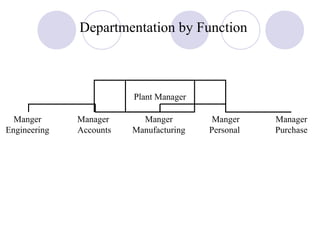
Departmentation by Function


                         Plant Manager

  Manger      Manager      Manger         Manger    Manager
Engineering   Accounts   Manufacturing   Personal   Purchase
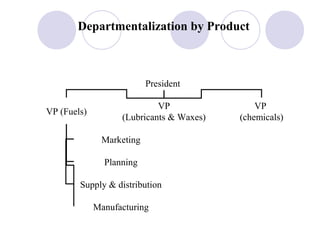
Departmentalization by Product


                          President

                            VP                VP
VP (Fuels)
                   (Lubricants & Waxes)   (chemicals)

              Marketing

               Planning

        Supply & distribution

             Manufacturing
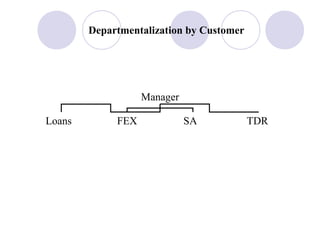
Departmentalization by Customer


                   Manager

Loans        FEX             SA           TDR
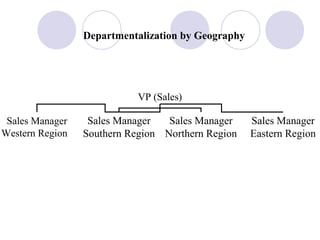
Departmentalization by Geography


                            VP (Sales)

 Sales Manager    Sales Manager   Sales Manager     Sales Manager
Western Region   Southern Region Northern Region    Eastern Region
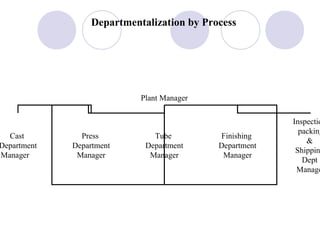
Departmentalization by Process


                            Plant Manager

                                                         Inspectio
                                                           packing
  Cast         Press           Tube         Finishing
                                                             &
Department   Department      Department     Department
                                                          Shippin
Manager       Manager         Manager        Manager
                                                            Dept
                                                          Manage
The coming of the New Organization

 Rapid and unexpected change
 Increasing diversity
 Change in managerial behaviour
 Adoption to computer technology
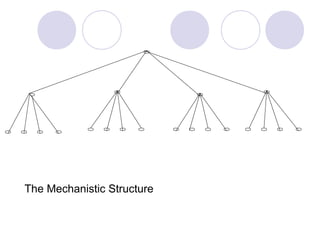
The Mechanistic Structure
The Mechanistic Structure……
 High horizontal differentiation
 Rigid hierarchical relationships
 Fixed duties
 High formalization
 Formalized communication channels
 Centralized decision authority
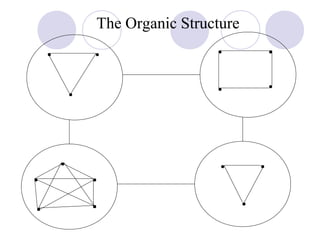
The Organic Structure
The Organic Structure…..

 Low  horizontal differentiation
 Collaboration (both horizontal and vertical)
 Adaptable duties
 Low formalization
 Informal communication
 Decentralized decision authority
Why do Structures Differ?
 Strategy
   Strategy             Structural Option
 Innovation   Organic: loose structures; low
              division of labour, low formalization,
              decentralized.
 Cost        Mechanistic: tight control; extensive
 minimizatio division of labour, high formalization,
 n           high centralization.
 Initiation   Mechanistic and Organic: mix of
              loose and tight properties; tight
              controls for current activities, loose
              controls for newer undertakings.
Why do Structures Differ?.....
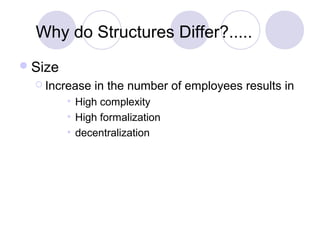
 Size
   Increase   in the number of employees results in
         • High complexity
         • High formalization
         • decentralization
Why do Structures Differ?....
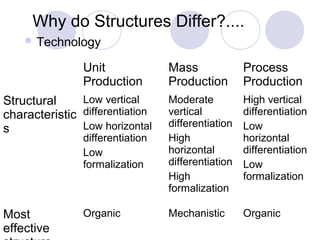
     Technology

                Unit              Mass              Process
                Production        Production        Production
Structural     Low vertical       Moderate          High vertical
characteristic differentiation    vertical          differentiation
               Low horizontal     differentiation   Low
s
                differentiation   High              horizontal
                Low               horizontal        differentiation
                formalization     differentiation   Low
                                  High              formalization
                                  formalization

Most            Organic           Mechanistic       Organic
effective
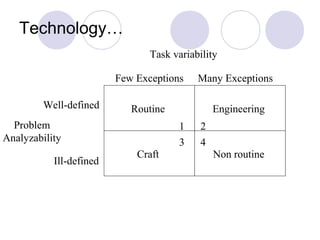
Technology…
                                Task variability

                         Few Exceptions    Many Exceptions

         Well-defined       Routine             Engineering
  Problem                             1     2
Analyzability                         3     4
                             Craft              Non routine
           Ill-defined
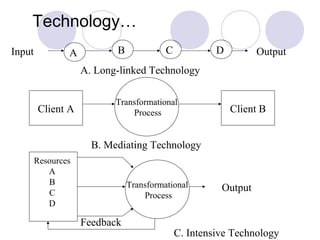
Technology…
Input           A          B             C            D         Output
                    A. Long-linked Technology

                           Transformational
        Client A               Process                    Client B


                      B. Mediating Technology
        Resources
           A
           B                   Transformational
           C
                                                       Output
                                   Process
           D

                    Feedback
                                             C. Intensive Technology
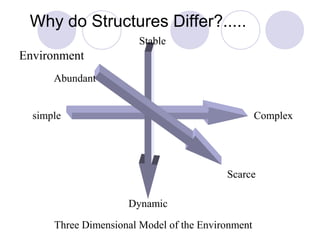
Why do Structures Differ?.....
                        Stable
Environment
      Abundant


  simple                                           Complex


                                          Scarce

                     Dynamic

      Three Dimensional Model of the Environment
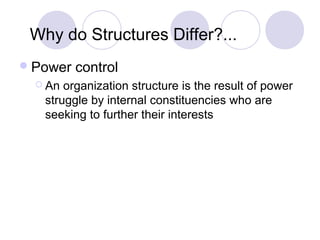
Why do Structures Differ?...
 Power   control
   An organization structure is the result of power
   struggle by internal constituencies who are
   seeking to further their interests
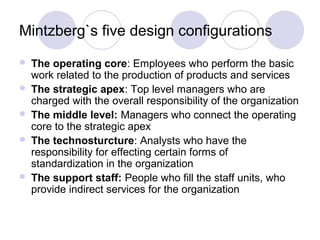
Mintzberg`s five design configurations
   The operating core: Employees who perform the basic
    work related to the production of products and services
   The strategic apex: Top level managers who are
    charged with the overall responsibility of the organization
   The middle level: Managers who connect the operating
    core to the strategic apex
   The technosturcture: Analysts who have the
    responsibility for effecting certain forms of
    standardization in the organization
   The support staff: People who fill the staff units, who
    provide indirect services for the organization
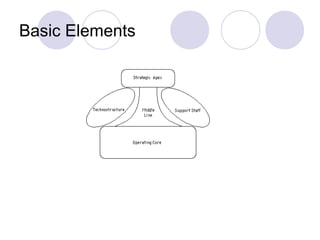
Basic Elements
Basic Subunits SubunitExample
positions from a manufacturing firm.
 Strategic Apex: Board of Directors, Chief
  Executive Officer
 Techno structure: Strategic Planning, Personnel
  Training, Operations Research, Systems
  Analysis and Design
 Support Staff: Legal Counsel, Public Relations,
  Payroll, Mailroom Clerks, Cafeteria Workers
 Middle Line: VP Operations, VP Marketing, Plant
  Managers Sales Managers
 Operating Core: Purchasing Agents, Machine
  Operators, Assemblers, Sales Persons,
  Shippers
The Simple Structure
 Low complexity
 Low formalization
 Centralized authority
The Machine Bureaucracy
 High in complexity, formalization and
  centralization
 Key part is technostructure
The Professional Bureaucracy
 Highin complexity, formalization
 Low centralization
The Divisional Structure
A set of autonomous units coordinated by
 central headquarters
The Adhocracy
A structure characterized as low in
 complexity, formalization centralization
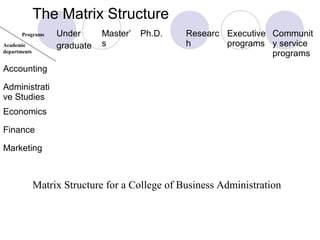
The Matrix Structure
       Programs    Under      Master’   Ph.D.    Researc Executive Communit
Academic           graduate   s                  h       programs y service
departments
                                                                   programs
Accounting

Administrati
ve Studies
Economics

Finance

Marketing


              Matrix Structure for a College of Business Administration

Structure

  • 1.
    The Organizational System  Organizational Structure  Organizational Designs
  • 2.
    What is Structure? The degree of complexity, formalization and centralization in the organization.  Complexity is the degree of vertical, horizontal and spatial differentiation in an organization  Formalization is the degree to which jobs within the organization are standardized.  Centralization is the degree to which decision making in concentrated at a single point in the organization
  • 3.
    Classical View ofStructure  Division of Labour – Specialization; breaking jobs down into simple and repetitions tasks  Unity of Command – a subordinate should have only one superior to whom he or she is directly responsible.  Responsibility - an obligation to perform  Line Authority – authority to direct the work of a subordinate
  • 4.
    Classical View ofStructure……  Chain of Command – the superior-subordinate authority chain that extends from the top of the organization to the lowest echelon  Staff Authority – positions that support, assist and advise line managers  Span of Control – the number of subordinates a manger can efficiently and effectively divert  Departmentation: grouping of activities on some common basis
  • 5.
    Departmentation by Function Plant Manager Manger Manager Manger Manger Manager Engineering Accounts Manufacturing Personal Purchase
  • 6.
    Departmentalization by Product President VP VP VP (Fuels) (Lubricants & Waxes) (chemicals) Marketing Planning Supply & distribution Manufacturing
  • 7.
    Departmentalization by Customer Manager Loans FEX SA TDR
  • 8.
    Departmentalization by Geography VP (Sales) Sales Manager Sales Manager Sales Manager Sales Manager Western Region Southern Region Northern Region Eastern Region
  • 9.
    Departmentalization by Process Plant Manager Inspectio packing Cast Press Tube Finishing & Department Department Department Department Shippin Manager Manager Manager Manager Dept Manage
  • 10.
    The coming ofthe New Organization  Rapid and unexpected change  Increasing diversity  Change in managerial behaviour  Adoption to computer technology
  • 11.
  • 12.
    The Mechanistic Structure…… High horizontal differentiation  Rigid hierarchical relationships  Fixed duties  High formalization  Formalized communication channels  Centralized decision authority
  • 13.
  • 14.
    The Organic Structure….. Low horizontal differentiation  Collaboration (both horizontal and vertical)  Adaptable duties  Low formalization  Informal communication  Decentralized decision authority
  • 15.
    Why do StructuresDiffer?  Strategy Strategy Structural Option Innovation Organic: loose structures; low division of labour, low formalization, decentralized. Cost Mechanistic: tight control; extensive minimizatio division of labour, high formalization, n high centralization. Initiation Mechanistic and Organic: mix of loose and tight properties; tight controls for current activities, loose controls for newer undertakings.
  • 16.
    Why do StructuresDiffer?.....  Size  Increase in the number of employees results in • High complexity • High formalization • decentralization
  • 17.
    Why do StructuresDiffer?....  Technology Unit Mass Process Production Production Production Structural Low vertical Moderate High vertical characteristic differentiation vertical differentiation Low horizontal differentiation Low s differentiation High horizontal Low horizontal differentiation formalization differentiation Low High formalization formalization Most Organic Mechanistic Organic effective
  • 18.
    Technology… Task variability Few Exceptions Many Exceptions Well-defined Routine Engineering Problem 1 2 Analyzability 3 4 Craft Non routine Ill-defined
  • 19.
    Technology… Input A B C D Output A. Long-linked Technology Transformational Client A Process Client B B. Mediating Technology Resources A B Transformational C Output Process D Feedback C. Intensive Technology
  • 20.
    Why do StructuresDiffer?..... Stable Environment Abundant simple Complex Scarce Dynamic Three Dimensional Model of the Environment
  • 21.
    Why do StructuresDiffer?...  Power control  An organization structure is the result of power struggle by internal constituencies who are seeking to further their interests
  • 22.
    Mintzberg`s five designconfigurations  The operating core: Employees who perform the basic work related to the production of products and services  The strategic apex: Top level managers who are charged with the overall responsibility of the organization  The middle level: Managers who connect the operating core to the strategic apex  The technosturcture: Analysts who have the responsibility for effecting certain forms of standardization in the organization  The support staff: People who fill the staff units, who provide indirect services for the organization
  • 23.
  • 24.
    Basic Subunits SubunitExample positionsfrom a manufacturing firm.  Strategic Apex: Board of Directors, Chief Executive Officer  Techno structure: Strategic Planning, Personnel Training, Operations Research, Systems Analysis and Design  Support Staff: Legal Counsel, Public Relations, Payroll, Mailroom Clerks, Cafeteria Workers  Middle Line: VP Operations, VP Marketing, Plant Managers Sales Managers  Operating Core: Purchasing Agents, Machine Operators, Assemblers, Sales Persons, Shippers
  • 25.
    The Simple Structure Low complexity  Low formalization  Centralized authority
  • 26.
    The Machine Bureaucracy High in complexity, formalization and centralization  Key part is technostructure
  • 27.
    The Professional Bureaucracy Highin complexity, formalization  Low centralization
  • 28.
    The Divisional Structure Aset of autonomous units coordinated by central headquarters
  • 29.
    The Adhocracy A structurecharacterized as low in complexity, formalization centralization
  • 30.
    The Matrix Structure Programs Under Master’ Ph.D. Researc Executive Communit Academic graduate s h programs y service departments programs Accounting Administrati ve Studies Economics Finance Marketing Matrix Structure for a College of Business Administration