what is a system?
A system is a collection on interrelated components
that work together to perform a specific task or
achieve a goal. In a system, the different
components are connected with each other and they
are interdependent. Each component is a subsystem
of the original system and carries out a part of the
system task.
Two Types of Systems
Natural Systems
Man Made Systems
Natural Systems





River Systems
Mountain Systems
Air Systems
Natural Systems
Eg.
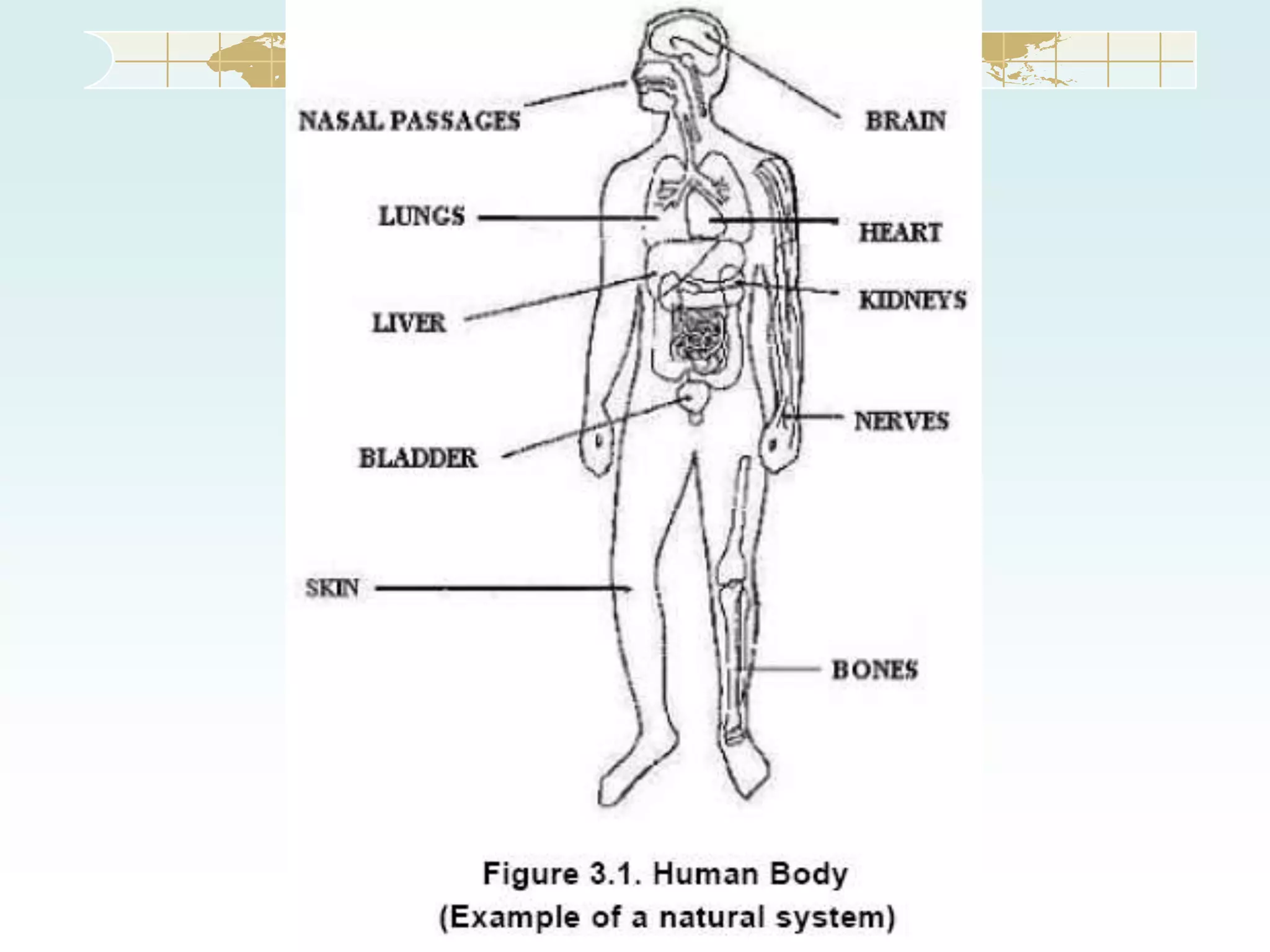
The human body represents a complete natural system. Our
human body contains complex muscle, bone, respiratory,
digestive and circulatory subsystems, each providing a specific
part of the system task.
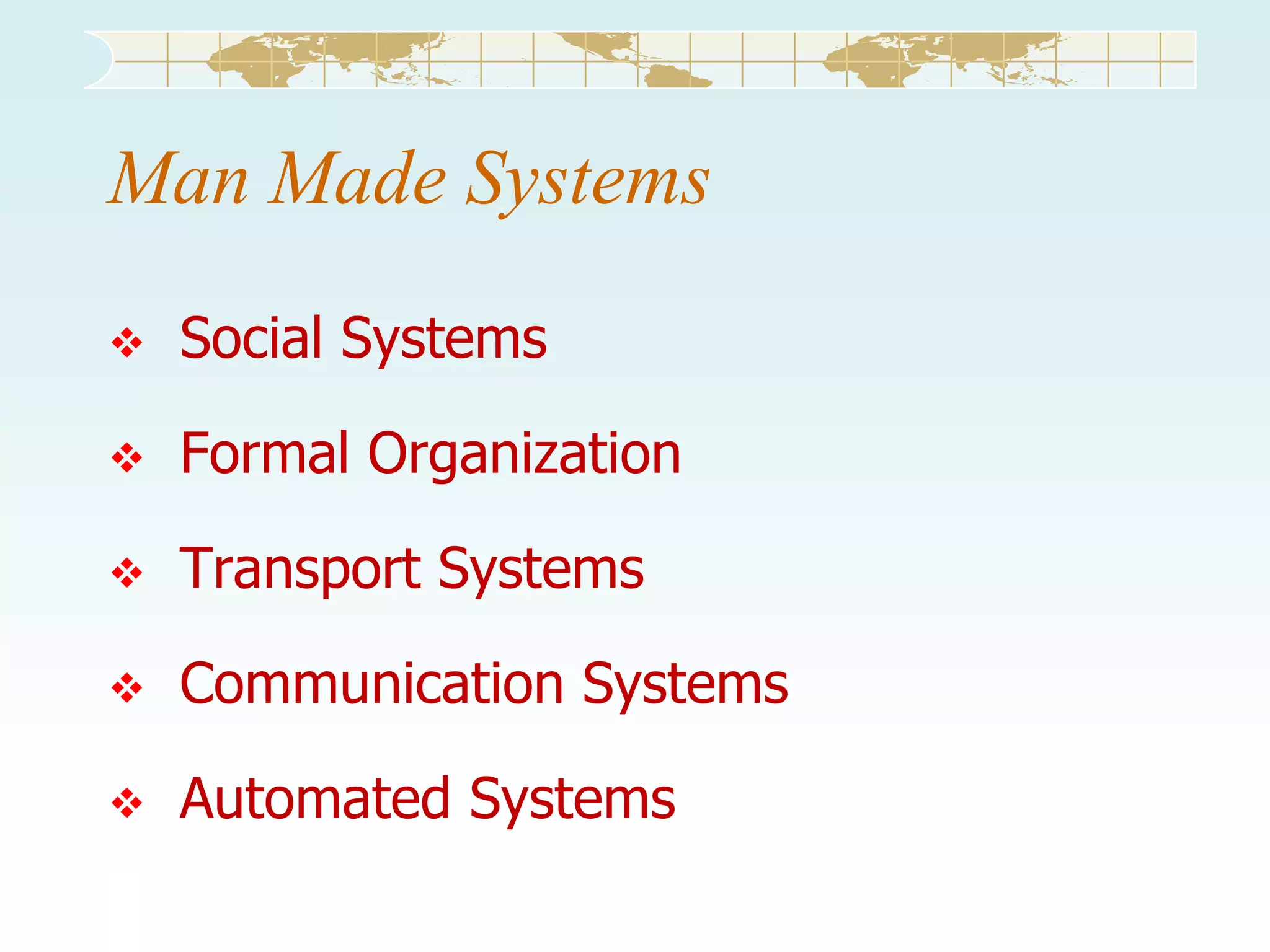
Man Made Systems


Social Systems



Formal Organization



Transport Systems



Communication Systems



Automated Systems
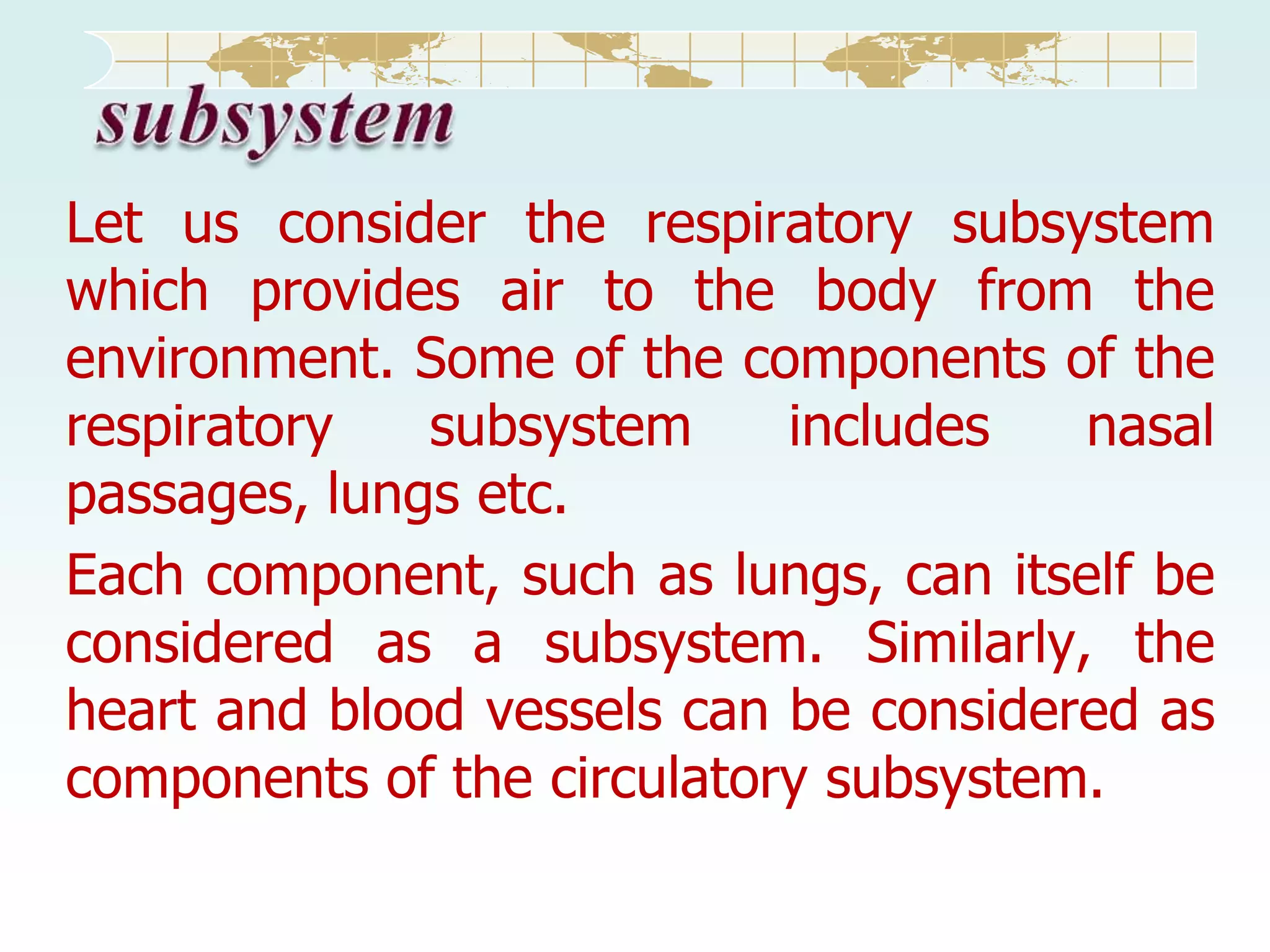
Let us consider the respiratory subsystem
which provides air to the body from the
environment. Some of the components of the
respiratory
subsystem
includes
nasal
passages, lungs etc.
Each component, such as lungs, can itself be
considered as a subsystem. Similarly, the
heart and blood vessels can be considered as
components of the circulatory subsystem.
What Is an Information System?
Data:
Streams of raw facts representing events such as
business transactions

Information:
Clusters of facts that are meaningful and useful to
human beings in the processes such as making
decisions
Computer-Based Information System (CBIS)
Rely on computer hardware and software
Processing and disseminating information
Formal Systems
Fixed definitions of data, procedures
Collecting, storing, processing,
disseminating, using data
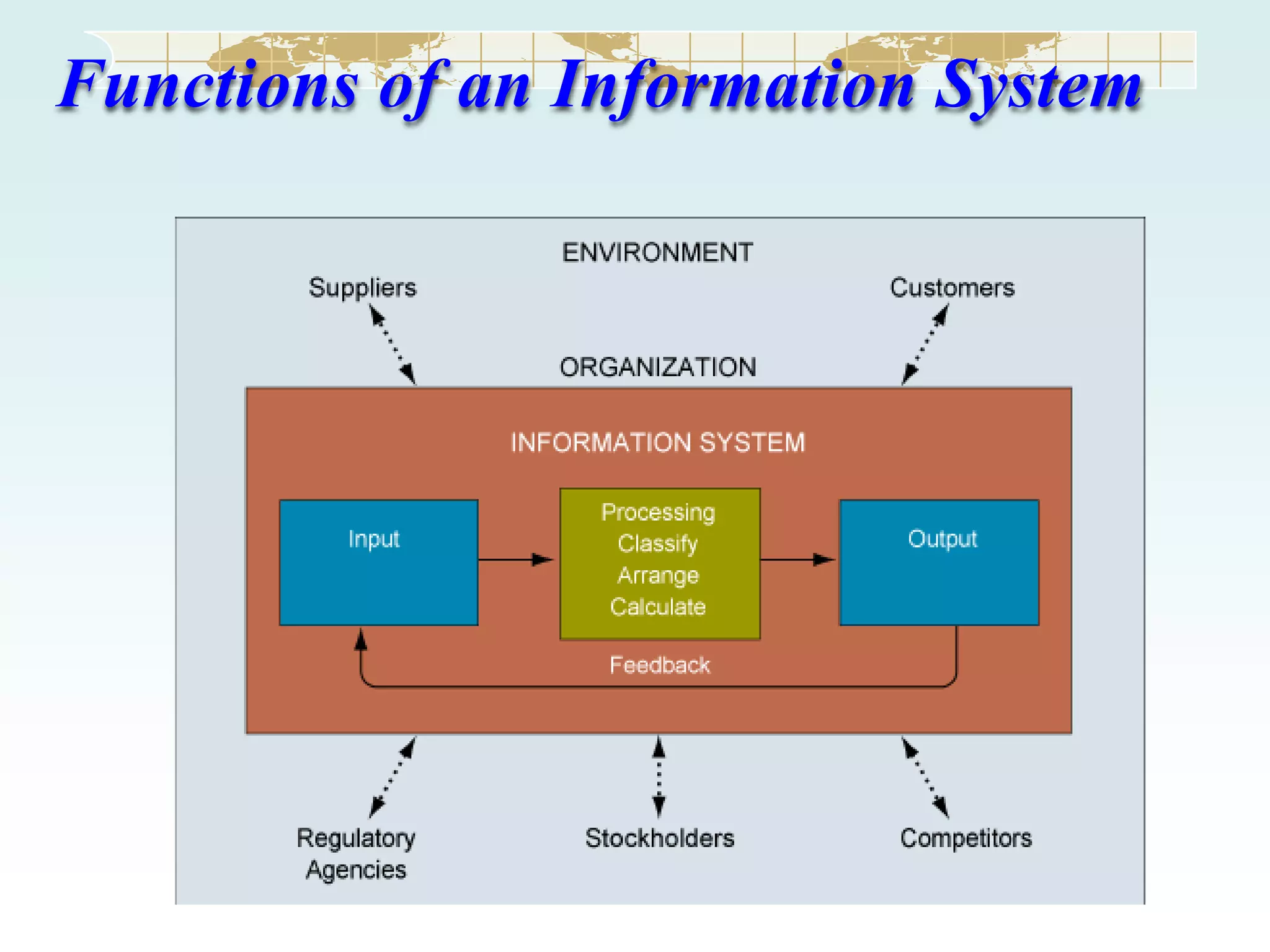
Functions of an Information System
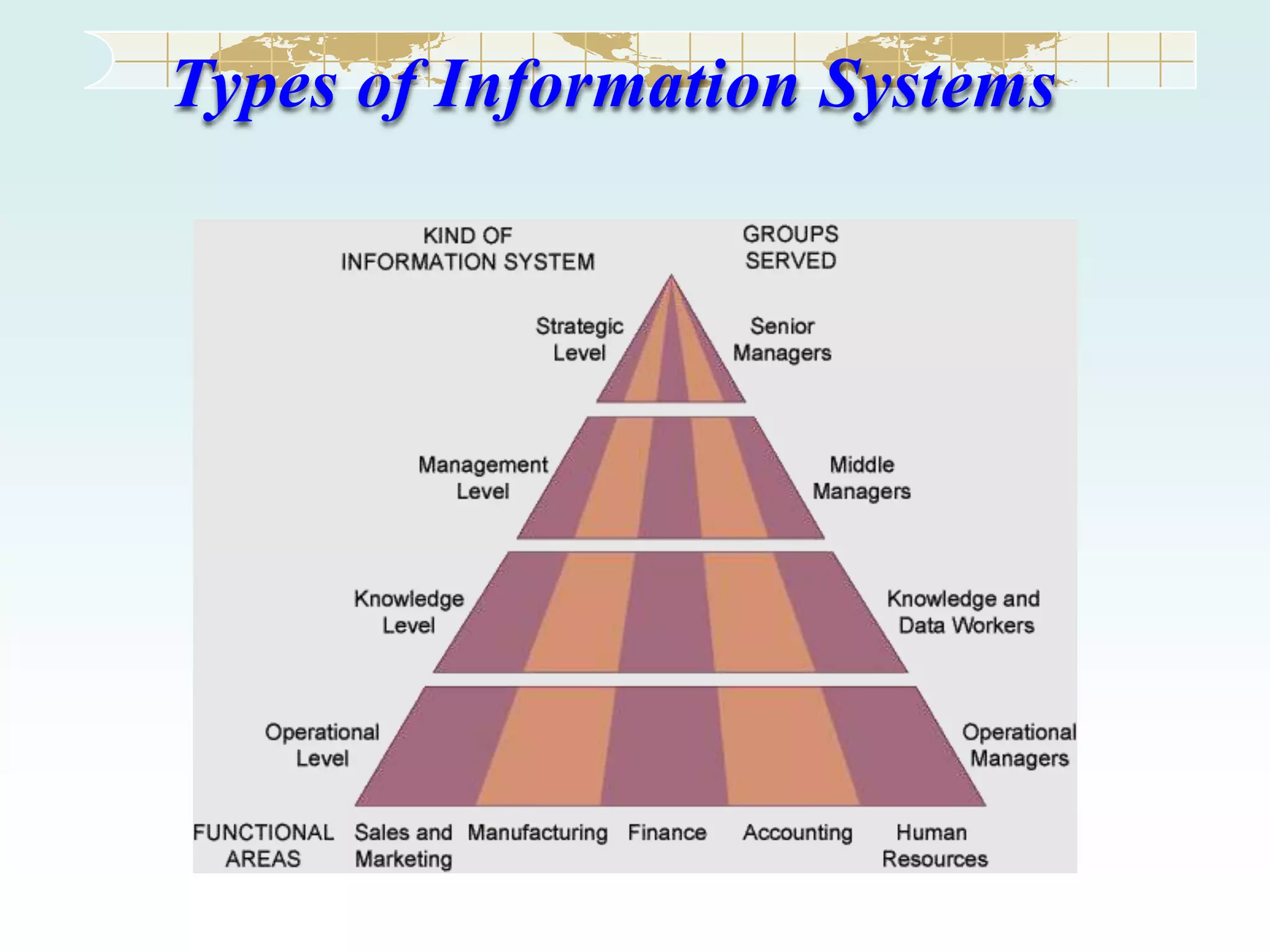
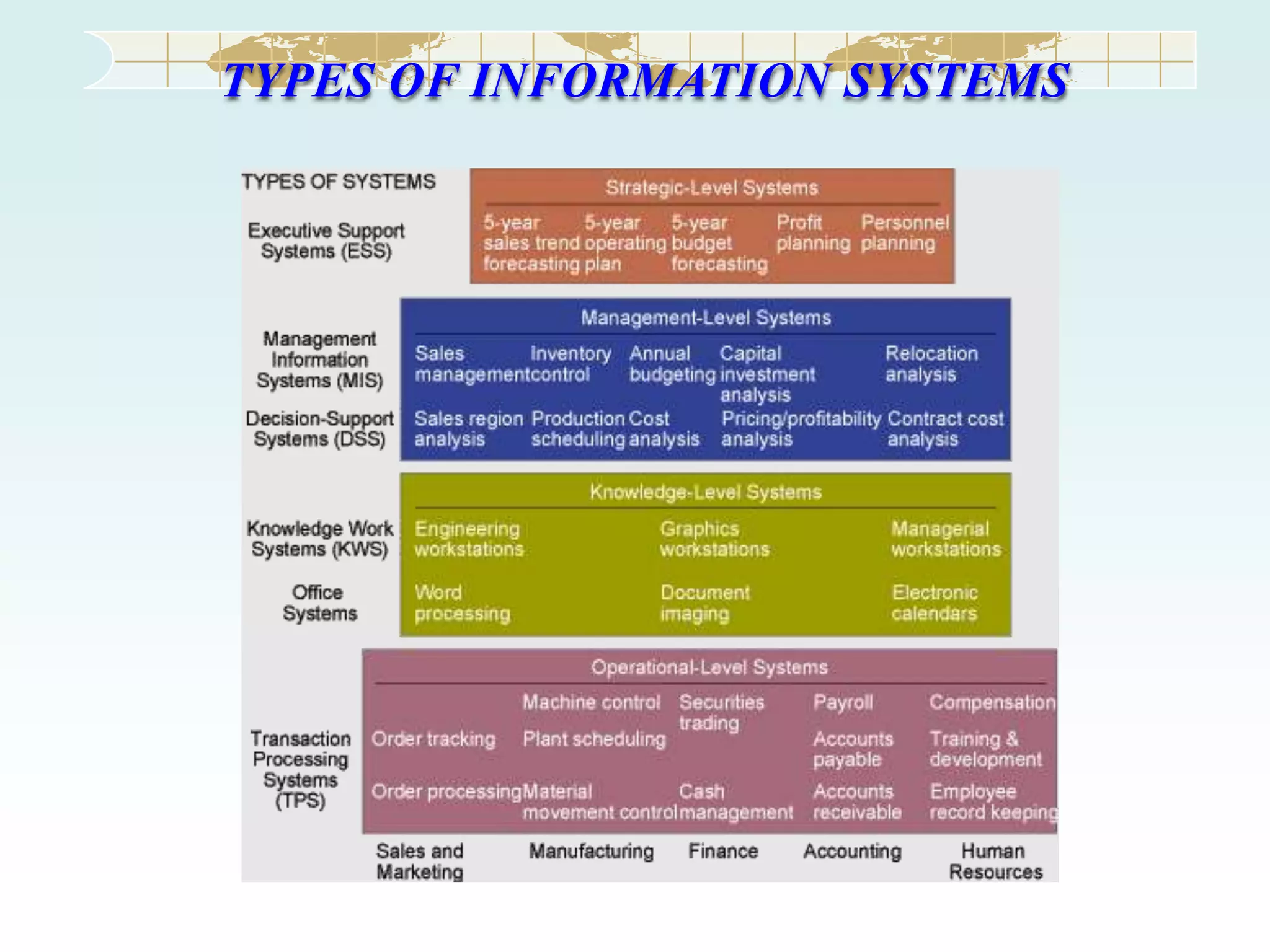
Types of Information Systems
TYPES OF INFORMATION SYSTEMS
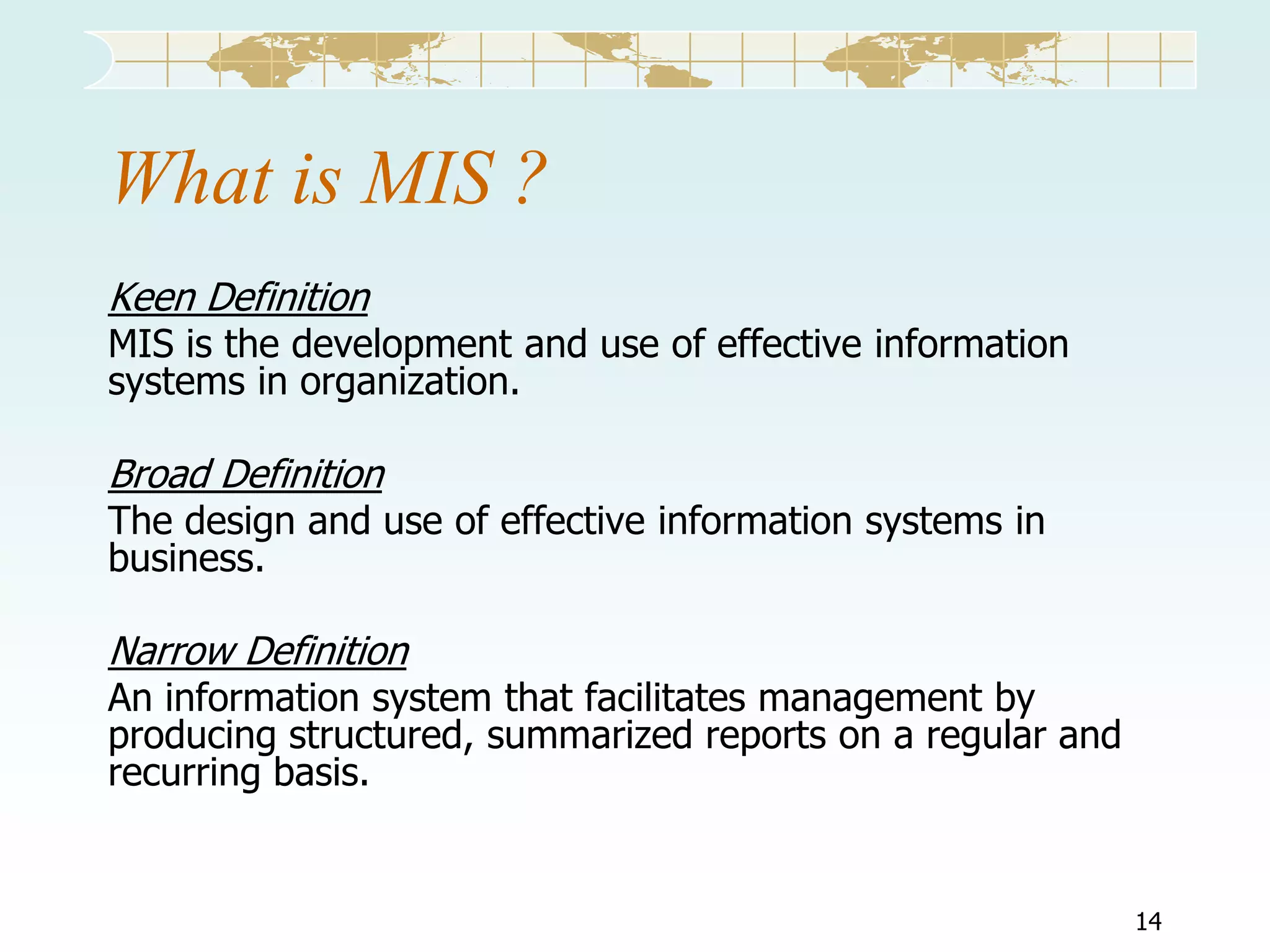
What is MIS ?
Keen Definition

MIS is the development and use of effective information
systems in organization.

Broad Definition

The design and use of effective information systems in
business.

Narrow Definition

An information system that facilitates management by
producing structured, summarized reports on a regular and
recurring basis.

14
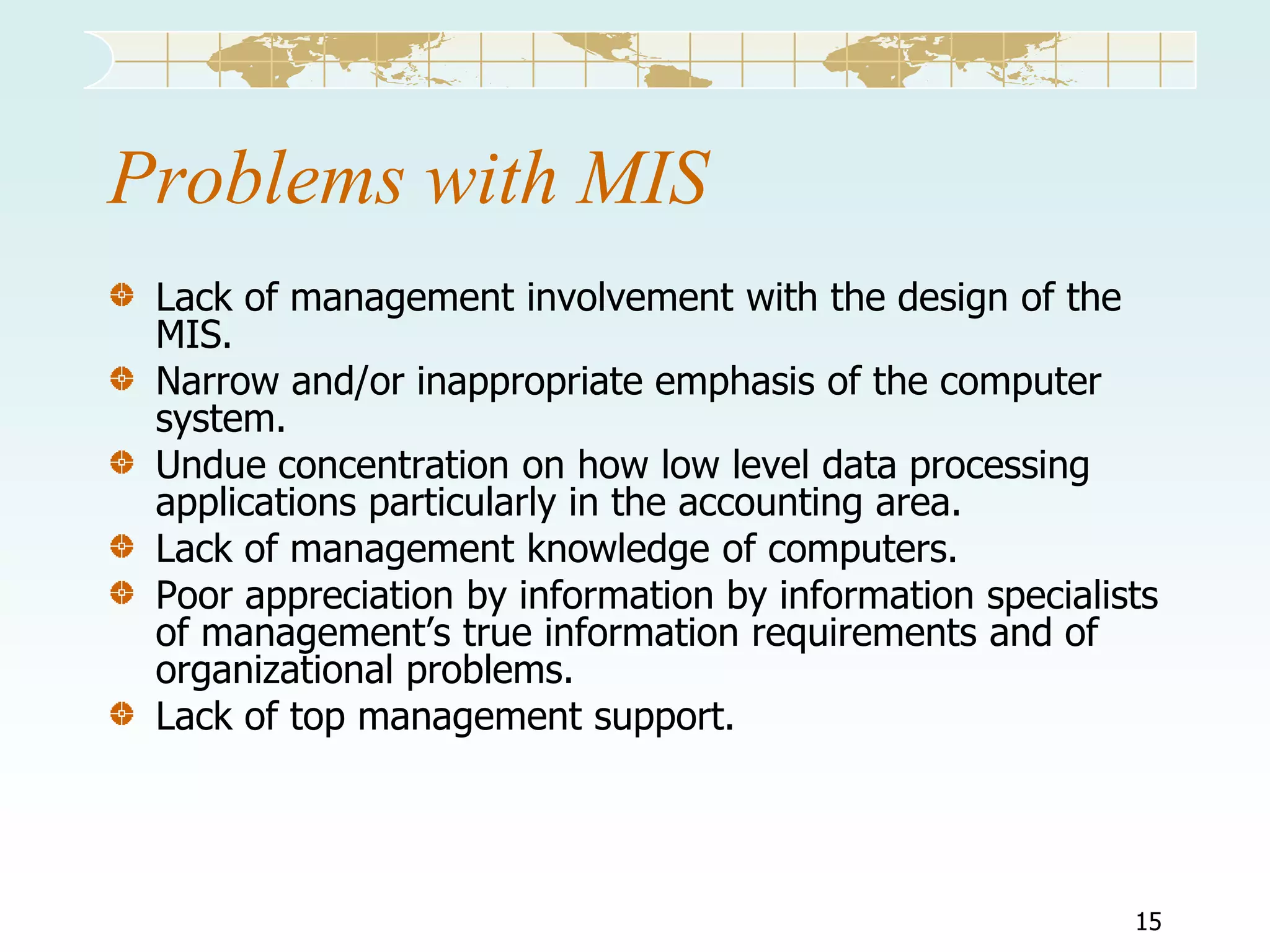
Problems with MIS
Lack of management involvement with the design of the
MIS.
Narrow and/or inappropriate emphasis of the computer
system.
Undue concentration on how low level data processing
applications particularly in the accounting area.
Lack of management knowledge of computers.
Poor appreciation by information by information specialists
of management’s true information requirements and of
organizational problems.
Lack of top management support.

15
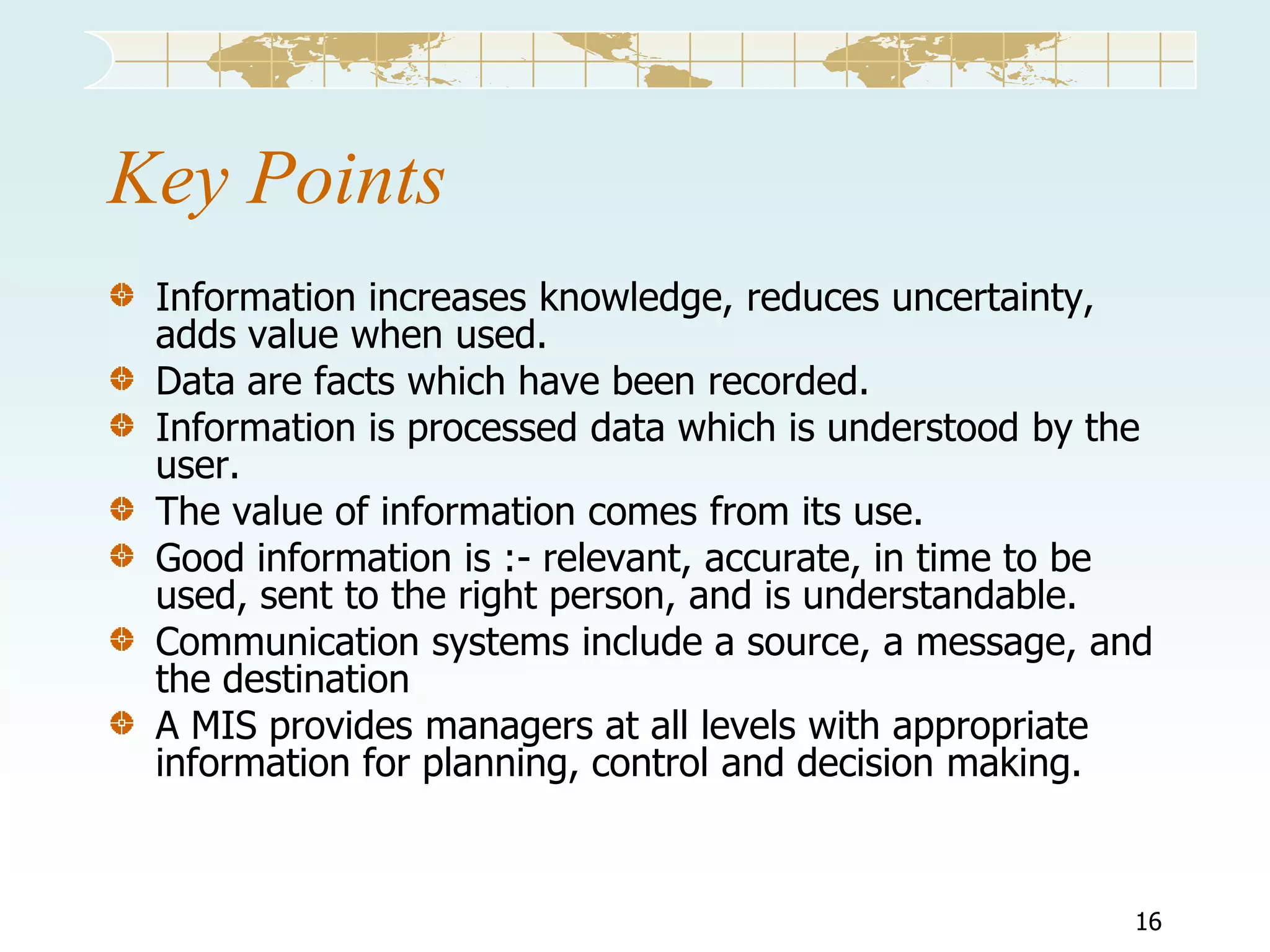
Key Points
Information increases knowledge, reduces uncertainty,
adds value when used.
Data are facts which have been recorded.
Information is processed data which is understood by the
user.
The value of information comes from its use.
Good information is :- relevant, accurate, in time to be
used, sent to the right person, and is understandable.
Communication systems include a source, a message, and
the destination
A MIS provides managers at all levels with appropriate
information for planning, control and decision making.

16
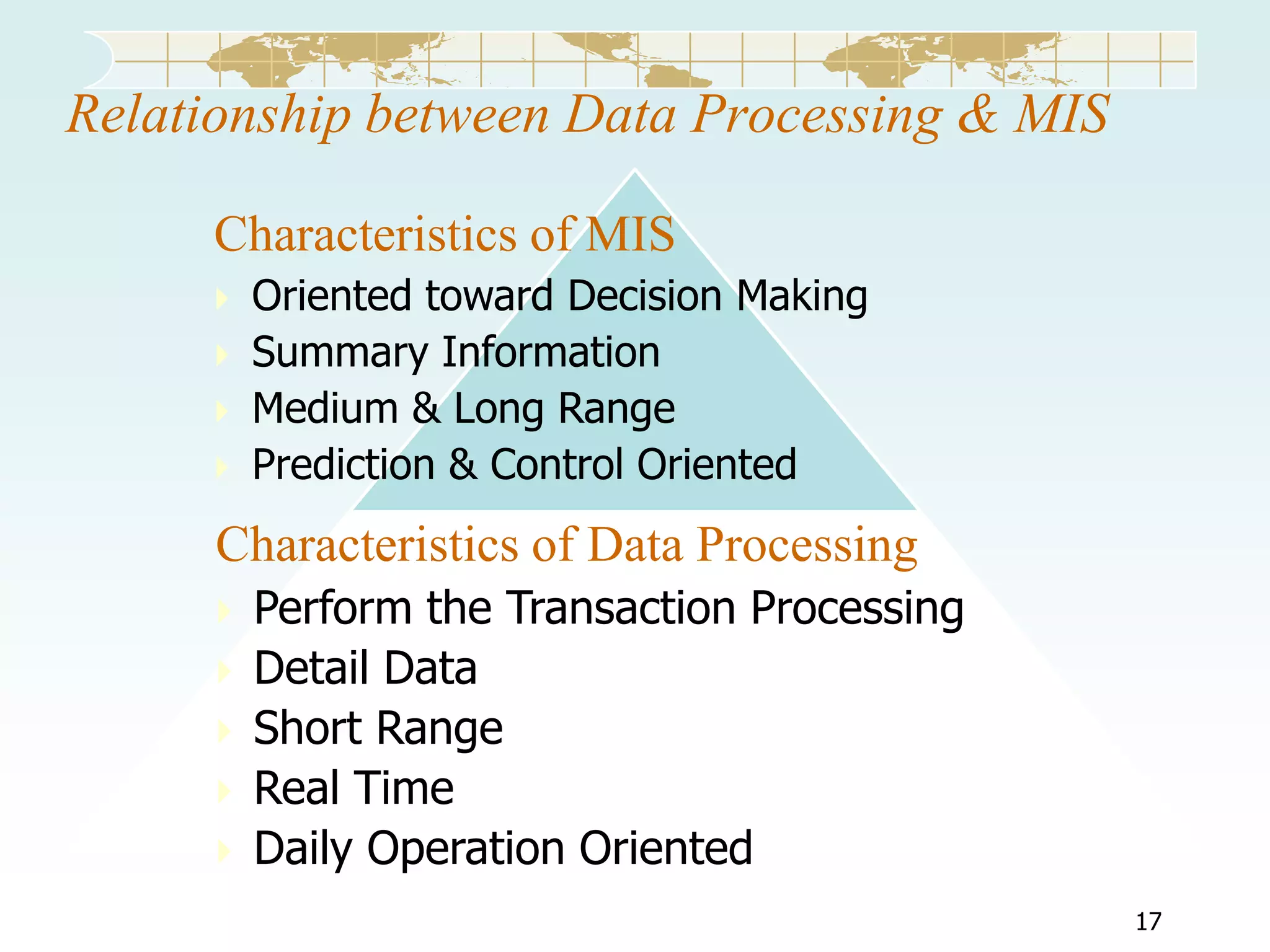
Relationship between Data Processing & MIS
Characteristics of MIS





Oriented toward Decision Making
Summary Information
Medium & Long Range
Prediction & Control Oriented

Characteristics of Data Processing







Perform the Transaction Processing
Detail Data
Short Range
Real Time
Daily Operation Oriented
17
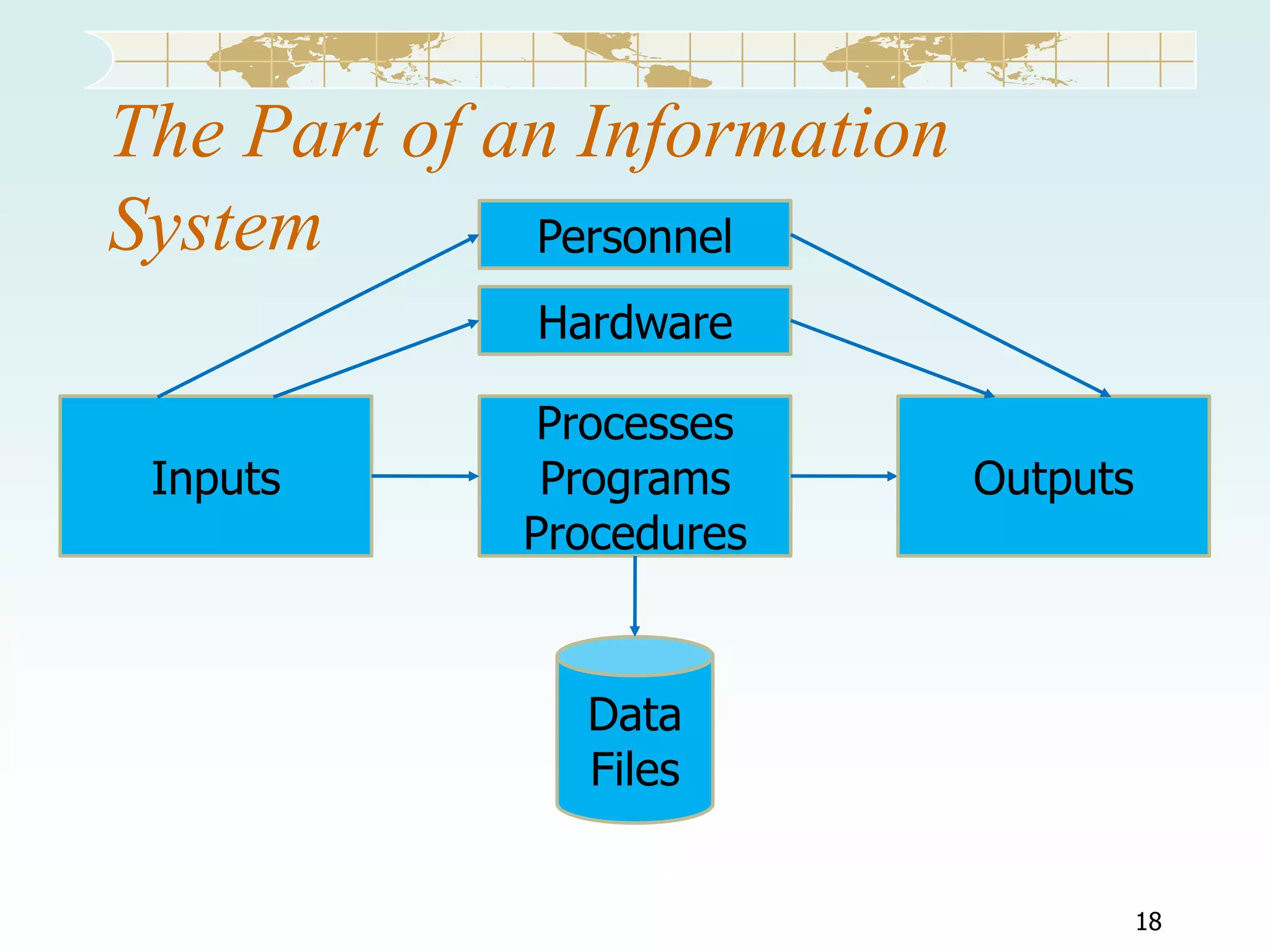
The Part of an Information
System
Personnel
Hardware
Inputs

Processes
Programs
Procedures

Outputs

Data
Files
18
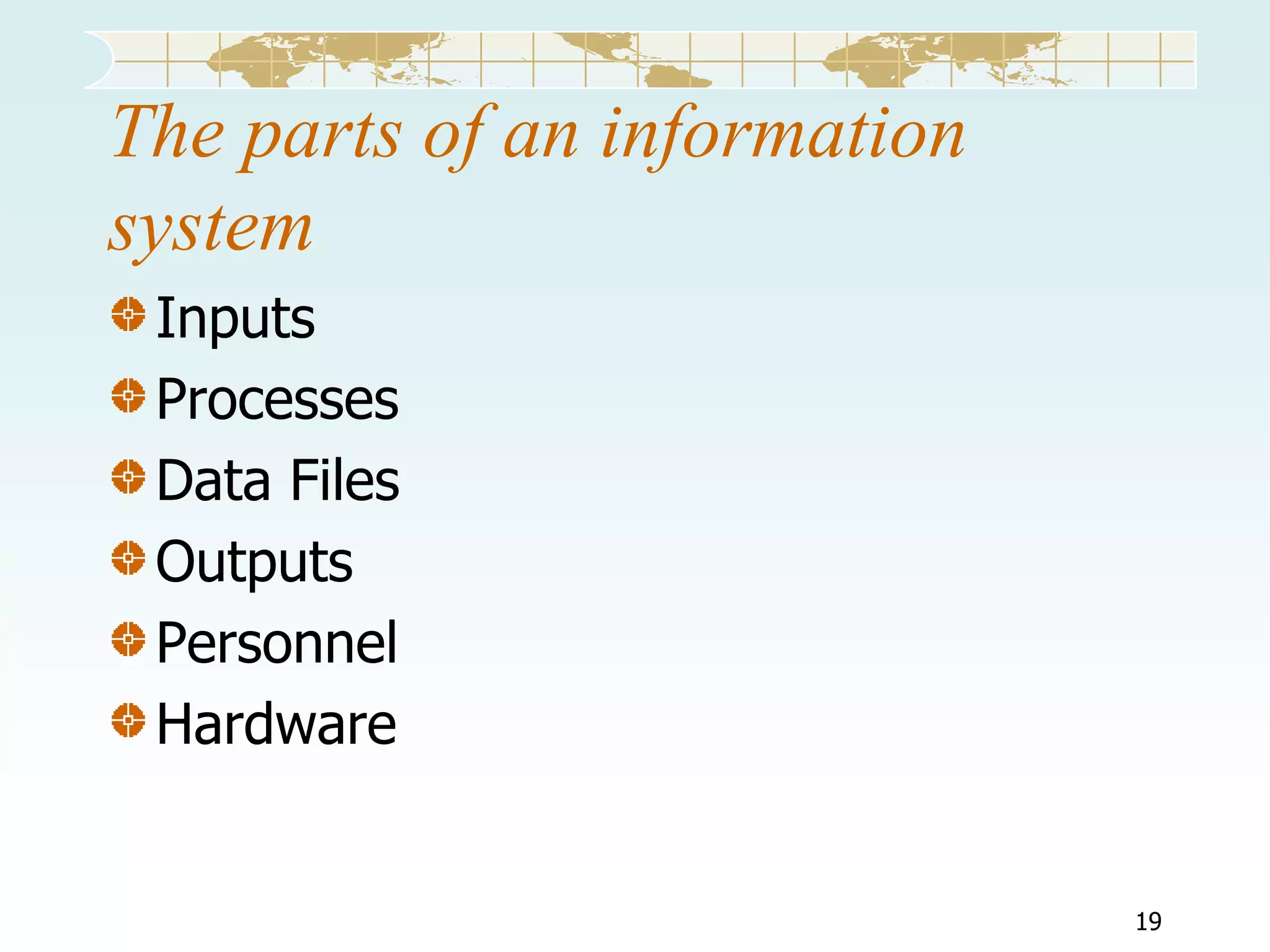
The parts of an information
system
Inputs
Processes
Data Files
Outputs
Personnel
Hardware

19
Systems
Named collection of processors tat satisfy
some functional need of the business.
Combination of manual and computer
processors.
Will take into account the needs of many
functional areas.
Considers the day-to-day and management
information needs of the organization.
20
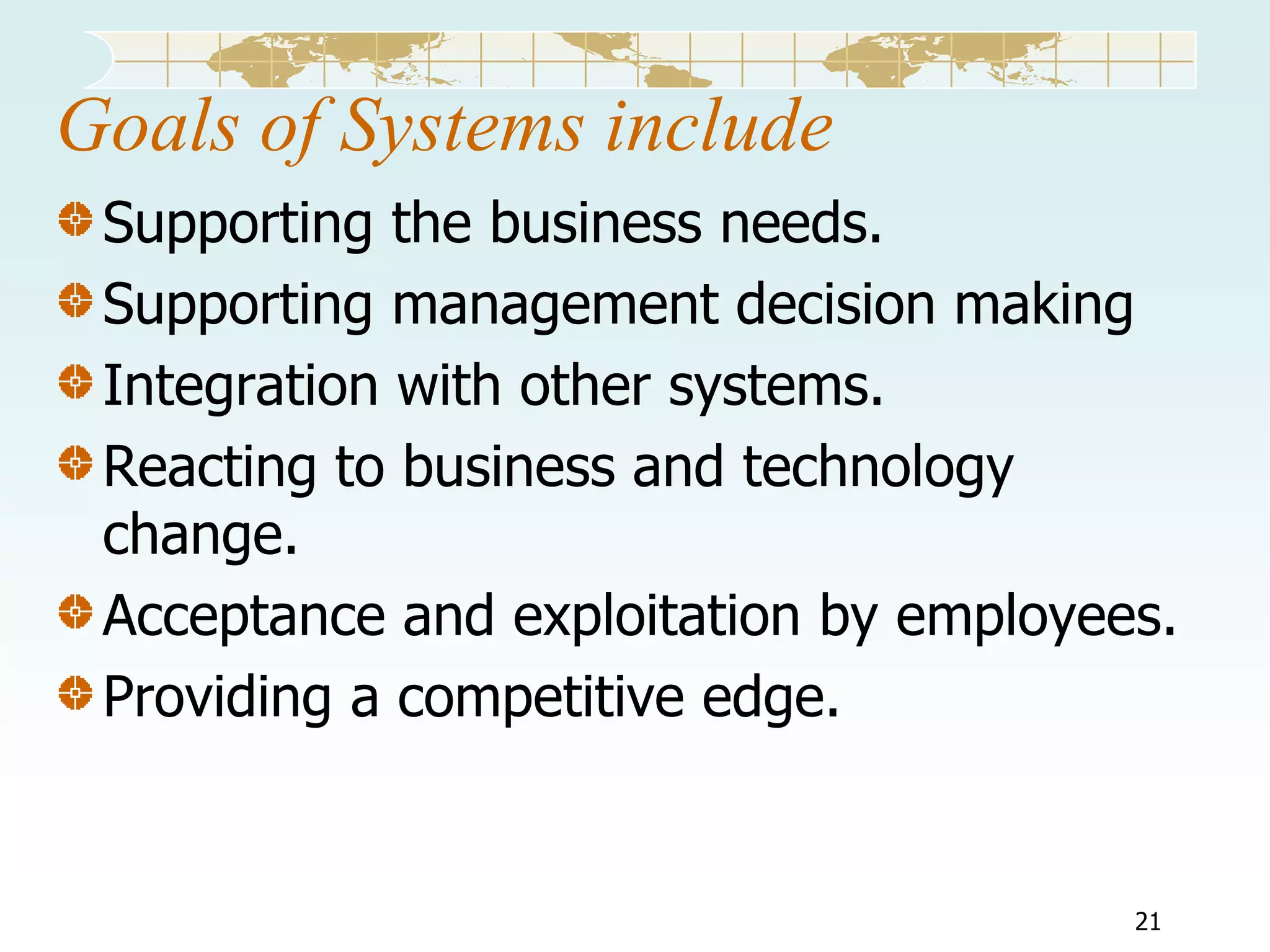
Goals of Systems include
Supporting the business needs.
Supporting management decision making
Integration with other systems.
Reacting to business and technology
change.
Acceptance and exploitation by employees.
Providing a competitive edge.

21
Categories of systems
Optional
Managerial
Strategic

22
Development of systems is far from
easy…?
Process of converting more abstract
concepts into more absolute products.
Many problems to overcome…
Business problems.
Technologies, tools and technique
problems.
Attitudes of the users and exiting
development staff.
23
Business problems
The lack of a clear direction.
A rapid rate of change.
No commitments from senior management.
Conflicting requirements.
Differences in management style.
Multiple solutions to the same problem.
Differing levels of responsibility.
Lack of control.
24
Technologies, tools, techniques
The proliferation of micro-computers.
Short life- span of the hardware.
A vast range of non-integrated software.
Instant worldwide communication raising
expectation levels.
Tools emerging only recently to help
control development.

25
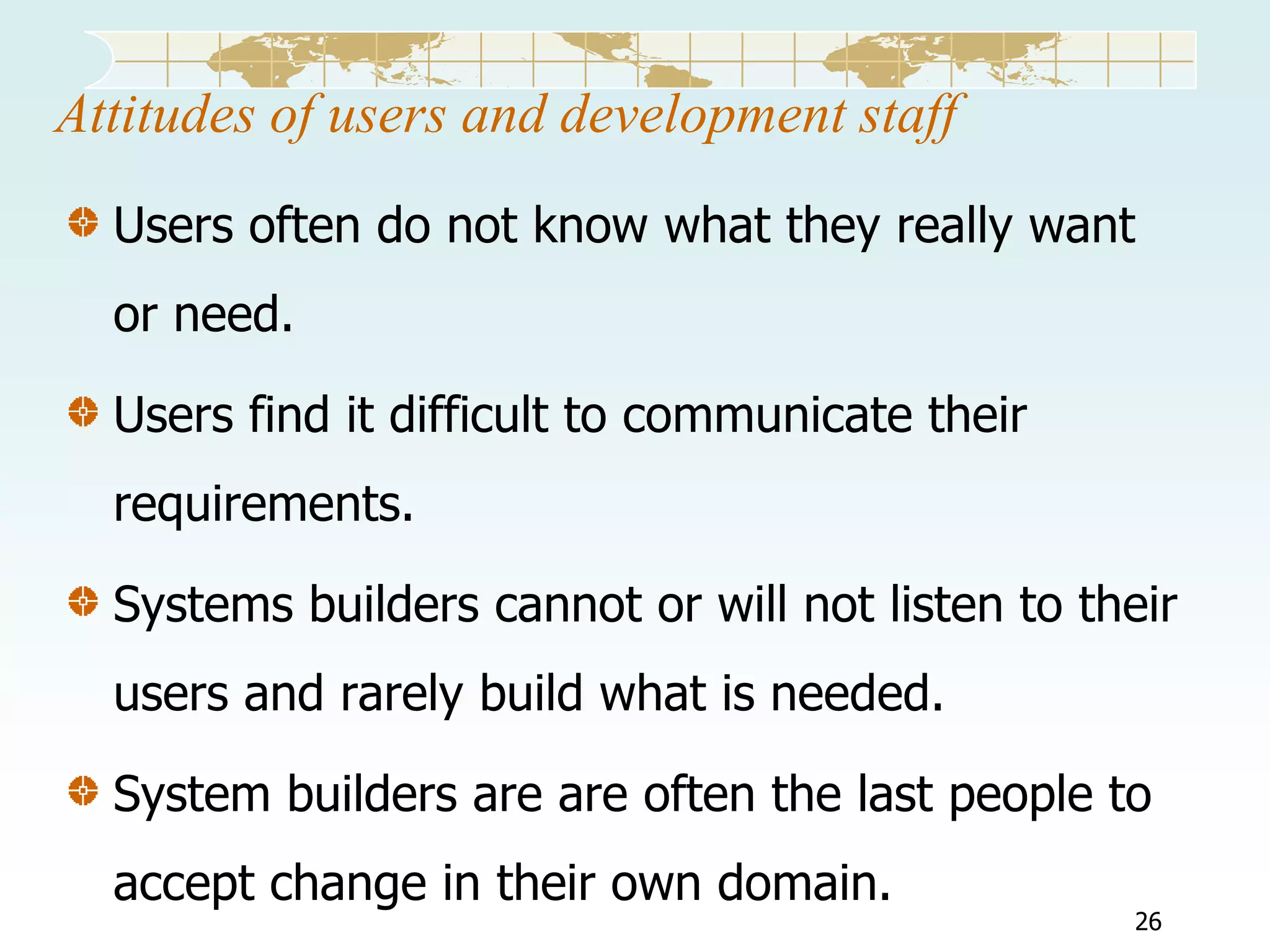
Attitudes of users and development staff
Users often do not know what they really want
or need.
Users find it difficult to communicate their
requirements.
Systems builders cannot or will not listen to their
users and rarely build what is needed.

System builders are are often the last people to
accept change in their own domain.

26
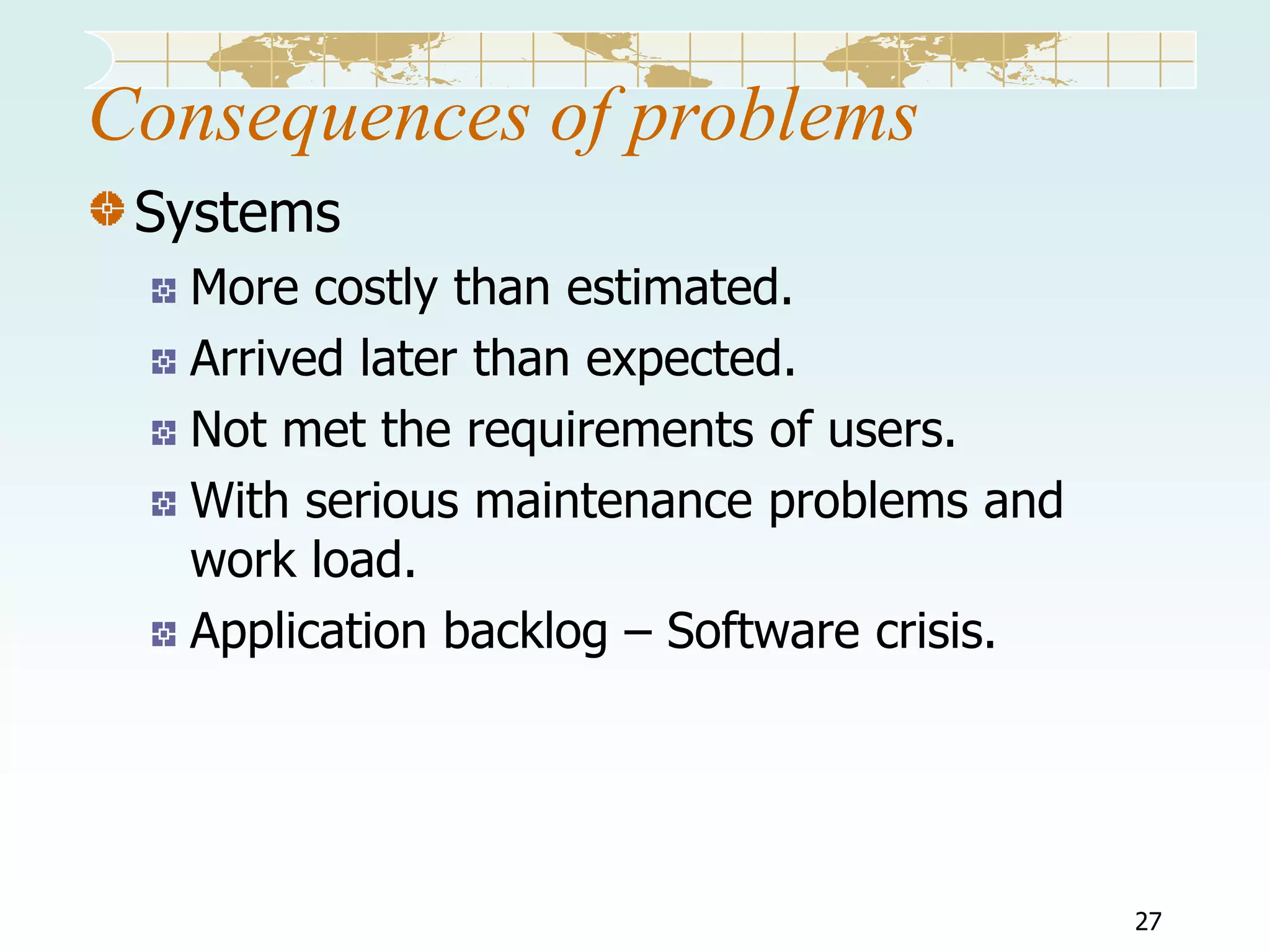
Consequences of problems
Systems
More costly than estimated.
Arrived later than expected.
Not met the requirements of users.
With serious maintenance problems and
work load.
Application backlog – Software crisis.

27
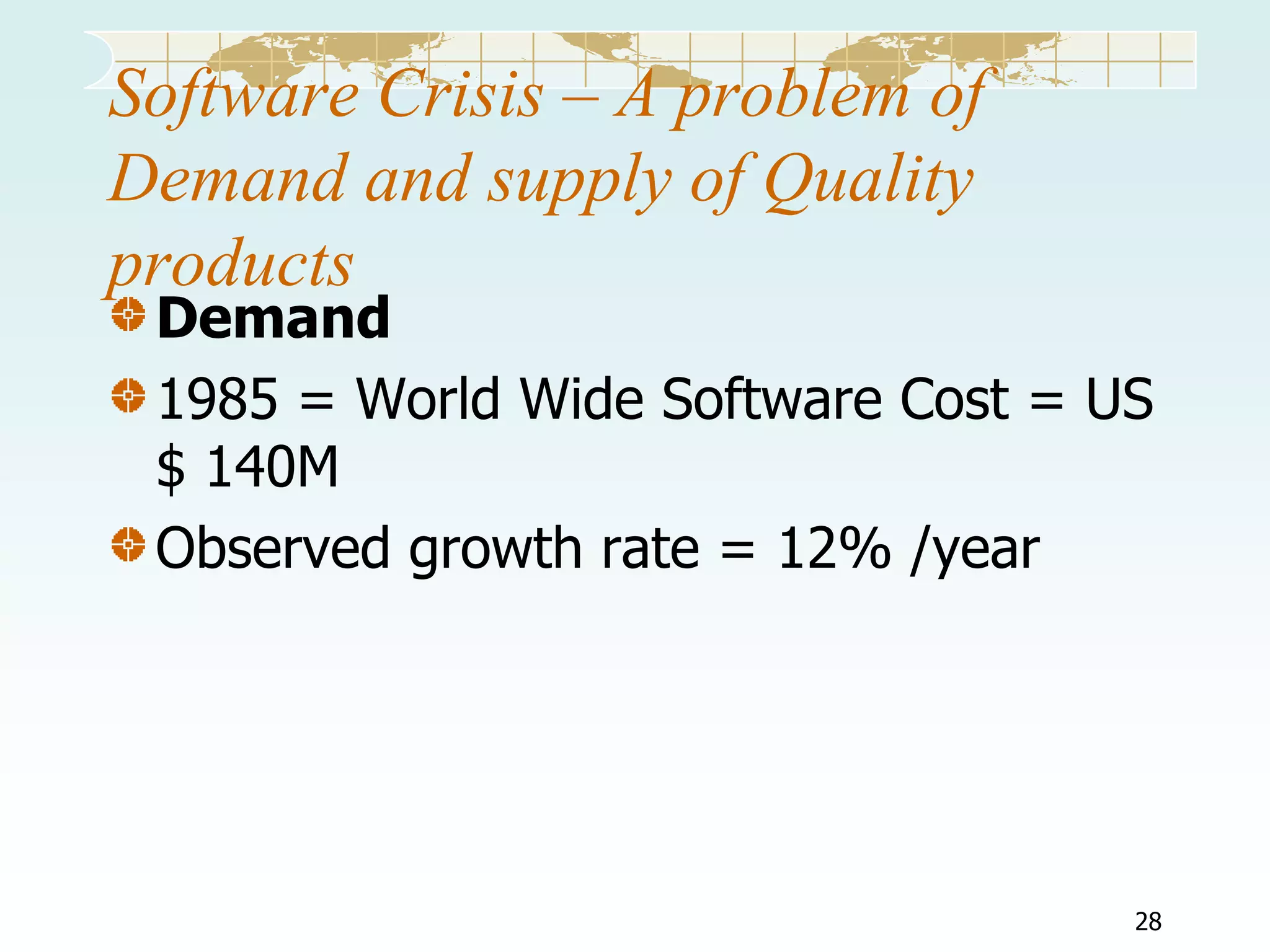
Software Crisis – A problem of
Demand and supply of Quality
products

Demand
1985 = World Wide Software Cost = US
$ 140M
Observed growth rate = 12% /year

28
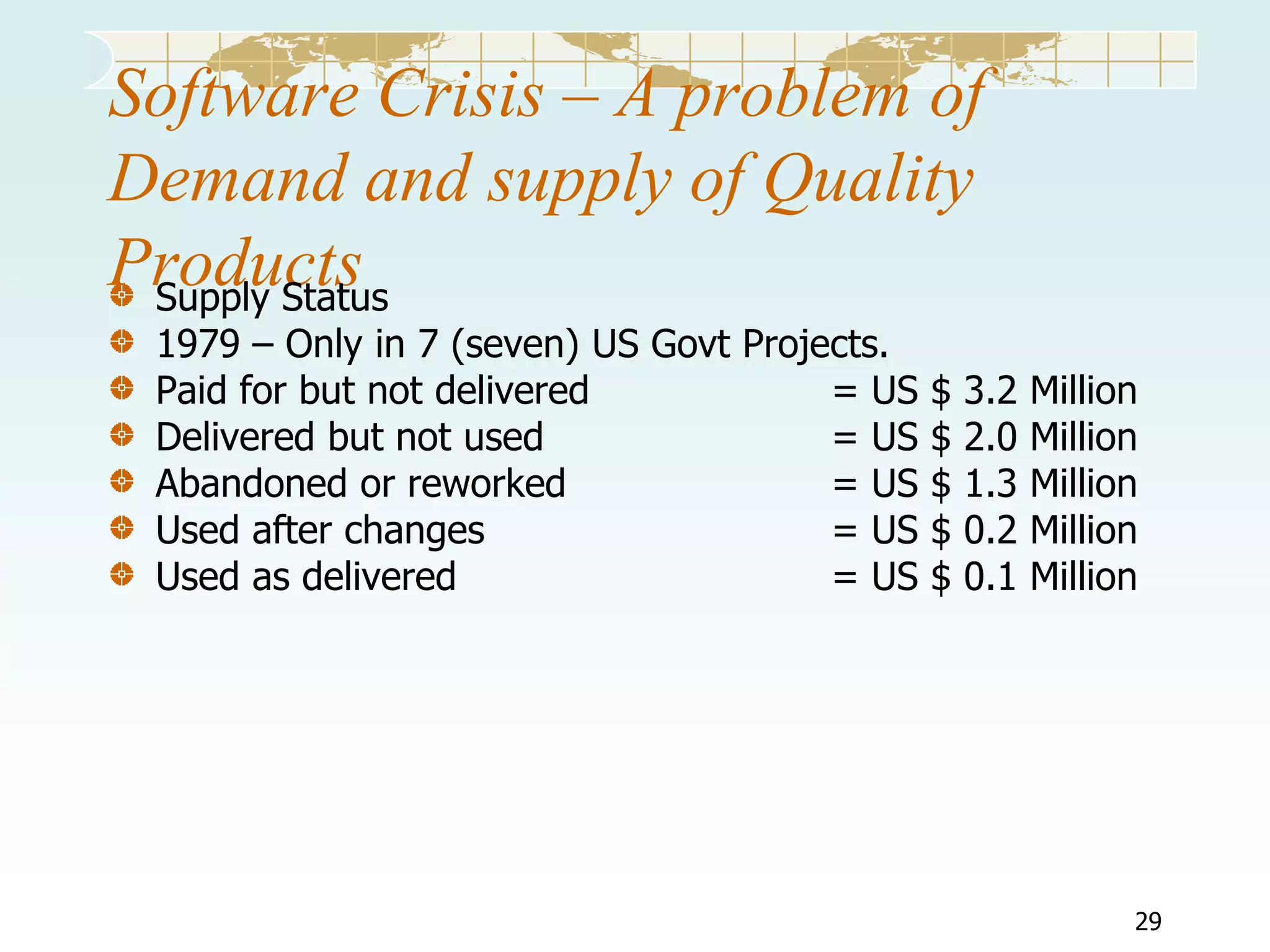
Software Crisis – A problem of
Demand and supply of Quality
Products
Supply Status
1979 – Only in 7 (seven) US Govt Projects.
Paid for but not delivered
= US
Delivered but not used
= US
Abandoned or reworked
= US
Used after changes
= US
Used as delivered
= US

$
$
$
$
$

3.2
2.0
1.3
0.2
0.1

Million
Million
Million
Million
Million

29
Structure programming Techniques.
Systems Life Cycle Approach.
Structured Systems Development
Methodologies.
Prototyping and CASE orientation.
Reusable Software Libraries.
Formal Methods.
30

Systems

  • 1.
    what is asystem? A system is a collection on interrelated components that work together to perform a specific task or achieve a goal. In a system, the different components are connected with each other and they are interdependent. Each component is a subsystem of the original system and carries out a part of the system task.
  • 2.
    Two Types ofSystems Natural Systems Man Made Systems
  • 3.
  • 4.
    Natural Systems Eg. The humanbody represents a complete natural system. Our human body contains complex muscle, bone, respiratory, digestive and circulatory subsystems, each providing a specific part of the system task.
  • 6.
    Man Made Systems  SocialSystems  Formal Organization  Transport Systems  Communication Systems  Automated Systems
  • 7.
    Let us considerthe respiratory subsystem which provides air to the body from the environment. Some of the components of the respiratory subsystem includes nasal passages, lungs etc. Each component, such as lungs, can itself be considered as a subsystem. Similarly, the heart and blood vessels can be considered as components of the circulatory subsystem.
  • 8.
    What Is anInformation System? Data: Streams of raw facts representing events such as business transactions Information: Clusters of facts that are meaningful and useful to human beings in the processes such as making decisions
  • 9.
    Computer-Based Information System(CBIS) Rely on computer hardware and software Processing and disseminating information
  • 10.
    Formal Systems Fixed definitionsof data, procedures Collecting, storing, processing, disseminating, using data
  • 11.
    Functions of anInformation System
  • 12.
  • 13.
  • 14.
    What is MIS? Keen Definition MIS is the development and use of effective information systems in organization. Broad Definition The design and use of effective information systems in business. Narrow Definition An information system that facilitates management by producing structured, summarized reports on a regular and recurring basis. 14
  • 15.
    Problems with MIS Lackof management involvement with the design of the MIS. Narrow and/or inappropriate emphasis of the computer system. Undue concentration on how low level data processing applications particularly in the accounting area. Lack of management knowledge of computers. Poor appreciation by information by information specialists of management’s true information requirements and of organizational problems. Lack of top management support. 15
  • 16.
    Key Points Information increasesknowledge, reduces uncertainty, adds value when used. Data are facts which have been recorded. Information is processed data which is understood by the user. The value of information comes from its use. Good information is :- relevant, accurate, in time to be used, sent to the right person, and is understandable. Communication systems include a source, a message, and the destination A MIS provides managers at all levels with appropriate information for planning, control and decision making. 16
  • 17.
    Relationship between DataProcessing & MIS Characteristics of MIS     Oriented toward Decision Making Summary Information Medium & Long Range Prediction & Control Oriented Characteristics of Data Processing      Perform the Transaction Processing Detail Data Short Range Real Time Daily Operation Oriented 17
  • 18.
    The Part ofan Information System Personnel Hardware Inputs Processes Programs Procedures Outputs Data Files 18
  • 19.
    The parts ofan information system Inputs Processes Data Files Outputs Personnel Hardware 19
  • 20.
    Systems Named collection ofprocessors tat satisfy some functional need of the business. Combination of manual and computer processors. Will take into account the needs of many functional areas. Considers the day-to-day and management information needs of the organization. 20
  • 21.
    Goals of Systemsinclude Supporting the business needs. Supporting management decision making Integration with other systems. Reacting to business and technology change. Acceptance and exploitation by employees. Providing a competitive edge. 21
  • 22.
  • 23.
    Development of systemsis far from easy…? Process of converting more abstract concepts into more absolute products. Many problems to overcome… Business problems. Technologies, tools and technique problems. Attitudes of the users and exiting development staff. 23
  • 24.
    Business problems The lackof a clear direction. A rapid rate of change. No commitments from senior management. Conflicting requirements. Differences in management style. Multiple solutions to the same problem. Differing levels of responsibility. Lack of control. 24
  • 25.
    Technologies, tools, techniques Theproliferation of micro-computers. Short life- span of the hardware. A vast range of non-integrated software. Instant worldwide communication raising expectation levels. Tools emerging only recently to help control development. 25
  • 26.
    Attitudes of usersand development staff Users often do not know what they really want or need. Users find it difficult to communicate their requirements. Systems builders cannot or will not listen to their users and rarely build what is needed. System builders are are often the last people to accept change in their own domain. 26
  • 27.
    Consequences of problems Systems Morecostly than estimated. Arrived later than expected. Not met the requirements of users. With serious maintenance problems and work load. Application backlog – Software crisis. 27
  • 28.
    Software Crisis –A problem of Demand and supply of Quality products Demand 1985 = World Wide Software Cost = US $ 140M Observed growth rate = 12% /year 28
  • 29.
    Software Crisis –A problem of Demand and supply of Quality Products Supply Status 1979 – Only in 7 (seven) US Govt Projects. Paid for but not delivered = US Delivered but not used = US Abandoned or reworked = US Used after changes = US Used as delivered = US $ $ $ $ $ 3.2 2.0 1.3 0.2 0.1 Million Million Million Million Million 29
  • 30.
    Structure programming Techniques. SystemsLife Cycle Approach. Structured Systems Development Methodologies. Prototyping and CASE orientation. Reusable Software Libraries. Formal Methods. 30