Organization Systems
Organization Systems “ our understanding of the world is largely determined by our ability to organize information” Do you agree? How do we organize information? Name some organization systems we commonly use….
Organization Systems Challenges of organizing information: Growth of content Ambiguity Heterogeneity Differences in perspectives Internal politics
Organizing web sites and intranets Information organization is closely related to: Navigation Labeling Indexing The best approach is to isolate the design of organization systems.
Organization Systems Are composed of: Organization Schemes (e.g. exact or ambiguous) Organization Structures (e.g. top-down or bottom-up)
Exact Organization Schemes Divide information into well defined and mutually exclusive sections Alphabetical Chronological Geographical
Ambiguous Organization Systems Divide information into categories that defy exact definition. Topic Task Audience Metaphor Hybrid
Organization Structures The structure of information defines the primary way in which users can navigate.
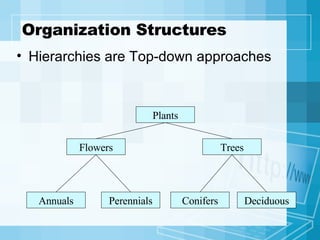
Organization Structures Hierarchies are Top-down approaches Plants Flowers Trees Annuals Perennials Conifers Deciduous
Organization Structures Designing taxonomies: Hierarchical categories must mutually exclusive. (be aware of it, but not constrain by it) Balance between breath and depth. Hierarchies are good but is only one component of a cohesive organization system.
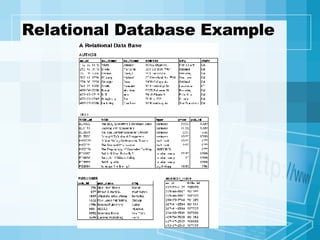
Organization Structures The Database Model: A bottom-up approach Metadata is the primary key that links Information Architecture with databases. A database is a collection of data arranged for optimizing storage and speed of search and retrieval. Most databases are build using the  relational   model . In this model data is stored within a set of relations or tables.
Relational Database Example
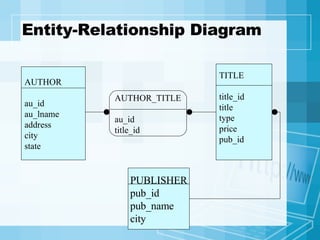
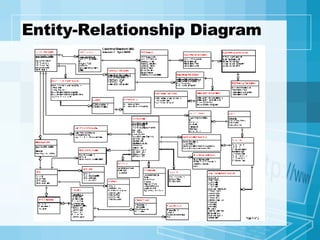
Entity-Relationship Diagram  AUTHOR au_id au_lname address city state AUTHOR_TITLE au_id title_id TITLE title_id title type price pub_id PUBLISHER pub_id pub_name city
Entity-Relationship Diagram
Organization Systems Information architects need to understand how metadata, controlled vocabulary, and database structures can be used to enable: Automatic generation of alphabetical indexes Dynamic presentation of associative “see also” links Fielded searching Advanced filtering and sorting of search results
Organization Systems Hypertext: highly nonlinear way of structuring information. Hypertext chunks can be connected hierarchically or not hierarchically, or both. Provides flexibility but it can be a source of user confusion.
Organization Structures Hypertext is a highly nonlinear way of sorting information. It involves two main components: Items or chunks of information that will be linked Links between those chunks of information. Hypertext provides with great flexibility. However, it presents substantial potential for complexity and user confusion.
Social Classification Examples: Flickr & Delicious Tagging, collaborative categorization, ethno-classification Users tag objects with one or more keywords User-centered, bottom up organizational structure
What is social classification? User added metadata Shared resource (pictures, URLs) Collaborative, social software Social Feedback Loop Folksonomy, free-tagging Broad ( Many users tag one resource ) or narrow ( Few users tag one resource ) folksonomies
Folksonomies “ The old way creates a tree. The new, rakes leaves together.” ~ David Weinberger “ Folksonomies don’t support searching and other types of browsing nearly as well as tags from controlled vocabularies from professionals.” ~ Lou Rosenfeld
Creating cohesive organization systems “ Suggesting organization is the first step in transforming data to information.” Consider exact and ambiguous organization systems Think about organization structures that influence how users can navigate Choose the right combination for your site
Creating cohesive organization systems You need to consider a variety of exact and ambiguous organization schemes. Exact schemes are best for “known item” search Ambiguous are best for browsing and associative learning when users have vaguely defined information needs whenever possible use both types of schemes
Creating cohesive organization systems Large web sites will use all three types of organization structures: Top-level ------ Hierarchical Homogeneous groups of information------ Database model Less structured, more creative content items ------- Hypertext
Creating cohesive organization systems When thinking about organization structures: The top level will most likely be hierarchical Collections of structured and homogeneous information are excellent candidates for the database model. Less structured, more creative relationships between content can be handled through hypertext.
Discussion Question Social Classification Folksonomies Issues with Folksonomies? Good or bad?

Organization Systems

  • 1.
  • 2.
    Organization Systems “our understanding of the world is largely determined by our ability to organize information” Do you agree? How do we organize information? Name some organization systems we commonly use….
  • 3.
    Organization Systems Challengesof organizing information: Growth of content Ambiguity Heterogeneity Differences in perspectives Internal politics
  • 4.
    Organizing web sitesand intranets Information organization is closely related to: Navigation Labeling Indexing The best approach is to isolate the design of organization systems.
  • 5.
    Organization Systems Arecomposed of: Organization Schemes (e.g. exact or ambiguous) Organization Structures (e.g. top-down or bottom-up)
  • 6.
    Exact Organization SchemesDivide information into well defined and mutually exclusive sections Alphabetical Chronological Geographical
  • 7.
    Ambiguous Organization SystemsDivide information into categories that defy exact definition. Topic Task Audience Metaphor Hybrid
  • 8.
    Organization Structures Thestructure of information defines the primary way in which users can navigate.
  • 9.
    Organization Structures Hierarchiesare Top-down approaches Plants Flowers Trees Annuals Perennials Conifers Deciduous
  • 10.
    Organization Structures Designingtaxonomies: Hierarchical categories must mutually exclusive. (be aware of it, but not constrain by it) Balance between breath and depth. Hierarchies are good but is only one component of a cohesive organization system.
  • 11.
    Organization Structures TheDatabase Model: A bottom-up approach Metadata is the primary key that links Information Architecture with databases. A database is a collection of data arranged for optimizing storage and speed of search and retrieval. Most databases are build using the relational model . In this model data is stored within a set of relations or tables.
  • 12.
  • 13.
    Entity-Relationship Diagram AUTHOR au_id au_lname address city state AUTHOR_TITLE au_id title_id TITLE title_id title type price pub_id PUBLISHER pub_id pub_name city
  • 14.
  • 15.
    Organization Systems Informationarchitects need to understand how metadata, controlled vocabulary, and database structures can be used to enable: Automatic generation of alphabetical indexes Dynamic presentation of associative “see also” links Fielded searching Advanced filtering and sorting of search results
  • 16.
    Organization Systems Hypertext:highly nonlinear way of structuring information. Hypertext chunks can be connected hierarchically or not hierarchically, or both. Provides flexibility but it can be a source of user confusion.
  • 17.
    Organization Structures Hypertextis a highly nonlinear way of sorting information. It involves two main components: Items or chunks of information that will be linked Links between those chunks of information. Hypertext provides with great flexibility. However, it presents substantial potential for complexity and user confusion.
  • 18.
    Social Classification Examples:Flickr & Delicious Tagging, collaborative categorization, ethno-classification Users tag objects with one or more keywords User-centered, bottom up organizational structure
  • 19.
    What is socialclassification? User added metadata Shared resource (pictures, URLs) Collaborative, social software Social Feedback Loop Folksonomy, free-tagging Broad ( Many users tag one resource ) or narrow ( Few users tag one resource ) folksonomies
  • 20.
    Folksonomies “ Theold way creates a tree. The new, rakes leaves together.” ~ David Weinberger “ Folksonomies don’t support searching and other types of browsing nearly as well as tags from controlled vocabularies from professionals.” ~ Lou Rosenfeld
  • 21.
    Creating cohesive organizationsystems “ Suggesting organization is the first step in transforming data to information.” Consider exact and ambiguous organization systems Think about organization structures that influence how users can navigate Choose the right combination for your site
  • 22.
    Creating cohesive organizationsystems You need to consider a variety of exact and ambiguous organization schemes. Exact schemes are best for “known item” search Ambiguous are best for browsing and associative learning when users have vaguely defined information needs whenever possible use both types of schemes
  • 23.
    Creating cohesive organizationsystems Large web sites will use all three types of organization structures: Top-level ------ Hierarchical Homogeneous groups of information------ Database model Less structured, more creative content items ------- Hypertext
  • 24.
    Creating cohesive organizationsystems When thinking about organization structures: The top level will most likely be hierarchical Collections of structured and homogeneous information are excellent candidates for the database model. Less structured, more creative relationships between content can be handled through hypertext.
  • 25.
    Discussion Question SocialClassification Folksonomies Issues with Folksonomies? Good or bad?