Designing  Organizational Structure:  Specialization and Coordination
A functional structure is a design that groups people on the basis of their common skills, expertise, or resources they use Functional structure is the bedrock of horizontal differentiation An organization groups tasks into functions to increase the effectiveness with which it achieves its goals
Allows economies of scale within departments Simplified mechanisms for control Clear definition of responsibilities Enables to accomplish functional goals Opportunity for focused competencies
Slow response to environmental changes May cause decisions to pile on top Inability to manage diversity Lack of coordination between functions
Functional structure is appropriate if the organization:  Limits itself to producing a small number of similar products Produces those products in one or a few locations Sells them to only one general type of client or customer
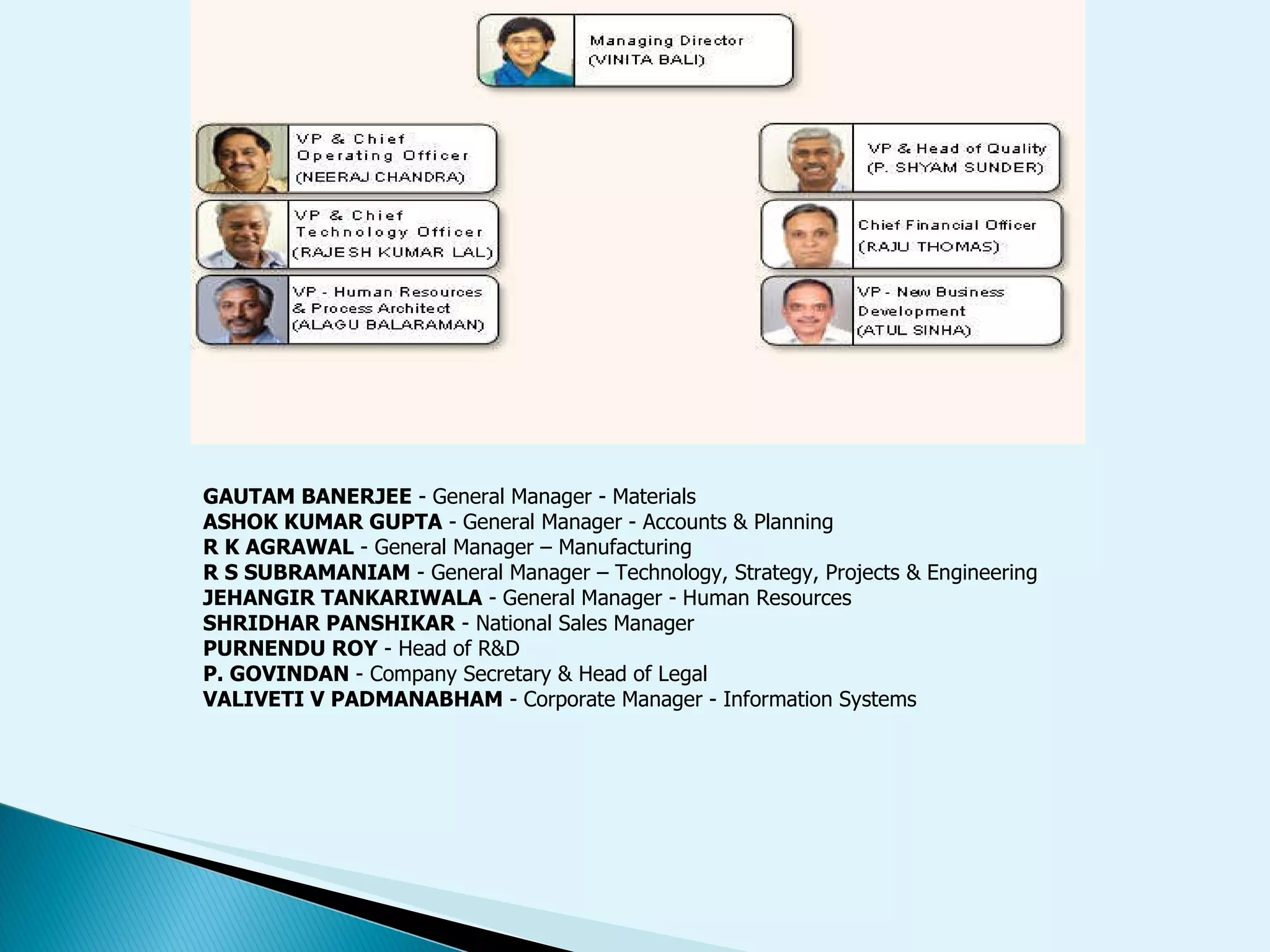
GAUTAM BANERJEE  - General Manager - Materials ASHOK KUMAR GUPTA  - General Manager - Accounts & Planning R K AGRAWAL  - General Manager – Manufacturing R S SUBRAMANIAM  - General Manager – Technology, Strategy, Projects & Engineering JEHANGIR TANKARIWALA  - General Manager - Human Resources SHRIDHAR PANSHIKAR  - National Sales Manager PURNENDU ROY  - Head of R&D P. GOVINDAN  - Company Secretary & Head of Legal VALIVETI V PADMANABHAM  - Corporate Manager - Information Systems
Organizations most commonly adopt the divisional structure to solve control problems that arise with too many products, regions, or customers The type of divisional structure depends on the problem to be solved Divisional structure creates smaller, more manageable subunits and takes the form Product structure Geographic structure Market structure
Ability to concentrate on specific businesses Can respond to fast change in environment Leads to client satisfaction as responsibility and contact points are clear Ease of measurement of unit performance  Decentralizes decision making  Scope for management to focus on strategy   Clear division of labor between corporate and divisional managers Profitable growth: when each division is its own profit center, individual profitability can be encouraged Internal labor market: the most able divisional managers are promoted to become corporate managers
Eliminates in-depth competence Conflict between goals of divisions Duplication of functions between divisions Complexity of inter-divisional coordination Managing the corporate-divisional relationship: finding the balance between centralization and decentralization Coordination problems between divisions: divisions start competing for resources and rivalry prevents cooperation Transfer pricing: problems between divisions often revolve around the transfer price  Bureaucratic costs: multidivisional structures are very expensive to operate
Product structure:  a divisional structure in which products are grouped into separate divisions according to their similarities or differences Organizations need to decide how to coordinate its product activities with support functions
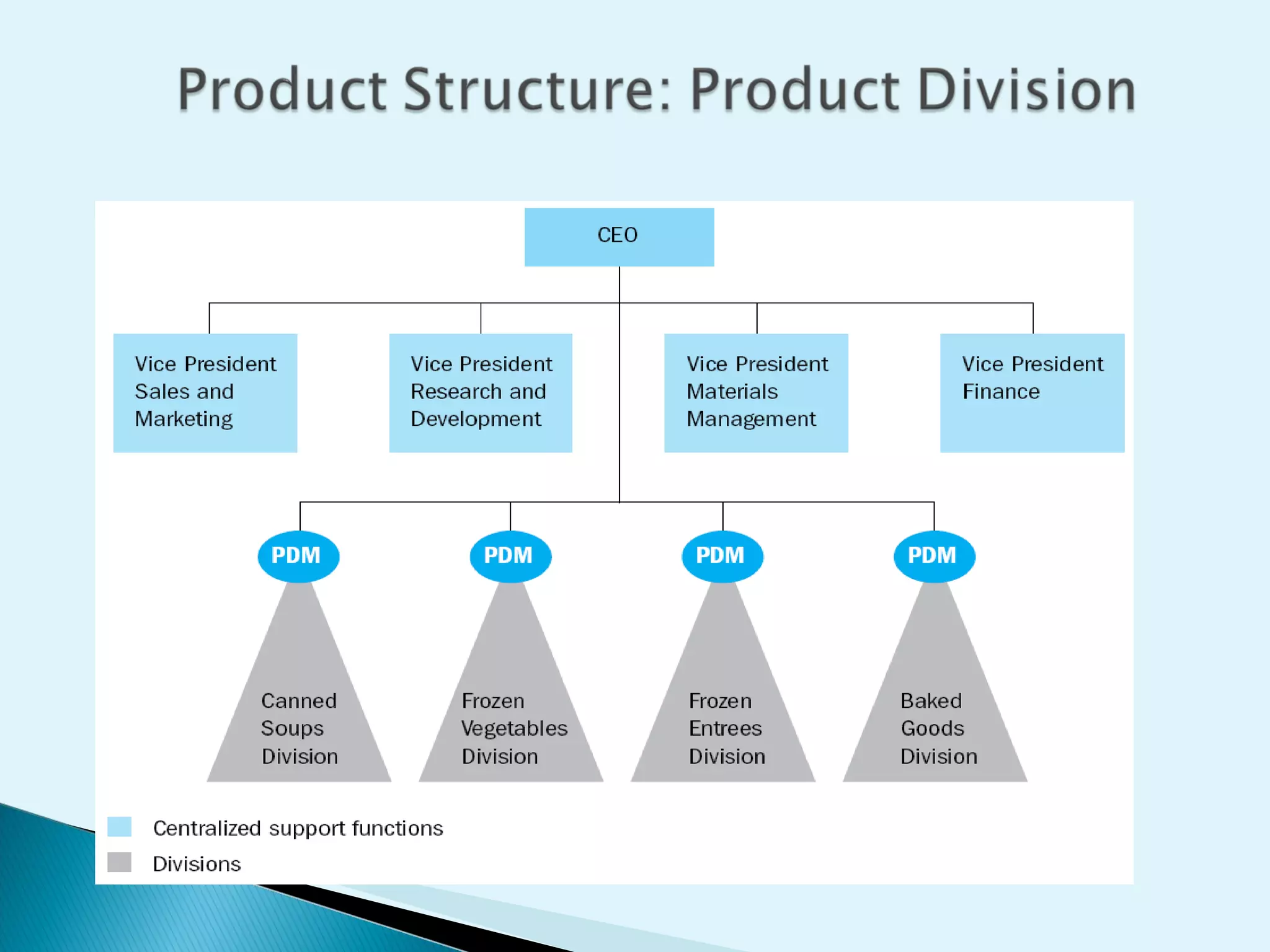
Product division structure:  a structure in which a centralized set of support functions service the needs of a number of different product lines Each product division uses the services of the central support function Support function is divided into product-oriented teams who focus on the needs of one particular product division
 
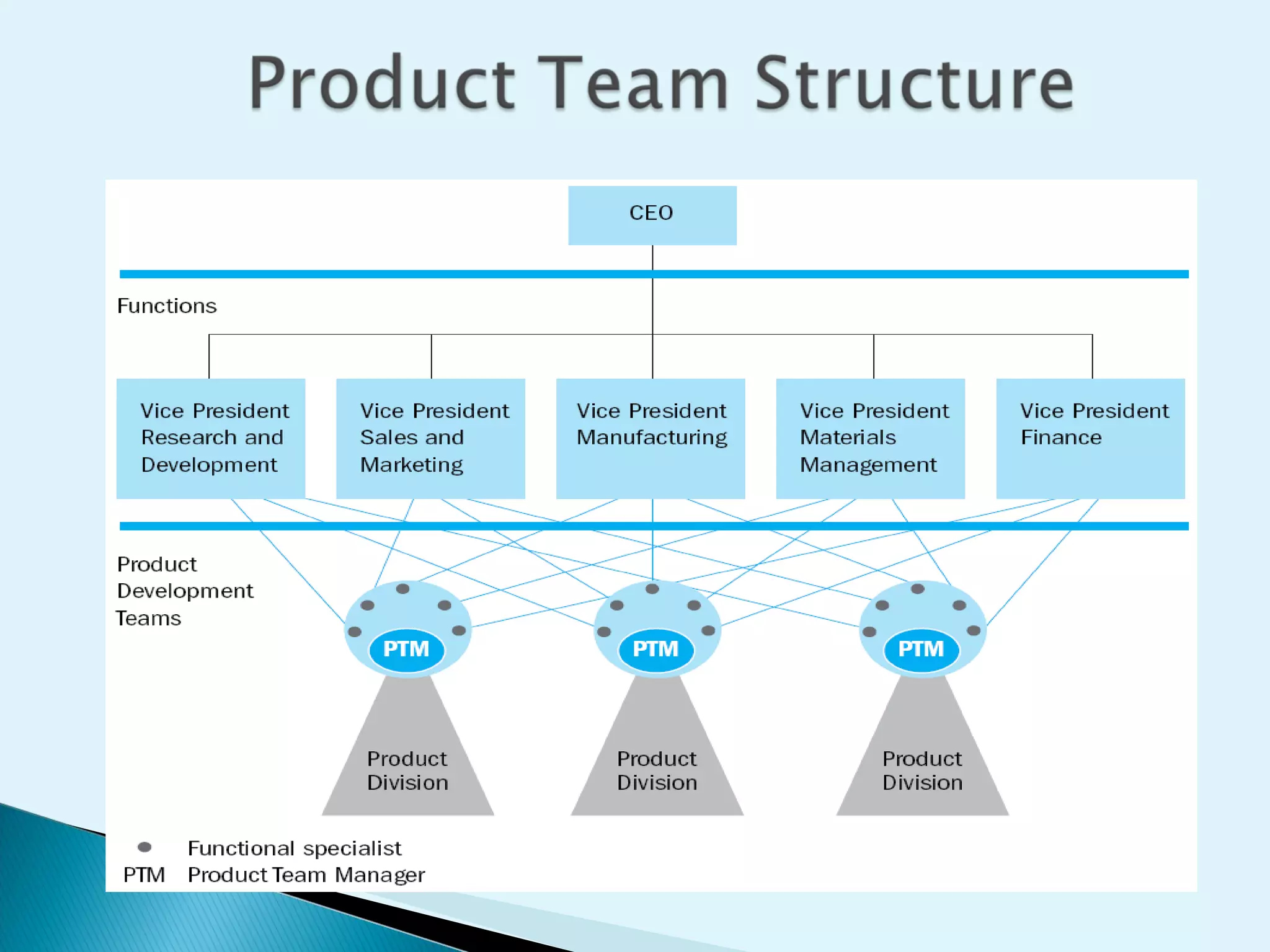
Product team structure:  specialists from the support functions are created that specialize in the needs of particular kind of product Focus on the needs of one product (or client) or a few related products Each team is a self-contained division headed by a product team manager
 
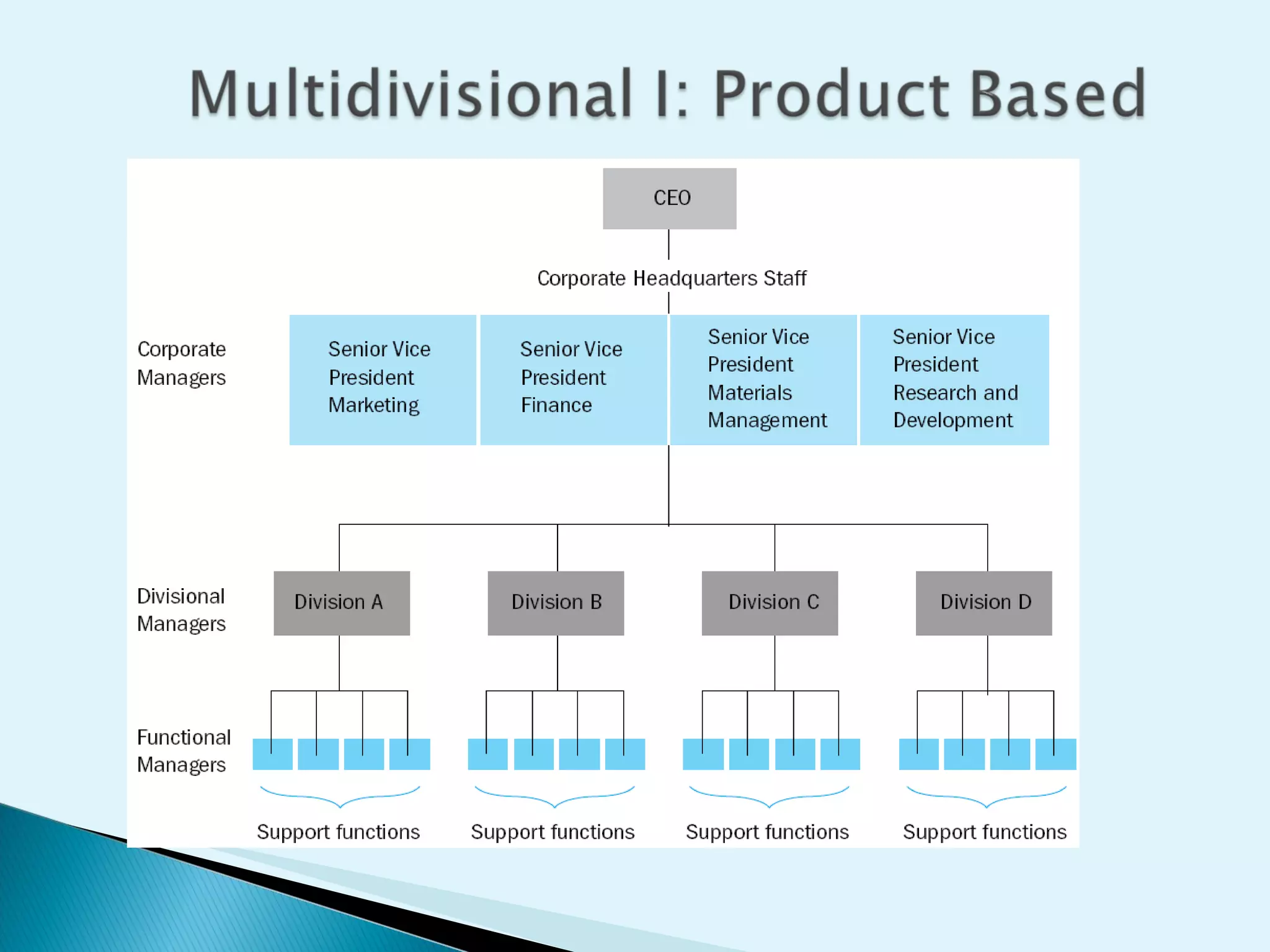
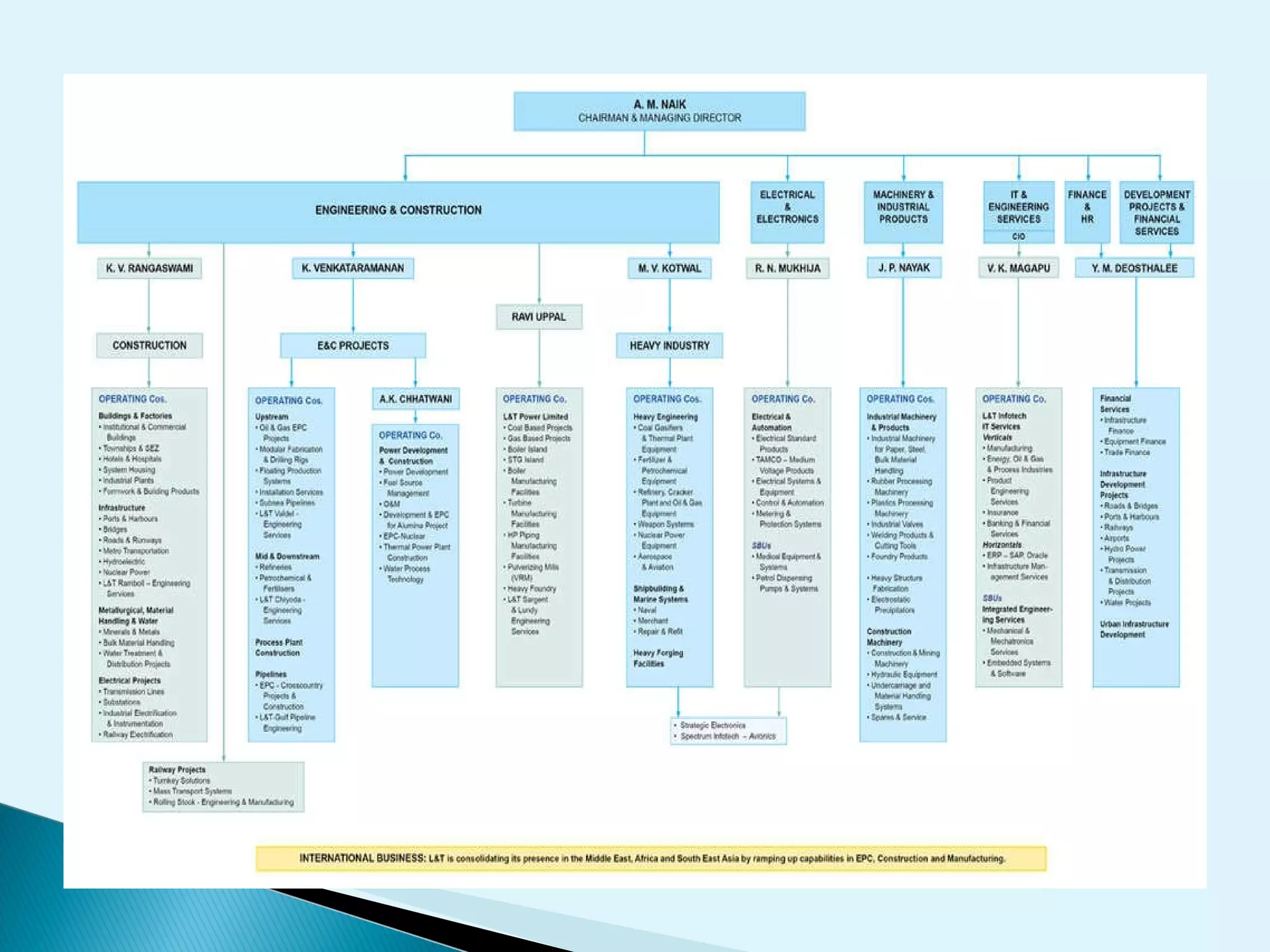
Multidivisional structure:  structure   in which support functions are placed in dependent self-contained divisions with its own set of support functions Corporate headquarters staff:  responsible for overseeing the activities of the managers heading each division  Allows a company to operate in many different businesses
 
 
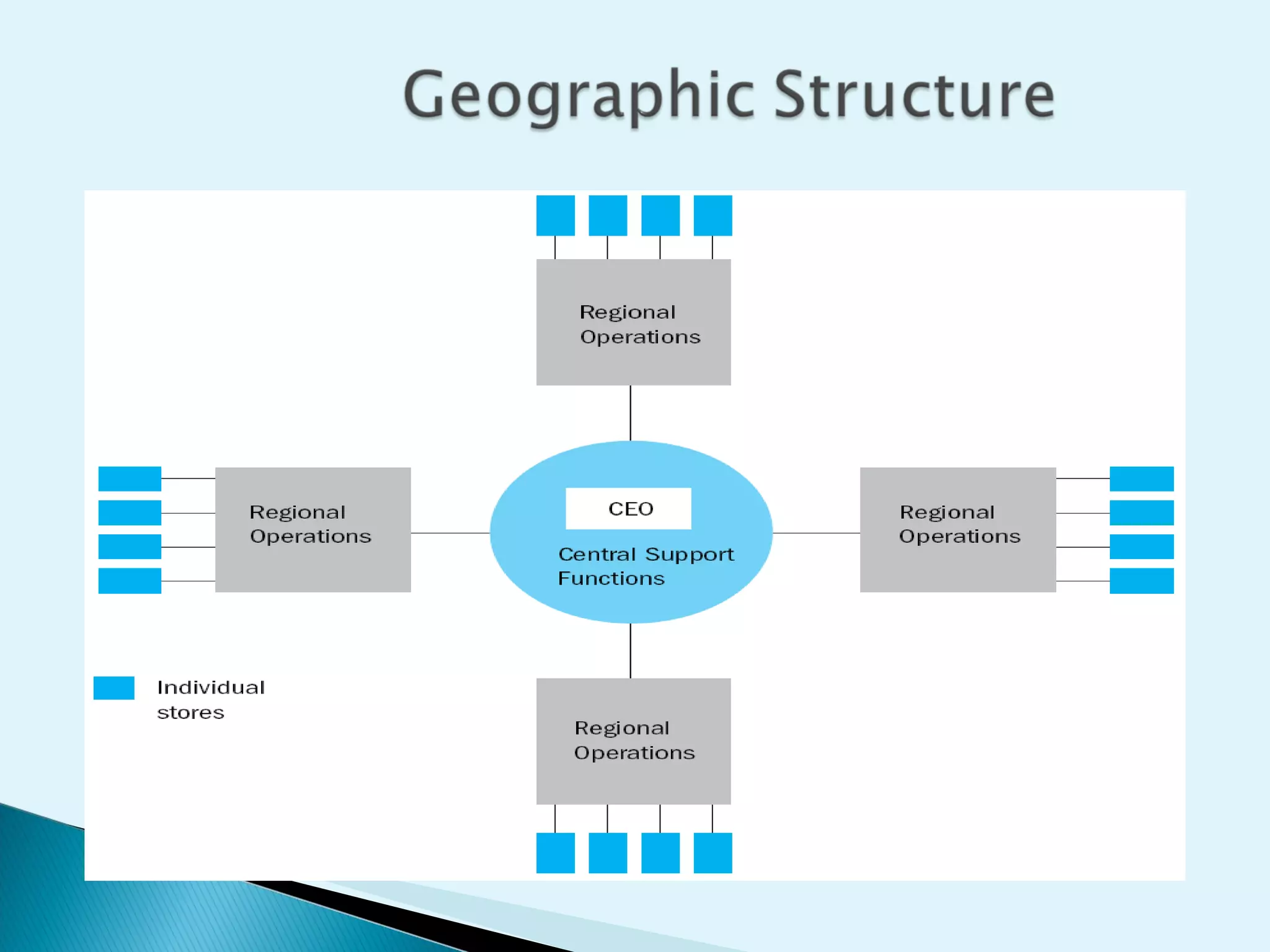
When the control problems that companies experience are a function of geography, a geographic divisional structure is appropriate Allows the organization to adjust its structure to align its core competences with the needs of customers in different geographic regions Allows some functions to be centralized and others decentralized
 
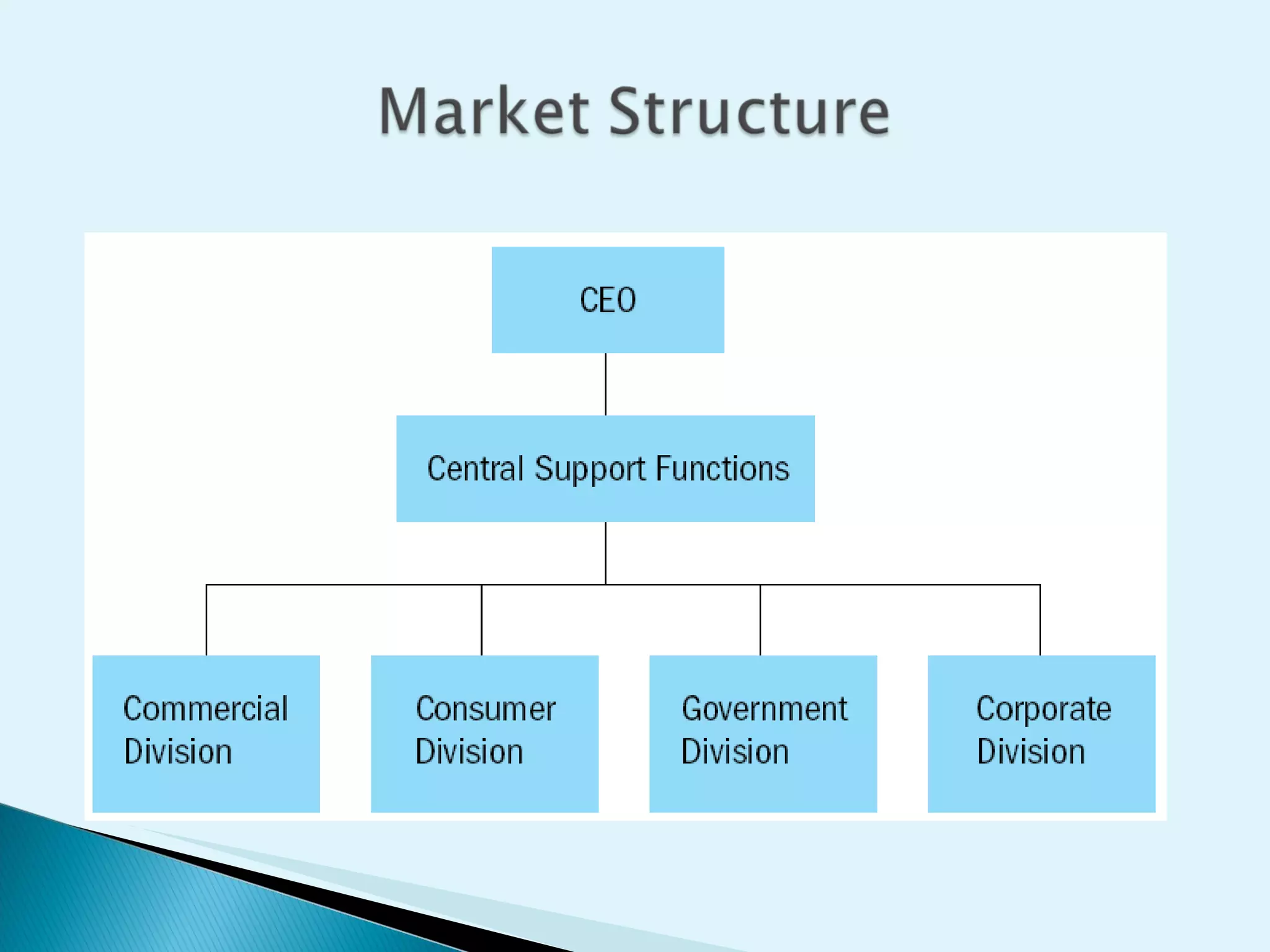
A market structure aligns functional skills and activities with the needs of different customer groups Each customer group has a different marketing focus, and the job of each group is to develop products to suit the needs of its specific customers Each customer group makes use of centralized support function
 
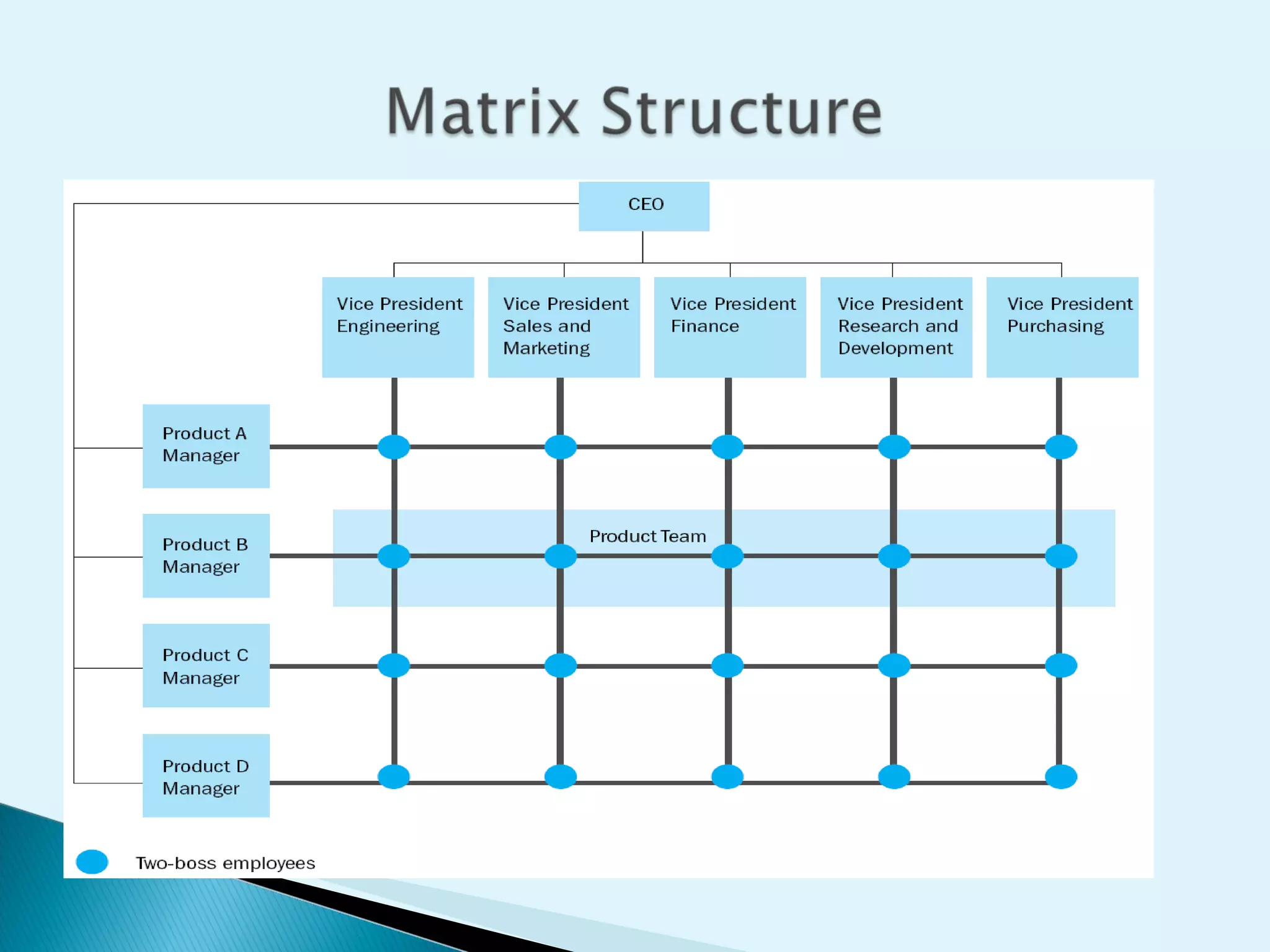
A n organizational design that groups people and resources in two ways simultaneously, by function and product Shows a vertical flow of functional responsibility and a horizontal flow of product responsibility The members report to two superiors: the product team manager and the functional manager The team is the building block and principal coordination and integration mechanism
 
Prevention of overlap of functions  Achieves coordination necessary to meet dual demands from customers Direct contact instead of bureaucracy Provides opportunity for both functional and product skill development Development of managerial skill   The use of cross-functional teams reduces functional barriers and subunit orientation Maximizes use of skilled professionals, who move from product to product as needed The dual functional and product focus promotes concern for both cost and quality
Means participants need good interpersonal skills and extensive training Lack of clarity about responsibilities Difficult to track profitability of products High degree of conflict over priorities Requires great effort to maintain power balance Matrix lacks a control structure that leads employees to develop stable expectations of one another The lack of a clearly defined hierarchy of authority can also lead to conflict between functions and product teams over the use of resources People are likely to experience a vacuum of authority and responsibility
Network structure:  a cluster of different organizations whose actions are coordinated by contracts and agreements rather than through a formal hierarchy of authority Very complex as companies form agreements with many suppliers, manufacturers, and distributors Such agreements are necessary as the organization outsources many of the value creation activities involved in production and marketing goods and services
Concentration on core competence  High degree of flexibility  Allows quick scale and reach without huge investments in factories, equipment, etc., Lowering of costs and complexities  Opportunity to leverage outsourced skills If a network partner can perform a specific functional activity reliably, and at a lower cost, production costs are reduced Avoids the high bureaucratic costs of operating a complex organizational structure Allows an organization to act in an organic way Network partners can be replaced if they do not perform up to standards
Lack of control over many functions Unhealthy dependence on partners Need for high degree of cooperation and   considerable level of mutual adjustment  Over-narrowing of expertise Ability to control a complex value- creation process is difficult because managers lack the means to effectively coordinate and motivate the various network partners
Divides an organization into two components: those that are oriented to the customer and/or the geographical region in which the company is doing business, called the front end a back end that is organized by product and technology Advantages: focus on more than one dimension at a time, manage cross-product strategies and coordination Disadvantages: lack of clarity about how the front end is supposed to work with the back end, high need for collaboration along with the high possibility for conflict
Hybrid structure:  large complex organizations that have many divisions make use of many different structures Each product division’s manager selects the structure (product, geographic, matrix) that best meets the needs of their particular environment and strategy

Ch06 - Organisation theory design and change gareth jones

  • 1.
    Designing OrganizationalStructure: Specialization and Coordination
  • 2.
    A functional structureis a design that groups people on the basis of their common skills, expertise, or resources they use Functional structure is the bedrock of horizontal differentiation An organization groups tasks into functions to increase the effectiveness with which it achieves its goals
  • 3.
    Allows economies ofscale within departments Simplified mechanisms for control Clear definition of responsibilities Enables to accomplish functional goals Opportunity for focused competencies
  • 4.
    Slow response toenvironmental changes May cause decisions to pile on top Inability to manage diversity Lack of coordination between functions
  • 5.
    Functional structure isappropriate if the organization: Limits itself to producing a small number of similar products Produces those products in one or a few locations Sells them to only one general type of client or customer
  • 6.
    GAUTAM BANERJEE - General Manager - Materials ASHOK KUMAR GUPTA - General Manager - Accounts & Planning R K AGRAWAL - General Manager – Manufacturing R S SUBRAMANIAM - General Manager – Technology, Strategy, Projects & Engineering JEHANGIR TANKARIWALA - General Manager - Human Resources SHRIDHAR PANSHIKAR - National Sales Manager PURNENDU ROY - Head of R&D P. GOVINDAN - Company Secretary & Head of Legal VALIVETI V PADMANABHAM - Corporate Manager - Information Systems
  • 7.
    Organizations most commonlyadopt the divisional structure to solve control problems that arise with too many products, regions, or customers The type of divisional structure depends on the problem to be solved Divisional structure creates smaller, more manageable subunits and takes the form Product structure Geographic structure Market structure
  • 8.
    Ability to concentrateon specific businesses Can respond to fast change in environment Leads to client satisfaction as responsibility and contact points are clear Ease of measurement of unit performance Decentralizes decision making Scope for management to focus on strategy Clear division of labor between corporate and divisional managers Profitable growth: when each division is its own profit center, individual profitability can be encouraged Internal labor market: the most able divisional managers are promoted to become corporate managers
  • 9.
    Eliminates in-depth competenceConflict between goals of divisions Duplication of functions between divisions Complexity of inter-divisional coordination Managing the corporate-divisional relationship: finding the balance between centralization and decentralization Coordination problems between divisions: divisions start competing for resources and rivalry prevents cooperation Transfer pricing: problems between divisions often revolve around the transfer price Bureaucratic costs: multidivisional structures are very expensive to operate
  • 10.
    Product structure: a divisional structure in which products are grouped into separate divisions according to their similarities or differences Organizations need to decide how to coordinate its product activities with support functions
  • 11.
    Product division structure: a structure in which a centralized set of support functions service the needs of a number of different product lines Each product division uses the services of the central support function Support function is divided into product-oriented teams who focus on the needs of one particular product division
  • 12.
  • 13.
    Product team structure: specialists from the support functions are created that specialize in the needs of particular kind of product Focus on the needs of one product (or client) or a few related products Each team is a self-contained division headed by a product team manager
  • 14.
  • 15.
    Multidivisional structure: structure in which support functions are placed in dependent self-contained divisions with its own set of support functions Corporate headquarters staff: responsible for overseeing the activities of the managers heading each division Allows a company to operate in many different businesses
  • 16.
  • 17.
  • 18.
    When the controlproblems that companies experience are a function of geography, a geographic divisional structure is appropriate Allows the organization to adjust its structure to align its core competences with the needs of customers in different geographic regions Allows some functions to be centralized and others decentralized
  • 19.
  • 20.
    A market structurealigns functional skills and activities with the needs of different customer groups Each customer group has a different marketing focus, and the job of each group is to develop products to suit the needs of its specific customers Each customer group makes use of centralized support function
  • 21.
  • 22.
    A n organizationaldesign that groups people and resources in two ways simultaneously, by function and product Shows a vertical flow of functional responsibility and a horizontal flow of product responsibility The members report to two superiors: the product team manager and the functional manager The team is the building block and principal coordination and integration mechanism
  • 23.
  • 24.
    Prevention of overlapof functions Achieves coordination necessary to meet dual demands from customers Direct contact instead of bureaucracy Provides opportunity for both functional and product skill development Development of managerial skill The use of cross-functional teams reduces functional barriers and subunit orientation Maximizes use of skilled professionals, who move from product to product as needed The dual functional and product focus promotes concern for both cost and quality
  • 25.
    Means participants needgood interpersonal skills and extensive training Lack of clarity about responsibilities Difficult to track profitability of products High degree of conflict over priorities Requires great effort to maintain power balance Matrix lacks a control structure that leads employees to develop stable expectations of one another The lack of a clearly defined hierarchy of authority can also lead to conflict between functions and product teams over the use of resources People are likely to experience a vacuum of authority and responsibility
  • 26.
    Network structure: a cluster of different organizations whose actions are coordinated by contracts and agreements rather than through a formal hierarchy of authority Very complex as companies form agreements with many suppliers, manufacturers, and distributors Such agreements are necessary as the organization outsources many of the value creation activities involved in production and marketing goods and services
  • 27.
    Concentration on corecompetence High degree of flexibility Allows quick scale and reach without huge investments in factories, equipment, etc., Lowering of costs and complexities Opportunity to leverage outsourced skills If a network partner can perform a specific functional activity reliably, and at a lower cost, production costs are reduced Avoids the high bureaucratic costs of operating a complex organizational structure Allows an organization to act in an organic way Network partners can be replaced if they do not perform up to standards
  • 28.
    Lack of controlover many functions Unhealthy dependence on partners Need for high degree of cooperation and considerable level of mutual adjustment Over-narrowing of expertise Ability to control a complex value- creation process is difficult because managers lack the means to effectively coordinate and motivate the various network partners
  • 29.
    Divides an organizationinto two components: those that are oriented to the customer and/or the geographical region in which the company is doing business, called the front end a back end that is organized by product and technology Advantages: focus on more than one dimension at a time, manage cross-product strategies and coordination Disadvantages: lack of clarity about how the front end is supposed to work with the back end, high need for collaboration along with the high possibility for conflict
  • 30.
    Hybrid structure: large complex organizations that have many divisions make use of many different structures Each product division’s manager selects the structure (product, geographic, matrix) that best meets the needs of their particular environment and strategy