
HISTORY & CONCEPTS OF KMPresentation Organization Structure & DesignMembers Mohammed Yunesi, ID: 1092300122Mahayaradl, ID: 1092300037MarwanNoman, ID: 1092300108Abdusamad Ahmed, ID: 109230043
 Organization Structure & Design* The Nature of Organizing* Departmentalization* Establishing Reporting Relationships* Allocating Authority* Coordinating Activities* Basic Forms of Organizational Design* Current Issues in Organizational Design
 Organizational StructureOrganizational structure is formal and informal framework of policies and rules, within which an organization arranges its lines of authority and communications, and allocates rights and duties.
 OrganizationFor most participating managers, the term organization implies a formalized intentional structure of roles or positions.
 Organizational role(1) verifiable objectives, which are major part of planning; (2) a clear idea of the major duties or activities involved;(3) an understood area of discretion or authority so that the person filling the role knows what he or she can do to accomplish goals.
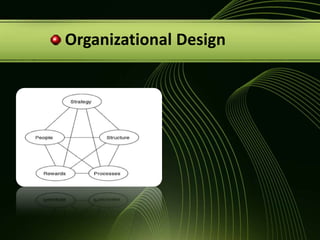
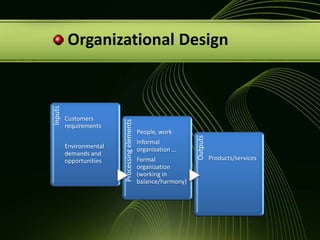
 Organizational Design… Enabling a group of people to combine, coordinate, and control resources and activities in order to produce value, all in a way appropriate to the environment in which the business competes.
 Organizational Design
 Organizational Design
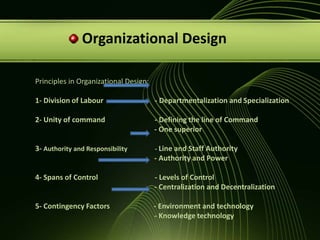
 Organizational DesignPrinciples in Organizational Design:1- Division of Labour-Departmentalization and Specialization2- Unity of command                           - Defining the line of Command                                                                 - One superior3- Authority and Responsibility                 - Line and Staff Authority                                                                 - Authority and Power4- Spans of Control                               - Levels of Control                                                                  - Centralization and Decentralization5- Contingency Factors- Environment and technology                                                                 - Knowledge technology
 Departmentalization…!
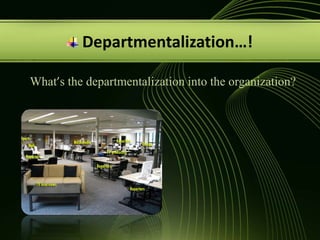
Departmentalization…!What’s the departmentalization into the organization?
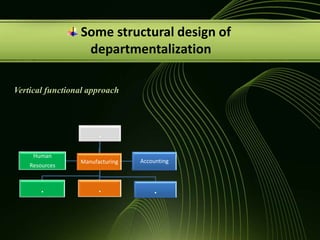
 Some structural design of departmentalization Vertical functional approach
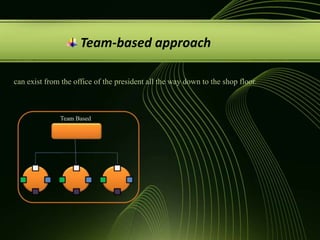
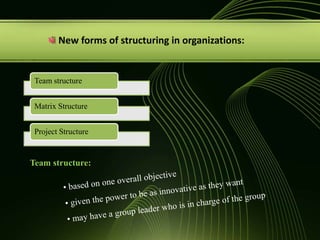
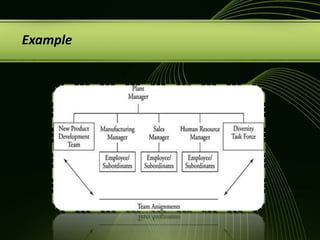
Team-based approachcan exist from the office of the president all the way down to the shop floor.Team Based
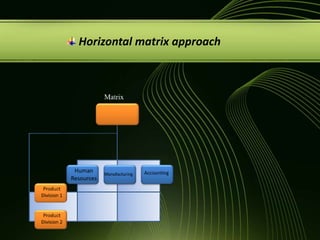
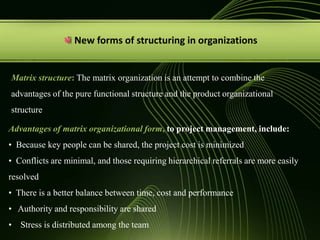
 HorizontalmatrixapproachMatrixHumanResourcesAccountingManufacturingProductDivision 1ProductDivision 2
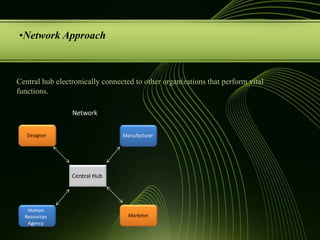
Network ApproachCentral hub electronically connected to other organizations that perform vital functions.NetworkManufacturerDesignerCentral HubHumanResourcesAgencyMarketer
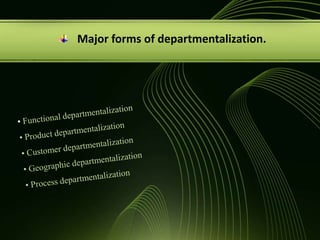
Majorformsofdepartmentalization.Functional departmentalization
 Product departmentalization
 Customer departmentalization
 Geographic departmentalization
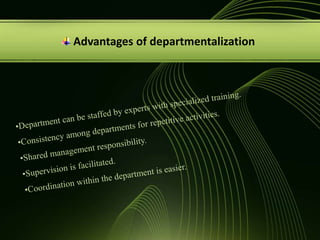
 Process departmentalization AdvantagesofdepartmentalizationDepartment can be staffed by experts with specialized training.
Consistency among departments for repetitive activities.
Shared management responsibility.
Supervision is facilitated.
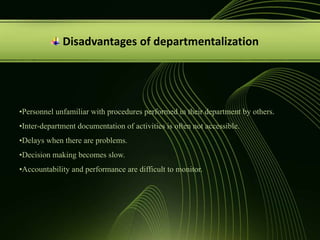
Coordination within the department is easier. DisadvantagesofdepartmentalizationPersonnel unfamiliar with procedures performed in their department by others.
Inter-department documentation of activities is often not accessible.
Delays when there are problems.
Decision making becomes slow.
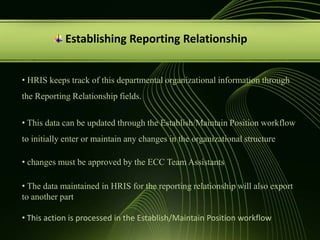
Accountability and performance are difficult to monitor.  EstablishingReportingRelationship HRIS keeps track of this departmental organizational information through the Reporting Relationship fields.
 This data can be updated through the Establish/Maintain Position workflow to initially enter or maintain any changes in the organizational structure
 changes must be approved by the ECC Team Assistants
 The data maintained in HRIS for the reporting relationship will also export to another part
 This action is processed in the Establish/Maintain Position workflow Allocating Authority
 Allocating AuthorityResponsibility.
Improving the quality of the service.
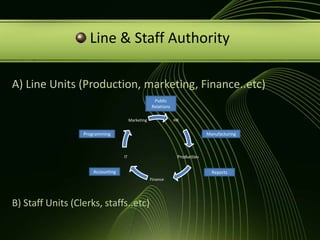
Span of control. Line & Staff AuthorityA) Line Units (Production, marketing, Finance..etc)B) Staff Units (Clerks, staffs..etc)Public RelationsManufacturingProgrammingAccountingReports
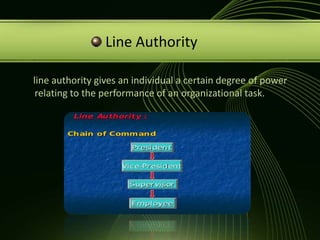
 Line Authority       line authority gives an individual a certain degree of power relating to the performance of an organizational task.
 Line Authority (2)line authority does not ensure effective performance.
line authority is not restricted to line personnel.Example:The head of marketing department has line authority over his or her employees by virtue of authority relationships between the department head and his or her directly-reporting employees.
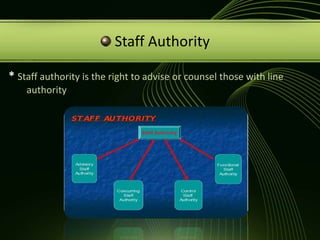
 Staff Authority* Staff authority is the right to advise or counsel those with line authority
 Staff Authority (2)Example:a quality control manager aids a production manager by determining the acceptable quality level of products or services at a manufacturing company, initiating quality programs, and carrying out statistical analysis to ensure compliance with quality standards.
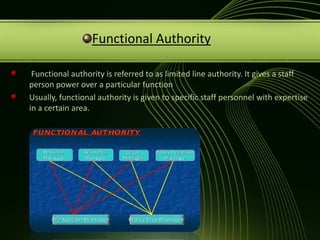
Functional AuthorityFunctional authority is referred to as limited line authority. It gives a staff person power over a particular functionUsually, functional authority is given to specific staff personnel with expertise in a certain area.
 Line & Staff ConflictWhy?Poor human relations

Organization Structure and Design