GENERAL ADMINISTRATIVE MANAGEMENT ROSALINA B. MEJORADA Master of Arts in Education Educational Management
Introduction Management is the process of getting things completed effectively and efficiently with and through other people.
Statement of the Problem What are the five elements of administration? What are the fourteen principl
 
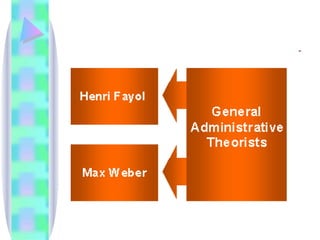
General Administrative Theory General administrative theorists Writers who developed general theories of what managers do and what constitutes good management practice Henri Fayol (France) Fourteen Principles of Management : Fundamental or universal principles of management practice Max Weber (Germany) Bureaucracy: Ideal type of organization characterized by division of labor, a clearly defined hierarchy, detailed rules and regulations, and impersonal relationships
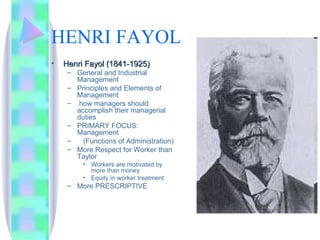
HENRI FAYOL Henri Fayol (1841-1925) General and Industrial Management Principles and Elements of Management  how managers should accomplish their managerial duties PRIMARY FOCUS:  Management (Functions of Administration) More Respect for Worker than Taylor Workers are motivated by more than money Equity in worker treatment More PRESCRIPTIVE
Fayol’s Administrative Theory Five Elements of Management -- Managerial Objectives Planning Organizing Command Coordination Control Keep machine functioning effectively and efficiently Replace quickly and efficiently any part or process that did not contribute to the objectives
Fayol’s Principles of Management Division of Labor:  Specialization allows individual to build up experience and continuously improve his skill. Thereby he can be more productive.
Fayol’s Principles of Management 2.Authority and Responsibility Authority is the right to give orders, and responsibility is it’s essential counterpart.  Whenever authority is exerted , responsibility arises.
Fayol’s Principles of Management 3.Discipline Upholding discipline is a core activity when running an organization, although its form varies across organizations.  Management can sanction employees with warnings, penalties, demotions or even dismissals.
Fayol’s Principles of Management 4. Unity of Command An employee must receive order from one superior only 5. Unity of Direction Each group of activities having one objective should be unified under one plan and leader
Fayol’s Principles of Management 6. Subordination of Individual Interest to the Common Interest   The interest of the majority  take precedence over the interest of the individual. 7. Remuneration of Personnel to maintain their loyalty and support , workers must be given fair wage for the services rendered.
Fayol’s Principles of Management  8.  Centralization The degree to which authority rests at the top of the organization 9.Scalar Chain/ Line of Authority Chain of supervision that connects from top to bottom
Fayol’s Principles of Management  10. Equity The provision of justice and the fair and impartial treatment of all employees. 11. Order The arrangement of employees where they will be of the most value to the organization and to provide career opportunities.
Fayol’s Principles of Management  12.  Initiative The fostering of creativity and innovation by encouraging employees to act on their own. 13. Stability of Tenure of Personnel Long-term employment is important for the development of skills that improve the organization’s performance.
Fayol’s Principles of Management  14.  Esprit de corps Comradeship, shared enthusiasm foster devotion to the common cause (organization).
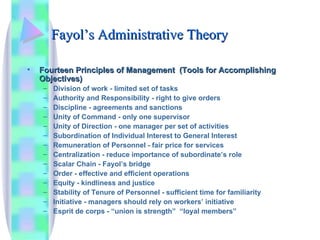
Fayol’s Administrative Theory Fourteen Principles of Management  (Tools for Accomplishing Objectives) Division of work - limited set of tasks Authority and Responsibility - right to give orders Discipline - agreements and sanctions Unity of Command - only one supervisor Unity of Direction - one manager per set of activities Subordination of Individual Interest to General Interest Remuneration of Personnel - fair price for services Centralization - reduce importance of subordinate’s role Scalar Chain - Fayol’s bridge Order - effective and efficient operations Equity - kindliness and justice Stability of Tenure of Personnel - sufficient time for familiarity Initiative - managers should rely on workers’ initiative Esprit de corps - “union is strength”  “loyal members”

Administrative theory

  • 1.
    GENERAL ADMINISTRATIVE MANAGEMENTROSALINA B. MEJORADA Master of Arts in Education Educational Management
  • 2.
    Introduction Management isthe process of getting things completed effectively and efficiently with and through other people.
  • 3.
    Statement of theProblem What are the five elements of administration? What are the fourteen principl
  • 4.
  • 5.
    General Administrative TheoryGeneral administrative theorists Writers who developed general theories of what managers do and what constitutes good management practice Henri Fayol (France) Fourteen Principles of Management : Fundamental or universal principles of management practice Max Weber (Germany) Bureaucracy: Ideal type of organization characterized by division of labor, a clearly defined hierarchy, detailed rules and regulations, and impersonal relationships
  • 6.
    HENRI FAYOL HenriFayol (1841-1925) General and Industrial Management Principles and Elements of Management how managers should accomplish their managerial duties PRIMARY FOCUS: Management (Functions of Administration) More Respect for Worker than Taylor Workers are motivated by more than money Equity in worker treatment More PRESCRIPTIVE
  • 7.
    Fayol’s Administrative TheoryFive Elements of Management -- Managerial Objectives Planning Organizing Command Coordination Control Keep machine functioning effectively and efficiently Replace quickly and efficiently any part or process that did not contribute to the objectives
  • 8.
    Fayol’s Principles ofManagement Division of Labor: Specialization allows individual to build up experience and continuously improve his skill. Thereby he can be more productive.
  • 9.
    Fayol’s Principles ofManagement 2.Authority and Responsibility Authority is the right to give orders, and responsibility is it’s essential counterpart. Whenever authority is exerted , responsibility arises.
  • 10.
    Fayol’s Principles ofManagement 3.Discipline Upholding discipline is a core activity when running an organization, although its form varies across organizations. Management can sanction employees with warnings, penalties, demotions or even dismissals.
  • 11.
    Fayol’s Principles ofManagement 4. Unity of Command An employee must receive order from one superior only 5. Unity of Direction Each group of activities having one objective should be unified under one plan and leader
  • 12.
    Fayol’s Principles ofManagement 6. Subordination of Individual Interest to the Common Interest The interest of the majority take precedence over the interest of the individual. 7. Remuneration of Personnel to maintain their loyalty and support , workers must be given fair wage for the services rendered.
  • 13.
    Fayol’s Principles ofManagement 8. Centralization The degree to which authority rests at the top of the organization 9.Scalar Chain/ Line of Authority Chain of supervision that connects from top to bottom
  • 14.
    Fayol’s Principles ofManagement 10. Equity The provision of justice and the fair and impartial treatment of all employees. 11. Order The arrangement of employees where they will be of the most value to the organization and to provide career opportunities.
  • 15.
    Fayol’s Principles ofManagement 12. Initiative The fostering of creativity and innovation by encouraging employees to act on their own. 13. Stability of Tenure of Personnel Long-term employment is important for the development of skills that improve the organization’s performance.
  • 16.
    Fayol’s Principles ofManagement 14. Esprit de corps Comradeship, shared enthusiasm foster devotion to the common cause (organization).
  • 17.
    Fayol’s Administrative TheoryFourteen Principles of Management (Tools for Accomplishing Objectives) Division of work - limited set of tasks Authority and Responsibility - right to give orders Discipline - agreements and sanctions Unity of Command - only one supervisor Unity of Direction - one manager per set of activities Subordination of Individual Interest to General Interest Remuneration of Personnel - fair price for services Centralization - reduce importance of subordinate’s role Scalar Chain - Fayol’s bridge Order - effective and efficient operations Equity - kindliness and justice Stability of Tenure of Personnel - sufficient time for familiarity Initiative - managers should rely on workers’ initiative Esprit de corps - “union is strength” “loyal members”

Editor's Notes

  • #17 Esprit de corps (French term) can be encouraged with verbal contact between employees and management