 Organizing: Arranging and structuring work
to accomplish an organizational’s goals.
 Organization chart: The visual
representation of an organatization’s
structure.
 Organizational Structure: The formal
arrangement of jobs within an organization.
 Organizational Design: Creating or
changing an organization’s structure.
 Work specialization: Dividing work activities
into separate job tasks.
 Departmentalization: The basis on which
jobs are grouped together.
 Formalization: How standardized an
organization’s jobs are and the extent to
which employee behavior is guided by rules
and procedures.
Coordinating
Establishing such relationships among
various parts of the organization that they
all together pull in the direction of the
organizational objectives.
Involves
Clear definition of authority-responsibility
relationship
Unity of direction
Unity of command
 Organizational Structure: is the formal
arrangement of jobs within organization.
This structure, which can be shown visually
in an organization chart.
 Organizational Design: When managers
create or change the structure, they are
engaged in organizational design, a
process that involves decisions about six key
elements: work specialization,
departmentalization, chain of command,
span of control, centralization and
decentralization, and formalization.
 Chain of command: The line of authority
extending from upper organizational
levels to the lowest level, which clarifies
who reports to whom.
 Span of Control: The number of
employees a manager can efficiently
and effectively manage.
 Number of employees who report to a
supervisor
› Traditional view = seven subordinates per
manager
› Lean organizations today = 30+ subordinates
 Supervisor Involvement
› must be closely involved with subordinates,
the span should be small
› need little involvement with subordinates, it
can be large
 Unbroken line of authority that
links all persons in an
organization
 Shows who reports to whom
 Associated with two underlying
principles
Unity of Command
Scalar Principle
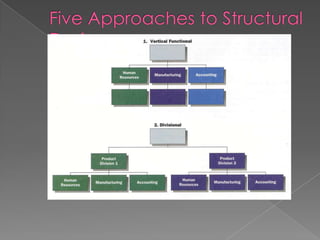
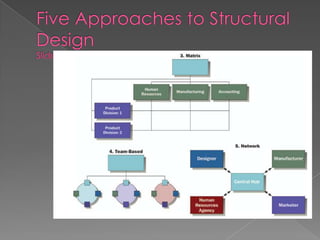
 Following are the different approaches to
organization structure:
1. Functional Organizational Structure
2. Product Organizational Structure
3. Geographical Organizational Structure
4. Matrix Organizational Structure
5. Team Organizational Structure
6. Virtual Organizational Structure
7. Line & Staff Organizational Structure
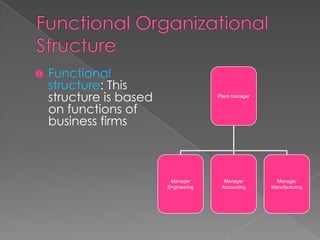
 Functional
structure: This
structure is based
on functions of
business firms
Plant manager
Manager
Engineering
Manager
Accounting
Manager
Manufacturing
 A functional structure would be effective
in single business firms where key
activities revolved around well- defined
skills and areas of specialization.
 The functional structure is most
appropriate when firms compete on the
basis of technical specialization or
efficiency in a relatively stable
environment.
 The departmental members may see the
activities from the narrow view point of
the department rather than the total
organization. This aspect results in poor
coordination and cooperation.
 Delay in decision making or ineffective
decision making.
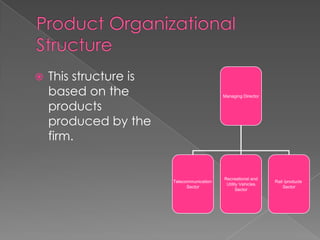
 This structure is
based on the
products
produced by the
firm.
Managing Director
Telecommunication
Sector
Recreational and
Utility Vehicles
Sector
Rail /products
Sector
 Appropriate for organizations with
multiple products.
 Suited for more dynamic environment.
 Moves decisions close to the problem
 Clarifies profit/ loss accountability.
 Involves difficulty in allocating overheads
 Results in duplication of equipment and
personnel.
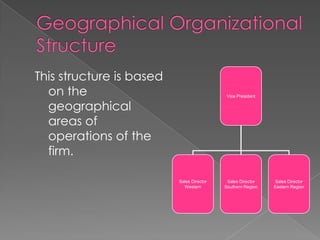
This structure is based
on the
geographical
areas of
operations of the
firm.
Vice President
Sales Director
Western
Sales Director
Southern Region
Sales Director
Eastern Region
 Improves functional coordination within
the target market.
 Takes advantage of economies of local
operations.
 Adds another layer of management to
run the geographic units.
 Can result in duplication of staff services
at head-quarters and regional levels,
creating a relative cost disadvantage.
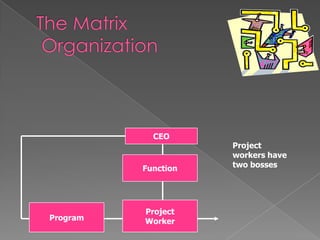
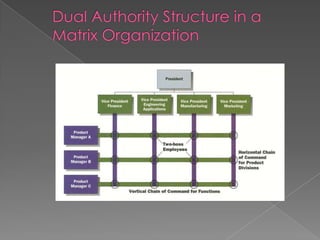
 Matrix is a hybrid grid structure wherein
pure project organization is
superimposed on a functional structure.
It combines vertical and horizontal lines
of authority.
Function
Project
WorkerProgram
CEO
Project
workers have
two bosses
 The matrix structure is commonly used in
the firms whose technological change is
rapid.
 This structure has considerable flexibility.
The personnel can be transferred from
one project to the other depending
upon the need of the project.
 Greater administrative cost associated
with its operation.
 Personnel spend much time in
exchanging information to coordinate
functional areas with projects.
 This structure is based on the business
teams.
 Same advantages as
functional structure
 Reduced barriers among
departments
 Quicker response time
 Better morale
 Reduced administrative
overhead
 Dual loyalties and
conflict
 Time and resources
spent on meetings
 Unplanned
decentralization
 These structures are not visible but their
presence is felt wherever necessary.
 An organizational structure that
disaggregates major functions to
separate companies that are brokered
by a small headquarters organization.
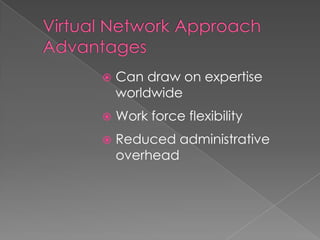
 Can draw on expertise
worldwide
 Work force flexibility
 Reduced administrative
overhead
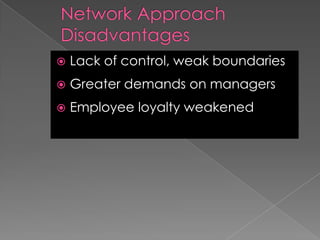
 Lack of control, weak boundaries
 Greater demands on managers
 Employee loyalty weakened
 Line Authority = individuals in
management positions have the
formal power to direct and
control immediate subordinates
 Staff Authority = granted to staff
specialists in their area of
expertise
 Line and staff organization is a
combination of line and functional
structures. Under it, line authority flows in
a vertical line in the same manner as in
the line organization. In addition, staff
specialists are attached to line positions
to advise them on important matters.
These specialists do not have power of
command over subordinates in other
departments. They are purely of advisory
nature.
 Advantages:
1) Expert advice
2) Reduced Workload
3) Quality decisions
4) Flexibility
 Disadvantages:
1) Line and staff conflicts
2) Confusion
3) Ineffective staff
4) Expensive

Org. structure by Neeraj Bhandari ( Surkhet.Nepal )

  • 2.
     Organizing: Arrangingand structuring work to accomplish an organizational’s goals.  Organization chart: The visual representation of an organatization’s structure.  Organizational Structure: The formal arrangement of jobs within an organization.
  • 3.
     Organizational Design:Creating or changing an organization’s structure.  Work specialization: Dividing work activities into separate job tasks.  Departmentalization: The basis on which jobs are grouped together.  Formalization: How standardized an organization’s jobs are and the extent to which employee behavior is guided by rules and procedures.
  • 5.
    Coordinating Establishing such relationshipsamong various parts of the organization that they all together pull in the direction of the organizational objectives. Involves Clear definition of authority-responsibility relationship Unity of direction Unity of command
  • 6.
     Organizational Structure:is the formal arrangement of jobs within organization. This structure, which can be shown visually in an organization chart.  Organizational Design: When managers create or change the structure, they are engaged in organizational design, a process that involves decisions about six key elements: work specialization, departmentalization, chain of command, span of control, centralization and decentralization, and formalization.
  • 7.
     Chain ofcommand: The line of authority extending from upper organizational levels to the lowest level, which clarifies who reports to whom.  Span of Control: The number of employees a manager can efficiently and effectively manage.
  • 8.
     Number ofemployees who report to a supervisor › Traditional view = seven subordinates per manager › Lean organizations today = 30+ subordinates  Supervisor Involvement › must be closely involved with subordinates, the span should be small › need little involvement with subordinates, it can be large
  • 9.
     Unbroken lineof authority that links all persons in an organization  Shows who reports to whom  Associated with two underlying principles Unity of Command Scalar Principle
  • 11.
     Following arethe different approaches to organization structure: 1. Functional Organizational Structure 2. Product Organizational Structure 3. Geographical Organizational Structure 4. Matrix Organizational Structure 5. Team Organizational Structure 6. Virtual Organizational Structure 7. Line & Staff Organizational Structure
  • 12.
     Functional structure: This structureis based on functions of business firms Plant manager Manager Engineering Manager Accounting Manager Manufacturing
  • 13.
     A functionalstructure would be effective in single business firms where key activities revolved around well- defined skills and areas of specialization.  The functional structure is most appropriate when firms compete on the basis of technical specialization or efficiency in a relatively stable environment.
  • 14.
     The departmentalmembers may see the activities from the narrow view point of the department rather than the total organization. This aspect results in poor coordination and cooperation.  Delay in decision making or ineffective decision making.
  • 15.
     This structureis based on the products produced by the firm. Managing Director Telecommunication Sector Recreational and Utility Vehicles Sector Rail /products Sector
  • 16.
     Appropriate fororganizations with multiple products.  Suited for more dynamic environment.  Moves decisions close to the problem  Clarifies profit/ loss accountability.
  • 17.
     Involves difficultyin allocating overheads  Results in duplication of equipment and personnel.
  • 18.
    This structure isbased on the geographical areas of operations of the firm. Vice President Sales Director Western Sales Director Southern Region Sales Director Eastern Region
  • 19.
     Improves functionalcoordination within the target market.  Takes advantage of economies of local operations.
  • 20.
     Adds anotherlayer of management to run the geographic units.  Can result in duplication of staff services at head-quarters and regional levels, creating a relative cost disadvantage.
  • 21.
     Matrix isa hybrid grid structure wherein pure project organization is superimposed on a functional structure. It combines vertical and horizontal lines of authority.
  • 22.
  • 24.
     The matrixstructure is commonly used in the firms whose technological change is rapid.  This structure has considerable flexibility. The personnel can be transferred from one project to the other depending upon the need of the project.
  • 25.
     Greater administrativecost associated with its operation.  Personnel spend much time in exchanging information to coordinate functional areas with projects.
  • 26.
     This structureis based on the business teams.
  • 27.
     Same advantagesas functional structure  Reduced barriers among departments  Quicker response time  Better morale  Reduced administrative overhead
  • 28.
     Dual loyaltiesand conflict  Time and resources spent on meetings  Unplanned decentralization
  • 29.
     These structuresare not visible but their presence is felt wherever necessary.  An organizational structure that disaggregates major functions to separate companies that are brokered by a small headquarters organization.
  • 30.
     Can drawon expertise worldwide  Work force flexibility  Reduced administrative overhead
  • 31.
     Lack ofcontrol, weak boundaries  Greater demands on managers  Employee loyalty weakened
  • 34.
     Line Authority= individuals in management positions have the formal power to direct and control immediate subordinates  Staff Authority = granted to staff specialists in their area of expertise
  • 35.
     Line andstaff organization is a combination of line and functional structures. Under it, line authority flows in a vertical line in the same manner as in the line organization. In addition, staff specialists are attached to line positions to advise them on important matters. These specialists do not have power of command over subordinates in other departments. They are purely of advisory nature.
  • 36.
     Advantages: 1) Expertadvice 2) Reduced Workload 3) Quality decisions 4) Flexibility
  • 37.
     Disadvantages: 1) Lineand staff conflicts 2) Confusion 3) Ineffective staff 4) Expensive