Production Management
UNIT 9 – WASTE MANAGEMENT
Waste - Definition
 Most legal definitions of waste can be summarized
as
 a product or a substance that is no longer suited for
its intended use
 According to the Basel Convention(1989),
 wastes are substances or objects which are
disposed or are intended to be disposed or are
required to be disposed off by national laws
 From a production stand point
 An inevitable consequence of development and industrial
progress is generation of waste
Regulations related to Waste Mgmt
 Ministry of Environment, Forest and Climate Change,
Government of India
 National Environment Policy, 2006
 Environment Protection Act, 1986
 Bio-medical Waste (Management and Handling) Rules,
2016
 The Batteries (Management and Handling) Rules, 2001
 The E-waste (Management and Handling) Rules, 2011
 The Plastic Waste (Management and Handling) Rules,
2011
 The Hazardous Wastes (Management, Handling and
Types of waste
Hazardous
 pose a threat to human health and the environment if it is
not handled properly
 For this reason, many countries have strict regulations
governing the storage, collection and treatment of
hazardous waste
 Much hazardous waste originates from industrial
production
 Industrial waste, biomedical waste, Electronic and electrical
equipment (EE waste)
Non hazardous
 All waste not included in hazardous category
 Solid waste: from cities
Health/environment hazards
Surface water contamination
 Takes place when the wastes reach water bodies
 Pollution of rivers, lakes and ground water
Ground water contamination
 Takes place when residues from waste, leach into the ground water
Soil contamination
 Caused by dumping of waste
 Waste can harm plants and can indirectly adversely impact the
health of humans and animals
Air contamination
 Caused by emissions from incinerators, other waste burning devices &
from landfills
International conventions
addressing waste
At the 1992 Rio Conference, waste was made one of the
priorities of Agenda 21
 Agenda 21 is a comprehensive plan of action to be taken
globally, nationally and locally and was adopted by more
than 178 Governments at the United Nations
Conference in Rio de Janeiro
At the Johannesburg World Summit on Sustainable
Development in 2002, the focus was on
 Initiatives to accelerate the shift to sustainable
consumption and production, reduction of resource
degradation, pollution and waste
International conventions
addressing waste
London convention on Prevention of Marine Pollution by
Dumping of Wastes and Other Matter, 1975
Entered into force in 1975
Objective is to prevent pollution of the sea by the
dumping of waste and other matter that is liable to create
hazards to human health, to harm living resources and
marine life, to damage amenities or to interfere with
other legitimate uses of the sea
The MARPOL Convention for the Prevention of Pollution
from Ships, 1978
Main international convention covering prevention of
pollution of marine environment by ships from
operational or accidental causes
International conventions
addressing waste
Baselconvention
 Convention was principally devoted to setting up a
framework for controlling the trans-boundary movements
of hazardous waste, that is, the movement of hazardous
waste across international frontiers
 It developed criteria for “environmentally sound
management of waste”
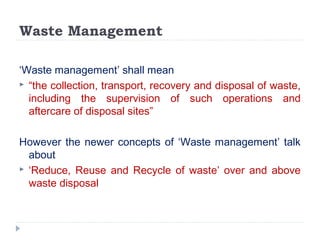
Waste Management
‘Waste management’ shall mean
 “the collection, transport, recovery and disposal of waste,
including the supervision of such operations and
aftercare of disposal sites”
However the newer concepts of ‘Waste management’ talk
about
 ‘Reduce, Reuse and Recycle of waste’ over and above
waste disposal
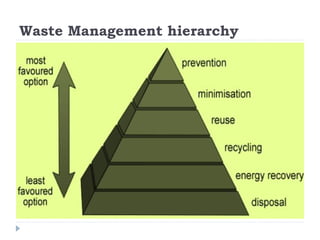
Waste Management hierarchy
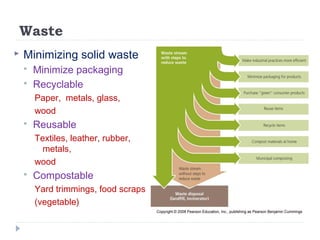
Waste
 Minimizing solid waste
 Minimize packaging
 Recyclable
Paper, metals, glass,
wood
 Reusable
Textiles, leather, rubber,
metals,
wood
 Compostable
Yard trimmings, food scraps
(vegetable)
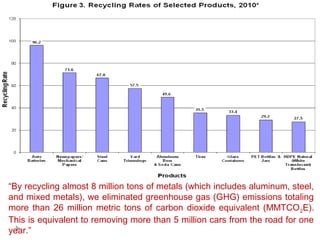
“By recycling almost 8 million tons of metals (which includes aluminum, steel,
and mixed metals), we eliminated greenhouse gas (GHG) emissions totaling
more than 26 million metric tons of carbon dioxide equivalent (MMTCO2E).
This is equivalent to removing more than 5 million cars from the road for one
year.”
CATEGORIES OF WASTE
DISPOSAL
1. DILUTE AND
DISPERSE
(ATTENUATION)
Throw it in the
river / lake / sea
Burn it
Basically this involves spreading trash thinly
over a large area to minimize its impact
Works for sewage, some waste chemicals,
when land-disposal is not available
Plastic in GANGA
2. CONCENTRATE
AND CONTAIN
(ISOLATION)
Waste dumps,
landfills
Historically, that’s how most of the solid
waste gets treated
Useful options
 Resource recovery
 Composting
 Vermicomposting
 Energy recovery
 Incineration
 Pyrolysis
 Gasification
 Bio-methanation or
anaerobic digestion
Incineration
is a waste treatment process that involves the
combustion of organic substances contained
in waste materials. Incineration and other high-
temperature waste treatment systems are
described as "thermal treatment". Incineration of
waste materials converts the waste into ash, flue
gas and heat.
Pyrolysis
is the thermal degradation of organic materials in the
absence of oxygen. Thermal decomposition of organic
components in the waste stream starts at 350°C–550°C
and goes up to 700°C–800°C in the absence of
air/oxygen.
Pyrolysis technology provides an opportunity for the
conversion of municipal solid wastes, agricultural
residues, scrap tires, non-recyclable plastics etc into
clean energy.
Gasification
is a process that converts organic- or fossil fuel-based
carbonaceous materials into carbon monoxide, hydrogen
and carbon dioxide. This is achieved by reacting the
material at high temperatures (>700 °C), without
combustion, with a controlled amount of oxygen and/or
steam.
The power derived from gasification and combustion of
the resultant gas is considered to be a source of
renewable energy if the gasified compounds were
obtained from biomass
Bio-methanation
In anaerobic digestion, organic material is converted to
biogas by a series of bacteria groups into methane and
carbon dioxide. The majority of commercially operating
digesters are plug flow and complete-mix reactors
operating at mesophilic temperatures.
Anaerobic digestion is a unique treatment solution for
animal manure as it can deliver positive benefits
related to multiple issues, including renewable
energy, water pollution, and air emissions.
Impacts of waste on health
 Chemical poisoning through chemical inhalation
 Uncollected waste can obstruct the storm water runoff
resulting in flood
 Low birth weight
 Cancer
 Congenital malformations
 Neurological disease
Impacts of waste on health
 Nausea and vomiting
 Increase in hospitalization of diabetic residents living near
hazard waste sites.
 Mercury toxicity from eating fish with high levels of
mercury.
Goorah, S., Esmyot, M., Boojhawon, R. (2009). The Health Impact of Nonhazardous Solid Waste Disposal in a
Community: The case of the Mare Chicose Landfill in Mauritius. Journal of Environment Health, 72(1) 48-
54
Kouznetsova, M., Hauang, X., Ma, J., Lessner, L. & Carpenter, D. (2007). Increased Rate of Hospitalization for
Diabetes and Residential Proximity of Hazardous waste Sites. Environmental Health Perspectives,
115(1)75-75
Barlaz, M., Kaplan, P., Ranjithan, S. & Rynk, R. (2003) Evaluating Environmental Impacts of solid Waste
Management Alternatives. BioCycle, 52-56.
Effects of waste on animals and
aquatics life
 Increase in mercury level in fish due to disposal of
mercury in the rivers.
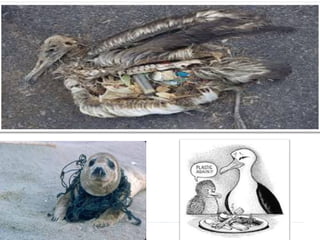
 Plastic found in oceans ingested by birds.
 Resulted in high algal population in rivers and sea.
 Degrades water and soil quality.
Impacts of waste on Environment
 Waste breaks down in landfills to form methane, a potent
greenhouse gas
 Change in climate and destruction of ozone layer due to
waste biodegradable
 Littering, due to waste pollutions, illegal dumping,
Leaching: is a process by which solid waste enter soil and
ground water and contaminating them.
 U.S. Environment Protection Agency (2009)
It is estimated that food wasted by the US and
Europe could feed the world three times over.
Food waste contributes to excess consumption of
freshwater and fossil fuels which, along with methane
and CO2 emissions from decomposing food, impacts
global climate change.
Every tonne of food waste prevented has the potential to
save 4.2 tonnes of CO2 equivalent. If we all stop wasting
food that could have been eaten, the CO2 impact would
be the equivalent of taking one in four cars off the road.
WHAT SHOULD BE DONE
 Reduce Waste
- Reduce office paper waste by implementing a formal policy to
duplex all draft reports and by making training manuals and
personnel information available electronically.
- Improve product design to use less materials.
- Redesign packaging to eliminate excess material while maintaining
strength.
- Work with customers to design and implement a packaging return
program.
- Switch to reusable transport containers.
- Purchase products in bulk.
WHAT SHOULD BE DONE
Reuse
- Reuse corrugated moving boxes internally.
- Reuse office furniture and supplies, such as interoffice
envelopes, file folders, and paper.
- Use durable towels, tablecloths, napkins, dishes, cups,
and glasses.
- Use incoming packaging materials for outgoing
shipments.
- Encourage employees to reuse office materials rather
than purchase new ones.
WHAT SHOULD BE DONE
Donate/Exchange
- old books
- old clothes
- old computers
- excess building materials
- old equipment to local organizations
WHAT SHOULD BE DONE
Employee Education
- Develop an “office recycling procedures” packet.
- Send out recycling reminders to all employees
including environmental articles.
- Train employees on recycling practices prior to
implementing recycling programs.
- Conduct an ongoing training process as new
technologies are introduced and new employees join
the institution.
WHAT SHOULD BE DONE
Employee Education
- education campaign on waste management that
includes an extensive internal web site, quarterly
newsletters, daily bulletins, promotional signs and
helpful reference labels within the campus of an
institution.
WHAT SHOULD BE DONE
Conduct outreach program adopting an
ecologically sound waste management system
which includes:
 waste reduction
 segregation at source
 composting
 recycling and re-use
 more efficient collection
 more environmentally sound disposal
Residents may be organized into small
groups to carry out the following:
1. construction of backyard compost pit
2. construction of storage bins where recyclable and
reusable materials are stored by each household
3. construction of storage centers where recyclable
and reusable materials collected by the street
sweepers are stored prior to selling to junk dealers
4. maintenance of cleanliness in yards and streets
5. greening of their respective areas
6. encouraging others to join
HOW TO REDUCE INDUSTRIAL
WASTE!
 Measure Your Waste. ...
 Be A More Efficient Business. ...
 Consider A Waste Exchange. ...
 Reduce The Amount Of Packaging. ...
 Think About Food Waste. ...
 Cut Down On Bottled Water! ...
 Use Signs. ...
 Hire A Professional Waste Management Business.
1. MEASURE YOUR WASTE
If you don't know how much waste you are
producing, how can you effectively reduce it?
By measuring your waste your can share the
results and challenge everyone in your business
to reduce the amount of waste they produce.
If you notice that you are producing a lot of a
specific type of waste from a specific area of
your business, you can take measures to reduce
that specific type of waste from that specific
area of your business.
2. BE A MORE EFFICIENT BUSINESS
 Try and discover a way you can use your
raw materials in a more efficient manner.
 For example, check if you can utilise
recycled materials within your business's
manufacturing process.
3. CONSIDER A WASTE EXCHANGE
 For some industries, one business's waste can
be another's resource. If you'd like to reduce
your business's industrial waste, look at the
waste that your business produces and discover
if your waste can be utilised as a resource in
another business's manufacturing process.
 By exchanging your waste in this manner
instead of disposing of it, you are preventing your
waste from becoming waste, which is the first
step in the waste hierarchy.
4. REDUCE THE AMOUNT OF
PACKAGING
 This can be done in two ways. Firstly, you can
reduce the amount of packaging on the products
that you produce.
 Secondly, compare the packaging of any
products you purchase.
 Many products have reduced packaging when
bought in bulk, so this can be a fantastic way of
reducing the amount of waste you produce.
5. THINK ABOUT FOOD WASTE
 Another waste reduction method regards food waste. Think about
the food waste your employees produce in your workplace's
'breakout room' or wherever your employees eat their food. A
fantastic way of reducing the amount of waste going to landfill is by
recycling your food waste.
 Food waste in landfill emits methane gas when it decomposes.
Methane gas is a very powerful greenhouse gas. When people think
about global warming, they think about carbon dioxide emissions
but methane gas is roughly 30 times more potent than carbon
dioxide as a heat trapping gas.
6. CUT DOWN ON BOTTLED WATER!
 Many businesses produce waste in the form of plastic drinking bottles. As with all
forms of waste, commercial or not, hazardous or not, it is important that we reduce all
forms of waste as much as possible in order to protect our precious planet.
 Tapwater.org wrote that “The UK consumes 18 billion plastic bottles each year" and
because only approximately 25% of these 18 billion plastic bottles are recycled “this
means 38 million plastic bottles end up in landfill every single day!"
 Whilst recycling plastic bottles is very important for the environment, recycling isn't the
first step on the waste hierarchy. There are three steps above recycling, prevention,
minimisation and reuse.
 By switching from bottled water to drinking glasses you can prevent plastic bottles
from becoming waste, or at the least reduce the amount of waste plastic bottles that
your business produces. Your business could also promote the use of reusable bottles
within the workplace for drinks within the workplace.
7. USE SIGNS
 If you have recycling systems in place but your employees aren't
using them to their full potential. For example, if waste paper is
being thrown into the general waste bin. Consider using signs to
promote recycling in your business. Place signs telling people to
recycle their waste.
 You could go one step further and try reducing the amount of
general waste bins in your workplace and place recycling bins in
more beneficial locations.
 For example a paper recycling bin next to the printer or an
aluminium recycling bin next to a drinks vending machine.
8. HIRE A PROFESSIONAL WASTE
MANAGEMENT BUSINESS
 A professional waste management business, will
be able to provide you with a variety of waste
management services designed to manage your
waste in an effective and responsible manner
that causes minimal disruption to your business.
Ex:BKP
WASTE
IS
NOT WASTE
UNTIL
IT IS
WASTED

Waste management-Production

  • 1.
    Production Management UNIT 9– WASTE MANAGEMENT
  • 2.
    Waste - Definition Most legal definitions of waste can be summarized as  a product or a substance that is no longer suited for its intended use  According to the Basel Convention(1989),  wastes are substances or objects which are disposed or are intended to be disposed or are required to be disposed off by national laws  From a production stand point  An inevitable consequence of development and industrial progress is generation of waste
  • 3.
    Regulations related toWaste Mgmt  Ministry of Environment, Forest and Climate Change, Government of India  National Environment Policy, 2006  Environment Protection Act, 1986  Bio-medical Waste (Management and Handling) Rules, 2016  The Batteries (Management and Handling) Rules, 2001  The E-waste (Management and Handling) Rules, 2011  The Plastic Waste (Management and Handling) Rules, 2011  The Hazardous Wastes (Management, Handling and
  • 4.
    Types of waste Hazardous pose a threat to human health and the environment if it is not handled properly  For this reason, many countries have strict regulations governing the storage, collection and treatment of hazardous waste  Much hazardous waste originates from industrial production  Industrial waste, biomedical waste, Electronic and electrical equipment (EE waste) Non hazardous  All waste not included in hazardous category  Solid waste: from cities
  • 5.
    Health/environment hazards Surface watercontamination  Takes place when the wastes reach water bodies  Pollution of rivers, lakes and ground water Ground water contamination  Takes place when residues from waste, leach into the ground water Soil contamination  Caused by dumping of waste  Waste can harm plants and can indirectly adversely impact the health of humans and animals Air contamination  Caused by emissions from incinerators, other waste burning devices & from landfills
  • 6.
    International conventions addressing waste Atthe 1992 Rio Conference, waste was made one of the priorities of Agenda 21  Agenda 21 is a comprehensive plan of action to be taken globally, nationally and locally and was adopted by more than 178 Governments at the United Nations Conference in Rio de Janeiro At the Johannesburg World Summit on Sustainable Development in 2002, the focus was on  Initiatives to accelerate the shift to sustainable consumption and production, reduction of resource degradation, pollution and waste
  • 7.
    International conventions addressing waste Londonconvention on Prevention of Marine Pollution by Dumping of Wastes and Other Matter, 1975 Entered into force in 1975 Objective is to prevent pollution of the sea by the dumping of waste and other matter that is liable to create hazards to human health, to harm living resources and marine life, to damage amenities or to interfere with other legitimate uses of the sea The MARPOL Convention for the Prevention of Pollution from Ships, 1978 Main international convention covering prevention of pollution of marine environment by ships from operational or accidental causes
  • 8.
    International conventions addressing waste Baselconvention Convention was principally devoted to setting up a framework for controlling the trans-boundary movements of hazardous waste, that is, the movement of hazardous waste across international frontiers  It developed criteria for “environmentally sound management of waste”
  • 9.
    Waste Management ‘Waste management’shall mean  “the collection, transport, recovery and disposal of waste, including the supervision of such operations and aftercare of disposal sites” However the newer concepts of ‘Waste management’ talk about  ‘Reduce, Reuse and Recycle of waste’ over and above waste disposal
  • 10.
  • 11.
    Waste  Minimizing solidwaste  Minimize packaging  Recyclable Paper, metals, glass, wood  Reusable Textiles, leather, rubber, metals, wood  Compostable Yard trimmings, food scraps (vegetable)
  • 12.
    “By recycling almost8 million tons of metals (which includes aluminum, steel, and mixed metals), we eliminated greenhouse gas (GHG) emissions totaling more than 26 million metric tons of carbon dioxide equivalent (MMTCO2E). This is equivalent to removing more than 5 million cars from the road for one year.”
  • 13.
    CATEGORIES OF WASTE DISPOSAL 1.DILUTE AND DISPERSE (ATTENUATION) Throw it in the river / lake / sea Burn it Basically this involves spreading trash thinly over a large area to minimize its impact Works for sewage, some waste chemicals, when land-disposal is not available Plastic in GANGA
  • 15.
    2. CONCENTRATE AND CONTAIN (ISOLATION) Wastedumps, landfills Historically, that’s how most of the solid waste gets treated
  • 17.
    Useful options  Resourcerecovery  Composting  Vermicomposting  Energy recovery  Incineration  Pyrolysis  Gasification  Bio-methanation or anaerobic digestion
  • 18.
    Incineration is a wastetreatment process that involves the combustion of organic substances contained in waste materials. Incineration and other high- temperature waste treatment systems are described as "thermal treatment". Incineration of waste materials converts the waste into ash, flue gas and heat.
  • 19.
    Pyrolysis is the thermaldegradation of organic materials in the absence of oxygen. Thermal decomposition of organic components in the waste stream starts at 350°C–550°C and goes up to 700°C–800°C in the absence of air/oxygen. Pyrolysis technology provides an opportunity for the conversion of municipal solid wastes, agricultural residues, scrap tires, non-recyclable plastics etc into clean energy.
  • 20.
    Gasification is a processthat converts organic- or fossil fuel-based carbonaceous materials into carbon monoxide, hydrogen and carbon dioxide. This is achieved by reacting the material at high temperatures (>700 °C), without combustion, with a controlled amount of oxygen and/or steam. The power derived from gasification and combustion of the resultant gas is considered to be a source of renewable energy if the gasified compounds were obtained from biomass
  • 21.
    Bio-methanation In anaerobic digestion,organic material is converted to biogas by a series of bacteria groups into methane and carbon dioxide. The majority of commercially operating digesters are plug flow and complete-mix reactors operating at mesophilic temperatures. Anaerobic digestion is a unique treatment solution for animal manure as it can deliver positive benefits related to multiple issues, including renewable energy, water pollution, and air emissions.
  • 22.
    Impacts of wasteon health  Chemical poisoning through chemical inhalation  Uncollected waste can obstruct the storm water runoff resulting in flood  Low birth weight  Cancer  Congenital malformations  Neurological disease
  • 23.
    Impacts of wasteon health  Nausea and vomiting  Increase in hospitalization of diabetic residents living near hazard waste sites.  Mercury toxicity from eating fish with high levels of mercury. Goorah, S., Esmyot, M., Boojhawon, R. (2009). The Health Impact of Nonhazardous Solid Waste Disposal in a Community: The case of the Mare Chicose Landfill in Mauritius. Journal of Environment Health, 72(1) 48- 54 Kouznetsova, M., Hauang, X., Ma, J., Lessner, L. & Carpenter, D. (2007). Increased Rate of Hospitalization for Diabetes and Residential Proximity of Hazardous waste Sites. Environmental Health Perspectives, 115(1)75-75 Barlaz, M., Kaplan, P., Ranjithan, S. & Rynk, R. (2003) Evaluating Environmental Impacts of solid Waste Management Alternatives. BioCycle, 52-56.
  • 24.
    Effects of wasteon animals and aquatics life  Increase in mercury level in fish due to disposal of mercury in the rivers.  Plastic found in oceans ingested by birds.  Resulted in high algal population in rivers and sea.  Degrades water and soil quality.
  • 26.
    Impacts of wasteon Environment  Waste breaks down in landfills to form methane, a potent greenhouse gas  Change in climate and destruction of ozone layer due to waste biodegradable  Littering, due to waste pollutions, illegal dumping, Leaching: is a process by which solid waste enter soil and ground water and contaminating them.  U.S. Environment Protection Agency (2009)
  • 27.
    It is estimatedthat food wasted by the US and Europe could feed the world three times over. Food waste contributes to excess consumption of freshwater and fossil fuels which, along with methane and CO2 emissions from decomposing food, impacts global climate change. Every tonne of food waste prevented has the potential to save 4.2 tonnes of CO2 equivalent. If we all stop wasting food that could have been eaten, the CO2 impact would be the equivalent of taking one in four cars off the road.
  • 29.
    WHAT SHOULD BEDONE  Reduce Waste - Reduce office paper waste by implementing a formal policy to duplex all draft reports and by making training manuals and personnel information available electronically. - Improve product design to use less materials. - Redesign packaging to eliminate excess material while maintaining strength. - Work with customers to design and implement a packaging return program. - Switch to reusable transport containers. - Purchase products in bulk.
  • 30.
    WHAT SHOULD BEDONE Reuse - Reuse corrugated moving boxes internally. - Reuse office furniture and supplies, such as interoffice envelopes, file folders, and paper. - Use durable towels, tablecloths, napkins, dishes, cups, and glasses. - Use incoming packaging materials for outgoing shipments. - Encourage employees to reuse office materials rather than purchase new ones.
  • 31.
    WHAT SHOULD BEDONE Donate/Exchange - old books - old clothes - old computers - excess building materials - old equipment to local organizations
  • 32.
    WHAT SHOULD BEDONE Employee Education - Develop an “office recycling procedures” packet. - Send out recycling reminders to all employees including environmental articles. - Train employees on recycling practices prior to implementing recycling programs. - Conduct an ongoing training process as new technologies are introduced and new employees join the institution.
  • 33.
    WHAT SHOULD BEDONE Employee Education - education campaign on waste management that includes an extensive internal web site, quarterly newsletters, daily bulletins, promotional signs and helpful reference labels within the campus of an institution.
  • 34.
    WHAT SHOULD BEDONE Conduct outreach program adopting an ecologically sound waste management system which includes:  waste reduction  segregation at source  composting  recycling and re-use  more efficient collection  more environmentally sound disposal
  • 35.
    Residents may beorganized into small groups to carry out the following: 1. construction of backyard compost pit 2. construction of storage bins where recyclable and reusable materials are stored by each household 3. construction of storage centers where recyclable and reusable materials collected by the street sweepers are stored prior to selling to junk dealers 4. maintenance of cleanliness in yards and streets 5. greening of their respective areas 6. encouraging others to join
  • 36.
    HOW TO REDUCEINDUSTRIAL WASTE!  Measure Your Waste. ...  Be A More Efficient Business. ...  Consider A Waste Exchange. ...  Reduce The Amount Of Packaging. ...  Think About Food Waste. ...  Cut Down On Bottled Water! ...  Use Signs. ...  Hire A Professional Waste Management Business.
  • 37.
    1. MEASURE YOURWASTE If you don't know how much waste you are producing, how can you effectively reduce it? By measuring your waste your can share the results and challenge everyone in your business to reduce the amount of waste they produce. If you notice that you are producing a lot of a specific type of waste from a specific area of your business, you can take measures to reduce that specific type of waste from that specific area of your business.
  • 38.
    2. BE AMORE EFFICIENT BUSINESS  Try and discover a way you can use your raw materials in a more efficient manner.  For example, check if you can utilise recycled materials within your business's manufacturing process.
  • 39.
    3. CONSIDER AWASTE EXCHANGE  For some industries, one business's waste can be another's resource. If you'd like to reduce your business's industrial waste, look at the waste that your business produces and discover if your waste can be utilised as a resource in another business's manufacturing process.  By exchanging your waste in this manner instead of disposing of it, you are preventing your waste from becoming waste, which is the first step in the waste hierarchy.
  • 40.
    4. REDUCE THEAMOUNT OF PACKAGING  This can be done in two ways. Firstly, you can reduce the amount of packaging on the products that you produce.  Secondly, compare the packaging of any products you purchase.  Many products have reduced packaging when bought in bulk, so this can be a fantastic way of reducing the amount of waste you produce.
  • 41.
    5. THINK ABOUTFOOD WASTE  Another waste reduction method regards food waste. Think about the food waste your employees produce in your workplace's 'breakout room' or wherever your employees eat their food. A fantastic way of reducing the amount of waste going to landfill is by recycling your food waste.  Food waste in landfill emits methane gas when it decomposes. Methane gas is a very powerful greenhouse gas. When people think about global warming, they think about carbon dioxide emissions but methane gas is roughly 30 times more potent than carbon dioxide as a heat trapping gas.
  • 42.
    6. CUT DOWNON BOTTLED WATER!  Many businesses produce waste in the form of plastic drinking bottles. As with all forms of waste, commercial or not, hazardous or not, it is important that we reduce all forms of waste as much as possible in order to protect our precious planet.  Tapwater.org wrote that “The UK consumes 18 billion plastic bottles each year" and because only approximately 25% of these 18 billion plastic bottles are recycled “this means 38 million plastic bottles end up in landfill every single day!"  Whilst recycling plastic bottles is very important for the environment, recycling isn't the first step on the waste hierarchy. There are three steps above recycling, prevention, minimisation and reuse.  By switching from bottled water to drinking glasses you can prevent plastic bottles from becoming waste, or at the least reduce the amount of waste plastic bottles that your business produces. Your business could also promote the use of reusable bottles within the workplace for drinks within the workplace.
  • 43.
    7. USE SIGNS If you have recycling systems in place but your employees aren't using them to their full potential. For example, if waste paper is being thrown into the general waste bin. Consider using signs to promote recycling in your business. Place signs telling people to recycle their waste.  You could go one step further and try reducing the amount of general waste bins in your workplace and place recycling bins in more beneficial locations.  For example a paper recycling bin next to the printer or an aluminium recycling bin next to a drinks vending machine.
  • 44.
    8. HIRE APROFESSIONAL WASTE MANAGEMENT BUSINESS  A professional waste management business, will be able to provide you with a variety of waste management services designed to manage your waste in an effective and responsible manner that causes minimal disruption to your business. Ex:BKP
  • 45.

Editor's Notes

  • #18 https://www.youtube.com/watch?v=5alysJM-n5g
  • #19 Biomethanation is a process by which organic material is microbiologically converted under anaerobic conditions to biogas. Three main physiological groups of microorganisms are involved: fermenting bacteria, organic acid oxidizing bacteria, and methanogenic archaea.
  • #24 Numerous epidemiology studies have been conducted to evaluate whether the health of people living near hazardous waste disposal sites is being adversely affected(Moeller, 20050.