ORGANISATIONAL BEHAVIOUR
 Presentation by
Mr. Basavaraj M. Naik M.Com, NET, KSET
Full-time Guest Lecturer
Department of Studies in Commerce
Rani Channamma University Belagavi
Post- Graduate Centre, Jamkhandi
UNIT 1: INTRODUCTION
Meaning and Definition, Nature, Scope,
Challenges and Opportunities for
organizational behavior,
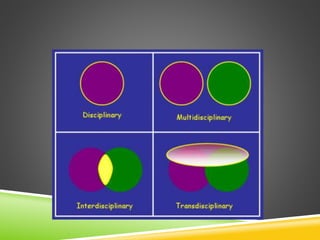
Disciplines contributing to the field of
Organizational Behavior,
Organizational Behavior Models.
Positive Organizational Behaviour.
CONCEPT OF OB
 Organisational behavior is a very important subject in
business management. It is an essential tool to
manage teams at work effectively. It also helps
managers understand and predict employee behaviour
in an organization.
 The study of Organizational Behavior (OB) is very
interesting and challenging too. It is related to
individuals, group of people working together in teams.
The study becomes more challenging when situational
factors interact. The study of organizational behavior
relates to the expected behavior of an individual in the
organization.
The study of Organizational Behavior (OB) is
very interesting and challenging too. It is
related to individuals, group of people working
together in teams. The study becomes more
challenging when situational factors interact.
The study of organizational behavior relates to
the expected behavior of an individual in the
organization.
DEFINITIONS:
According to Davis and Newstram,
“Organisational behaviour is the study and
application of knowledge about how people act
within organizations.”
In words of K Aswathappa, “OB is the study of
human behaviour in organizational setting, of
the interface between human behaviour and
organization and of the organization itself.”
According to Fred Luthans, “Behaviour is
directly concerned with the understanding,
prediction and control of human behaviour in
organizations.”
SCOPE OF OB
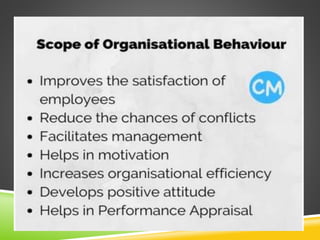
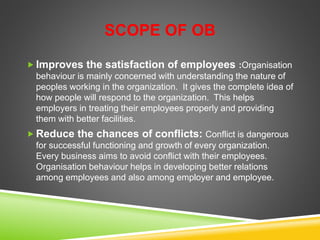
 Improves the satisfaction of employees :Organisation
behaviour is mainly concerned with understanding the nature of
peoples working in the organization. It gives the complete idea of
how people will respond to the organization. This helps
employers in treating their employees properly and providing
them with better facilities.
 Reduce the chances of conflicts: Conflict is dangerous
for successful functioning and growth of every organization.
Every business aims to avoid conflict with their employees.
Organisation behaviour helps in developing better relations
among employees and also among employer and employee.
Facilitates management :Organisation behaviour
does a systematic analysis of peoples working in the
organisation and provides all the required information
to employers. It performs analysis of individual
behaviour, group behaviour and organisation
behaviour. This helps in better management of
organisation affairs.
Helps in motivation: Companies develop a better
system of motivating their employees through
organisational behaviour. Through organisational
behaviour, complete information regarding employee’s
need and requirement is well understood.
 Increases organisational efficiency:
 It aims at increasing the efficiency of the organisation through maximum
utilisation of resources. Organisational behaviour attempts to reduce the
wastage of resources. It helps in the identification of the right type of human
skill required for the organisation for better productivity. Accordingly, the
selection and recruitment process is conducted to hire the right peoples. It
minimizes the wastage of cost and time involved in these processes.
 Develops positive attitude:
 Organisational behaviour develops a positive working environment within the
organisation. It leads to co-operation and mutual trust among peoples
working in the organisation. It makes it easy to predict the individual’s
behaviour, needs and requirements. Organisation can accordingly focus on
employee’s needs and work for their betterment to increase their satisfaction
level.
 Helps in Performance Appraisal: Performance
appraisal is an important element for improving the
performance of the employees. Employees when
awarded for their good performance feel motivated to
work better. They look forward to being appraised for
their good performance.
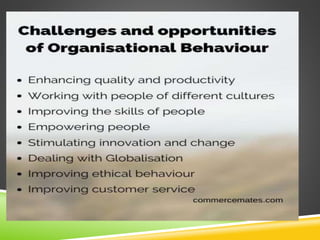
Enhancing Quality and Productivity:
Maintaining the quality of its products is a
challenging task for every organization. It is the
driving force through which companies are able to
attract more & more customers & hold them for the
long term.
Every organization should focus on quality
factor to increase its customer base. The main
dimensions covered under the quality factors are
Features, Reliability, Durability, Performance,
Conformance with standards, Responses &
Reputation.
Working with People in Different Cultures
Every employee working in an organization
wants to retain their own values & cultures
although they are working in the same company
where they need to follow some rules &
regulations.
Same decision of organization may be
welcomed & accepted by people of one culture
& opposed by people from another culture.
Therefore managers need to treat every
employee differently as per their individual
differences in order to ensure cooperation &
increase productivity.
Improving the Skills of People
Skills of people need to improved & upgraded
as per the requirements from time to time. In
the business area, there are always lots of
changes which occur at a faster rate in terms
of technology, environment & structure.
 Empowering People
 Empowerment of employees is another challenging task for every
organization. Productivity of employees generally gets reduced
when kept under stringent rules & regulations as compared when
they are allotted some freedom.
 Delegating appropriate responsibility & power to employees at
different level is important & challenging task for managers.
Employees should be allowed & encouraged to participate in
various work-related decisions. This will improve employer-
employee relations in the organization & also the commitment of
employees to work.
 Stimulating ( Encourage) Innovation and Change
 Today every business needs to focus on innovative ideas in order to bring
changes to beat the tough competition in the market. Business should
always focus to differentiate their product from their competitor’s product.
It will help them in getting more & more customers.
 Dealing with Globalization
 Today globalization of business is something that is increasing worldwide
at a great pace. Now the operations of the business are not limited to one
particular location or nation, but they are performed internationally.
Business nowadays are conducted beyond the national boundary of one
country & have their presence in different countries of the world.
Improving Ethical Behaviour:
Better ethical behaviour in working culture is a must for
an organization to increase its productivity. It should
always be ensured that employees behave positively &
abide by all rules & regulations of the organization.
 This will help in increasing their productivity & reducing
conflicts. Clear cut instruction should be given
regarding what is right behaviour & what is wrong.
Managers should organize various workshops,
seminars & training programmes in order to improve
ethical behaviour of employees.
Improving customer service:
Business is unsuccessful if it fails to treat its
customer well & provide them with better
service. If businesses have a large number of
satisfied customers it will help it in enjoying large
profits in the long run.
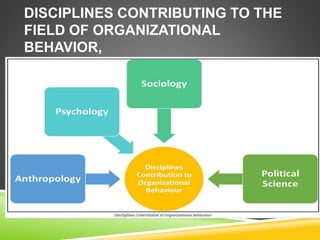
DISCIPLINES CONTRIBUTING TO THE
FIELD OF ORGANIZATIONAL
BEHAVIOR,
PSYCHOLOGY:
 Psychology has perhaps the first influence on the field of
organizational behavior because it is a science of behavior. A
psychologist studies almost all aspects of behavior.
 Psychology deals with studying human behavior that seeks
to explain and sometimes change the behavior of humans.
 Psychologists are primarily interested in predicting the
behavior of individuals to a great extent by observing the
dynamics of personal factors.
 Some of the numerous areas of interest within the
disciplines of psychology are:
 General Psychology
 Experimental Psychology
 Clinical Psychology
 Consumer Psychology
 Personality and Social Psychology
 Industrial Psychology
 Counselling Psychology
 Educational Psychology
 Consulting Psychology
SOCIOLOGY
 The major focus of sociologists is on studying the social systems
in which individuals fill their roles. The focus is on group
dynamics. (system of behaviors and psychological processes
occurring within a social group, or between social groups.) They
have made their greatest contribution to OB through their study of
group behavior in organizations, particularly formal and
sophisticated organizations.
 Sociological concepts, theories, models, and techniques help
significantly to understand better the group dynamics,
organizational culture, formal organization theory and structure,
corporate technology, bureaucracy, communications, power,
conflict, and intergroup behavior. Psychologists are primarily
interested in focusing their attention on individual behavior.
ANTHROPOLOGY
 The main aim of anthropology is to acquire a better understanding of
the relationship between the human being and the environment.
 Adaptations to surroundings constitute culture. The manner in which
people view their surroundings is a part of the culture.
 Their work on culture and environment has helped us to understand
differences in fundamental values, attitudes, and behavior among
people in different countries and within different organizations.
 Anthropologists contribute to study some aspects of organizational
settings – similar values, comparative attitudes between or among
the employees.
POLITICAL SCIENCES
 Contributions of political scientists are significant to the
understanding of behavior in organizations. Political scientists
study the behavior of individuals and groups within a political
environment.
 They contribute to understanding the dynamics of power centers,
structuring of conflict and conflict resolution tactics, allocation of
power and how people manipulate power for individual self-
interest.
 The knowledge of political science can be utilized in the study the
behavior of employees, executives at micro as well as macro
level.
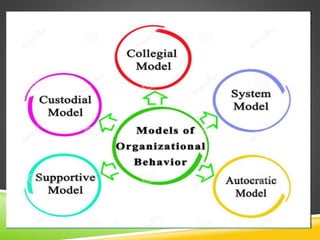
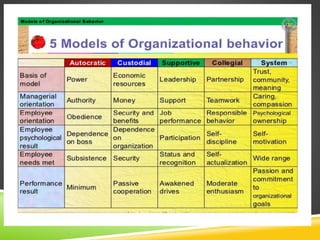
AUTOCRATIC MODEL
Autocratic model is the model that depends
upon strength, power and formal authority.
In an autocratic organization, the people
(management/owners) who manage the tasks
in an Organisation have formal authority for
controlling the employees who work under
them. These lower-level employees have little
control over the work function. Their ideas and
innovations are not generally welcomed, as the
key decisions are made at the top
management level.
CUSTODIAL MODEL
 The custodial model is based around the concept of providing
economic security for employees – through wages and other
benefits – that will create employee loyalty and motivation.
 In some countries, many professional companies provide health
benefits, corporate cars, financial packaging of salary, and so on –
these are incentives designed to attract and retain quality staff.
 The underlying theory for the organization is that they will have a
greater skilled workforce, more motivated employees, and have a
competitive advantage through employee knowledge and
expertise.
SUPPORTIVE MODEL
 Unlike the two earlier approaches, the supportive model is
focused around aspiring leadership.
 It is not based upon control and authority (the autocratic model) or
upon incentives (the custodial model), but instead tries to
motivate staff through the manager-employee relationship and
how employees are treated on a day-to-day basis.
 Quite opposite to the autocratic model, this approach states that
employees are self-motivated and have value and insight to
contribute to the organisation, beyond just their day-to-day role.
 The intent of this model is to motivate employees through a
positive workplace where their ideas are encouraged and often
adapted.
COLLEGIAL MODEL
 The collegial model is based around teamwork – everybody
working as colleagues (hence the name of the model).
 The overall environment and corporate culture need to be aligned
to this model, where everybody is actively participating – is not
about status and job titles – everybody is encouraged to work
together to build a better organisation.
 The role of the manager is to foster this teamwork and create
positive and energetic workplaces. In much regard, the manager
can be considered to be the “coach” of the team. And as coach,
the goal is to make the team perform well overall, rather than
focus on their own performance, or the performance of key
individuals.
 The collegial model is quite effective in organisations that need to
find new approaches – marketing teams, research and
development, technology/software – indeed anywhere the
competitive landscape is constantly changing and ideas and
innovation are key competitive success factors.
SYSTEM MODEL
 The final organisational model is referred to as the system model.
 This is the most contemporary model of the five models discussed
above. In the system model, the organisation looks at the overall
structure and team environment, and considers that individuals
have different goals, talents and potential.
 The intent of the system model is to try and balance the goals of
the individual with the goals of the organisation.
 Individuals obviously want good remuneration, job security, but
also want to work in a positive work environment where the
organisation adds value to the community and/or its customers.
 The system of model should be an overall partnership of
managers and employees with a common goal, and where
everybody feels that they have a stake in the organisation.
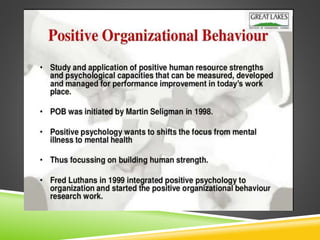
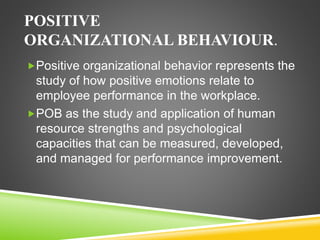
POSITIVE
ORGANIZATIONAL BEHAVIOUR.
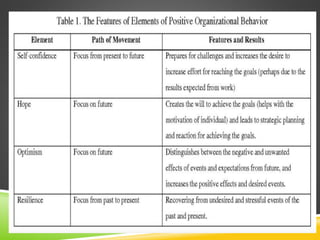
Positive organizational behavior represents the
study of how positive emotions relate to
employee performance in the workplace.
POB as the study and application of human
resource strengths and psychological
capacities that can be measured, developed,
and managed for performance improvement.
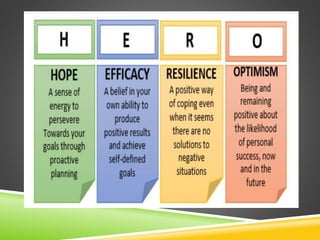
Hope: As a verb, its definitions include: “expect
with confidence” and “to follow a desire with
anticipation”. It creates positive impact on
emotional health, ability to cope with illness
and other hardships ( constraints ) . It provides
determination to achieve goals.
 Self-efficacy: represents the best fit with all the criteria of POB
among all the four capacities. Self-efficacy belief appears to
determine how much effort people will spend on a task and how
long they will continue with it.
 Resilience : ( flexibility ) Resiliency can be developed
by enhancing assets that a person has through
education, training and nurturing social relationships.
Risk factors should be managed and adaptation
process should be enhanced.
 Optimism : A thinking style which relates positive
events to internal, permanent, and comprehensive
causes. A common idiom used to illustrate optimism
versus pessimism is a glass with water at the halfway
point, where the optimist is said to see the glass as
half full, but the pessimist sees the glass as half empty.
IMPORTANCE OF OB
 It builds better relationship by achieving people’s, organizational,
and social objectives.
 It covers a wide array of human resource like behavior, training
and development, change management, leadership, teams etc.
 It brings coordination which is the essence of management.
 It improves goodwill of the organization.
 It helps to achieve objectives quickly.
 It makes optimum utilization of resources.
 It facilitates motivation.
 It leads to higher efficiency.
 It improves relations in the organization.
LIMITATIONS OF ORGANIZATIONAL
BEHAVIOR:
 Behavioral bias: It further causes dependence,
indiscipline, and irresponsibility.
 Law of diminishing returns: It says that beyond a
certain point, there is a decline in output even after
each additional good or positive factor.
 Unethical practices and manipulation of people:
Knowledge of motivation and communication acquired
can be used to exploit subordinates in an Organization
by the manipulative managers.
Thank you
REFERENCES:
 https://commercemates.com/challenges-and-opportunities-of-
organisational-behaviour/
 https://www.economicsdiscussion.net/management/organisational
-behaviour/31869
 Models of OB-
https://www.economicsdiscussion.net/management/organisational
-behaviour/31869

Organisational Behaviour

  • 1.
    ORGANISATIONAL BEHAVIOUR  Presentationby Mr. Basavaraj M. Naik M.Com, NET, KSET Full-time Guest Lecturer Department of Studies in Commerce Rani Channamma University Belagavi Post- Graduate Centre, Jamkhandi
  • 2.
    UNIT 1: INTRODUCTION Meaningand Definition, Nature, Scope, Challenges and Opportunities for organizational behavior, Disciplines contributing to the field of Organizational Behavior, Organizational Behavior Models. Positive Organizational Behaviour.
  • 4.
    CONCEPT OF OB Organisational behavior is a very important subject in business management. It is an essential tool to manage teams at work effectively. It also helps managers understand and predict employee behaviour in an organization.  The study of Organizational Behavior (OB) is very interesting and challenging too. It is related to individuals, group of people working together in teams. The study becomes more challenging when situational factors interact. The study of organizational behavior relates to the expected behavior of an individual in the organization.
  • 5.
    The study ofOrganizational Behavior (OB) is very interesting and challenging too. It is related to individuals, group of people working together in teams. The study becomes more challenging when situational factors interact. The study of organizational behavior relates to the expected behavior of an individual in the organization.
  • 6.
    DEFINITIONS: According to Davisand Newstram, “Organisational behaviour is the study and application of knowledge about how people act within organizations.” In words of K Aswathappa, “OB is the study of human behaviour in organizational setting, of the interface between human behaviour and organization and of the organization itself.” According to Fred Luthans, “Behaviour is directly concerned with the understanding, prediction and control of human behaviour in organizations.”
  • 10.
    SCOPE OF OB Improves the satisfaction of employees :Organisation behaviour is mainly concerned with understanding the nature of peoples working in the organization. It gives the complete idea of how people will respond to the organization. This helps employers in treating their employees properly and providing them with better facilities.  Reduce the chances of conflicts: Conflict is dangerous for successful functioning and growth of every organization. Every business aims to avoid conflict with their employees. Organisation behaviour helps in developing better relations among employees and also among employer and employee.
  • 11.
    Facilitates management :Organisationbehaviour does a systematic analysis of peoples working in the organisation and provides all the required information to employers. It performs analysis of individual behaviour, group behaviour and organisation behaviour. This helps in better management of organisation affairs. Helps in motivation: Companies develop a better system of motivating their employees through organisational behaviour. Through organisational behaviour, complete information regarding employee’s need and requirement is well understood.
  • 12.
     Increases organisationalefficiency:  It aims at increasing the efficiency of the organisation through maximum utilisation of resources. Organisational behaviour attempts to reduce the wastage of resources. It helps in the identification of the right type of human skill required for the organisation for better productivity. Accordingly, the selection and recruitment process is conducted to hire the right peoples. It minimizes the wastage of cost and time involved in these processes.  Develops positive attitude:  Organisational behaviour develops a positive working environment within the organisation. It leads to co-operation and mutual trust among peoples working in the organisation. It makes it easy to predict the individual’s behaviour, needs and requirements. Organisation can accordingly focus on employee’s needs and work for their betterment to increase their satisfaction level.
  • 13.
     Helps inPerformance Appraisal: Performance appraisal is an important element for improving the performance of the employees. Employees when awarded for their good performance feel motivated to work better. They look forward to being appraised for their good performance.
  • 15.
    Enhancing Quality andProductivity: Maintaining the quality of its products is a challenging task for every organization. It is the driving force through which companies are able to attract more & more customers & hold them for the long term. Every organization should focus on quality factor to increase its customer base. The main dimensions covered under the quality factors are Features, Reliability, Durability, Performance, Conformance with standards, Responses & Reputation.
  • 16.
    Working with Peoplein Different Cultures Every employee working in an organization wants to retain their own values & cultures although they are working in the same company where they need to follow some rules & regulations. Same decision of organization may be welcomed & accepted by people of one culture & opposed by people from another culture. Therefore managers need to treat every employee differently as per their individual differences in order to ensure cooperation & increase productivity.
  • 17.
    Improving the Skillsof People Skills of people need to improved & upgraded as per the requirements from time to time. In the business area, there are always lots of changes which occur at a faster rate in terms of technology, environment & structure.
  • 18.
     Empowering People Empowerment of employees is another challenging task for every organization. Productivity of employees generally gets reduced when kept under stringent rules & regulations as compared when they are allotted some freedom.  Delegating appropriate responsibility & power to employees at different level is important & challenging task for managers. Employees should be allowed & encouraged to participate in various work-related decisions. This will improve employer- employee relations in the organization & also the commitment of employees to work.
  • 19.
     Stimulating (Encourage) Innovation and Change  Today every business needs to focus on innovative ideas in order to bring changes to beat the tough competition in the market. Business should always focus to differentiate their product from their competitor’s product. It will help them in getting more & more customers.  Dealing with Globalization  Today globalization of business is something that is increasing worldwide at a great pace. Now the operations of the business are not limited to one particular location or nation, but they are performed internationally. Business nowadays are conducted beyond the national boundary of one country & have their presence in different countries of the world.
  • 20.
    Improving Ethical Behaviour: Betterethical behaviour in working culture is a must for an organization to increase its productivity. It should always be ensured that employees behave positively & abide by all rules & regulations of the organization.  This will help in increasing their productivity & reducing conflicts. Clear cut instruction should be given regarding what is right behaviour & what is wrong. Managers should organize various workshops, seminars & training programmes in order to improve ethical behaviour of employees.
  • 21.
    Improving customer service: Businessis unsuccessful if it fails to treat its customer well & provide them with better service. If businesses have a large number of satisfied customers it will help it in enjoying large profits in the long run.
  • 22.
    DISCIPLINES CONTRIBUTING TOTHE FIELD OF ORGANIZATIONAL BEHAVIOR,
  • 23.
    PSYCHOLOGY:  Psychology hasperhaps the first influence on the field of organizational behavior because it is a science of behavior. A psychologist studies almost all aspects of behavior.  Psychology deals with studying human behavior that seeks to explain and sometimes change the behavior of humans.  Psychologists are primarily interested in predicting the behavior of individuals to a great extent by observing the dynamics of personal factors.
  • 24.
     Some ofthe numerous areas of interest within the disciplines of psychology are:  General Psychology  Experimental Psychology  Clinical Psychology  Consumer Psychology  Personality and Social Psychology  Industrial Psychology  Counselling Psychology  Educational Psychology  Consulting Psychology
  • 25.
    SOCIOLOGY  The majorfocus of sociologists is on studying the social systems in which individuals fill their roles. The focus is on group dynamics. (system of behaviors and psychological processes occurring within a social group, or between social groups.) They have made their greatest contribution to OB through their study of group behavior in organizations, particularly formal and sophisticated organizations.  Sociological concepts, theories, models, and techniques help significantly to understand better the group dynamics, organizational culture, formal organization theory and structure, corporate technology, bureaucracy, communications, power, conflict, and intergroup behavior. Psychologists are primarily interested in focusing their attention on individual behavior.
  • 26.
    ANTHROPOLOGY  The mainaim of anthropology is to acquire a better understanding of the relationship between the human being and the environment.  Adaptations to surroundings constitute culture. The manner in which people view their surroundings is a part of the culture.  Their work on culture and environment has helped us to understand differences in fundamental values, attitudes, and behavior among people in different countries and within different organizations.  Anthropologists contribute to study some aspects of organizational settings – similar values, comparative attitudes between or among the employees.
  • 27.
    POLITICAL SCIENCES  Contributionsof political scientists are significant to the understanding of behavior in organizations. Political scientists study the behavior of individuals and groups within a political environment.  They contribute to understanding the dynamics of power centers, structuring of conflict and conflict resolution tactics, allocation of power and how people manipulate power for individual self- interest.  The knowledge of political science can be utilized in the study the behavior of employees, executives at micro as well as macro level.
  • 29.
    AUTOCRATIC MODEL Autocratic modelis the model that depends upon strength, power and formal authority. In an autocratic organization, the people (management/owners) who manage the tasks in an Organisation have formal authority for controlling the employees who work under them. These lower-level employees have little control over the work function. Their ideas and innovations are not generally welcomed, as the key decisions are made at the top management level.
  • 30.
    CUSTODIAL MODEL  Thecustodial model is based around the concept of providing economic security for employees – through wages and other benefits – that will create employee loyalty and motivation.  In some countries, many professional companies provide health benefits, corporate cars, financial packaging of salary, and so on – these are incentives designed to attract and retain quality staff.  The underlying theory for the organization is that they will have a greater skilled workforce, more motivated employees, and have a competitive advantage through employee knowledge and expertise.
  • 31.
    SUPPORTIVE MODEL  Unlikethe two earlier approaches, the supportive model is focused around aspiring leadership.  It is not based upon control and authority (the autocratic model) or upon incentives (the custodial model), but instead tries to motivate staff through the manager-employee relationship and how employees are treated on a day-to-day basis.  Quite opposite to the autocratic model, this approach states that employees are self-motivated and have value and insight to contribute to the organisation, beyond just their day-to-day role.  The intent of this model is to motivate employees through a positive workplace where their ideas are encouraged and often adapted.
  • 32.
    COLLEGIAL MODEL  Thecollegial model is based around teamwork – everybody working as colleagues (hence the name of the model).  The overall environment and corporate culture need to be aligned to this model, where everybody is actively participating – is not about status and job titles – everybody is encouraged to work together to build a better organisation.
  • 33.
     The roleof the manager is to foster this teamwork and create positive and energetic workplaces. In much regard, the manager can be considered to be the “coach” of the team. And as coach, the goal is to make the team perform well overall, rather than focus on their own performance, or the performance of key individuals.  The collegial model is quite effective in organisations that need to find new approaches – marketing teams, research and development, technology/software – indeed anywhere the competitive landscape is constantly changing and ideas and innovation are key competitive success factors.
  • 34.
    SYSTEM MODEL  Thefinal organisational model is referred to as the system model.  This is the most contemporary model of the five models discussed above. In the system model, the organisation looks at the overall structure and team environment, and considers that individuals have different goals, talents and potential.  The intent of the system model is to try and balance the goals of the individual with the goals of the organisation.
  • 35.
     Individuals obviouslywant good remuneration, job security, but also want to work in a positive work environment where the organisation adds value to the community and/or its customers.  The system of model should be an overall partnership of managers and employees with a common goal, and where everybody feels that they have a stake in the organisation.
  • 38.
    POSITIVE ORGANIZATIONAL BEHAVIOUR. Positive organizationalbehavior represents the study of how positive emotions relate to employee performance in the workplace. POB as the study and application of human resource strengths and psychological capacities that can be measured, developed, and managed for performance improvement.
  • 40.
    Hope: As averb, its definitions include: “expect with confidence” and “to follow a desire with anticipation”. It creates positive impact on emotional health, ability to cope with illness and other hardships ( constraints ) . It provides determination to achieve goals.
  • 41.
     Self-efficacy: representsthe best fit with all the criteria of POB among all the four capacities. Self-efficacy belief appears to determine how much effort people will spend on a task and how long they will continue with it.
  • 42.
     Resilience :( flexibility ) Resiliency can be developed by enhancing assets that a person has through education, training and nurturing social relationships. Risk factors should be managed and adaptation process should be enhanced.  Optimism : A thinking style which relates positive events to internal, permanent, and comprehensive causes. A common idiom used to illustrate optimism versus pessimism is a glass with water at the halfway point, where the optimist is said to see the glass as half full, but the pessimist sees the glass as half empty.
  • 45.
    IMPORTANCE OF OB It builds better relationship by achieving people’s, organizational, and social objectives.  It covers a wide array of human resource like behavior, training and development, change management, leadership, teams etc.  It brings coordination which is the essence of management.  It improves goodwill of the organization.  It helps to achieve objectives quickly.  It makes optimum utilization of resources.  It facilitates motivation.  It leads to higher efficiency.  It improves relations in the organization.
  • 46.
    LIMITATIONS OF ORGANIZATIONAL BEHAVIOR: Behavioral bias: It further causes dependence, indiscipline, and irresponsibility.  Law of diminishing returns: It says that beyond a certain point, there is a decline in output even after each additional good or positive factor.  Unethical practices and manipulation of people: Knowledge of motivation and communication acquired can be used to exploit subordinates in an Organization by the manipulative managers.
  • 47.
  • 48.