1-1
Chapter One
1-2
Organizations and Organizational Behavior
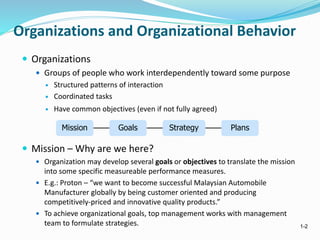
 Organizations
 Groups of people who work interdependently toward some purpose
 Structured patterns of interaction
 Coordinated tasks
 Have common objectives (even if not fully agreed)
 Mission – Why are we here?
 Organization may develop several goals or objectives to translate the mission
into some specific measureable performance measures.
 E.g.: Proton – “we want to become successful Malaysian Automobile
Manufacturer globally by being customer oriented and producing
competitively-priced and innovative quality products.”
 To achieve organizational goals, top management works with management
team to formulate strategies.
Mission Goals Strategy Plans
1-3
Organizations and Organizational Behavior
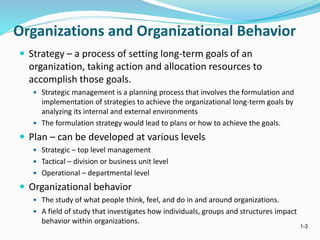
 Strategy – a process of setting long-term goals of an
organization, taking action and allocation resources to
accomplish those goals.
 Strategic management is a planning process that involves the formulation and
implementation of strategies to achieve the organizational long-term goals by
analyzing its internal and external environments
 The formulation strategy would lead to plans or how to achieve the goals.
 Plan – can be developed at various levels
 Strategic – top level management
 Tactical – division or business unit level
 Operational – departmental level
 Organizational behavior
 The study of what people think, feel, and do in and around organizations.
 A field of study that investigates how individuals, groups and structures impact
behavior within organizations.
1-4
Why Study Organizational Behavior?
 OB theories help you to make sense of the workplace
 Question and rebuild your personal theories for work
 Important -- much of our time is in organizations
 OB provides knowledge/tools to work with others
 Helps you to get things done
 OB improves an organization’s financial health
1-5
Three Good Reasons Why You Should Care
About . . . Organizational Behavior
1. Understanding the dynamics of behavior in organizations is
essential to achieving personal success as a manager,
regardless of your area of specialization
2. Principles of organizational behavior are involved in
making people both productive and happy on their jobs
3. To achieve success in today’s rapidly changing
environment, organizations must successfully address a
wide variety of OB issues
1-6
Characteristics of the Field of OB
 OB applies the scientific method to practical managerial
problems
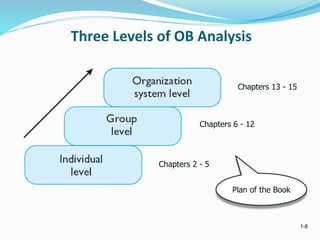
 OB focuses on three levels of analysis: individuals, groups, and
organizations
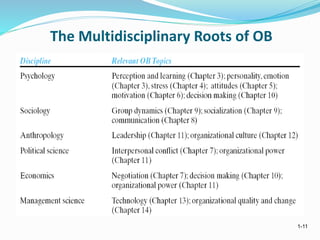
 OB is multidisciplinary in nature
 OB seeks to improve organizational effectiveness and the
quality of life at work
1-7
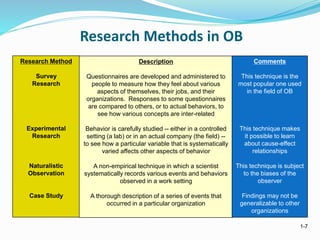
Research Methods in OB
Research Method
Survey
Research
Experimental
Research
Naturalistic
Observation
Case Study
Description
Questionnaires are developed and administered to
people to measure how they feel about various
aspects of themselves, their jobs, and their
organizations. Responses to some questionnaires
are compared to others, or to actual behaviors, to
see how various concepts are inter-related
Behavior is carefully studied -- either in a controlled
setting (a lab) or in an actual company (the field) --
to see how a particular variable that is systematically
varied affects other aspects of behavior
A non-empirical technique in which a scientist
systematically records various events and behaviors
observed in a work setting
A thorough description of a series of events that
occurred in a particular organization
Comments
This technique is the
most popular one used
in the field of OB
This technique makes
it possible to learn
about cause-effect
relationships
This technique is subject
to the biases of the
observer
Findings may not be
generalizable to other
organizations
1-8
Three Levels of OB Analysis
Chapters 2 - 5
Chapters 6 - 12
Chapters 13 - 15
Plan of the Book
1-9
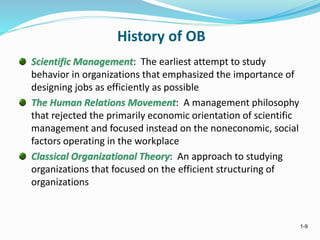
History of OB
Scientific Management: The earliest attempt to study
behavior in organizations that emphasized the importance of
designing jobs as efficiently as possible
The Human Relations Movement: A management philosophy
that rejected the primarily economic orientation of scientific
management and focused instead on the noneconomic, social
factors operating in the workplace
Classical Organizational Theory: An approach to studying
organizations that focused on the efficient structuring of
organizations
1-10
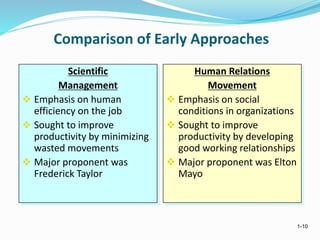
Comparison of Early Approaches
Scientific
Management
 Emphasis on human
efficiency on the job
 Sought to improve
productivity by minimizing
wasted movements
 Major proponent was
Frederick Taylor
Human Relations
Movement
 Emphasis on social
conditions in organizations
 Sought to improve
productivity by developing
good working relationships
 Major proponent was Elton
Mayo
1-11
The Multidisciplinary Roots of OB
1-12
Challenges and Opportunities for OB
 The workplace is contains a wide mix of cultures, races, ethnic
groups, genders and ages
 Employees have to learn to cope with rapid change due to
global competition
 Corporate loyalty has decreased due to corporate downsizing
and use of temp workers
 Managers can benefit from OB theory and concepts
1-13
Current Issues in OB
Cross-cultural aspects of behavior
Unethical behavior in organizations
Conserving energy and preserving the environment
Workforce diversity
Understanding and minimizing poor leadership decision-
making
Increasing team responsibility
Unrelenting change
1-14
Responding to Changes in Technology
 Creating Leaner Organizations
 Automation: The process f replacing people with machines, which includes
white-collar and mental-labor as well as blue-collar and menial labor
 Downsizing/Rightsizing: The process of adjusting the number of employees
needed to work in newly designed organizations
 Outsourcing: The process of eliminating those parts of organizations that
focus on noncore sectors of the business and hiring outside firms to perform
these functions instead
 Creating Virtual Enterprises
 Highly flexible, temporary organizations formed by groups of companies
that join forces to exploit a specific opportunity
 Increasing the Use of Telecommuting
 The practice of using communications technology to enable work to be
performed from remote locations
1-15
Responding to Globalization
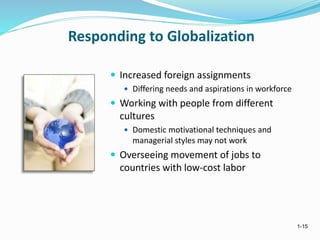
 Increased foreign assignments
 Differing needs and aspirations in workforce
 Working with people from different
cultures
 Domestic motivational techniques and
managerial styles may not work
 Overseeing movement of jobs to
countries with low-cost labor
1-16
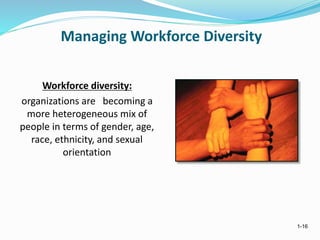
Managing Workforce Diversity
Workforce diversity:
organizations are becoming a
more heterogeneous mix of
people in terms of gender, age,
race, ethnicity, and sexual
orientation
1-17
Diversity Implications
“Managers have to shift their
philosophy from treating everyone
alike to recognizing differences
and responding to those
differences in ways that ensure
employee retention and greater
productivity while, at the same
time, not discriminating.”
1-18
Implications for Managers
 OB helps with:
 Insights to improve people skills
 Valuing of workforce diversity
 Empowering people and creating a positive work
environment
 Dealing with labor shortages
 Coping in a world of temporariness
 Creating an ethically healthy work environment
1-19
Keep in Mind…
• OB’s goal is to understand and predict human
behavior in organizations.
• Fundamental consistencies underlie behavior.
• It is more important than ever to learn OB
concepts.
• Both managers and employees must learn to cope
with temporariness.

Ob chapter 1 introduction to ob

  • 1.
  • 2.
    1-2 Organizations and OrganizationalBehavior  Organizations  Groups of people who work interdependently toward some purpose  Structured patterns of interaction  Coordinated tasks  Have common objectives (even if not fully agreed)  Mission – Why are we here?  Organization may develop several goals or objectives to translate the mission into some specific measureable performance measures.  E.g.: Proton – “we want to become successful Malaysian Automobile Manufacturer globally by being customer oriented and producing competitively-priced and innovative quality products.”  To achieve organizational goals, top management works with management team to formulate strategies. Mission Goals Strategy Plans
  • 3.
    1-3 Organizations and OrganizationalBehavior  Strategy – a process of setting long-term goals of an organization, taking action and allocation resources to accomplish those goals.  Strategic management is a planning process that involves the formulation and implementation of strategies to achieve the organizational long-term goals by analyzing its internal and external environments  The formulation strategy would lead to plans or how to achieve the goals.  Plan – can be developed at various levels  Strategic – top level management  Tactical – division or business unit level  Operational – departmental level  Organizational behavior  The study of what people think, feel, and do in and around organizations.  A field of study that investigates how individuals, groups and structures impact behavior within organizations.
  • 4.
    1-4 Why Study OrganizationalBehavior?  OB theories help you to make sense of the workplace  Question and rebuild your personal theories for work  Important -- much of our time is in organizations  OB provides knowledge/tools to work with others  Helps you to get things done  OB improves an organization’s financial health
  • 5.
    1-5 Three Good ReasonsWhy You Should Care About . . . Organizational Behavior 1. Understanding the dynamics of behavior in organizations is essential to achieving personal success as a manager, regardless of your area of specialization 2. Principles of organizational behavior are involved in making people both productive and happy on their jobs 3. To achieve success in today’s rapidly changing environment, organizations must successfully address a wide variety of OB issues
  • 6.
    1-6 Characteristics of theField of OB  OB applies the scientific method to practical managerial problems  OB focuses on three levels of analysis: individuals, groups, and organizations  OB is multidisciplinary in nature  OB seeks to improve organizational effectiveness and the quality of life at work
  • 7.
    1-7 Research Methods inOB Research Method Survey Research Experimental Research Naturalistic Observation Case Study Description Questionnaires are developed and administered to people to measure how they feel about various aspects of themselves, their jobs, and their organizations. Responses to some questionnaires are compared to others, or to actual behaviors, to see how various concepts are inter-related Behavior is carefully studied -- either in a controlled setting (a lab) or in an actual company (the field) -- to see how a particular variable that is systematically varied affects other aspects of behavior A non-empirical technique in which a scientist systematically records various events and behaviors observed in a work setting A thorough description of a series of events that occurred in a particular organization Comments This technique is the most popular one used in the field of OB This technique makes it possible to learn about cause-effect relationships This technique is subject to the biases of the observer Findings may not be generalizable to other organizations
  • 8.
    1-8 Three Levels ofOB Analysis Chapters 2 - 5 Chapters 6 - 12 Chapters 13 - 15 Plan of the Book
  • 9.
    1-9 History of OB ScientificManagement: The earliest attempt to study behavior in organizations that emphasized the importance of designing jobs as efficiently as possible The Human Relations Movement: A management philosophy that rejected the primarily economic orientation of scientific management and focused instead on the noneconomic, social factors operating in the workplace Classical Organizational Theory: An approach to studying organizations that focused on the efficient structuring of organizations
  • 10.
    1-10 Comparison of EarlyApproaches Scientific Management  Emphasis on human efficiency on the job  Sought to improve productivity by minimizing wasted movements  Major proponent was Frederick Taylor Human Relations Movement  Emphasis on social conditions in organizations  Sought to improve productivity by developing good working relationships  Major proponent was Elton Mayo
  • 11.
  • 12.
    1-12 Challenges and Opportunitiesfor OB  The workplace is contains a wide mix of cultures, races, ethnic groups, genders and ages  Employees have to learn to cope with rapid change due to global competition  Corporate loyalty has decreased due to corporate downsizing and use of temp workers  Managers can benefit from OB theory and concepts
  • 13.
    1-13 Current Issues inOB Cross-cultural aspects of behavior Unethical behavior in organizations Conserving energy and preserving the environment Workforce diversity Understanding and minimizing poor leadership decision- making Increasing team responsibility Unrelenting change
  • 14.
    1-14 Responding to Changesin Technology  Creating Leaner Organizations  Automation: The process f replacing people with machines, which includes white-collar and mental-labor as well as blue-collar and menial labor  Downsizing/Rightsizing: The process of adjusting the number of employees needed to work in newly designed organizations  Outsourcing: The process of eliminating those parts of organizations that focus on noncore sectors of the business and hiring outside firms to perform these functions instead  Creating Virtual Enterprises  Highly flexible, temporary organizations formed by groups of companies that join forces to exploit a specific opportunity  Increasing the Use of Telecommuting  The practice of using communications technology to enable work to be performed from remote locations
  • 15.
    1-15 Responding to Globalization Increased foreign assignments  Differing needs and aspirations in workforce  Working with people from different cultures  Domestic motivational techniques and managerial styles may not work  Overseeing movement of jobs to countries with low-cost labor
  • 16.
    1-16 Managing Workforce Diversity Workforcediversity: organizations are becoming a more heterogeneous mix of people in terms of gender, age, race, ethnicity, and sexual orientation
  • 17.
    1-17 Diversity Implications “Managers haveto shift their philosophy from treating everyone alike to recognizing differences and responding to those differences in ways that ensure employee retention and greater productivity while, at the same time, not discriminating.”
  • 18.
    1-18 Implications for Managers OB helps with:  Insights to improve people skills  Valuing of workforce diversity  Empowering people and creating a positive work environment  Dealing with labor shortages  Coping in a world of temporariness  Creating an ethically healthy work environment
  • 19.
    1-19 Keep in Mind… •OB’s goal is to understand and predict human behavior in organizations. • Fundamental consistencies underlie behavior. • It is more important than ever to learn OB concepts. • Both managers and employees must learn to cope with temporariness.