Human Resource Management
Mr. Shrinivas V K
Human Resource Management
Outline
Definition
Meaning of HRM
Core Elements of HRM
Objectives of HRM
Functions of HRM
Scope of HRM
Role of HRM
Challenges of HRM in Indian Economy / Modern Management
Relationship with other social sciences – Approaches to HRM /
Interdisciplinary approach
Newspaper Articles
Human Resource Management
Definition 1 – Integration
HRM is a series of integrated decisions that form the
employment relationships; their quality contributes to the
ability of the organizations and the employees to achieve
their objectives
Human Resource Management
Definition 2- Influencing
 HRM is concerned with the people dimensions
management. Since every organization is made up
of people ,acquiring their services, developing
their skills , motivating them to higher levels of
performance and ensuring that they continue to
maintain their commitment to the organization are
essential to achieving organizational objectives.
This is true regardless of the type of the
organization- Govt, business education , health,
recreational or social action
Definition 3 Applicability
• HRM is planning, organizing directing and controlling
of the procurement , development, compensation ,
integration, maintenance, and separation of human
resources to the end that individual, organizational
and social objectives are accomplished.
Core Elements of HRM
Organizations ------People ------ Management
Meaning of HRM
 It is concerned with management of people from
Recruitment to Retirement
 To select right person, at the right place for the right job.
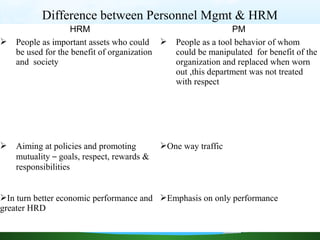
Difference between Personnel Mgmt & HRM
HRM PM
 People as important assets who could
be used for the benefit of organization
and society
 People as a tool behavior of whom
could be manipulated for benefit of the
organization and replaced when worn
out ,this department was not treated
with respect
 Aiming at policies and promoting
mutuality – goals, respect, rewards &
responsibilities
One way traffic
In turn better economic performance and
greater HRD
Emphasis on only performance
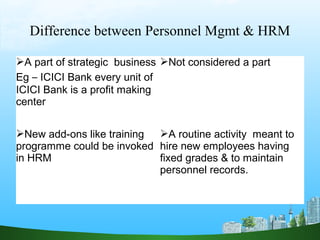
Difference between Personnel Mgmt & HRM
A part of strategic business
Eg – ICICI Bank every unit of
ICICI Bank is a profit making
center
Not considered a part
New add-ons like training
programme could be invoked
in HRM
A routine activity meant to
hire new employees having
fixed grades & to maintain
personnel records.
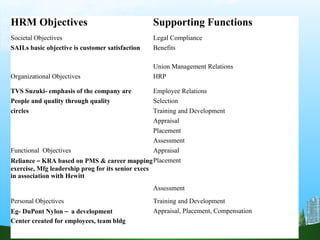
HRM OBJECTIVES AND FUNCTIONS
HRM Objectives Supporting Functions
Societal Objectives Legal Compliance
SAILs basic objective is customer satisfaction Benefits
Union Management Relations
Organizational Objectives HRP
TVS Suzuki- emphasis of the company are Employee Relations
People and quality through quality Selection
circles Training and Development
Appraisal
Placement
Assessment
Functional Objectives Appraisal
Reliance – KRA based on PMS & career mapping
exercise, Mfg leadership prog for its senior execs
in association with Hewitt
Placement
Assessment
Personal Objectives Training and Development
Eg- DuPont Nylon – a development Appraisal, Placement, Compensation
Center created for employees, team bldg
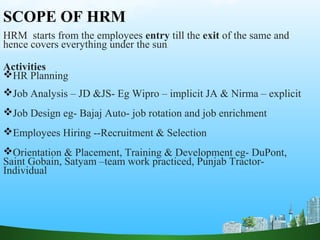
SCOPE OF HRM
HRM starts from the employees entry till the exit of the same and
hence covers everything under the sun.
Activities
HR Planning
Job Analysis – JD &JS- Eg Wipro – implicit JA & Nirma – explicit
Job Design eg- Bajaj Auto- job rotation and job enrichment
Employees Hiring --Recruitment & Selection
Orientation & Placement, Training & Development eg- DuPont,
Saint Gobain, Satyam –team work practiced, Punjab Tractor-
Individual
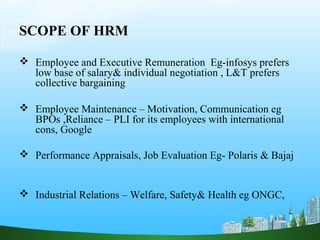
SCOPE OF HRM
 Employee and Executive Remuneration Eg-infosys prefers
low base of salary& individual negotiation , L&T prefers
collective bargaining
 Employee Maintenance – Motivation, Communication eg
BPOs ,Reliance – PLI for its employees with international
cons, Google
 Performance Appraisals, Job Evaluation Eg- Polaris & Bajaj
 Industrial Relations – Welfare, Safety& Health eg ONGC,
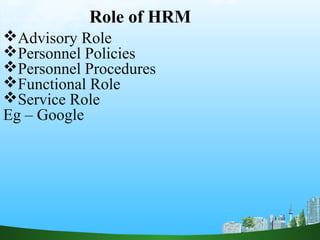
Role of HRM
Advisory Role
Personnel Policies
Personnel Procedures
Functional Role
Service Role
Eg – Google
Role of HRM
HR Managers Today
 Humanitarian Role
 Counselor
 Mediator
 Spokesman
 Problem Solver
 Change Agent
Future
 Enhancement of
Human & Non Human
Resources
 Maximization of
people to achieve
organizational goals
 Synergizing IT with
HR
Managing diverse
workforce
Planning- plan & research about wage trends,labour mkt etc
Organizing- manpower and resources
Staffing- recruitment & selection
Directing- issuance of orders and instructions to follow plan of action
Controlling – to regulate the activities
Operational Functions of HRM
Procurement- planning , Recruitment & Selection , Induction &
Placement
Development – T & D, Career Planning & Counseling
Compensation- Wage & Salary administration
Integration
Maintenance – improving work conditions, retentions
Separation - caused by resignations, retirement, death, medical reasons
etc
Managerial functions of HRM
CHALLENGES OF HRM IN INDIAN ECONOMY
World becoming a Global Village eg-GE, Ranbaxy, Glaxo, TCS
Corporate Re-organizations eg- Air India & IA,
New Organizational Structures- Virtual , boundary less , flat , Wipro –
diversification – soaps, edible oils etc Forward & Backward Integration
,M&As
Diverse workforce- eg. Teenagers, Nuclear families, working mothers etc
Gen Y
Change in Employee Expectations- more of benefits
 People Focus – concept of flexi time –hughes software, L&T – nanhi kali,
TCS joined Tata Mgmt Training Center for balance scorecard & other systems l
, Protection of Interests of Weaker sections
Employee Engagement
Attrition
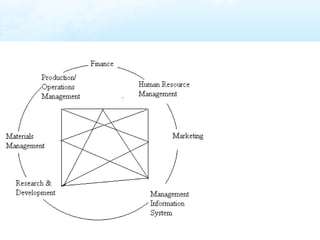
Approaches to HRM / Interdisciplinary
Approaches
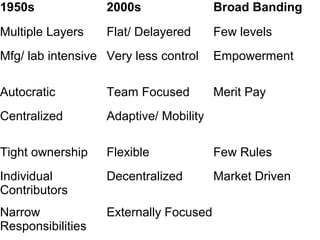
Changes in Organization Design
1950s 2000s Broad Banding
Multiple Layers Flat/ Delayered Few levels
Mfg/ lab intensive Very less control Empowerment
Autocratic Team Focused Merit Pay
Centralized Adaptive/ Mobility
Tight ownership Flexible Few Rules
Individual
Contributors
Decentralized Market Driven
Narrow
Responsibilities
Externally Focused
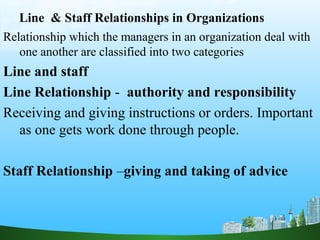
Line & Staff Relationships in Organizations
Relationship which the managers in an organization deal with
one another are classified into two categories
Line and staff
Line Relationship - authority and responsibility
Receiving and giving instructions or orders. Important
as one gets work done through people.
Staff Relationship –giving and taking of advice
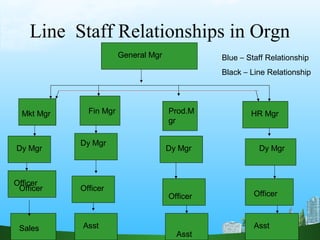
Line Staff Relationships in Orgn
General Mgr
Mkt Mgr Fin Mgr HR MgrProd.M
gr
Dy Mgr
Dy Mgr
Dy Mgr Dy Mgr
Officer
Sales
Officer
Officer
Officer
Blue – Staff Relationship
Black – Line Relationship
Asst
Officer
Asst
Asst
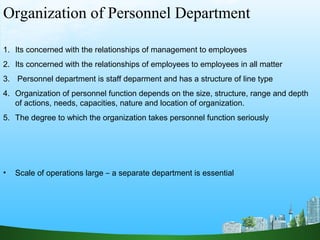
Organization of Personnel Department
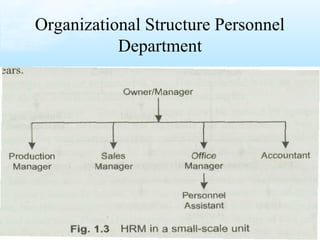
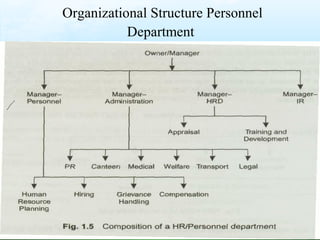
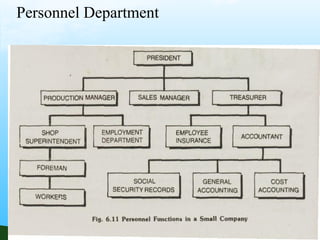
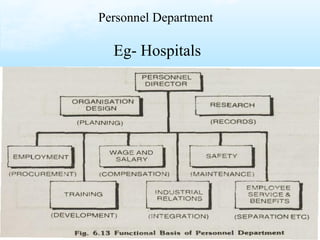
1. Its concerned with the relationships of management to employees
2. Its concerned with the relationships of employees to employees in all matter
3. Personnel department is staff deparment and has a structure of line type
4. Organization of personnel function depends on the size, structure, range and depth
of actions, needs, capacities, nature and location of organization.
5. The degree to which the organization takes personnel function seriously
• Scale of operations large – a separate department is essential
Organizational Structure Personnel
Department
Organizational Structure Personnel
Department
Personnel Department
Eg- Hospitals
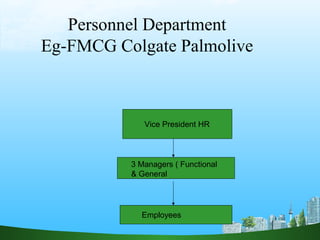
Personnel Department
Eg-FMCG Colgate Palmolive
Vice President HR
3 Managers ( Functional
& General
Employees
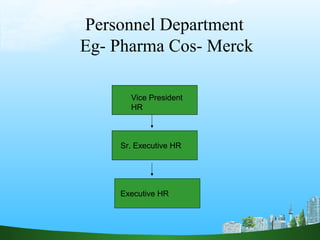
Personnel Department
Eg- Pharma Cos- Merck
Vice President
HR
Sr. Executive HR
Executive HR
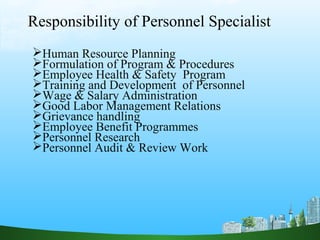
Responsibility of Personnel Specialist
Human Resource Planning
Formulation of Program & Procedures
Employee Health & Safety Program
Training and Development of Personnel
Wage & Salary Administration
Good Labor Management Relations
Grievance handling
Employee Benefit Programmes
Personnel Research
Personnel Audit & Review Work
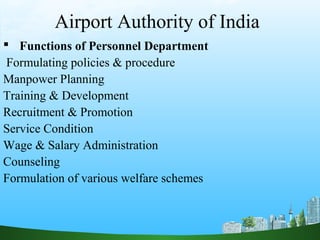
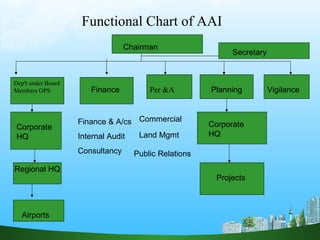
Airport Authority of India
 Functions of Personnel Department
Formulating policies & procedure
Manpower Planning
Training & Development
Recruitment & Promotion
Service Condition
Wage & Salary Administration
Counseling
Formulation of various welfare schemes
Functional Chart of AAI
Regional HQ
Chairman
Secretary
Corporate
HQ
Airports
Dep't under Board
Members OPS Finance Per &A Planning
Corporate
HQ
Projects
Vigilance
Commercial
Land Mgmt
Public Relations
Finance & A/cs
Internal Audit
Consultancy
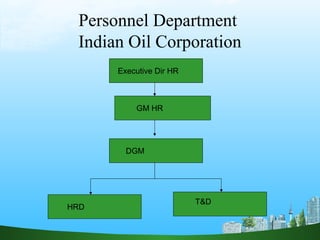
Personnel Department
Indian Oil Corporation
Executive Dir HR
GM HR
DGM
HRD
T&D
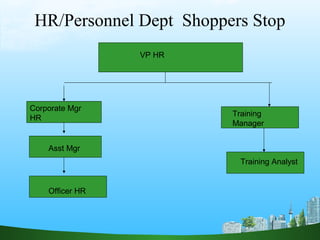
HR/Personnel Dept Shoppers Stop
Officer HR
Asst Mgr
Corporate Mgr
HR
Training Analyst
Training
Manager
VP HR
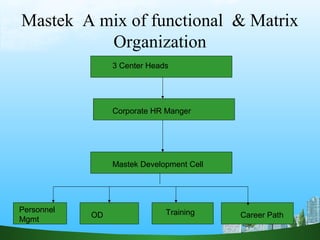
Mastek A mix of functional & Matrix
Organization
3 Center Heads
Corporate HR Manger
Mastek Development Cell
Personnel
Mgmt
OD Training Career Path
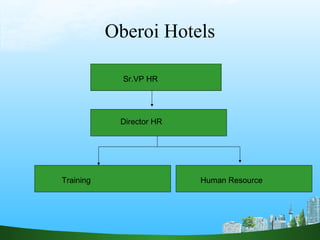
Oberoi Hotels
Sr.VP HR
Director HR
Training Human Resource
Summary
HRM is a tool that helps managers to plan, recruit,
select, train, develop, remunerate, motivate and
make maximum utilization of human and non human
resources for the organization and society at large.
“One machine can do the work
of fifty ordinary men. No
machine can do the work of one
extraordinary man.”
- Elbert Hubbard
Introduction to HRM

Introduction to HRM

  • 1.
  • 2.
    Human Resource Management Outline Definition Meaningof HRM Core Elements of HRM Objectives of HRM Functions of HRM Scope of HRM Role of HRM Challenges of HRM in Indian Economy / Modern Management Relationship with other social sciences – Approaches to HRM / Interdisciplinary approach Newspaper Articles
  • 3.
    Human Resource Management Definition1 – Integration HRM is a series of integrated decisions that form the employment relationships; their quality contributes to the ability of the organizations and the employees to achieve their objectives
  • 4.
    Human Resource Management Definition2- Influencing  HRM is concerned with the people dimensions management. Since every organization is made up of people ,acquiring their services, developing their skills , motivating them to higher levels of performance and ensuring that they continue to maintain their commitment to the organization are essential to achieving organizational objectives. This is true regardless of the type of the organization- Govt, business education , health, recreational or social action
  • 5.
    Definition 3 Applicability •HRM is planning, organizing directing and controlling of the procurement , development, compensation , integration, maintenance, and separation of human resources to the end that individual, organizational and social objectives are accomplished. Core Elements of HRM Organizations ------People ------ Management
  • 6.
    Meaning of HRM It is concerned with management of people from Recruitment to Retirement  To select right person, at the right place for the right job.
  • 7.
    Difference between PersonnelMgmt & HRM HRM PM  People as important assets who could be used for the benefit of organization and society  People as a tool behavior of whom could be manipulated for benefit of the organization and replaced when worn out ,this department was not treated with respect  Aiming at policies and promoting mutuality – goals, respect, rewards & responsibilities One way traffic In turn better economic performance and greater HRD Emphasis on only performance
  • 8.
    Difference between PersonnelMgmt & HRM A part of strategic business Eg – ICICI Bank every unit of ICICI Bank is a profit making center Not considered a part New add-ons like training programme could be invoked in HRM A routine activity meant to hire new employees having fixed grades & to maintain personnel records.
  • 9.
    HRM OBJECTIVES ANDFUNCTIONS HRM Objectives Supporting Functions Societal Objectives Legal Compliance SAILs basic objective is customer satisfaction Benefits Union Management Relations Organizational Objectives HRP TVS Suzuki- emphasis of the company are Employee Relations People and quality through quality Selection circles Training and Development Appraisal Placement Assessment Functional Objectives Appraisal Reliance – KRA based on PMS & career mapping exercise, Mfg leadership prog for its senior execs in association with Hewitt Placement Assessment Personal Objectives Training and Development Eg- DuPont Nylon – a development Appraisal, Placement, Compensation Center created for employees, team bldg
  • 10.
    SCOPE OF HRM HRMstarts from the employees entry till the exit of the same and hence covers everything under the sun. Activities HR Planning Job Analysis – JD &JS- Eg Wipro – implicit JA & Nirma – explicit Job Design eg- Bajaj Auto- job rotation and job enrichment Employees Hiring --Recruitment & Selection Orientation & Placement, Training & Development eg- DuPont, Saint Gobain, Satyam –team work practiced, Punjab Tractor- Individual
  • 11.
    SCOPE OF HRM Employee and Executive Remuneration Eg-infosys prefers low base of salary& individual negotiation , L&T prefers collective bargaining  Employee Maintenance – Motivation, Communication eg BPOs ,Reliance – PLI for its employees with international cons, Google  Performance Appraisals, Job Evaluation Eg- Polaris & Bajaj  Industrial Relations – Welfare, Safety& Health eg ONGC,
  • 12.
    Role of HRM AdvisoryRole Personnel Policies Personnel Procedures Functional Role Service Role Eg – Google
  • 13.
    Role of HRM HRManagers Today  Humanitarian Role  Counselor  Mediator  Spokesman  Problem Solver  Change Agent Future  Enhancement of Human & Non Human Resources  Maximization of people to achieve organizational goals  Synergizing IT with HR Managing diverse workforce
  • 14.
    Planning- plan &research about wage trends,labour mkt etc Organizing- manpower and resources Staffing- recruitment & selection Directing- issuance of orders and instructions to follow plan of action Controlling – to regulate the activities Operational Functions of HRM Procurement- planning , Recruitment & Selection , Induction & Placement Development – T & D, Career Planning & Counseling Compensation- Wage & Salary administration Integration Maintenance – improving work conditions, retentions Separation - caused by resignations, retirement, death, medical reasons etc Managerial functions of HRM
  • 15.
    CHALLENGES OF HRMIN INDIAN ECONOMY World becoming a Global Village eg-GE, Ranbaxy, Glaxo, TCS Corporate Re-organizations eg- Air India & IA, New Organizational Structures- Virtual , boundary less , flat , Wipro – diversification – soaps, edible oils etc Forward & Backward Integration ,M&As Diverse workforce- eg. Teenagers, Nuclear families, working mothers etc Gen Y Change in Employee Expectations- more of benefits  People Focus – concept of flexi time –hughes software, L&T – nanhi kali, TCS joined Tata Mgmt Training Center for balance scorecard & other systems l , Protection of Interests of Weaker sections Employee Engagement Attrition
  • 16.
    Approaches to HRM/ Interdisciplinary Approaches
  • 17.
    Changes in OrganizationDesign 1950s 2000s Broad Banding Multiple Layers Flat/ Delayered Few levels Mfg/ lab intensive Very less control Empowerment Autocratic Team Focused Merit Pay Centralized Adaptive/ Mobility Tight ownership Flexible Few Rules Individual Contributors Decentralized Market Driven Narrow Responsibilities Externally Focused
  • 18.
    Line & StaffRelationships in Organizations Relationship which the managers in an organization deal with one another are classified into two categories Line and staff Line Relationship - authority and responsibility Receiving and giving instructions or orders. Important as one gets work done through people. Staff Relationship –giving and taking of advice
  • 19.
    Line Staff Relationshipsin Orgn General Mgr Mkt Mgr Fin Mgr HR MgrProd.M gr Dy Mgr Dy Mgr Dy Mgr Dy Mgr Officer Sales Officer Officer Officer Blue – Staff Relationship Black – Line Relationship Asst Officer Asst Asst
  • 20.
    Organization of PersonnelDepartment 1. Its concerned with the relationships of management to employees 2. Its concerned with the relationships of employees to employees in all matter 3. Personnel department is staff deparment and has a structure of line type 4. Organization of personnel function depends on the size, structure, range and depth of actions, needs, capacities, nature and location of organization. 5. The degree to which the organization takes personnel function seriously • Scale of operations large – a separate department is essential
  • 21.
  • 22.
  • 23.
  • 24.
  • 25.
    Personnel Department Eg-FMCG ColgatePalmolive Vice President HR 3 Managers ( Functional & General Employees
  • 26.
    Personnel Department Eg- PharmaCos- Merck Vice President HR Sr. Executive HR Executive HR
  • 27.
    Responsibility of PersonnelSpecialist Human Resource Planning Formulation of Program & Procedures Employee Health & Safety Program Training and Development of Personnel Wage & Salary Administration Good Labor Management Relations Grievance handling Employee Benefit Programmes Personnel Research Personnel Audit & Review Work
  • 28.
    Airport Authority ofIndia  Functions of Personnel Department Formulating policies & procedure Manpower Planning Training & Development Recruitment & Promotion Service Condition Wage & Salary Administration Counseling Formulation of various welfare schemes
  • 29.
    Functional Chart ofAAI Regional HQ Chairman Secretary Corporate HQ Airports Dep't under Board Members OPS Finance Per &A Planning Corporate HQ Projects Vigilance Commercial Land Mgmt Public Relations Finance & A/cs Internal Audit Consultancy
  • 30.
    Personnel Department Indian OilCorporation Executive Dir HR GM HR DGM HRD T&D
  • 31.
    HR/Personnel Dept ShoppersStop Officer HR Asst Mgr Corporate Mgr HR Training Analyst Training Manager VP HR
  • 32.
    Mastek A mixof functional & Matrix Organization 3 Center Heads Corporate HR Manger Mastek Development Cell Personnel Mgmt OD Training Career Path
  • 33.
    Oberoi Hotels Sr.VP HR DirectorHR Training Human Resource
  • 34.
    Summary HRM is atool that helps managers to plan, recruit, select, train, develop, remunerate, motivate and make maximum utilization of human and non human resources for the organization and society at large.
  • 35.
    “One machine cando the work of fifty ordinary men. No machine can do the work of one extraordinary man.” - Elbert Hubbard