Education for an Innovative Society – A Caribbean Perspective Presentation to the Canada-Caribbean-Central America Education Partnership Forum Newfoundland, November 1, 2008 Hazel Simmons-McDonald The University of the West Indies Open Campus
Focus of the Presentation *  Examine key terms in definition for  clarification purposes Education as a vehicle for building an innovative society- (a) learning and the labour market and (b) lifelong learning. The role of Distance Education in building innovative societies – the Caribbean and the UWI contribution. Can partnerships contribute to building innovative  Caribbean societies?  Some questions for further consideration.
Definition “ An innovative society is one that is well-governed, prepares youth both for citizenship and work, is strong in science and technology, and makes the links between education, research, industry and prosperity.”  (CBIE document)
Some challenges of developing (and other) societies Increasing drop out rates from educational institutions – particularly males. Increasing costs for security and maintenance of law and order. Diversion of funds from development initiatives to law enforcement maintenance.
Some effects The effects of social disorder and unrest can distract and hinder the ability of governments to focus on factors that promote development. There is an inextricable link between education and the development of good social conduct among citizens. The inability of education systems to foster holistic development can result in an increase in social disorder that can pose challenges for good governance.
Education and Innovation The notion of “innovation” must be extended to an examination of education itself which requires a transcendence of the distinction between ‘education’ and ‘training’ if it is going to  be a key driver of innovation.
Characteristics of programmes that promote active learning and positive  outcomes relevance to the background, abilities, needs and experiences of students delivered by teachers who are “accessible, responsive, up-to-date, and effective” promote more ‘active’ than ‘passive’ learning link theory with practice and provide “guided practice-based learning opportunities, real-life learning and work placements ensure that learning proceeds in “digestible chunks” include opportunities for “self-managed” learning. (Scott, Geoff. 2003: 66)
Less powerful uses of ICTs in Ed. Presentation of ‘large amounts’ of information on-screen for students to read or download. Use of web discussions that are unmediated. Lack of a broad learning system for contextualising online learning. “ Infotainment”
More powerful uses of ICTs use of simulations – these require student engagement in “realistic representations of problems and dilemmas...’ interactive learning – providing in one platform links for access to staff, online library resources, other students... animations of hard-to-see processes online videos with the possibility for discussion  coaching by staff teleconferences.  (Scott, G. 2003:68-69)
A  point about on Learning and the labour market  Universities – like colleges – (should) have as  primary objectives  the cognitive development of individuals – i.e. the development of critical thinkers and and problem solvers They must also have as objectives the cultivation of the emotional intelligence and creative abilities of learners.  These are essential to driving innovation -
Strategic Plan 2007-2012 - Aim (#4) To create an Open Campus to enable the University to expand the scope, enhance the appeal and improve the efficiency of its service to the individuals, communities and countries which it serves (p.31)
Why Open Campus? Improve service to the UWI 12 and ‘under-served’ communities in campus countries. To support the economic, social and cultural growth of the UWI 12 countries. To provide regional and equal access to education and professional development opportunities.
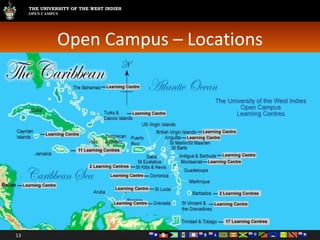
Open Campus – Locations
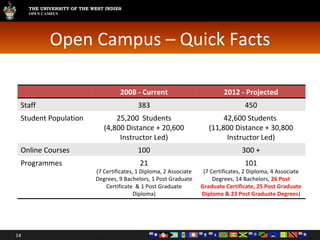
Open Campus – Quick Facts 2008 - Current 2012 - Projected Staff 383 450 Student Population 25,200  Students (4,800 Distance + 20,600 Instructor Led) 42,600 Students  (11,800 Distance + 30,800 Instructor Led) Online Courses 100 300 + Programmes 21 (7 Certificates, 1 Diploma, 2 Associate Degrees, 9 Bachelors, 1 Post Graduate Certificate  & 1 Post Graduate Diploma) 101 (7 Certificates, 2 Diploma, 4 Associate Degrees, 14 Bachelors,  26 Post Graduate Certificate, 25 Post Graduate Diploma & 23 Post Graduate Degrees )
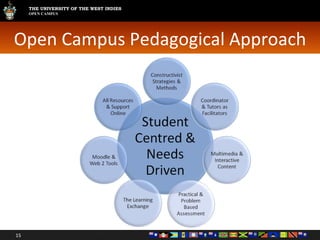
Open Campus Pedagogical Approach
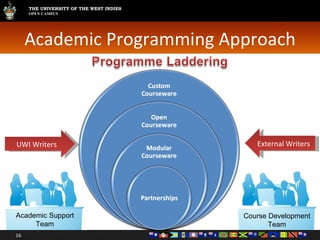
Academic Programming Approach UWI Writers External Writers Course Development Team Academic Support Team
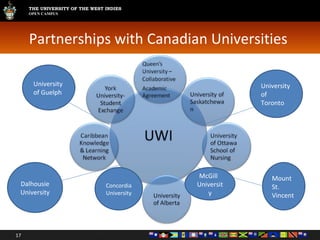
Partnerships with Canadian Universities  Concordia University McGill  University University of Guelph Dalhousie University University of Toronto Mount St. Vincent
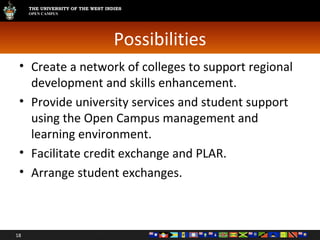
Possibilities Create a network of colleges to support regional development and skills enhancement. Provide university services and student support using the Open Campus management and learning environment. Facilitate credit exchange and PLAR. Arrange student exchanges.
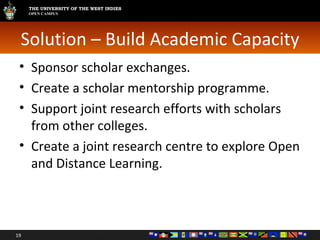
Solution – Build Academic Capacity Sponsor scholar exchanges. Create a scholar mentorship programme. Support joint research efforts with scholars from other colleges. Create a joint research centre to explore Open and Distance Learning.
Questions for Consideration  How can we address issues such as  Quality assurance What are some common strategic objectives that  would  benefit international partnerships?

Education for an Innovative Society

  • 1.
    Education for anInnovative Society – A Caribbean Perspective Presentation to the Canada-Caribbean-Central America Education Partnership Forum Newfoundland, November 1, 2008 Hazel Simmons-McDonald The University of the West Indies Open Campus
  • 2.
    Focus of thePresentation * Examine key terms in definition for clarification purposes Education as a vehicle for building an innovative society- (a) learning and the labour market and (b) lifelong learning. The role of Distance Education in building innovative societies – the Caribbean and the UWI contribution. Can partnerships contribute to building innovative Caribbean societies? Some questions for further consideration.
  • 3.
    Definition “ Aninnovative society is one that is well-governed, prepares youth both for citizenship and work, is strong in science and technology, and makes the links between education, research, industry and prosperity.” (CBIE document)
  • 4.
    Some challenges ofdeveloping (and other) societies Increasing drop out rates from educational institutions – particularly males. Increasing costs for security and maintenance of law and order. Diversion of funds from development initiatives to law enforcement maintenance.
  • 5.
    Some effects Theeffects of social disorder and unrest can distract and hinder the ability of governments to focus on factors that promote development. There is an inextricable link between education and the development of good social conduct among citizens. The inability of education systems to foster holistic development can result in an increase in social disorder that can pose challenges for good governance.
  • 6.
    Education and InnovationThe notion of “innovation” must be extended to an examination of education itself which requires a transcendence of the distinction between ‘education’ and ‘training’ if it is going to be a key driver of innovation.
  • 7.
    Characteristics of programmesthat promote active learning and positive outcomes relevance to the background, abilities, needs and experiences of students delivered by teachers who are “accessible, responsive, up-to-date, and effective” promote more ‘active’ than ‘passive’ learning link theory with practice and provide “guided practice-based learning opportunities, real-life learning and work placements ensure that learning proceeds in “digestible chunks” include opportunities for “self-managed” learning. (Scott, Geoff. 2003: 66)
  • 8.
    Less powerful usesof ICTs in Ed. Presentation of ‘large amounts’ of information on-screen for students to read or download. Use of web discussions that are unmediated. Lack of a broad learning system for contextualising online learning. “ Infotainment”
  • 9.
    More powerful usesof ICTs use of simulations – these require student engagement in “realistic representations of problems and dilemmas...’ interactive learning – providing in one platform links for access to staff, online library resources, other students... animations of hard-to-see processes online videos with the possibility for discussion coaching by staff teleconferences. (Scott, G. 2003:68-69)
  • 10.
    A pointabout on Learning and the labour market Universities – like colleges – (should) have as primary objectives the cognitive development of individuals – i.e. the development of critical thinkers and and problem solvers They must also have as objectives the cultivation of the emotional intelligence and creative abilities of learners. These are essential to driving innovation -
  • 11.
    Strategic Plan 2007-2012- Aim (#4) To create an Open Campus to enable the University to expand the scope, enhance the appeal and improve the efficiency of its service to the individuals, communities and countries which it serves (p.31)
  • 12.
    Why Open Campus?Improve service to the UWI 12 and ‘under-served’ communities in campus countries. To support the economic, social and cultural growth of the UWI 12 countries. To provide regional and equal access to education and professional development opportunities.
  • 13.
    Open Campus –Locations
  • 14.
    Open Campus –Quick Facts 2008 - Current 2012 - Projected Staff 383 450 Student Population 25,200 Students (4,800 Distance + 20,600 Instructor Led) 42,600 Students (11,800 Distance + 30,800 Instructor Led) Online Courses 100 300 + Programmes 21 (7 Certificates, 1 Diploma, 2 Associate Degrees, 9 Bachelors, 1 Post Graduate Certificate & 1 Post Graduate Diploma) 101 (7 Certificates, 2 Diploma, 4 Associate Degrees, 14 Bachelors, 26 Post Graduate Certificate, 25 Post Graduate Diploma & 23 Post Graduate Degrees )
  • 15.
  • 16.
    Academic Programming ApproachUWI Writers External Writers Course Development Team Academic Support Team
  • 17.
    Partnerships with CanadianUniversities Concordia University McGill University University of Guelph Dalhousie University University of Toronto Mount St. Vincent
  • 18.
    Possibilities Create anetwork of colleges to support regional development and skills enhancement. Provide university services and student support using the Open Campus management and learning environment. Facilitate credit exchange and PLAR. Arrange student exchanges.
  • 19.
    Solution – BuildAcademic Capacity Sponsor scholar exchanges. Create a scholar mentorship programme. Support joint research efforts with scholars from other colleges. Create a joint research centre to explore Open and Distance Learning.
  • 20.
    Questions for Consideration How can we address issues such as Quality assurance What are some common strategic objectives that would benefit international partnerships?