ORGANIZATION  DEVELOPMENT The New Approach to change
What is OD A series of planned processes by which human resources are identified, utilized, and developed in ways that strengthen organizational effectiveness by increasing problem-solving capabilities and planning OD IMPLIES: planning identification and use of human resources strengthening of organizational effectiveness
How does OD affect top management? It is long-range in perspective Requests support from the top managers, because they control resources and rewards Expands their ideas, beliefs, and behavior
How does OD affect employees? diagnosing problems considering solutions selecting a solution identifying change objectives implementing planned change evaluating results
OD brings MANAGERS and  EMPLOYEES together holding them all responsible for the success and failure of a change effort.
Key terms in OD CHANGE   = a departure from the status quo Alpha change  – constant progress Beta change  – variable progress Gamma change  – variable progress combined with a radical change = transformational change CHANGE AGENT  = the person responsible for beginning and maintaining a change effort CLIENT   = organization, group, individual whose interests the change agent primarily servers CULTURE   = basic assumption and beliefs shared by the members of an organization INTERVENTION   = a change effort
ORGANIZATIONAL DEVELOPMENT   ( different from OD ) = any effort to improve an organization SPONSOR   = one who underwrites, legitimizes and champions a change effort or OD intervention STAKEHOLDER   = one who has an interest in an OD intervention SUBSYSTEM   = part of a system (e.g. work units, department, divisions, activities, processes, structures) SYSTEM   = inputs, transformation processes, outputs Key terms in OD
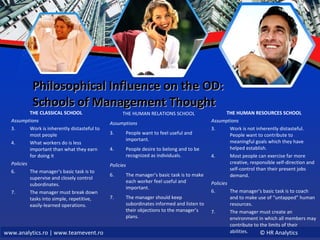
Philosophical Influence on the OD:  Schools of Management Thought THE CLASSICAL SCHOOL Assumptions Work is inherently distasteful to most people What workers do is less important than what they earn for doing it Policies The manager’s basic task is to supervise and closely control subordinates. The manager must break down tasks into simple, repetitive, easily-learned operations. THE HUMAN RESOURCES SCHOOL Assumptions Work is not inherently distasteful. People want to contribute to meaningful goals which they have helped establish. Most people can exercise far more creative, responsible self-direction and self-control than their present jobs demand. Policies The manager’s basic task is to coach and to make use of “untapped” human resources.  The manager must create an environment in which all members may contribute to the limits of their abilities. THE HUMAN RELATIONS SCHOOL Assumptions People want to feel useful and important. People desire to belong and to be recognized as individuals. Policies The manager’s basic task is to make each worker feel useful and important. The manager should keep subordinates informed and listen to their objections to the manager’s plans.
THE CLASSICAL SCHOOL The manager must establish work routines and procedures and enforce these firmly and fairly. Expectations People can tolerate work if the pay is decent ant the boss is fair. If tasks are simple enough and people are closely controlled, they will produce up to standards. THE HUMAN RELATIONS SCHOOL The manager should allow subordinates to exercise some self-directions and self-control on routine matters.  Expectations Sharing information with subordinates and involving them in routing decisions will satisfy their basic needs to belong and feel important. Satisfying these needs will improve morale and reduce resistance to formal authority; subordinates will “willingly cooperate”. THE HUMAN RESOURCES SCHOOL The manager must encourage full participation on important matters, continually broadening subordinate self-direction and control. Expectations Expanding subordinate influence, self-direction, and self-control will lead to direct improvements in operating efficiency. Work satisfaction may improve as a “by-product” of subordinates’ making full use of their resources. Source:  Miles, R.E.(1975),  Theories of Management: Implications for Organizational Behavior and Development , New York: McGraw-Hill, p. 35.
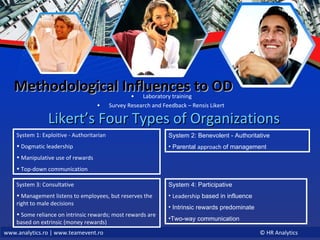
Methodological Influences to OD Laboratory training Survey Research and Feedback – Rensis Likert  Likert’s Four Types of Organizations System 1: Exploitive - Authoritarian Dogmatic leadership Manipulative use of rewards Top-down communication System 2: Benevolent - Authoritative Parental  approach  of management System 3: Consultative Management listens to employees, but reserves the right to male decisions Some reliance on intrinsic rewards; most rewards are based on extrinsic (money rewards) System 4: Participative Leadership  based in influence Intrinsic rewards predominate  Two-way communication
Newer contributions to the  development of OD TQM  =  Total Quality Management   drives attention on the creative human potential and on people’s ability to improve their work BPR  =  Business Process Reengineering  brings  interest to the radical organizational change and restructuring
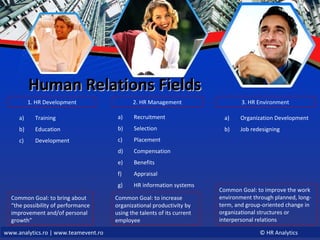
Human Relations Fields 1. HR Development Training Education Development Common Goal: to bring about “the possibility of performance improvement and/of personal growth” 2. HR Management Recruitment  Selection Placement Compensation Benefits Appraisal HR information systems Common Goal: to increase organizational productivity by using the talents of its current employee 3. HR Environment Organization Development Job redesigning Common Goal: to improve the work environment through planned, long-term, and group-oriented change in organizational structures or interpersonal relations
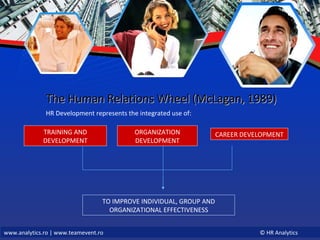
The Human Relations Wheel (McLagan, 1989) HR Development represents the integrated use of: TRAINING AND DEVELOPMENT ORGANIZATION DEVELOPMENT CAREER DEVELOPMENT TO IMPROVE INDIVIDUAL, GROUP AND ORGANIZATIONAL EFFECTIVENESS
Knowledge Requirements for OD specialists Organization Development HR planning Training and development Employment and personnel practices Compensation and benefits Personnel research Collective bargaining HR information system Health and safety
OD can only intervene in situations of: Need for change felt at the top of the management Problems in the work environment Managers committed to long-term improvement Managers and employees are all willing to listen to the OD’s key assumptions formulated by internal or external consultants Trust and cooperation Top managers are willing to provide all necessary resources for expertise
Alternatives to OD THE LEGALISTIC APPROACH  –  intervenes when there are differences between the legal standards and the organization’s practices THE DIALECTIC APPROACH  –  public debate between two persons or groups analyzing the same problem from two different perspectives  THE LEADERSHIP CHANGE APPROACH  –  the temporary change of the leader   4.  THE PERSUASIVE APPROACH  –  convincing people that change is needed 5.  THE COERCITIVE APPROACH  –  imposing change by force; it is generally counterproductive and it is considered as a last alternative
BRAS OV Str. Zizinului bl. 9, ap. 3 Tel: 0742 060716 [email_address] SIBIU Str. Some s ului nr.7 Tel: 0723 774455 office @analytics.ro   www.analytics.ro | www.teamevent.ro

Organisation Development

  • 1.
    ORGANIZATION DEVELOPMENTThe New Approach to change
  • 2.
    What is ODA series of planned processes by which human resources are identified, utilized, and developed in ways that strengthen organizational effectiveness by increasing problem-solving capabilities and planning OD IMPLIES: planning identification and use of human resources strengthening of organizational effectiveness
  • 3.
    How does ODaffect top management? It is long-range in perspective Requests support from the top managers, because they control resources and rewards Expands their ideas, beliefs, and behavior
  • 4.
    How does ODaffect employees? diagnosing problems considering solutions selecting a solution identifying change objectives implementing planned change evaluating results
  • 5.
    OD brings MANAGERSand EMPLOYEES together holding them all responsible for the success and failure of a change effort.
  • 6.
    Key terms inOD CHANGE = a departure from the status quo Alpha change – constant progress Beta change – variable progress Gamma change – variable progress combined with a radical change = transformational change CHANGE AGENT = the person responsible for beginning and maintaining a change effort CLIENT = organization, group, individual whose interests the change agent primarily servers CULTURE = basic assumption and beliefs shared by the members of an organization INTERVENTION = a change effort
  • 7.
    ORGANIZATIONAL DEVELOPMENT ( different from OD ) = any effort to improve an organization SPONSOR = one who underwrites, legitimizes and champions a change effort or OD intervention STAKEHOLDER = one who has an interest in an OD intervention SUBSYSTEM = part of a system (e.g. work units, department, divisions, activities, processes, structures) SYSTEM = inputs, transformation processes, outputs Key terms in OD
  • 8.
    Philosophical Influence onthe OD: Schools of Management Thought THE CLASSICAL SCHOOL Assumptions Work is inherently distasteful to most people What workers do is less important than what they earn for doing it Policies The manager’s basic task is to supervise and closely control subordinates. The manager must break down tasks into simple, repetitive, easily-learned operations. THE HUMAN RESOURCES SCHOOL Assumptions Work is not inherently distasteful. People want to contribute to meaningful goals which they have helped establish. Most people can exercise far more creative, responsible self-direction and self-control than their present jobs demand. Policies The manager’s basic task is to coach and to make use of “untapped” human resources. The manager must create an environment in which all members may contribute to the limits of their abilities. THE HUMAN RELATIONS SCHOOL Assumptions People want to feel useful and important. People desire to belong and to be recognized as individuals. Policies The manager’s basic task is to make each worker feel useful and important. The manager should keep subordinates informed and listen to their objections to the manager’s plans.
  • 9.
    THE CLASSICAL SCHOOLThe manager must establish work routines and procedures and enforce these firmly and fairly. Expectations People can tolerate work if the pay is decent ant the boss is fair. If tasks are simple enough and people are closely controlled, they will produce up to standards. THE HUMAN RELATIONS SCHOOL The manager should allow subordinates to exercise some self-directions and self-control on routine matters. Expectations Sharing information with subordinates and involving them in routing decisions will satisfy their basic needs to belong and feel important. Satisfying these needs will improve morale and reduce resistance to formal authority; subordinates will “willingly cooperate”. THE HUMAN RESOURCES SCHOOL The manager must encourage full participation on important matters, continually broadening subordinate self-direction and control. Expectations Expanding subordinate influence, self-direction, and self-control will lead to direct improvements in operating efficiency. Work satisfaction may improve as a “by-product” of subordinates’ making full use of their resources. Source: Miles, R.E.(1975), Theories of Management: Implications for Organizational Behavior and Development , New York: McGraw-Hill, p. 35.
  • 10.
    Methodological Influences toOD Laboratory training Survey Research and Feedback – Rensis Likert Likert’s Four Types of Organizations System 1: Exploitive - Authoritarian Dogmatic leadership Manipulative use of rewards Top-down communication System 2: Benevolent - Authoritative Parental approach of management System 3: Consultative Management listens to employees, but reserves the right to male decisions Some reliance on intrinsic rewards; most rewards are based on extrinsic (money rewards) System 4: Participative Leadership based in influence Intrinsic rewards predominate Two-way communication
  • 11.
    Newer contributions tothe development of OD TQM = Total Quality Management drives attention on the creative human potential and on people’s ability to improve their work BPR = Business Process Reengineering brings interest to the radical organizational change and restructuring
  • 12.
    Human Relations Fields1. HR Development Training Education Development Common Goal: to bring about “the possibility of performance improvement and/of personal growth” 2. HR Management Recruitment Selection Placement Compensation Benefits Appraisal HR information systems Common Goal: to increase organizational productivity by using the talents of its current employee 3. HR Environment Organization Development Job redesigning Common Goal: to improve the work environment through planned, long-term, and group-oriented change in organizational structures or interpersonal relations
  • 13.
    The Human RelationsWheel (McLagan, 1989) HR Development represents the integrated use of: TRAINING AND DEVELOPMENT ORGANIZATION DEVELOPMENT CAREER DEVELOPMENT TO IMPROVE INDIVIDUAL, GROUP AND ORGANIZATIONAL EFFECTIVENESS
  • 14.
    Knowledge Requirements forOD specialists Organization Development HR planning Training and development Employment and personnel practices Compensation and benefits Personnel research Collective bargaining HR information system Health and safety
  • 15.
    OD can onlyintervene in situations of: Need for change felt at the top of the management Problems in the work environment Managers committed to long-term improvement Managers and employees are all willing to listen to the OD’s key assumptions formulated by internal or external consultants Trust and cooperation Top managers are willing to provide all necessary resources for expertise
  • 16.
    Alternatives to ODTHE LEGALISTIC APPROACH – intervenes when there are differences between the legal standards and the organization’s practices THE DIALECTIC APPROACH – public debate between two persons or groups analyzing the same problem from two different perspectives THE LEADERSHIP CHANGE APPROACH – the temporary change of the leader 4. THE PERSUASIVE APPROACH – convincing people that change is needed 5. THE COERCITIVE APPROACH – imposing change by force; it is generally counterproductive and it is considered as a last alternative
  • 17.
    BRAS OV Str.Zizinului bl. 9, ap. 3 Tel: 0742 060716 [email_address] SIBIU Str. Some s ului nr.7 Tel: 0723 774455 office @analytics.ro www.analytics.ro | www.teamevent.ro

Editor's Notes