Managing Organizational
Change and Learning
Managing Organizational
Change and Learning
        A Proactive Behavior
Why is it Important to Adapt to
Change?
 Individuals, teams, or organizations
  that do not adapt to change in timely
  ways are unlikely to survive.
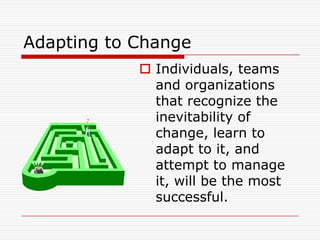
Adapting to Change
             Individuals, teams
              and organizations
              that recognize the
              inevitability of
              change, learn to
              adapt to it, and
              attempt to manage
              it, will be the most
              successful.
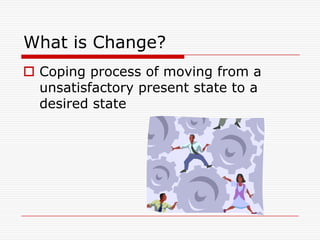
What is Change?
 Coping process of moving from a
  unsatisfactory present state to a
  desired state
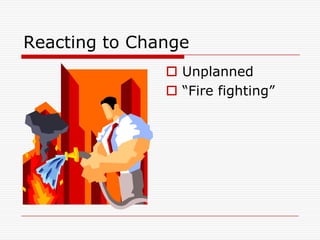
Reacting to Change
                Unplanned
                ―Fire fighting‖
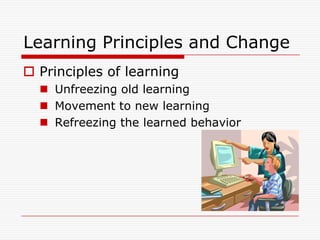
Learning Principles and Change
 Principles of learning
   Unfreezing old learning
   Movement to new learning
   Refreezing the learned behavior
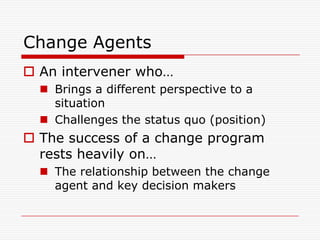
Change Agents
 An intervener who…
   Brings a different perspective to a
    situation
   Challenges the status quo (position)
 The success of a change program
  rests heavily on…
   The relationship between the change
    agent and key decision makers
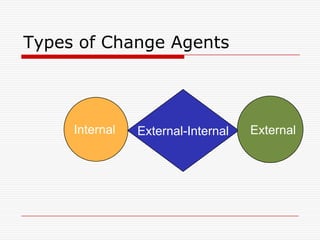
Types of Change Agents


     Internal   External-Internal   External
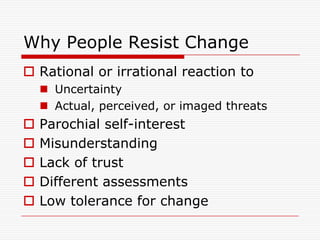
Why People Resist Change
 Rational or irrational reaction to
     Uncertainty
     Actual, perceived, or imaged threats
   Parochial self-interest
   Misunderstanding
   Lack of trust
   Different assessments
   Low tolerance for change
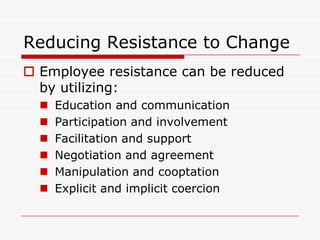
Reducing Resistance to Change
 Employee resistance can be reduced
  by utilizing:
     Education and communication
     Participation and involvement
     Facilitation and support
     Negotiation and agreement
     Manipulation and cooptation
     Explicit and implicit coercion
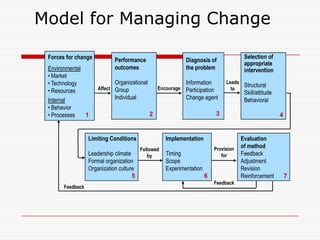
Model for Managing Change

 Forces for change                                                                      Selection of
                             Performance                      Diagnosis of
                                                                                        appropriate
 Environmental               outcomes                         the problem               intervention
 • Market
 • Technology                Organizational                   Information       Leads
                                                                                      Structural
                      Affect Group                Encourage   Participation       to
 • Resources                                                                            Skill/attitude
 Internal                    Individual                       Change agent              Behavioral
 • Behavior
 • Processes   1                              2                            3                             4


                  Limiting Conditions                Implementation                    Evaluation
                                          Followed                         Provision   of method
                  Leadership climate         by      Timing                   for      Feedback
                  Formal organization                Scope                             Adjustment
                  Organization culture               Experimentation                   Revision
                                     5                                 6               Reinforcement         7
                                                                           Feedback
       Feedback
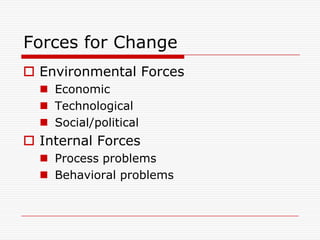
Forces for Change
 Environmental Forces
   Economic
   Technological
   Social/political
 Internal Forces
   Process problems
   Behavioral problems
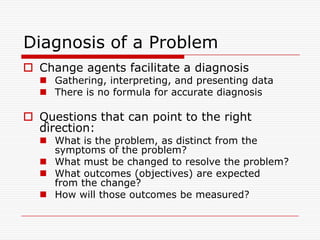
Diagnosis of a Problem
 Change agents facilitate a diagnosis
   Gathering, interpreting, and presenting data
   There is no formula for accurate diagnosis

 Questions that can point to the right
  direction:
   What is the problem, as distinct from the
    symptoms of the problem?
   What must be changed to resolve the problem?
   What outcomes (objectives) are expected
    from the change?
   How will those outcomes be measured?
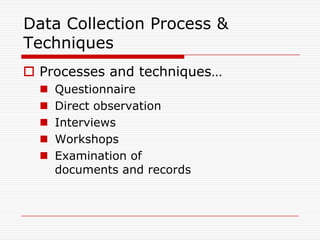
Data Collection Process &
Techniques
 Processes and techniques…
     Questionnaire
     Direct observation
     Interviews
     Workshops
     Examination of
      documents and records
Intervention


          Intervention –
          A specific action or program
          undertaken to focus the change
          process on particular targets.
Depth & Approach of Change
 Depth of intended change
   Scope and intensity of organizational
    change efforts
 Approaches to achieving change
   Structural
   Behavioral
   Technological
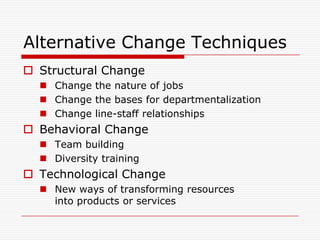
Alternative Change Techniques
 Structural Change
   Change the nature of jobs
   Change the bases for departmentalization
   Change line-staff relationships
 Behavioral Change
   Team building
   Diversity training
 Technological Change
   New ways of transforming resources
    into products or services
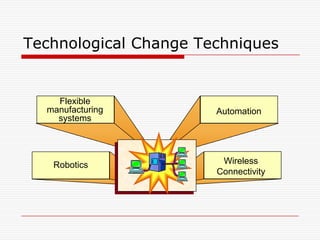
Technological Change Techniques


    Flexible
  manufacturing        Automation
    systems


   Robotics             Wireless
                       Connectivity
High-Tech Disappointments
 High-tech changes often disappoint
   Structural changes not implemented
   Behavioral changes lacking
     Employee training
     Compensation
     Management style
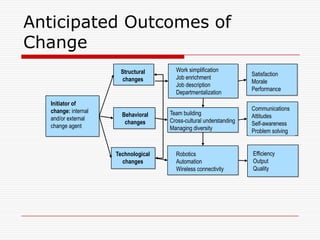
Anticipated Outcomes of
Change
                       Structural       Work simplification
                                                                     Satisfaction
                        changes         Job enrichment
                                                                     Morale
                                        Job description
                                                                     Performance
                                        Departmentalization
   Initiator of
   change: internal                                                  Communications
                        Behavioral    Team building                  Attitudes
   and/or external                    Cross-cultural understanding
                         changes                                     Self-awareness
   change agent                       Managing diversity             Problem solving


                      Technological     Robotics                     Efficiency
                        changes         Automation                   Output
                                        Wireless connectivity        Quality
Appreciative Inquiry
 A method of focusing on and bringing about
  positive change
   Uses metaphors and narratives to strengthen an
    individual or organization’s ability to anticipate,
    seize, or initiate positive potential
   A positive approach to change that completely
    lets go of problem-based management
   Individual engagement to bring about creative
    solutions
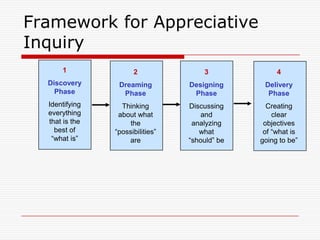
Framework for Appreciative
Inquiry
      1               2               3              4
  Discovery      Dreaming         Designing      Delivery
    Phase         Phase            Phase          Phase
  Identifying     Thinking        Discussing      Creating
  everything     about what           and           clear
  that is the        the           analyzing     objectives
    best of     “possibilities”      what        of “what is
   “what is”        are           “should” be   going to be”
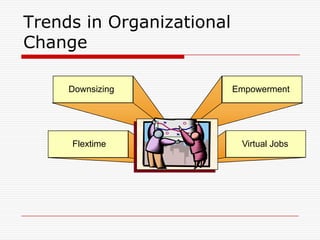
Trends in Organizational
Change

     Downsizing            Empowerment


     Flextime               Virtual Jobs
Limiting Conditions
 Selection of a change technique…
   Based on diagnosis of the problem
   Tempered by the conditions at the
    time an intervention is to occur
 Conditions to consider…
     Leadership climate
     The formal organization
     The organizational culture
     Resistance to change
Implementing & Evaluating Change
 The implementation of proposed
  change has two dimensions:
   Timing — when to make the change
   Scope — how much change to make
 Feedback should be solicited during
  the monitoring phase
   It helps determine the success of the
    change
Ethical Issues of Change
 Change itself is not unethical
   It creates opportunities for unethical
    behavior
 Ethical choices are always guided by
  the underlying values of management
   Employ and empower managers
    who create and foster a culture that
    encourages ethical behavior
Guidelines for Managing Change
 Everyone involved must have…
   High and visible commitment to the effort
   Advance information that lets them know what
    is to happen and why they are being asked to do
    what they are to do
 The change effort…
   Must connect to other parts of the organization,
    especially evaluation and reward systems
   Should be directed by line managers and
    assisted by a change agent, if necessary
Guidelines for Managing Change
 For a change to be effective…
    The effort must be based on good diagnosis and
     consistent with the conditions in the
     organization
    Management must remain committed to the
     effort through all its steps
    Evaluation is essential and must consist of more
     than asking people how they felt about the effort
    People must see the connection between the
     effort and the organization’s mission and goals
    Change agents, if used, must be competent and
     perceived as such
The Learning Organization
 Learning is a key ingredient in…
   Growing
   Becoming more effective
   Becoming more socially responsible
   Sustaining the business’s value
    proposition
A Learning Perspective
 Scanning the environment
 Performance issues
 Metrics
 Experimental philosophy
 Transparency
 Education
 Operational variety
 Multiple advocates
 Engaged leaders and role models
Manager’s Role in Learning
Organizations
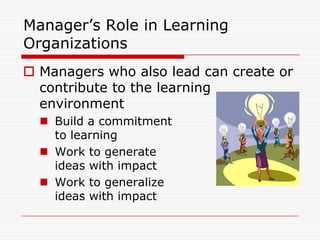
 Managers who also lead can create or
  contribute to the learning
  environment
   Build a commitment
    to learning
   Work to generate
    ideas with impact
   Work to generalize
    ideas with impact
Manager’s Role in Learning
Organizations
 Sustaining a learning organization requires
     A commitment to learning
     Generation & implementation of creative ideas
     Building cohesive teams
     Fostering collaboration and support

 What is learned must be implemented
  in order to execute a change
   Managers must be decisive and action
    oriented
Converting a Traditional
Organization
 Change the way information and
  experienced are used
   Change the way information is
    sought, used, stored and reviewed
   Information must be shared, available,
    and transparent
   Actively work to make information, new
    ideas, and creativity part of the culture
Planned Change
 Results from
  deliberate
  attempts by
  managers to
  improve
  organizational
  operations
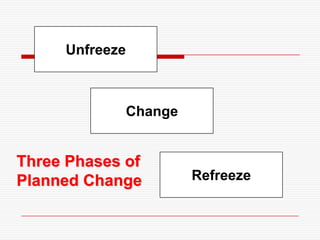
Unfreeze


             Change


Three Phases of
Planned Change        Refreeze
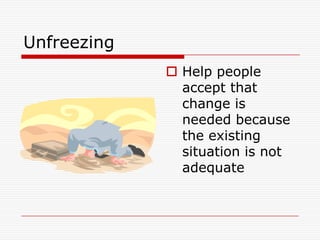
Unfreezing
              Help people
               accept that
               change is
               needed because
               the existing
               situation is not
               adequate
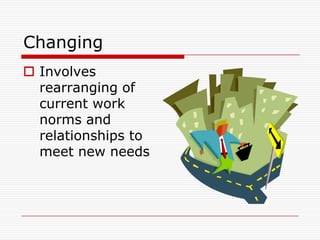
Changing
 Involves
  rearranging of
  current work
  norms and
  relationships to
  meet new needs
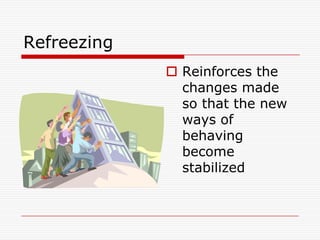
Refreezing
              Reinforces the
               changes made
               so that the new
               ways of
               behaving
               become
               stabilized
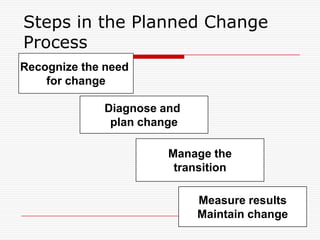
Steps in the Planned Change
Process
Recognize the need
    for change

             Diagnose and
              plan change

                       Manage the
                        transition

                            Measure results
                            Maintain change
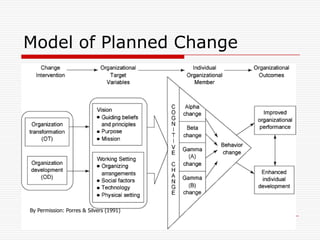
Model of Planned Change


By Permission: Porres & Silvers (1991)
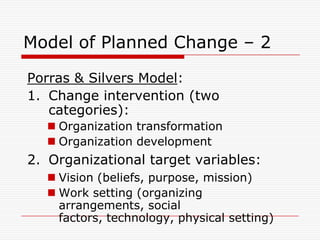
Model of Planned Change – 2

Porras & Silvers Model:
1. Change intervention (two
   categories):
   Organization transformation
   Organization development
2. Organizational target variables:
   Vision (beliefs, purpose, mission)
   Work setting (organizing
    arrangements, social
    factors, technology, physical setting)
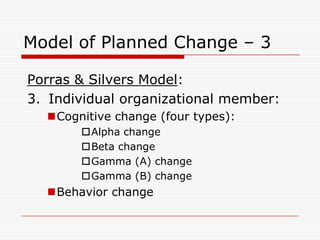
Model of Planned Change – 3

Porras & Silvers Model:
3. Individual organizational member:
  Cognitive change (four types):
       Alpha change
       Beta change
       Gamma (A) change
       Gamma (B) change
  Behavior change
Model of Planned Change – 4

Porras & Silvers Model:
4. Organizational outcomes:
    Improved organizational performance
    Enhanced individual development
Managing the Planned Change
Process
 Improving the organization’s ability to
  cope with unplanned changes that are
  thrust upon it
 Modifying employee’s attitudes and
  behaviors to make them more
  effective contributors to the
  organization’s goals
Initiating the Planned Change
Process
   Recognize the need for change
   Diagnose and plan change
   Formulate Goals
   Determine stakeholders’ needs
   Examine driving and restraining
    forces
Force-Field Analysis
 Process of analyzing the forces that
  drive change and the forces that
  restrain it
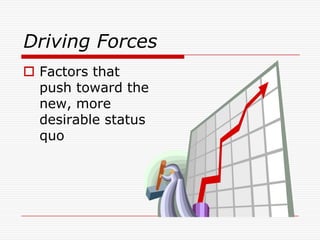
Driving Forces
 Factors that
  push toward the
  new, more
  desirable status
  quo
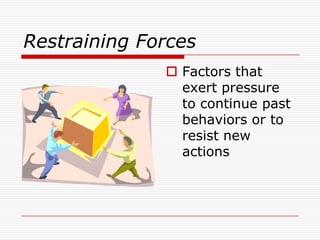
Restraining Forces
               Factors that
                exert pressure
                to continue past
                behaviors or to
                resist new
                actions
Managing the Planned Change
Process
 Consider contingencies to determine
  the best interventions
 Manage the transition
 Measure results
 Maintain change

Managing change

  • 1.
  • 2.
    Managing Organizational Change andLearning A Proactive Behavior
  • 3.
    Why is itImportant to Adapt to Change?  Individuals, teams, or organizations that do not adapt to change in timely ways are unlikely to survive.
  • 4.
    Adapting to Change  Individuals, teams and organizations that recognize the inevitability of change, learn to adapt to it, and attempt to manage it, will be the most successful.
  • 5.
    What is Change? Coping process of moving from a unsatisfactory present state to a desired state
  • 6.
    Reacting to Change  Unplanned  ―Fire fighting‖
  • 7.
    Learning Principles andChange  Principles of learning  Unfreezing old learning  Movement to new learning  Refreezing the learned behavior
  • 8.
    Change Agents  Anintervener who…  Brings a different perspective to a situation  Challenges the status quo (position)  The success of a change program rests heavily on…  The relationship between the change agent and key decision makers
  • 9.
    Types of ChangeAgents Internal External-Internal External
  • 10.
    Why People ResistChange  Rational or irrational reaction to  Uncertainty  Actual, perceived, or imaged threats  Parochial self-interest  Misunderstanding  Lack of trust  Different assessments  Low tolerance for change
  • 11.
    Reducing Resistance toChange  Employee resistance can be reduced by utilizing:  Education and communication  Participation and involvement  Facilitation and support  Negotiation and agreement  Manipulation and cooptation  Explicit and implicit coercion
  • 12.
    Model for ManagingChange Forces for change Selection of Performance Diagnosis of appropriate Environmental outcomes the problem intervention • Market • Technology Organizational Information Leads Structural Affect Group Encourage Participation to • Resources Skill/attitude Internal Individual Change agent Behavioral • Behavior • Processes 1 2 3 4 Limiting Conditions Implementation Evaluation Followed Provision of method Leadership climate by Timing for Feedback Formal organization Scope Adjustment Organization culture Experimentation Revision 5 6 Reinforcement 7 Feedback Feedback
  • 13.
    Forces for Change Environmental Forces  Economic  Technological  Social/political  Internal Forces  Process problems  Behavioral problems
  • 14.
    Diagnosis of aProblem  Change agents facilitate a diagnosis  Gathering, interpreting, and presenting data  There is no formula for accurate diagnosis  Questions that can point to the right direction:  What is the problem, as distinct from the symptoms of the problem?  What must be changed to resolve the problem?  What outcomes (objectives) are expected from the change?  How will those outcomes be measured?
  • 15.
    Data Collection Process& Techniques  Processes and techniques…  Questionnaire  Direct observation  Interviews  Workshops  Examination of documents and records
  • 16.
    Intervention Intervention – A specific action or program undertaken to focus the change process on particular targets.
  • 17.
    Depth & Approachof Change  Depth of intended change  Scope and intensity of organizational change efforts  Approaches to achieving change  Structural  Behavioral  Technological
  • 18.
    Alternative Change Techniques Structural Change  Change the nature of jobs  Change the bases for departmentalization  Change line-staff relationships  Behavioral Change  Team building  Diversity training  Technological Change  New ways of transforming resources into products or services
  • 19.
    Technological Change Techniques Flexible manufacturing Automation systems Robotics Wireless Connectivity
  • 20.
    High-Tech Disappointments  High-techchanges often disappoint  Structural changes not implemented  Behavioral changes lacking  Employee training  Compensation  Management style
  • 21.
    Anticipated Outcomes of Change Structural Work simplification Satisfaction changes Job enrichment Morale Job description Performance Departmentalization Initiator of change: internal Communications Behavioral Team building Attitudes and/or external Cross-cultural understanding changes Self-awareness change agent Managing diversity Problem solving Technological Robotics Efficiency changes Automation Output Wireless connectivity Quality
  • 22.
    Appreciative Inquiry  Amethod of focusing on and bringing about positive change  Uses metaphors and narratives to strengthen an individual or organization’s ability to anticipate, seize, or initiate positive potential  A positive approach to change that completely lets go of problem-based management  Individual engagement to bring about creative solutions
  • 23.
    Framework for Appreciative Inquiry 1 2 3 4 Discovery Dreaming Designing Delivery Phase Phase Phase Phase Identifying Thinking Discussing Creating everything about what and clear that is the the analyzing objectives best of “possibilities” what of “what is “what is” are “should” be going to be”
  • 24.
    Trends in Organizational Change Downsizing Empowerment Flextime Virtual Jobs
  • 25.
    Limiting Conditions  Selectionof a change technique…  Based on diagnosis of the problem  Tempered by the conditions at the time an intervention is to occur  Conditions to consider…  Leadership climate  The formal organization  The organizational culture  Resistance to change
  • 26.
    Implementing & EvaluatingChange  The implementation of proposed change has two dimensions:  Timing — when to make the change  Scope — how much change to make  Feedback should be solicited during the monitoring phase  It helps determine the success of the change
  • 27.
    Ethical Issues ofChange  Change itself is not unethical  It creates opportunities for unethical behavior  Ethical choices are always guided by the underlying values of management  Employ and empower managers who create and foster a culture that encourages ethical behavior
  • 28.
    Guidelines for ManagingChange  Everyone involved must have…  High and visible commitment to the effort  Advance information that lets them know what is to happen and why they are being asked to do what they are to do  The change effort…  Must connect to other parts of the organization, especially evaluation and reward systems  Should be directed by line managers and assisted by a change agent, if necessary
  • 29.
    Guidelines for ManagingChange  For a change to be effective…  The effort must be based on good diagnosis and consistent with the conditions in the organization  Management must remain committed to the effort through all its steps  Evaluation is essential and must consist of more than asking people how they felt about the effort  People must see the connection between the effort and the organization’s mission and goals  Change agents, if used, must be competent and perceived as such
  • 30.
    The Learning Organization Learning is a key ingredient in…  Growing  Becoming more effective  Becoming more socially responsible  Sustaining the business’s value proposition
  • 31.
    A Learning Perspective Scanning the environment  Performance issues  Metrics  Experimental philosophy  Transparency  Education  Operational variety  Multiple advocates  Engaged leaders and role models
  • 32.
    Manager’s Role inLearning Organizations  Managers who also lead can create or contribute to the learning environment  Build a commitment to learning  Work to generate ideas with impact  Work to generalize ideas with impact
  • 33.
    Manager’s Role inLearning Organizations  Sustaining a learning organization requires  A commitment to learning  Generation & implementation of creative ideas  Building cohesive teams  Fostering collaboration and support  What is learned must be implemented in order to execute a change  Managers must be decisive and action oriented
  • 34.
    Converting a Traditional Organization Change the way information and experienced are used  Change the way information is sought, used, stored and reviewed  Information must be shared, available, and transparent  Actively work to make information, new ideas, and creativity part of the culture
  • 35.
    Planned Change  Resultsfrom deliberate attempts by managers to improve organizational operations
  • 36.
    Unfreeze Change Three Phases of Planned Change Refreeze
  • 37.
    Unfreezing  Help people accept that change is needed because the existing situation is not adequate
  • 38.
    Changing  Involves rearranging of current work norms and relationships to meet new needs
  • 39.
    Refreezing  Reinforces the changes made so that the new ways of behaving become stabilized
  • 40.
    Steps in thePlanned Change Process Recognize the need for change Diagnose and plan change Manage the transition Measure results Maintain change
  • 41.
    Model of PlannedChange By Permission: Porres & Silvers (1991)
  • 42.
    Model of PlannedChange – 2 Porras & Silvers Model: 1. Change intervention (two categories):  Organization transformation  Organization development 2. Organizational target variables:  Vision (beliefs, purpose, mission)  Work setting (organizing arrangements, social factors, technology, physical setting)
  • 43.
    Model of PlannedChange – 3 Porras & Silvers Model: 3. Individual organizational member: Cognitive change (four types): Alpha change Beta change Gamma (A) change Gamma (B) change Behavior change
  • 44.
    Model of PlannedChange – 4 Porras & Silvers Model: 4. Organizational outcomes:  Improved organizational performance  Enhanced individual development
  • 45.
    Managing the PlannedChange Process  Improving the organization’s ability to cope with unplanned changes that are thrust upon it  Modifying employee’s attitudes and behaviors to make them more effective contributors to the organization’s goals
  • 46.
    Initiating the PlannedChange Process  Recognize the need for change  Diagnose and plan change  Formulate Goals  Determine stakeholders’ needs  Examine driving and restraining forces
  • 47.
    Force-Field Analysis  Processof analyzing the forces that drive change and the forces that restrain it
  • 48.
    Driving Forces  Factorsthat push toward the new, more desirable status quo
  • 49.
    Restraining Forces  Factors that exert pressure to continue past behaviors or to resist new actions
  • 50.
    Managing the PlannedChange Process  Consider contingencies to determine the best interventions  Manage the transition  Measure results  Maintain change