2015 INTERNATIONAL MARINE 
SPATIAL PLANNING SYMPOSIUM: 
SHARING PRACTICAL SOLUTIONS
David Fluharty 
on behalf of many researchers and 
collaborators
October 6, 2015, URI
3‐Nov‐15 CMSP 2
Coastal and Marine Spatial Planning 
(CMSP): An idea whose time has come?
Presidential Executive Order 13547 of 19‐July‐
2010 sets a high bar for CMSP in US:
– Comprehensive   
– Regional
– Integrated
– Resilient [vis a vis hazards – economy]
– Ecosystem Based Management
– Best Available Science and Information
ICES CM 2013/I05 3
Strategic Advice on Designing and 
Implementing Coastal and Marine 
Spatial Plans 
 Many options for marine spatial planning; 
 What are the attributes of existing plans?
 Empirical review to compare Marine Spatial 
Plans from around the world
Finding: Ecosystem Scale 
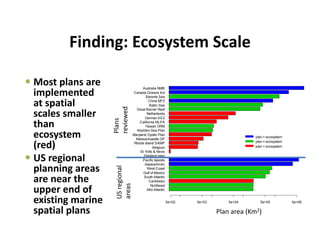
 Most plans are 
implemented 
at spatial 
scales smaller 
than 
ecosystem 
(red)
 US regional 
planning areas 
are near the 
upper end of 
existing marine 
spatial plans
Mid-Atlantic
Northeast
Caribbean
South Atlantic
Gulf of Mexico
West Coast
Alaska/Arctic
Pacific Islands
Shetland Isles
St. Kitts & Nevis
Belgium
Rhode Island SAMP
Massachusetts OP
Maryland Oyster Plan
Wadden Sea Plan
Hawaii ORM
California MLPA
German EEZ
Netherlands
Great Barrier Reef
Baltic Sea
China MFZ
Barents Sea
Canada Oceans Act
Australia NMB
5e+02 5e+03 5e+04 5e+05 5e+06
plan > ecosystem
plan = ecosystem
plan < ecosystem
Plan area (km
2
)
Plan area (Km2)
Plans 
reviewed
US regional 
areas
Finding: Implementation of Planning 
Process
• There were few, if any, institutional changes 
made in governing bodies to accomplish or 
implement CMSP.  
• The primary modus operandi for National 
plans is to call upon existing agencies to 
cooperate in producing CMSP plans using 
existing authorities. 
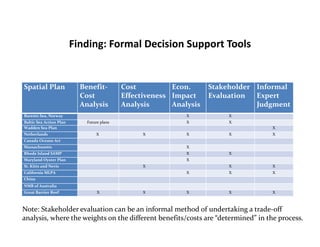
Finding: Formal Decision Support Tools
Spatial Plan Benefit‐
Cost 
Analysis
Cost 
Effectiveness 
Analysis
Econ. 
Impact 
Analysis
Stakeholder
Evaluation
Informal 
Expert 
Judgment
Barents Sea, Norway X X
Baltic Sea Action Plan Future plans X X
Wadden Sea Plan X
Netherlands X X X X X
Canada Oceans Act
Massachusetts X
Rhode Island SAMP X X
Maryland Oyster Plan X
St. Kitts and Nevis X X X
California MLPA X X X
China
NMB of Australia
Great Barrier Reef X X X X X
Note: Stakeholder evaluation can be an informal method of undertaking a trade‐off 
analysis, where the weights on the different benefits/costs are “determined” in the process. 
ICES CM 2013/I05 8
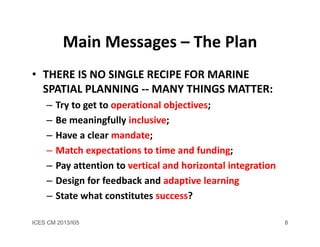
Main Messages – The Plan
• THERE IS NO SINGLE RECIPE FOR MARINE 
SPATIAL PLANNING ‐‐ MANY THINGS MATTER:
– Try to get to operational objectives;
– Be meaningfully inclusive;
– Have a clear mandate;
– Match expectations to time and funding;
– Pay attention to vertical and horizontal integration
– Design for feedback and adaptive learning
– State what constitutes success? 
Main Messages – The Process
Value of MSP is not just the Plan it is the 
PROCESS* of bringing all parties together to make 
the plan because it:
– Clarifies objectives
– Examines trade‐offs among objectives
– Involves stakeholders [makes more legitimate and 
thus easier to implement and enforce – but it does 
take more time]
– Reduces conflict
Process must be repeated at intervals – No final plan 
rather continuous adaptation. 
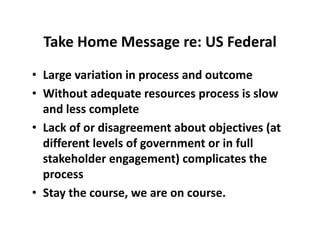
Take Home Message re: US Federal
• Large variation in process and outcome
• Without adequate resources process is slow 
and less complete
• Lack of or disagreement about objectives (at 
different levels of government or in full 
stakeholder engagement) complicates the 
process
• Stay the course, we are on course.
Horizontal Integration relies on sectors perceiving they are participating in 
a neutral , fair forum like the Arthurian “Round Table” in Camelot

2015 International Spatial Planning Symposium: Sharing Practical Solutions