James Houle 
Program Manager 
UNH Stormwater Center
Context 
• Climate Mitigation is all about carbon 
(reducing emissions) 
• Climate Adaptation is all about water
General Outline 
• Problem: There are changing patterns and there 
need to be new innovations for municipal 
infrastructure built with more useful and relevant 
data. 
• Solutions: Widespread application of GI 
incorporating storage and flexible conveyance in 
the landscape 
• Benefits: improve local community resilience, or 
the ability of a community to bounce back quickly 
from climate impacts
Climate Solutions New England (CSNE), 2014
Extreme Events Increasing 
% increase from 1958‐2012 in the amount of precipitation from 
extreme rain events (heaviest 1% of all daily events from 1958‐2012 
Source: Kenneth Kunkel, Cooperative Institute for Climate and Satelites, Noreth Carolina Sate and NOAA NCDC
• NOAA Rainfall 
data last updated 
in 1963 
• Research 
examining impacts 
including the last 
50 yrs show that 
28‐60% increase 
rainfall depths 
(Guo 2006) 
• infrastructure 
design today relies 
on outdated data
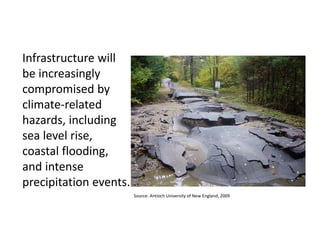
Infrastructure will 
be increasingly 
compromised by 
climate‐related 
hazards, including 
sea level rise, 
coastal flooding, 
and intense 
precipitation events. 
Source: Antioch University of New England, 2009
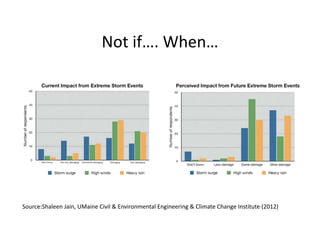
Not if…. When… 
Source:Shaleen Jain, UMaine Civil & Environmental Engineering & Climate Change Institute (2012)
Three things you can do now 
1.) Use up‐to‐date design standards 
2.) Include multiple no‐risk improvements to all 
designs 
3.) Identify hotspots and implement 
preventative GI pilot projects
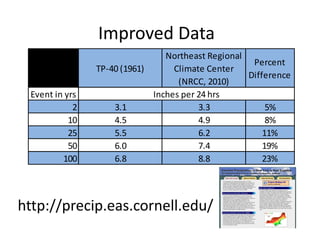
Improved Data 
TP‐40 (1961) 
Northeast Regional 
Climate Center 
(NRCC, 2010) 
Percent 
Difference 
Event in yrs 
Inches per 24 hrs 
2 3.1 3.3 5% 
10 4.5 4.9 8% 
25 5.5 6.2 11% 
50 6.0 7.4 19% 
100 6.8 8.8 23% 
http://precip.eas.cornell.edu/
up‐to‐date code 
http://www.southeastwatershedalliance.org/Final_SWA_SWStandards_Dec_2012.pdf
2013 Model Regulations 
$0 Cost Controls 
http://www.southeastwatershedalliance.org/Final_SWA_SWStandards_Dec_2012.pdf
TSS (lbs) TP (lbs) TN (lbs) 
10‐years 1,471,440 4,470 122,400 
25‐years 3,678,600 11,175 122,400
Municipalities are facing decisions about the construction or 
reconstruction of water resource infrastructure today that will 
have a profound impact on the size, scope, cost of drainage, 
and relative risk years into the future.
15
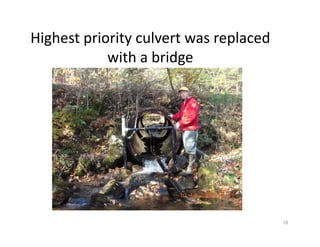
Highest priority culvert was replaced 
with a bridge 
16
17
Questions?

Green Infrastructure

  • 1.
    James Houle ProgramManager UNH Stormwater Center
  • 2.
    Context • ClimateMitigation is all about carbon (reducing emissions) • Climate Adaptation is all about water
  • 3.
    General Outline •Problem: There are changing patterns and there need to be new innovations for municipal infrastructure built with more useful and relevant data. • Solutions: Widespread application of GI incorporating storage and flexible conveyance in the landscape • Benefits: improve local community resilience, or the ability of a community to bounce back quickly from climate impacts
  • 4.
    Climate Solutions NewEngland (CSNE), 2014
  • 5.
    Extreme Events Increasing % increase from 1958‐2012 in the amount of precipitation from extreme rain events (heaviest 1% of all daily events from 1958‐2012 Source: Kenneth Kunkel, Cooperative Institute for Climate and Satelites, Noreth Carolina Sate and NOAA NCDC
  • 6.
    • NOAA Rainfall data last updated in 1963 • Research examining impacts including the last 50 yrs show that 28‐60% increase rainfall depths (Guo 2006) • infrastructure design today relies on outdated data
  • 7.
    Infrastructure will beincreasingly compromised by climate‐related hazards, including sea level rise, coastal flooding, and intense precipitation events. Source: Antioch University of New England, 2009
  • 8.
    Not if…. When… Source:Shaleen Jain, UMaine Civil & Environmental Engineering & Climate Change Institute (2012)
  • 9.
    Three things youcan do now 1.) Use up‐to‐date design standards 2.) Include multiple no‐risk improvements to all designs 3.) Identify hotspots and implement preventative GI pilot projects
  • 10.
    Improved Data TP‐40(1961) Northeast Regional Climate Center (NRCC, 2010) Percent Difference Event in yrs Inches per 24 hrs 2 3.1 3.3 5% 10 4.5 4.9 8% 25 5.5 6.2 11% 50 6.0 7.4 19% 100 6.8 8.8 23% http://precip.eas.cornell.edu/
  • 11.
  • 12.
    2013 Model Regulations $0 Cost Controls http://www.southeastwatershedalliance.org/Final_SWA_SWStandards_Dec_2012.pdf
  • 13.
    TSS (lbs) TP(lbs) TN (lbs) 10‐years 1,471,440 4,470 122,400 25‐years 3,678,600 11,175 122,400
  • 14.
    Municipalities are facingdecisions about the construction or reconstruction of water resource infrastructure today that will have a profound impact on the size, scope, cost of drainage, and relative risk years into the future.
  • 15.
  • 16.
    Highest priority culvertwas replaced with a bridge 16
  • 17.
  • 22.