ORDER AMOEBIDA
(FAMILY ACANTHAMOEBIDAE)
2
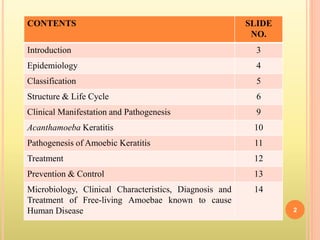
CONTENTS SLIDE
NO.
Introduction 3
Epidemiology 4
Classification 5
Structure & Life Cycle 6
Clinical Manifestation and Pathogenesis 9
Acanthamoeba Keratitis 10
Pathogenesis of Amoebic Keratitis 11
Treatment 12
Prevention & Control 13
Microbiology, Clinical Characteristics, Diagnosis and
Treatment of Free-living Amoebae known to cause
Human Disease
14
INTRODUCTION
 Small, free living, widely distributed in soil and water.
 Cause diseases in humans and other animals.
 Normally, they live as:
• Phagotrophs- in aquatic habitats where they feed on bacteria.
• Opportunists- in humans, they may produce serious
infection of the central nervous system (CNS) and the eye.
o ‘Amphizoic’ have ability to live in two Worlds, as free-
living organisms and as endoparasites.
3
EPIDEMIOLOGY
 Aerobic, eukaryotic protists that comprise several genera.
 Worldwide Geographic distribution.
 Found in freshwater, mud and moist soil and normally feeding
on bacteria.
 Hundreds of patients with Central Nervous System (CNS)
invasion by Acanthamoeba spp. and thousands of
Acanthamoeba keratitis have been reported Worldwide.
 Through the late-1990s, 103 cases of meningoencephalitis
due to Acanthamoeba species were reported although that
number is now estimated to be closer to 200 worldwide.
 Acanthamoeba keratitis is much more common, with more
than 3000 cases distributed globally. 4
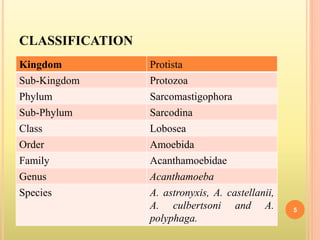
CLASSIFICATION
Kingdom Protista
Sub-Kingdom Protozoa
Phylum Sarcomastigophora
Sub-Phylum Sarcodina
Class Lobosea
Order Amoebida
Family Acanthamoebidae
Genus Acanthamoeba
Species A. astronyxis, A. castellanii,
A. culbertsoni and A.
polyphaga.
5
STRUCTURE AND LIFE CYCLE
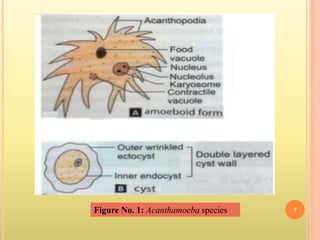
 The nuclei are characterized by a large central nucleolus
or karyosome and a nuclear membrane without
chromatin granules.
 Acanthamoeba has two stages:
1) Trophozoite- an amoeboid form with spine or thorn like
pseudopodia (acanthopodia). 15-25 µm in size. Nucleus is
single with central karyosome and no peripheral chromatin.
2) Cysts- Double walled (outer wrinkled ectocyst and inner
endocyst) with large central, dense nucleolus surrounded by
halo.
6
Figure No. 1: Acanthamoeba species 7
Figure No. 2: Life Cycle of Acanthamoeba spp. showing
stages and proposed portals of entry
8
CLINICAL MANIFESTATIONS AND
PATHOGENESIS
Two distinct clinical syndromes that infect humans:
1) Granulomatous amoebic encephalitis (GAE)
2) Amoebic keratitis (AK)
9
ACANTHAMOEBA KERATITIS
Mode of Infection
o Through corneal trauma.
o Exposure to contaminated
water.
o Wearing contaminated
contact lenses.
10
PATHOGENESIS OF AMOEBIC
KERATITIS
 Mechanism of adhesion-
Mannose binding protein
on Acanthamoeba adheres
to glycoprotein receptors
on corneal epithelium.
 Characterised by- corneal
infiltration and ulcerations,
iritis, scleritis, hypopyon,
severe pain and loss of
vision.
 A. polyphaga and A.
castellanii frequently
identified species in the
corneal scrapping.
Figure No. 3: Acanthamoeba
keratitis with the characteristic
infiltrate
11
TREATMENT
 Acanthamoeba keratitis may be treated with
antimicrobial agents.
 Treatment is difficult, but some cases have been treated
successfully with ketoconazole, miconazole, and
propamidine isethionate.
12
PREVENTION & CONTROL
o The Amoebic keratitis, caused by contact lens is
preventable by means of:
• Proper cleaning of contact lenses by using commercial rather
than home made saline solutions.
• Disinfecting contact lenses preferably with a thermal system.
• Not wearing lenses during sleep and while swimming.
13
MICROBIOLOGY, CLINICAL
CHARACTERISTICS, DIAGNOSIS AND
TREATMENT OF FREE-LIVING AMOEBAE KNOWN
TO CAUSE HUMAN DISEASE
Acanthamoeba spp.
Disease Amoebic keratitis
Epidemiology Corneal trauma; poor contact lens
hygiene.
At risk Contact lens wearers (>80% of
cases)
Signs & Symptoms Intense pain, photophobia, tearing;
dendriform epitheliopathy (early);
stromal ring.
Clinical Course Prodrome of days; subacute to
chronic keratitis. 14
CONTINUED…
Laboratory Diagnosis Corneal scraping or biopsy to find
tropozoites or cysts confocal
microscopy.
Distinct Morphologic Features Vesicular nucleus; finger-like
pseudopodia projecting from surface;
Cyst wall with 2 layers and with
pores.
Culture Non-nutrient agar with gram-negative
bacteria; Tissue culture cells (Monkey
kidney cell line, Human Epithelial
type 2 cells-HEp2, Vero and diploid
macrophage cell line); Optimal
growth at 37ºC (CNS isolates) or at
30ºC (corneal isolates).
CT/MRI of head Not applicable.
Antimicrobial therapy Polyhexamethylene biguanide
(PHMB), chlorhexidine, propamidine,
hexamidine, tropical and oral
voriconzole.
15

Order amoebidae

  • 1.
  • 2.
    2 CONTENTS SLIDE NO. Introduction 3 Epidemiology4 Classification 5 Structure & Life Cycle 6 Clinical Manifestation and Pathogenesis 9 Acanthamoeba Keratitis 10 Pathogenesis of Amoebic Keratitis 11 Treatment 12 Prevention & Control 13 Microbiology, Clinical Characteristics, Diagnosis and Treatment of Free-living Amoebae known to cause Human Disease 14
  • 3.
    INTRODUCTION  Small, freeliving, widely distributed in soil and water.  Cause diseases in humans and other animals.  Normally, they live as: • Phagotrophs- in aquatic habitats where they feed on bacteria. • Opportunists- in humans, they may produce serious infection of the central nervous system (CNS) and the eye. o ‘Amphizoic’ have ability to live in two Worlds, as free- living organisms and as endoparasites. 3
  • 4.
    EPIDEMIOLOGY  Aerobic, eukaryoticprotists that comprise several genera.  Worldwide Geographic distribution.  Found in freshwater, mud and moist soil and normally feeding on bacteria.  Hundreds of patients with Central Nervous System (CNS) invasion by Acanthamoeba spp. and thousands of Acanthamoeba keratitis have been reported Worldwide.  Through the late-1990s, 103 cases of meningoencephalitis due to Acanthamoeba species were reported although that number is now estimated to be closer to 200 worldwide.  Acanthamoeba keratitis is much more common, with more than 3000 cases distributed globally. 4
  • 5.
    CLASSIFICATION Kingdom Protista Sub-Kingdom Protozoa PhylumSarcomastigophora Sub-Phylum Sarcodina Class Lobosea Order Amoebida Family Acanthamoebidae Genus Acanthamoeba Species A. astronyxis, A. castellanii, A. culbertsoni and A. polyphaga. 5
  • 6.
    STRUCTURE AND LIFECYCLE  The nuclei are characterized by a large central nucleolus or karyosome and a nuclear membrane without chromatin granules.  Acanthamoeba has two stages: 1) Trophozoite- an amoeboid form with spine or thorn like pseudopodia (acanthopodia). 15-25 µm in size. Nucleus is single with central karyosome and no peripheral chromatin. 2) Cysts- Double walled (outer wrinkled ectocyst and inner endocyst) with large central, dense nucleolus surrounded by halo. 6
  • 7.
    Figure No. 1:Acanthamoeba species 7
  • 8.
    Figure No. 2:Life Cycle of Acanthamoeba spp. showing stages and proposed portals of entry 8
  • 9.
    CLINICAL MANIFESTATIONS AND PATHOGENESIS Twodistinct clinical syndromes that infect humans: 1) Granulomatous amoebic encephalitis (GAE) 2) Amoebic keratitis (AK) 9
  • 10.
    ACANTHAMOEBA KERATITIS Mode ofInfection o Through corneal trauma. o Exposure to contaminated water. o Wearing contaminated contact lenses. 10
  • 11.
    PATHOGENESIS OF AMOEBIC KERATITIS Mechanism of adhesion- Mannose binding protein on Acanthamoeba adheres to glycoprotein receptors on corneal epithelium.  Characterised by- corneal infiltration and ulcerations, iritis, scleritis, hypopyon, severe pain and loss of vision.  A. polyphaga and A. castellanii frequently identified species in the corneal scrapping. Figure No. 3: Acanthamoeba keratitis with the characteristic infiltrate 11
  • 12.
    TREATMENT  Acanthamoeba keratitismay be treated with antimicrobial agents.  Treatment is difficult, but some cases have been treated successfully with ketoconazole, miconazole, and propamidine isethionate. 12
  • 13.
    PREVENTION & CONTROL oThe Amoebic keratitis, caused by contact lens is preventable by means of: • Proper cleaning of contact lenses by using commercial rather than home made saline solutions. • Disinfecting contact lenses preferably with a thermal system. • Not wearing lenses during sleep and while swimming. 13
  • 14.
    MICROBIOLOGY, CLINICAL CHARACTERISTICS, DIAGNOSISAND TREATMENT OF FREE-LIVING AMOEBAE KNOWN TO CAUSE HUMAN DISEASE Acanthamoeba spp. Disease Amoebic keratitis Epidemiology Corneal trauma; poor contact lens hygiene. At risk Contact lens wearers (>80% of cases) Signs & Symptoms Intense pain, photophobia, tearing; dendriform epitheliopathy (early); stromal ring. Clinical Course Prodrome of days; subacute to chronic keratitis. 14
  • 15.
    CONTINUED… Laboratory Diagnosis Cornealscraping or biopsy to find tropozoites or cysts confocal microscopy. Distinct Morphologic Features Vesicular nucleus; finger-like pseudopodia projecting from surface; Cyst wall with 2 layers and with pores. Culture Non-nutrient agar with gram-negative bacteria; Tissue culture cells (Monkey kidney cell line, Human Epithelial type 2 cells-HEp2, Vero and diploid macrophage cell line); Optimal growth at 37ºC (CNS isolates) or at 30ºC (corneal isolates). CT/MRI of head Not applicable. Antimicrobial therapy Polyhexamethylene biguanide (PHMB), chlorhexidine, propamidine, hexamidine, tropical and oral voriconzole. 15