DEUTEROMYCOTINA-FUNGI IMPERFECTII
FUNGI AND PLANT PATHOLOGY
M.SC SPECIAL PAPER
Dr. Vishnupriya Sharma
GENERAL CHARACTERISTICS
• In Deuteromycotina no perfect stage is present
• They reproduce asexually only
• Their perfect stage is either lost during course of evolution or may not have existed at
all
• Such kind of all fungi are known as Deuteromyocotina or simply Fungi imperfectii
• Identification of such fungi can be made through their mycelial structure and mode of
asexual reproduction
• Fungi imperfectii are known to reproduce through the process known as parasexual
cycle in which plasmogamy, karyogamy and haploidization takes place but not in the
specified points
PARASEXUAL CYCLE
Pontecorvo and Roper (1952) discovered parasexual cycle in Aspergillus nidulans ( imperfect stage of
Emericella nidulans.
Sequence of events in a complete parasexual cycle
►Formation of heterokaryotic mycelium
►Fusion between two nuclei i.e. like and unlike nuclei
►Multiplication of diploid nuclei side by side with the haploid nuclei
►Occasional mitotic crossing- over during the multiplication of the diploid nuclei
►Sorting out of diploid nuclei
►Occasional haploidization of the diploid nuclei
►Sorting out of new haploid strains.
FORM GENUS OR FORM GENERA
#Schrocter used the term form genus or form genera for the members of
Deuteromycotina.
Since they are in reality not necessarily the assemblage of related species as one
genus which is an imperfect genus may represent the imperfect stage of more than
one perfect fungi
It is believed that members of fungi imperfectii are imperfect stages of
ascomycotina or basidiomycotina
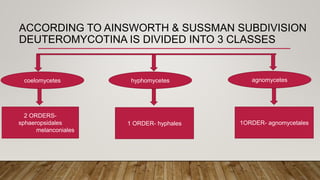
ACCORDING TO AINSWORTH & SUSSMAN SUBDIVISION
DEUTEROMYCOTINA IS DIVIDED INTO 3 CLASSES
coelomycetes agnomyceteshyphomycetes
2 ORDERS-
sphaeropsidales
melanconiales
1 ORDER- hyphales 1ORDER- agnomycetales
CLASSIFICATION OF
DEUTEROMYCETES –SACCARDO
SYSTEM
ASEXUAL SPORES ARE
PRESENT
ASEXUAL SPORES ARE
ABSENT
Mycelia sterilea
Conidia and conidiophores are
enclosed
Conidia and conidiophores
are free
Conidia
produced in
acervuli-
Melanconiales
Conidia produced
in pycnidia-
Sphaeropsidales
Moniliales
1.SPHAEROPSIDALES
• Fruiting body pycnidium, flask shaped
• Basal portion of pycnidium is lined by conidiophores bearing conidia
• Conidia comes out from the ostiole as cirrus or in the form of smoke like mass of
conidia
• Most species are saprophytic but few of them are parasitic
• They predominantly cause leaf spot but also grow on fruits ,stem causing blight, rot
and canker disease
• Eg Macrophomina, Phyllosticta, Phoma, Diplodia,Botriodiplodia
2. MELANCONIALES
• The fruiting body is acervulus
• It is a plate like structure on the surface and on upper surface the conidiophores
are present which form a palisade like layer
• Some bristles like structures known as setae are also present in between the
conidiophores
• Commonly named as Anthracnose as it produces characteristic lesions
• Eg Gloeosporium, Colletotrichum, Pestolatia
3. MONILIALES
• Also called as hyphales
• No fruiting bodies are formed
• Conidiophores are micronematous bear conidia
• Conidiophore may be free or show gradual aggregation
• Size , shape and colour of conidia may vary
• Eg Monilia, Curvularia, Bipolaris, Cercospora
4. MYCELIA STERELIA
• It includes those forms which lack conidia formation
• Produce sclerotia or rhizomorph
• Various other forms of mycelium without spore formation
• Eg Rhizoctonia, Sclerotium
thanks

Deuteromycotina

  • 1.
    DEUTEROMYCOTINA-FUNGI IMPERFECTII FUNGI ANDPLANT PATHOLOGY M.SC SPECIAL PAPER Dr. Vishnupriya Sharma
  • 2.
    GENERAL CHARACTERISTICS • InDeuteromycotina no perfect stage is present • They reproduce asexually only • Their perfect stage is either lost during course of evolution or may not have existed at all • Such kind of all fungi are known as Deuteromyocotina or simply Fungi imperfectii • Identification of such fungi can be made through their mycelial structure and mode of asexual reproduction • Fungi imperfectii are known to reproduce through the process known as parasexual cycle in which plasmogamy, karyogamy and haploidization takes place but not in the specified points
  • 3.
    PARASEXUAL CYCLE Pontecorvo andRoper (1952) discovered parasexual cycle in Aspergillus nidulans ( imperfect stage of Emericella nidulans. Sequence of events in a complete parasexual cycle ►Formation of heterokaryotic mycelium ►Fusion between two nuclei i.e. like and unlike nuclei ►Multiplication of diploid nuclei side by side with the haploid nuclei ►Occasional mitotic crossing- over during the multiplication of the diploid nuclei ►Sorting out of diploid nuclei ►Occasional haploidization of the diploid nuclei ►Sorting out of new haploid strains.
  • 4.
    FORM GENUS ORFORM GENERA #Schrocter used the term form genus or form genera for the members of Deuteromycotina. Since they are in reality not necessarily the assemblage of related species as one genus which is an imperfect genus may represent the imperfect stage of more than one perfect fungi It is believed that members of fungi imperfectii are imperfect stages of ascomycotina or basidiomycotina
  • 5.
    ACCORDING TO AINSWORTH& SUSSMAN SUBDIVISION DEUTEROMYCOTINA IS DIVIDED INTO 3 CLASSES coelomycetes agnomyceteshyphomycetes 2 ORDERS- sphaeropsidales melanconiales 1 ORDER- hyphales 1ORDER- agnomycetales
  • 6.
    CLASSIFICATION OF DEUTEROMYCETES –SACCARDO SYSTEM ASEXUALSPORES ARE PRESENT ASEXUAL SPORES ARE ABSENT Mycelia sterilea Conidia and conidiophores are enclosed Conidia and conidiophores are free Conidia produced in acervuli- Melanconiales Conidia produced in pycnidia- Sphaeropsidales Moniliales
  • 7.
    1.SPHAEROPSIDALES • Fruiting bodypycnidium, flask shaped • Basal portion of pycnidium is lined by conidiophores bearing conidia • Conidia comes out from the ostiole as cirrus or in the form of smoke like mass of conidia • Most species are saprophytic but few of them are parasitic • They predominantly cause leaf spot but also grow on fruits ,stem causing blight, rot and canker disease • Eg Macrophomina, Phyllosticta, Phoma, Diplodia,Botriodiplodia
  • 8.
    2. MELANCONIALES • Thefruiting body is acervulus • It is a plate like structure on the surface and on upper surface the conidiophores are present which form a palisade like layer • Some bristles like structures known as setae are also present in between the conidiophores • Commonly named as Anthracnose as it produces characteristic lesions • Eg Gloeosporium, Colletotrichum, Pestolatia
  • 9.
    3. MONILIALES • Alsocalled as hyphales • No fruiting bodies are formed • Conidiophores are micronematous bear conidia • Conidiophore may be free or show gradual aggregation • Size , shape and colour of conidia may vary • Eg Monilia, Curvularia, Bipolaris, Cercospora
  • 10.
    4. MYCELIA STERELIA •It includes those forms which lack conidia formation • Produce sclerotia or rhizomorph • Various other forms of mycelium without spore formation • Eg Rhizoctonia, Sclerotium
  • 11.