Presenter : Dr. Itrat Hussain
Moderator : Dr. Harsh Jain
Mandibular Orthognathic
Procedures
CONTENTS
1. Introduction
2. Historical aspects
3. Anatomical & physiological considerations of
mandibular osteotomies
4. Timing for the mandibular osteotomies
5. Mandibular osteotomies
6. Soft tissue changes after mandibular
osteotomies
7. Complications
8. References
INTRODUCTION
Orthognathic surgery is a process in
which dentofacial deformities and malocclusions
are corrected with orthodontics and surgical
operations of the facial skeleton, sometimes
combined with various soft tissue procedures.
The term orthognathic originates from the
Greek words orthos , ‘straight’, and gnathos ‘jaw’.
It is possible to correct, or
“straighten”, deformities separately in either the
maxilla or the mandible with many types
of surgical techniques or to do procedures
concurrently on both jaws.
HISTORY
Orthognathic surgery was originally developed in
the United States of America (Steinhäuser ).
The first mandibular osteotomy is considered to be
Hullihen´s procedure in 1849 to correct anterior
open bite & mandibular dento alveolar protrusion
with an intraoral osteotomy.
Osteotomy of the mandibular body for the
correction of mandibular horizontal excess was
performed by Vilray Blair (1890).
Berger (1897) described a condylar osteotomy for the
correction of prognathism.
Limberg in 1925 first reported the subcondylar
osteotomy as an extraoral technique, later it was
modified to the intraoral vertical subcondylar osteotomy.
A variation of the vertical subcondylar osteotomy was
suggested by Wassmund in 1927,which is similar to the
inverted –L-osteotomy.
Hofer in 1936 demonstrated an anterior
mandibular alveolar osteotomy to
advance anterior teeth in correction of a
mandibular dentoalveolar retrusion.
In 1954, Caldwell and Letterman
developed a Vertical Ramus Osteotomy
Technique, which had the advantage of
minimizing trauma to the inferior alveolar
neurovascular bundle.
The greatest development in osteotomies of the vertical ramus
is the sagittal split osteotomy credited to Obwegeser in 1955.
The major modifications in the osteotomies design were first
made by Dalpont in 1961.
This was further discussed by Hunsuck in 1968 in order to
decrease the trauma to overlying soft tissues.
Kent & Hinds in 1971 initially presented the use of single tooth
osteotomies of the mandible.
Macintosh closely followed with his description of the total
mandibular alveolar osteotomy in 1974.
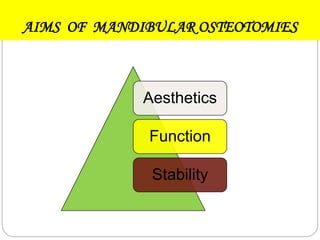
Aesthetics
Function
Stability
AIMS OF MANDIBULAR OSTEOTOMIES
PRINCIPLES IN TREATING
MANDIBULAR DEFORMITIESPatient’s perception of the deformity and expectations
Surgeon’s recognition of the deformity
Complete physical examination, model surgery, cephalometric
analysis
Optimal treatment plan
Counseling of the patient
Informed consent
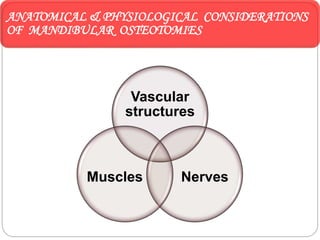
Vascular
structures
NervesMuscles
ANATOMICAL & PHYSIOLOGICAL CONSIDERATIONS
OF MANDIBULAR OSTEOTOMIES
VASCULAR STRUCTURES
Bell and Levy’s work {1970} demonstrated
that blood flow through the mandibular
periosteum could easily maintain a sufficient
blood supply to the teeth of a mobile segment,
even when the labial periosteum was degloved.
Subapical Osteotomies need to be carefully
planned to ensure as large a vascular pedicle as
possible.
The proximal segment of the vertical sub sigmoid
osteotomy maintains its blood supply through the
temporomandibular joint capsule and the
attachment of the lateral pterygoid muscle.
But the inferior tip of this fragment has undergone
vascular necrosis in some studies.
This led to the suggestion that fewer problems may
occur if the cut was made above the angle of the
mandible.
We should minimize the periosteal and
muscle attachment stripping on the medial
surface of the proximal fragment with either
the C or L osteotomy or any of their
variations.
The greater distance from the apices of the
teeth not only minimizes direct pulpal injury
but increases the vascular pedicle to the
mobile segment as well.
NERVES
In most cases in orthognathic surgery avoiding injury to
marginal mandibular branch of facial nerve is achieved
because soft tissue anatomy in patients undergoing the
surgery has not been disturbed by disease or trauma.
The course of the inferior alveolar nerve into the vertical
ramus and then through the body of the mandible makes
it extremely susceptible to damage from almost every
mandibular surgical procedure.
In most cases the surgeon’s main goal relative to this
nerve is only to minimize the trauma because its
avoidance is almost impossible.
MUSCLES
Orthognathic surgery affects muscles in
primarily two ways:
It changes the length of a muscle or it changes the
direction of muscle function.
The muscles commonly discussed in orthognathic
surgery of the mandible have been the muscles of
mastication and the suprahyoid group of muscles .
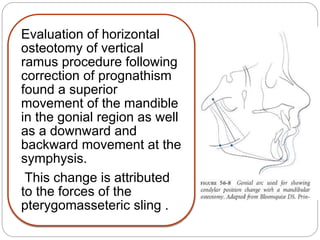
Evaluation of horizontal
osteotomy of vertical
ramus procedure following
correction of prognathism
found a superior
movement of the mandible
in the gonial region as well
as a downward and
backward movement at the
symphysis.
This change is attributed
to the forces of the
pterygomasseteric sling .
TIMING OF OSTEOTOMY
Union of epiphysis
& diaphysis
MANDIBULAR OSTEOTOMIES
VERTICAL RAMUS OSTEOTOMIES
BILATERAL SAGITTAL SPLIT OSTEOTOMY
HORIZONTAL RAMUS OSTEOTOMIES
SUB APICAL OSTEOTOMIES [segmental osteotomies]
TOTAL ALVEOLAR OSTEOTOMIES
HORIZONTAL OSTEOTOMY OF SYMPHYSIS/ GENIOPLASTY
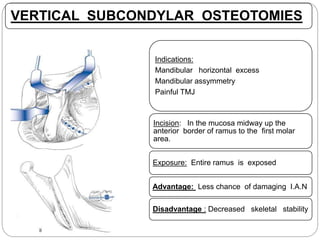
VERTICAL SUBCONDYLAR OSTEOTOMIES
Indications:
Mandibular horizontal excess
Mandibular assymmetry
Painful TMJ
Incision: In the mucosa midway up the
anterior border of ramus to the first molar
area.
Exposure: Entire ramus is exposed
Advantage: Less chance of damaging I.A.N
Disadvantage : Decreased skeletal stability
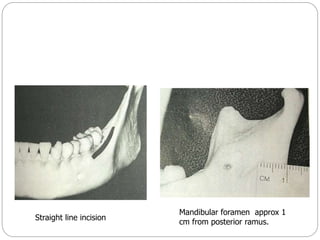
Straight line incision
Mandibular foramen approx 1
cm from posterior ramus.
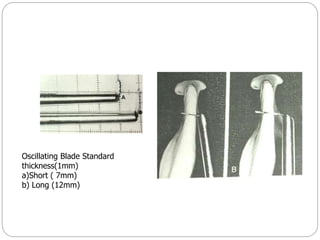
Oscillating Blade Standard
thickness(1mm)
a)Short ( 7mm)
b) Long (12mm)
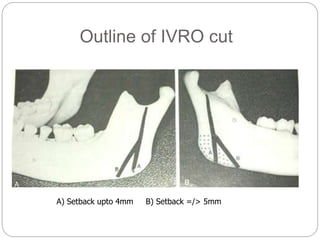
Outline of IVRO cut
A) Setback upto 4mm B) Setback =/> 5mm
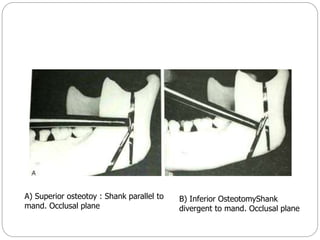
A) Superior osteotoy : Shank parallel to
mand. Occlusal plane
B) Inferior OsteotomyShank
divergent to mand. Occlusal plane
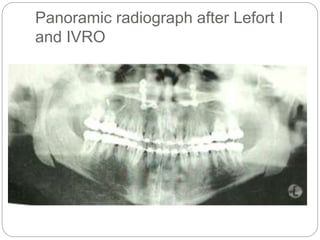
Panoramic radiograph after Lefort I
and IVRO
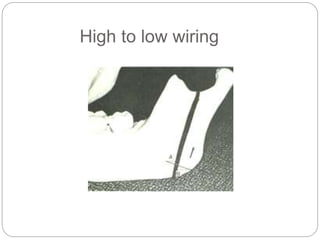
High to low wiring
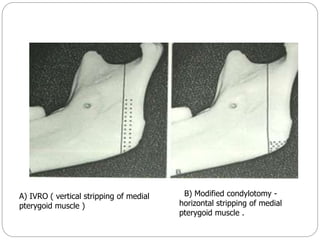
A) IVRO ( vertical stripping of medial
pterygoid muscle )
B) Modified condylotomy -
horizontal stripping of medial
pterygoid muscle .
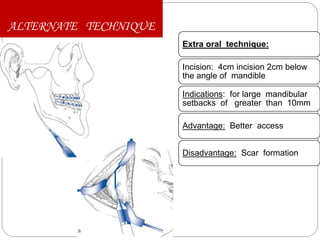
ALTERNATE TECHNIQUE
Extra oral technique:
Incision: 4cm incision 2cm below
the angle of mandible
Indications: for large mandibular
setbacks of greater than 10mm
Advantage: Better access
Disadvantage: Scar formation
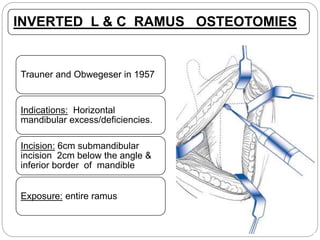
INVERTED L & C RAMUS OSTEOTOMIES
Trauner and Obwegeser in 1957
Indications: Horizontal
mandibular excess/deficiencies.
Incision: 6cm submandibular
incision 2cm below the angle &
inferior border of mandible
Exposure: entire ramus
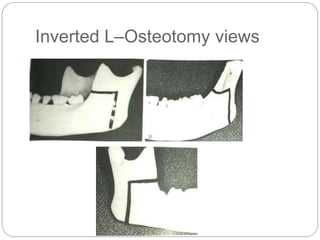
Inverted L–Osteotomy views
ALTERNATE TECHNIQUES FOR
INVERTED L OSTEOTOMIES [C –
osteotomy]
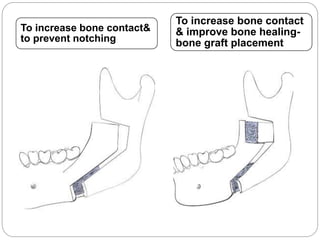
Advantage :
To increase
the bone
contact
during
advancement
To increase bone contact&
to prevent notching
To increase bone contact
& improve bone healing-
bone graft placement
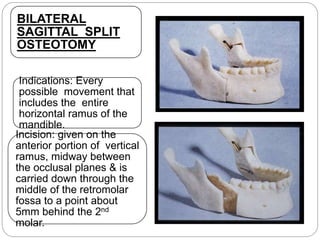
BILATERAL
SAGITTAL SPLIT
OSTEOTOMY
Indications: Every
possible movement that
includes the entire
horizontal ramus of the
mandible.
Incision: given on the
anterior portion of vertical
ramus, midway between
the occlusal planes & is
carried down through the
middle of the retromolar
fossa to a point about
5mm behind the 2nd
molar.
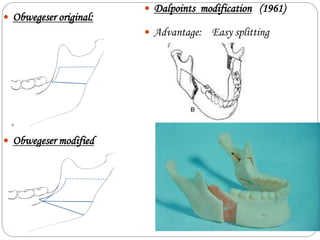
 Dalpoints modification (1961)
 Advantage: Easy splitting
 Obwegeser original:
 Obwegeser modified
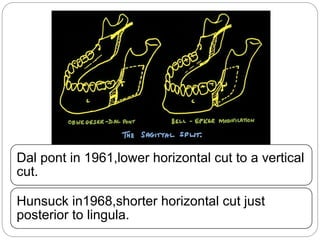
Dal pont in 1961,lower horizontal cut to a vertical
cut.
Hunsuck in1968,shorter horizontal cut just
posterior to lingula.
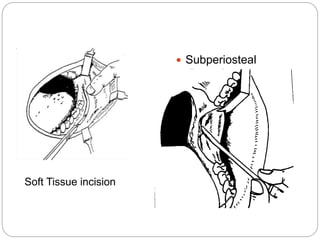
Soft Tissue incision
 Subperiosteal
dissection
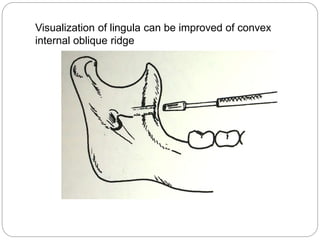
Visualization of lingula can be improved of convex
internal oblique ridge
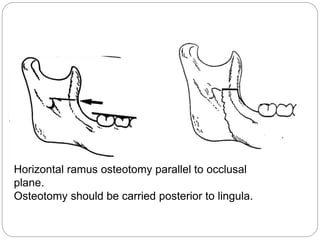
Horizontal ramus osteotomy parallel to occlusal
plane.
Osteotomy should be carried posterior to lingula.
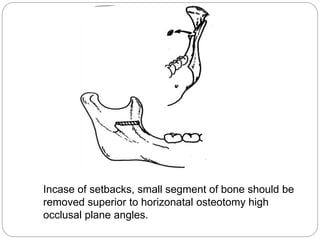
Incase of setbacks, small segment of bone should be
removed superior to horizonatal osteotomy high
occlusal plane angles.
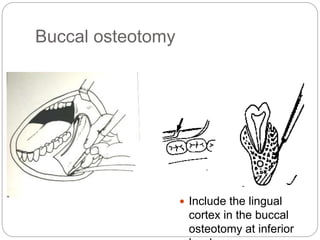
Buccal osteotomy
 Include the lingual
cortex in the buccal
osteotomy at inferior
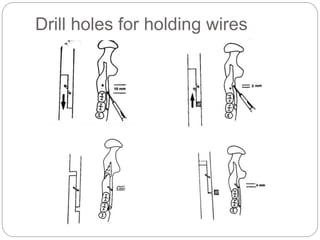
Drill holes for holding wires
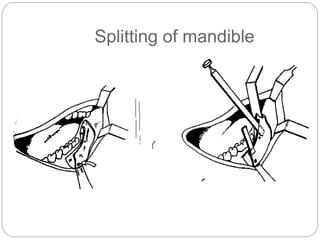
Splitting of mandible
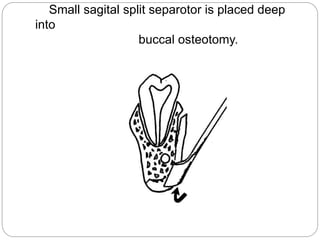
Small sagital split separotor is placed deep
into
buccal osteotomy.
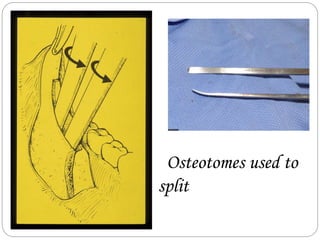
Osteotomes used to
split
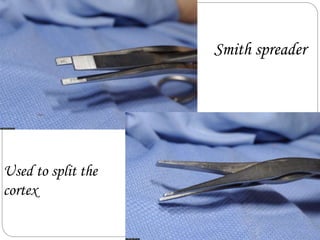
Smith spreader
Used to split the
cortex
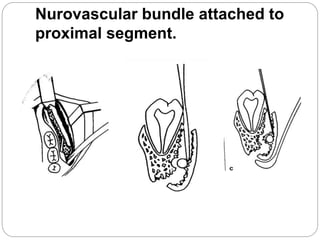
Nurovascular bundle attached to
proximal segment.
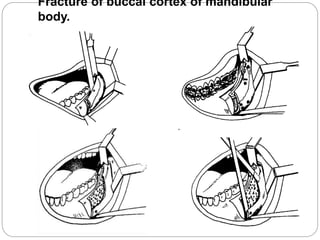
Fracture of buccal cortex of mandibular
body.
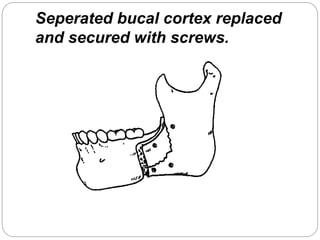
Seperated bucal cortex replaced
and secured with screws.
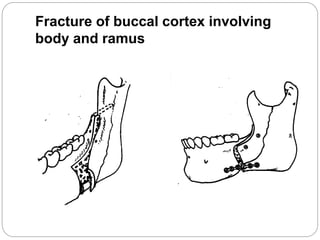
Fracture of buccal cortex involving
body and ramus
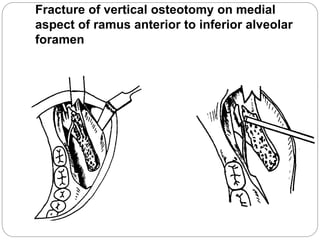
Fracture of vertical osteotomy on medial
aspect of ramus anterior to inferior alveolar
foramen
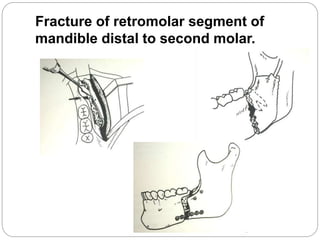
Fracture of retromolar segment of
mandible distal to second molar.
Stripping of
pterygomasseteric
sling
 Stripping of medial pterygoid
muscle and stylomandibular
ligament on medial aspect, in
case of mandibular setback
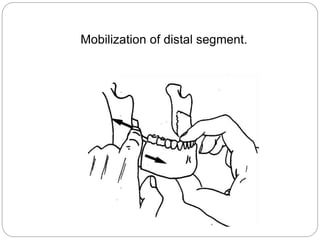
Mobilization of distal segment.
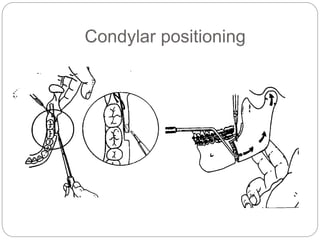
Condylar positioning
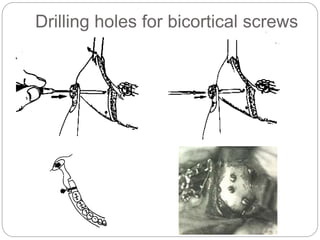
Drilling holes for bicortical screws
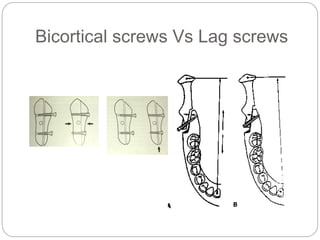
Bicortical screws Vs Lag screws
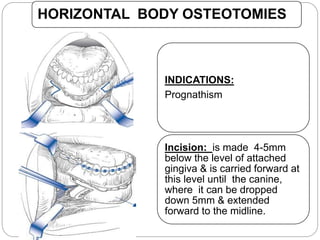
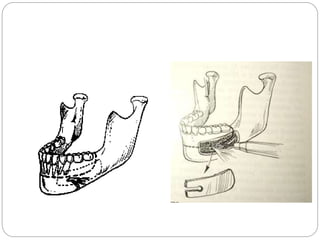
HORIZONTAL BODY OSTEOTOMIES
INDICATIONS:
Prognathism
Incision: is made 4-5mm
below the level of attached
gingiva & is carried forward at
this level until the canine,
where it can be dropped
down 5mm & extended
forward to the midline.
SUBAPICAL OSTEOTOMIES
Anterior subapical
Posterior subapical
Total alveolar osteotomy
ANTERIOR SUBAPICAL OSTEOTOMY
Indications: To move the anterior
mandible in every desirable
direction[ant,post,sup,inf-
repositioning]
Incision : is started 1cm behind
the planned vertical osteotomy&
is carried 4-5mm below the
attached gingiva & is brought to
the midline & connected with the
opposing incision.
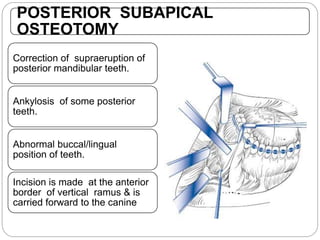
POSTERIOR SUBAPICAL
OSTEOTOMY
Correction of supraeruption of
posterior mandibular teeth.
Ankylosis of some posterior
teeth.
Abnormal buccal/lingual
position of teeth.
Incision is made at the anterior
border of vertical ramus & is
carried forward to the canine
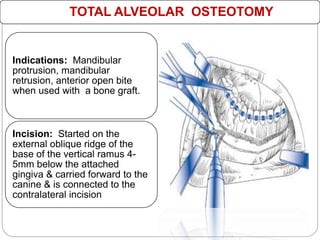
TOTAL ALVEOLAR OSTEOTOMY
Indications: Mandibular
protrusion, mandibular
retrusion, anterior open bite
when used with a bone graft.
Incision: Started on the
external oblique ridge of the
base of the vertical ramus 4-
5mm below the attached
gingiva & carried forward to the
canine & is connected to the
contralateral incision
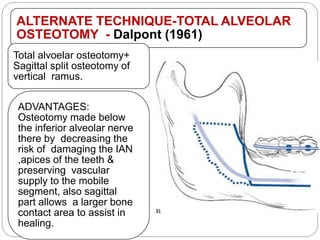
ALTERNATE TECHNIQUE-TOTAL ALVEOLAR
OSTEOTOMY - Dalpont (1961)
Total alvoelar osteotomy+
Sagittal split osteotomy of
vertical ramus.
ADVANTAGES:
Osteotomy made below
the inferior alveolar nerve
there by decreasing the
risk of damaging the IAN
,apices of the teeth &
preserving vascular
supply to the mobile
segment, also sagittal
part allows a larger bone
contact area to assist in
healing.
SOFT TISSUE CHANGES INDUCED BY SURGERY
Advancement of the mandible :
 Increase in lower lip protrusion, chin prominence.
 Enhanced chin neck definition.
 Decreased prominence of labiomental fold.
 Decreased lower lip eversion.
 Increased lower third facial height.
Total subapical surgery for dentoalveolar horizontal
deficiency:
Increased lower lip prominence, Increased lower facial
height, decreased depth of labiomental fold.
Correction of Mandibular horizontal excess:
Reduced chin prominence & lower lip eversion,
decreased lower facial height, increased prominence of
angles.
Excessive setbacks in older & obese individuals:
Increased fullness in the submental region & produce
poor chin & neck contour.
GENIOPLASTIES
Hofer (1942) , Converse (1950) , Trauner & Obwegeser
(1957)
Genioplasty can be used as a single procedure or it can be
used as an adjunctive procedure along with other major
osteomies of the jaw bone.
Deformities of the chin should be considered in all 3
planes:
AP
Vertical
Transverse
It can be used to augment, reduce, straighten or lengthen
the chin.
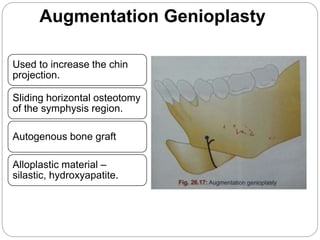
Augmentation Genioplasty
Used to increase the chin
projection.
Sliding horizontal osteotomy
of the symphysis region.
Autogenous bone graft
Alloplastic material –
silastic, hydroxyapatite.
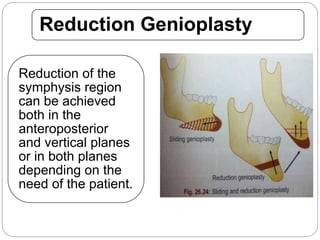
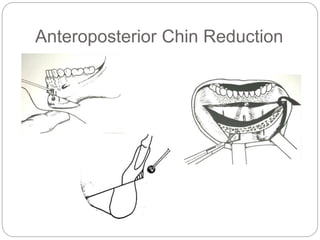
Reduction Genioplasty
Reduction of the
symphysis region
can be achieved
both in the
anteroposterior
and vertical planes
or in both planes
depending on the
need of the patient.
Straightening Genioplasty Procedure
Indication:
• In Facial asymmetry, where the
complete correction of the asymmetry
cannot be achieved by appropriate
jaw osteotomies. E.g., TM joint
ankylosis.
• The horizontal osteotomy is done and
segment Is shifted laterally and than
contoured to get desired result.
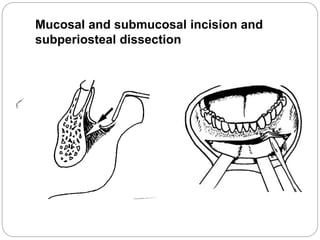
Mucosal and submucosal incision and
subperiosteal dissection
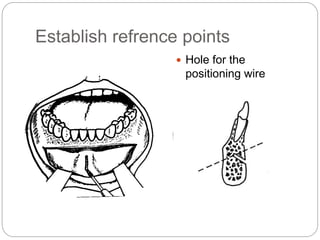
Establish refrence points
 Hole for the
positioning wire
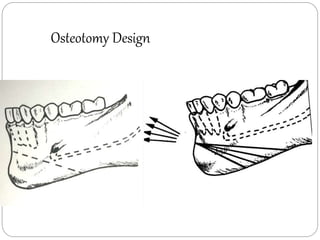
Osteotomy Design
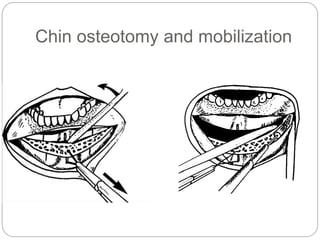
Chin osteotomy and mobilization
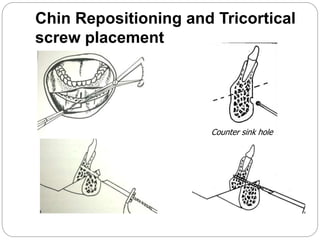
Chin Repositioning and Tricortical
screw placement
Counter sink hole
Bone plate fixation
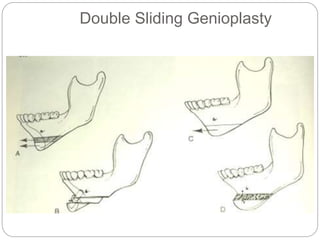
Double Sliding Genioplasty
Anteroposterior Chin Reduction
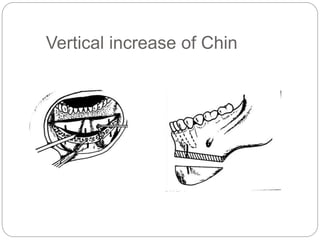
Vertical increase of Chin
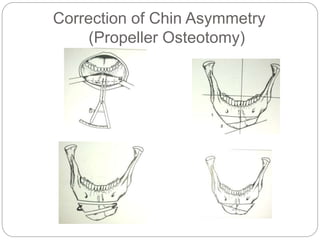
Correction of Chin Asymmetry
(Propeller Osteotomy)
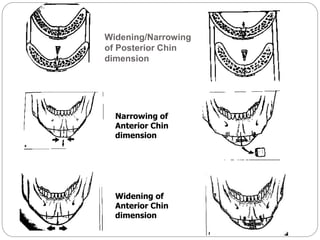
Widening/Narrowing
of Posterior Chin
dimension
Narrowing of
Anterior Chin
dimension
Widening of
Anterior Chin
dimension
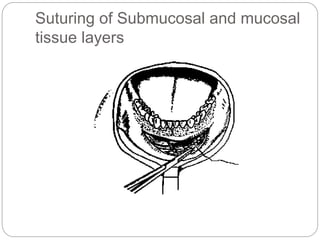
Suturing of Submucosal and mucosal
tissue layers
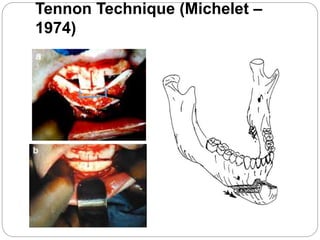
Tennon Technique (Michelet –
1974)
dimensional reduction genioplasty. Keyhan
SO, Khiabani K, Hemmat S, Varedi P , Br J Oral
Maxillofac Surg.2013]

Mandibular orthognathic procedures 1- ih

  • 2.
    Presenter : Dr.Itrat Hussain Moderator : Dr. Harsh Jain Mandibular Orthognathic Procedures
  • 3.
    CONTENTS 1. Introduction 2. Historicalaspects 3. Anatomical & physiological considerations of mandibular osteotomies 4. Timing for the mandibular osteotomies 5. Mandibular osteotomies 6. Soft tissue changes after mandibular osteotomies 7. Complications 8. References
  • 4.
    INTRODUCTION Orthognathic surgery isa process in which dentofacial deformities and malocclusions are corrected with orthodontics and surgical operations of the facial skeleton, sometimes combined with various soft tissue procedures. The term orthognathic originates from the Greek words orthos , ‘straight’, and gnathos ‘jaw’. It is possible to correct, or “straighten”, deformities separately in either the maxilla or the mandible with many types of surgical techniques or to do procedures concurrently on both jaws.
  • 5.
    HISTORY Orthognathic surgery wasoriginally developed in the United States of America (Steinhäuser ). The first mandibular osteotomy is considered to be Hullihen´s procedure in 1849 to correct anterior open bite & mandibular dento alveolar protrusion with an intraoral osteotomy. Osteotomy of the mandibular body for the correction of mandibular horizontal excess was performed by Vilray Blair (1890).
  • 6.
    Berger (1897) describeda condylar osteotomy for the correction of prognathism. Limberg in 1925 first reported the subcondylar osteotomy as an extraoral technique, later it was modified to the intraoral vertical subcondylar osteotomy. A variation of the vertical subcondylar osteotomy was suggested by Wassmund in 1927,which is similar to the inverted –L-osteotomy.
  • 7.
    Hofer in 1936demonstrated an anterior mandibular alveolar osteotomy to advance anterior teeth in correction of a mandibular dentoalveolar retrusion. In 1954, Caldwell and Letterman developed a Vertical Ramus Osteotomy Technique, which had the advantage of minimizing trauma to the inferior alveolar neurovascular bundle.
  • 8.
    The greatest developmentin osteotomies of the vertical ramus is the sagittal split osteotomy credited to Obwegeser in 1955. The major modifications in the osteotomies design were first made by Dalpont in 1961. This was further discussed by Hunsuck in 1968 in order to decrease the trauma to overlying soft tissues. Kent & Hinds in 1971 initially presented the use of single tooth osteotomies of the mandible. Macintosh closely followed with his description of the total mandibular alveolar osteotomy in 1974.
  • 9.
  • 10.
    PRINCIPLES IN TREATING MANDIBULARDEFORMITIESPatient’s perception of the deformity and expectations Surgeon’s recognition of the deformity Complete physical examination, model surgery, cephalometric analysis Optimal treatment plan Counseling of the patient Informed consent
  • 11.
    Vascular structures NervesMuscles ANATOMICAL & PHYSIOLOGICALCONSIDERATIONS OF MANDIBULAR OSTEOTOMIES
  • 12.
    VASCULAR STRUCTURES Bell andLevy’s work {1970} demonstrated that blood flow through the mandibular periosteum could easily maintain a sufficient blood supply to the teeth of a mobile segment, even when the labial periosteum was degloved. Subapical Osteotomies need to be carefully planned to ensure as large a vascular pedicle as possible.
  • 13.
    The proximal segmentof the vertical sub sigmoid osteotomy maintains its blood supply through the temporomandibular joint capsule and the attachment of the lateral pterygoid muscle. But the inferior tip of this fragment has undergone vascular necrosis in some studies. This led to the suggestion that fewer problems may occur if the cut was made above the angle of the mandible.
  • 14.
    We should minimizethe periosteal and muscle attachment stripping on the medial surface of the proximal fragment with either the C or L osteotomy or any of their variations. The greater distance from the apices of the teeth not only minimizes direct pulpal injury but increases the vascular pedicle to the mobile segment as well.
  • 15.
    NERVES In most casesin orthognathic surgery avoiding injury to marginal mandibular branch of facial nerve is achieved because soft tissue anatomy in patients undergoing the surgery has not been disturbed by disease or trauma. The course of the inferior alveolar nerve into the vertical ramus and then through the body of the mandible makes it extremely susceptible to damage from almost every mandibular surgical procedure. In most cases the surgeon’s main goal relative to this nerve is only to minimize the trauma because its avoidance is almost impossible.
  • 16.
    MUSCLES Orthognathic surgery affectsmuscles in primarily two ways: It changes the length of a muscle or it changes the direction of muscle function. The muscles commonly discussed in orthognathic surgery of the mandible have been the muscles of mastication and the suprahyoid group of muscles .
  • 17.
    Evaluation of horizontal osteotomyof vertical ramus procedure following correction of prognathism found a superior movement of the mandible in the gonial region as well as a downward and backward movement at the symphysis. This change is attributed to the forces of the pterygomasseteric sling .
  • 18.
    TIMING OF OSTEOTOMY Unionof epiphysis & diaphysis
  • 19.
    MANDIBULAR OSTEOTOMIES VERTICAL RAMUSOSTEOTOMIES BILATERAL SAGITTAL SPLIT OSTEOTOMY HORIZONTAL RAMUS OSTEOTOMIES SUB APICAL OSTEOTOMIES [segmental osteotomies] TOTAL ALVEOLAR OSTEOTOMIES HORIZONTAL OSTEOTOMY OF SYMPHYSIS/ GENIOPLASTY
  • 20.
    VERTICAL SUBCONDYLAR OSTEOTOMIES Indications: Mandibularhorizontal excess Mandibular assymmetry Painful TMJ Incision: In the mucosa midway up the anterior border of ramus to the first molar area. Exposure: Entire ramus is exposed Advantage: Less chance of damaging I.A.N Disadvantage : Decreased skeletal stability
  • 21.
    Straight line incision Mandibularforamen approx 1 cm from posterior ramus.
  • 22.
  • 23.
    Outline of IVROcut A) Setback upto 4mm B) Setback =/> 5mm
  • 24.
    A) Superior osteotoy: Shank parallel to mand. Occlusal plane B) Inferior OsteotomyShank divergent to mand. Occlusal plane
  • 25.
    Panoramic radiograph afterLefort I and IVRO
  • 26.
  • 27.
    A) IVRO (vertical stripping of medial pterygoid muscle ) B) Modified condylotomy - horizontal stripping of medial pterygoid muscle .
  • 28.
    ALTERNATE TECHNIQUE Extra oraltechnique: Incision: 4cm incision 2cm below the angle of mandible Indications: for large mandibular setbacks of greater than 10mm Advantage: Better access Disadvantage: Scar formation
  • 29.
    INVERTED L &C RAMUS OSTEOTOMIES Trauner and Obwegeser in 1957 Indications: Horizontal mandibular excess/deficiencies. Incision: 6cm submandibular incision 2cm below the angle & inferior border of mandible Exposure: entire ramus
  • 30.
  • 31.
    ALTERNATE TECHNIQUES FOR INVERTEDL OSTEOTOMIES [C – osteotomy] Advantage : To increase the bone contact during advancement
  • 32.
    To increase bonecontact& to prevent notching To increase bone contact & improve bone healing- bone graft placement
  • 33.
    BILATERAL SAGITTAL SPLIT OSTEOTOMY Indications: Every possiblemovement that includes the entire horizontal ramus of the mandible. Incision: given on the anterior portion of vertical ramus, midway between the occlusal planes & is carried down through the middle of the retromolar fossa to a point about 5mm behind the 2nd molar.
  • 34.
     Dalpoints modification(1961)  Advantage: Easy splitting  Obwegeser original:  Obwegeser modified
  • 35.
    Dal pont in1961,lower horizontal cut to a vertical cut. Hunsuck in1968,shorter horizontal cut just posterior to lingula.
  • 36.
    Soft Tissue incision Subperiosteal dissection
  • 37.
    Visualization of lingulacan be improved of convex internal oblique ridge
  • 38.
    Horizontal ramus osteotomyparallel to occlusal plane. Osteotomy should be carried posterior to lingula.
  • 39.
    Incase of setbacks,small segment of bone should be removed superior to horizonatal osteotomy high occlusal plane angles.
  • 40.
    Buccal osteotomy  Includethe lingual cortex in the buccal osteotomy at inferior
  • 41.
    Drill holes forholding wires
  • 42.
  • 43.
    Small sagital splitseparotor is placed deep into buccal osteotomy.
  • 44.
  • 45.
    Smith spreader Used tosplit the cortex
  • 46.
    Nurovascular bundle attachedto proximal segment.
  • 47.
    Fracture of buccalcortex of mandibular body.
  • 48.
    Seperated bucal cortexreplaced and secured with screws.
  • 49.
    Fracture of buccalcortex involving body and ramus
  • 50.
    Fracture of verticalosteotomy on medial aspect of ramus anterior to inferior alveolar foramen
  • 51.
    Fracture of retromolarsegment of mandible distal to second molar.
  • 52.
    Stripping of pterygomasseteric sling  Strippingof medial pterygoid muscle and stylomandibular ligament on medial aspect, in case of mandibular setback
  • 53.
  • 54.
  • 55.
    Drilling holes forbicortical screws
  • 56.
  • 57.
    HORIZONTAL BODY OSTEOTOMIES INDICATIONS: Prognathism Incision:is made 4-5mm below the level of attached gingiva & is carried forward at this level until the canine, where it can be dropped down 5mm & extended forward to the midline.
  • 58.
    SUBAPICAL OSTEOTOMIES Anterior subapical Posteriorsubapical Total alveolar osteotomy
  • 59.
    ANTERIOR SUBAPICAL OSTEOTOMY Indications:To move the anterior mandible in every desirable direction[ant,post,sup,inf- repositioning] Incision : is started 1cm behind the planned vertical osteotomy& is carried 4-5mm below the attached gingiva & is brought to the midline & connected with the opposing incision.
  • 60.
    POSTERIOR SUBAPICAL OSTEOTOMY Correction ofsupraeruption of posterior mandibular teeth. Ankylosis of some posterior teeth. Abnormal buccal/lingual position of teeth. Incision is made at the anterior border of vertical ramus & is carried forward to the canine
  • 61.
    TOTAL ALVEOLAR OSTEOTOMY Indications:Mandibular protrusion, mandibular retrusion, anterior open bite when used with a bone graft. Incision: Started on the external oblique ridge of the base of the vertical ramus 4- 5mm below the attached gingiva & carried forward to the canine & is connected to the contralateral incision
  • 63.
    ALTERNATE TECHNIQUE-TOTAL ALVEOLAR OSTEOTOMY- Dalpont (1961) Total alvoelar osteotomy+ Sagittal split osteotomy of vertical ramus. ADVANTAGES: Osteotomy made below the inferior alveolar nerve there by decreasing the risk of damaging the IAN ,apices of the teeth & preserving vascular supply to the mobile segment, also sagittal part allows a larger bone contact area to assist in healing.
  • 64.
    SOFT TISSUE CHANGESINDUCED BY SURGERY Advancement of the mandible :  Increase in lower lip protrusion, chin prominence.  Enhanced chin neck definition.  Decreased prominence of labiomental fold.  Decreased lower lip eversion.  Increased lower third facial height.
  • 65.
    Total subapical surgeryfor dentoalveolar horizontal deficiency: Increased lower lip prominence, Increased lower facial height, decreased depth of labiomental fold. Correction of Mandibular horizontal excess: Reduced chin prominence & lower lip eversion, decreased lower facial height, increased prominence of angles. Excessive setbacks in older & obese individuals: Increased fullness in the submental region & produce poor chin & neck contour.
  • 66.
    GENIOPLASTIES Hofer (1942) ,Converse (1950) , Trauner & Obwegeser (1957) Genioplasty can be used as a single procedure or it can be used as an adjunctive procedure along with other major osteomies of the jaw bone. Deformities of the chin should be considered in all 3 planes: AP Vertical Transverse It can be used to augment, reduce, straighten or lengthen the chin.
  • 67.
    Augmentation Genioplasty Used toincrease the chin projection. Sliding horizontal osteotomy of the symphysis region. Autogenous bone graft Alloplastic material – silastic, hydroxyapatite.
  • 68.
    Reduction Genioplasty Reduction ofthe symphysis region can be achieved both in the anteroposterior and vertical planes or in both planes depending on the need of the patient.
  • 69.
    Straightening Genioplasty Procedure Indication: •In Facial asymmetry, where the complete correction of the asymmetry cannot be achieved by appropriate jaw osteotomies. E.g., TM joint ankylosis. • The horizontal osteotomy is done and segment Is shifted laterally and than contoured to get desired result.
  • 70.
    Mucosal and submucosalincision and subperiosteal dissection
  • 71.
    Establish refrence points Hole for the positioning wire
  • 72.
  • 73.
    Chin osteotomy andmobilization
  • 74.
    Chin Repositioning andTricortical screw placement Counter sink hole
  • 75.
  • 76.
  • 77.
  • 78.
  • 79.
    Correction of ChinAsymmetry (Propeller Osteotomy)
  • 80.
    Widening/Narrowing of Posterior Chin dimension Narrowingof Anterior Chin dimension Widening of Anterior Chin dimension
  • 81.
    Suturing of Submucosaland mucosal tissue layers
  • 82.
  • 83.
    dimensional reduction genioplasty.Keyhan SO, Khiabani K, Hemmat S, Varedi P , Br J Oral Maxillofac Surg.2013]