Oral Mucosa
ORAL MUCOUS MEMBRANE:
The moist lining of the oral
cavity that is in continuation
with the exterior surface of
skin on one hand and oesophagus
on the other
ORAL MUCOUS MEMBRANE :
•Located anatomically between skin
& GIT
•Shows some of the properties of
each
Functions of Oral Mucosa….
 Protection
 Sensation
 Secretion
 Thermal regulation
 Lubrication
Functions of Oral Mucosa….
Protection:
Separates & protects deeper tissues &
organs from environment
Shows number of adaptations of
epithelium & CT to withstands insults of
mechanical forces & surface abrasions
Acts as major barrier to threats of toxic
substances produced by
microorganisms
Functions of Oral Mucosa….
Sensation:
Provides considerable information about events
within oral cavity
Lips & tongue perceive stimuli outside the mouth
Receptors respond to temp, touch & pain
Tongue has taste buds
Receptors for reflexes of swallowing, gagging,
salivating
Functions of Oral Mucosa….
Secretion:
Minor salivary glands associated with
oral mucosa & ducts of major salivary
glands open into oral mucosa– ‘saliva’-
maintance of moist surface
Sebaceous glands frequently present-
insignificant secretion
Functions of Oral Mucosa….
Thermal Regulation:
Considerable body heat is dissipated
through oral mucosa by panting --(DOG)
In human beings- no obvious
specializations of the blood vessels
exist for control of heat transfer
 covers all structures inside the oral
cavity except the teeth.
 it consist of epithelium & lamina
propria lining all the surfaces of the
oral cavity.
 it varies in color from pink to brownish
depending on an individual's skin color
Clinical features
Clinical features
Clinical features
Factors responsible for Colour :
Concentration & dilatation of small
blood vessels in the underlying
connective tissue
Thickness of epithelium
Degree of keratinization
Amount of melanin pigment in the
epithelium
Clinical features
Sebaceous glands are present in the upper lip &
buccal mucosa
Fordyce's spots
Papillae on the dorsum of tongue
Rugae of the palate
Stippling on gingiva
Lining mucosa of lips & cheeks is soft & pliable
Gingiva & hard palate are firm
Organization of oral mucosa
2 parts of oral cavity-
Outer vestibule-bounded by the lips
& cheeks
Oral cavity proper-separated from
the vestibule by alveolus bearing the
teeth & gingiva
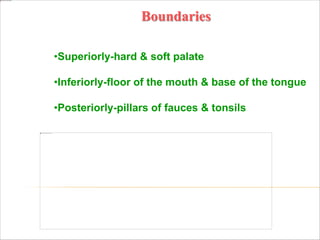
Boundaries
•Superiorly-hard & soft palate
•Inferiorly-floor of the mouth & base of the tongue
•Posteriorly-pillars of fauces & tonsils
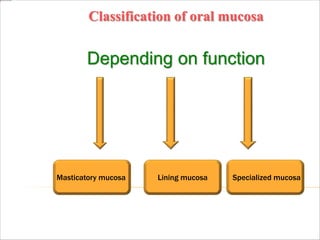
Classification of oral mucosa
Depending on function
Masticatory mucosa Lining mucosa Specialized mucosa
Masticatory mucosa
It’s 25% of total mucosa.
It doesn’t stretch and is attached to bone.
During mastication it bears chewing forces.
It covers Gingiva [free{marginal}attached
and interdental] & hard palate.
Primary mucosa to be in contact with food
during mastication.
MASTICATORY MUCOSA IS USUALLY
KERATINIZED.
Lining mucosa
It’s 60% of total mucosa.
It’s exposed to very mild forces.
It covers the floor of mouth, ventral (underside)
tongue, alveolar mucosa, cheeks, lips and soft palate.
Does not function in mastication and therefore has
minimal attrition.
Specialized mucosa
•It’s also called sensory mucosa as it bears taste
buds and specialized papillae.
•It’s 15% of total mucosa
•Dorsal surface of tongue
ORAL MUCOUS MEMBRANE
Epithelium Connective tissue
Component tissues & glands
Interface between the epithelium &
connective tissue is irregular
Connective tissue papillae interdigitate with
rete ridges or pegs
Basal lamina is present at the interface
between the epithelum & connective tissues
Submucosa separates the oral mucosa from
the underlying bone or muscle
Gingiva &parts of hard palate - no
submucosa - mucoperiosteum
ORAL MUCOUS MEMBRANE
Component tissues & glands
Minor salivary glands are situated in
the submucosa
Sebaceous glands lie in the lamina
propria
Infiltration of lymphocytes & plasma
cells in the connective tissue
Oral Epithelium
•Stratified squamous epithelium
Depending upon location :
•Keratinized
•Non keratinized (tissue are :-floor of mouth,
inner lining of cheek, sublingual tissues
Para
Ortho
Keratinization
process by which epithelial cells are
exposed to external environment lose
their moisture & replace by horny
tissue which contain keratin
involves series of biochemical &
morphological events that occurs in
the cell as it progresses from basal
layer to stratum corneum
Keratinization
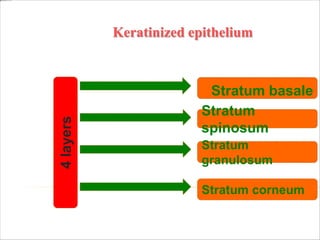
Keratinized epithelium
4
layers
Stratum
spinosum
Stratum
granulosum
Stratum corneum
Stratum basale
Keratinized epithelium
Stratum basale
•Layer of cuboidal cells adjacent to the basal lamina
•Cells are capable of division & can synthesize DNA .
Stratum basale
Single layer of cuboidal cells
New cells are generated
Basal cells & parabasal spinous cell-
stratum germinativum
Stratum basale
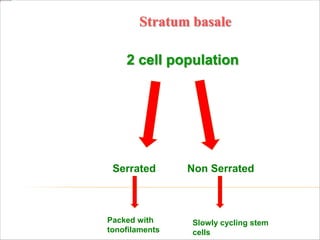
2 cell population
Serrated Non Serrated
Packed with
tonofilaments
Slowly cycling stem
cells
Stratum spinosum
•Irregularly polyhedral & larger than
basal cells
•Cells are joined by intercellular bridges
•Cells frequently shrink away from each
other, remaining in contact only at points
known as intercellular bridges or
desmosomes
•Basal & prickle cell layer together
constitute from half to two thirds of the
LINING MUCOSA
 It’s 60% of total mucosa.
 It’s exposed to very mild forces.
 It covers the floor of mouth, ventral (underside) tongue,
alveolar mucosa, cheeks, lips and soft palate.
 Does not function in mastication and therefore has minimal
attrition.
 It’s NON-KERATINIZED & SOFT.
SPECIALIZED MUCOSA
It’s also called
sensory mucosa
as it bears taste
buds and
specialized
papillae.
It’s 15% of total
mucosa.
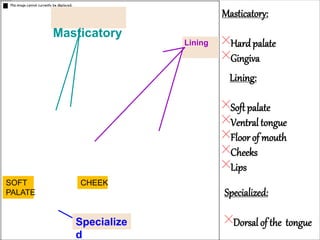
Masticatory
Lining
Masticatory:
Hard palate
Gingiva
Lining:
Soft palate
Ventral tongue
Floor of mouth
Cheeks
Lips
Specialized:
Dorsal of the tongue
Specialize
d
CHEEK
SOFT
PALATE
WHAT IS KERATINIZATION ??
 It’s a process by which epithelial cells are
exposed to external environment lose their
moisture & replace by horny tissue which
contain keratin.
OR
 The process of keratinization invloves series
of biochemical & morphological events that
occurs in the cell as it progresses from basal
layer to stratum corneum.
 Event that occurs in this are:-
a. Gradual flattening of cell
b. Disappearence of nucleus
c. Increased prevelence of tonofilaments
d. Increased prevelence of KERATOHYLINE
GRANULES (granules in the stratum
granulosum)
 Its more resistance to infections & irritation
than non keratinized epithelium.
PARAKERATINIZATION
A pattern of keratinization characterized by
incomplete keratinization of the cells in the stratum
corneum. The cells are flattened and composed
primarily of packed tonofilaments. However, the cells
may retain remnants of nuclei and other organelles.
ORTHOKERATINIZATION:-
A form of keratinization where the cells of the
stratum corneum become very flat, loose their
nuclei and cytoplasmic organelles and are now
composed of densely packed tonofilaments
cemented by filaggrin.
FUNCTIONS OF THE ORAL
MUCOSA
Protection
Sensation
Secretion
Thermal regulation
PROTECTION
Oral Mucosa separates,& protects deeper
tissue /organs in oral regions from the
following:-
[a] Environment of oral cavity.
[b] Mechanical forces of biting & mastication ,to
surface abrasion from hard particle in diet.
[c] Microorganisms may cause infection if they get
access into the underlying tissue.
[d] Toxins produced by micro organisms.
SENSATION
Rich innervations of oral mucosa
makes it a good receptor of
temperature ,touch, pain, thirst.
Certain reflexes such as swallowing,
etching, gagging and salivation.
Secretion:
→Various major /minor /mucous and
serous salivary glands open into the oral
cavity & makes it moist which helps in
mastication ,swallowing and digestion of
the food.
→The major secretion associated with oral
mucosa is SALIVA.
Thermal Regulation:
→Important in dogs (due to
considerable amount of body heat)
→There is no specialized blood vessels
for controlling heat transfer in
human oral mucosa ,so it plays little
part in regulation of body
temperature.
BOUNDRIES OF ORAL CAVITY
 SUPERIOR BORDER
Formed by hard and soft palate
 INFERIOR BORDER
Formed by mouth and base of tongue
 POSTERIOR BORDER
Pillars of fauces and tonsils
FAUSES:- a Latin plural word for
throat
 In anatomy it’s the hinder part of the
mouth, which leads into the pharynx.
 The fauces are regarded as the two
pillars of mucous membrane. One being
anterior, known as the palatoglossal
arch and the second is posterior, the
palatopharyngeal arch. Between these
two arches is the palatine tonsil.
HISTOLOGY OF ORAL MUCOSA
 These layer separated by:-
(a)BASAL LAMINA [originate by
epithelium]
(b)BASEMENT MEMBRANE
[originate by connective tissue]
 The connective tissue projection into
epithelium called PAPILLA.
 The epithelium projection into lamina
propria are called EPITHELIAL
ORAL EPITHELIUM
 Its ECTODERM in origin {except the tongue
which is ENDODERMAL in origin}
 Its STRATIFIED SQUAMOUS EPITHELIUM.
 At base the cells varies from cuboidal / low
columnar to flat squamous cells
 It maintains the structural integrity by system
of continuous cell renewal in which cells are
produced by mitotic division.
During migration of cells numerous
morphological & biochemical
changes occur in the formation of
dead cells that’s packed with large
number of keratin filament, These
cells form protective surface layer &
gradually shed off, this entire
sequence of even from mitosis at
the basal layer to the ultimate
desquamation is k/a KERATINIZATION
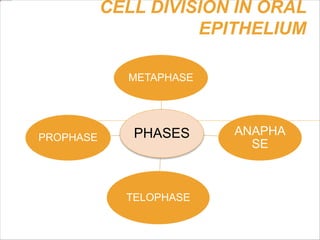
CELL DIVISION IN ORAL
EPITHELIUM
PHASES
METAPHASE
ANAPHA
SE
TELOPHASE
PROPHASE
LAYERS OF EPITHELIUM
Depending upon location
epithelium may be divided
into:-
Keratinized
Non keratinized (tissue are :-
floor of mouth, inner lining of
cheek, sublingual tissues.
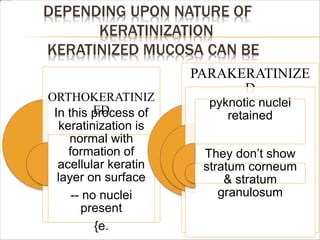
DEPENDING UPON NATURE OF
KERATINIZATION
KERATINIZED MUCOSA CAN BE
ORTHOKERATINIZ
ED
In this process of
keratinization is
normal with
formation of
acellular keratin
layer on surface
-- no nuclei
present
{e.
PARAKERATINIZE
D
.
pyknotic nuclei
retained
They don’t show
stratum corneum
& stratum
granulosum
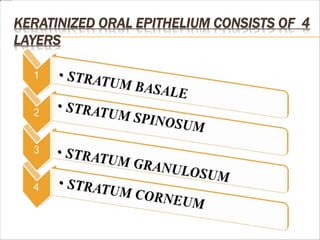
KERATINIZED ORAL EPITHELIUM CONSISTS OF 4
LAYERS
Keratinized epithelium
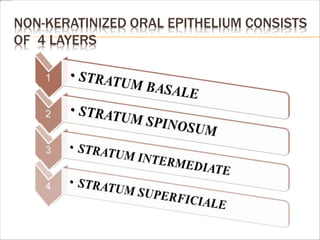
NON-KERATINIZED ORAL EPITHELIUM CONSISTS
OF 4 LAYERS
NON KERATINIZED EPITHELIUM
STRATUM BASALE
 Its also k/a proliferative /
germinative layer.
 Cells are capable of
division & can synthesize
DNA .
 Cells are cuboidal &
columnar cells adjacent
to basement membrane
THERE ARE 2 TYPES OF BASAL CELLS
• Packed with
tonofilaments
SERRATED
• made up of slowly
cycling stem cells [give
rise to amplifying cell
for cell division]
 Serrated basal cells are single layer cuboid
cells ,these are packed with tonofilaments.
 Have protoplasmic process which projects from
basal surface towards connective tissue, where
hemidesmosomes are present.
 Adjacent cells consist of adjacent cell
membrane & pair of denser region & are
attached by desmosomes
 Cell junction may be present [tight ,close & gap]
THE CELL IN THE BASAL
LAYER ARE OF 2 TYPES:-
Progenitor
cells:-
proliferates &
give rise to
new cells.
Maturing cells/
keratinocytes
cells:-
migrates & matures
& eventually shed
off.
Protein synthesis activities are
indicated by ribosomes & RER.
Only basal cells can divide.(basal
cells & parabasal spinous cells k/a
STRATUM GERMINATIVUM.)
MAIN FEATURE OF STRATUM
BASALE IS CELL DIVISION
STRATUM SPINOSUM
 Also k/a prickle cell layer
[ because of cell shape]
When cells of this layer
shrinks away ,remaining in
contact only at 1 point k/a
INTERCELLULAR BRIDGE/
DESMOSOMES which gives
cells a spiny like profile.
Spinous cells are irregularly
polyhedral & larger than basal cell.
The intercellular spaces contain
glycoprotein, glycosaminoglycans,
& fibronectin.
STRATUM GRANULOSUM
 Cells are flat & wide [3-5 cells thick] larger
than spinous layer.
 Prominent in keratinized epithelium &
deficient in non keratinized epithelium.
 Having numerous dense , small
KERATOHYLINE GRANULES (granules in
the stratum granulosum ,which helps in
production of dead layer of cells on skin
surface), stains intensely with basic dye.
 Under light microscope,
granules are basophilic
[blue with hematoxylin
stain] & under electron
microscope they are
dense [appearing
black]
STRATUM CORNEUM
o It consist of tightly packed
cornified cells.
o Intercellular junctions (ICJ)
between the flattened cells are
marked ,flat cells
devoid of nuclei & packed with
keratin filament. This form of
keratinization is referred to as
orthokeratinization, i.e. complete
keratinization of the epithelial
cells.
o Orthokeratinized epithelia
provide the best protection
against mechanical injury.
 The cells contain densely packed
Tonofilaments.
 They continuously shed off & replaced by
migrating cells from underlying layers
 Cells found in this layer are compact
& dehydrated .
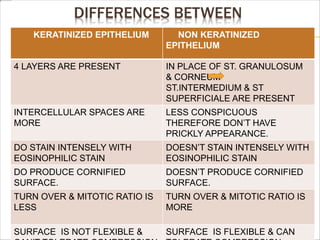
DIFFERENCES BETWEEN
KERATINIZED EPITHELIUM NON KERATINIZED
EPITHELIUM
4 LAYERS ARE PRESENT IN PLACE OF ST. GRANULOSUM
& CORNEUM
ST.INTERMEDIUM & ST
SUPERFICIALE ARE PRESENT
INTERCELLULAR SPACES ARE
MORE
LESS CONSPICUOUS
THEREFORE DON’T HAVE
PRICKLY APPEARANCE.
DO STAIN INTENSELY WITH
EOSINOPHILIC STAIN
DOESN’T STAIN INTENSELY WITH
EOSINOPHILIC STAIN
DO PRODUCE CORNIFIED
SURFACE.
DOESN’T PRODUCE CORNIFIED
SURFACE.
TURN OVER & MITOTIC RATIO IS
LESS
TURN OVER & MITOTIC RATIO IS
MORE
SURFACE IS NOT FLEXIBLE & SURFACE IS FLEXIBLE & CAN
LAMINA PROPRIA
 The lamina propria is the connective tissue under
the epithelium.
 It consists of:
(a)The papillary layer between
the rete ridges
(b)The reticular layer (deeper)
ORAL MUCOUS MEMBRANE
 Lymphocytes are common cells found in
lamina propria.
 Mast cells
 Macrophages
 Fat cells
 Plasma cells
 Eosinophils undifferentiated cells are also
found in this.
SUBMUCOSA
 It’s a connective tissue layer.
 Attaches lamina propria of oral mucosa to
underlying bone /muscle.
a) Glands
b) Blood vessels
c) Nerves
d) Adipose tissue
Are present in it.
Large blood vessels enter
the submucosa & divide
here into smaller
branches.(due to which
subepithelial capillary
network in papillae is
formed.
NERVE SUPPLY :-
 Nerve supply to oral mucosa is sensory.
 Nerve fibers are myelinated previously which
loses myelin sheath before splitting into their
ends.
 The smooth muscles of blood vessals are
supplied by non-myelinated visceral nerve
fibers. They form network in reticular layer of
lamina propria that finally terminates in a
SUBEPITHELIAL PLEXUS.
KERATINIZED AREAS
MASTICATORY MUCOSA
 Area that bears masticatory forces &
compression form masticatory mucosa.
 Areas are:-
GENERAL INTRODUCTION :-
 Epithelium of masticatory mucosa is thicker
than other regions.
 Its ortho/parakeratinized
 Having greater number of papillae/unit area
of mucosa.
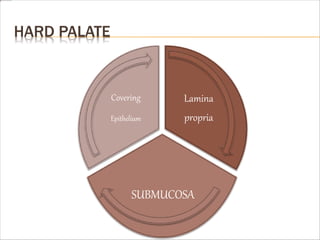
HARD PALATE
Lamina
propria
SUBMUCOSA
Covering
Epithelium
COVERING EPITHELIUM
Epithelium of hard palate is thick
orthokeratinzed.
[some parts may show
parakeratinization],stratified
squamous epithelium &
anterolaterally its transverse
palatine ridges {rugue}.
LAMINA PROPRIA
It shows long papillae &
dense network of thick
collagen tissue especially
under
Rugue. Blood supply is
moderated by short
capillary loops
 The junction between the epithelium &
underlying lamina propria is corrugated
& the papillae are long & elongated to
prevent epithelium from being tipped
under masticatory forces.
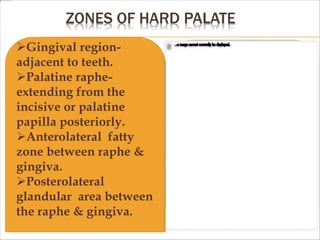
ZONES OF HARD PALATE
Gingival region-
adjacent to teeth.
Palatine raphe-
extending from the
incisive or palatine
papilla posteriorly.
Anterolateral fatty
zone between raphe &
gingiva.
Posterolateral
glandular area between
the raphe & gingiva.
GINGIVAL AREA & MEDIAN PALATINE RAPHE
 These don’t have the submucosal layer beneath
the lamina propria
 They are directly attached to bone.
 Thick layers of submucosa are present in wide
region extending b/w palatine gingiva & palatine
raphe
 A dense band of fibrous connective tissue joins
lamina propria to the mucoperiosteum( there fore
its immovable)
 The thick submucosa in palatal region is divided
into irregular compartments :-
Anterior part -- filled with adipose tissue.
Posterior part –with glands.
 Glandular zone extends onto soft palate.
 Oral mucosa of hard palate contains the
ANTERIOR PALATINE NERVES & BLOOD
VESSALS which passes through the junction of
alveolar process & horizontal plate of hard palate.
ZONES OF HARD PALATE WHICH DIFFERS FROM
SUB MUCOSAL LAYER
 Gingival region
 Palatal raphe
 Anteriolateral area or fatty zone between the raphe
& gingiva
 Posterolateral area or glandular zone between the
raphe & gingiva
The zone that don’t have a submucosal layer occur
peripherially where palatine tissue are identical with
gingiva & along the midline of hard palate .
INCISIVE PAPILLA
 Its situated in the
midline of the hard
palate.(immediately
posterior to maxillary
CI)
 It’s a projection which is
composed of dense
connective tissue.
 It overlies the oral
opening of incisive
canal.
INCISIVE CANAL
 It contains remnants
of oral part of
(a)Nasoplatine duct
(b)Nasoplatine nerve &
vessals
NASOPALATINE DUCT
 Its lined by simple or
pseudostratified
columnar epithelium
which is rich in
GOBLET CELLS.
 Its vestigial in human
beings & functional in
lower
mammals(JACOBSON
’S ORGAN OF
OLFACTION).
PALATINE RUGUE
 Its anterior 1/3rd
mucosa of hard palate
which extends laterally
from incisive papilla &
anterior part of raphe.
 Laterally its supported
by submucosal
cushion of adipose
tissue.
 Core is composed of
dense connective
tissue because of
which its immovable.
EPITHELIAL PEARL
 Are circular arranged ,keratinized epithelial
cells.
 These are remnants of eithelium formed
during fusion of palatine processes.
 May be found in lamina propria (in the region
of incisive papilla)
GINGIVA
 Part of the oral
mucosa that
covers the
alveolar
processes of the
jaws and
surrounds the
neck of the teeth.
PARTS OF GINGIVA
 It’s consist of 2 parts :-
i. The part facing the oral cavity is
MASTICATORY MUCOSA ,which is
orthokeratinized or parakeratinized.
ii. The part facing the tooth that forms the
gingival sulcus & joins gingiva to tooth, its
non-keratinized.
DIVISIONS OF GINGIVA
 FREE GINGIVA
 GINGIVAL SULCUS
 ATTACHED GINGIVA
 INTERDENTAL GINGIVA
FREE GINGIVA:
 Also k/a marginal gingiva.
 It’s a border of gingiva
surrounding the teeth in a collar
like manner
 Its demarkated from attached
gingiva by a shallow linear
depression called FREE
GINGIVAL GROOVE which run
parallel to gingival
margin(distance is 0.5-1.5mm )
 Its 1mm wide
 Forms soft tissue wall of gingival
sulcus.
ATTACHED GINGIVA
 It’s the region between the free gingival groove ,
alveolar mucosa & mucogingival junction.
 Its firm , resilient & tightly bound to
underlying periosteum of alveolar bone.
 Its width which is the distance between MGJ
& PROJECTION on the external surface of
the bottom of gingival sulcus increases with
age & in supra erupted teeth.
 in incisor region
3.5 - 4.5 mm in maxilla
3.3 - 3.9mm in mandible
 width in premolar region
1.9mm in maxilla
1.8mm in mandible
GINGIVAL SULCUS
A shallow groove between the
marginal gingiva and the tooth
surface, bound by sulcular
epithelium laterally and junctional
epithelium apically .
It’s V shaped & in healthy
individuals , the depth of gingival
sulcus is 1.8-2mm.
The probing depth of normal
gingival sulcus is 2-3mm
INTERDENTAL GINGIVA
 Is the part of gingiva that ocupies the gingival
embrasure (fills the space between the 2
adjacent teeth)
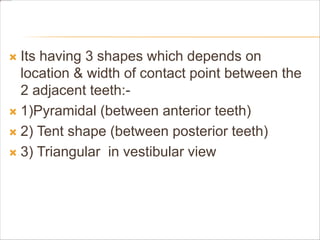
 Its having 3 shapes which depends on
location & width of contact point between the
2 adjacent teeth:-
 1)Pyramidal (between anterior teeth)
 2) Tent shape (between posterior teeth)
 3) Triangular in vestibular view
INTERDENTAL GROOVES
 The gingiva appears slightly depressed
between 2 adjacent teeth which forms
vertical folds called INTERDENTAL
GROOVE.
 The interdental papilla can be pyramidal or
have a "col" shape
COL
 In between the buccal
& lingual area peaks of
interdental gingiva of
posterior tooth
generally the central
concave area fits
below the contact
point, this depressed
part of interdental
papilla is covered by
thin non keratinized
epithelium & k/a ‘COL’
BLOOD SUPPLY OF GINGIVA
 Its derived from periosteal vessels or
branches of alveolar arteries.
 Blood vessels runs through interdental
septa,perforates it through its crest & enters
gingiva then forms loops within connective
tissue
LYMPHATIC SUPPLY OF GINGIVA
 Lymph from gingiva is drained into
submandibular & submental lymph nodes.
NERVE SUPPLY OF GINGIVA
 Gingiva is innervated by :----
I. terminal branches of periodontal nerve
fibers
II. Infraorbital
III. Palatine
IV. Lingual
V. Mental &
VI. Buccal nerves
AGE CHANGES IN GINGIVA:-
 With aging apical margination of
dentogingival junction occurs.
 Epithelium becomes thinner
 Flattening of epithelium connective tissue
junction occurs.
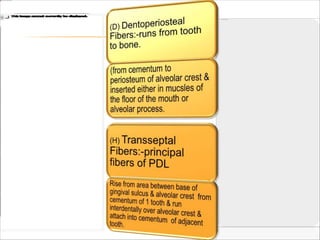
GINGIVAL FIBERS
 These are of 5 groups which collectively form
GINGIVAL LIGAMENT.
 These are largely composed of collagenous
fibers.
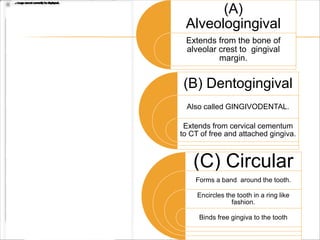
(A)
Alveologingival
Extends from the bone of
alveolar crest to gingival
margin.
(C) Circular
Forms a band around the tooth.
Encircles the tooth in a ring like
fashion.
Binds free gingiva to the tooth
(B) Dentogingival
Also called GINGIVODENTAL.
Extends from cervical cementum
to CT of free and attached gingiva.
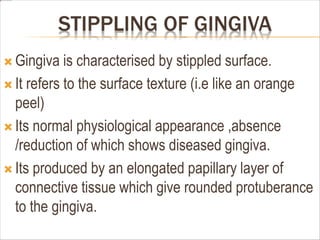
STIPPLING OF GINGIVA
 Gingiva is characterised by stippled surface.
 It refers to the surface texture (i.e like an orange
peel)
 Its normal physiological appearance ,absence
/reduction of which shows diseased gingiva.
 Its produced by an elongated papillary layer of
connective tissue which give rounded protuberance
to the gingiva.
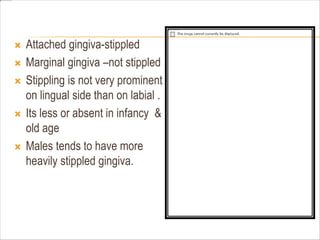
 Attached gingiva-stippled
 Marginal gingiva –not stippled
 Stippling is not very prominent
on lingual side than on labial .
 Its less or absent in infancy &
old age
 Males tends to have more
heavily stippled gingiva.
VERMILION BORDER OF LIP
 It’s a transitional area between the skin of lip
& mucous membrane of oral cavity.
 Area is pink or red in colour due to the thin
epithelium & high vascularity because the
papillae of lamina propria are long , blood
vessels are very near to epithelial surface
giving it red color.
 Here keratinization ends.
 Occasionally contains sebaceous glands.
 It lacks salivary gland.
 Between the vermilion border of lip & the
thicker non keratinized labial mucosa is an
intermediate zone covered by
parakeratinized oral epithelium
 In infants this area is thickened as an
adaptation to suckling called SUCKLING
PAD.
MUCOSA OF SOFT PALATE
 Is thin non keratinized statified squamous
epithelium with taste buds.
 Lamina propria is thick & highly vascularied,red
in colour.
 Elastic fibers are rich in this layer.
 Submucosa is loose & contains continuous
layer
of mucous glands, taste buds & minor salivary
gland .
VENTRAL SURFACE OF TONGUE
 Epithelium of this surface is thin, non –
keratinized & loosely textured.
 Lamina propria is thick ,having short papilla
with rich capillary network.
 Due to loose texture of the mucosa its
loosely attached to underlying structure so
the tongue is freely mobile.
FLOOR OF THE ORAL CAVITY
 Its covered by stratified
squamous, non-
keratinized epithelium
that has a pink color.
 Its thin & loosely
adherent to the
underlying structure
which allows free
mobility to tongue.
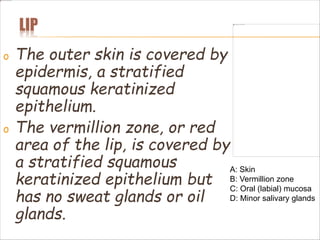
LIP
o The outer skin is covered by
epidermis, a stratified
squamous keratinized
epithelium.
o The vermillion zone, or red
area of the lip, is covered by
a stratified squamous
keratinized epithelium but
has no sweat glands or oil
glands.
A: Skin
B: Vermillion zone
C: Oral (labial) mucosa
D: Minor salivary glands
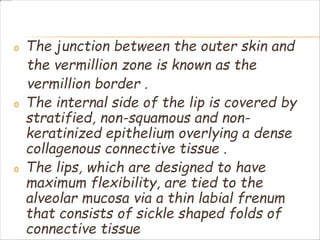
o The junction between the outer skin and
the vermillion zone is known as the
vermillion border .
o The internal side of the lip is covered by
stratified, non-squamous and non-
keratinized epithelium overlying a dense
collagenous connective tissue .
o The lips, which are designed to have
maximum flexibility, are tied to the
alveolar mucosa via a thin labial frenum
that consists of sickle shaped folds of
connective tissue
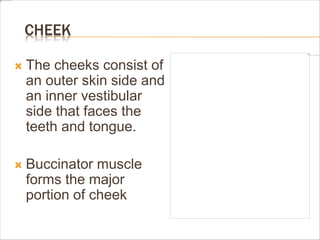
CHEEK
 The cheeks consist of
an outer skin side and
an inner vestibular
side that faces the
teeth and tongue.
 Buccinator muscle
forms the major
portion of cheek
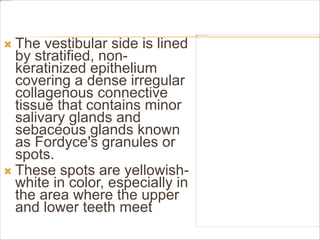
 The vestibular side is lined
by stratified, non-
keratinized epithelium
covering a dense irregular
collagenous connective
tissue that contains minor
salivary glands and
sebaceous glands known
as Fordyce's granules or
spots.
 These spots are yellowish-
white in color, especially in
the area where the upper
and lower teeth meet
SPECIALIZED MUCOSA [TONGUE]
 Dorsal surface of tongue is covered by
specialized mucosa.
 It’s non keratinized.
 Containing numerous papilla having taste buds.
 Anterior 2/3rd supplied by TRIGEMINAL NERVE
through its lingual branch.
 Posterior 1/3rd supplied by
GLOSSOPHARYNGEAL NERVE.
DIVISION OF TONGUE
BOTH THE PARTS ARE SEPARATED BY ‘V’
SHAPED FURROW K/A SULCUS
TERMINALIS
ANTERIOR PART:-
 Also k/a PAPILLARY
PART.(ant 2/3rd)
 Contain many fine
,pointed,cone shaped
papillae which gives velvety
appearence
POSTERIOR PART:-
 Also called LYMPHATIC
PART
 It faces posteriorly(1/3rd)
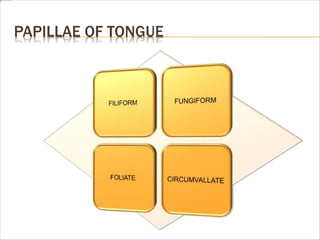
PAPILLAE OF TONGUE
FILIFORM PAPILLAE
The smallest and most
numerous found in
humans.
 They are conical,
elongated projections
of CT covered with
highly keratinized
stratified squamous
epithelium.
Filiform papillae DO
NOT contain taste
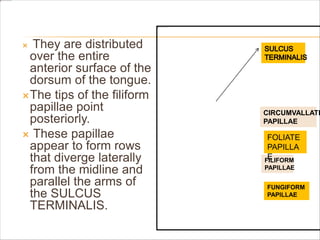
 They are distributed
over the entire
anterior surface of the
dorsum of the tongue.
The tips of the filiform
papillae point
posteriorly.
 These papillae
appear to form rows
that diverge laterally
from the midline and
parallel the arms of
the SULCUS
TERMINALIS.
FUNGIFORM
PAPILLAE
FILIFORM
PAPILLAE
FOLIATE
PAPILLA
E
CIRCUMVALLATE
PAPILLAE
FUNGIFORM PAPILLAE
 Found chiefly at the side
& tip of tongue ,scattered
between filiform papillae.
 Are round, elevated ,red
& mushroom-shaped
(narrow stalk and a
smooth-surfaced, dilated
upper part)
 The word Fungiform is
taken from fungus like.
 They’re 150-400 in µm in
diameter.
 Their colour is derived
from a rich capillary
network visible through
thin epithelium.
 They may or may not be
keratinized
 Have vascular core of
lamina propria
 1-3 Taste buds are
present in the stratified
squamous epithelium on
the dorsal surface of these
TASTE BUD
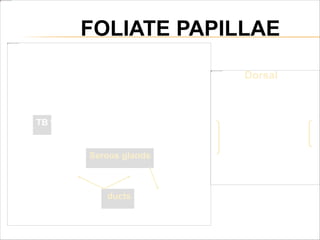
FOLIATE PAPILLAE
They occur on the
posterolateral surfaces of
the tongue as 4-10
vertical folds)
They are poorly
developed in humans
(frequently seen in
mammals)though they are
recognized more easily in
younger individuals.
These are raised ,round to oval follicles
with lymphoid aggregate in the center.
Lined by stratified squamous epithelium.
These papillae contain many taste buds in
the epithelium of the facing walls of
neighboring papillae.
Serous glands
Dorsal
TB
ducts
FOLIATE PAPILLAE
CIRCUMVALLATE PAPILLAE
 The human tongue has 8
to 12 of these
papillae.These are the
extremely large, dome-
shaped structures that
reside in the mucosa just
anterior to the sulcus
terminalis.
 lined with stratified
squamous epithelium that
contains numerous taste
buds.
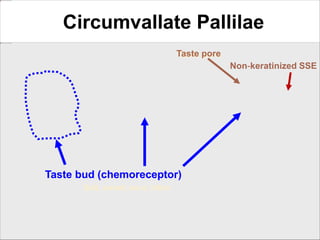
Taste bud (chemoreceptor)
Salt, sweet, sour, bitter
Non-keratinized SSE
Taste pore
Circumvallate Pallilae
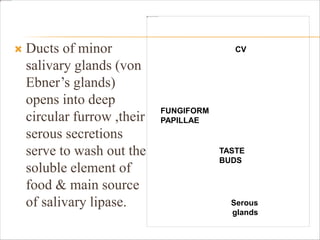
 Ducts of minor
salivary glands (von
Ebner’s glands)
opens into deep
circular furrow ,their
serous secretions
serve to wash out the
soluble element of
food & main source
of salivary lipase.
TASTE
BUDS
Serous
glands
CV
FUNGIFORM
PAPILLAE
TASTE BUD
 These are also k/a
GUSTATORY CALICULI
(SMALL CUP SHAPED
STRUCTURE)
 These are made up of
modified epithelial cells
arranged in groups.
 These are found in
tongue,soft
palate,epiglottis &
posterior wall of oral part
of pharynx.but most
numerous on
circumvallate papillae of
 More in no in infants than in adults
 These are ovoid, barrel-shaped intra-
epithelial structures about (80microns
high & 40 microns thick) and are
associated with tongue papillae except
filiform type.
 The outer surface of the taste bud
covered by flat epithelial cells (covers
gustatory pore of taste bud)
 The gustatory pore leads to a small
canal i.e lined by supporting cells of
taste buds
 Outer supporting cells are like staves of
a barrel.
 Inner supporting cells are spindle
shaped.
 The taste receptor or neuroepithelial
cells are receptors of the taste
stimuli.(found between the inner
supporting cells).
 These receptor cells have finger like
 Base of each taste bud is penetrated by a
group of gustatory nerve fibers.
 Substance to be tasted ,dissolves in saliva &
enters in taste bud, tasted by neuroepithelial
cells & stimuli is taken by a rich plexus of
nerves found below the taste bud.
REGIONS OF DISTRIBUTION OF TASTE
4 taste sensations:
 Sweet
 Salty
 Sour and
 Bitter
 Sweet :Tip of the tongue.
 Salty:-lateral borders of
tongue.(mediated by
intermediofacial nerve by
chorda tympani)
 Bitter & Sour:-( mediated
through glossopharyngeal
nerve) palate & posterior
part of tongue.
 Bitter in middle
 Sour in posterolateral part
of tongue.
LINGUAL TONSIL
 The lingual follicles are
round or oval-shaped
organs located at the
back of the tongue
behind the foramen
cecum and the sulcus
terminalis in the
mucous membrane
covering the tongue.
 The lingual crypts is
lined with stratified
squamous epithelium.
 They enlarge gradually from birth to about
seven years of age and then shrinks. Each
oval consists of a large number of lymphoid
follicles. The lingual tonsils are part of the
lymphatic system and are important to the
body's defense against infection. They are
composed of lymphoid tissue, which contains
germ-killing cells. The tonsils help protect
against upper respiratory tract infection.
NON KERATINOCYTES
Other epithelial cells seen in epithelium called
clear cells have a clear halo around the nuclei.
These are –
1. MELANOCYTES
2. LANGER HAN’S CELLS
3. MERKLE’S CELL &
4. INFLAMMATORY CELLS
 are about 10% of epithelium cells.
 No desmosomes except merkel’s cells & few
tonofilaments.
 Do not participate in maturation. so called as
non keratinocytes.

MELANOCYTES
 specialized pigment cells whiich produce melanin.
 seen in basal layers.
 Arise from neural crest & enter the epithelium at about 4
thweek of intra uterine life.
 no desmosomes & tonofilaments.
 But posses long dendritic processes extending b/w
keratinocytes.
 produce melanin as small, dense,structures called
melanosomes
.
-- Same number of melanocytes in both light & darkly
pigmented individuals but difference is from the
activity of these cells in production of melanin.
-- Sometime seen in connective tissue & the melanin is
engulfed by macrophages called as melanophages.
 Seen in gingiva,buccal mucosa, hard palate
& tongue
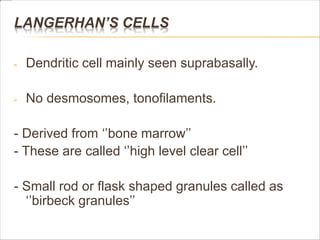
LANGERHAN’S CELLS
- Dendritic cell mainly seen suprabasally.
- No desmosomes, tonofilaments.
- Derived from ‘’bone marrow’’
- These are called ‘’high level clear cell’’
- Small rod or flask shaped granules called as
‘’birbeck granules’’
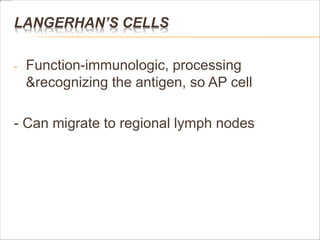
LANGERHAN’S CELLS
- Function-immunologic, processing
&recognizing the antigen, so AP cell
- Can migrate to regional lymph nodes
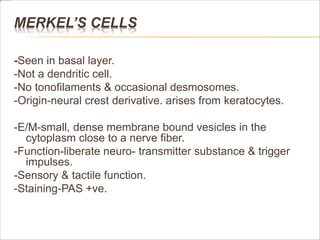
MERKEL’S CELLS
-Seen in basal layer.
-Not a dendritic cell.
-No tonofilaments & occasional desmosomes.
-Origin-neural crest derivative. arises from keratocytes.
-E/M-small, dense membrane bound vesicles in the
cytoplasm close to a nerve fiber.
-Function-liberate neuro- transmitter substance & trigger
impulses.
-Sensory & tactile function.
-Staining-PAS +ve.
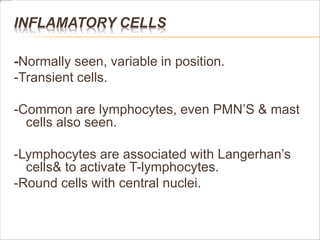
INFLAMATORY CELLS
-Normally seen, variable in position.
-Transient cells.
-Common are lymphocytes, even PMN’S & mast
cells also seen.
-Lymphocytes are associated with Langerhan’s
cells& to activate T-lymphocytes.
-Round cells with central nuclei.
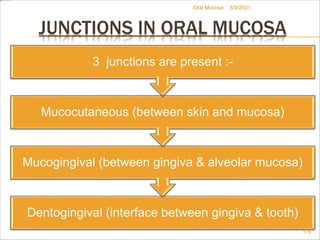
JUNCTIONS IN ORAL MUCOSA
Dentogingival (interface between gingiva & tooth)
Mucogingival (between gingiva & alveolar mucosa)
Mucocutaneous (between skin and mucosa)
3 junctions are present :-
8/9/2021
176
Oral Mucosa
MUCOCUTANEOUS JUNCTION
It’s a junction between skin &
mucosa
8/9/2021
177
Oral Mucosa
VERMILION BORDER OF LIP
 It’s a transitional area between the skin of lip
& mucous membrane of oral cavity.
 Area is pink or red in colour due to the thin
epithelium & high vascularity because the
papillae of lamina propria are long , blood
vessels are very near to epithelial surface
giving it red color.
 Here keratinization ends.
 Occasionally contains sebaceous glands.
 It lacks salivary gland.
MUCOGINGIVAL JUNCTION
 Junction between gingiva &
alveolar mucosa
 Clinically identified by
change of color from bright
pink –paler pink, also by
stippling of gingiva
 Histologically identified by
type of epithelium -which is
either keratinized or
parakeratinized &
composition of lamina
propria -numerous collagen
bundles.
8/9/2021
179
Oral Mucosa
 Coronal to
mucogingival junction
clinically visible
depression in gingiva
k/a free gingival groove-
whose level
corresponds to the
bottom of gingival
sulcus.
 It demarcates free
/attached gingiva.
8/9/2021
181
Oral Mucosa
DENTOGINGIVAL JUNCTION AND JUNCTIONAL
JUNCTIONAL EPITHELIUM
 Dentogingival junction is
the region where the oral
mucosa meets the surface
of the tooth .
 Formed by junctional
epithelium & gingival
fibers & together
considered as a functional
unit called :-
DENTOGINGIVAL UNIT.
 ITS A POINT OF
REDUCED RESISTANCE
TO MECHANICAL
FORCES & BACTERIAL
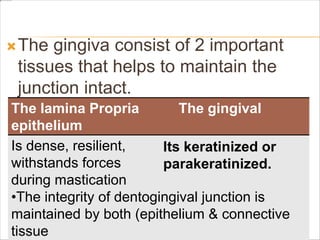
The gingiva consist of 2 important
tissues that helps to maintain the
junction intact.
The lamina Propria The gingival
epithelium
Is dense, resilient,
withstands forces
during mastication
•The integrity of dentogingival junction is
maintained by both (epithelium & connective
tissue
Its keratinized or
parakeratinized.
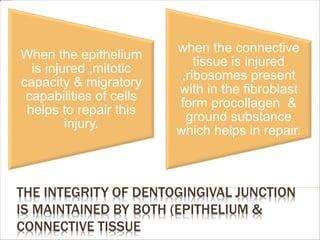
THE INTEGRITY OF DENTOGINGIVAL JUNCTION
IS MAINTAINED BY BOTH (EPITHELIUM &
CONNECTIVE TISSUE
When the epithelium
is injured ,mitotic
capacity & migratory
capabilities of cells
helps to repair this
injury.
when the connective
tissue is injured
,ribosomes present
with in the fibroblast
form procollagen &
ground substance
which helps in repair.
 Firmness of the junction is maintained by
gingival portion of PERIODONTAL
LIGAMENT.
 Defense mechanism of the body helps in
defense against bacterial injury.
 The lysosomes of junctional epithelium may
have phagocytic function.
GINGIVAL SULCUS
 It’s a small pocket
that extends from
free gingival margin
to dentogingival
junction.
 Its depth in healthy
gingiva is at
approximate level of
free gingival groove
on outer surface of
PERIODONTAL POCKET
SULCULAR EPITHELIUM
 It’s the epithelium lining the gingival sulcus
extending from coronal limit of junctional
epithelium to the crest of gingival margin.
 It lacks rete peg.
 It is the non-keratinized or parakeratinized,
thin, stratified, squamous epithelium, the
junction between the epithelium & lamina
propria is smooth & straight.
 Its semi permeable & allows passage of toxin
from gingiva into sulcus.
JUNCTIONAL EPITHELIUM
 The epithelium that is
attached to the tooth
surface (enamel or
sometimes cementum)
continuous with sulcular
epithelium.
 Derived from reduced
enamel epithelium of the
tooth germ.
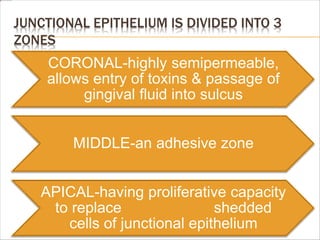
JUNCTIONAL EPITHELIUM IS DIVIDED INTO 3
ZONES
CORONAL-highly semipermeable,
allows entry of toxins & passage of
gingival fluid into sulcus
MIDDLE-an adhesive zone
APICAL-having proliferative capacity
to replace shedded
cells of junctional epithelium
PRIMARY ATTACHMENT EPITHELIUM
 Attachment of junctional epithelium onto tooth surface is called
ATTACHMENT EPITHELIUM.
 During eruption tip of tooth approaches the oral mucosa because
of which the reduced enamel epithelium & oral epithelium meet
& fuses.
 The remnant of primary enamel cuticle is called
NYSMYTH’S MEMBRANE.
 The epithelium covering the tip of crown degenerates from its
center & crown emerges through this perforation.
 Reduced enamel epithelium remain & its called primary
attachment epithelium once tip of crown emerges.
 With eruption of tooth the reduced enamel
epithelium moves apically, reducing its lenght
,eventually a shallow groove develops
between gingiva & surface of tooth k/a
gingival sulcus,which extends around
circumference of tooth which is bordered by
attachment epithelium at its base & laterally
by free gingival margin.
SHIFTING OF DENTOGINGIVAL JUNCTION
 Dento gingival junction - the region where the
tooth is attached to gingiva & its formed as tooth
erupts into oral cavity.
 Almost entire enamel is covered by epithelium
when tip of enamel first emerges through the
mucous membrane (eruption continues until it
reaches plane of occlusion & by that time 1/3rd-
1/4th of enamel is still covered by gingiva)
 As crown continues to grow attachment
epithelium separates from enamel gradually
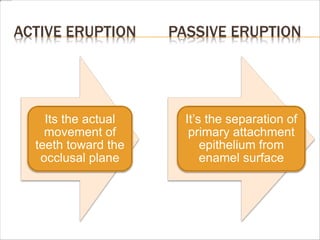
ACTIVE ERUPTION PASSIVE ERUPTION
Its the actual
movement of
teeth toward the
occlusal plane
It’s the separation of
primary attachment
epithelium from
enamel surface
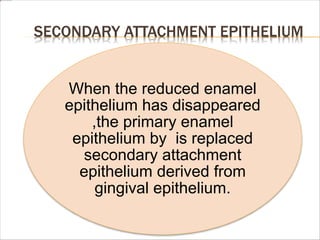
SECONDARY ATTACHMENT EPITHELIUM
When the reduced enamel
epithelium has disappeared
,the primary enamel
epithelium by is replaced
secondary attachment
epithelium derived from
gingival epithelium.
APICAL SHIFT OF GINGIVAL SULCUS
 Crown exposure ,which involves passive
eruption & further recession is described in 4
stages:-
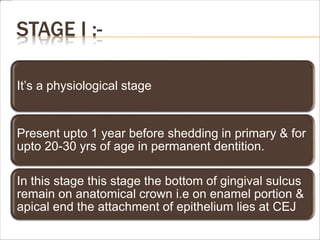
STAGE I :-
It’s a physiological stage
Present upto 1 year before shedding in primary & for
upto 20-30 yrs of age in permanent dentition.
In this stage this stage the bottom of gingival sulcus
remain on anatomical crown i.e on enamel portion &
apical end the attachment of epithelium lies at CEJ
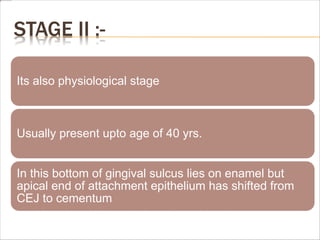
STAGE II :-
Its also physiological stage
Usually present upto age of 40 yrs.
In this bottom of gingival sulcus lies on enamel but
apical end of attachment epithelium has shifted from
CEJ to cementum
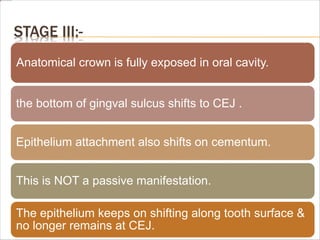
STAGE III:-
Anatomical crown is fully exposed in oral cavity.
the bottom of gingval sulcus shifts to CEJ .
Epithelium attachment also shifts on cementum.
This is NOT a passive manifestation.
The epithelium keeps on shifting along tooth surface &
no longer remains at CEJ.
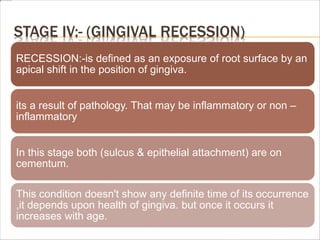
STAGE IV:- (GINGIVAL RECESSION)
RECESSION:-is defined as an exposure of root surface by an
apical shift in the position of gingiva.
its a result of pathology. That may be inflammatory or non –
inflammatory
In this stage both (sulcus & epithelial attachment) are on
cementum.
This condition doesn't show any definite time of its occurrence
,it depends upon health of gingiva. but once it occurs it
increases with age.
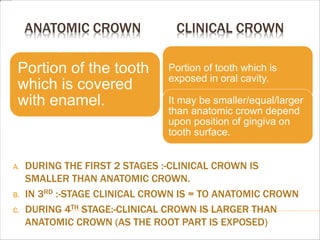
ANATOMIC CROWN CLINICAL CROWN
A. DURING THE FIRST 2 STAGES :-CLINICAL CROWN IS
SMALLER THAN ANATOMIC CROWN.
B. IN 3RD :-STAGE CLINICAL CROWN IS = TO ANATOMIC CROWN
C. DURING 4TH STAGE:-CLINICAL CROWN IS LARGER THAN
ANATOMIC CROWN (AS THE ROOT PART IS EXPOSED)
Portion of the tooth
which is covered
with enamel.
Portion of tooth which is
exposed in oral cavity.
It may be smaller/equal/larger
than anatomic crown depend
upon position of gingiva on
tooth surface.
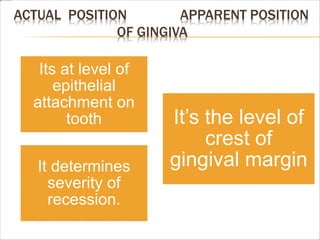
ACTUAL POSITION APPARENT POSITION
OF GINGIVA
Its at level of
epithelial
attachment on
tooth
It determines
severity of
recession.
It’s the level of
crest of
gingival margin
SULCUS & CUTICLES
An organic attachment called EPITHELIAL
ATTACHMENT ,which is present between the
epithelium & tooth.
This mechanism is given by ORBAN & GOTTLIEB.
It involves primary cuticle forming an organic union
between ameloblast & enamel.
When oral epithelium replaces the ameloblast
secondary cuticle is formed.
When epithelium proliferates
beyond the CEJ ,cuticle extends
along cementum.
CEMENTAL CUTICLE &
SECONDARY ENAMEL
CUTICLE ARE CALLED AS
DENTAL CUTICLE.
DEEPENING OF SULCUS (POCKET FORMATION)
As tip of crown emerges through oral mucosa the gingival
sulcus forms.
Separation of reduced enamel epithelium from actively
erupting tooth causes deepening of sulcus.
Initially after eruption of crown tip ,epithelium separates
rapidly from tooth surface, later when it occludes the
separation of attachment from tooth surface slows down.
Under normal conditions ,sulcus depth differs ;4
5 % of all measured sulci are below 0.5 mm.
Average sulcus =1.8 mm
Lymphcytes, plasma cells & langerhans cells
are seen in infected or inflamed sulcular & oral
epithelium, which produce defense reaction to
bacteria
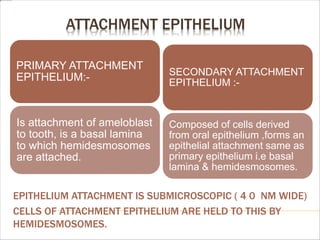
ATTACHMENT EPITHELIUM
EPITHELIUM ATTACHMENT IS SUBMICROSCOPIC ( 4 0 NM WIDE)
CELLS OF ATTACHMENT EPITHELIUM ARE HELD TO THIS BY
HEMIDESMOSOMES.
PRIMARY ATTACHMENT
EPITHELIUM:-
Is attachment of ameloblast
to tooth, is a basal lamina
to which hemidesmosomes
are attached.
SECONDARY ATTACHMENT
EPITHELIUM :-
Composed of cells derived
from oral epithelium ,forms an
epithelial attachment same as
primary epithelium i.e basal
lamina & hemidesmosomes.
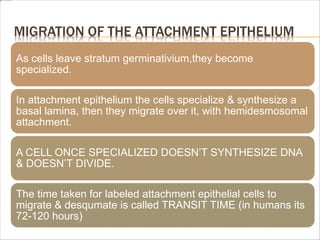
MIGRATION OF THE ATTACHMENT EPITHELIUM
As cells leave stratum germinativium,they become
specialized.
In attachment epithelium the cells specialize & synthesize a
basal lamina, then they migrate over it, with hemidesmosomal
attachment.
A CELL ONCE SPECIALIZED DOESN’T SYNTHESIZE DNA
& DOESN’T DIVIDE.
The time taken for labeled attachment epithelial cells to
migrate & desqumate is called TRANSIT TIME (in humans its
72-120 hours)
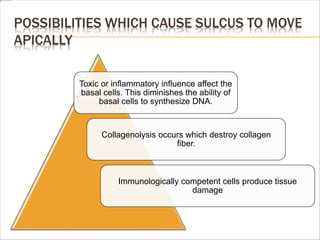
POSSIBILITIES WHICH CAUSE SULCUS TO MOVE
APICALLY
Toxic or inflammatory influence affect the
basal cells. This diminishes the ability of
basal cells to synthesize DNA.
Collagenolysis occurs which destroy collagen
fiber.
Immunologically competent cells produce tissue
damage
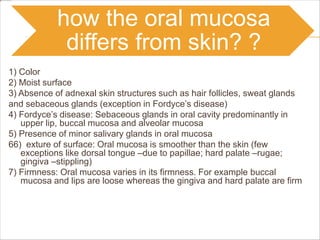
how the oral mucosa
differs from skin? ?
1) Color
2) Moist surface
3) Absence of adnexal skin structures such as hair follicles, sweat glands
and sebaceous glands (exception in Fordyce’s disease)
4) Fordyce’s disease: Sebaceous glands in oral cavity predominantly in
upper lip, buccal mucosa and alveolar mucosa
5) Presence of minor salivary glands in oral mucosa
66) exture of surface: Oral mucosa is smoother than the skin (few
exceptions like dorsal tongue –due to papillae; hard palate –rugae;
gingiva –stippling)
7) Firmness: Oral mucosa varies in its firmness. For example buccal

mucosa and lips are loose whereas the gingiva and hard palate are firm
DEVELOPMENT OF ORAL MUCOSA
 Its initiated by rupture of buccopharyngeal
membrane at about 26days in utero. With this
fusion of embryonic stomatodeum & foregut
takes place & entire stomatodeum is lined by
epithelium (derived by ectoderm & endoderm)
 The single layer lining changes to double layer
in 5-6 week of intrauterine life.
 Epithelium of dental lamina vestibule region
divides rapidly & thickens by 8-9 weeks.
 8-11 weeks palatal selves rise & close which
establish future morphology of adult oral cavity

 By 10-14 weeks –thickened epithelium of
dental lamina shows central cellular
degeneration which cause separation of cells
of cheek & alveolar mucous-forms ORAL
VESTIBULE.
 At around 7TH week lingual mucosa forms &
develop circumvallate & foliate papillae
 At around 10th week filiform papillae
develops
 Between 10-12 weeks cells of masticatory &
lining mucosa show division ,stratification &
thickening.(keratinized area –hard palate
,alveolar ridges of gingiva contain darkly
stained columnar cells.
 The epithelium that forms areas of lining
mucosa retains cuboidal basal cells.
 Between 13-20 weeks epithelium is fully
developed & show distinct layers .
 There is development of keratohyline
granules ,merkel cells & langerhans cells.
 Oral epithelium shows parakeratinization it
becomes orthokeratinized after birth with
eruption of teeth.
AGE CHANGES
 As age increases mucosa turns to be smoother
 Dryer {atrophic / friable}
 These changes represent the cumulative effects
of {a} systemic disease
{b} drug therapy
HISTOLOGICALLY:-
The epithelium appears thinner
REFERENCES
 Oral development & histology
3rd edition
James K Avery

Oral mucosa

  • 1.
  • 2.
    ORAL MUCOUS MEMBRANE: Themoist lining of the oral cavity that is in continuation with the exterior surface of skin on one hand and oesophagus on the other
  • 3.
  • 4.
    ORAL MUCOUS MEMBRANE: •Located anatomically between skin & GIT •Shows some of the properties of each
  • 5.
    Functions of OralMucosa….  Protection  Sensation  Secretion  Thermal regulation  Lubrication
  • 6.
    Functions of OralMucosa…. Protection: Separates & protects deeper tissues & organs from environment Shows number of adaptations of epithelium & CT to withstands insults of mechanical forces & surface abrasions Acts as major barrier to threats of toxic substances produced by microorganisms
  • 7.
    Functions of OralMucosa…. Sensation: Provides considerable information about events within oral cavity Lips & tongue perceive stimuli outside the mouth Receptors respond to temp, touch & pain Tongue has taste buds Receptors for reflexes of swallowing, gagging, salivating
  • 8.
    Functions of OralMucosa…. Secretion: Minor salivary glands associated with oral mucosa & ducts of major salivary glands open into oral mucosa– ‘saliva’- maintance of moist surface Sebaceous glands frequently present- insignificant secretion
  • 9.
    Functions of OralMucosa…. Thermal Regulation: Considerable body heat is dissipated through oral mucosa by panting --(DOG) In human beings- no obvious specializations of the blood vessels exist for control of heat transfer
  • 10.
     covers allstructures inside the oral cavity except the teeth.  it consist of epithelium & lamina propria lining all the surfaces of the oral cavity.  it varies in color from pink to brownish depending on an individual's skin color Clinical features
  • 12.
  • 13.
    Clinical features Factors responsiblefor Colour : Concentration & dilatation of small blood vessels in the underlying connective tissue Thickness of epithelium Degree of keratinization Amount of melanin pigment in the epithelium
  • 14.
    Clinical features Sebaceous glandsare present in the upper lip & buccal mucosa Fordyce's spots Papillae on the dorsum of tongue Rugae of the palate Stippling on gingiva Lining mucosa of lips & cheeks is soft & pliable Gingiva & hard palate are firm
  • 15.
    Organization of oralmucosa 2 parts of oral cavity- Outer vestibule-bounded by the lips & cheeks Oral cavity proper-separated from the vestibule by alveolus bearing the teeth & gingiva
  • 16.
    Boundaries •Superiorly-hard & softpalate •Inferiorly-floor of the mouth & base of the tongue •Posteriorly-pillars of fauces & tonsils
  • 17.
    Classification of oralmucosa Depending on function Masticatory mucosa Lining mucosa Specialized mucosa
  • 18.
    Masticatory mucosa It’s 25%of total mucosa. It doesn’t stretch and is attached to bone. During mastication it bears chewing forces. It covers Gingiva [free{marginal}attached and interdental] & hard palate. Primary mucosa to be in contact with food during mastication. MASTICATORY MUCOSA IS USUALLY KERATINIZED.
  • 19.
    Lining mucosa It’s 60%of total mucosa. It’s exposed to very mild forces. It covers the floor of mouth, ventral (underside) tongue, alveolar mucosa, cheeks, lips and soft palate. Does not function in mastication and therefore has minimal attrition.
  • 20.
    Specialized mucosa •It’s alsocalled sensory mucosa as it bears taste buds and specialized papillae. •It’s 15% of total mucosa •Dorsal surface of tongue
  • 21.
    ORAL MUCOUS MEMBRANE EpitheliumConnective tissue Component tissues & glands
  • 22.
    Component tissues &glands Interface between the epithelium & connective tissue is irregular Connective tissue papillae interdigitate with rete ridges or pegs Basal lamina is present at the interface between the epithelum & connective tissues Submucosa separates the oral mucosa from the underlying bone or muscle Gingiva &parts of hard palate - no submucosa - mucoperiosteum
  • 23.
  • 24.
  • 25.
  • 26.
    Component tissues &glands Minor salivary glands are situated in the submucosa Sebaceous glands lie in the lamina propria Infiltration of lymphocytes & plasma cells in the connective tissue
  • 27.
    Oral Epithelium •Stratified squamousepithelium Depending upon location : •Keratinized •Non keratinized (tissue are :-floor of mouth, inner lining of cheek, sublingual tissues Para Ortho
  • 28.
    Keratinization process by whichepithelial cells are exposed to external environment lose their moisture & replace by horny tissue which contain keratin involves series of biochemical & morphological events that occurs in the cell as it progresses from basal layer to stratum corneum
  • 29.
  • 30.
  • 31.
  • 32.
    Stratum basale •Layer ofcuboidal cells adjacent to the basal lamina •Cells are capable of division & can synthesize DNA .
  • 33.
    Stratum basale Single layerof cuboidal cells New cells are generated Basal cells & parabasal spinous cell- stratum germinativum
  • 34.
    Stratum basale 2 cellpopulation Serrated Non Serrated Packed with tonofilaments Slowly cycling stem cells
  • 35.
    Stratum spinosum •Irregularly polyhedral& larger than basal cells •Cells are joined by intercellular bridges •Cells frequently shrink away from each other, remaining in contact only at points known as intercellular bridges or desmosomes •Basal & prickle cell layer together constitute from half to two thirds of the
  • 36.
    LINING MUCOSA  It’s60% of total mucosa.  It’s exposed to very mild forces.  It covers the floor of mouth, ventral (underside) tongue, alveolar mucosa, cheeks, lips and soft palate.  Does not function in mastication and therefore has minimal attrition.  It’s NON-KERATINIZED & SOFT.
  • 37.
    SPECIALIZED MUCOSA It’s alsocalled sensory mucosa as it bears taste buds and specialized papillae. It’s 15% of total mucosa.
  • 38.
    Masticatory Lining Masticatory: Hard palate Gingiva Lining: Soft palate Ventraltongue Floor of mouth Cheeks Lips Specialized: Dorsal of the tongue Specialize d CHEEK SOFT PALATE
  • 39.
    WHAT IS KERATINIZATION??  It’s a process by which epithelial cells are exposed to external environment lose their moisture & replace by horny tissue which contain keratin. OR  The process of keratinization invloves series of biochemical & morphological events that occurs in the cell as it progresses from basal layer to stratum corneum.
  • 40.
     Event thatoccurs in this are:- a. Gradual flattening of cell b. Disappearence of nucleus c. Increased prevelence of tonofilaments d. Increased prevelence of KERATOHYLINE GRANULES (granules in the stratum granulosum)  Its more resistance to infections & irritation than non keratinized epithelium.
  • 41.
    PARAKERATINIZATION A pattern ofkeratinization characterized by incomplete keratinization of the cells in the stratum corneum. The cells are flattened and composed primarily of packed tonofilaments. However, the cells may retain remnants of nuclei and other organelles. ORTHOKERATINIZATION:- A form of keratinization where the cells of the stratum corneum become very flat, loose their nuclei and cytoplasmic organelles and are now composed of densely packed tonofilaments cemented by filaggrin.
  • 42.
    FUNCTIONS OF THEORAL MUCOSA Protection Sensation Secretion Thermal regulation
  • 43.
    PROTECTION Oral Mucosa separates,&protects deeper tissue /organs in oral regions from the following:- [a] Environment of oral cavity. [b] Mechanical forces of biting & mastication ,to surface abrasion from hard particle in diet. [c] Microorganisms may cause infection if they get access into the underlying tissue. [d] Toxins produced by micro organisms.
  • 44.
    SENSATION Rich innervations oforal mucosa makes it a good receptor of temperature ,touch, pain, thirst. Certain reflexes such as swallowing, etching, gagging and salivation.
  • 45.
    Secretion: →Various major /minor/mucous and serous salivary glands open into the oral cavity & makes it moist which helps in mastication ,swallowing and digestion of the food. →The major secretion associated with oral mucosa is SALIVA.
  • 46.
    Thermal Regulation: →Important indogs (due to considerable amount of body heat) →There is no specialized blood vessels for controlling heat transfer in human oral mucosa ,so it plays little part in regulation of body temperature.
  • 47.
    BOUNDRIES OF ORALCAVITY  SUPERIOR BORDER Formed by hard and soft palate  INFERIOR BORDER Formed by mouth and base of tongue  POSTERIOR BORDER Pillars of fauces and tonsils
  • 48.
    FAUSES:- a Latinplural word for throat  In anatomy it’s the hinder part of the mouth, which leads into the pharynx.  The fauces are regarded as the two pillars of mucous membrane. One being anterior, known as the palatoglossal arch and the second is posterior, the palatopharyngeal arch. Between these two arches is the palatine tonsil.
  • 49.
  • 50.
    HISTOLOGY OF ORALMUCOSA  These layer separated by:- (a)BASAL LAMINA [originate by epithelium] (b)BASEMENT MEMBRANE [originate by connective tissue]  The connective tissue projection into epithelium called PAPILLA.  The epithelium projection into lamina propria are called EPITHELIAL
  • 51.
    ORAL EPITHELIUM  ItsECTODERM in origin {except the tongue which is ENDODERMAL in origin}  Its STRATIFIED SQUAMOUS EPITHELIUM.  At base the cells varies from cuboidal / low columnar to flat squamous cells  It maintains the structural integrity by system of continuous cell renewal in which cells are produced by mitotic division.
  • 52.
    During migration ofcells numerous morphological & biochemical changes occur in the formation of dead cells that’s packed with large number of keratin filament, These cells form protective surface layer & gradually shed off, this entire sequence of even from mitosis at the basal layer to the ultimate desquamation is k/a KERATINIZATION
  • 53.
    CELL DIVISION INORAL EPITHELIUM PHASES METAPHASE ANAPHA SE TELOPHASE PROPHASE
  • 54.
    LAYERS OF EPITHELIUM Dependingupon location epithelium may be divided into:- Keratinized Non keratinized (tissue are :- floor of mouth, inner lining of cheek, sublingual tissues.
  • 55.
    DEPENDING UPON NATUREOF KERATINIZATION KERATINIZED MUCOSA CAN BE ORTHOKERATINIZ ED In this process of keratinization is normal with formation of acellular keratin layer on surface -- no nuclei present {e. PARAKERATINIZE D . pyknotic nuclei retained They don’t show stratum corneum & stratum granulosum
  • 56.
    KERATINIZED ORAL EPITHELIUMCONSISTS OF 4 LAYERS
  • 59.
  • 60.
    NON-KERATINIZED ORAL EPITHELIUMCONSISTS OF 4 LAYERS
  • 61.
  • 63.
    STRATUM BASALE  Itsalso k/a proliferative / germinative layer.  Cells are capable of division & can synthesize DNA .  Cells are cuboidal & columnar cells adjacent to basement membrane
  • 64.
    THERE ARE 2TYPES OF BASAL CELLS • Packed with tonofilaments SERRATED • made up of slowly cycling stem cells [give rise to amplifying cell for cell division]
  • 65.
     Serrated basalcells are single layer cuboid cells ,these are packed with tonofilaments.  Have protoplasmic process which projects from basal surface towards connective tissue, where hemidesmosomes are present.  Adjacent cells consist of adjacent cell membrane & pair of denser region & are attached by desmosomes  Cell junction may be present [tight ,close & gap]
  • 66.
    THE CELL INTHE BASAL LAYER ARE OF 2 TYPES:- Progenitor cells:- proliferates & give rise to new cells. Maturing cells/ keratinocytes cells:- migrates & matures & eventually shed off.
  • 67.
    Protein synthesis activitiesare indicated by ribosomes & RER. Only basal cells can divide.(basal cells & parabasal spinous cells k/a STRATUM GERMINATIVUM.) MAIN FEATURE OF STRATUM BASALE IS CELL DIVISION
  • 68.
    STRATUM SPINOSUM  Alsok/a prickle cell layer [ because of cell shape] When cells of this layer shrinks away ,remaining in contact only at 1 point k/a INTERCELLULAR BRIDGE/ DESMOSOMES which gives cells a spiny like profile.
  • 69.
    Spinous cells areirregularly polyhedral & larger than basal cell. The intercellular spaces contain glycoprotein, glycosaminoglycans, & fibronectin.
  • 72.
    STRATUM GRANULOSUM  Cellsare flat & wide [3-5 cells thick] larger than spinous layer.  Prominent in keratinized epithelium & deficient in non keratinized epithelium.  Having numerous dense , small KERATOHYLINE GRANULES (granules in the stratum granulosum ,which helps in production of dead layer of cells on skin surface), stains intensely with basic dye.
  • 73.
     Under lightmicroscope, granules are basophilic [blue with hematoxylin stain] & under electron microscope they are dense [appearing black]
  • 74.
    STRATUM CORNEUM o Itconsist of tightly packed cornified cells. o Intercellular junctions (ICJ) between the flattened cells are marked ,flat cells devoid of nuclei & packed with keratin filament. This form of keratinization is referred to as orthokeratinization, i.e. complete keratinization of the epithelial cells. o Orthokeratinized epithelia provide the best protection against mechanical injury.
  • 75.
     The cellscontain densely packed Tonofilaments.  They continuously shed off & replaced by migrating cells from underlying layers  Cells found in this layer are compact & dehydrated .
  • 76.
    DIFFERENCES BETWEEN KERATINIZED EPITHELIUMNON KERATINIZED EPITHELIUM 4 LAYERS ARE PRESENT IN PLACE OF ST. GRANULOSUM & CORNEUM ST.INTERMEDIUM & ST SUPERFICIALE ARE PRESENT INTERCELLULAR SPACES ARE MORE LESS CONSPICUOUS THEREFORE DON’T HAVE PRICKLY APPEARANCE. DO STAIN INTENSELY WITH EOSINOPHILIC STAIN DOESN’T STAIN INTENSELY WITH EOSINOPHILIC STAIN DO PRODUCE CORNIFIED SURFACE. DOESN’T PRODUCE CORNIFIED SURFACE. TURN OVER & MITOTIC RATIO IS LESS TURN OVER & MITOTIC RATIO IS MORE SURFACE IS NOT FLEXIBLE & SURFACE IS FLEXIBLE & CAN
  • 77.
    LAMINA PROPRIA  Thelamina propria is the connective tissue under the epithelium.  It consists of: (a)The papillary layer between the rete ridges (b)The reticular layer (deeper)
  • 79.
  • 80.
     Lymphocytes arecommon cells found in lamina propria.  Mast cells  Macrophages  Fat cells  Plasma cells  Eosinophils undifferentiated cells are also found in this.
  • 81.
    SUBMUCOSA  It’s aconnective tissue layer.  Attaches lamina propria of oral mucosa to underlying bone /muscle. a) Glands b) Blood vessels c) Nerves d) Adipose tissue Are present in it.
  • 82.
    Large blood vesselsenter the submucosa & divide here into smaller branches.(due to which subepithelial capillary network in papillae is formed.
  • 83.
    NERVE SUPPLY :- Nerve supply to oral mucosa is sensory.  Nerve fibers are myelinated previously which loses myelin sheath before splitting into their ends.  The smooth muscles of blood vessals are supplied by non-myelinated visceral nerve fibers. They form network in reticular layer of lamina propria that finally terminates in a SUBEPITHELIAL PLEXUS.
  • 84.
    KERATINIZED AREAS MASTICATORY MUCOSA Area that bears masticatory forces & compression form masticatory mucosa.  Areas are:-
  • 85.
    GENERAL INTRODUCTION :- Epithelium of masticatory mucosa is thicker than other regions.  Its ortho/parakeratinized  Having greater number of papillae/unit area of mucosa.
  • 86.
  • 87.
    COVERING EPITHELIUM Epithelium ofhard palate is thick orthokeratinzed. [some parts may show parakeratinization],stratified squamous epithelium & anterolaterally its transverse palatine ridges {rugue}.
  • 88.
    LAMINA PROPRIA It showslong papillae & dense network of thick collagen tissue especially under Rugue. Blood supply is moderated by short capillary loops
  • 89.
     The junctionbetween the epithelium & underlying lamina propria is corrugated & the papillae are long & elongated to prevent epithelium from being tipped under masticatory forces.
  • 90.
    ZONES OF HARDPALATE Gingival region- adjacent to teeth. Palatine raphe- extending from the incisive or palatine papilla posteriorly. Anterolateral fatty zone between raphe & gingiva. Posterolateral glandular area between the raphe & gingiva.
  • 91.
    GINGIVAL AREA &MEDIAN PALATINE RAPHE  These don’t have the submucosal layer beneath the lamina propria  They are directly attached to bone.  Thick layers of submucosa are present in wide region extending b/w palatine gingiva & palatine raphe  A dense band of fibrous connective tissue joins lamina propria to the mucoperiosteum( there fore its immovable)
  • 92.
     The thicksubmucosa in palatal region is divided into irregular compartments :- Anterior part -- filled with adipose tissue. Posterior part –with glands.  Glandular zone extends onto soft palate.  Oral mucosa of hard palate contains the ANTERIOR PALATINE NERVES & BLOOD VESSALS which passes through the junction of alveolar process & horizontal plate of hard palate.
  • 93.
    ZONES OF HARDPALATE WHICH DIFFERS FROM SUB MUCOSAL LAYER  Gingival region  Palatal raphe  Anteriolateral area or fatty zone between the raphe & gingiva  Posterolateral area or glandular zone between the raphe & gingiva The zone that don’t have a submucosal layer occur peripherially where palatine tissue are identical with gingiva & along the midline of hard palate .
  • 94.
    INCISIVE PAPILLA  Itssituated in the midline of the hard palate.(immediately posterior to maxillary CI)  It’s a projection which is composed of dense connective tissue.  It overlies the oral opening of incisive canal.
  • 95.
    INCISIVE CANAL  Itcontains remnants of oral part of (a)Nasoplatine duct (b)Nasoplatine nerve & vessals
  • 96.
    NASOPALATINE DUCT  Itslined by simple or pseudostratified columnar epithelium which is rich in GOBLET CELLS.  Its vestigial in human beings & functional in lower mammals(JACOBSON ’S ORGAN OF OLFACTION).
  • 97.
    PALATINE RUGUE  Itsanterior 1/3rd mucosa of hard palate which extends laterally from incisive papilla & anterior part of raphe.  Laterally its supported by submucosal cushion of adipose tissue.  Core is composed of dense connective tissue because of which its immovable.
  • 98.
    EPITHELIAL PEARL  Arecircular arranged ,keratinized epithelial cells.  These are remnants of eithelium formed during fusion of palatine processes.  May be found in lamina propria (in the region of incisive papilla)
  • 99.
    GINGIVA  Part ofthe oral mucosa that covers the alveolar processes of the jaws and surrounds the neck of the teeth.
  • 100.
    PARTS OF GINGIVA It’s consist of 2 parts :- i. The part facing the oral cavity is MASTICATORY MUCOSA ,which is orthokeratinized or parakeratinized. ii. The part facing the tooth that forms the gingival sulcus & joins gingiva to tooth, its non-keratinized.
  • 101.
    DIVISIONS OF GINGIVA FREE GINGIVA  GINGIVAL SULCUS  ATTACHED GINGIVA  INTERDENTAL GINGIVA
  • 102.
    FREE GINGIVA:  Alsok/a marginal gingiva.  It’s a border of gingiva surrounding the teeth in a collar like manner  Its demarkated from attached gingiva by a shallow linear depression called FREE GINGIVAL GROOVE which run parallel to gingival margin(distance is 0.5-1.5mm )  Its 1mm wide  Forms soft tissue wall of gingival sulcus.
  • 103.
    ATTACHED GINGIVA  It’sthe region between the free gingival groove , alveolar mucosa & mucogingival junction.
  • 104.
     Its firm, resilient & tightly bound to underlying periosteum of alveolar bone.  Its width which is the distance between MGJ & PROJECTION on the external surface of the bottom of gingival sulcus increases with age & in supra erupted teeth.  in incisor region 3.5 - 4.5 mm in maxilla 3.3 - 3.9mm in mandible  width in premolar region 1.9mm in maxilla 1.8mm in mandible
  • 105.
    GINGIVAL SULCUS A shallowgroove between the marginal gingiva and the tooth surface, bound by sulcular epithelium laterally and junctional epithelium apically . It’s V shaped & in healthy individuals , the depth of gingival sulcus is 1.8-2mm. The probing depth of normal gingival sulcus is 2-3mm
  • 106.
    INTERDENTAL GINGIVA  Isthe part of gingiva that ocupies the gingival embrasure (fills the space between the 2 adjacent teeth)
  • 107.
     Its having3 shapes which depends on location & width of contact point between the 2 adjacent teeth:-  1)Pyramidal (between anterior teeth)  2) Tent shape (between posterior teeth)  3) Triangular in vestibular view
  • 108.
    INTERDENTAL GROOVES  Thegingiva appears slightly depressed between 2 adjacent teeth which forms vertical folds called INTERDENTAL GROOVE.  The interdental papilla can be pyramidal or have a "col" shape
  • 110.
    COL  In betweenthe buccal & lingual area peaks of interdental gingiva of posterior tooth generally the central concave area fits below the contact point, this depressed part of interdental papilla is covered by thin non keratinized epithelium & k/a ‘COL’
  • 112.
    BLOOD SUPPLY OFGINGIVA  Its derived from periosteal vessels or branches of alveolar arteries.  Blood vessels runs through interdental septa,perforates it through its crest & enters gingiva then forms loops within connective tissue
  • 113.
    LYMPHATIC SUPPLY OFGINGIVA  Lymph from gingiva is drained into submandibular & submental lymph nodes.
  • 114.
    NERVE SUPPLY OFGINGIVA  Gingiva is innervated by :---- I. terminal branches of periodontal nerve fibers II. Infraorbital III. Palatine IV. Lingual V. Mental & VI. Buccal nerves
  • 115.
    AGE CHANGES INGINGIVA:-  With aging apical margination of dentogingival junction occurs.  Epithelium becomes thinner  Flattening of epithelium connective tissue junction occurs.
  • 116.
    GINGIVAL FIBERS  Theseare of 5 groups which collectively form GINGIVAL LIGAMENT.  These are largely composed of collagenous fibers.
  • 117.
    (A) Alveologingival Extends from thebone of alveolar crest to gingival margin. (C) Circular Forms a band around the tooth. Encircles the tooth in a ring like fashion. Binds free gingiva to the tooth (B) Dentogingival Also called GINGIVODENTAL. Extends from cervical cementum to CT of free and attached gingiva.
  • 119.
    STIPPLING OF GINGIVA Gingiva is characterised by stippled surface.  It refers to the surface texture (i.e like an orange peel)  Its normal physiological appearance ,absence /reduction of which shows diseased gingiva.  Its produced by an elongated papillary layer of connective tissue which give rounded protuberance to the gingiva.
  • 120.
     Attached gingiva-stippled Marginal gingiva –not stippled  Stippling is not very prominent on lingual side than on labial .  Its less or absent in infancy & old age  Males tends to have more heavily stippled gingiva.
  • 122.
    VERMILION BORDER OFLIP  It’s a transitional area between the skin of lip & mucous membrane of oral cavity.  Area is pink or red in colour due to the thin epithelium & high vascularity because the papillae of lamina propria are long , blood vessels are very near to epithelial surface giving it red color.  Here keratinization ends.  Occasionally contains sebaceous glands.  It lacks salivary gland.
  • 123.
     Between thevermilion border of lip & the thicker non keratinized labial mucosa is an intermediate zone covered by parakeratinized oral epithelium  In infants this area is thickened as an adaptation to suckling called SUCKLING PAD.
  • 124.
    MUCOSA OF SOFTPALATE  Is thin non keratinized statified squamous epithelium with taste buds.  Lamina propria is thick & highly vascularied,red in colour.  Elastic fibers are rich in this layer.  Submucosa is loose & contains continuous layer of mucous glands, taste buds & minor salivary gland .
  • 125.
    VENTRAL SURFACE OFTONGUE  Epithelium of this surface is thin, non – keratinized & loosely textured.  Lamina propria is thick ,having short papilla with rich capillary network.  Due to loose texture of the mucosa its loosely attached to underlying structure so the tongue is freely mobile.
  • 127.
    FLOOR OF THEORAL CAVITY  Its covered by stratified squamous, non- keratinized epithelium that has a pink color.  Its thin & loosely adherent to the underlying structure which allows free mobility to tongue.
  • 128.
    LIP o The outerskin is covered by epidermis, a stratified squamous keratinized epithelium. o The vermillion zone, or red area of the lip, is covered by a stratified squamous keratinized epithelium but has no sweat glands or oil glands. A: Skin B: Vermillion zone C: Oral (labial) mucosa D: Minor salivary glands
  • 129.
    o The junctionbetween the outer skin and the vermillion zone is known as the vermillion border . o The internal side of the lip is covered by stratified, non-squamous and non- keratinized epithelium overlying a dense collagenous connective tissue . o The lips, which are designed to have maximum flexibility, are tied to the alveolar mucosa via a thin labial frenum that consists of sickle shaped folds of connective tissue
  • 130.
    CHEEK  The cheeksconsist of an outer skin side and an inner vestibular side that faces the teeth and tongue.  Buccinator muscle forms the major portion of cheek
  • 131.
     The vestibularside is lined by stratified, non- keratinized epithelium covering a dense irregular collagenous connective tissue that contains minor salivary glands and sebaceous glands known as Fordyce's granules or spots.  These spots are yellowish- white in color, especially in the area where the upper and lower teeth meet
  • 132.
    SPECIALIZED MUCOSA [TONGUE] Dorsal surface of tongue is covered by specialized mucosa.  It’s non keratinized.  Containing numerous papilla having taste buds.  Anterior 2/3rd supplied by TRIGEMINAL NERVE through its lingual branch.  Posterior 1/3rd supplied by GLOSSOPHARYNGEAL NERVE.
  • 134.
    DIVISION OF TONGUE BOTHTHE PARTS ARE SEPARATED BY ‘V’ SHAPED FURROW K/A SULCUS TERMINALIS ANTERIOR PART:-  Also k/a PAPILLARY PART.(ant 2/3rd)  Contain many fine ,pointed,cone shaped papillae which gives velvety appearence POSTERIOR PART:-  Also called LYMPHATIC PART  It faces posteriorly(1/3rd)
  • 135.
  • 136.
    FILIFORM PAPILLAE The smallestand most numerous found in humans.  They are conical, elongated projections of CT covered with highly keratinized stratified squamous epithelium. Filiform papillae DO NOT contain taste
  • 138.
     They aredistributed over the entire anterior surface of the dorsum of the tongue. The tips of the filiform papillae point posteriorly.  These papillae appear to form rows that diverge laterally from the midline and parallel the arms of the SULCUS TERMINALIS. FUNGIFORM PAPILLAE FILIFORM PAPILLAE FOLIATE PAPILLA E CIRCUMVALLATE PAPILLAE
  • 139.
    FUNGIFORM PAPILLAE  Foundchiefly at the side & tip of tongue ,scattered between filiform papillae.  Are round, elevated ,red & mushroom-shaped (narrow stalk and a smooth-surfaced, dilated upper part)  The word Fungiform is taken from fungus like.  They’re 150-400 in µm in diameter.
  • 140.
     Their colouris derived from a rich capillary network visible through thin epithelium.  They may or may not be keratinized  Have vascular core of lamina propria  1-3 Taste buds are present in the stratified squamous epithelium on the dorsal surface of these TASTE BUD
  • 141.
    FOLIATE PAPILLAE They occuron the posterolateral surfaces of the tongue as 4-10 vertical folds) They are poorly developed in humans (frequently seen in mammals)though they are recognized more easily in younger individuals.
  • 142.
    These are raised,round to oval follicles with lymphoid aggregate in the center. Lined by stratified squamous epithelium. These papillae contain many taste buds in the epithelium of the facing walls of neighboring papillae.
  • 143.
  • 144.
    CIRCUMVALLATE PAPILLAE  Thehuman tongue has 8 to 12 of these papillae.These are the extremely large, dome- shaped structures that reside in the mucosa just anterior to the sulcus terminalis.  lined with stratified squamous epithelium that contains numerous taste buds.
  • 145.
    Taste bud (chemoreceptor) Salt,sweet, sour, bitter Non-keratinized SSE Taste pore Circumvallate Pallilae
  • 146.
     Ducts ofminor salivary glands (von Ebner’s glands) opens into deep circular furrow ,their serous secretions serve to wash out the soluble element of food & main source of salivary lipase. TASTE BUDS Serous glands CV FUNGIFORM PAPILLAE
  • 147.
    TASTE BUD  Theseare also k/a GUSTATORY CALICULI (SMALL CUP SHAPED STRUCTURE)  These are made up of modified epithelial cells arranged in groups.  These are found in tongue,soft palate,epiglottis & posterior wall of oral part of pharynx.but most numerous on circumvallate papillae of
  • 148.
     More inno in infants than in adults  These are ovoid, barrel-shaped intra- epithelial structures about (80microns high & 40 microns thick) and are associated with tongue papillae except filiform type.  The outer surface of the taste bud covered by flat epithelial cells (covers gustatory pore of taste bud)
  • 149.
     The gustatorypore leads to a small canal i.e lined by supporting cells of taste buds  Outer supporting cells are like staves of a barrel.  Inner supporting cells are spindle shaped.  The taste receptor or neuroepithelial cells are receptors of the taste stimuli.(found between the inner supporting cells).  These receptor cells have finger like
  • 150.
     Base ofeach taste bud is penetrated by a group of gustatory nerve fibers.  Substance to be tasted ,dissolves in saliva & enters in taste bud, tasted by neuroepithelial cells & stimuli is taken by a rich plexus of nerves found below the taste bud.
  • 151.
    REGIONS OF DISTRIBUTIONOF TASTE 4 taste sensations:  Sweet  Salty  Sour and  Bitter
  • 152.
     Sweet :Tipof the tongue.  Salty:-lateral borders of tongue.(mediated by intermediofacial nerve by chorda tympani)  Bitter & Sour:-( mediated through glossopharyngeal nerve) palate & posterior part of tongue.  Bitter in middle  Sour in posterolateral part of tongue.
  • 153.
    LINGUAL TONSIL  Thelingual follicles are round or oval-shaped organs located at the back of the tongue behind the foramen cecum and the sulcus terminalis in the mucous membrane covering the tongue.  The lingual crypts is lined with stratified squamous epithelium.
  • 154.
     They enlargegradually from birth to about seven years of age and then shrinks. Each oval consists of a large number of lymphoid follicles. The lingual tonsils are part of the lymphatic system and are important to the body's defense against infection. They are composed of lymphoid tissue, which contains germ-killing cells. The tonsils help protect against upper respiratory tract infection.
  • 155.
    NON KERATINOCYTES Other epithelialcells seen in epithelium called clear cells have a clear halo around the nuclei. These are – 1. MELANOCYTES 2. LANGER HAN’S CELLS 3. MERKLE’S CELL & 4. INFLAMMATORY CELLS  are about 10% of epithelium cells.  No desmosomes except merkel’s cells & few tonofilaments.  Do not participate in maturation. so called as non keratinocytes. 
  • 157.
    MELANOCYTES  specialized pigmentcells whiich produce melanin.  seen in basal layers.  Arise from neural crest & enter the epithelium at about 4 thweek of intra uterine life.  no desmosomes & tonofilaments.  But posses long dendritic processes extending b/w keratinocytes.  produce melanin as small, dense,structures called melanosomes
  • 160.
    . -- Same numberof melanocytes in both light & darkly pigmented individuals but difference is from the activity of these cells in production of melanin. -- Sometime seen in connective tissue & the melanin is engulfed by macrophages called as melanophages.
  • 161.
     Seen ingingiva,buccal mucosa, hard palate & tongue
  • 162.
    LANGERHAN’S CELLS - Dendriticcell mainly seen suprabasally. - No desmosomes, tonofilaments. - Derived from ‘’bone marrow’’ - These are called ‘’high level clear cell’’ - Small rod or flask shaped granules called as ‘’birbeck granules’’
  • 164.
    LANGERHAN’S CELLS - Function-immunologic,processing &recognizing the antigen, so AP cell - Can migrate to regional lymph nodes
  • 165.
    MERKEL’S CELLS -Seen inbasal layer. -Not a dendritic cell. -No tonofilaments & occasional desmosomes. -Origin-neural crest derivative. arises from keratocytes. -E/M-small, dense membrane bound vesicles in the cytoplasm close to a nerve fiber. -Function-liberate neuro- transmitter substance & trigger impulses. -Sensory & tactile function. -Staining-PAS +ve.
  • 167.
    INFLAMATORY CELLS -Normally seen,variable in position. -Transient cells. -Common are lymphocytes, even PMN’S & mast cells also seen. -Lymphocytes are associated with Langerhan’s cells& to activate T-lymphocytes. -Round cells with central nuclei.
  • 169.
    JUNCTIONS IN ORALMUCOSA Dentogingival (interface between gingiva & tooth) Mucogingival (between gingiva & alveolar mucosa) Mucocutaneous (between skin and mucosa) 3 junctions are present :- 8/9/2021 176 Oral Mucosa
  • 170.
    MUCOCUTANEOUS JUNCTION It’s ajunction between skin & mucosa 8/9/2021 177 Oral Mucosa
  • 171.
    VERMILION BORDER OFLIP  It’s a transitional area between the skin of lip & mucous membrane of oral cavity.  Area is pink or red in colour due to the thin epithelium & high vascularity because the papillae of lamina propria are long , blood vessels are very near to epithelial surface giving it red color.  Here keratinization ends.  Occasionally contains sebaceous glands.  It lacks salivary gland.
  • 172.
    MUCOGINGIVAL JUNCTION  Junctionbetween gingiva & alveolar mucosa  Clinically identified by change of color from bright pink –paler pink, also by stippling of gingiva  Histologically identified by type of epithelium -which is either keratinized or parakeratinized & composition of lamina propria -numerous collagen bundles. 8/9/2021 179 Oral Mucosa
  • 174.
     Coronal to mucogingivaljunction clinically visible depression in gingiva k/a free gingival groove- whose level corresponds to the bottom of gingival sulcus.  It demarcates free /attached gingiva. 8/9/2021 181 Oral Mucosa
  • 175.
    DENTOGINGIVAL JUNCTION ANDJUNCTIONAL JUNCTIONAL EPITHELIUM  Dentogingival junction is the region where the oral mucosa meets the surface of the tooth .  Formed by junctional epithelium & gingival fibers & together considered as a functional unit called :- DENTOGINGIVAL UNIT.  ITS A POINT OF REDUCED RESISTANCE TO MECHANICAL FORCES & BACTERIAL
  • 176.
    The gingiva consistof 2 important tissues that helps to maintain the junction intact. The lamina Propria The gingival epithelium Is dense, resilient, withstands forces during mastication •The integrity of dentogingival junction is maintained by both (epithelium & connective tissue Its keratinized or parakeratinized.
  • 177.
    THE INTEGRITY OFDENTOGINGIVAL JUNCTION IS MAINTAINED BY BOTH (EPITHELIUM & CONNECTIVE TISSUE When the epithelium is injured ,mitotic capacity & migratory capabilities of cells helps to repair this injury. when the connective tissue is injured ,ribosomes present with in the fibroblast form procollagen & ground substance which helps in repair.
  • 178.
     Firmness ofthe junction is maintained by gingival portion of PERIODONTAL LIGAMENT.  Defense mechanism of the body helps in defense against bacterial injury.  The lysosomes of junctional epithelium may have phagocytic function.
  • 179.
    GINGIVAL SULCUS  It’sa small pocket that extends from free gingival margin to dentogingival junction.  Its depth in healthy gingiva is at approximate level of free gingival groove on outer surface of
  • 180.
  • 181.
    SULCULAR EPITHELIUM  It’sthe epithelium lining the gingival sulcus extending from coronal limit of junctional epithelium to the crest of gingival margin.  It lacks rete peg.  It is the non-keratinized or parakeratinized, thin, stratified, squamous epithelium, the junction between the epithelium & lamina propria is smooth & straight.  Its semi permeable & allows passage of toxin from gingiva into sulcus.
  • 183.
    JUNCTIONAL EPITHELIUM  Theepithelium that is attached to the tooth surface (enamel or sometimes cementum) continuous with sulcular epithelium.  Derived from reduced enamel epithelium of the tooth germ.
  • 186.
    JUNCTIONAL EPITHELIUM ISDIVIDED INTO 3 ZONES CORONAL-highly semipermeable, allows entry of toxins & passage of gingival fluid into sulcus MIDDLE-an adhesive zone APICAL-having proliferative capacity to replace shedded cells of junctional epithelium
  • 187.
    PRIMARY ATTACHMENT EPITHELIUM Attachment of junctional epithelium onto tooth surface is called ATTACHMENT EPITHELIUM.  During eruption tip of tooth approaches the oral mucosa because of which the reduced enamel epithelium & oral epithelium meet & fuses.  The remnant of primary enamel cuticle is called NYSMYTH’S MEMBRANE.  The epithelium covering the tip of crown degenerates from its center & crown emerges through this perforation.  Reduced enamel epithelium remain & its called primary attachment epithelium once tip of crown emerges.
  • 188.
     With eruptionof tooth the reduced enamel epithelium moves apically, reducing its lenght ,eventually a shallow groove develops between gingiva & surface of tooth k/a gingival sulcus,which extends around circumference of tooth which is bordered by attachment epithelium at its base & laterally by free gingival margin.
  • 189.
    SHIFTING OF DENTOGINGIVALJUNCTION  Dento gingival junction - the region where the tooth is attached to gingiva & its formed as tooth erupts into oral cavity.  Almost entire enamel is covered by epithelium when tip of enamel first emerges through the mucous membrane (eruption continues until it reaches plane of occlusion & by that time 1/3rd- 1/4th of enamel is still covered by gingiva)  As crown continues to grow attachment epithelium separates from enamel gradually
  • 190.
    ACTIVE ERUPTION PASSIVEERUPTION Its the actual movement of teeth toward the occlusal plane It’s the separation of primary attachment epithelium from enamel surface
  • 192.
    SECONDARY ATTACHMENT EPITHELIUM Whenthe reduced enamel epithelium has disappeared ,the primary enamel epithelium by is replaced secondary attachment epithelium derived from gingival epithelium.
  • 193.
    APICAL SHIFT OFGINGIVAL SULCUS  Crown exposure ,which involves passive eruption & further recession is described in 4 stages:-
  • 195.
    STAGE I :- It’sa physiological stage Present upto 1 year before shedding in primary & for upto 20-30 yrs of age in permanent dentition. In this stage this stage the bottom of gingival sulcus remain on anatomical crown i.e on enamel portion & apical end the attachment of epithelium lies at CEJ
  • 196.
    STAGE II :- Itsalso physiological stage Usually present upto age of 40 yrs. In this bottom of gingival sulcus lies on enamel but apical end of attachment epithelium has shifted from CEJ to cementum
  • 197.
    STAGE III:- Anatomical crownis fully exposed in oral cavity. the bottom of gingval sulcus shifts to CEJ . Epithelium attachment also shifts on cementum. This is NOT a passive manifestation. The epithelium keeps on shifting along tooth surface & no longer remains at CEJ.
  • 198.
    STAGE IV:- (GINGIVALRECESSION) RECESSION:-is defined as an exposure of root surface by an apical shift in the position of gingiva. its a result of pathology. That may be inflammatory or non – inflammatory In this stage both (sulcus & epithelial attachment) are on cementum. This condition doesn't show any definite time of its occurrence ,it depends upon health of gingiva. but once it occurs it increases with age.
  • 199.
    ANATOMIC CROWN CLINICALCROWN A. DURING THE FIRST 2 STAGES :-CLINICAL CROWN IS SMALLER THAN ANATOMIC CROWN. B. IN 3RD :-STAGE CLINICAL CROWN IS = TO ANATOMIC CROWN C. DURING 4TH STAGE:-CLINICAL CROWN IS LARGER THAN ANATOMIC CROWN (AS THE ROOT PART IS EXPOSED) Portion of the tooth which is covered with enamel. Portion of tooth which is exposed in oral cavity. It may be smaller/equal/larger than anatomic crown depend upon position of gingiva on tooth surface.
  • 200.
    ACTUAL POSITION APPARENTPOSITION OF GINGIVA Its at level of epithelial attachment on tooth It determines severity of recession. It’s the level of crest of gingival margin
  • 201.
    SULCUS & CUTICLES Anorganic attachment called EPITHELIAL ATTACHMENT ,which is present between the epithelium & tooth. This mechanism is given by ORBAN & GOTTLIEB. It involves primary cuticle forming an organic union between ameloblast & enamel. When oral epithelium replaces the ameloblast secondary cuticle is formed.
  • 202.
    When epithelium proliferates beyondthe CEJ ,cuticle extends along cementum. CEMENTAL CUTICLE & SECONDARY ENAMEL CUTICLE ARE CALLED AS DENTAL CUTICLE.
  • 203.
    DEEPENING OF SULCUS(POCKET FORMATION) As tip of crown emerges through oral mucosa the gingival sulcus forms. Separation of reduced enamel epithelium from actively erupting tooth causes deepening of sulcus. Initially after eruption of crown tip ,epithelium separates rapidly from tooth surface, later when it occludes the separation of attachment from tooth surface slows down.
  • 204.
    Under normal conditions,sulcus depth differs ;4 5 % of all measured sulci are below 0.5 mm. Average sulcus =1.8 mm Lymphcytes, plasma cells & langerhans cells are seen in infected or inflamed sulcular & oral epithelium, which produce defense reaction to bacteria
  • 205.
    ATTACHMENT EPITHELIUM EPITHELIUM ATTACHMENTIS SUBMICROSCOPIC ( 4 0 NM WIDE) CELLS OF ATTACHMENT EPITHELIUM ARE HELD TO THIS BY HEMIDESMOSOMES. PRIMARY ATTACHMENT EPITHELIUM:- Is attachment of ameloblast to tooth, is a basal lamina to which hemidesmosomes are attached. SECONDARY ATTACHMENT EPITHELIUM :- Composed of cells derived from oral epithelium ,forms an epithelial attachment same as primary epithelium i.e basal lamina & hemidesmosomes.
  • 206.
    MIGRATION OF THEATTACHMENT EPITHELIUM As cells leave stratum germinativium,they become specialized. In attachment epithelium the cells specialize & synthesize a basal lamina, then they migrate over it, with hemidesmosomal attachment. A CELL ONCE SPECIALIZED DOESN’T SYNTHESIZE DNA & DOESN’T DIVIDE. The time taken for labeled attachment epithelial cells to migrate & desqumate is called TRANSIT TIME (in humans its 72-120 hours)
  • 207.
    POSSIBILITIES WHICH CAUSESULCUS TO MOVE APICALLY Toxic or inflammatory influence affect the basal cells. This diminishes the ability of basal cells to synthesize DNA. Collagenolysis occurs which destroy collagen fiber. Immunologically competent cells produce tissue damage
  • 208.
    how the oralmucosa differs from skin? ? 1) Color 2) Moist surface 3) Absence of adnexal skin structures such as hair follicles, sweat glands and sebaceous glands (exception in Fordyce’s disease) 4) Fordyce’s disease: Sebaceous glands in oral cavity predominantly in upper lip, buccal mucosa and alveolar mucosa 5) Presence of minor salivary glands in oral mucosa 66) exture of surface: Oral mucosa is smoother than the skin (few exceptions like dorsal tongue –due to papillae; hard palate –rugae; gingiva –stippling) 7) Firmness: Oral mucosa varies in its firmness. For example buccal mucosa and lips are loose whereas the gingiva and hard palate are firm
  • 209.
    DEVELOPMENT OF ORALMUCOSA  Its initiated by rupture of buccopharyngeal membrane at about 26days in utero. With this fusion of embryonic stomatodeum & foregut takes place & entire stomatodeum is lined by epithelium (derived by ectoderm & endoderm)  The single layer lining changes to double layer in 5-6 week of intrauterine life.  Epithelium of dental lamina vestibule region divides rapidly & thickens by 8-9 weeks.  8-11 weeks palatal selves rise & close which establish future morphology of adult oral cavity 
  • 210.
     By 10-14weeks –thickened epithelium of dental lamina shows central cellular degeneration which cause separation of cells of cheek & alveolar mucous-forms ORAL VESTIBULE.  At around 7TH week lingual mucosa forms & develop circumvallate & foliate papillae  At around 10th week filiform papillae develops
  • 211.
     Between 10-12weeks cells of masticatory & lining mucosa show division ,stratification & thickening.(keratinized area –hard palate ,alveolar ridges of gingiva contain darkly stained columnar cells.  The epithelium that forms areas of lining mucosa retains cuboidal basal cells.  Between 13-20 weeks epithelium is fully developed & show distinct layers .
  • 212.
     There isdevelopment of keratohyline granules ,merkel cells & langerhans cells.  Oral epithelium shows parakeratinization it becomes orthokeratinized after birth with eruption of teeth.
  • 213.
    AGE CHANGES  Asage increases mucosa turns to be smoother  Dryer {atrophic / friable}  These changes represent the cumulative effects of {a} systemic disease {b} drug therapy HISTOLOGICALLY:- The epithelium appears thinner
  • 214.
    REFERENCES  Oral development& histology 3rd edition James K Avery

Editor's Notes

  • #35 Protein synthesis
  • #51 tissue [ lamina propria & submucosa are connective tissue component]
  • #52 a)BASAL LAMINA [originate by epithelium] The term "basal lamina" is usually used with electron microscopy, while the term "basement membrane" is usually used with light microscopy
  • #70 Tonofilaments are joined to attachment plaque by an agglutinating substances.
  • #71 Basal cells of gingiva & palate contains greater no. of hemidesmosomes (than tongue,alveolar & buccal mucosa)this is because of the intercellular spaces of spinous cells in keratinized epithelia is larger & distended.
  • #83 The blood supply consist of deep plexus of large vessals in submucosa, which gives rise to secondary plexus in papillary layer of lamina propria.
  • #149 (in front of PALATOGLOSSAL ARCHES
  • #152 Each papilla is surrounded by a moat-like invagination
  • #156 .(in adults they are more in old as with increase in age they get atrophied) Mid dorsal region of oral part contains NO taste bud.
  • #168 Melanosomes seen in l/m called Melanin granules